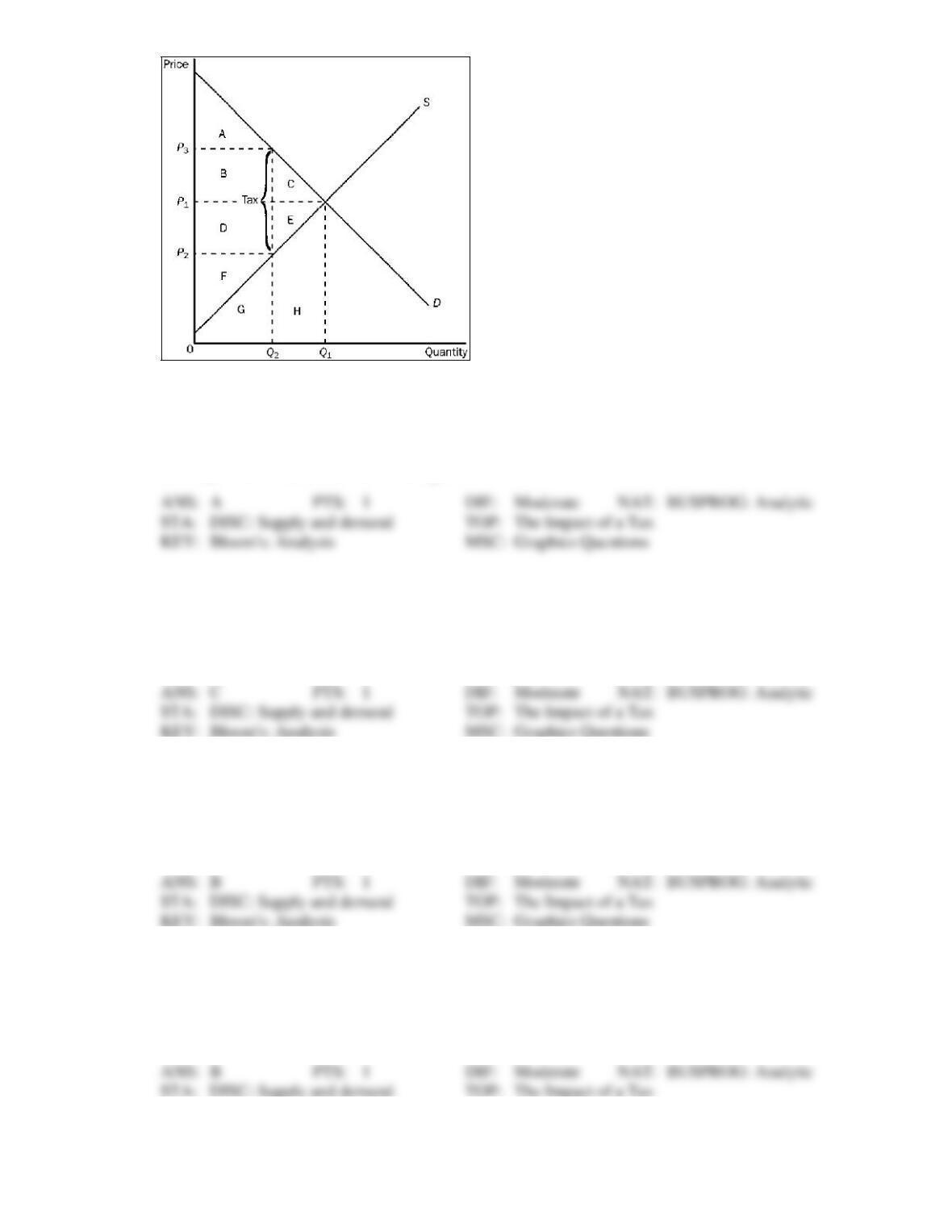
279. Refer to Figure 4-25. The equilibrium price before the tax is imposed is
a.
P1.
b.
P2.
c.
P3.
d.
impossible to determine from the figure.
280. Refer to Figure 4-25. The price that buyers pay after the tax is imposed is
a.
P1.
b.
P2.
c.
P3.
d.
impossible to determine from the figure.
281. Refer to Figure 4-25. The price that sellers receive after the tax is imposed is
a.
P1.
b.
P2.
c.
P3.
d.
impossible to determine from the figure.
282. Refer to Figure 4-25. Consumer surplus before the tax was levied is represented by area
a.
A.
b.
A + B + C.
c.
D + E + F.
d.
F.
283. Refer to Figure 4-25. Producer surplus before the tax was levied is represented by area
a.
A.
b.
A + B + C.
c.
D + E + F.
d.
F.
284. Refer to Figure 4-25. After the tax is levied, consumer surplus is represented by area
a.
A.
b.
A + B + C.
c.
D + E + F.
d.
F.
285. Refer to Figure 4-25. After the tax is levied, producer surplus is represented by area
a.
A.
b.
A + B + C.
c.
D + E + F.
d.
F.
286. Refer to Figure 4-25. The tax causes a reduction in consumer surplus that is represented by area
a.
A.
b.
B + C.
c.
D + E.
d.
F.
287. Refer to Figure 4-25. The tax causes a reduction in producer surplus that is represented by area
a.
A.
b.
B + C.
c.
D + E.
d.
F.
288. Refer to Figure 4-25. The benefit to the government is
a.
measured by tax revenue and is represented by area A + B.
b.
measured by tax revenue and is represented by area B + D.
c.
measured by the net gain in total surplus and is represented by area B + D.
d.
measured by the net gain in total surplus and is represented by area D + E.
289. An increase in the demand for a product will cause output to
a.
increase and both the demand for and prices of the resources used to produce the product
to increase.
b.
increase and both the demand for and prices of the resources used to produce the product
to decrease.
c.
decrease; the demand for the resources used to produce the product will remain constant.
d.
decrease; the price of resources used to produce the product will decrease.
290. Which of the following is a true statement regarding the economic impact of a subsidy?
a.
The distribution of the benefits from a subsidy will depend on whether the subsidy is
legally granted to the buyer or seller.
b.
When demand is relatively inelastic, the benefits of a subsidy will mainly accrue to sellers.
c.
When supply is relatively elastic, the benefits of a subsidy will mainly accrue to buyers.
d.
When demand is relatively elastic, the benefits of a subsidy will mainly accrue to buyers.
291. The average tax rate (ATR) is defined as
a.
taxable income divided by tax liability.
b.
change in tax liability divided by change in taxable income.
c.
tax liability divided by taxable income.
d.
change in taxable income divided by change in tax liability.
292. During the imposition of price controls in the 1970s, long gasoline lines were common. In the absence
of price controls, markets would have eliminated such excess demand by
a.
allowing the price to rise, so gas was rationed to those willing to pay the most for it.
b.
increasing the gap between supply and demand.
c.
allowing price to decline, so the poor could afford to buy more gas.
d.
mandating a 50-mile-per-hour speed limit to reduce consumption.
293. If an increase in the government-imposed minimum wage pushes the price (wage) of unskilled labor
above market equilibrium, which of the following will most likely occur in the unskilled labor market?
a.
an increase in demand for unskilled labor
b.
a decrease in the supply of unskilled labor
c.
a shortage of unskilled labor
d.
a surplus of unskilled labor
294. With a price ceiling above the equilibrium price,
a.
quantity demanded would exceed quantity supplied.
b.
quantity supplied would exceed quantity demanded.
c.
the market would be in equilibrium.
d.
the equilibrium price would be expected to fall over time.
295. Rent controls generally fix the price of rental housing below market equilibrium. Economic analysis
suggests these controls
a.
are effective in helping the poor find housing.
b.
improve the quality of housing available to consumers.
c.
create a surplus of rental housing.
d.
reduce the future supply of rental housing.
296. Because illegal drug markets operate outside the legal system,
a.
the quality of these drugs has increased.
b.
the sellers of illegal drugs earn less money.
c.
there is less violence in these markets than if they were legal.
d.
none of the above.
297. Currently, federal and state gasoline taxes (imposed statutorily on the sellers of gasoline) amount to
about $.45 per gallon. Suppose the current price of gasoline is $1.20 per gallon, and that if the tax was
not in place, the price would be only $.80.
a.
The full incidence of the tax is falling on consumers.
b.
The full incidence of the tax is falling on suppliers.
c.
A $.05 burden is being borne by sellers and $.40 by consumers.
d.
A $.05 burden is being borne by consumers and $.40 by sellers.
298. The deadweight loss resulting from levying a tax on an economic activity is
a.
the tax revenue directed to the government as the result of the tax.
b.
the loss of potential gains from trade from activities forgone because of the tax.
c.
the increase in the price of an activity as the result of the tax levied on it.
d.
the marginal benefits derived from the expansion in government activities made possible
by the increase in tax revenues.
299. Suppose there is an increase in the excise tax imposed on cigarettes, a good for which the demand is
relatively inelastic. The short-run burden of the tax increase will be borne primarily by
a.
consumers, because the increase in market price will be large relative to the increase in the
excise tax.
b.
firms, because the increase in market price will be large relative to the increase in the
excise tax.
c.
consumers, because the increase in market price will be small relative to the increase in
the excise tax.
d.
firms, because the increase in market price will be small relative to the increase in the
excise tax.
300. An income tax is regressive if
a.
the tax liability of high-income recipients exceeds the tax liability of those with low
incomes.
b.
the tax liability of high-income recipients is less than the tax liability of those with low
incomes.
c.
high-income recipients pay a higher percentage of their incomes in taxes than those with
low incomes.
d.
high-income recipients pay a lower percentage of their incomes in taxes than those whose
incomes are low.
301. Use the table below to choose the correct answer.
Income
Tax liability
$10,000
$1,000
20,000
2,000
30,000
3,000
40,000
4,000
For the income range illustrated, the tax shown here is
a.
regressive.
b.
proportional.
c.
progressive.
d.
progressive up to $30,000 but regressive beyond that.
302. In the mid-1940s, the marginal income tax rate in the top income tax bracket was 94 percent. In the
1960s, the top rate was lowered to 70 percent, and in the 1980s, the top rate was again lowered to 28
percent. The data show that as a result of these tax rate reductions, tax revenue (particularly from the
rich) increased. This is consistent with the idea illustrated with the
a.
Laffer curve.
b.
production possibilities curve.
c.
supply of loanable funds curve.
d.
demand for unskilled labor curve.
303. The Laffer curve illustrates the principle that
a.
when tax rates are quite high, reducing tax rates will increase tax revenue.
b.
when tax rates are quite low, reducing tax rates will increase tax revenue.
c.
when tax rates are quite high, reducing tax rates will decrease tax revenue.
d.
increasing tax rates always increases tax revenue.
304. If Joan pays $5,000 in taxes when she earns $20,000 and must pay $12,000 in taxes when she earns
$30,000, she faces a marginal tax rate in this income range of
a.
25 percent.
b.
30 percent.
c.
40 percent.
d.
70 percent.
305. A legal minimum wage is an example of
a.
the invisible hand principle.
b.
a price floor.
c.
a price ceiling.
d.
a fringe benefit.
306. Both price floors and price ceilings, when effective, lead to
a.
shortages.
b.
surpluses.
c.
an increase in the quantity traded.
d.
a reduction in the quantity traded.
307. If there was an increase in the excise tax on beer, what would be the effect on the equilibrium price
and quantity of beer?
a.
price increases, quantity decreases
b.
price decreases, quantity decreases
c.
price increases, quantity increases
d.
price decreases, quantity increases
308. The more elastic the supply of a product, the more likely it is that the burden of a tax will
a.
fall on sellers.
b.
fall on buyers.
c.
fall equally on both buyers and sellers.
d.
be borne by the public sector, and not by market participants.
309. When the price of a good is legally set below the equilibrium level, a shortage often results. This
shortage
a.
is a temporary failure of the market mechanism.
b.
is the result of a shift in demand.
c.
is the result of a shift in supply.
d.
occurs because the price ceiling prevents the market mechanism from establishing an
equilibrium price.
310. Which of the following statements regarding black markets is true?
a.
The reliability of products sold in black markets is generally higher than the reliability of
products sold in legal markets.
b.
The prices of goods in black markets are generally lower than the prices of similar
products in legal markets.
c.
The laws of supply and demand do not affect the prices of goods exchanged in black
markets.
d.
The rate of violence is higher in black markets than in legal markets.
311. The market pricing system corrects an excess supply by
a.
raising the product price and increasing producer profits.
b.
lowering the product price and decreasing producer profits.
c.
raising the product price and decreasing producer profits.
d.
lowering the product price and increasing producer profits.
312. The Laffer Curve indicates that
a.
when tax rates are high, a rate reduction may lead to an increase in tax revenue.
b.
when tax rates are low, an increase in tax rates will generally lead to a reduction in tax
revenues.
c.
an increase in tax rates will always lead to an increase in tax revenues.
d.
the deadweight losses resulting from taxation are small at the tax rate that maximizes the
revenues derived by the government.
313. An effective minimum wage
a.
imposes a price ceiling on the wages of various categories of low-skill workers.
b.
increases the demand for low-skill workers.
c.
makes it easier for low skill workers to find jobs.
d.
increases the earnings of some low-skill workers while reducing the employment and
training opportunities available to others.
314. If Susan’s income increases from $40,000 to $50,000 and her tax liability increases from $6,000 to
$9,000, which of the following is true?
a.
Her marginal tax rate is 18 percent in this range.
b.
Her marginal tax rate is 30 percent in this range.
c.
Her average tax rate was 22.5 percent when her income was $40,000.
d.
The tax structure must be regressive in the range between $40,000 and $50,000.
315. When a government subsidy is granted to the buyers of a product, sellers can end up capturing some of
the benefit because
a.
the market price of the product will fall in response to the subsidy.
b.
the market price of the product will rise in response to the subsidy.
c.
the market price of the product will not change in response to the subsidy.
d.
producers will reduce the supply of the product.
316. A black market is
a.
a market that operates outside the legal system, either by selling illegal goods or by selling
goods at illegal prices.
b.
a market where goods and services can be obtained at lower prices.
c.
a government-mandated market where controls are placed on prices.
d.
a market where exchanges are made using bartering.
317. Black markets that operate outside the legal system are often characterized by
a.
low profits for suppliers.
b.
lower opportunity costs for suppliers and buyers.
c.
decreased prices.
d.
the use of violence as a means of settling disputes.
318. Suppose the U.S. government banned the sale and production of cigarettes. Which of the following
would be most likely to occur?
a.
No one would smoke anymore.
b.
The amount of violence involved in the buying and selling of cigarettes would increase.
c.
The price of cigarettes would decrease.
d.
The supply for cigarettes would become elastic.
319. The “incidence of a tax” is the term used to indicate
a.
the responsibility for collecting the tax.
b.
who actually bears the tax burden.
c.
who the tax is initially levied on.
d.
the regressive rate structure of the tax.
320. Suppose that the minimum wage was increased to $10 per hour. Which of the following would be
most likely to result from the minimum wage increase?
a.
an increase in the employment of low-skill workers previously employed at wage rates of
less than $10 per hour
b.
an increase in the number of jobs providing low-skill workers with on-the-job training
c.
a reduction in the number of teenagers unemployed
d.
an increase in the demand for high-skill workers providing services that are a good
substitute for those whose wages were pushed up by the higher minimum wage
321. If political officials want to minimize the excess burden accompanying a tax, they should set the tax at
a rate
a.
that will maximize the revenue derived from the tax.
b.
slightly above the rate that will maximize the revenue derived from the tax.
c.
well below the rate that will maximize the revenue derived from the tax.
d.
that is the highest that could possibly be imposed.
322. If the Federal government enacts a new excise tax of $1.50 per six-pack of beer. Which of the
following is most likely to occur?
a.
Consumers of beer will pay a higher price and buy a larger quantity.
b.
Consumers of beer will pay a higher price, which will increase the profits of beer
companies, inducing them to sell a larger quantity.
c.
Consumers of beer will pay a higher price and buy a smaller quantity.
d.
Consumers of beer will buy less wine from France.
323. The more elastic the supply of a product, the more likely it is that the burden of a tax will
a.
fall on sellers.
b.
fall on buyers.
c.
fall equally on both buyers and sellers.
d.
be borne by the public sector, and not by market participants.
ESSAY
324. Suppose the United Auto Workers union obtains a substantial wage increase for auto workers. How
will this affect the market for automobiles?
325. Joanne states, “If raising the minimum wage to $10 an hour is good, like Senator Largess suggests,
then raising it to $20 an hour would be twice as good.” Is Joanne correct? Why or why not?
326. Lowincomesville, North Carolina, is a poor town. The mayor has decided to impose a law to cut all
rental rates on apartments in half and to fix them at this level. Will this help the poor? Why or why
not? Be sure to distinguish between the short run and the long run.
327. Bill the butcher is upset because the government plans to tax beef $.10 a pound. “I hate paying taxes,”
he says. “Because of this, I’m raising all my beef prices by $.10 a pound. The consumers will bear this
burden, not me.” Do you see anything wrong with this way of thinking? Explain.
328. The City of Greenville needs to raise revenue. Alderman Black has proposed a $10 tax on red cars in
the city, currently numbering 2,000. Mayor White, who wants more than $20,000 in revenue, proposes
taxing these cars at $100 each. Councilwoman Bluestone goes even farther, suggesting a $1,000 per
red car tax, arguing that her proposal will raise $2 million. If maximizing tax revenue is the only
consideration, which proposal should pass? Why?
329. The state of Florida is considering putting an excise tax on either good X or good Y. An economist
discovers the supply of good X is more elastic than the supply of good Y, while the demand elasticities
are identical. Which good should Florida tax in order to minimize the deadweight loss of the tax?
330. Government programs such as Medicare substantially subsidize health care purchases by some
consumers in the U.S. economy. Who benefits from these subsidies? How do they affect the price of
health care? If you are not a recipient of this program, are you made better or worse off by the
subsidy? Explain.
331. Suppose the U.S. Government banned the sale and production of cigarettes. What are likely effects of
this action on the market for cigarettes?