284. Tampering with the price mechanism
a.
can be efficient for a while.
b.
cannot be attempted in a market economy.
c.
can enhance societal welfare if done properly.
d.
often produces undesired side effects.
285. In high schools, all teachers were paid the same based on years of service and regardless of specialization. Beginning
in the 1970s, a shortage of science and math teachers developed as private industry paid more for math and science skills
than schools could offer. At the same time, a decline in the number of school-age children tended to reduce the demand
for all other teachers, which led to a surplus. The economist’s solution to this problem would be
a.
merit pay to reward the best teachers.
b.
recognition that all teachers do comparable work and should be paid the same.
c.
to raise the wages of all teachers.
d.
to raise the wages of teachers in fields that are in short supply and lower those of others.
286. In an attempt to reduce poaching of elephant tusks for ivory, officials in Kenya burned illegally gathered ivory.
Economists tend to point out that
a.
poaching can be reduced with price supports for ivory.
b.
the supply of ivory has fallen, leading to an increase in price and reward for poaching.
c.
burning ivory decreases demand, leading to lower prices and reward for poaching.
d.
the demand for ivory is higher, leading to an increase in price and reward for poaching.
e.
burning ivory raises demand, and controlled prices will lead to even greater poaching.
287. What is the economic reasoning behind the proposal to legalize drugs?
a.
Legal drugs will greatly increase the supply, which will reduce the price Americans pay to foreign producers
of the drugs.
b.
All forms of government restrictions on behavior are immoral, and ought to be removed.
c.
Legal drugs will be much cheaper than illegal drugs, which will reduce incentive for crime to obtain money
for drugs and to protect drug “businesses.”
d.
Legal drugs will be more expensive than illegal drugs, and the market system will encourage more production,
thus lowering the price.
e.
Dealing with supply is always easier than dealing with demand, and legalization accomplishes that.
288. Imagine that the state legislature raises the tax on gasoline by 10 cents/gallon. What most likely happens next?
a.
Service station operators pass along the tax to you, adding the 10 cents to the price of a gallon of gas.
b.
Service station operators grumble, but pay the tax without passing the cost along to you.
c.
Service station operators pass along as much of the tax to you as they can, probably about 6 cents/gallon.
d.
None of these choices.
289. Economists use the mechanism of supply and demand to study:
a.
inflation
b.
unemployment
c.
environmental protection
d.
both a and b
e.
all of these
290. Consumers expressed outrage at the high price of chainsaws after Hurricane Andrew hit Florida and Louisiana, with
newspaper editorials accusing suppliers of unconscionable price gouging. Use a supply and demand graph to assist in
explaining the increase in the price of chain saws after Hurricane Andrew.
291. After Hurricane Andrew hit Florida and Louisiana, consumers expressed outrage at the high prices being charged for
chainsaws, generators, and bottled water. If governments followed the consumers’ demands and imposed price ceilings in
these markets, what is the likely result?
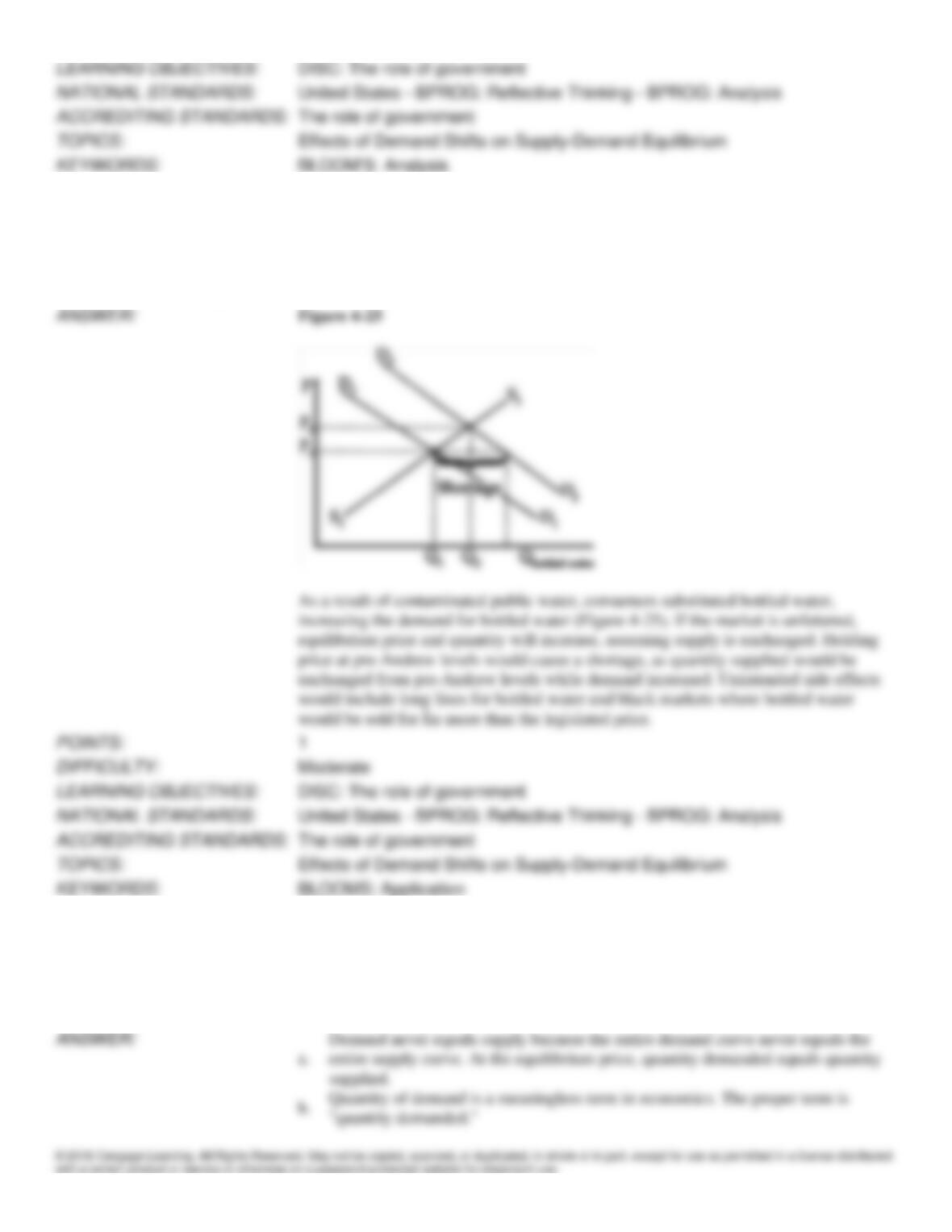
292. Producers were accused of price gouging as the price of bottled water soared after Hurricane Andrew. Consumers
clamored for price controls to keep bottled water at pre-Andrew levels. Use supply and demand analysis to graphically
show the effect of setting a price ceiling on bottled water after Hurricane Andrew at the pre-hurricane equilibrium price.
Use your graph to assist in explaining the likely unintended effects of such a price control. Be sure that your graph is
completely and correctly labeled.
293. The following are common errors students make when discussing supply and demand. What is the mistake in each?
a.
At equilibrium, demand equals supply.
b.
The quantity of demand is greater than the quantity of supply.
c.
They move along the line from both ends to an equilibrium in the middle.
d.
The increase in demand causes an increase in supply.
“quantity demanded.”
294. Distinguish between scarcity and shortage.
295. Distinguish between demand and quantity demanded. Do the same for supply and quantity supplied.
296. Define the following terms and explain their importance to the study of economics.
a.
demand
b.
surplus
c.
equilibrium
d.
law of supply and demand
e.
quantity demanded
cause the price to fall.
move toward equilibrium.
products (substitutes and complements).
297. The demand for home computers has increased, yet the price has fallen. Explain this apparent paradox.
any upward pressure on price due to the increase in demand.
298. “The market has failed to provide enough rental housing in New York City. This demonstrates another failure of free
markets-they may lead to shortages of necessities.” Explain why you agree or disagree.
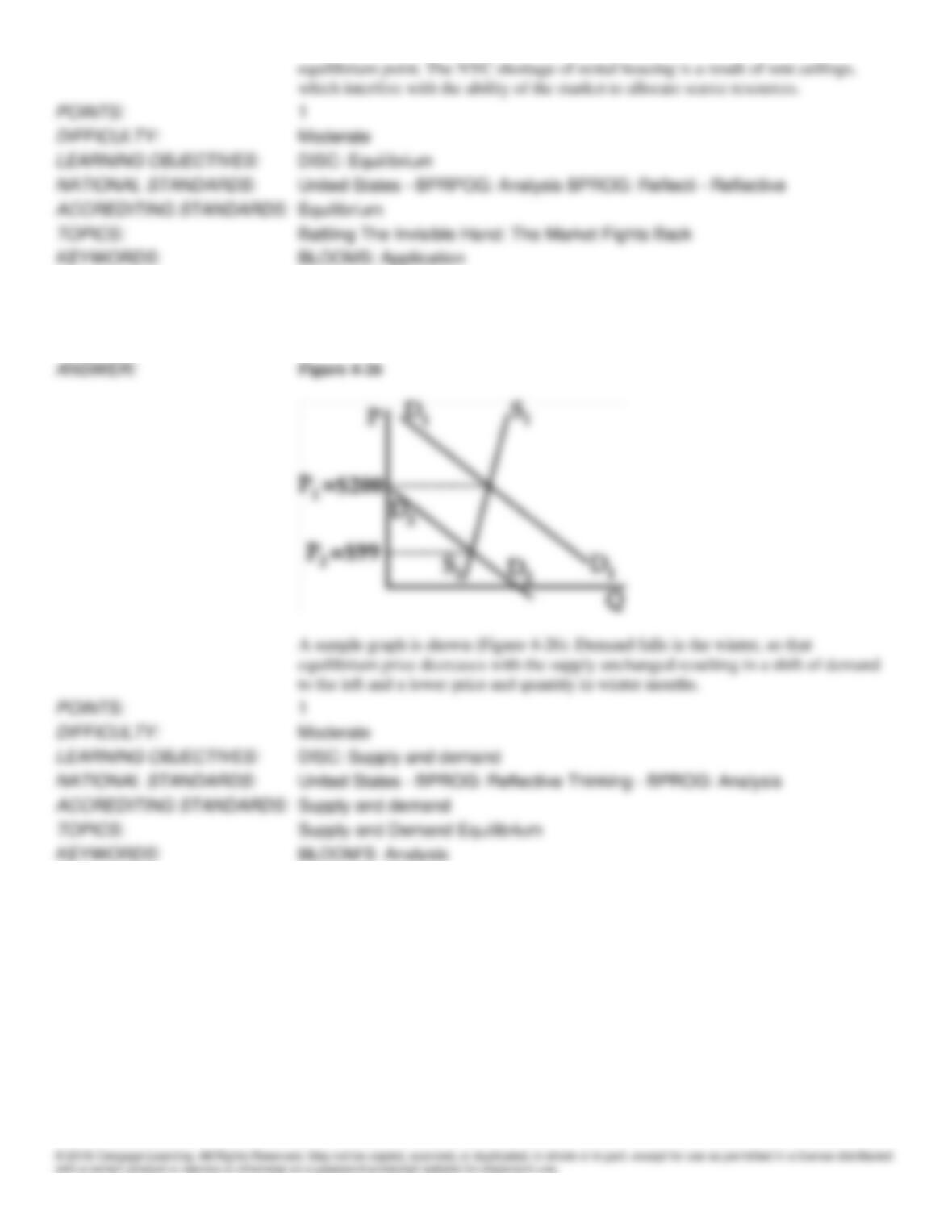
299. Some hotels in Myrtle Beach, South Carolina charge over $200 a night in the summer but sometimes as little as $99
a night in the winter. Use supply and demand analysis, including graphical and verbal explanation, for these winter
“sales.”
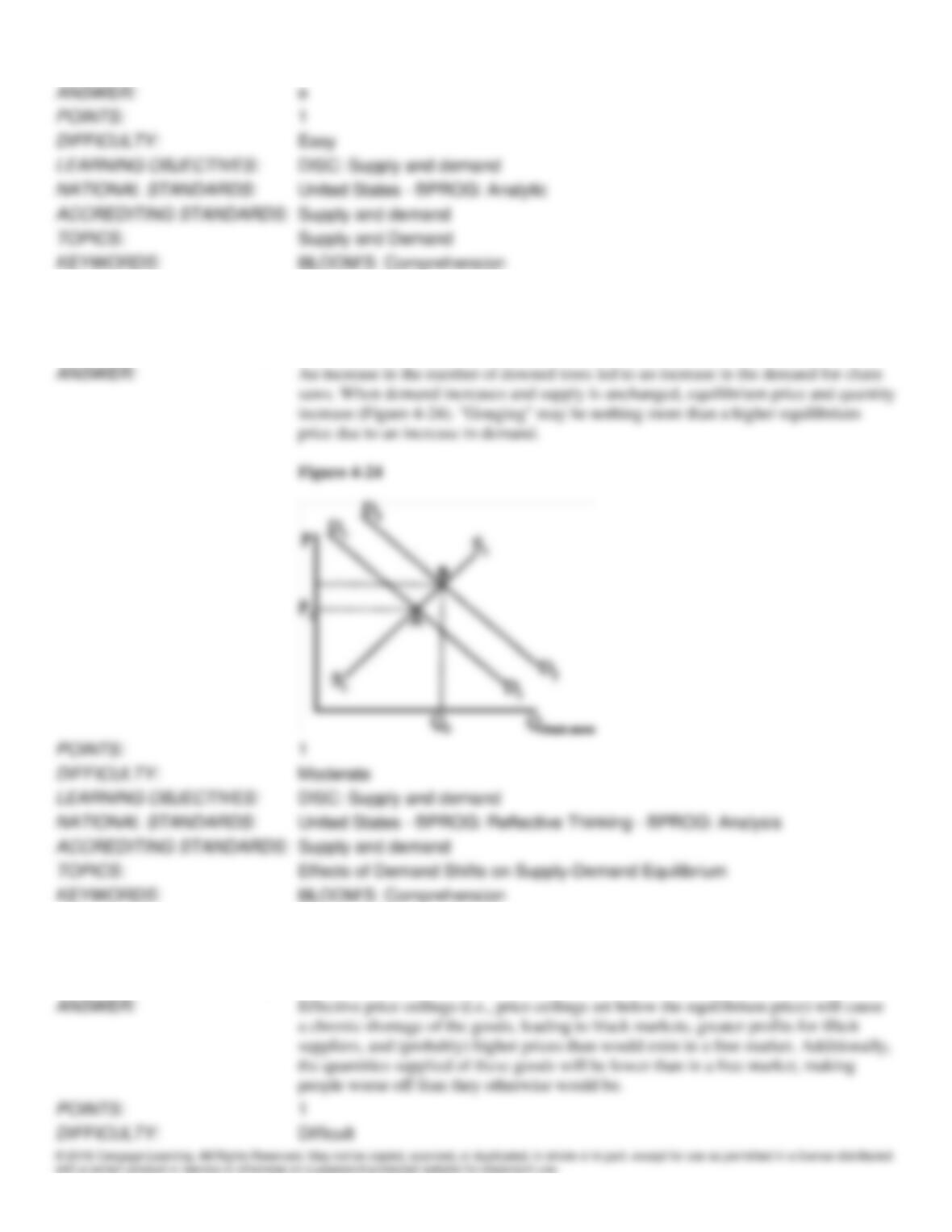
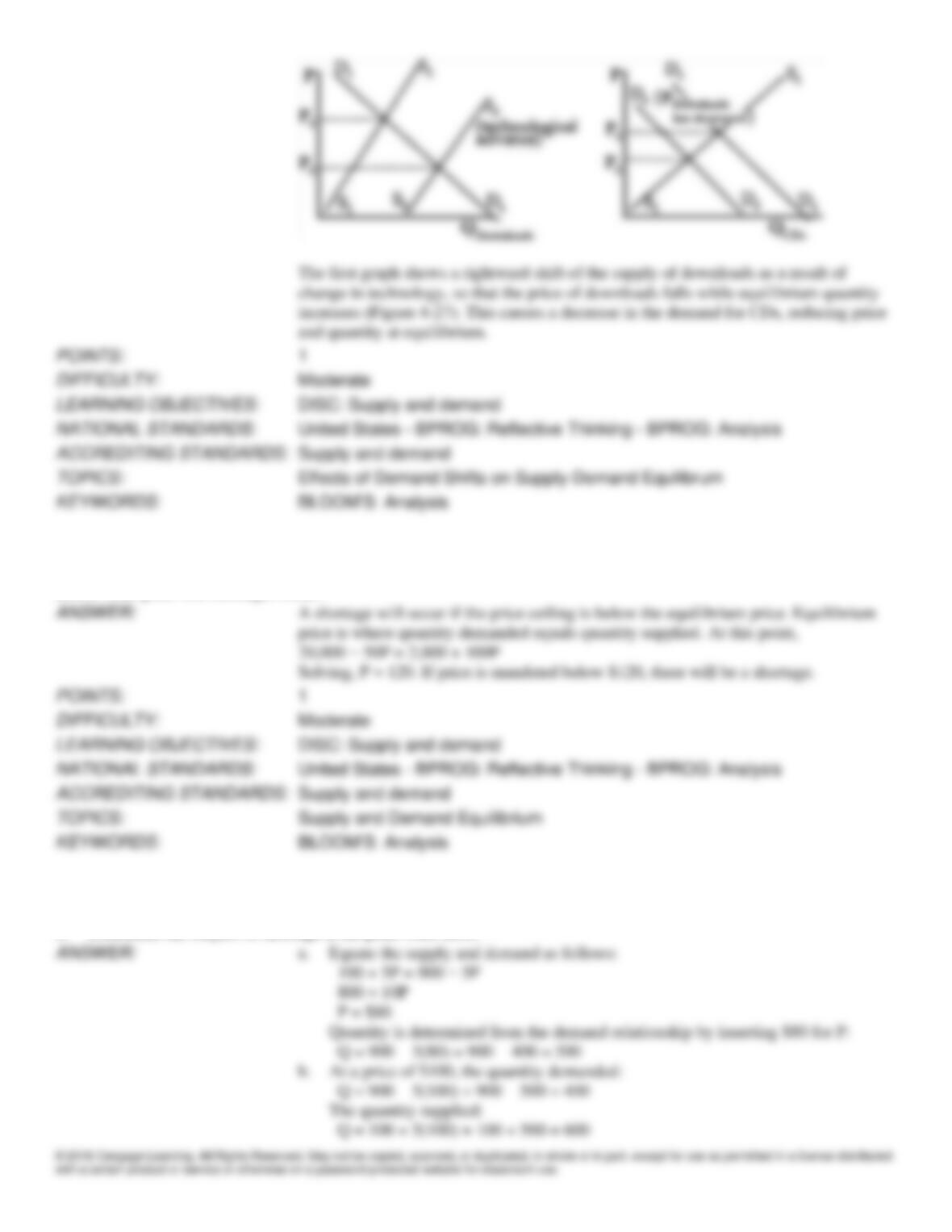
300. Show graphically the effect of technological advance on the price of music downloads. In a separate graph show
what happens to the price of CDs as a secondary effect of the new download technology.
ANSWER:
Figure 4-27
301. The demand for a textbook written by Schwarz and Mobley is Q = 20,000 − 50P; supply is Q = 2,000 + 100P.
Students complain about the high price of textbooks, resulting in a price ceiling and, unfortunately, a shortage of texts.
Below what price will shortages occur?
302. Suppose demand can be described with the equation Q = 900 − 5P and supply with the equation Q = 100 + 5P.
a.
Determine the equilibrium price and quantity.
b.
Determine the surplus or shortage if the price were $100.
a.
Equate the supply and demand as follows:
Quantity is determined from the demand relationship by inserting $80 for P:
b.
The quantity supplied:
The quantity supplied exceeds the quantity demanded by 200. There is a surplus.
303. Explain the effect of the following changes on equilibrium price and quantity of a commodity:
(a)
increase in average incomes.
(b)
increase in population.
304. Draw a graph of a market in equilibrium. Describe what might cause a change in demand or supply and how this
would affect the diagram. Indicate how the equilibrium price and quantity will change.
305. Suppose demand can be described with the equation Q = 900 − 5P and supply with the equation Q = 100 + 5P.
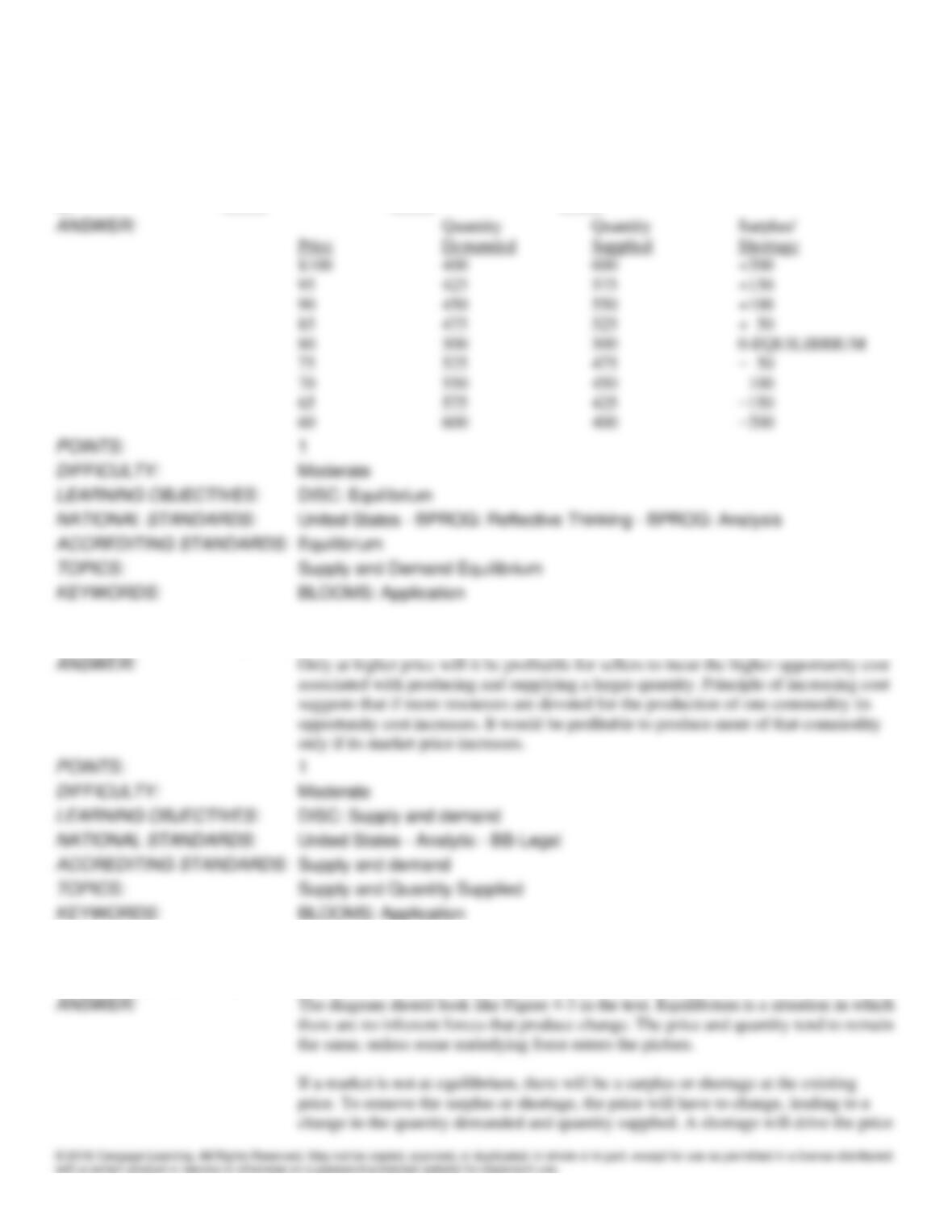
Complete the following table. Determine the equilibrium price and quantity.
Quantity
Quantity
Surplus/
Price
Demanded
Supplied
Shortage
$100
_____
_____
_____
95
_____
_____
_____
90
_____
_____
_____
85
_____
_____
_____
80
_____
_____
_____
75
_____
_____
_____
70
_____
_____
_____
65
_____
_____
_____
60
_____
_____
_____
Quantity
Quantity
Surplus/
Price
Demanded
Supplied
Shortage
$100
400
600
+200
95
425
575
+150
90
450
550
+100
85
475
525
+ 50
80
500
500
0-EQUILIBRIUM
75
525
475
70
550
450
65
575
425
60
600
400
306. Why are sellers willing to sell more at a higher price?
307. Define equilibrium as it relates to markets. Describe the process by which a market reaches a new equilibrium.
Include an appropriate diagram.
308. Distinguish the terms price ceiling and price floor.
309. Give an example of a price floor. Draw a corresponding diagram and explain why there is a continuing surplus.
310. Give an example of a price ceiling. Draw a corresponding diagram and explain why there is a continuing shortage.
311. In some markets, demand can be approximated by
Q = 50 − 5P + 10Y
where Q is quantity, P price per unit, and Y = buyers’ income. Supply can be approximated by
Q = −5 + 10P.
a.
If Y = 20, what is equilibrium price and output?
b.
If Y rises to 25, what is the new equilibrium price and output?
a.
b.
312. Price floors are typically accompanied by a standard series of symptoms. What are they?
313. List some of the problems that may arise when prices are controlled.