International Economics, 9e (Husted/Melvin)
Chapter 4 The Heckscher-Ohlin Model
4.1 Multiple-Choice Questions
1) According to the Heckscher-Ohlin (HO) model the source of comparative advantage is a
country’s
A) technology.
B) advertising.
C) factor endowments.
D) Both A and C.
2) The HO model rules out the classical model’s basis for trade by assuming that ________ is
(are) identical between countries.
A) factor endowments
B) factor intensities
C) technology
D) opportunity costs
3) If tastes are identical between countries, then comparative advantage is determined by
A) supply conditions only.
B) demand conditions only.
C) supply and demand conditions.
D) Can’t tell without more information.
4) The HO theorem states that a country will have comparative advantage in the good whose
production is relatively intensive in the ________ with which the country is relatively abundant.
A) tastes
B) technology
C) factor
D) opportunity costs
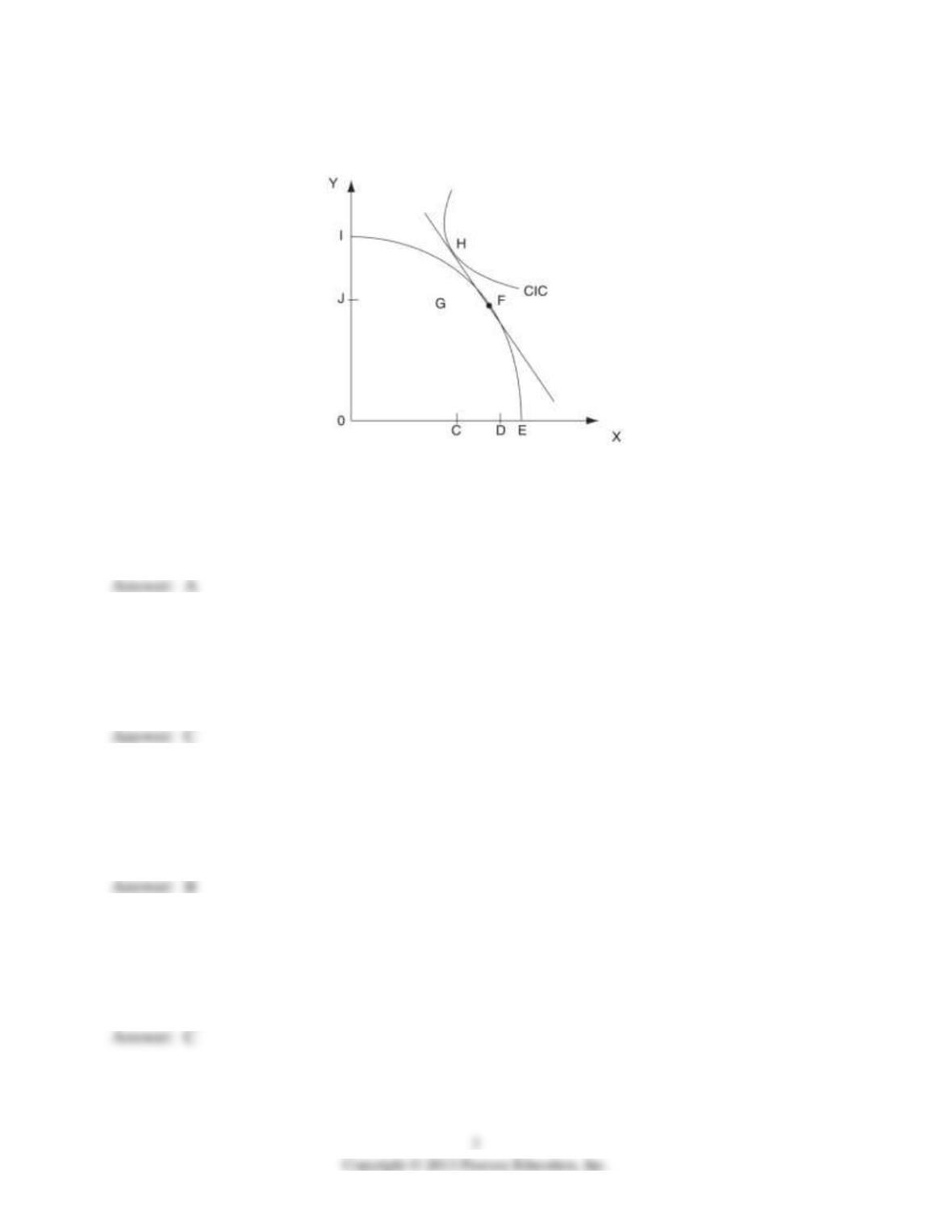
Answer the question(s) below based on the following diagram of a country that is in international
trade equilibrium.
5) Refer to the figure above. This country has comparative advantage in
A) X.
B) Y.
C) both X and Y.
D) Can’t tell without more information.
6) Refer to the figure above. This country’s exports equal
A) CE units of X.
B) GH units of Y.
C) CD units of X.
D) DE units of Y.
7) Refer to the figure above. This country’s imports equal
A) CE units of X.
B) GH units of Y.
C) CD units of X.
D) DE units of Y.
8) Refer to the figure above. Which of the following is true?
A) This country is completely specialized in the production of X.
B) This country consumes at point F.
C) The value of this country’s consumption equals the value of its production.
D) None of the above.
9) Refer to the figure above. If Y is labor intensive then according to the HO theory, this country
should be ________ abundant.
A) capital
B) labor
C) both capital and labor
D) Can’t tell without more information
10) Refer to the figure above. If this country is labor abundant, then according to the HO theory
good X should be ________ intensive.
A) capital
B) labor
C) both capital and labor
D) Can’t tell without more information
11) One of the predictions of the HO model is that
A) countries with different factor endowments but similar technologies and preferences will have
a strong basis for trade with each other.
B) countries will tend to specialize, but not completely, in their comparative advantage good.
C) reciprocal demand leads to an equilibrium terms of trade by inducing changes in both demand
and supply.
D) All of the above.
12) According to the Rybczynski theorem, at constant world prices, if a country experiences a
gain in its capital stock it will produce
A) more of the capital intensive good and less of the labor intensive good.
B) more of both goods.
C) less of the capital intensive good and more of the labor intensive good.
D) less of both goods.
13) According to the factor price equalization theorem, if country A is labor abundant, then if
country A initiates international trade
A) wages and rents should fall in A.
B) rents and rents should rise in A.
C) wages should rise and rents should fall in A.
D) wages should fall and rents should rise in A.
14) According to the factor price equalization theorem, if country B is labor abundant, then if
country B initiates trade with country A
A) wages and rents should fall in A.
B) rents and rents should rise in A.
C) wages should rise and rents should fall in A.
D) wages should fall and rents should rise in A.
15) According to the factor price equalization theorem, the ________ factor should oppose free
trade policies in any given country.
A) abundant
B) scarce
C) neither
D) Can’t tell without more information
16) Let Kj and Lj denote the capital and labor stocks of country j (j = A,B), then country A is
said to be capital abundant relative to country B if
A) KA > KB.
B) KA/LA > KB/LB.
C) LA < LB.
D) All of the above.
17) Let Kj and Lj denote the capital and labor inputs in the production of good j (j = S,T), then
good S is said to be capital intensive relative to good T if
A) KS > KT.
B) KS/LS > KT/LT.
C) LS < LT.
D) All of the above.
18) According to the HO model,
A) everyone automatically gains from trade.
B) the gainers from trade outnumber the losers from trade.
C) the scarce factor necessarily gains from trade.
D) None of the above.
19) The HO model assumes that ________ are identical between countries.
A) tastes
B) technology sets
C) factor endowments
D) Both A and B
20) The assumption of increasing opportunity costs in the HO model increases the likelihood that
A) there will be incomplete specialization in production after trade begins.
B) countries will be better off with free international trade.
C) countries will maximize their standards of living from free international trade.
D) All of the above.
21) The HO model predicts that once trade begins factor prices will equalize between countries.
This result occurs because of the assumption of
A) identical technology sets available to each country.
B) constant opportunity costs.
C) one factor of production.
D) free international mobility of factors.
22) Suppose that there are two factors, capital and land, and that the United States is relatively
capital abundant while Canada is relatively land abundant. According to the HO model,
A) Canadian landowners should support Canada-U.S. free trade.
B) Canadian capital owners should oppose Canada-U.S. free trade.
C) U.S. capital owners should support Canada-U.S. free trade.
D) All of the above.
23) Which of the following is false?
A) International differences in tastes, if sufficiently large, could overturn the comparative
advantage predictions of the HO model.
B) The classical and HO models make similar assumptions about international differences in
technology.
C) The HO model predicts that some groups will be hurt by international trade.
D) Both the classical and the HO models predict that countries gain from international trade.
24) Which of the following is true?
A) In the HO model complete specialization in the production of exports is a likely outcome of
international trade.
B) In the classical model, complete specialization seldom occurs due to the assumption of
increasing opportunity costs.
C) Complete specialization is more likely if opportunity costs change little as the production
point moves closer to either axis.
D) All of the above are true.
25) In the HO model, the production possibility frontier is bowed out due to the assumption of
A) identical tastes.
B) different factor intensities in the production of the two goods.
C) increasing returns to scale.
D) Two of the above.
26) Which of the following is a critical element of the Heckscher-Ohlin model?
A) That different goods display different factor intensities in their production.
B) That some countries have no comparative advantage in anything.
C) That trade may not be beneficial.
D) All of the above.
27) Which of the following is true about the distribution of income in the U.S. in the last three
decades?
A) For much of this period real wages paid to college graduates have risen significantly.
B) Real wages paid to blue-collar workers have grown only slightly.
C) There has been a shift in the distribution in income across various segments of the economy,
with the real earnings of the richest in America rising to record levels.
D) All of the above are true.
28) Which of the following theorems predicts that trade benefits the abundant factors of a
country and harms the scarce factors?
A) The Stolper-Samuelson theorem.
B) The Rybczynski theorem.
C) The Heckscher-Ohlin theorem.
D) None of the above.
4.2 True or False Questions
1) Country A is labor abundant relative to country B if it has a larger labor force than B’s.
2) According to the Rybczynski theorem, if a country increases its endowment of capital and
prices remain constant, then its output of both the capital and labor intensive goods will rise.
3) Tastes are assumed to be identical across countries to rule out differences in demand
determining the direction of trade.
4) Both the classical and the HO model predict that the pattern of trade is determined largely by
international differences in factor endowments.
5) The assumption that the two goods are made using different factor intensities raises the
likelihood of incomplete specialization after trade begins.
6) In the HO model, reciprocal demand leads to an equilibrium price by inducing changes in both
demand and supply.
7) According to the factor price equalization theorem, free international trade will result in wages
equating rents worldwide.
8) If the factor price equalization theorem is true then, eventually, U.S. wages will fall to the
level found today in the least developed countries of the world.
9) According the Stolper-Samuelson theorem, the scarce factor in any given country should
oppose international trade by that country.
10) Even if some people are hurt by international trade, the HO model predicts that free
international trade improves the standard of living for the country as a whole.
11) According to the HO model, countries with different factor endowments but similar
technologies and preferences will have a strong basis for trade with each other.
12) The Heckscher-Ohlin model is an alternative to the classical theory of international trade
that focuses on the factors of production that countries possess.
13) The Heckscher-Ohlin model basically states that countries will specialize and trade those
goods in which they have comparative advantage.
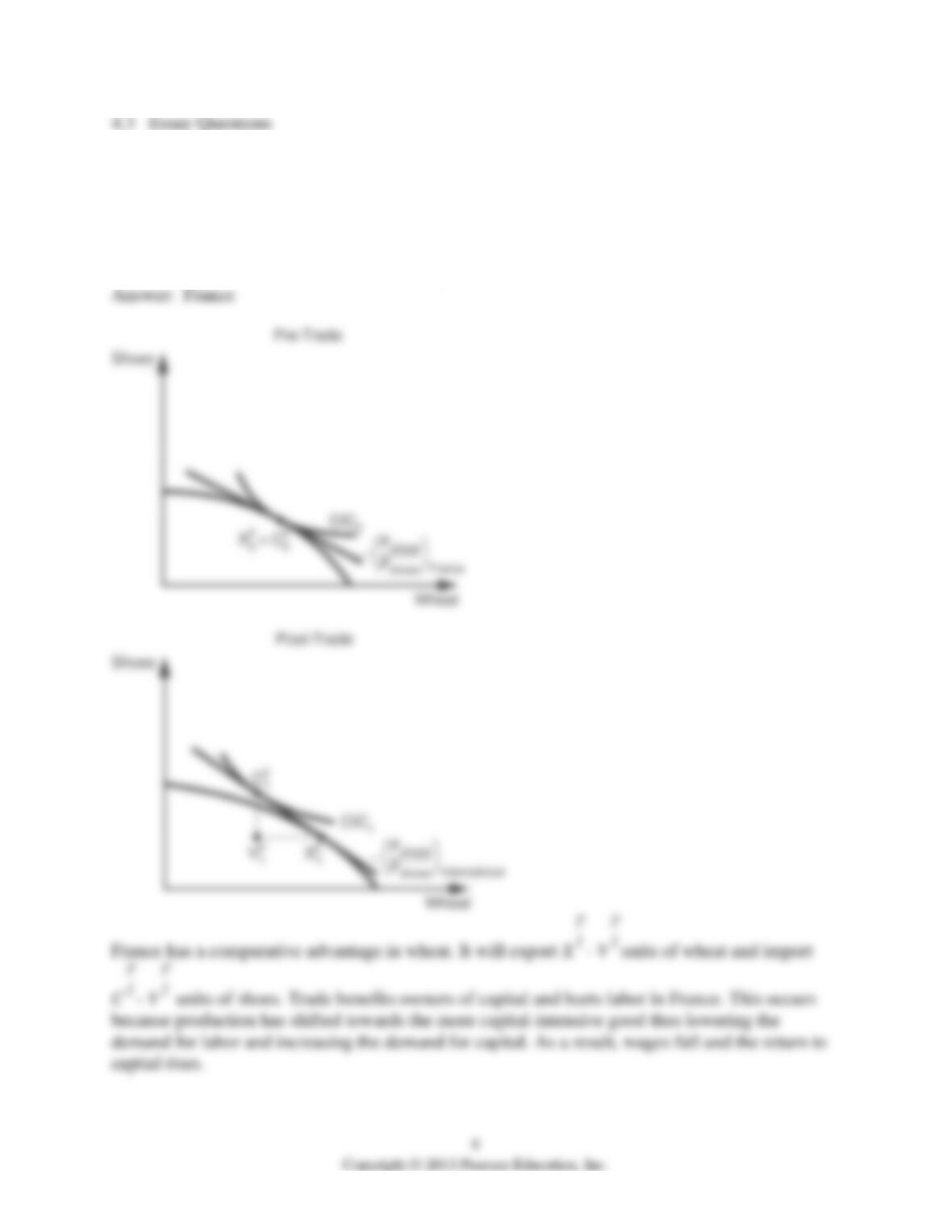
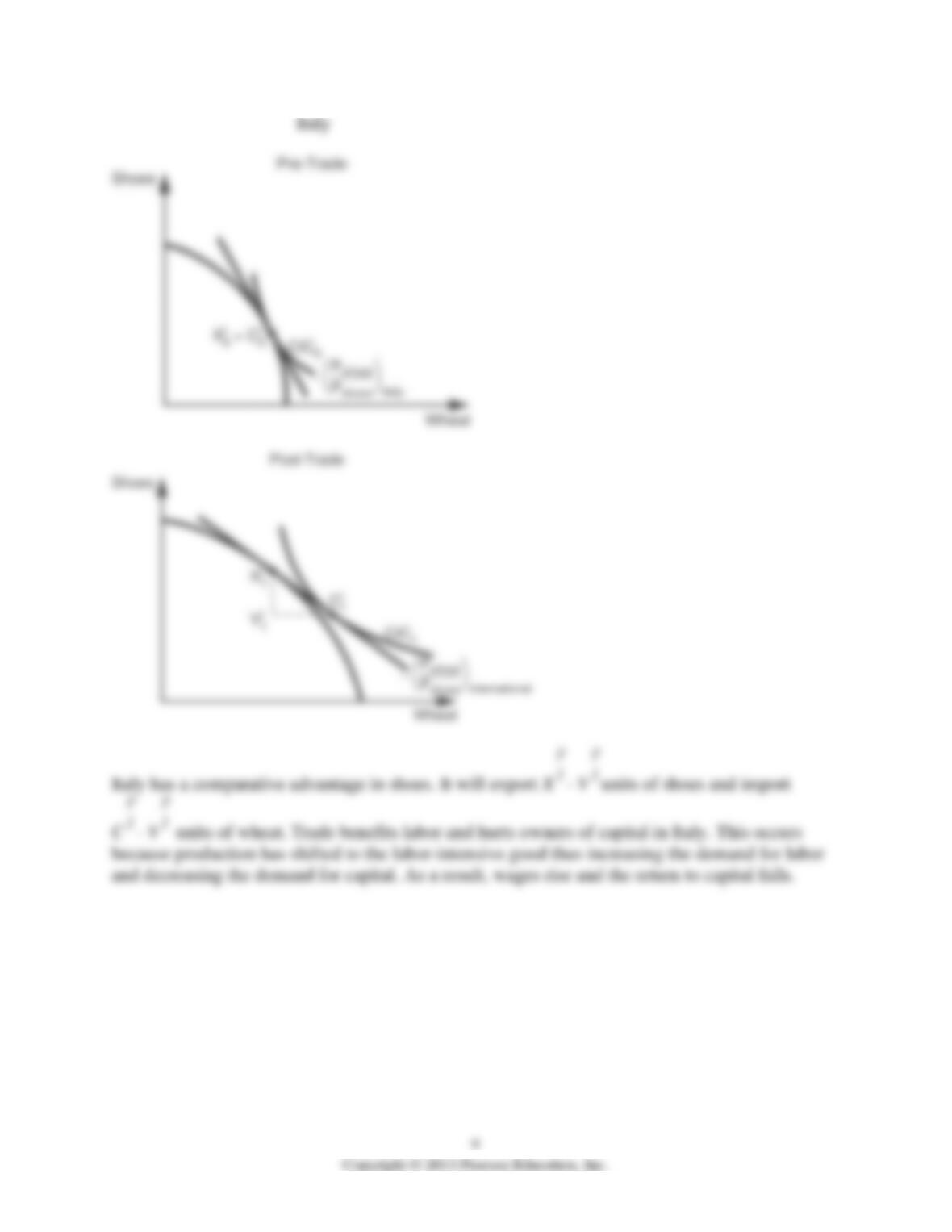
1) France is capital abundant and Italy is labor abundant. Shoes are labor intensive and wheat is
capital intensive. Draw diagrams to illustrate the pre- and post-trade equilibria for each of the
two countries including the production points, the consumption points, the international price,
and the volumes of exports and imports for each. Be sure to identify which country has
comparative advantage in which good. Which factors gain and which lose when trade is opened
between the two countries? Explain carefully.
2) Explain how free international trade tends to lead to factor price equalization under the
assumptions of the HO model. What does this process predict about which groups should be in
favor of or opposed to free international trade?
3) Explain carefully why the assumption of identical technology worldwide eliminates the
classical basis for international trade.
4) Compare and contrast the classical and HO theories of international trade.
5) Describe the controversy surrounding the HO model and the widening of the American
income gap.