76. Price floors lead to market surpluses.
a.
True
b.
False
77. Price ceilings are designed to protect sellers, while price floors are designed to protect buyers.
a.
True
b.
False
78. Price supports increase the supply of affordable milk for U.S. families.
a.
True
b.
False
79. A minimum wage law may cause unemployment among low-skill workers.
a.
True
b.
False
80. Sugar price supports primarily benefit consumers.
a.
True
b.
False
81. Sugar price supports ensure an abundance of sugar, and hence reasonable prices for consumers.
a.
True
b.
False
82. Price controls usually enhance efficiency in the allocation of resources.
a.
True
b.
False
83. One effect of market intervention is resource misallocation.
a.
True
b.
False
84. Price ceilings will likely result in the growth of black markets.
a.
True
b.
False
85. Shortages normally accompany an effective price floor.
a.
True
b.
False
86. While demand shifts have an effect on equilibrium price and quantity, supply shifts have no such effect.
a.
True
b.
False
87. Any change that shifts the supply curve outward to the right, and does not affect the demand durve will lower the
equilibrium price and raise the equilibrium.
a.
True
b.
False
88. Any event that causes either the demand curve or the supply curve to shift will also change the equilibrium price and
quantity.
a.
True
b.
False
89. During the Revolutionary War, the Pennsylvania legislature attempted to help the Continental Army by enacting
a.
wage floors for soldiers in the army.
b.
bonuses for soldiers who re-enlisted.
c.
laws to buy food for the soldiers stationed in Pennsylvania.
d.
price controls on essential commodities.
e.
All of the above are correct.
90. The mechanism of supply and demand is
a.
a fundamental tool in both microeconomics and macroeconomics.
b.
the only real “law” of economics.
c.
a fundamental tool only in microeconomics.
d.
a fundamental tool only in macroeconomics.
91. When used in a professional or technical sense, the law of supply and demand refers to
a.
some vague influences on economic affairs.
b.
the fact that prices go up when commodities are scarce.
c.
the market forces that show how prices and quantities are determined.
d.
the controls that regulate the amount of scarce goods that each consumer can purchase.
92. The most basic investigative tool of economics is the
a.
concept of scarcity.
b.
mechanism of supply and demand.
c.
coordination and trade syndrome.
d.
inflation-unemployment trade-off.
e.
regulation of business.
93. One motive for “battling the invisible hand” is
a.
unhappiness about the prices that occur in free markets.
b.
envy toward those who apparently benefit from certain prices.
c.
a desire to have government “correct” some problems.
d.
an attempt to produce justice between buyers and sellers.
e.
All of the above are correct.
94. During the American Revolution, the Pennsylvania legislature enacted price controls on essential commodities. The
result of this legislation was
a.
a large increase in the availability of those items, ending shortages.
b.
a severe shortage of those essential commodities.
c.
an increase in the price of those items, thus alleviating shortages.
d.
new efforts to increase production of those commodities.
e.
a minor inconvenience as persons adjusted to the new law.
95. During the American Revolution, Washington’s army nearly starved to death after price controls were enacted to
“help” buy food for the army at affordable prices. The Continental Congress later passed a law which
a.
exhorted the public to obey the law and help supply food to the army.
b.
passed tax increases to punish those who refused to sell the food.
c.
revised the American Law of Supply and Demand.
d.
overrode local ordinances and essentially repealed the price controls.
e.
called for the repeal of other price control measures.
96. Price controls are usually enacted in response to
a.
popular opinion.
b.
governmental studies.
c.
scholarly research on the effects of high prices.
d.
laws enacted in other countries.
e.
All of the above are correct.
97. A demand schedule is a table showing how the ____ of some product during a specified period of time changes as
____ changes, holding all other determinants of quantity demanded constant.
a.
demand; the price of its complement
b.
demand; the quantity supplied
c.
quantity demanded; the price of its substitute
d.
quantity demanded; the price of that product
98. The demand curve for a good connects points describing how much consumers
a.
actually bought at different prices during a particular period.
b.
actually bought at different prices in different periods.
c.
would have been willing and able to buy at different prices during a particular period.
d.
would have been willing and able to buy at different prices in different periods.
99. The demand curve for a typical good has
a.
a negative slope because some consumers switch to other goods as the price of the good rises.
b.
a negative slope because the supply of the good rises as demand rises.
c.
a negative slope because the good has less “snob appeal” as its price falls.
d.
an inverse slope because as the price goes up, the good has more profitability.
e.
a positive slope because price is a clear indicator of need.
100. Assume the demand schedule for cookies is downward sloping. If the price of cookies falls from $1.50 to $1.25 per
dozen,
a.
the demand for cookies will fall.
b.
the demand for cookies will rise.
c.
a larger quantity of cookies will be demanded.
d.
a smaller quantity of cookies will be demanded.
101. When a demand schedule is drawn as a graph,
a.
price is measured on the vertical axis.
b.
quantity is measured on the horizontal axis.
c.
the resulting curve has a negative slope.
d.
the other variables (besides price and quantity) are held constant.
e.
All of the above are correct.
102. An individual’s demand schedule
a.
provides information about what quantity a consumer is willing and able to buy at each price.
b.
tells a buyer how many other buyers will try to purchase an item.
c.
is a schedule that regulates monthly sales of scarce goods and services.
d.
is of no use without its accompanying supply schedule.
103. The slope of a demand curve is almost always
a.
positive, because when people buy more of a good the cost of producing it will rise.
b.
positive, because the more money a person has, the more of a particular good will be bought.
c.
negative, because when people buy more of a good the cost of producing it will fall.
d.
negative, because with everything else equal, the same people will buy more of a good when its price is lower.
e.
positive, because as the price rises, people want to sell more of the good.
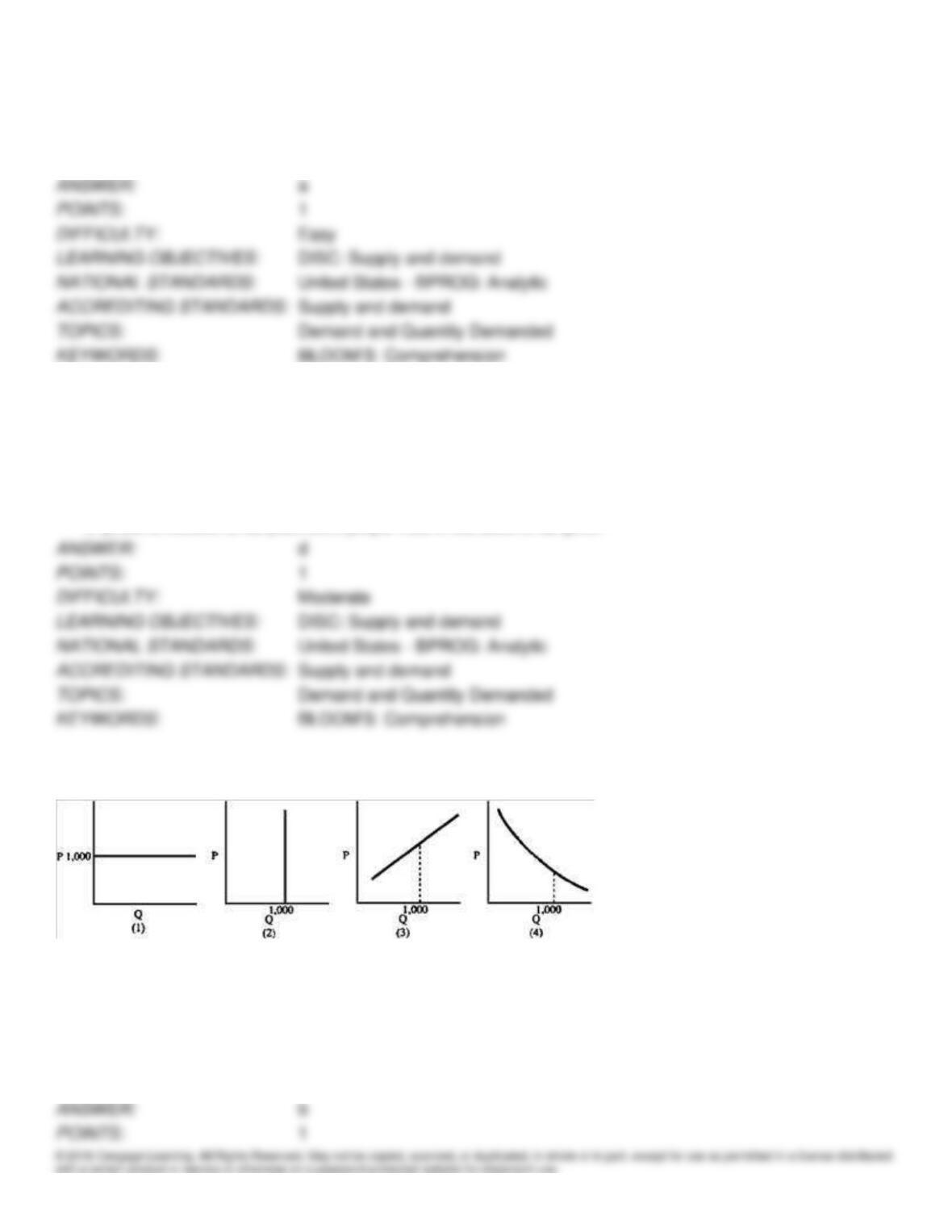
Figure 4-1
104. If the government has stated that it will pay whatever it must to obtain 1,000 units of good X, which demand curve in
Figure 4-1 is appropriate?
a.
1
b.
2
c.
3
d.
4
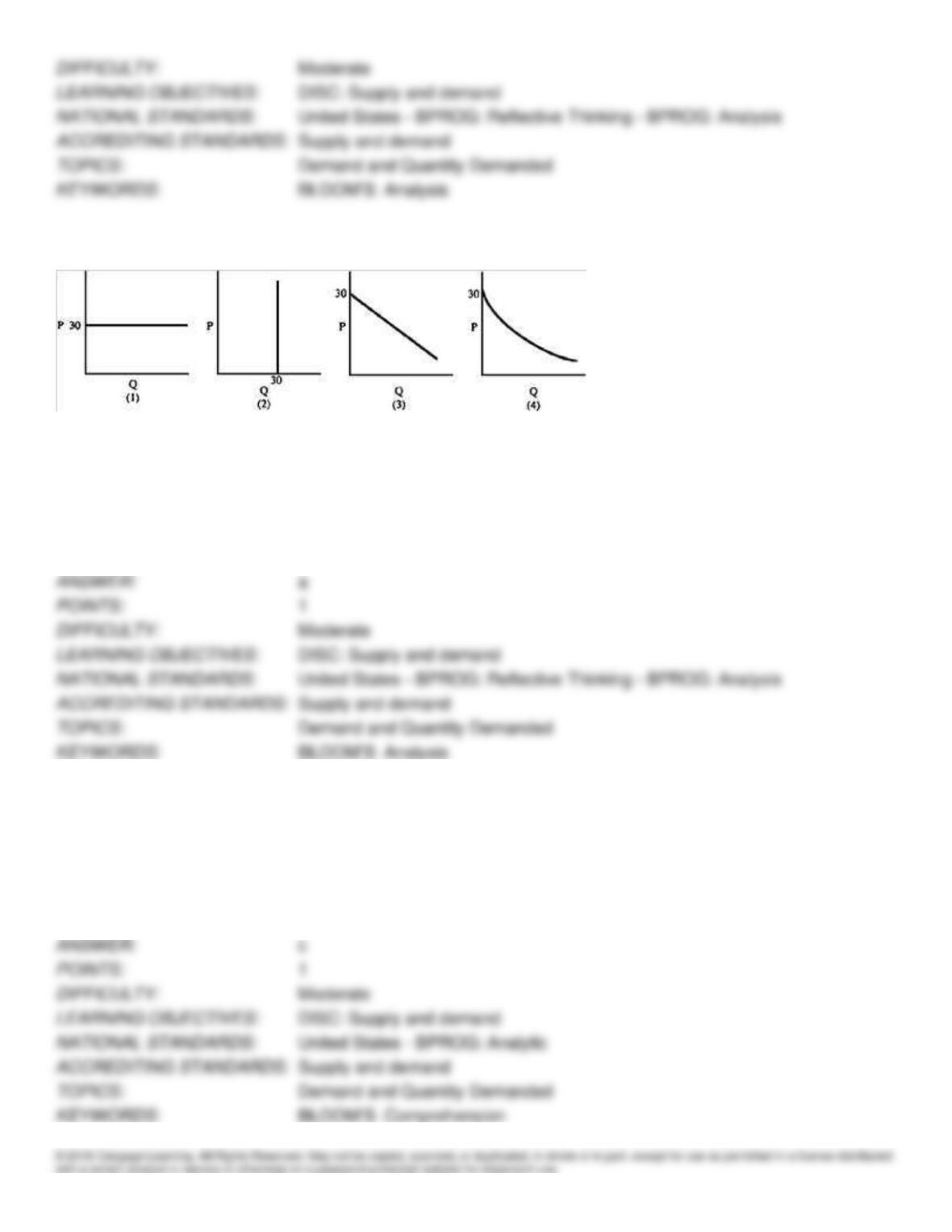
Figure 4-2
105. If the government has stated that it will buy any amount of good X offered at $30, which demand curve in Figure 4-2
is appropriate?
a.
1
b.
2
c.
3
d.
4
106. A common misperception about consumer demand is that
a.
demand depends on many other variables.
b.
price is a major determinant of quantity.
c.
it is a fixed amount.
d.
quantity cannot be determined in advance.
e.
All of the above are correct.
107. Economists emphasize the importance of ____ in analyzing demand.
a.
quantity
b.
market potential
c.
wants and needs
d.
price
e.
sales opportunities
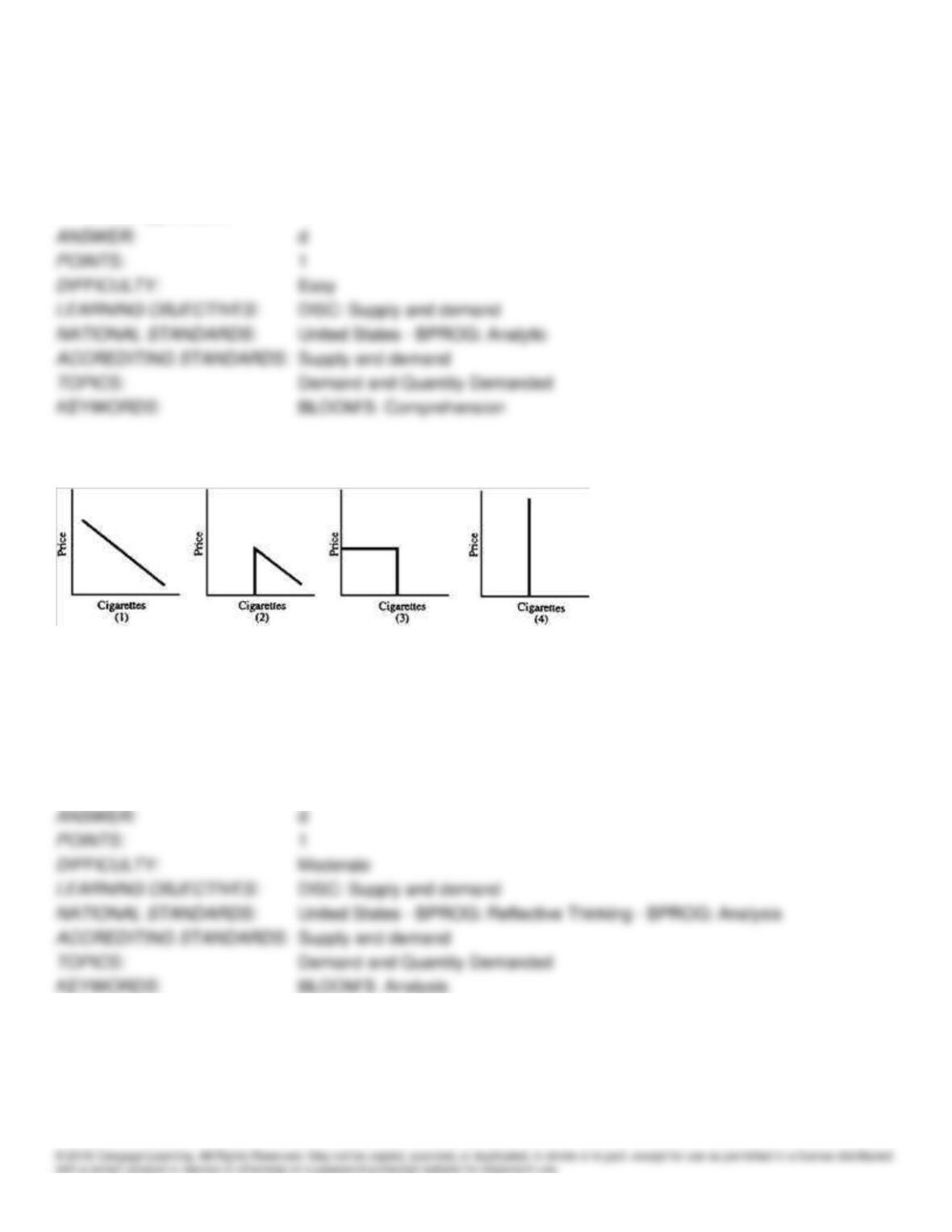
Figure 4-3
108. A 1985 Harvard study showed that the price of cigarettes does not affect how much an individual smokes but
whether he smokes. If this is correct, which graph in Figure 4-3 shows the typical individual’s demand curve for
cigarettes?
a.
1
b.
2
c.
3
d.
4
109. In an attempt to forecast enrollment, a major university hired an economist to give a “head count.” One variable
which she would probably emphasize more than any other in trying to forecast this is
a.
how interested people are in attending college.
b.
the employment opportunities that college opens up.
c.
survey results on public interest in education.
d.
her instinct about what the public wants.
e.
tuition (the price of attending).
110. A demand schedule shows
a.
the “market potential” for a product.
b.
how much consumers are willing and able to buy at different prices.
c.
possible combinations of output under different conditions.
d.
how much producers would like to sell at different prices.
e.
All of the above are correct.
111. If price rises, what happens to demand for a product?
a.
It increases.
b.
It decreases.
c.
It does not change.
d.
Uncertain-economic theory has no answer to this question.
112. Each point on the demand curve is
a.
demand for the product.
b.
a quantity demanded at that price.
c.
the amount that people want to buy.
d.
the amount people want to buy at different income levels.
e.
All of the above are correct.
113. If price rises, what happens to quantity demanded for a product?
a.
It increases.
b.
It decreases.
c.
It does not change.
d.
Uncertain-economic theory has no answer to this question.
114. Why does quantity demanded decrease when price increases?
a.
People choose to reduce consumption of the item.
b.
People “drop out” of the market for the item.
c.
People find substitutes for the item.
d.
All of the above are correct.
115. A demand curve can be thought of as
a.
a graphical display of “market potential.”
b.
a graphical representation of the information in a demand schedule.
c.
showing how much people want to buy.
d.
a forecasting tool.
e.
All of the above are correct.
116. An important assumption that is made when constructing a demand schedule is that
a.
only price and quantity matter in determining demand.
b.
people always want a certain amount of a product.
c.
demand is too important to be left to the economists.
d.
all other determinants of demand are held constant.
e.
demand has a positive slope.
117. The price for labor is the wage rate. What happens to the demand for labor if wages increase?
a.
It increases.
b.
It decreases.
c.
It does not change.
d.
Uncertain-economic theory has no answer to this question.
118. The price for labor is the wage rate. What happens to the quantity of labor demanded if wages increase?
a.
It increases.
b.
It decreases.
c.
It does not change.
d.
The whole demand schedule shifts to the left.
119. Firms often seek to borrow money to expand their capital stock, and the price they pay for that money is the interest
rate. What happens to the demand for money if the interest rate increases?
a.
It increases.
b.
It decreases.
c.
It does not change.
d.
The quantity of money demanded will increase.
120. Firms often seek to borrow money to expand their capital stock, and the price they pay for that money is the interest
rate. What happens to quantity of money demanded if the interest rate increases?
a.
It increases.
b.
It decreases.
c.
It does not change.
d.
Uncertain-the law of demand does not apply to money.
121. From 2007 to 2008, the Federal Reserve System reduced interest rates, the price that borrowers pay. As a result,
economists expected demand for money to
a.
increase.
b.
decrease.
c.
not change.
d.
be influenced by the interest rate, but with an uncertain effect.
122. From 2007 to 2008, the Federal Reserve System reduced interest rates, the price which borrowers pay. As a result,
economists expected the quantity of money demanded to
a.
increase.
b.
decrease.
c.
not change.
d.
not change, although the demand schedule itself will shift outward.
123. Which of the following would be most likely to cause an outward shift of the demand curve for electricity?
a.
a decrease in the price of electricity
b.
an increase in the price of air conditioners
c.
an increase in the price of heating oil
d.
a decrease in the price of natural gas
124. The U.S. government banned cigarette advertising on radio and television after January, 1971. You would expect to
find that after the ban took effect the price of magazine ads for
a.
all goods fell.
b.
only cigarettes fell.
c.
all goods rose.
d.
only cigarettes rose.
125. Some medical authorities announced in the late 1980s that an acne medicine named Retin-A also had previously
unknown wrinkle-reducing properties. An economist would expect to find that, after this announcement, the price of
Retin-A ____ and the quantity sold ____.
a.
rose; fell
b.
rose; rose
c.
fell; fell
d.
fell; rose
126. What factors are held constant along a given demand curve for a good?
a.
the price of the good
b.
the technology used to produce the good
c.
the supply of the good
d.
consumer incomes and the prices of other goods
127. Which of the following would cause an increase in demand for Toyota automobiles?
a.
an increase in the price of Toyota automobiles
b.
a decrease in the price of Toyota automobiles
c.
a decrease in the price of Honda automobiles
d.
an increase in the price of Honda automobiles
128. A decrease in price of a certain good most likely will lead to
a.
an increase in quantity demanded and an increase in demand.
b.
an increase in quantity demanded but no change in demand.
c.
an increase in demand but no change in quantity demanded.
d.
no change in demand and no change in quantity demanded.
129. Which of the following will shift the demand curve for milk?
a.
change in the income of buyers of milk
b.
change in the price of milk
c.
change in input prices for milk
d.
All of the above are correct.
130. A shift in the demand curve occurs when
a.
suppliers place more goods on the market.
b.
the price of a good rises.
c.
consumers want to buy more or less than before at a given price.
d.
the price of the good falls.
131. When there is an increase in demand,
a.
the demand curve shifts toward the origin of the graph.
b.
the demand curve twists clockwise.
c.
the demand curve shifts away from the origin of the graph.
d.
the demand curve twists counterclockwise.
e.
a lower price has increased the amount of the good that consumers will buy.
132. A shift in the demand curve for sailboats resulting from an increase in incomes will lead to
a.
higher prices of sailboats.
b.
lower prices of sailboats.
c.
a corresponding shift in the supply curve for sailboats.
d.
lower output of sailboats.
e.
no change in the price of sailboats.
133. If the price of oil, a close substitute for coal, increases then the
a.
supply curve for coal will shift to the right.
b.
demand curve for coal will shift to the right.
c.
equilibrium price and quantity of coal will not change.
d.
demand curve for coal will shift to the left.
e.
supply curve of coal will shift to the left.
134. We observed that the price of a good rises and the quantity purchased also rises. Everything else being equal, it is
consistent that
a.
the price of a substitute good fell.
b.
the price of a complement rose.
c.
income rose.
d.
costs of inputs increased.
135. An increase in the price of gasoline shifts the demand for tires to the
a.
left, because gasoline and tires are substitutes.
b.
left, because gasoline and tires are normally used together.
c.
right, because gasoline and tires are substitutes.
d.
right, because gasoline and tires are normally used together.
136. If orange juice prices double next year, there will be a
a.
rightward shift in the demand for grapefruit juice.
b.
rightward shift in the supply of grapefruit juice.
c.
leftward shift in the supply of grapefruit juice.
d.
leftward shift in the demand for grapefruit juice.
137. We observe that the price of food rises and the quantity purchased also rises. This means the