13
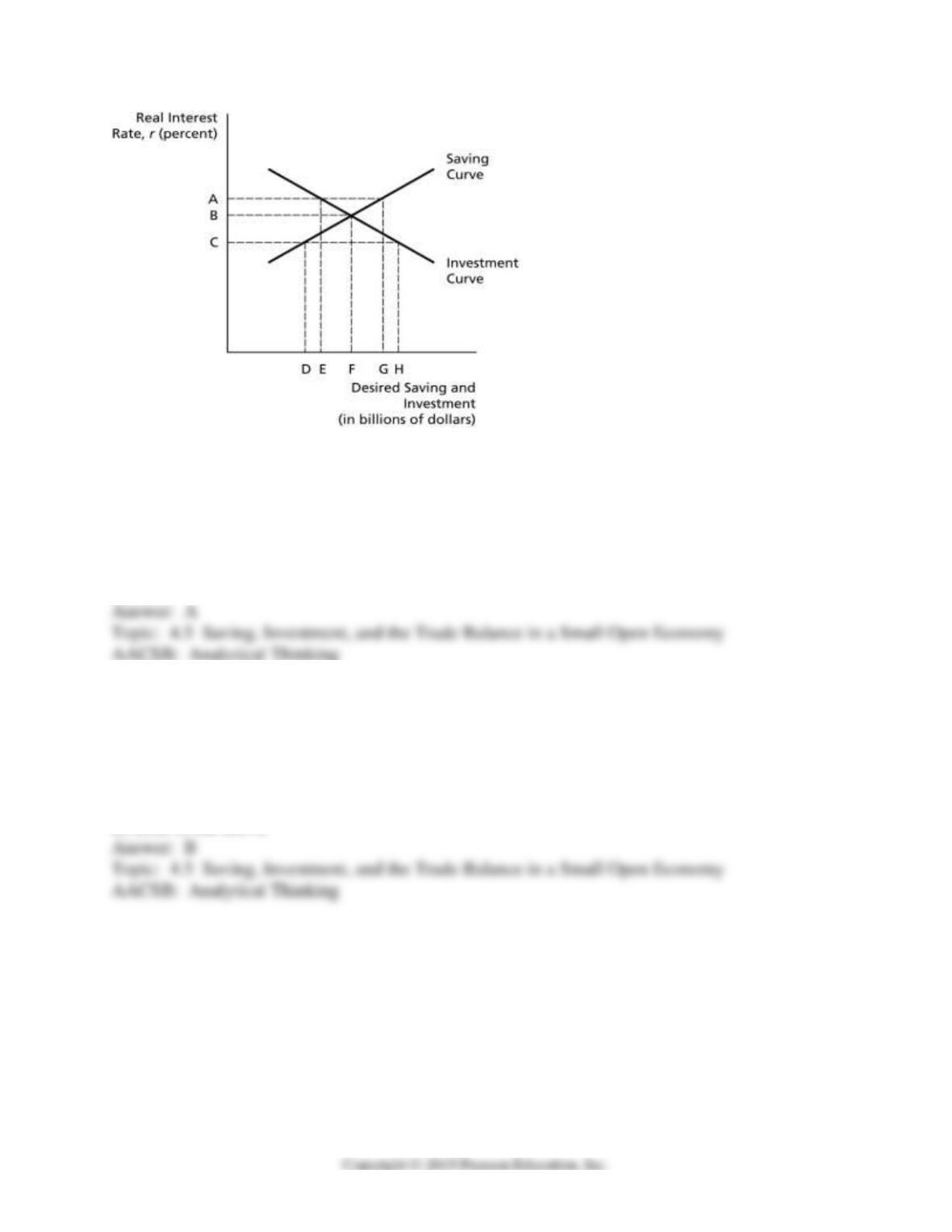
4) Based on the Saving-Investment Diagram, if the world real interest rate is indicated by A, then
________.
A) the difference between values G and E measures the trade surplus
B) the difference between values G and F measures the trade surplus
C) the domestic real interest rate is indicated by B
D) desired saving has decreased
E) none of the above
5) Based on the Saving-Investment Diagram, if the world real interest rate is indicated by C, then
________.
A) the difference between values H and D measures the net capital outflow
B) the difference between values H and D measures the trade deficit
C) the domestic real interest rate is indicated by B
D) the difference between values H and F measures the trade deficit
E) none of the above
6) Based on the Saving-Investment Diagram, if the difference between values G and E measures
the net capital outflow, then ________.
A) the difference between values G and E measures the trade surplus
B) the difference between values H and D measures the trade surplus
C) the domestic real interest rate is indicated by B
D) desired saving has decreased
E) none of the above
7) Based on the Saving-Investment Diagram, if the difference between values G and E measures
the net capital outflow, then ________.
A) the difference between values G and E measures the trade deficit
B) the difference between values H and D measures the trade deficit
C) the domestic real interest rate is indicated by C
D) desired investment has increased
E) none of the above
8) Based on the Saving-Investment Diagram, if the difference between values G and E measures
the net capital outflow, then ________.
A) the difference between values H and E measures the trade deficit
B) the difference between values F and D measures the trade surplus
C) the domestic real interest rate is indicated by A
D) the difference between values F and E measures the trade deficit
E) none of the above
9) Based on the Saving-Investment Diagram, the difference between values H and E could
measure the net capital inflow, if ________.
A) the difference between values H and D measures the trade surplus
B) the domestic real interest rate is indicated by A
C) desired saving has increased
D) desired investment has decreased
E) none of the above
10) Based on the Saving-Investment Diagram, if the domestic real interest rate is indicated by B,
then ________.
A) the value of net exports is zero
B) the diagram represents a closed economy
C) the world real interest rate is indicated by A
D) the difference between values F and E measures the net capital inflow
E) none of the above
11) Based on the Saving-Investment Diagram, if the world real interest rate declines from A to
C, then the change in net exports is measured by the difference between values ________.
A) G and E
B) H and G plus E and D
C) H and G minus E and D
D) G and F plus F and E
E) none of the above
12) In a small open economy, goods market equilibrium occurs when desired saving minus
desired investment equals net exports. Explain.
13) If desired saving increases in a small open economy, net exports (net capital outflow) rise.
What happens to net exports if desired saving rises in most of the world’s economies at the same
time?
16
4.6 Response to Changes in Saving and Investment in a Small Open Economy
1) If there is a decline in world autonomous consumption ________.
A) the domestic real interest rate would fall
B) domestic investment would rise
C) net exports would fall
D) all of the above
E) none of the above
2) If there is a decline in world autonomous consumption ________.
A) domestic investment would decline
B) the domestic real interest rate would fall
C) net exports would go up
D) all of the above
E) none of the above
3) Which of the following would lead domestic investment to rise?
A) a decline of government spending throughout the world
B) an increase in world taxes
C) a decrease in world autonomous consumption
D) all of the above
E) none of the above
4) Which of the following would lead domestic investment to rise?
A) an increase in government spending throughout the world
B) an increase in world taxes
C) an increase in world autonomous consumption
D) all of the above
E) none of the above
17
5) If there is a decrease in world taxes ________.
A) domestic investment would fall
B) net exports would increase
C) domestic interest rates would go up
D) all of the above
E) none of the above
6) If there is an increase in world taxes ________.
A) domestic investment would fall
B) net exports would increase
C) the domestic interest rate would go down
D) all of the above
E) none of the above
7) If there is a decrease in world investment ________.
A) domestic investment would fall
B) net capital outflow would increase
C) the domestic interest rate would go up
D) all of the above
E) none of the above
8) If there is a decrease in world investment ________.
A) domestic saving would rise
B) net exports would decrease
C) domestic output would go up
D) all of the above
E) none of the above
9) A small open economy would typically enjoy a higher trade balance if, in the domestic
economy, ________.
A) autonomous consumption expenditures decrease
B) taxes go up
C) government spending decreases
D) all of the above
E) none of the above
10) A small open economy would typically enjoy a higher trade balance if, in the domestic
economy, ________.
A) autonomous consumption expenditures increase
B) taxes decrease
C) government spending decreases
D) all of the above
E) none of the above
11) The concept of twin deficits refers to ________.
A) the phenomenon of simultaneous trade and government budget deficits
B) the phenomenon of simultaneous government and private budget deficits
C) the phenomenon of simultaneous state and federal budget deficits
D) all of the above
E) none of the above
12) An increase in autonomous investment in a small open economy will cause ________.
A) a trade surplus to shrink
B) a trade deficit to increase
C) lower net capital outflows
D) all of the above
E) none of the above
19
13) An increase in autonomous investment in a small open economy will cause ________.
A) a trade surplus to shrink
B) a trade deficit to shrink
C) higher net capital outflows
D) all of the above
E) none of the above
14) When an economy becomes attractive to global investors, sparking a capital inflow, one
result is often a decrease in net exports. Why?
15) In an open economy, an increase in saving might not cause an increase in domestic
investment. Why not? Does that mean that an increase in saving is undesirable?
16) If policymakers in an open economy want to increase the wealth of their citizens, should they
seek to increase saving, or to increase investment? Explain.
4.7 Large Versus Small Open Economies
1) The saving-investment analysis for large open economies is somewhat more complicated than
the analysis for small open economies mainly because ________.
A) there is more information to keep track of for larger economies
B) there are more unknowns in larger economies
C) a larger economy may actually affect the world economy
D) all of the above
E) none of the above
2) Which of the following is an exogenous variable in the model of a small open economy, but
an endogenous variable in the model of a large open economy?
A)
B) C
C) Y
D) NX
E) G
3) Which of the following is true of a small open economy, but not of a large open economy?
A) Net exports are unlikely to be close to zero.
B) The domestic real interest rate is equal to the world real interest rate.
C) Changes in desired investment result in changes in the trade balance.
D) Changes in desired investment result in changes in actual investment.
E) none of the above
4) If we observe an economy in which desired saving has changed, but there has been no change
in actual investment, we may infer that ________.
A) net exports have changed
B) actual saving has changed
C) the domestic real interest rate has not changed
D) all of the above
E) none of the above
5) If we observe an economy in which desired saving has changed, but there has been no change
in actual investment, we may infer that ________.
A) this is a closed economy
B) this is a large economy
C) the trade balance has changed in the same direction as the change in desired saving
D) all of the above
E) none of the above
6) If we observe an economy in which desired saving has changed, but there has been no change
in actual investment, we may infer that ________.
A) this is a closed economy
B) this is a large economy
C) the world real interest rate has not changed
D) all of the above
E) none of the above
7) Suppose the world economy is divided into two halves. In Region A, all economies
experience a decrease in desired saving, while desired saving is unchanged in Region B. If there
is open trade and perfect capital mobility across the two regions, which of the following is true?
A) Actual saving in Region B has increased.
B) Actual investment in Region A has increased.
C) Region A’s imports from Region B have decreased.
D) all of the above
E) none of the above
8) Suppose the world economy is divided into two halves. In Region A, all economies
experience a decrease in desired saving, while desired saving is unchanged in Region B. If there
is open trade and perfect capital mobility across the two regions, which of the following is true?
A) Actual investment in Region B has increased.
B) There is a net capital flow from Region B to Region A.
C) Actual investment in Region A has increased.
D) all of the above
E) none of the above
9) An increase in ________ in an open economy of any size leads to ________.
A) desired saving; an increase in net capital outflows
B) desired investment; a decrease in net capital outflows
C) desired saving; an increase in the trade balance
D) all of the above
E) none of the above
10) In a large open economy, an increase in ________ leads to ________.
A) desired saving; an increase in the domestic interest rate
B) desired investment; an decrease in the domestic interest rate
C) desired saving; an increase in desired investment
D) desired saving; a decrease in actual investment
E) none of the above
11) In a large open economy ________.
A) the effect of shifts in saving and investment on the trade balance are in the same direction as
in a closed economy
B) the effect of shifts in saving and investment on net capital flows are in the same direction as
in a closed economy
C) the effect of shifts in saving and investment on the domestic real interest rate and the actual
levels of saving and investment are in the same direction as in a closed economy
D) all of the above
E) none of the above
12) In a large open economy ________.
A) the effect of shifts in saving and investment on the trade balance are in the same direction as
in a small open economy
B) the effect of shifts in saving and investment on net capital flows are in the same direction as
in a small open economy
C) the effect of shifts in saving and investment on the domestic real interest rate and the actual
levels of saving and investment are in the same direction as in a closed economy
D) all of the above
E) none of the above
23
13) China is a large open economy with an extraordinarily high saving rate. If, as seems likely,
there is a decrease in desired saving in the coming years, what effects should we expect to see on
China’s trade balance (net capital flow), domestic real interest rate, and actual levels of saving
and investment?