26) Why does a sports car cost more than a truck?
A) because sports car manufacturers are greedier than truck manufacturers
B) because sports cars are priced higher in order to make them attractive as status symbols
C) because more scarce resources are required to produce a sports car than to produce a truck
D) because truck manufacturers know that their customers have relatively low incomes
27) Why does an economy need a rationing mechanism?
A) because of scarcity
B) because it preserves the power of the wealthy
C) because it eliminates poverty
D) All of the above are correct.
28) Prices play a role in a market
A) because they distribute scarce goods to those consumers who value them most highly.
B) because when prices are in equilibrium, product shortages or surpluses can occur.
C) because they help eliminate poverty.
D) because they eliminate scarcity.
29) Which of the following statement is FALSE?
A) Only the price system can be used to ration goods.
B) Random assignment can be a method of rationing.
C) Coupons can be used to ration goods.
D) Queuing can be used for rationing.
30) Which one of the following statements is TRUE?
A) An effective price ceiling results in a surplus of the good.
B) An effective price floor results in a shortage of the good.
C) When the market clearing price of a good is the equilibrium, then everyone can afford it.
D) The market clearing price of a good reflects its relative scarcity.
31) All of the following are methods of rationing goods EXCEPT
A) political power.
B) the profit motive.
C) first come, first served.
D) prices.
32) Because of scarcity, rationing is
A) unimportant because people get what they want.
B) necessary because people cannot get everything they want.
C) unimportant because prices clear markets.
D) not a problem because governments can determine what everybody wants.
33) Which of the following are ways to ration goods and services?
A) price
B) physical force
C) political power
D) All of the above are correct.
34) The price rationing mechanism of a freely functioning market leads to the most efficient use
of resources because
A) all gains from mutually beneficial trade are captured.
B) the government regulates the market.
C) of the rise of the legislative apparatus that supports trade.
D) the Supreme Court determines market activities.
35) Which rationing system leads to the most efficient use of available resources?
A) free market
B) physical force
C) first come, first served
D) random assignment
36) “Scarcity implies that some way of rationing goods must be found.” Explain what this
statement means. How is this rationing done?
4.4 Price Ceilings
1) Price ceilings are designed to
A) establish a maximum allowable price.
B) allow free market prices to be achieved.
C) create surpluses where none existed before.
D) none of the above.
2) In order to be effective, a price ceiling
A) must be set above equilibrium price.
B) must be set below equilibrium price.
C) must be set at equilibrium price.
D) must be a zero price.
3) If the government sets a maximum price at which a good or service can be sold, it thereby
creates
A) a price floor.
B) a black market price.
C) a price ceiling.
D) an illegal price control.
65
4) Price ceilings are adopted in most cases because
A) the government views the current equilibrium price as too high for consumers.
B) the government wants to create surpluses.
C) the government favors a non-intervention policy.
D) producers need incentives to produce more of the good or service.
5) Which of the following statements is FALSE?
A) The rationing function of prices is not allowed to freely operate when the government
imposes price controls.
B) Price controls may take the form of price ceilings or price floors.
C) Price ceilings below the equilibrium price can cause black markets to develop.
D) Rent controls are examples of price floors.
6) Price ceilings set below the equilibrium price cause
A) shortages.
B) surpluses.
C) a new market equilibrium.
7) Price floors
A) provide free market incentives for producers.
B) create surpluses by setting the price above equilibrium.
C) create shortages by setting the price above equilibrium.
D) are used by advocates of the free market.
8) A price ceiling set below a market equilibrium price causes
A) a shortage.
B) a surplus.
C) producers to receive higher prices.
D) consumers to pay higher prices.
9) Governments may intervene in private markets through
A) rationing by political power.
B) price floors.
C) price ceilings.
D) all of the above.
10) Price controls may be thought of as
A) a restraint on the rationing function of prices.
B) useful tools that promote production.
C) necessary in market economies.
D) the freeing-up of free market forces.
11) If a price floor is set below the current market clearing price, then
A) a surplus must immediately occur.
B) a shortage must immediately occur.
C) there will be incentives for black markets to develop.
D) quantity demanded will remain equal to quantity supplied at the current market clearing price.
12) Excess quantity demanded may result from
A) a government-imposed minimum price above market equilibrium.
B) a government-imposed maximum price below market equilibrium.
C) an oversupply of output.
D) technological progress.
13) If a price ceiling is set above the current market clearing price, then
A) a surplus must immediately occur.
B) a shortage must immediately occur.
C) there will be incentives for black markets to develop.
D) quantity demanded will remain equal to quantity supplied at the current market clearing price.
14) A price floor above the market clearing price typically results in
I. an excess quantity supplied
II. a shortage
III. an excess quantity demand
A) I only
B) II only
C) III only
D) II and III only
15) Which of the following is most likely to generate a surplus?
A) a price floor
B) a price ceiling
C) an illegal market
D) all of these
16) A price ceiling is
A) the lowest price a seller can charge for a good without losing all her customers.
B) a legal minimum price that can be charged for a particular good or service.
C) a legal maximum price that can be charged for a particular good or service.
D) the lowest price a buyer can pay for a good without having to report the purchase to the
government.
69
17) Assume that the market clearing price for portable power banks is $5, but that the maximum
price that can be charged is $4. This is an example of
A) a price control that will lead to a surplus of portable power banks on the market.
B) a price floor that will lead to a shortage of portable power banks on the market.
C) markets failing to ration a fixed quantity of portable power banks.
D) a price ceiling that will likely lead to a shortage of portable power banks on the market.
18) A price floor that is set above market equilibrium will cause
A) an excess quantity demanded.
B) a shortage.
C) a surplus.
D) queuing on the part of consumers.
19) A maximum legal price that may be charged for a particular good or service is known as a
A) price floor.
B) price ceiling.
C) black market.
D) price support.
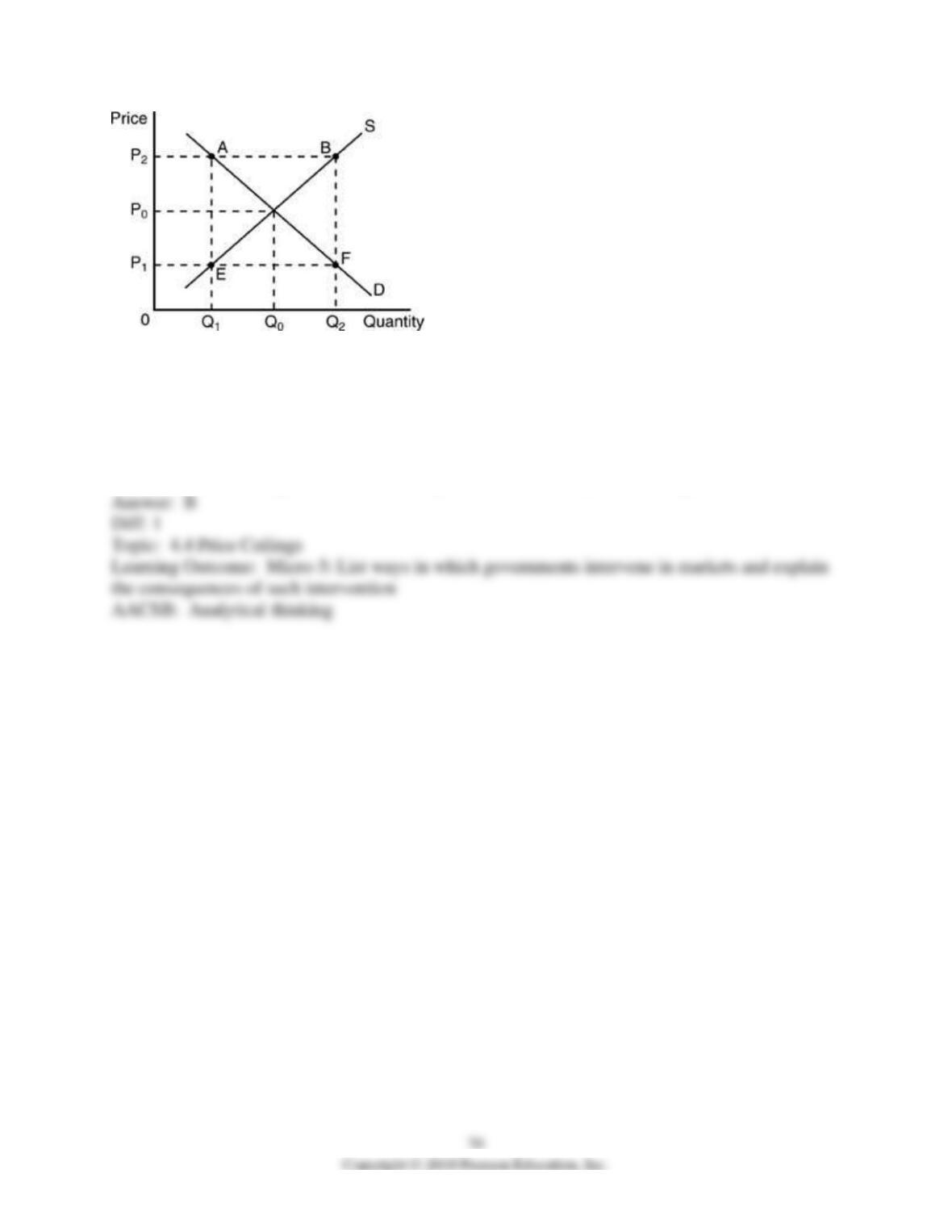
20) Refer to the above figure. Other things being equal, when the government imposes a price
floor at P2, then we would expect
A) the quantity demanded is Q2.
B) a surplus will occur.
C) price to decline until an equilibrium is achieved at P0.
D) consumers to bid against each other for goods and force the price even higher.
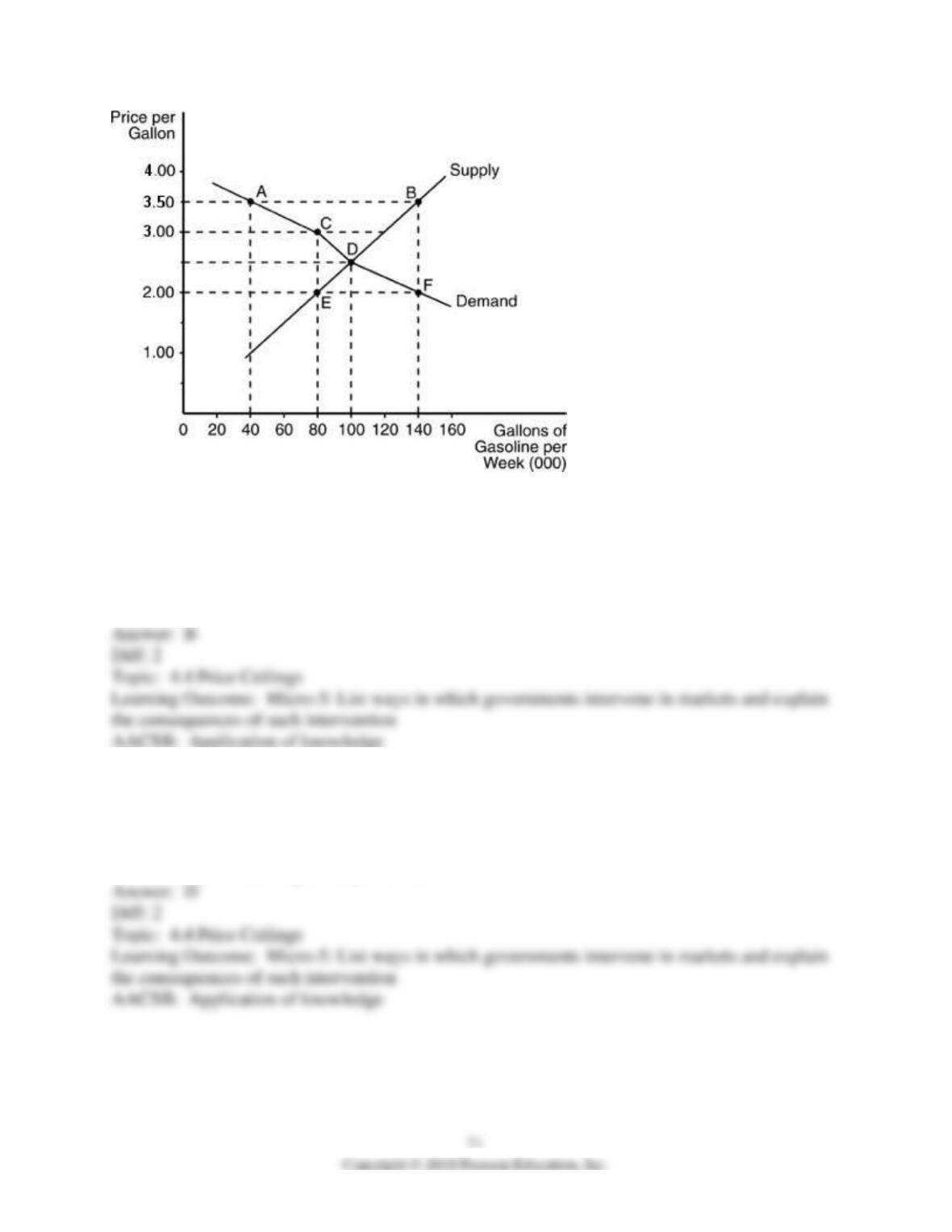
21) Refer to the above figure. If government sets the maximum legal price of gasoline at $2 per
gallon, then the $2 limit acts as
A) a price floor.
B) a price ceiling.
C) an equilibrium price.
D) a just price.
22) Refer to the above figure. At a price of $2 per gallon, there is
A) a surplus of 20,000 gallons per month.
B) a shortage of 40,000 gallons per month.
C) a shortage of 80,000 gallons per month.
D) a shortage of 60,000 gallons per month.
72
23) Refer to the above figure. At a price of $2 per gallon, the quantity demanded of gasoline is
A) 80,000 gallons per month.
B) 100,000 gallons per month.
C) 60,000 gallons per month.
D) 140,000 gallons per month.
24) Refer to the above figure. If the government set a price floor of $3.50 per gallon, there would
be
A) an excess quantity demanded equal to 100,000 gallons.
B) an excess quantity supplied equal to the distance BD.
C) an excess quantity supplied equal to the distance BF.
D) an excess quantity supplied equal to 100,000 gallons.
25) Government policies such as price controls, rent controls, and quantity restrictions have the
effect of
A) promoting the attainment of an unhindered market equilibrium.
B) allowing quantity demanded to adjust to equality with aggregate supply.
C) creating excess quantities demanded or excess quantities supplied.
D) pushing prices to market clearing levels more rapidly than private market forces.
73
26) When a government imposes price controls, the result is that
A) the rationing function of prices is not allowed to function freely.
B) the price system operates more efficiently.
C) all trades are as mutually beneficial to each party as possible.
D) scarcity usually disappears.
27) When the government sets a maximum price that can be charged for a good or service, it
creates
A) a price support.
B) a price floor.
C) a white market.
D) a price ceiling.
28) A black market is a market in which
A) goods are traded at prices above their legal maximum prices.
B) sales taxes are effectively doubled.
C) goods are sold at outlet prices.
D) sales take place exclusively at outlet prices.
29) If a price ceiling were established above the equilibrium price,
A) it would have no effect on the quantity demanded.
B) it would create a shortage.
C) it would create a surplus.
D) none of the above.
30) A price ceiling below the market clearing price results in
I. excess quantity demand
II. excess quantity supplied
III. entry of new producers
A) I only
B) II only
C) III only
D) Both I and III
31) Which of the following is NOT a predictable result of a price ceiling set below the market
clearing price?
A) an illegal market in the good
B) excess quantity supplied
C) excess quantity demanded
D) lines to purchase the product
32) Price ceilings often generate
A) market clearing prices.
B) rapid increases in supply to meet the excess demand.
C) equilibriums that utilize rationing by price.
D) black markets.
33) An example of a black market is
A) a retail market.
B) a discount market.
C) scalping.
D) barter.
34) An effective price ceiling usually generates
A) fire sales as firms try to unload their excess inventories.
B) higher nominal prices.
C) the use of nonprice rationing devices.
D) happy sellers and dissatisfied buyers.
35) A market in which a price-controlled good is sold at an illegally high price is known as
A) a flooring market.
B) a ceiling market.
C) a black market.
D) a supermarket.
36) Which of the following statements is most accurate regarding who benefits and loses from
establishment of a minimum wage above the market clearing wage?
A) Individuals who obtain jobs benefit because they earn a higher wage, but some individuals
lose because employers will not hire them at the minimum wage.
B) All workers benefit equally from the establishment of the minimum wage because just as
many workers as before remain employed, and all earn the higher minimum wage.
C) All employers benefit equally from the establishment of the minimum wage because they are
able to hire fewer workers at a lower wage.
D) All employers lose because they must pay the higher minimum wage to the same number of
employees as they did before the minimum wage was established.
37) A price floor set below the equilibrium price will cause which of the following?
A) an increase in demand
B) a shortage
C) a surplus
D) none of the above
38) If the government imposed a price ceiling on gasoline above this good’s current market
clearing price, there would be
A) a shortage of gasoline. at the ceiling price.
B) a surplus of gasoline at the ceiling price.
C) an increase in the price of gasoline.
D) no change in the price of gasoline.
39) A price ceiling set below the market clearing price will tend to cause which of the following?
A) a surplus
B) a shortage
C) an increase in demand
D) a reduction in supply
40) A price ceiling set above the equilibrium price will cause which of the following?
A) an increase in supply
B) a surplus
C) a shortage
D) no effect on either the price or quantity
41) A price ceiling is
A) the lowest price a seller can charge without losing all of its customers.
B) a legal minimum price below which a good or service cannot be sold.
C) a legal price above which a good or service cannot be sold.
D) a nonprice rationing device.
42) Price controls
A) exist when firms decide that they want to charge a higher price for their product.
B) exist when consumers boycott a product.
C) are government-mandated minimum or maximum prices that may be charged for goods.
D) are the benefit of discount stores like Sam’s Club.
43) Nonprice rationing devices are required
A) because the price system does not allocate resources efficiently.
B) when there are price floors but not when there are price ceilings.
C) so that prices will go back to equilibrium.
D) to allocate goods when there is a price ceiling.
44) All of the following are examples of nonprice rationing devices EXCEPT
A) price controls.
B) queues.
C) black markets.
D) waiting lists.
45) In the 1970s, the government placed price ceilings on gasoline prices. A shortage of gasoline
occurred, and long lines formed at the pumps. Some gas stations required that in addition to
paying the price on the pump you had to buy a blank will. The action of having to purchase the
will in order to purchase gas is known as
A) a surplus.
B) a price support.
C) the price system.
D) a black market.
79
46) Price controls often generate
A) more efficient markets.
B) black markets.
C) rapid adjustment to market-clearing prices.
D) greater price flexibility.
47) Suppose the market clearing price for gasoline is $2.25 per gallon. Now suppose that policy
makers pass a law requiring that the maximum price that can be charged is $2.0 per gallon. Such
a situation is an example of
A) a price control that will lead to a surplus of gasoline on the market.
B) a price floor that will lead to a shortage of gasoline on the market.
C) a price ceiling that will lead to a shortage of gasoline on the market.
D) a price floor that will lead to a surplus of gasoline on the market.
48) Suppose the market clearing price is $20 and the price ceiling is $15. The price that prevails
in the market will be
A) $20.
B) $15.
C) less than $15.
D) $0.
80
49) Suppose the market clearing price is $15 and the price ceiling is $17. The price that prevails
in the market will be
A) $17.
B) $15.
C) less than $15.
D) more than $17.
50) A price ceiling established below the market clearing price will usually cause
A) nonprice rationing.
B) an excess supply.
C) no change in the market clearing price.
D) a decrease in the market clearing price.