90) If both supply and demand simultaneously decrease
A) the market clearing price definitely rises, and the equilibrium quantity definitely falls.
B) the market clearing price definitely rises, and the effect on the equilibrium quantity is
indeterminate.
C) the market clearing price definitely falls, and the effect on the equilibrium quantity is
indeterminate.
D) the effect on the market clearing price is indeterminate, and the equilibrium quantity
definitely falls.
91) If supply and demand both simultaneously increase
A) the market clearing price definitely rises, and the equilibrium quantity definitely falls.
B) the market clearing price definitely rises, and the effect on the equilibrium quantity is
indeterminate.
C) the market clearing price definitely falls, and the effect on the equilibrium quantity is
indeterminate.
D) the effect on the market clearing price is indeterminate, and the equilibrium quantity
definitely rises.
92) We cannot predict the effect on the market clearing price, but know that the equilibrium
quantity will increase when
A) supply increases and demand decreases.
B) supply and demand for a product simultaneously decrease.
C) supply and demand for a product simultaneously increase.
D) supply decreases and demand increases.
93) We cannot predict the effect on the market clearing price, but know that the equilibrium
quantity will decrease when
A) supply increases and demand decreases
B) supply decreases and demand increases.
C) supply and demand for a product simultaneously decrease.
D) supply and demand for a product simultaneously increase.
94) We cannot predict the effect on the equilibrium quantity, but know that the market clearing
price will decrease when
A) supply increases and demand increases.
B) supply decreases and demand decreases.
C) supply decreases and at the same time demand increases.
D) supply increases and at the same time demand decreases.
95) We cannot predict the effect on the equilibrium quantity, but know that the market clearing
price will increase when
A) supply decreases and at the same time demand increases.
B) supply increases and demand increases simultaneously.
C) supply and demand decreases simultaneously.
D) supply and demand increases simultaneously.
96) If supply decreases and demand increases
A) the market clearing price definitely rises, and the equilibrium quantity falls.
B) the market clearing price definitely rises, and the equilibrium quantity is indeterminate.
C) the market clearing price definitely falls, and the effect on the equilibrium quantity is
indeterminate.
D) the effect on the market clearing price is indeterminate, and the equilibrium quantity
definitely falls.
97) If both the demand curve and the supply curve shift to the right, we can unambiguously
conclude that the
A) market clearing price will increase.
B) market clearing price will decrease.
C) equilibrium quantity will increase.
D) equilibrium quantity will decrease.
98) Which one of the following could account for an increase in the market clearing price of
portable power banks?
A) a decrease in demand for portable power banks
B) an increase in supply of portable power banks
C) an increase in supply along with a decrease in demand
D) an increase in demand along with a decrease in supply
99) In September 2005, destruction to U.S. gasoline refineries was caused by back-to-back
storms along the U.S. Gulf Coast—Hurricane Katrina and Hurricane Rita. In one week, the
average price of a gallon of gasoline in the United States increased by about 40 cents. Which of
the following best explains why these events pushed up the price of gasoline?
A) The demand curve for gasoline shifted to the left along the supply curve for gasoline.
B) The supply curve for gasoline shifted to the left along the demand curve for gasoline.
C) The demand curve for gasoline shifted to the right along the supply curve for gasoline.
D) The supply curve for gasoline shifted to the right along the demand curve for gasoline.
100) In 2010, a British Petroleum oil rig exploded in the Gulf of Mexico. The explosion resulted
in a major oil spill and a decrease in the supply of oil. At the same time, the average price of
gasoline decreased. Which of the following best explains the decrease in the price of gasoline?
A) The quantity demanded of gasoline increased.
B) The demand for gasoline decreased, and the effect of the decrease in demand on the gasoline
price was greater than the price effect of the decrease in supply.
C) The demand for gasoline increased, and the effect of the increase in demand on the gasoline
price was less than the price effect of the decrease in supply.
D) The demand for gasoline remained unchanged.
101) The market for gasoline in May is in equilibrium, at a market clearing price of $2.50 per
gallon. After Memorial Day, the demand curve for gasoline increases, which causes
A) the demand curve for gasoline to shift to the right, creating a shortage at $2.50 per gallon
which causes the market clearing price of gasoline to rise.
B) the demand curve for gasoline to shift to the right, creating a shortage at $2.50 per gallon
which causes the market clearing price of gasoline to fall.
C) the demand curve for gasoline to shift to the left, creating a shortage at $2.50 per gallon which
causes the market clearing price of gasoline to rise.
D) the demand curve for gasoline to shift to the left, creating a shortage at $2.50 per gallon
which causes the market clearing price of gasoline to fall.
102) Suppose the price of crude oil used to produce gasoline rises significantly. At the same
time, consumers purchase hybrid cars in great numbers. In the market for gasoline, demand shifts
to the ________ and supply shifts to the ________.
A) left, left
B) left, right
C) right, left
D) right, right
103) Suppose the price of crude oil used to produce gasoline rises significantly. At the same
time, consumers purchase hybrid cars in great numbers. In the market for gasoline, the market
clearing price ________ and the equilibrium quantity ________.
A) definitely falls, is indeterminate
B) is indeterminate, definitely falls
C) definitely falls, definitely rises
D) definitely rises, is indeterminate
104) Economists assume that when there is a change in supply and/or demand, the market
clearing price returns to the equilibrium
A) quickly.
B) slowly.
C) after a protracted negotiation process.
D) after an adjustment period.
105) When the supply and/or demand curve shift, the new market clearing price is
A) reached instantaneously.
B) reached only after the government intervenes in the market.
C) reached after some period of adjustment.
D) never reached.
106) Suppose the price of lumber decreases. In the market for new homes, we would expect
which of the following to occur?
A) the market clearing price will fall and the equilibrium quantity will rise.
B) the market clearing price will rise and the equilibrium quantity will fall.
C) both the market clearing price and the equilibrium quantity will fall.
D) both the market clearing price and the equilibrium quantity will rise.
107) If the demand for a product remains the same and the supply falls,
A) the market clearing price will fall and the equilibrium quantity will rise.
B) the market clearing price will rise and the equilibrium quantity will fall.
C) both the market clearing price and the equilibrium quantity will fall.
D) both the market clearing price and the equilibrium quantity will rise.
108) If one day it was discovered that lime juice caused cancer, which of the following would
likely result?
A) The supply curve for lime juice would shift to the right.
B) The supply curve for lime juice would shift to the left.
C) The demand curve for lime juice would shift to the right.
D) The demand curve for lime juice would shift to the left.
109) If the demand for a product rises and the supply stays the same
A) the market clearing price will fall and the equilibrium quantity will rise.
B) the market clearing price will rise and the equilibrium quantity will fall.
C) both the market clearing price and the equilibrium quantity will fall.
D) both the market clearing price and the equilibrium quantity will rise.
110) If the demand for a product falls and the supply stays the same
A) the market clearing price will fall and the equilibrium quantity will rise.
B) the market clearing price will rise and the equilibrium quantity will fall.
C) both the market clearing price and the equilibrium quantity will fall.
D) both the market clearing price and the equilibrium quantity will rise.
111) If both buyers and sellers expect the price of a commodity to rise in the future, it is likely
that the market clearing price ________ and the equilibrium quantity ________.
A) will fall, cannot be predicted
B) will rise, cannot be predicted
C) cannot be predicted, will fall
D) cannot be predicted, will rise
112) If both buyers and sellers expect the price of a commodity to fall in the future, it is likely
that the market clearing price ________ and the equilibrium quantity ________.
A) will fall, cannot be predicted
B) will rise, cannot be predicted
C) cannot be predicted, will fall
D) cannot be predicted, will rise
113) When supply and demand for a product increase simultaneously, we
A) can predict that both the market clearing price and the equilibrium quantity will increase.
B) can predict that both the market clearing price and the equilibrium quantity will decrease.
C) cannot predict the market clearing price, but know that the equilibrium quantity will increase.
D) cannot predict the change in either the equilibrium quantity or the market clearing price.
114) When supply and demand for a product decrease simultaneously, we
A) can predict that both equilibrium price and quantity will increase.
B) can predict that both equilibrium price and quantity will decrease.
C) cannot predict equilibrium price, but know that equilibrium quantity will decrease.
D) cannot predict the change in either the equilibrium quantity or equilibrium price.
115) When supply increases and at the same time demand decreases, we
A) can predict that both equilibrium price and quantity will increase.
B) can predict that both equilibrium price and quantity will decrease.
C) cannot predict equilibrium quantity, but know that equilibrium price will decrease.
D) cannot predict the change in either the equilibrium quantity or equilibrium price.
116) Suppose there is a simultaneous increase in demand and increase in supply. Given this
information, we know with certainty that
A) both the equilibrium price and the equilibrium quantity will increase.
B) the equilibrium price will increase, and the equilibrium quantity will increase.
C) the equilibrium quantity will increase.
D) the equilibrium price will increase.
49
117) If producers must receive a higher price to be induced to produce any quantity, we can
conclude that
A) supply decreased.
B) demand decreased.
C) both supply and demand increased.
D) demand increased.
118) In the market for domestic avocados, what would happen to the market clearing price and
the equilibrium quantity if there was a drought in avocado growing areas?
A) The market clearing price would rise, and the equilibrium quantity would rise.
B) The market clearing price would fall, and the equilibrium quantity would rise.
C) The market clearing price would rise, and the equilibrium quantity would fall.
D) The market clearing price would fall, and the equilibrium quantity would fall.
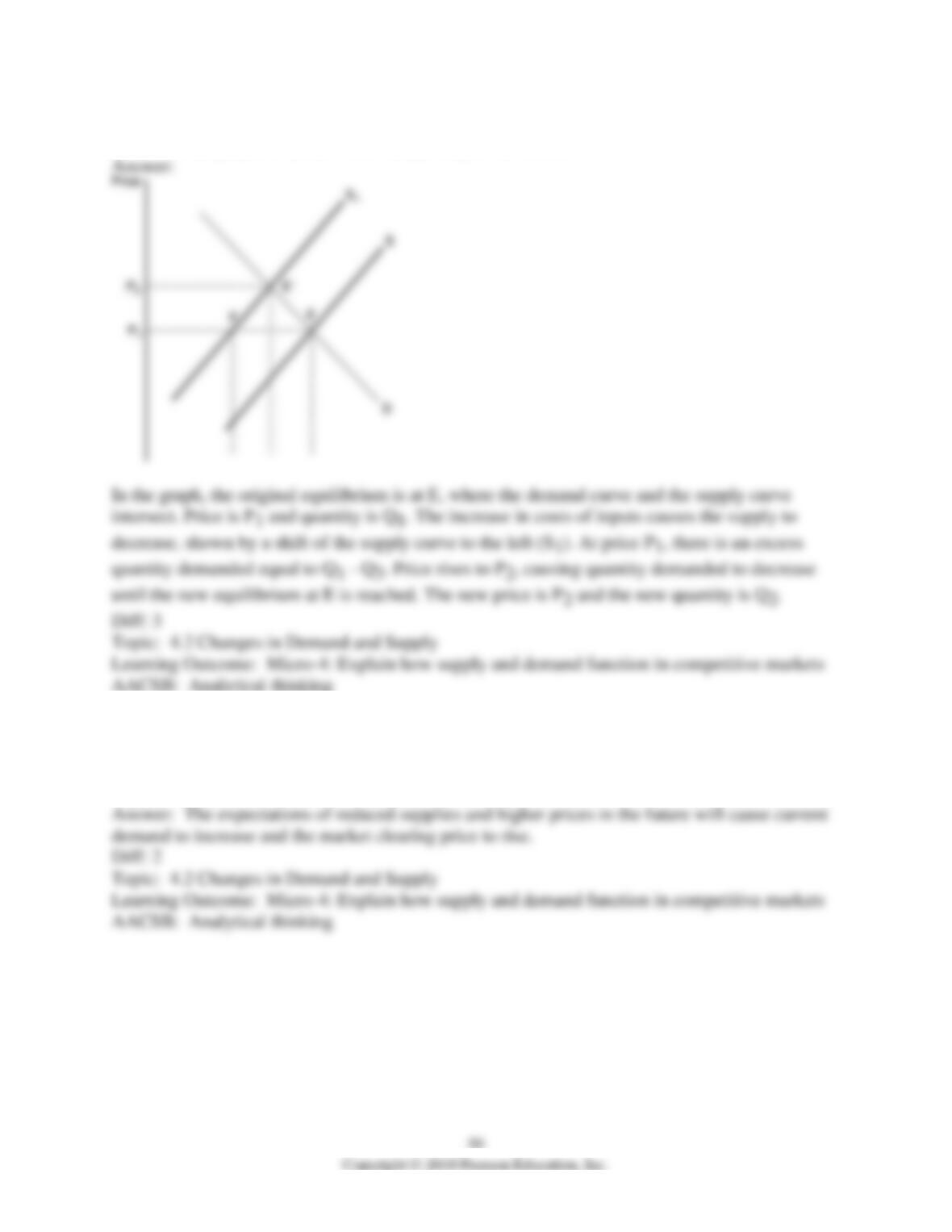
119) Using a graph, show a market equilibrium. Suppose the costs of inputs increase. How is this
shown on the graph? Explain what is happening in the market.
120) Suppose that the market for coffee is in equilibrium at a price of $9.50 per pound and a
monthly quantity of 20 million pounds. News of a drought in Brazil arrives so that people know
that the supply of coffee months from now will be sharply reduced. What, if anything, will
happen in the coffee market now? Explain.
121) Suppose that initially a market is in equilibrium at a price of $10 and a quantity of 5000
units per day. Several months later, the market is in a new equilibrium at a price of $5 and a
quantity of 5000 units per day. What happened in the market?
122) Describe the market process that should occur if the price of a product is below its
equilibrium price; now describe what would occur if the price is above its equilibrium price,
assuming no market interference.
123) Would it take longer for a labor market to move to a new equilibrium for house painters or
architects? Why?
124) Assume that CDs are a normal good and that the price of stereo equipment falls while the
labor costs of producing CDs increase. What will happen in the market for CDs?
125) Suppose local educators argue that teachers’ salaries are too low. At the same time it is said
that the school district received 750 applications for 5 new openings. Are salaries too low?
4.3 The Rationing Function of Prices
1) In economic terms, the total price of a pound of meat for an individual who has waited in line
is
A) the money price paid to the butcher for the pound of meat.
B) the money price of meat relative to the price of bread or other necessity.
C) the money price of the meat plus the opportunity cost of time spent waiting in line.
D) the money price of an equal amount of meat substitute, such as beans and rice.
53
2) According to the text, during World War II rationing was conducted in the U.S. through the
use of
A) queuing.
B) lotteries.
C) coupons.
D) sharing.
3) In a market, the rationing function of prices results in
A) long waiting lines.
B) a price ceiling.
C) an equilibrium between supply and demand.
D) a shortage or surplus.
4) Queuing is a way to ration goods
A) on a first-come, first-serve basis.
B) through prices.
C) through the use of political power.
D) through markets.
5) Which of the following statements about a price system is TRUE?
I. Prices ration goods and services.
II. Prices indicate relative scarcity.
A) I only
B) II only
C) Both I and II
D) Neither I nor II
6) Ways to ration goods include
A) first-come, first-served.
B) political power.
C) prices.
D) all of the above.
7) A long line at the campus bookstore at the beginning of the term is an example of
A) price rationing.
B) an ineffective price ceiling.
C) a non-price rationing device.
D) an ineffective price floor.
8) Other things being equal, a higher price induces
A) buyers to reduce the amount they want to buy and sellers to increase the amount they are
willing to sell.
B) buyers to increase the amount they want to buy and sellers to reduce the amount they are
willing to sell.
C) buyers to reduce the amount they want to buy and sellers to reduce the amount they are
willing to sell.
D) buyers to increase the amount they want to buy and sellers to increase the amount they are
willing to sell.
9) Prices in a market economy perform a rationing function because they reflect
A) the demand of all buyers in the market.
B) the extent to which the goods are necessities.
C) the strength of the supply curve.
D) the relative scarcity of the goods.
10) In a world of scarcity, there has to be some way to ration the available resources. According
to economists, the most efficient use of available resources occurs when rationing occurs via
A) queuing.
B) lotteries.
C) political power.
D) the price system.
11) Which of the following will tend to occur when a surplus exists in a market?
A) supply will increase and demand will decrease until the surplus disappears.
B) supply will decrease and demand will increase until the surplus disappears.
C) the price will tend to rise over time.
D) the price will tend to decrease over time.
12) In a market system, relative scarcities of resources are indicated by
A) supply and demand being out of equilibrium.
B) surpluses.
C) excess demand and excess supply.
D) relative market prices.
13) The rationing function of prices refers to
A) the situation when government must intervene in a market when there is a large shortage or
surplus.
B) the synchronization of decisions by buyers and sellers that leads to an equilibrium.
C) the synchronization of decisions by buyers and sellers through the direction of government
agencies.
D) the situation when only the rich get the goods they want.
14) All other factors being constant, a reduction in price tends to cause which of the following?
A) an increase in supply and an increase in demand
B) a reduction in supply and an increase in demand
C) an increase in quantity supplied and a reduction in quantity demanded
D) a reduction in quantity supplied and an increase in quantity demanded
15) Prices can achieve the rationing function when
A) prices are flexible.
B) prices are inflexible.
C) they are controlled by the government.
D) price controls are in place and ration coupons are used too.
16) When prices are used as a rationing device, goods that are relatively more scarce than they
used to be will have
A) greater demand.
B) lower excess demands.
C) higher prices.
D) long queues.
58
17) Which of the following statements is NOT true about the rationing of goods?
A) Goods can only be rationed by price.
B) Goods can be rationed on a first come first serve basis.
C) Goods can be rationed by random.
D) Goods can be rationed by the use of coupons.
18) Prices ration goods to
A) the people who most deserve it.
B) the people with the lowest opportunity cost of time.
C) the people willing and able to pay the highest price.
D) the richest people.
19) In a freely operating market system, queuing is most likely to occur when
A) selling necessities.
B) the market clearing price increases.
C) demand fluctuates unpredictably and quickly.
D) demand increases gradually over time.
20) In situations in which prices cannot be used to signal relative scarcities of goods, which of
the following can serve as a rationing mechanism?
A) queuing
B) political power
C) random assignment
D) all of the above
21) Rationing through the price system
A) leads to an inefficient use of available resources.
B) leads to high prices.
C) works only with government interference.
D) leads to an efficient use of available resources.
22) Rationing of resources, goods, and services
A) is not required under the price system.
B) is required because of scarcity.
C) must be done by the government.
D) happens only when the price is zero.
23) Rationing occurs for goods
A) that have a positive price.
B) that have a zero price.
C) that have a negative price.
D) that are not manufactured.
24) Rationing goods on the basis of price is a direct result of
A) scarcity.
B) queuing.
C) government intervention.
D) the profit motive.
25) What would happen in the market for rice if its demand increased but the price was NOT
allowed to change?
A) There would be a surplus of rice.
B) There would be a shortage of rice.
C) The supply of rice would increase.
D) The supply of rice would decrease.