International Economics, 6e (Gerber)
Chapter 4 Comparative Advantage and Factor Endowments
4.1 Introduction: The Determinants of Comparative Advantage
1) There are no questions for this section.
Topic: Introduction: The Determinants of Comparative
Advantage
4.2 Modern Trade Theory
1) A production possibilities curve that is bowed out represents the case of
A) constant costs.
B) increasing costs.
C) decreasing costs.
D) internal costs.
E) external costs.
2) A production possibilities curve that is a straight line represents the case of
A) constant costs.
B) increasing costs.
C) decreasing costs.
D) constant opportunity costs but increasing real costs.
E) constant opportunity costs but decreasing real costs.
3) The straight-line production possibilities curve introduced in the text
A) is not subject to increasing opportunity costs.
B) fails to reflect tradeoffs.
C) fails to benefit trading nations.
D) refutes the principles of comparative advantage.
E) All of the above.
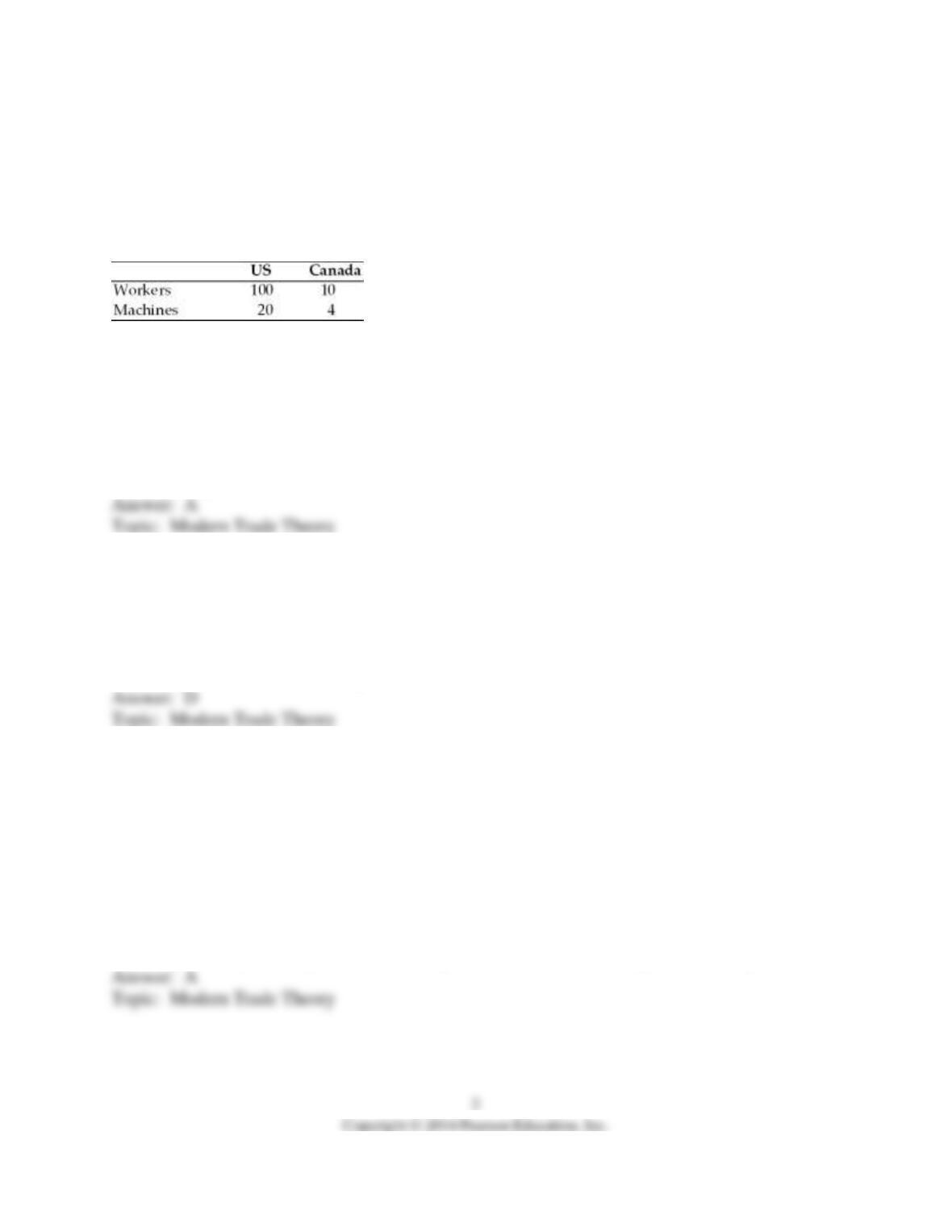
Use the below mentioned table for the following question(s).
Suppose that all goods are made with two factors—labor and capital. The table below shows the
total endowments of each factor in the United States and Canada.
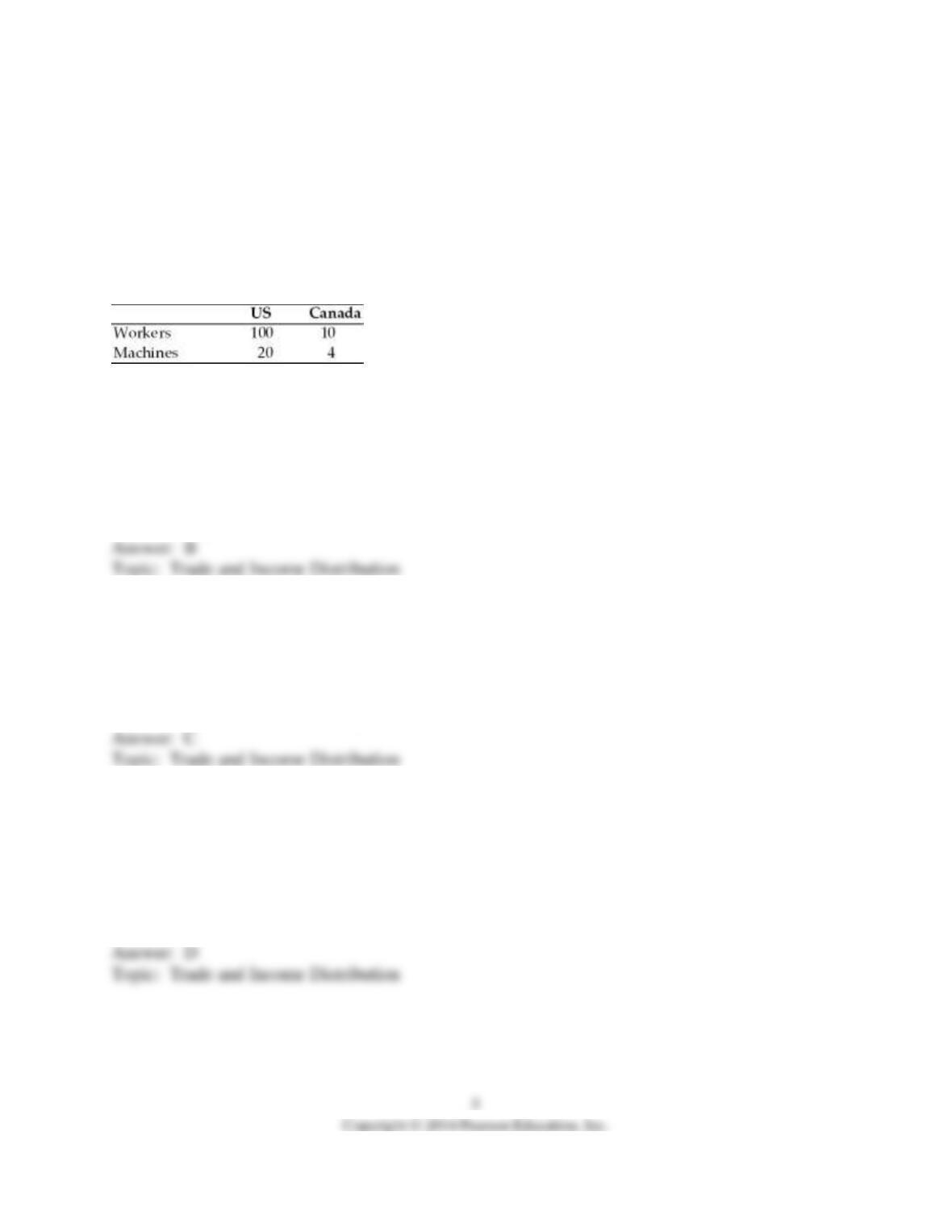
Table 4.1
Endowment of Labor and Capital
4) Based on Table 4.1, according to the Heckscher-Ohlin Theorem, U.S. exports should be goods
that
A) intensively use labor input.
B) intensively use capital input.
C) use capital and labor in about equal proportions.
D) use either labor or capital input, depending on the good.
E) Not enough information to tell.
5) The Heckscher-Ohlin Theorem predicts
A) who benefits and who loses from trade.
B) which factors are abundant.
C) the income distribution effects of trade.
D) which goods will be exported.
E) the importance of intraindustry trade.
6) Suppose that a country is producing on its PPC at a point to the left of the tangency between
the trade line and the PPC. At the production point,
A) the opportunity cost in production of the good on the horizontal axis is less than its trade
price.
B) the opportunity cost in production of the good on the horizontal axis is more than its trade
price.
C) the opportunity cost in production of the good on the vertical axis is less than its trade price.
D) the opportunity cost in production of the good on the horizontal axis may be either less than
or more than its trade price.
E) the opportunity cost in production of the good on the vertical axis equals its trade price.
7) If the trade line that passes through the production point on the PPC has a slope that is
shallower than the slope of the PPC at the same point, then
A) the country can get greater gains from trade if it moves production away from the vertical
axis.
B) the country can get greater gains from trade if it moves production toward the vertical axis.
C) the country cannot improve on its gains from trade.
D) There are no gains from trade in this example.
E) There is not enough information to tell how it can improve its gains from trade.
8) Which of the following is NOT a proposition of the Heckscher-Ohlin model?
A) A country has a comparative advantage in the production of that commodity which uses more
intensively the country’s more abundant resource.
B) The effect of international trade is to tend to equalize factor prices between the trading
nations.
C) If Mexico is an unskilled labor abundant country, then Mexico has a comparative advantage
in the production of goods that use unskilled labor more intensively.
D) If the United States is a skilled labor abundant country, then the United States has a
comparative advantage in the production of goods that use skilled labor more intensively.
E) Countries will completely specialize in the product in which they have a comparative
advantage if free trade is allowed to occur.
9) Suppose that Brazil is capital abundant and Chile is natural resource abundant. If timber is
natural resource intensive and computers are capital intensive, then
A) Chile will produce more computers after trade begins with Brazil.
B) Brazil will produce more timber after trade begins with Chile.
C) Chile will produce more timber after trade begins with Brazil.
D) Brazil will completely specialize in computers once trade begins with Chile.
10) Suppose that Brazil is capital abundant and Chile is natural resource abundant. If timber is
natural resource intensive and computers are capital intensive, then according to the Heckscher-
Ohlin Theorem, Chile should export goods that
A) intensively use labor input.
B) intensively use capital input.
C) intensively use natural resources.
D) use capital and labor in about equal proportions.
4
11) Using the HO model, assume that the United States is capital abundant and Mexico is labor
abundant. If soybeans are capital intensive and avocados are labor intensive,
A) Mexico will produce more soybeans once trade is introduced.
B) the United States will produce more avocados once trade is introduced.
C) avocado prices in the United States will fall once trade begins.
D) soybean prices in Mexico will rise once trade begins.
12) Using the HO model, assume that the United States is capital abundant and Mexico is labor
abundant. If soybeans are capital intensive and avocados are labor intensive, it would be
reasonable to expect the United States to
A) specialize completely in soybean production.
B) specialize completely in avocado production.
C) increase soybean production, but still produce some avocados.
D) increase avocado production, but still produce some soybeans.
13) What is the source of comparative advantage in the Heckscher-Ohlin model?
14) In the Heckscher-Ohlin model, what assumption is made about opportunity costs?
4.3 Trade and Income Distribution
Use the below mentioned table for the following question(s).
Suppose that all goods are made with two factors—labor and capital. The table below shows the
total endowments of each factor in the United States and Canada.
Table 4.1
Endowment of Labor and Capital
1) Based on Table 4.1, according to the Stolper-Samuelson Theorem, the income distribution
effects of free trade in the United States are likely to favor
A) capital.
B) labor.
C) either capital or labor, depending on U.S. productivity.
D) neither capital nor labor.
E) Not enough information to tell.
2) The Stolper-Samuelson Theorem predicts
A) the level of productivity in export industries.
B) which factors are abundant.
C) the income distribution effects of trade.
D) which goods will be exported.
E) the importance of intraindustry trade.
3) If the price of a good rises, then the effect on the income of the factors that are used
intensively in its production will be
A) to raise income by an absolute amount that is less than the rise in prices.
B) to raise income by an absolute amount that is more than the rise in prices.
C) to raise income by a smaller percentage than the rise in prices.
D) to raise income by a greater percentage than the rise in prices.
E) to cause income to fall.
4) After trade opens, the short run impact on the income of the variable factor will be
A) a decrease.
B) an increase.
C) zero.
D) indeterminate, depending on the consumption pattern of the owners of the variable factor.
E) indeterminate, depending on the productivity of the variable factor.
5) After trade opens, the short run impact on the income of the specific factor that is relatively
scarce will be
A) a decrease in its income.
B) an increase in its income.
C) no change in its income.
D) indeterminate, income effects are not possible to know.
6) Suppose that Brazil is capital abundant and Chile is natural resource abundant. If timber is
natural resource intensive and computers are capital intensive, then according to the Stolper-
Samuelson Theorem, the incomes of the owners of ________ are likely to rise in Brazil after
trade with Chile begins.
A) capital
B) labor
C) natural resources
D) It is impossible to determine which will be favored.
7) Using the specific factors model, assume that strawberry production requires the specific
factor of land, tractor production requires the specific factor of capital, and labor is variable. If
the United States is capital abundant compared to Mexico, and Mexico is land abundant
compared to the United States, then in the short run with trade we would expect
A) the income of U.S. land owners to increase.
B) the income of U.S. workers to increase.
C) the income of Mexican workers to increase.
D) the income of Mexican land owners to increase.
8) Using the specific factors model, assume that strawberry production requires the specific
factor of land, tractor production requires the specific factor of capital, and labor is variable. If
the United States is capital abundant compared to Mexico, and Mexico is land abundant
compared to the United States, then in the short run with trade, which of the following is TRUE?
A) Mexican wages will rise more than the increase in the price of tractors in Mexico.
B) U.S. wages will rise less than the fall in the price of tractors in the United States.
C) The owners of capital in the United States will see a larger increase in their incomes in
percentage terms than the increase in the price of tractors.
D) The owners of land in Mexico will see a smaller increase in their incomes in percentage terms
than the increase in the price of strawberries.
9) Nations get significant advantages if they have a single, valuable, natural resource, with little
downside risk.
10) What is the Heckscher-Ohlin theorem? Using the case studies in the chapter on U.S. trade
with China describe the theory and the resulting trade patterns that would support it.
11) Which types of workers are most likely to favor lowering trade barriers in the United States?
4.4 Empirical Tests of the Theory of Comparative Advantage
1) Empirical tests of the theory of comparative advantage have provided
A) strong support for both the Ricardian and Heckscher-Ohlin models.
B) mixed support for the Ricardian model and strong support for the Heckscher-Ohlin model.
C) strong support for the Ricardian model and mixed support for the Heckscher-Ohlin model.
D) mixed support for both Ricardian and Heckscher-Ohlin models.
E) no support for either the Ricardian or the Heckscher-Ohlin models.
4.5 Extension of the Heckscher-Ohlin Model
1) Tijuana, Mexico is across the border from San Diego, California. It has become a world-
leading producer and exporter of television sets and computer monitors, which it assembles in
modern factories owned by multinational consumer electronics firms such as Sony. Initially,
these electronics were produced in the industrialized countries of their parent companies, and
after several years, the production moved to Tiajuana. This is an example of
A) the product cycle.
B) intraindustry trade.
C) the specific factors model.
D) the magnification effect.
E) None of the above.
2) Which of the following would NOT be associated with the LATE PHASE of the product
cycle?
A) Consumption in high income countries begins to exceed production.
B) Increasing share of output is moving to developing countries where abundant low skilled and
semi-skilled labor keep production costs low.
C) Consumption continues to grow in low income countries.
D) There is experimentation and improvement in design and manufacturing.
3) Which of the following would be associated with the early phase of the product cycle?
A) Large amounts of production in low-income, developing countries
B) A standardized product with an assembly-line style production process
C) Sophisticated marketing and customer feedback mechanisms
D) More consumption in low-income, developing countries
4) Which of the following is TRUE according to the case study on U.S. / China trade presented
in the chapter?
A) China has relative abundance in capital.
B) China has relative abundance in skilled labor.
C) The United States has relative scarcity in unskilled labor.
D) The United States has relative scarcity in capital.
5) If the case study on U.S. / China trade is correct in its analysis of factor abundance,
A) Chinese capital owners should see their income rise as trade increases.
B) U.S. skilled labor inputs should see their incomes fall as trade increases.
C) U.S. capital owners should see their income fall as trade increases.
D) Chinese unskilled labor should see their income rise as trade increases.
6) The opportunity cost of producing in low-income, developing countries rises over the product
cycle, according to theory.
7) Chinese exports of toys and footwear can be explained by factor endowments, while Chinese
exports of telecommunications equipment and computers and accessories can be explained by
product-cycle analysis.
8) The O in OLI theory stands for ownership, and the asset owned can be tangible or intangible.
9) The L in OLI theory stands for loyalty, and this factor makes it more difficult for firms to
substitute foreign operations for domestic as they fear a loss of sales due to negative publicity.
10) According to OLI theory, a firm might be unwilling to license its production to a foreign firm
for fear that its technology may be stolen or its brand name harmed, which leads the firm to
internalize control over its asset and set up its own foreign subsidiary.
11) OLI theory is a direct contradiction of trade theory, especially trade theory based on
comparative advantage.
12) Offshoring became a concern in the 1980s when modern communication and transport
technology made it possible for firms to relocate production abroad.
13) Offshoring by domestic firms causes job losses not job expansion in the home market.
14) The bulk of offshoring is vertical, relating to producing a component piece in an overall
supply chain production.
15) The primary interest of firms engaging in offshoring is to find lower wages and to decrease
production costs.
16) Most migrants move from developing to developed nations.
17) The United States has the largest percentage of foreigners in its overall population of any
nation.
18) Describe the product cycle, including addressing the various inputs that are required over
time and the resulting production location decisions.
19) What are the factors that have been identified that affect a migration decision? Give
examples of each.
20) How is offshoring of services different from past trade patterns?
21) Offshoring required which types of advances?
22) What does research thus far suggest about job loss and offshoring?
23) Forces inside a nation that cause people to think about leaving that nation are called what in
migration theory?
12
24) The relocation of service industry functions to another country is called what?
25) If General Motors imports parts from its plants in Canada and Mexico for finished trucks that
it will sell across the NAFTA region, what type of trade does this represent?
4.6 The Impact of Trade on Wages and Jobs
1) Wage inequality has been on the rise in virtually all high-income industrial economies since
the 1970s. The causes are probably numerous, but the leading explanation for the greatest share
of the increase in inequality is
A) the growth of trade with developing countries.
B) the growth of trade with other high income industrial countries.
C) technological change which increased the relative demand for skilled workers.
D) technological change which increased the relative demand for unskilled workers.
E) technological change which decreased the relative demand for skilled workers.
2) Most economists attribute the growing income inequality in the United States to
A) trade.
B) macroeconomic policies.
C) technological change.
D) changing values.
E) taxes.