112) Rent control is an example of
A) a price floor.
B) a price ceiling.
C) the rationing function of prices not working.
D) the government increasing the demand for certain products.
113) What would happen in the market for rental housing in your community if the local
government legally mandated rents that were below the market clearing price?
A) There would be a surplus of rental housing.
B) There would be a shortage of rental housing.
C) The demand for rental housing would increase.
D) The supply of rental housing would decrease.
114) Which group of individuals most likely benefits from rent controls?
A) the unemployed who fail to obtain rental housing
B) low-income wage earners who fail to obtain rental housing
C) single parent families without savings or other financial assets who fail to obtain rental
housing
D) upper-income professionals who rent apartments at the price ceiling rate
115) Which of the following would likely result as a consequence of rent controls?
A) a reduction in the rate of construction of rental housing units
B) unimproved buildings and apartment complexes
C) limits on tenant mobility
D) All of the above are correct.
116) In a city that has rent control for apartments, there is
A) less turnover of apartments.
B) a surplus of apartments available to rent.
C) a shortage of renters in the city.
D) neither a surplus nor a shortage of apartments.
117) Suppose that the current equilibrium price of gasoline is $3.50 per gallon and that the
government passes a law that requires the price to be no more than $3 per gallon. What will be
the effects?
118) In some developing countries and in some former Communist countries, people exchange
their domestic currencies for foreign currencies such as the dollar in black markets. Why would
this practice go on?
119) Finding an apartment in New York City is difficult. People even scan the obituaries in the
hopes of finding an apartment. Provide an economic explanation for this.
120) Who gains and who loses from rent controls?
4.5 Price Floors and Quantity Restrictions
1) In which decade did the U.S. federal government first establish a system of agricultural price
supports?
A) 1990s
B) 1970s
C) 1950s
D) 1930s
2) In the United States, government-imposed price supports are most often associated with
A) agricultural products.
B) industrial products.
C) consumer electronics.
D) commercial building products.
3) What is the result of an agricultural support price established above the equilibrium price?
A) The market gravitates toward and remains in equilibrium.
B) There will be excess quantity supplied of the product involved.
C) There will be excess quantity demanded the product in this market.
D) Since the support price is set above the equilibrium price, it will have no impact on the
market price.
4) Agriculture price supports that establish a price floor at which agricultural products may be
purchased that exceeds the market clearing price
A) create a shortage of agricultural products.
B) result in the quantity of these products supplied exceeding the quantity demanded at the floor
price.
C) benefit taxpayers, who receive subsidies from producers that the price support program forces
to sell to the government at an artificially established price.
D) benefit consumers, who are willing and able to purchase more agricultural products at the
floor price.
5) One result of the agriculture price supports cited in the text is that
A) sometimes surplus food is given away.
B) food shortages result in most cases.
C) small farms receive most of the benefits.
D) none of the above.
6) Of the following groups, which benefits most from a government price support program that
establishes a floor price for an agricultural product that is higher than the product’s market
clearing price?
A) consumers, who purchase more units of the product than they did before the price support
program was implemented
B) taxpayers, who no longer must provide funds to purchase surplus units of the product once the
price support program is in place
C) producers, who earn a higher price on the sale of each unit and also sell more units, thereby
unambiguously earning higher revenues
D) the government, which receives subsidy payments from producers that are required to sell
more of the product at a higher price under the government’s program
7) Government intervention in agriculture usually involves
A) price ceilings in order to keep food prices low.
B) price ceilings in order to subsidize U.S. exports.
C) price supports in order to keep farm incomes high.
D) price supports in order to keep agricultural imports low.
8) Who ultimately benefits from price supports in agriculture?
A) consumers
B) grocery store owners
C) farmers
D) exporters
9) When the government sets a price floor which is below the equilibrium price
A) a surplus will develop.
B) a shortage will develop.
C) the equilibrium price will be maintained.
D) a price ceiling will follow.
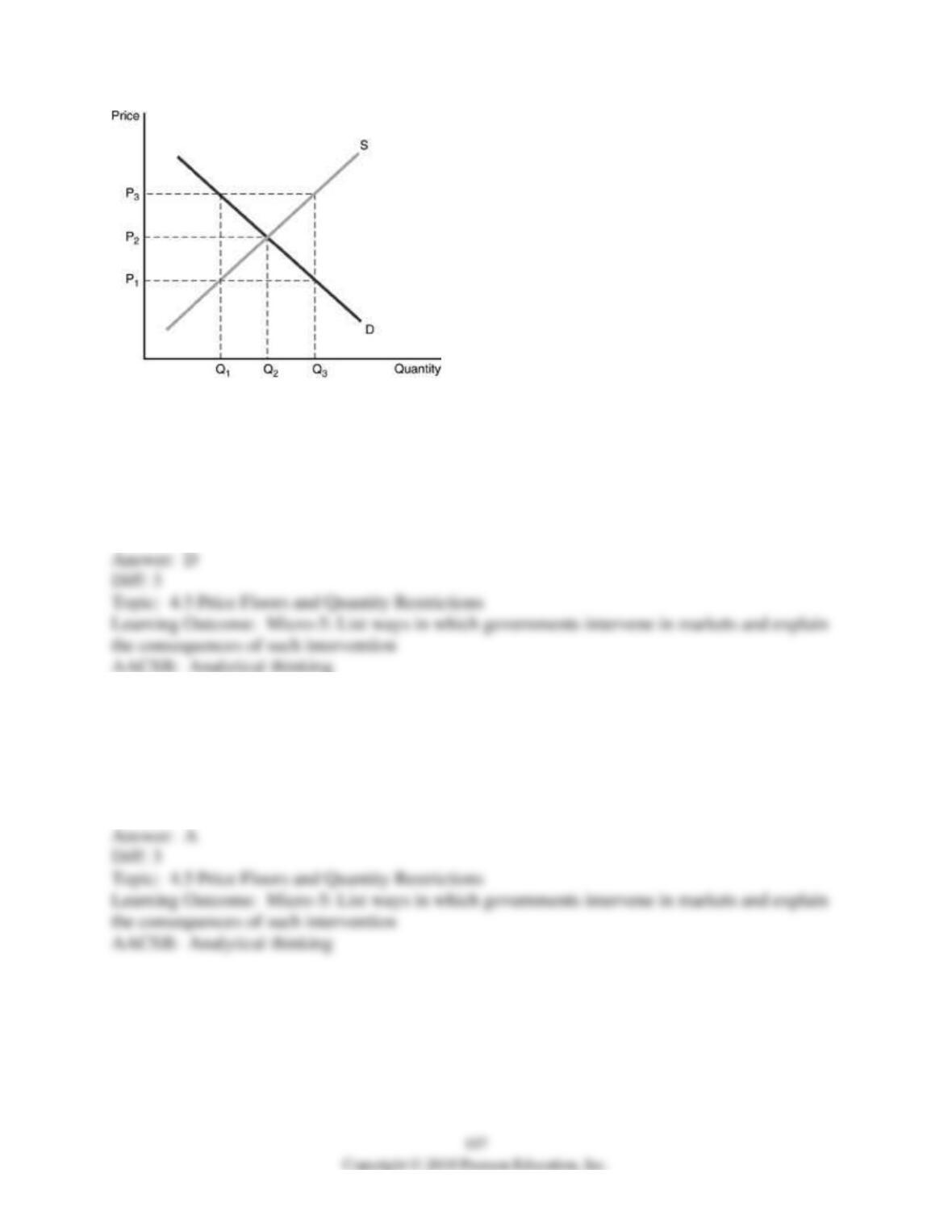
10) Refer to the above figure for the corn market. The government wants to set an effective price
support in the corn market. To be effective the price should be set
A) below P1.
B) at P1.
C) at P2.
D) at P3.
11) Refer to the above figure. A price support set at P3 will
A) lead to a surplus of Q3 minus Q1.
B) lead to a shortage of Q3 minus Q1.
C) lead to an equilibrium quantity of Q2.
D) be ineffective.
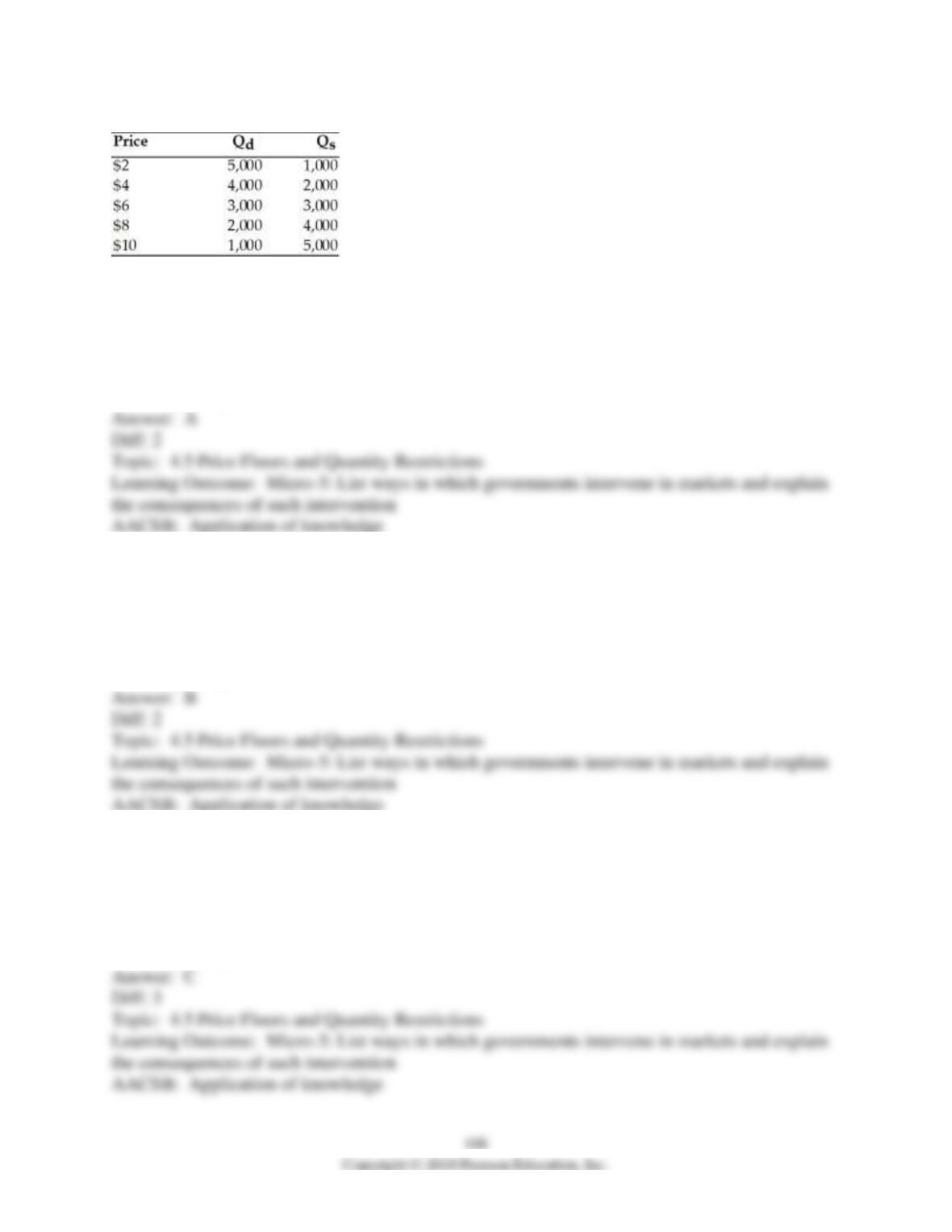
Strawberries (pounds)
12) Consider the above table. Assuming the government imposes a price floor on strawberries of
$8 per pound, what would be the likely result?
A) a surplus of 2,000 pounds of strawberries
B) a shortage of 2,000 pounds of strawberries
C) No change, equilibrium would prevail.
D) The quantity demanded of strawberries would fall to zero.
13) Consider the above table. Assuming the government imposes a price ceiling on strawberries
of $4 per pound, what would be the likely result?
A) a surplus of 2,000 pounds of strawberries
B) a shortage of 2,000 pounds of strawberries
C) No change, equilibrium would prevail.
D) The quantity demanded of strawberries would fall to zero.
14) Consider the above table. If the government imposes a price ceiling on strawberries of $8 per
pound, what would be the likely result?
A) a surplus of 2,000 pounds of strawberries on the market
B) a shortage of 2,000 pounds of strawberries on the market
C) Market equilibrium will be reached.
D) The quantity demanded of strawberries would fall to zero.
15) Which of the following will likely occur when price floors in agriculture are implemented?
A) Quantity supplied will exceed quantity demanded.
B) Quantity demanded will exceed quantity supplied.
C) Farmland will be underutilized.
D) Supply will decrease.
16) If the federal government sets a minimum price for wheat at $5.00 per bushel when the
equilibrium price is $4.50, then
A) a surplus will be created causing the price to fall to the equilibrium price of $4.50.
B) a permanent surplus will develop because the government established the minimum price at
$5.00.
C) a shortage will be created causing the price to rise to the equilibrium price of $4.50.
D) a permanent shortage will develop because the government established the minimum price at
$5.00.
17) When the government establishes a minimum price for an agricultural product above the
equilibrium price, the government is creating a(n)
A) price ceiling.
B) elevated price.
C) price floor.
D) surplus price.
18) If the government created a surplus of an agricultural product due to price supports, how
might they dispose of this surplus?
A) give it away to a foreign country
B) purchase it and store it away
C) have the farmer destroy the crop
D) Any of these answers might be a successful tool in disposing of agricultural surpluses.
19) Which of the following is most likely to benefit from government established price floors in
agriculture?
A) large farm owners and corporate farms
B) small farmers
C) cattle ranchers
D) low income farmers
20) Federally provided agricultural subsidies in the United States have ________ with the
passage of the 2002 Farm Security Act and the 2007 Food, Security, and Bioenergy Act.
A) been abolished
B) been maintained
C) increased to the level of EU price supports
D) been made a function of tax revenues
21) What has been the market outcome of government-enforced price floors for agricultural
products?
A) Not enough food has been produced.
B) Farmers have been made worse off.
C) A shortage of agricultural products has resulted.
D) A surplus of agricultural products has resulted.
22) Price floors in agriculture lead to
A) efficient farming techniques being employed.
B) surpluses of supported farm products.
C) more competition in farming.
D) the most efficient market solution.
23) All of the following result from price floors in agriculture EXCEPT
A) surpluses of agricultural products that have price floors.
B) higher prices to consumers for agricultural products that have price floors.
C) lower prices to consumers for agricultural products that have price floors.
D) governmental bureaucracy.
24) One effect of a minimum wage in the market for low-skilled labor is
A) a shortage of low-skilled labor.
B) a surplus of low-skilled labor.
C) no effect in the market for low-skilled labor.
D) an increase in demand for low-skilled labor.
25) A minimum wage is an example of a
A) price ceiling.
B) price floor.
C) black market.
D) market clearing price.
26) In the United States, the minimum wage is defined as
A) the wage that the youngest job entrant into the job market makes.
B) the lowest wage that a corporation should pay a worker if the corporation wants to ensure that
its employees are well trained.
C) the lowest hourly wage rate a firm may legally pay its workers, as legislated by the U.S.
government.
D) the wage ceiling above which a firm no longer must pay its employees additional benefits.
27) In the United States, the wage floor legislated by government below which it is generally
illegal to pay workers is known as
A) the minimum wage.
B) the wage ceiling.
C) the employment gap.
D) the going wage.
28) Which of the following is an effect of a minimum wage law that establishes a wage floor
above the current market clearing wage?
A) surplus labor, or unemployment
B) a decrease in the market clearing wage
C) a decrease in the quantity of labor supplied
D) an increase in the quantity of labor supplied
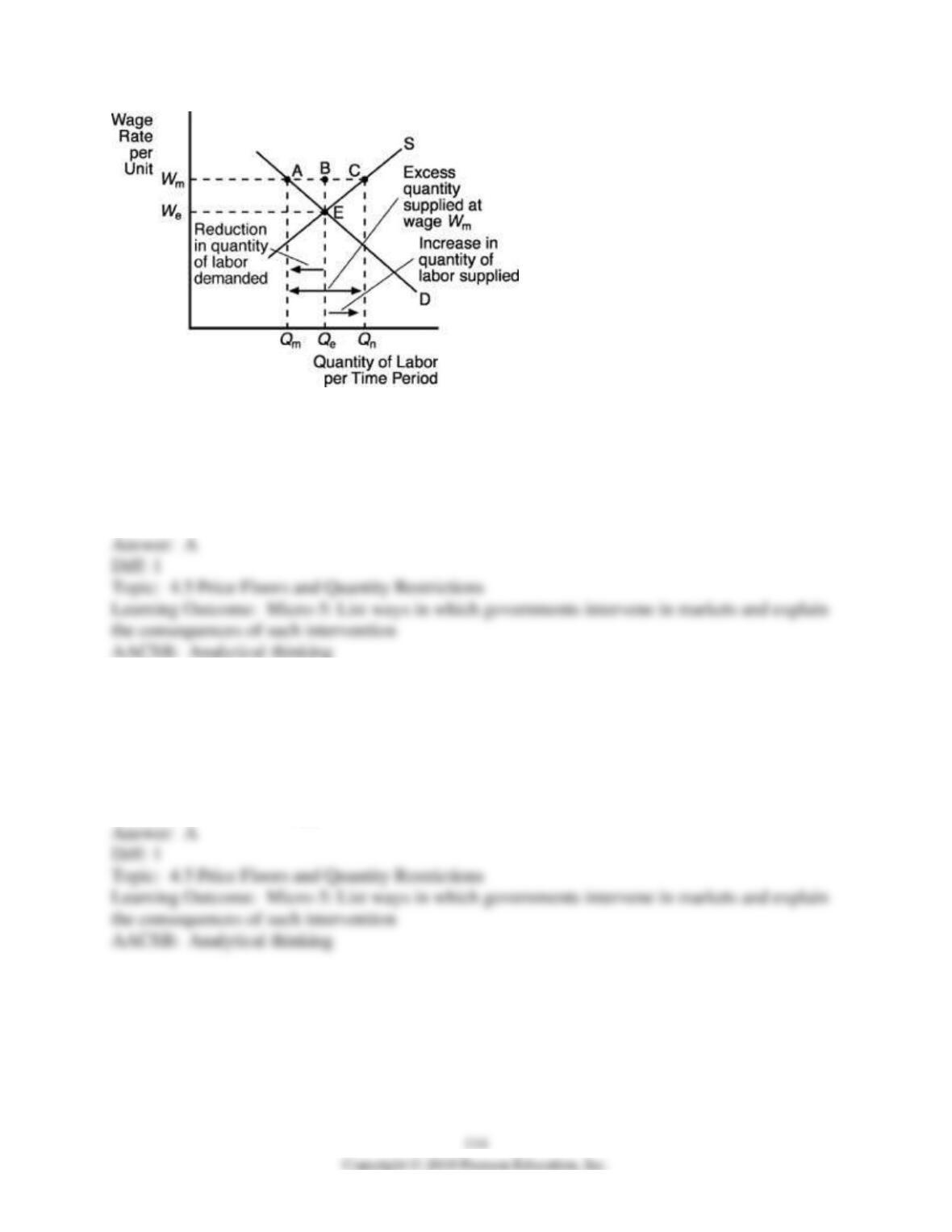
29) According to the above figure, the market clearing wage rate is
A) We.
B) Wm.
C) We – Wm.
D) Wm + We.
30) According to the above figure, if the government imposes a minimum wage equal to Wm,
the effect will be
A) a reduction in employment from Qe to Qm.
B) an increase in employment from Qe to Qm.
C) a decrease in labor supplied, from C to E.
D) an increase in labor supplied, from A to E.
31) If an excess quantity of labor demanded exists in a free market, there is a tendency for
A) quantity supplied to rise.
B) the wage rate to fall.
C) quantity demanded to fall.
D) the wage rate to rise.
32) The effect of legislation establishing a minimum wage above the market clearing wage is
A) unemployment.
B) a shortage of labor.
C) higher wages for all workers.
D) a shift of the demand for labor curve.
33) As a result of establishing a legal minimum wage above the market clearing wage
A) there will be a shortage of workers.
B) firms will hire fewer workers.
C) firms will hire more workers.
D) fewer workers will want to work.