9) The largest component of GDP in the expenditure approach is
A) personal consumption expenditures.
B) gross private domestic investment.
C) government expenditure on goods and services.
D) net exports.
10) Of the following, the largest component of GDP is
A) personal consumption expenditure.
B) gross private domestic investment.
C) government expenditure on goods and services.
D) net exports of goods and services.
11) Which of the following is NOT part of the expenditure approach to measuring GDP?
A) gross private domestic investment
B) net exports of goods and services
C) net interest
D) personal consumption expenditures
12) To measure GDP using the expenditure approach you must collect data on
A) inflation.
B) exports.
C) wages.
D) saving.
13) Aggregate expenditures include all of the following EXCEPT
A) consumption of food.
B) purchases of intermediate goods.
C) purchases of a piece of capital equipment.
D) purchases of guns by the government.
14) Gross Domestic Product is equal to the sum of consumption expenditure, investment, net
exports, and ________.
A) government expenditures on goods and services
B) saving
C) profits
D) net taxes
15) Which of the following items is not a component of the expenditure approach to measuring
U.S. GDP?
A) purchases of food made by families
B) Social Security payments made by the government
C) purchases of U.S.-made movies by Europeans
D) purchases of new homes made by families
16) In the expenditure approach to GDP, the largest component is
A) government expenditure on goods and services.
B) personal consumption expenditures.
C) gross private domestic investment.
D) net exports.
17) Let C represent consumption expenditure, S saving, I gross private domestic investment, G
government expenditure on goods and services, and X – M net exports of goods and services.
Then GDP equals
A) C + S + G + X – M.
B) C + S + G – X – M.
C) C + I + G + X – M.
D) C + I + G – X – M.
18) According to the BEA, in the second quarter of 2012 personal consumption expenditures
grew by 1.7 percent, gross private domestic investment grew by 3.0 percent, government
expenditure on goods and services decreased by -0.9 percent, imports grew by 2.9%, and exports
grew by 6.0%. Given these data, it is most likely that
A) GDP growth was positive in the 2nd quarter.
B) GDP growth was negative in the 2nd quarter.
C) the economy hit a business cycle peak.
D) the economy hit a business cycle trough.
19) Consumption expenditure is the payment by households for consumption of
A) goods but not services.
B) services but not goods.
C) goods and services.
D) services and for saving.
20) The largest component of GDP is
A) gross private domestic investment.
B) personal consumption expenditures.
C) net exports of goods and services.
D) government expenditure on goods and services.
21) Personal consumption expenditures include
A) expenditures by households on goods and services produced only in the United States.
B) expenditures by households on goods and services produced in the United States and the rest
of the world.
C) the purchase of new homes.
D) the purchase of used goods and new goods.
22) Which of the following purchases is included in personal consumption expenditures when
determining gross domestic product?
A) purchase of a new house because of the arrival of a new baby
B) purchase of a new office building
C) vacation expenses for a spring trip to Fort Lauderdale
D) purchases of jeans to add to a store’s inventory
23) Personal consumption expenditures include all of the following EXCEPT spending on
A) consumer durable goods.
B) consumer nondurable goods.
C) consumer services.
D) new housing.
24) All of the following household expenditures are included in consumption expenditure
EXCEPT
A) payment to a dentist for filling a tooth.
B) purchase of corporate stock.
C) purchase of a new purse.
D) purchase of hair styling.
25) Gross private domestic investment is all purchases of newly produced business capital goods
and buildings
A) minus the change in business inventories.
B) plus the change in business inventories plus residential construction.
C) plus fixed investment minus inventory investment.
D) plus purchases of capital goods produced in previous years to replace any depreciated capital
goods.
26) The difference between gross investment and net investment is
A) inflation.
B) depreciation.
C) initial capital.
D) consumption.
27) Goods that are produced this year, stored in inventories, and then sold to consumers next
year
A) count in this year’s GDP.
B) count in next year’s GDP.
C) count in both this year’s and next year’s GDP.
D) are not counted as a part of GDP.
28) A new 2015 Honda Civic produced in 2015 and purchased in 2016 is
A) part of GDP in 2015.
B) part of GDP in 2016.
C) not part of GDP in either year because it was produced in one year and sold in another year.
D) part of GDP in both 2015 and 2016.
29) Which of the following are examples of the gross private domestic investment component of
GDP?
I. the purchase of production machinery by IBM
II. an increase in the finished goods inventory at Intel
A) I only
B) II only
C) both I and II
D) neither I nor II
30) In the calculation of gross domestic product by the expenditure approach, the “investment”
component is
A) net investment.
B) gross investment minus depreciation.
C) gross investment plus depreciation.
D) gross investment.
31) An example of “investment” in computing real GDP using the expenditure approach is the
purchase of
A) a new set of tools by an auto mechanic, for use in repairing cars.
B) 100 shares of IBM stock.
C) a 100 year old house by a married couple.
D) computer chips by Dell to put in their personal computers.
32) An example of “investment” in the national income accounts is the purchase of
A) a new van by a potter, who packs it with his wares and travels to art shows.
B) 100 shares of Intel stock on the New York Stock Exchange.
C) a 100-year-old house that was just put on the protected historic sites list in the year in
question.
D) a U.S. government bond.
33) According to the BEA, in the second quarter of 2012 business spending on equipment and
software rose by 4.7 percent. Using the expenditure approach, this change increases
A) gross private domestic investment.
B) government expenditure on goods and services.
C) net exports of goods and services.
D) personal consumption expenditures.
34) According to the BEA, in the second quarter of 2012 purchases of new residential structures
rose by 8.9 percent. Using the expenditure approach, this change increases
A) gross private domestic investment.
B) government expenditure on goods and services.
C) net exports of goods and services.
D) personal consumption expenditures.
35) In the national income accounts, the purchase of a new house counts as
A) consumption expenditure.
B) investment.
C) a transfer.
D) an addition to inventory.
36) All of the following are included in gross private domestic investment expenditure EXCEPT
a
A) business’s purchase of a fleet of cars.
B) household’s purchase of a new house.
C) business’s purchase of another company’s stock.
D) a retail store’s purchase of shoes to add to its inventory.
37) In the national income accounts, government expenditure on goods and services refer to
those purchases made by
A) federal and state governments only.
B) the federal government only.
C) state and local governments only.
D) all levels of government.
38) In the national income accounts, government expenditure on goods and services exclude
A) transfer payments.
B) state and local government purchases.
C) local government purchases but include state government purchases.
D) spending on national defense.
39) Which of the following is included in the government expenditure component of the
expenditure approach to GDP?
A) state government expenditure on local schools
B) transfer payments
C) changes in inventories
D) taxes
40) According to the BEA, in the second quarter of 2012 state and local government spending on
goods and services changed by -1.4 percent. Using the expenditure approach, this change leads
to
A) a decrease in government expenditure on goods and services.
B) no change in GDP because only federal government expenditures are included in GDP.
C) a decrease in gross private domestic investment.
D) no change in GDP because state and local government expenditure is always canceled out by
federal government expenditure.
41) Which one of the following transactions in a particular year is included in gross domestic
product for that year?
A) Social Security payments to retirees
B) The government pays a computer services company that assisted in the delivery of Social
Security payments to retirees.
C) A car is produced in the previous year and remains in inventory for the entire year under
consideration.
D) A stay-at-home parent performs housework that the family would otherwise have paid a maid
$20,000 a year to perform.
42) Which of the following is included in government expenditures when measuring GDP?
A) Social Security payments
B) unemployment compensation payments
C) pension payment made to past presidents
D) the current president’s salary
43) Transfer payments
A) are included in the government expenditure category in gross domestic product.
B) refer to all payments made to households by governments.
C) refer to payments made by the government that are not made to purchase a good or service.
D) are made by households to firms in exchange for goods and services.
44) In the computation of GDP, Social Security payments count as
A) transfer payments and are included in GDP.
B) transfer payments and are not included in GDP.
C) government expenditure on goods and services and are included in GDP.
D) government expenditure on goods and services and are not included in GDP.
45) Which of the following items is NOT part of government expenditure on goods and services
in the GDP accounts?
A) gasoline purchases for government car pools
B) Social Security expenditures
C) new computer hardware for use by the IRS
D) drapes to brighten up the president’s office
46) Transfer payments are not included in GDP because
A) their market value cannot be accurately determined.
B) they do not generate additional income.
C) they are not purchases of goods or services.
D) their value is included in government expenditure.
47) Which of the following transfer payments is included in GDP?
A) Social Security payments
B) welfare payments
C) veteran’s benefits
D) none of the above
48) Which of the following is NOT part of GDP calculated using the expenditure approach?
A) General Motors’ purchases of new capital equipment
B) expenditures by the federal government for national defense
C) Social Security payments made to the elderly
D) the purchase of new homes by consumers
49) Transfer payments are not part of government expenditure on goods and services because
transfer payments
A) are not predictable given the nature of their appropriation and allocation.
B) do not represent the purchase of a final good or service.
C) are not always spent on goods produced in the U.S.
D) The premise of the question is incorrect because transfer payments are part of government
purchases of goods and services.
50) Government expenditures included in the expenditure approach to GDP include ________.
A) Social Security and education
B) net exports
C) buying a new bomber
D) Both answers A and C are correct.
51) According to the BEA, in the second quarter of 2012 federal government spending on goods
and services changed by -0.1 percent. This decrease could have been caused by a decrease in
spending on
A) national defense.
B) Social Security.
C) interest payments on the national debt.
D) unemployment benefits.
52) Net exports of goods and services equal the
A) exports of goods and services divided by the imports of goods and services.
B) exports of goods and services plus the imports of goods and services.
C) exports of goods and services minus the imports of goods and services.
D) imports of goods and services minus the exports of goods and services.
53) Net exports is negative if
A) the value of exports exceeds the value of imports.
B) the value of imports exceeds the value of exports.
C) the tariff payments are included in the value of imported and exported items.
D) too much production occurs in the exporting country during the year.
54) In 2014, net exports in the United States were
A) zero.
B) positive.
C) negative.
D) greater than personal consumption expenditures.
55) To calculate GDP using the expenditure approach, in part it is necessary to
A) add imports and exports.
B) add imports and subtract exports.
C) add exports and subtract imports.
D) subtract both exports and imports.
56) An increase in exports of goods or services with no change in imports of goods or services
A) decreases GDP.
B) increases GDP.
C) may increase or decrease GDP depending on whether it is the export of goods or the export of
services that increased.
D) has no effect on GDP.
57) By itself, an increase in exports
A) increases GDP.
B) decreases GDP.
C) means imports decrease by the same amount.
D) can either increase or decrease GDP, depending on whether the exports are durable or
nondurable.
58) If Ford sells 200 Explorers for a total of $400,000 to Germany, while the United States
imports 100 BMWs for a total of $500,000 from Germany
A) U.S. GDP increases because it sells more Explorers.
B) U.S. GDP decreases because net exports are negative.
C) Germany’s GDP decreases.
D) U.S. net exports is positive.
59) An U.S. firm buys a new industrial sewing machine from a company located in France.
Which of the following is TRUE?
I. U.S. net exports decrease.
II. U.S. investment increases.
A) only I
B) only II
C) both I and II
D) neither I nor II
60) If an American firm produces goods that are sold to a German household, then
A) German GDP increases but not U.S. GDP.
B) U.S. GDP increases.
C) the transaction is considered an export in the German GDP accounts.
D) net exports in the United States will not change because an export immediately generates an
offsetting import.
61) In the calculation of GDP by the expenditure approach, exports from the United States must
be
A) subtracted because they are included in the consumption of a foreign country.
B) ignored because they are not bought by U.S. citizens.
C) subtracted if they are bought by foreign firms for investment purposes.
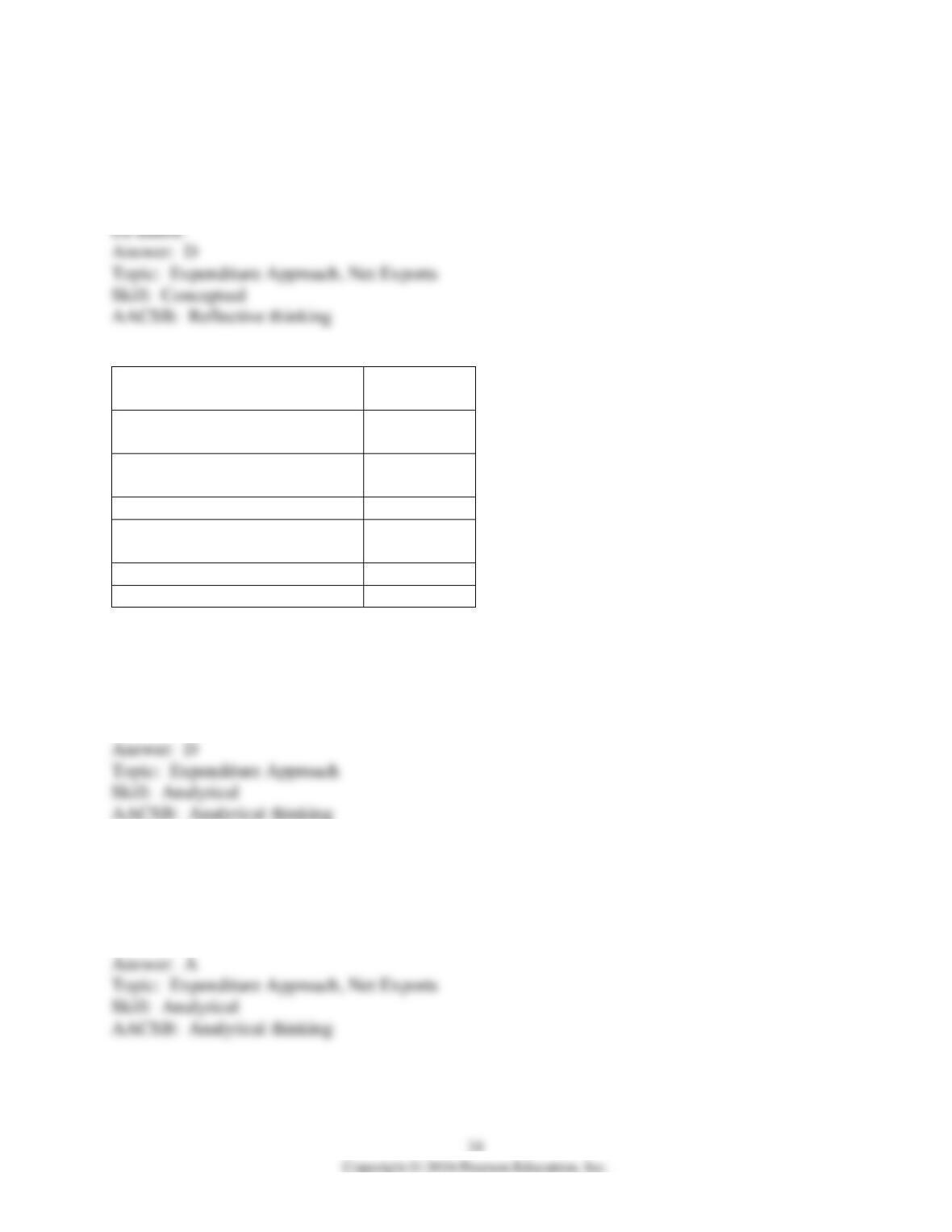
Item
Millions of
dollars
Personal consumption
expenditure
80
Government expenditure on
goods and services
30
Net taxes
35
Gross private domestic
investment
20
Imports of goods and services
10
Exports of goods and services
20
62) Using the information in the table above, calculate the value of GDP.
A) $185 million
B) $145 million
C) $195 million
D) $140 million
63) Use the information in the table above to calculate the value of net exports.
A) $10 million
B) $0
C) -$10 million
D) $30 million
64) Last year in the country of Nerf imports equaled exports. Nerf’s GDP was $500 million, its
consumer expenditure was $380 million, and its investment was $20 million. Nerf’s government
expenditure on goods and services were ________.
A) $100 million
B) $900 million
C) $500 million
D) zero
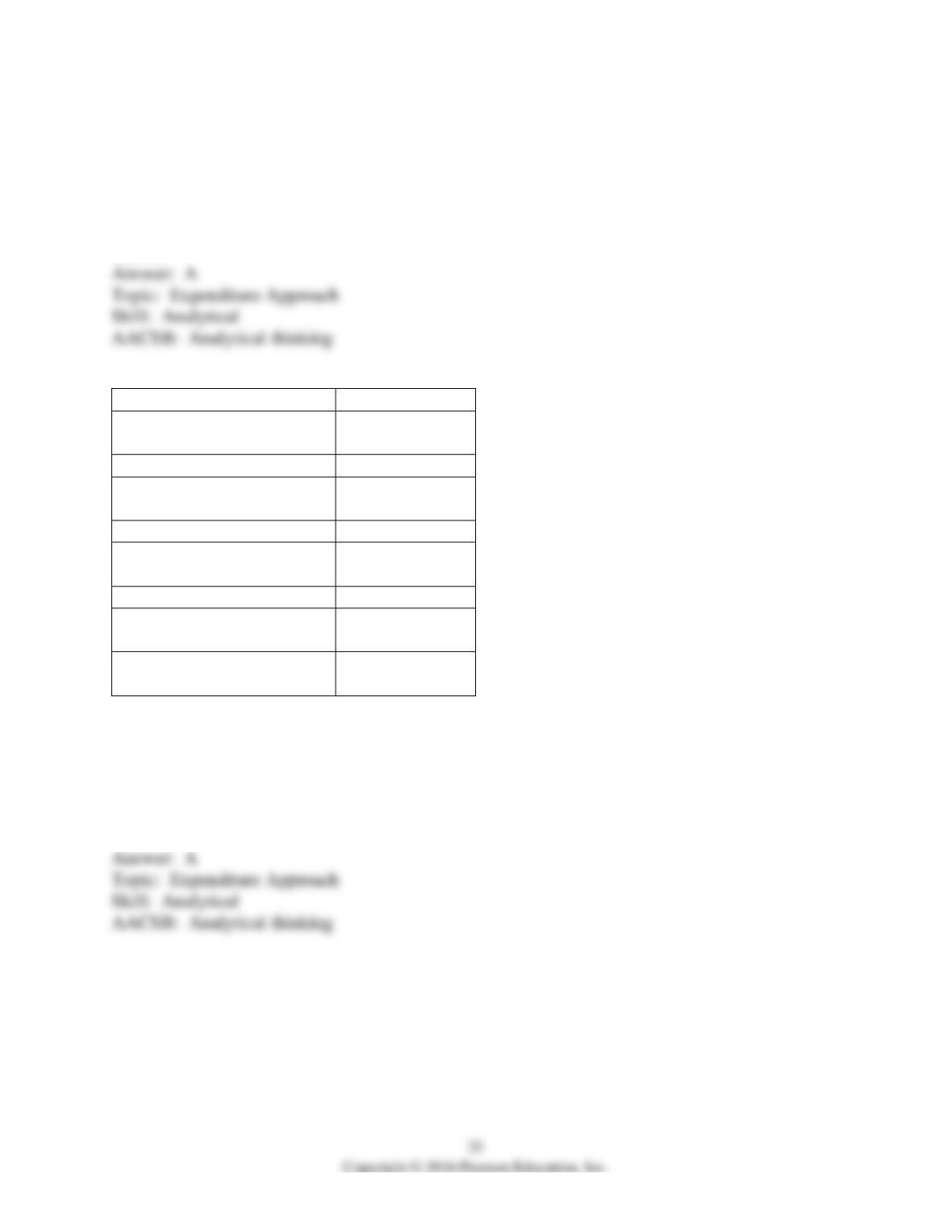
Item
Billions of dollars
Government expenditure on
goods and services
250
Compensation of employees
1,675
Gross private domestic
investment
325
Rental income
20
Personal consumption
expenditures
1425
Net interest
40
Net exports of goods and
services
100
Indirect business taxes and
depreciation
300
65) The above table shows some (but not all) national income accounting data for a hypothetical
country. According to these data, the value of GDP is ________ billion.
A) $2100
B) $1850
C) $2000
D) $2050
36
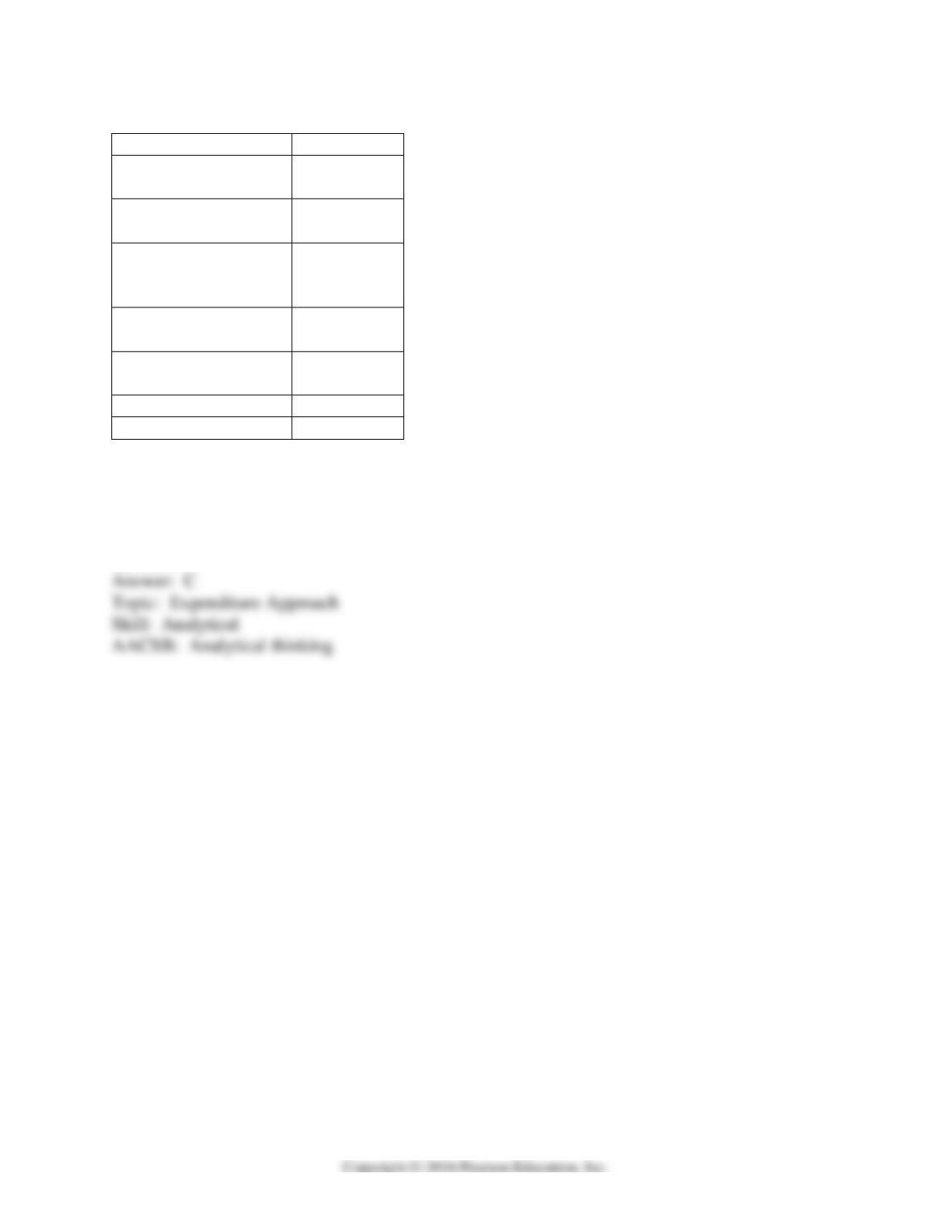
Item
Dollars
Personal consumption
expenditure
1500
Gross private domestic
investment
355
Government
expenditure on goods
and services
590
Exports of goods and
services
70
Imports of goods and
services
50
Depreciation
200
Indirect business taxes
75
66) Based on the data in the above table, gross domestic product equals
A) $2,190.
B) $2,840.
C) $2,465.
D) $2,750.
Item
Billions of dollars
Personal consumption
expenditure
100
Gross private domestic
investment
10
Government expenditure on
goods and services
50
Exports of goods and
services
30
Imports of goods and
services
30
Net taxes
50
67) The above table shows data from the GDP accounts of Hypothetica. Hypothetica’s GDP is
________ billion.
A) $270
B) $210
C) $190
D) $160
68) If imports are $100 million less than exports, government expenditures are $500 million,
consumer expenditures are $1 billion, and gross investment spending is $500 million, then GDP
is
A) $1 billion.
B) $1.9 billion.
C) $2 billion.
D) $2.1 billion.
69) If consumption expenditures are $500 million, net investment is $100 million, depreciation
equals $5 million, imports are $50 million, exports are $55 million, government expenditure on
goods and services is $220 million, and government transfer payments are $20 million, then
GDP is
A) $790 million.
B) $800 million.
C) $830 million.
D) $850 million.
Component
Amount
(billions of
dollars)
Net taxes
1,635
Personal consumption
expenditure
5,566
Depreciation
622
Government expenditure
1,784
Gross investment
1,234
Exports
957
Imports
1,138
Household saving
1,202
70) Using the data in the table above, what is the value of GDP?
A) $13,516 billion
B) $10,679 billion
C) $9,541 billion
D) $8,403 billion
71) Using the data in the above table, what is the value of net exports?
A) -$181 billion
B) $181 billion
C) $957 billion
D) -$957 billion
72) Using the data in the above table, what is the value of national saving?
A) $1,202 billion
B) $2,837 billion
C) $1,053 billion
Component
Amount
(dollars)
Net taxes
10
Personal consumption
expenditure
50
Depreciation
8
Government expenditure
20
Gross investment
26
Net exports
-10
Compensation of
employees
65
73) Using the information in the table above, calculate gross domestic product.
A) $118
B) $108
C) $86
D) $78
74) Using the information in the table above, calculate the government’s budget deficit or
surplus.
A) $2
B) -$4
C) -$10
D) $4
Component
Amount
(billions of
dollars)
Personal consumption
expenditure
3,720
Government
expenditure
430
Gross investment
610
Net investment
520
Exports
650
Imports
720
75) Using the information in the table above, calculate gross domestic product.
A) $5,130 billion
B) $5,320 billion
C) $4,760 billion
D) $4,690 billion
76) Using the information in the table above, net exports equals
A) $1,370 billion.
B) $650 billion.
C) $20 billion.
D) -$70 billion.
77) Using the information in the table above, depreciation equals
A) -$90 billion.
B) $90 billion.
C) -$70 billion.
D) some amount that cannot be determined.