244. If the price of a good is below the equilibrium price,
a.
suppliers will find inventories building; they will cut output and raise prices.
b.
suppliers will find inventories being depleted. They will increase production and raise prices.
c.
the demand curve will shift down until an equilibrium is established at the existing price.
d.
the supply curve will shift up until an equilibrium is established at the existing price.
245. Throughout history, governments have used price controls to
a.
protect buyers.
b.
protect sellers.
c.
serve the “public interest.”
d.
All of the above are correct.
246. Ticket “scalping” is an example of
a.
experimental economics.
b.
the limitation of the volume of transactions.
c.
the development of a black market.
d.
favoritism.
247. The imposition of price ceilings on a market often results in
a.
an increase in investment in the industry.
b.
a persistent surplus in the market.
c.
the diversion of income toward black-market suppliers.
d.
lower prices being offered on the black market.
248. Suppose that in a free market 2,000 patients purchase an operation to receive an artificial heart at a price of $500,000
per operation. Without the heart, each patient will die. The government decides this price is too high and imposes a
maximum price of $200,000. Everything else equal,
a.
more patients will now die.
b.
fewer patients will now die.
c.
more patients will now die only if the demand curve is vertical.
d.
more patients will now die only if the demand curve is horizontal.
249. Normally, to the extent that a governmental control mechanism succeeds in affecting price, it can be expected to lead
to a corresponding
a.
reduction in the volume of sales only if the price is forced down.
b.
reduction in the volume of sales if the price is forced down and an increase in the volume of sales if the price
is forced up.
c.
decrease in the volume of sales whether the price is forced up or down.
d.
increase in the volume of sales whether the price is forced up or down.
250. The major drawback of a price ceiling is
a.
it causes a surplus.
b.
government regulations of this kind are difficult to enforce.
c.
it causes a shortage.
d.
There is no drawback.
251. If the supply curve for housing has the normal positive slope, rent controls will likely
a.
increase the amount of housing.
b.
improve the quality of housing.
c.
aggravate the housing shortage.
d.
help low-income families find suitable housing.
e.
increase the demand for housing.
252. Price ceilings will likely
a.
result in the accumulation of surpluses.
b.
increase the volume of transactions as we move along the demand curve.
c.
increase production as producers respond to higher consumer demand at the low ceiling price.
d.
result in the development of black markets.
253. In relation to prices that would prevail in an uncontrolled market, prices charged by a black market are usually
a.
lower, since it is hard for the sellers to locate buyers.
b.
lower, since it is hard for the buyers to locate sellers.
c.
higher, since black marketers expect compensation for the risk of being caught.
d.
higher, since most people enjoy goods more if they are illegal.
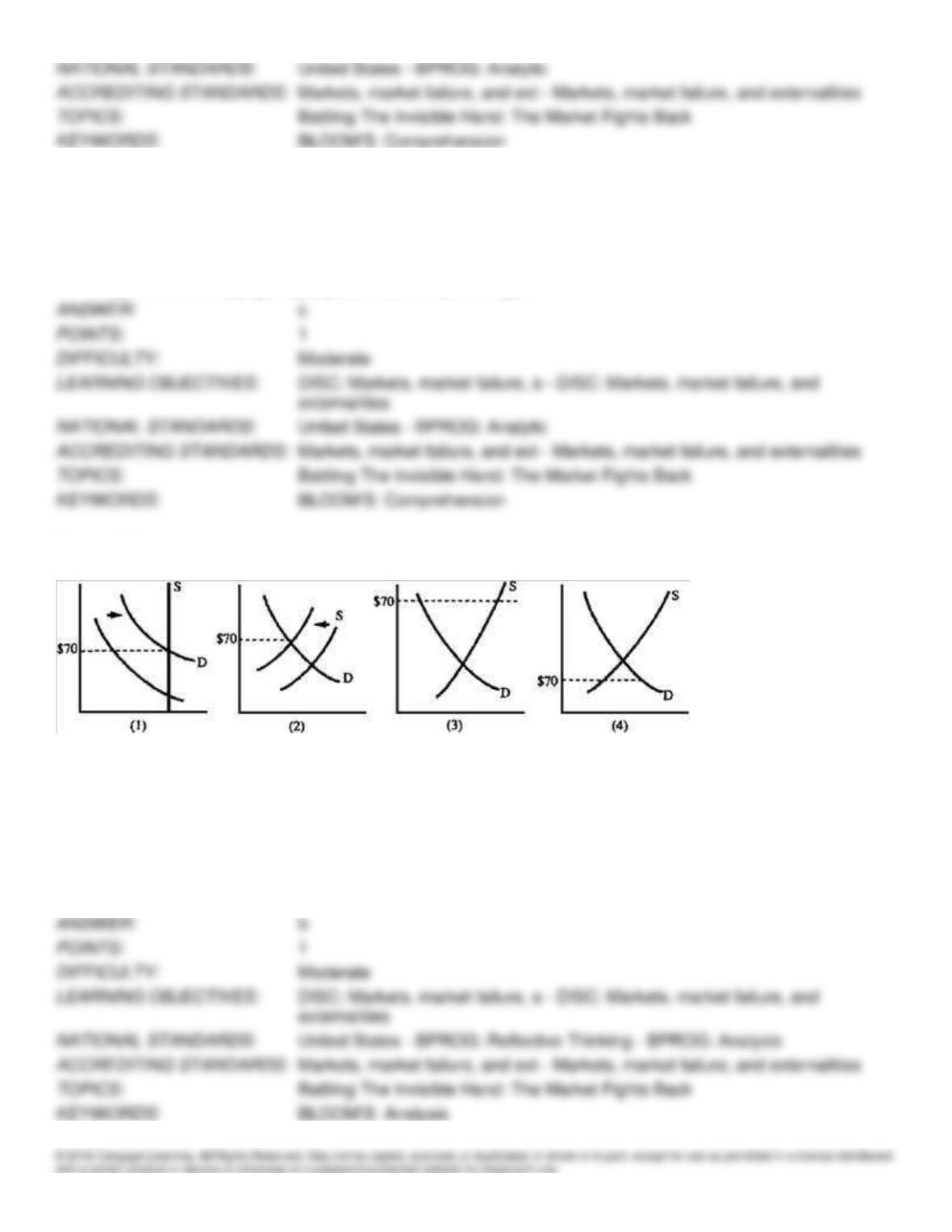
Figure 4-22
254. Because of falling oil prices in the past, Libya could afford fewer imported goods. Government controls were
established to limit imports of cigarettes. In 1985, the market price of Marlboros rose to $70 a carton. Which graph in
Figure 4-22 best depicts this situation?
a.
1
b.
2
c.
3
d.
4
255. Lines, ration coupons, and black markets are symptoms of a
a.
price floor.
b.
price ceiling.
c.
free market.
d.
barter economy.
256. The demand by sterile couples for babies to adopt has grown rapidly, while the supply has dwindled because of
improved contraception, liberal abortion laws, and an increase in the probability that unwed mothers will keep their
children. It violates the law to sell human beings at any age, but for every twenty legal adoptions there seemingly is one
baby sale at a price up to $50,000. The generic term economists apply to the market produced by this type of shortage is
a.
“black market.”
b.
“white slave market.”
c.
“the adoption market.”
d.
“baby market.”
257. In 1989, Hurricane Hugo devastated Charleston, South Carolina, leaving residents with no electricity for light or
refrigeration, and completely cut off from the outside world by fallen trees and washed-out roads. Consequently, the price
of ice rose 1,000 percent and generators 300 percent. Tree removal firms were charging $4,000 to cut up a single tree.
Outraged, the city government enacted an emergency law prohibiting price “gouging.” This law is an example of
a.
the cost disease of services.
b.
a price ceiling.
c.
the laissez-faire rule.
d.
the indispensable necessity syndrome.
258. Which of the following will tend to occur if price controls are imposed on a product?
a.
persistent shortages
b.
illegal markets
c.
illicit channels of distribution
d.
industry investment slows or stops
e.
All of the above are correct.
259. Why do price ceilings tend to cause persistent imbalances in the market?
a.
Quantity demanded exceeds quantity supplied but price cannot rise to remove the shortage.
b.
Quantity demanded exceeds quantity supplied but price cannot fall to remove the surplus.
c.
Quantity supplied exceeds quantity demanded but price cannot rise to remove the shortage.
d.
Quantity supplied exceeds quantity demanded but price cannot fall to remove the surplus.
260. Economists generally recognize that rent controls cause shortages in housing, yet rent controls tend to persist. Why
does this occur?
a.
Many people do not understand the effects that controls cause.
b.
Property owners are politically unpopular.
c.
Many persons tend to benefit from rent controls.
d.
All of the above are correct.
261. How does rent control tend to cause persistent imbalances in the market for housing?
a.
Quantity demanded exceeds quantity supplied but price cannot rise to remove the shortage.
b.
Quantity demanded exceeds quantity supplied but price cannot fall to remove the surplus.
c.
Quantity supplied exceeds quantity demanded but price cannot rise to remove the shortage.
d.
Quantity supplied exceeds quantity demanded but price cannot fall to remove the surplus.
262. The government of Economica announces that it will purchase its farmers’ surplus of milk. From this announcement,
you can infer that Economica has a
a.
free market for milk.
b.
price ceiling above the equilibrium price for milk.
c.
price floor above the equilibrium price for milk.
d.
price floor below the equilibrium price for milk.
263. If the U.S. government starts to sell off its stockpile of cheese,
a.
consumers will be less willing to purchase cheese.
b.
the equilibrium quantity demanded will rise.
c.
farmers will hoard the cheese they produce.
d.
the quantity of cheese that spoils before sale will rise.
Exhibit 4-1
The following are the equations for the supply and demand curves in the market for weezils:
Demand:
Qd = 20 − 2P
Supply:
Qs = 5 + 3P
where Qd is the quantity demanded, Qs is the quantity supplied, and P is the price per weezil in dollars.
264. Refer to Exhibit 4-1. According to the data given, the equilibrium price of a weezil is
a.
$3.
b.
$5.
c.
$11.
d.
$14.
265. Refer to Exhibit 4-1. According to the data given, when the market is in Equilibrium, how many weezils are sold?
a.
3
b.
5
c.
11
d.
14
266. Refer to Exhibit 4-1. If consumers decide that they want 20 percent fewer weezils at every price, the equation for the
new demand curve for weezils will be
a.
Qd = 20 − 1.6P.
b.
Qd = 0.2(20 − 2P).
c.
Qd = 0.8(20 − 2P).
d.
Qd = 80(20 − 2P).
267. Refer to Exhibit 4-1. If the government imposes a price floor of $4 a weezil, how many weezils will be sold?
a.
5
b.
10
c.
12
d.
14
268. To be effective, a price floor must be
a.
above the equilibrium price.
b.
at the equilibrium price.
c.
below the equilibrium price.
d.
anywhere on the graph.
269. The United States typically experiences a large surplus of milk annually. This is caused by
a.
a price ceiling in the market.
b.
not enough demand for milk.
c.
a price floor in the market.
d.
overproduction of milk by the cows.
270. Which of the following is a symptom of a price floor?
a.
scalping of Super Bowl tickets
b.
surplus cheese
c.
the New York city housing shortage
d.
black markets
e.
milk shortages
271. Which of the following is an example of a price floor?
a.
rent controls
b.
maximum prices for gasoline
c.
usury laws that set maximum interest rates
d.
the minimum wage
272. The U.S. government restricts the production of peanuts by limiting production licenses. By also prohibiting imports,
the government maintains prices well above levels peanut farmers would obtain if supply were not restricted. Economists
call this type of program a(n)
a.
price ceiling.
b.
price floor.
c.
opportunity cost.
d.
shortage.
e.
efficiency move.
273. A government policy that prevents the price of a good or service from falling below a specified level is called a price
floor and usually results in
a.
a shortage.
b.
a surplus.
c.
a black market.
d.
fewer producers of the good or service.
e.
a decrease in demand.
274. Which of the following will tend to occur if price floors are imposed on a product?
a.
persistent surpluses
b.
problems of disposal of goods
c.
disguised discounts developing to eliminate excess production
d.
overinvestment in the industry
e.
All of the above are correct.
275. Which of the following is not a symptom associated with a price floor?
a.
Excess of quantity demanded over quantity supplied.
b.
Sellers offering discounts in disguised forms.
c.
Problem of disposal created by excess supply.
d.
Survival of inefficient businesses.
276. In early 1996, Congress proposed an agriculture bill that would gradually reduce price supports for many agricultural
products. If the bill were to be approved, what would most likely happen to the number of families employed in
agriculture?
a.
It would decrease, because agricultural prices would fall.
b.
It would decrease, because agricultural prices would rise.
c.
It would increase, because agricultural prices would fall.
d.
It would increase, because agricultural prices would rise.
277. Who tends to benefit from the sugar price supports?
a.
users of sugar in other products
b.
individual users of sugar
c.
producers of other agricultural products
d.
producers of sugar
e.
All of the above are correct.
278. In a move to free the economy from unnecessary regulation, Congress decides to remove sugar price supports. What
would most likely happen to the number of producers of sugar?
a.
It would decrease, because sugar prices would fall.
b.
It would decrease, because sugar prices would rise.
c.
It would increase, because sugar prices would fall.
d.
It would increase, because sugar prices would rise.
279. The quantity of goods exchanged in a market will be below the equilibrium quantity
a.
when the price is either held above or below the equilibrium price.
b.
only when the price is held above the equilibrium price.
c.
only when the price is held below the equilibrium price.
d.
only when the price is rising.
280. Which of the following suggests that the “laws” of supply and demand are being disobeyed?
a.
outside forces disturbing an equilibrium
b.
persistent shortages or surpluses
c.
the market never moving from an equilibrium
d.
“other things” not always being equal
281. How do legal controls on prices lead to corruption?
a.
Persons who benefit from the controls are willing to bribe officials to keep the controls in place.
b.
Persons who make the laws may favor certain groups at the expense of others.
c.
Selling in the black market is very profitable, and persons therefore willingly break the law.
d.
Discrimination may occur as a means to limit buying or selling select groups.
e.
All of the above are correct.
282. What are the major problems that will tend to arise if there are legal limits on the movement of prices?
a.
favoritism and corruption of officials and market participants
b.
unenforceability of laws and higher costs of transactions
c.
increasing restrictions to enforce the laws
d.
misallocation of resources as prices no longer correspond to costs
e.
All of the above are correct.
283. Legal limits on prices will tend to cause misallocation of resources because
a.
production (or opportunity) cost no longer corresponds to market price.
b.
people are unable to determine their preferences at the high or low price.
c.
producers no longer have incentive to be profitable.
d.
consumers no longer have incentive to spend their income efficiently.
e.
All of the above are correct.