Macroeconomics, 12e (Parkin)
Chapter 4 Measuring GDP and Economic Growth
1 Gross Domestic Product
1) Gross domestic product is the total ________ produced within a country in a given time
period.
A) market value of all final and intermediate goods and services
B) market value of all goods and services
C) amount of final and intermediate goods and services
D) market value of all final goods and services
2) Gross domestic product
A) includes all the goods and none of the services produced in an economy in a given time
period.
B) measures the value of the aggregate production of goods and services in a country during a
given time period.
C) measures the value of labor payments generated in an economy in a given time period.
D) is generally less than federal expenditure in any time period.
3) Gross domestic product is a measure of the total value of all
A) sales in an economy over a period of time.
B) consumer income in an economy over a period of time.
C) capital accumulation in an economy over a period of time.
D) final goods and services produced in an economy over a period of time.
4) Gross domestic product (GDP) is the ________ in a given time period.
A) value of personal consumption expenditures, gross private domestic investment, and federal
government expenditures
B) sum of wage and salary compensation of employees and corporate profits
C) value of all final and intermediate goods and services produced by the economy excluding
those goods exported to foreign nations
D) market value of final goods and services produced by the economy
5) Gross domestic product (GDP) measures the
A) number of final goods and services produced in the economy in a given time period.
B) number of final goods and services sold in the economy in a given time period.
C) market value of old and new final goods and services sold in the economy in a given time
period.
D) market value of final goods and services produced in the economy in a given time period.
6) GDP is defined as the market value of all ________ in a given time period.
A) final goods produced in a country
B) final goods and services produced by citizens of a particular country regardless of where in
the world they are located
C) final goods and services produced in a country by only the citizens of the country
D) final goods and services produced in a country
7) In the definition of GDP, “market value” refers to
A) valuing production in production units.
B) not counting intermediate products.
C) valuing production according to the market price.
D) when the production took place.
8) In the United States, GDP is typically measured
A) monthly.
B) quarterly.
C) daily.
D) weekly.
9) If Nike, an American corporation, produces sneakers in Thailand this would
A) count as part of U.S. GDP since it is a U.S. corporation.
B) count for both Thailand’s GDP and U.S. GDP.
C) add to Thailand’s GDP but not to U.S. GDP.
D) add to neither U.S. GDP nor Thailand’s GDP.
10) If Frito Lay, an American snack company, opens a new manufacturing facility in Mexico and
produces snacks which are distributed in South America, then Mexico’s GDP ________ and U.S.
GDP ________.
A) increases; does not change
B) does not change; increases
C) increases; decreases
D) increases; increases
11) The word “final” in the definition of GDP refers to
A) not counting intermediate goods or services.
B) the time period when production took place.
C) valuing production at market prices.
D) counting the intermediate goods and services used to produce GDP.
12) A loaf of bread purchased by one of your instructors would be best described as
A) an intermediate good.
B) a financial asset.
C) a used good.
D) a final good.
13) Which of the following is a final good?
A) the memory chips in your new smart phone
B) a share of IBM stock
C) flour purchased at the store to bake cookies
D) flour used by the bakery to bake cookies
14) In 2013, Ozzie purchased a 2010 Ford Escort from his neighbor for his son, purchased a
2009 “one owner” Camry from Larchmont Toyota for his wife, bought a 2013 new Ford for
himself, and sold his 2002 Dodge Caravan to his teenage nephew. Which, if any, of these
transactions will be included in GDP in 2013?
A) all four transactions
B) all three purchases but not the sale
C) the purchase of the Ford and the Caravan
D) only the purchase of the Ford
15) Which of the following expenditures associated with the production of a new high-
performance SUV will be directly included in GDP?
A) the sale of bonds to finance the construction of the assembly plant
B) the purchase of used welding robots to assemble to vehicles
C) the purchase of new tires to be installed on the new vehicles
D) the purchase of new machine tools to manufacture the engines
16) Intermediate goods are excluded from GDP because
A) their inclusion would involve double counting.
B) they represent goods that have never been purchased so they cannot be counted.
C) their inclusion would understate GDP.
D) the premise of the question is incorrect because intermediate goods are directly included in
calculating GDP.
17) A ton of coal purchased by your local utility to burn to make electricity would be best
described as
A) an intermediate good.
B) a financial asset.
C) a used good.
D) a final product.
18) Which of the following expenditures is for an intermediate good?
A) The government buys new tires for its military vehicles.
B) A U.S. tire firm sells new tires to Canada.
C) General Motors buys new tires to put on the cars it’s building.
D) You buy new tires for your used car.
19) GDP does not directly include intermediate goods because
A) intermediate goods are not valuable.
B) intermediate goods are not useful to consumers.
C) that would count the intermediate goods twice.
D) that would understate the true size of GDP.
20) The calculation of the final goods and services sold in an economy would NOT include
A) the purchase of a lawnmower by a household.
B) General Motors’ purchases of tires for new automobiles.
C) Ford Motor Company’s purchase of a new industrial robot to be used to produce cars.
D) the purchase of a service by a household.
21) In computing GDP, it is essential to
A) avoid double counting.
B) include government transfer payments.
C) include government tax revenues.
D) count all intermediate products directly as they are produced.
22) Double counting (counting the same thing twice) in GDP accounting is avoided by not
including
A) net exports.
B) intermediate goods.
C) illegal activities.
D) depreciation.
23) GDP counts only final goods and services because this
A) method avoids including any goods that are produced this year and sold next year.
B) method avoids double counting of goods going through several stages of production.
C) amount can be more easily determined in the marketplace.
D) method avoids understating the value of GDP produced during a given year.
24) The circular flow model shows that consumer goods and services produced by business firms
are sold in the
A) goods market.
B) factor market.
C) labor market.
D) financial market.
25) The factor market can best be described as where
A) households buy goods and services.
B) firms buy goods and services.
C) firms buy the services of labor, land and capital.
D) governments sell goods and services.
26) In the circular flow of income
A) households demand goods and services that are supplied by firms, and the firms demand
factors that are supplied by intermediate firms.
B) households demand goods and services that are supplied by firms, while supplying factors
that are demanded by firms.
C) households sell goods and services while firms sell factors.
D) households buy goods and services while firms sell goods and services. Firms obtain labor
from households, capital from government, and raw materials from other firms.
27) The circular flow shows that the household sector earns its income by
A) selling factors of production.
B) buying factors of production.
C) selling goods and services.
D) selling financial assets.
28) The circular flow of income shows that
A) households transact only in the goods market.
B) governments purchase goods and services.
C) firms generally are the demanders in the goods markets and suppliers in the factor markets.
D) None of the above answers is correct.
29) Which of the following is TRUE regarding the circular flow diagram?
I. “Aggregate income” is the flow of income earned by firms.
II. Retained earnings are considered income earned by firms rather than part of households’
income.
III. The government, households, and firms all have transactions in the goods market.
A) I only
B) I and II
C) I and III
D) III only
30) If we compare the four sources of spending in the economy we see that
A) household consumption is the smallest.
B) government expenditure is the largest.
C) business investment is the largest.
D) household consumption is the largest.
31) Compared to the other sources of spending, net exports is
A) large and negative.
B) small and negative.
C) large and positive.
D) small and positive.
32) The circular flow diagram shows that
A) the flow of payments to the factors used to produce goods and services exceeds the flow of
payments for final goods and services.
B) goods and factor markets are independent.
C) the total amount of income generated by the economy equals the total purchases of final
goods and services.
D) consumption expenditure equals saving.
33) The circular flow diagram shows
A) how nominal GDP is distinct from real GDP.
B) how the prices of factors are determined.
C) the effects of inflation in a simple economy.
D) the flows between different sectors of the economy.
34) The circular flow diagram indicates that
A) households sell the services of factors of production to firms.
B) firms buy the services of factors of production from the government.
C) households sell goods and services to the government.
D) firms buy goods and services from households.
35) In the circular flow model of an economy, households
A) receive income from buyers of goods and services.
B) receive income from the sale of factors in the goods markets.
C) pay firms for the use of their factors.
D) receive income from producers for the use of factors in the factor markets.
36) In the circular flow diagram, aggregate expenditure includes the sum of
A) saving and investment.
B) consumption and investment.
C) consumption, investment, and saving.
D) income and saving.
37) In the circular flow of economic activity
A) aggregate expenditure measures the dollar value of purchases of factors.
B) aggregate expenditure measures the dollar value of purchases of final goods and services.
C) aggregate income measures the dollar value of labor resources only.
D) aggregate expenditure is measured as it moves through the financial markets.
38) In the circular flow diagram, aggregate expenditure includes
A) consumption expenditure, saving, investment and government expenditure.
B) consumption expenditure, saving, investment and net exports.
C) consumption expenditure, investment, government expenditure and net exports.
D) consumption expenditure, saving, government expenditure and net exports.
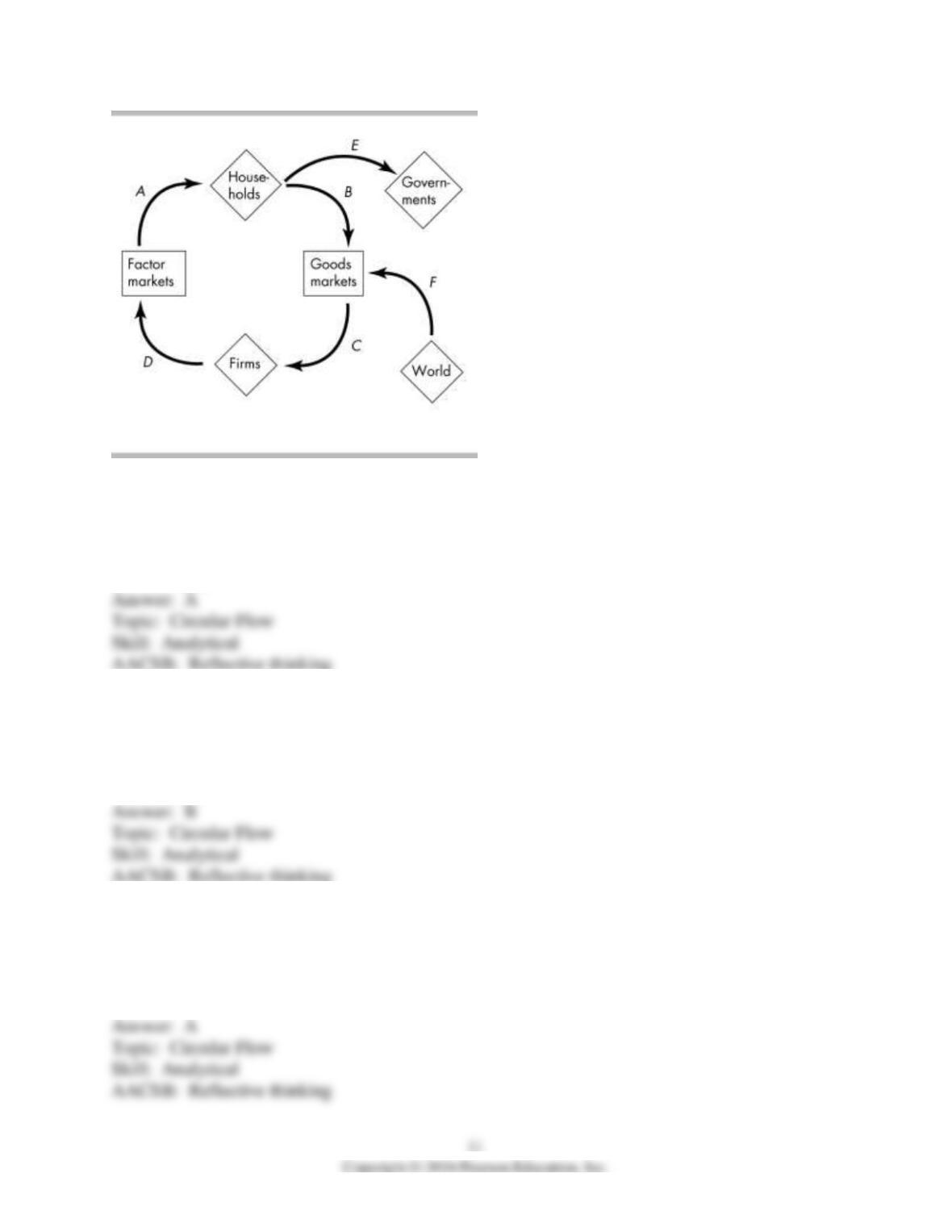
39) In the above figure, flow B represents ________.
A) household purchases of goods and services
B) household borrowing
C) household income
D) firms’ payments for labor services
40) In the above figure, flow B represents households’ ________.
A) income
B) consumption expenditures
C) saving
D) investment
41) In the above figure, household income is shown by flow
A) A.
B) B.
C) C.
D) F.
42) In the above figure, consumption expenditure is shown by flow
A) A.
B) B.
C) C.
D) F.
43) Which of the following are equal to one another?
I. aggregate production
II. aggregate expenditure
III. aggregate income
A) I equals II, but not III.
B) I equals III, but not II.
C) II equals III, but not I.
D) I equals II equals III.
44) Choose the best statement.
A) GDP equals aggregate expenditure and equals aggregate income.
B) An increase in government purchases increases aggregate expenditure but does not change
GDP.
C) An increase in compensation of employees increases aggregate income but does not change
GDP.
D) GDP always equals aggregate expenditure and sometimes equals aggregate income.
45) According to the circular flow diagram, the dollar value of a nation’s output is equal to
A) profits.
B) total income.
C) net income minus taxes.
D) wages.
46) Total output and total income in the circular flow model
A) are measures of the economy’s level of savings.
B) include only intermediate goods.
C) are equal to each other.
D) are related because national income is less than national product.
47) The circular flow shows that
A) aggregate production equals aggregate expenditure.
B) aggregate expenditure is less than aggregate income.
C) GDP equals aggregate income.
D) Both answers A and C are correct.
48) Comparing aggregate expenditure and aggregate incomes shows that
A) aggregate expenditure is usually greater than aggregate income.
B) aggregate income is usually greater than aggregate expenditure.
C) they are equal.
D) aggregate income cannot equal aggregate expenditure if we have any savings.
49) Gross domestic product (GDP) is
A) the value of all final goods and services produced in a country during a year.
B) the sum of consumption expenditure, investment, government expenditure on goods and
services, and net exports.
C) the sum of compensation of employees, proprietors’ income, net interest, rental income,
corporate profits, depreciation, and indirect business taxes minus subsidies.
D) all of the above.
50) Gross domestic product can be calculated
A) either by valuing the nation’s output of goods and services or by valuing the income generated
in the production process.
B) by adding up the personal consumption of all members of the society.
C) by adding up the value of all intermediate goods used in the economy.
D) by adding up the income tax returns of all members of the society.
51) Gross domestic product is the
A) value of the final goods and services produced in a country during a specific time.
B) total amount that buyers spent on the final goods and services produced in a country during a
specific time.
C) total amount of income earned in producing the final goods and services in a country during a
specific time.
D) All of the above answers are correct.
52) Which of the following is CORRECT?
A) Aggregate expenditure equals GDP but is less than aggregate income.
B) Aggregate income is greater than GDP but equal to aggregate expenditure.
C) Aggregate income is greater than aggregate expenditure but equal to GDP.
D) Aggregate income, aggregate expenditure and GDP are all equal.
53) GDP equals
A) C + S + G + (X + M).
B) C + I + G + (X + M).
C) C + I + G + (X – M).
D) C + S + G + (X – M).
54) Depreciation is defined as the
A) decrease in the stock of capital due to wear and tear.
B) increase in the stock of capital due to investment by firms.
C) increase in the stock of capital due to wear and tear.
D) decrease in the stock of capital due to investment by firms.
55) Suppose Mail Boxes Etc. buys a new copier for its store for $1000. A year later, when the
firm wants to upgrade to a new copier, it finds that the old copier is only worth $750. Over the
year the copier was used, ________ has occurred.
A) replacement investment
B) gross investment
C) depreciation
D) net investment
56) Net investment equals
A) capital stock minus depreciation.
B) gross investment minus depreciation.
C) the total quantity of plant, equipment and buildings.
D) gross investment/depreciation.
57) Which of the following relationships is CORRECT?
A) Net Investment = Gross Investment + Depreciation
B) Consumption expenditure = Net Investment – Depreciation
C) Gross Investment = Net Investment + Depreciation
D) Depreciation = Gross Investment – Consumption expenditure
58) Gross investment equals net investment plus
A) capital.
B) capital gains.
C) depreciation.
D) dividends paid to the owners of the company.
59) Gross investment is equal to
A) depreciation minus net investment.
B) net investment plus capital stock.
C) depreciation plus net investment.
D) net investment minus capital stock.
60) Gross investment equals
A) net investment – depreciation + change in inventories.
B) net investment + depreciation.
C) net investment + change in inventories.
D) depreciation + change in inventories.
61) ________ is gross investment minus ________.
A) The capital stock; net investment
B) The capital stock; depreciation
C) Depreciation; replacement investment
D) Net investment; depreciation
62) The difference between gross investment and net investment is
A) the capital stock.
B) depreciation.
C) the real interest rate.
D) equal to saving.
63) If depreciation is less than gross investment, then net investment is
A) positive.
B) negative.
C) zero.
D) This situation could never occur because it is impossible for depreciation to be less than gross
investment.
64) Net investment
A) equals gross investment plus depreciation.
B) is the only measure of investment used to calculate GDP.
C) equals gross investment minus depreciation.
D) is equivalent to the existing capital stock in the economy.
65) Net investment equals
A) gross investment + depreciation.
B) depreciation + addition to inventories.
C) savings – depreciation.
D) gross investment – depreciation.
66) Net investment is the
A) total amount of gross investment minus depreciation.
B) value of software and other network related products.
C) profit or loss in the stock market.
D) value of the depreciated capital multiplied by the changes in the price level.
67) Which of the following is NOT a final good?
A) a new computer sold to an NYU student
B) a new car sold to Avis for use in their fleet of rental cars
C) a purse sold to a foreign visitor
D) a hot dog sold to a spectator at a Chicago Bears football game
68) GDP equals
A) aggregate expenditure.
B) aggregate income.
C) the value of the aggregate production in a country during a given time period.
D) all of the above.
2 Measuring U.S. GDP
1) Two methods of measuring GDP are
A) the income approach and the expenditure approach.
B) the income approach and the receipts approach.
C) the goods approach and the services approach.
D) the saving approach and the investment approach.
2) GDP can be computed as the sum of
A) all sales that have taken place in an economy over a period of time.
B) the total expenditures of consumers and business over a period of time.
C) the total expenditures of consumption, investment, and government expenditure on goods and
services over a period of time.
D) the total expenditures of consumption, investment, government expenditure on goods and
services, and net exports over a period of time.
3) GDP using the expenditure approach equals the sum of personal consumption expenditures
plus
A) gross private investment.
B) gross private investment plus government expenditure on goods and services.
C) gross private investment plus government expenditure on goods and services minus imports
of goods and services.
D) gross private investment plus government expenditure on goods and services plus net exports
of goods and services.
4) The expenditure approach measures GDP by adding
A) compensation of employees, rental income, corporate profits, net interest, and proprietors’
income.
B) compensation of employees, rental income, corporate profits, net interest, proprietors’ income,
subsidies paid by the government, indirect taxes paid, and depreciation.
C) compensation of employees, rental income, corporate profits, net interest, proprietors’ income,
indirect taxes paid, and depreciation and subtracting subsidies paid by the government.
D) consumption expenditure, gross private domestic investment, net exports of goods and
services, and government expenditure on goods and services.
5) The four categories of expenditure used by the expenditure approach method to calculate GDP
are
A) consumption expenditure, taxes, saving and investment.
B) consumption expenditure, investment, net imports and saving.
C) saving, taxes, government expenditure and investment.
D) consumption expenditure, investment, government expenditure and net exports.
6) In the equation, GDP = C + I + G + X – M, G refers to
A) federal government expenditures plus all transfer payments.
B) local, state, and federal government spending for all purposes.
C) the taxes and expenditures of all government units.
D) local, state, and federal government expenditure on goods and services, but does not include
transfer payments.
7) The components of the expenditure approach to measuring GDP include all of the following
EXCEPT
A) net exports.
B) government expenditure on goods and services.
C) investment.
D) the implicit payments for unpaid household work.
8) All of the following are components of the expenditure approach to measuring GDP EXCEPT
A) Shaniq’s purchase of a meal at the Olive Garden in Atlanta.
B) a Senator from Iowa being paid the monthly salary.
C) the army buying new M1 Abram tanks.
D) Ford Motor Company buying new Dell computers for use in its marketing department in
Dearborn, Michigan.