CHAPTER 04—ANALYSIS OF FINANCIAL STATEMENTS
c.
Borrow using short-term debt and use the proceeds to repay debt that has a maturity of more than one year.
d.
Issue new stock, then use some of the proceeds to purchase additional inventory and hold the remainder as
cash.
e.
Use cash to increase inventory holdings.
4-2 Liquidity Ratios
FOFM.BRIG.16.04.02 – Liquidity Ratios
United States – BUSPROG.FOFM.BRIG.16.06 – Reflective thinking
United States – OH – DISC.FOFM.BRIG.16.05 – Financial analysis and cash flows
Current ratio
Bloom’s: Analysis
Multiple Choice: Conceptual
53. Which of the following statements is CORRECT?
a.
A reduction in inventories would have no effect on the current ratio.
b.
An increase in inventories would have no effect on the current ratio.
c.
If a firm increases its sales while holding its inventories constant, then, other things held constant, its inventory
turnover ratio will increase.
d.
A reduction in the inventory turnover ratio will generally lead to an increase in the ROE.
e.
If a firm increases its sales while holding its inventories constant, then, other things held constant, its fixed
assets turnover ratio will decline.
4-3 Asset Management Ratios
FOFM.BRIG.16.04.03 – Asset Management Ratios
United States – BUSPROG.FOFM.BRIG.16.03 – Analytic skills
United States – BUSPROG.FOFM.BRIG.16.06 – Reflective thinking
United States – OH – DISC.FOFM.BRIG.16.05 – Financial analysis and cash flows
Bloom’s: Comprehension
Multiple Choice: Conceptual
54. Companies E and P each reported the same earnings per share (EPS), but Company E’s stock trades at a higher price.
Which of the following statements is CORRECT?
a.
Company E probably has fewer growth opportunities.
b.
Company E is probably judged by investors to be riskier.
c.
Company E must have a higher market-to-book ratio.
d.
Company E must pay a lower dividend.
e.
Company E trades at a higher P/E ratio.
CHAPTER 04—ANALYSIS OF FINANCIAL STATEMENTS
55. Which of the following statements is CORRECT?
a.
Borrowing by using short-term notes payable and then using the proceeds to retire long-term debt is an
example of “window dressing.” Offering discounts to customers who pay with cash rather than buy on credit
and then using the funds that come in quicker to purchase additional inventories is another example of
“window dressing.”
b.
Borrowing on a long-term basis and using the proceeds to retire short-term debt would improve the current
ratio and thus could be considered to be an example of “window dressing.”
c.
Offering discounts to customers who pay with cash rather than buy on credit and then using the funds that
come in quicker to purchase fixed assets is an example of “window dressing.”
d.
Using some of the firm’s cash to reduce long-term debt is an example of “window dressing.”
e.
“Window dressing” is any action that does not improve a firm’s fundamental long-run position and thus
increases its intrinsic value.
FOFM.BRIG.16.04.10 – Uses and Limitations of Ratios
United States – BUSPROG.FOFM.BRIG.16.03 – Analytic skills
United States – BUSPROG.FOFM.BRIG.16.06 – Reflective thinking
United States – OH – DISC.FOFM.BRIG.16.05 – Financial analysis and cash flows
Window dressing
Bloom’s: Comprehension
Multiple Choice: Conceptual
56. Casey Communications recently issued new common stock and used the proceeds to pay off some of its short-term
notes payable. This action had no effect on the company’s total assets or operating income. Which of the following effects
would occur as a result of this action?
a.
The company’s current ratio increased.
b.
The company’s times interest earned ratio decreased.
c.
The company’s basic earning power ratio increased.
d.
The company’s equity multiplier increased.
e.
The company’s total debt to total capital ratio increased.
4-6 Market Value Ratios
FOFM.BRIG.16.04.06 – Market Value Ratios
United States – BUSPROG.FOFM.BRIG.16.03 – Analytic skills
United States – BUSPROG.FOFM.BRIG.16.06 – Reflective thinking
United States – OH – DISC.FOFM.BRIG.16.05 – Financial analysis and cash flows
Financial statement analysis
Bloom’s: Analysis
Multiple Choice: Conceptual
CHAPTER 04—ANALYSIS OF FINANCIAL STATEMENTS
57. A firm’s new president wants to strengthen the company’s financial position. Which of the following actions would
make it financially stronger?
a.
Increase accounts receivable while holding sales constant.
b.
Increase EBIT while holding sales and assets constant.
c.
Increase accounts payable while holding sales constant.
d.
Increase notes payable while holding sales constant.
e.
Increase inventories while holding sales constant.
FOFM.BRIG.16.04.00 – Comprehensive
Miscellaneous ratios
Bloom’s: Application
Multiple Choice: Conceptual
58. If the CEO of a large, diversified, firm were filling out a fitness report on a division manager (i.e., “grading” the
manager), which of the following situations would be likely to cause the manager to receive a better grade? In all cases,
assume that other things are held constant.
a.
The division’s basic earning power ratio is above the average of other firms in its industry.
b.
The division’s total assets turnover ratio is below the average for other firms in its industry.
c.
The division’s total debt to total capital ratio is above the average for other firms in the industry.
d.
The division’s inventory turnover is 6×, whereas the average for its competitors is 8×.
e.
The division’s DSO (days’ sales outstanding) is 40 days, whereas the average for its competitors is 30 days.
FOFM.BRIG.16.04.00 – Comprehensive
United States – OH – DISC.FOFM.BRIG.16.05 – Financial analysis and cash flows
Miscellaneous ratios
FOFM.BRIG.16.04.00 – Comprehensive
United States – OH – DISC.FOFM.BRIG.16.05 – Financial analysis and cash flows
Miscellaneous ratios
Bloom’s: Application
Multiple Choice: Conceptual
CHAPTER 04—ANALYSIS OF FINANCIAL STATEMENTS
59. Which of the following would indicate an improvement in a company’s financial position, holding other things
constant?
a.
The inventory and total assets turnover ratios both decline.
b.
The total debt to total capital ratio increases.
c.
The profit margin declines.
d.
The times-interest-earned ratio declines.
e.
The current and quick ratios both increase.
FOFM.BRIG.16.04.00 – Comprehensive
United States – BUSPROG.FOFM.BRIG.16.06 – Reflective thinking
United States – OH – DISC.FOFM.BRIG.16.05 – Financial analysis and cash flows
Miscellaneous ratios
Bloom’s: Application
Multiple Choice: Conceptual
60. If a bank loan officer were considering a company’s loan request, which of the following statements would you
consider to be CORRECT?
a.
The lower the company’s inventory turnover ratio, other things held constant, the lower the interest rate the
bank would charge the firm.
b.
Other things held constant, the higher the days sales outstanding ratio, the lower the interest rate the bank
would charge.
c.
Other things held constant, the lower the total debt to total capital ratio, the lower the interest rate the bank
would charge.
d.
The lower the company’s TIE ratio, other things held constant, the lower the interest rate the bank would
charge.
e.
Other things held constant, the lower the current ratio, the lower the interest rate the bank would charge the
firm.
FOFM.BRIG.16.04.00 – Comprehensive
United States – BUSPROG.FOFM.BRIG.16.03 – Analytic skills
United States – BUSPROG.FOFM.BRIG.16.06 – Reflective thinking
United States – OH – DISC.FOFM.BRIG.16.05 – Financial analysis and cash flows
Bloom’s: Application
Multiple Choice: Conceptual
Bloom’s: Application
Multiple Choice: Conceptual
CHAPTER 04—ANALYSIS OF FINANCIAL STATEMENTS
61. Which of the following statements is CORRECT?
a.
The use of debt financing will tend to lower the basic earning power ratio, other things held constant.
b.
A firm that employs financial leverage will have a higher equity multiplier than an otherwise identical firm
that has no debt in its capital structure.
c.
If two firms have identical sales, interest rates paid, operating costs, and assets, but differ in the way they are
financed, the firm with less debt will generally have the higher expected ROE.
d.
The numerator used in the TIE ratio is earnings before taxes (EBT). EBT is used because interest is paid with
post-tax dollars, so the firm’s ability to pay current interest is affected by taxes.
e.
All else equal, increasing the total debt to total capital ratio will increase the ROA.
FOFM.BRIG.16.04.00 – Comprehensive
United States – BUSPROG.FOFM.BRIG.16.03 – Analytic skills
United States – BUSPROG.FOFM.BRIG.16.06 – Reflective thinking
United States – OH – DISC.FOFM.BRIG.16.05 – Financial analysis and cash flows
Leverage effects
Bloom’s: Comprehension
62. A firm wants to strengthen its financial position. Which of the following actions would increase its quick ratio?
a.
Offer price reductions along with generous credit terms that would (1) enable the firm to sell some of its
excess inventory and (2) lead to an increase in accounts receivable.
b.
Issue new common stock and use the proceeds to increase inventories.
c.
Speed up the collection of receivables and use the cash generated to increase inventories.
d.
Use some of its cash to purchase additional inventories.
e.
Issue new common stock and use the proceeds to acquire additional fixed assets.
4-2 Liquidity Ratios
FOFM.BRIG.16.04.02 – Liquidity Ratios
United States – BUSPROG.FOFM.BRIG.16.03 – Analytic skills
United States – BUSPROG.FOFM.BRIG.16.06 – Reflective thinking
United States – OH – DISC.FOFM.BRIG.16.05 – Financial analysis and cash flows
Quick ratio
Bloom’s: Application
63. Amram Company’s current ratio is 2.0. Considered alone, which of the following actions would lower the current
ratio?
a.
Borrow using short-term notes payable and use the proceeds to reduce accruals.
b.
Borrow using short-term notes payable and use the proceeds to reduce long-term debt.
c.
Use cash to reduce accruals.
CHAPTER 04—ANALYSIS OF FINANCIAL STATEMENTS
d.
Use cash to reduce short-term notes payable.
e.
Use cash to reduce accounts payable.
4-2 Liquidity Ratios
FOFM.BRIG.16.04.02 – Liquidity Ratios
United States – BUSPROG.FOFM.BRIG.16.03 – Analytic skills
United States – BUSPROG.FOFM.BRIG.16.06 – Reflective thinking
United States – OH – DISC.FOFM.BRIG.16.05 – Financial analysis and cash flows
Current ratio
Bloom’s: Application
Multiple Choice: Conceptual
64. Which of the following statements is CORRECT?
a.
If a security analyst saw that a firm’s days’ sales outstanding (DSO) was higher than the industry average, and
was increasing and trending still higher, this would be interpreted as a sign of strength.
b.
A high average DSO indicates that none of its customers are paying on time. In addition, it makes no sense to
evaluate the firm’s DSO with the firm’s credit terms.
c.
There is no relationship between the days’ sales outstanding (DSO) and the average collection period (ACP).
These ratios measure entirely different things.
d.
A reduction in accounts receivable would have no effect on the current ratio, but it would lead to an increase
in the quick ratio.
e.
If a firm increases its sales while holding its accounts receivable constant, then, other things held constant, its
days’ sales outstanding will decline.
4-3 Asset Management Ratios
FOFM.BRIG.16.04.03 – Asset Management Ratios
United States – BUSPROG.FOFM.BRIG.16.03 – Analytic skills
United States – BUSPROG.FOFM.BRIG.16.06 – Reflective thinking
United States – OH – DISC.FOFM.BRIG.16.05 – Financial analysis and cash flows
Accounts receivable
Bloom’s: Analysis
Multiple Choice: Conceptual
65. Which of the following statements is CORRECT?
CHAPTER 04—ANALYSIS OF FINANCIAL STATEMENTS
a.
If one firm has a higher total debt to total capital ratio than another, we can be certain that the firm with the
higher total debt to total capital ratio will have the lower TIE ratio, as that ratio depends entirely on the amount
of debt a firm uses.
b.
A firm’s use of debt will have no effect on its profit margin.
c.
If two firms differ only in their use of debt—i.e., they have identical assets, identical total invested capital,
sales, operating costs, interest rates on their debt, and tax rates—but one firm has a higher total debt to total
capital ratio, the firm that uses more debt will have a lower profit margin on sales and a lower return on assets.
d.
The total debt to total capital ratio as it is generally calculated makes an adjustment for the use of assets leased
under operating leases, so the debt ratios of firms that lease different percentages of their assets are still
comparable.
e.
If two firms differ only in their use of debt—i.e., they have identical assets, identical total invested capital,
operating costs, and tax rates—but one firm has a higher total debt to total capital ratio, the firm that uses more
debt will have a higher operating margin and return on assets.
c
MODERATE
4-4 Debt Management Ratios
FOFM.BRIG.16.04.04 – Debt Management Ratios
United States – BUSPROG.FOFM.BRIG.16.06 – Reflective thinking
United States – OH – DISC.FOFM.BRIG.16.05 – Financial analysis and cash flows
Debt management
Bloom’s: Analysis
Multiple Choice: Conceptual
66. Which of the following statements is CORRECT?
a.
If Firms X and Y have the same P/E ratios, then their market-to–book ratios must also be equal.
b.
If Firms X and Y have the same net income, number of shares outstanding, and price per share, then their P/E
ratios must also be the same.
c.
If Firms X and Y have the same earnings per share and market-to–book ratio, they must have the same
price/earnings ratio.
d.
If Firm X’s P/E ratio exceeds that of Firm Y, then Y is likely to be less risky and/or be expected to grow at a
faster rate.
e.
If Firms X and Y have the same net income, number of shares outstanding, and price per share, then their
market-to–book ratios must also be the same.
MODERATE
4-6 Market Value Ratios
FOFM.BRIG.16.04.06 – Market Value Ratios
CHAPTER 04—ANALYSIS OF FINANCIAL STATEMENTS
67. Which of the following statements is CORRECT?
a.
Suppose a firm’s total assets turnover ratio falls from 1.0 to 0.9, but at the same time its profit margin rises
from 9% to 10%, and its debt increases from 40% of total assets to 60%. The firm finances using only debt
and common equity and total assets equal total invested capital. Under these conditions, the ROE will
increase.
b.
Suppose a firm’s total assets turnover ratio falls from 1.0 to 0.9, but at the same time its profit margin rises
from 9% to 10% and its debt increases from 40% of total assets to 60%. The firm finances using only debt and
common equity and total assets equal total invested capital. Without additional information, we cannot tell
what will happen to the ROE.
c.
The DuPont equation provides information about how operations affect the ROE, but the equation does not
include the effects of debt on the ROE.
d.
Other things held constant, an increase in the total debt to total capital ratio will result in an increase in the
profit margin.
e.
Suppose a firm’s total assets turnover ratio falls from 1.0 to 0.9, but at the same time its profit margin rises
from 9% to 10%, and its debt increases from 40% of total assets to 60%. The firm finances using only debt
and common equity and total assets equal total invested capital. Under these conditions, the ROE will
decrease.
a
MODERATE
United States – BUSPROG.FOFM.BRIG.16.03 – Analytic skills
United States – BUSPROG.FOFM.BRIG.16.06 – Reflective thinking
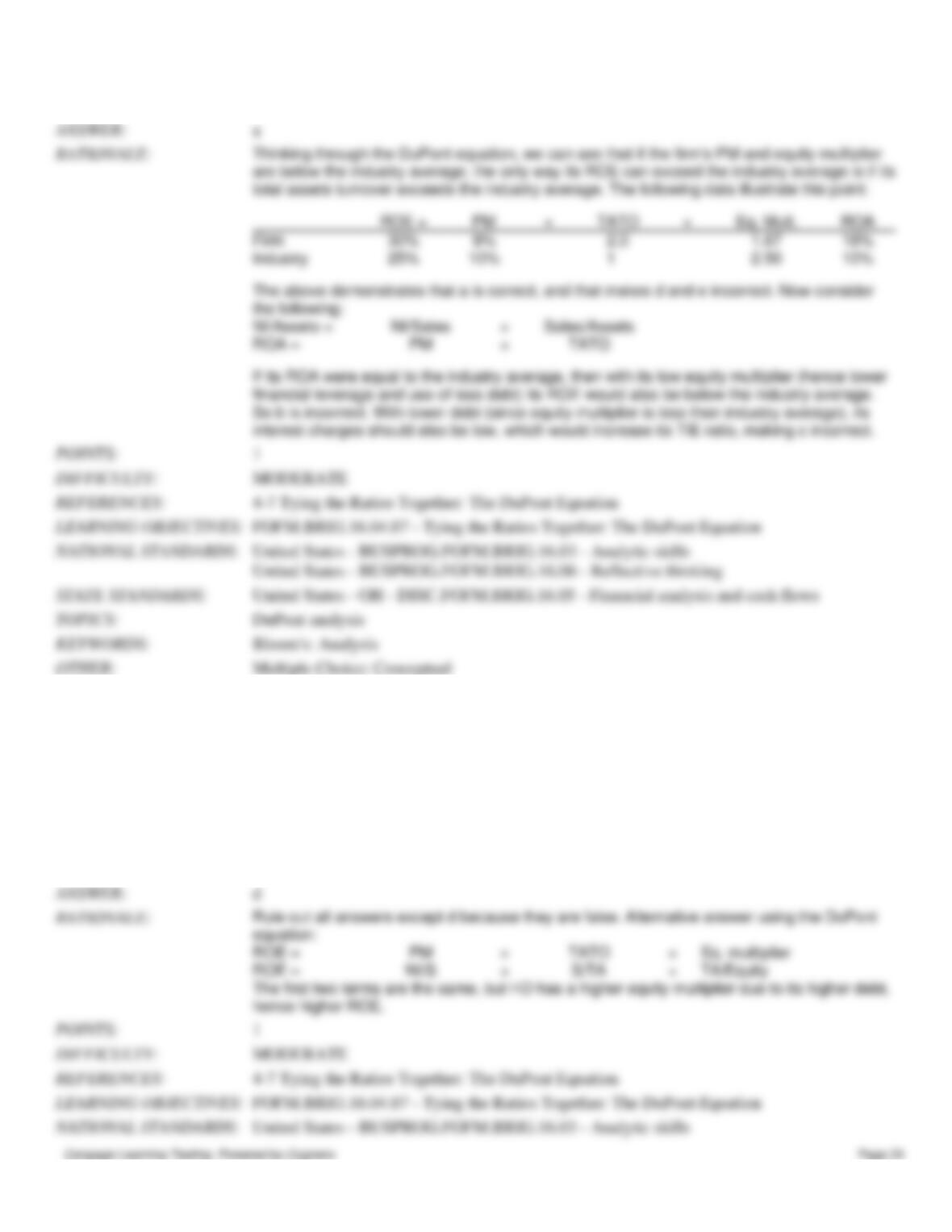
68. You observe that a firm’s ROE is above the industry average, but both its profit margin and equity multiplier are below
the industry average. Which of the following statements is CORRECT?
a.
Its total assets turnover must be above the industry average.
b.
Its return on assets must equal the industry average.
c.
Its TIE ratio must be below the industry average.
d.
Its total assets turnover must be below the industry average.
United States – BUSPROG.FOFM.BRIG.16.03 – Analytic skills
United States – BUSPROG.FOFM.BRIG.16.06 – Reflective thinking
CHAPTER 04—ANALYSIS OF FINANCIAL STATEMENTS
e.
Its total assets turnover must equal the industry average.
4-7 Tying the Ratios Together: The DuPont Equation
FOFM.BRIG.16.04.07 – Tying the Ratios Together: The DuPont Equation
United States – OH – DISC.FOFM.BRIG.16.05 – Financial analysis and cash flows
DuPont analysis
Multiple Choice: Conceptual
69. Companies HD and LD are both profitable, and they have the same total assets (TA), total invested capital, sales (S),
return on assets (ROA), and profit margin (PM). Both firms finance using only debt and common equity. However,
Company HD has the higher total debt to total capital ratio. Which of the following statements is CORRECT?
a.
Company HD has a lower total assets turnover than Company LD.
b.
Company HD has a lower equity multiplier than Company LD.
c.
Company HD has a higher fixed assets turnover than Company LD.
d.
Company HD has a higher ROE than Company LD.
e.
Company HD has a lower operating income (EBIT) than Company LD.
4-7 Tying the Ratios Together: The DuPont Equation
FOFM.BRIG.16.04.07 – Tying the Ratios Together: The DuPont Equation
United States – BUSPROG.FOFM.BRIG.16.03 – Analytic skills
CHAPTER 04—ANALYSIS OF FINANCIAL STATEMENTS
70. Taggart Technologies is considering issuing new common stock and using the proceeds to reduce its outstanding debt.
The stock issue would have no effect on total assets, the interest rate Taggart pays, EBIT, or the tax rate. Which of the
following is likely to occur if the company goes ahead with the stock issue?
a.
The ROA will decline.
b.
Taxable income will decline.
c.
The tax bill will increase.
d.
Net income will decrease.
e.
The times-interest-earned ratio will decrease.
FOFM.BRIG.16.04.00 – Comprehensive
United States – BUSPROG.FOFM.BRIG.16.03 – Analytic skills
United States – OH – DISC.FOFM.BRIG.16.05 – Financial analysis and cash flows
Financial statement analysis
Bloom’s: Analysis
Multiple Choice: Conceptual
71. Which of the following statements is CORRECT?
a.
The ratio of long-term debt to total capital is more likely to experience seasonal fluctuations than is either the
DSO or the inventory turnover ratio.
b.
If two firms have the same ROA, the firm with the most debt can be expected to have the lower ROE.
c.
An increase in the DSO, other things held constant, could be expected to increase the total assets turnover
ratio.
d.
An increase in the DSO, other things held constant, could be expected to increase the ROE.
e.
An increase in a firm’s total debt to total capital ratio, with no changes in its sales or operating costs, could be
expected to lower its profit margin.
United States – BUSPROG.FOFM.BRIG.16.06 – Reflective thinking
United States – OH – DISC.FOFM.BRIG.16.05 – Financial analysis and cash flows
DuPont analysis
Bloom’s: Analysis
Multiple Choice: Conceptual
CHAPTER 04—ANALYSIS OF FINANCIAL STATEMENTS
72. HD Corp and LD Corp have identical assets, sales, interest rates paid on their debt, tax rates, and EBIT. Both firms
finance using only debt and common equity and total assets equal total invested capital. However, HD uses more debt
than LD. Which of the following statements is CORRECT?
a.
Without more information, we cannot tell if HD or LD would have a higher or lower net income.
b.
HD would have the lower equity multiplier for use in the DuPont equation.
c.
HD would have to pay more in income taxes.
d.
HD would have the lower net income as shown on the income statement.
e.
HD would have the higher operating margin.
United States – OH – DISC.FOFM.BRIG.16.05 – Financial analysis and cash flows
Financial statement analysis
Bloom’s: Analysis
Multiple Choice: Conceptual
73. Companies HD and LD have the same sales, tax rate, interest rate on their debt, total assets, and basic earning power.
Both firms finance using only debt and common equity and total assets equal total invested capital. Both companies have
positive net incomes. Company HD has a higher total debt to total capital ratio and, therefore, a higher interest expense.
Which of the following statements is CORRECT?
a.
Company HD pays less in taxes.
b.
Company HD has a lower equity multiplier.
c.
Company HD has a higher ROA.
d.
Company HD has a higher times-interest-earned (TIE) ratio.
e.
Company HD has more net income.
FOFM.BRIG.16.04.00 – Comprehensive
United States – OH – DISC.FOFM.BRIG.16.05 – Financial analysis and cash flows
Financial statement analysis
Bloom’s: Analysis
Multiple Choice: Conceptual
CHAPTER 04—ANALYSIS OF FINANCIAL STATEMENTS
74. Companies HD and LD have the same tax rate, sales, total assets, and basic earning power. Both companies have
positive net incomes. Both firms finance using only debt and common equity and total assets equal total invested capital.
Company HD has a higher total debt to total invested capital ratio and, therefore, a higher interest expense. Which of the
following statements is CORRECT?
a.
Company HD has a lower equity multiplier.
b.
Company HD has more net income.
c.
Company HD pays more in taxes.
d.
Company HD has a lower ROE.
e.
Company HD has a lower times-interest-earned (TIE) ratio.
FOFM.BRIG.16.04.00 – Comprehensive
United States – BUSPROG.FOFM.BRIG.16.06 – Reflective thinking
United States – OH – DISC.FOFM.BRIG.16.05 – Financial analysis and cash flows
Leverage, taxes, ratios
Bloom’s: Analysis
Multiple Choice: Conceptual
75. Which of the following statements is CORRECT?
a.
If a firm has high current and quick ratios, this always indicate that the firm is managing its liquidity position
well.
b.
If a firm sold some inventory for cash and left the funds in its bank account, its current ratio would probably
not change much, but its quick ratio would decline.
c.
If a firm sold some inventory on credit, its current ratio would probably not change much, but its quick ratio
would decline.
d.
If a firm sold some inventory on credit as opposed to cash, there is no reason to think that either its current or
quick ratio would change.
e.
The inventory turnover ratio and days sales outstanding (DSO) are two ratios that are used to assess how
FOFM.BRIG.16.04.00 – Comprehensive
United States – OH – DISC.FOFM.BRIG.16.05 – Financial analysis and cash flows
Leverage, taxes, ratios
Bloom’s: Analysis
Multiple Choice: Conceptual
CHAPTER 04—ANALYSIS OF FINANCIAL STATEMENTS
effectively a firm is managing its current assets.
e
MODERATE
Comprehensive
FOFM.BRIG.16.04.00 – Comprehensive
United States – BUSPROG.FOFM.BRIG.16.03 – Analytic skills
United States – OH – DISC.FOFM.BRIG.16.05 – Financial analysis and cash flows
Various ratios
Bloom’s: Analysis
Multiple Choice: Conceptual
76. Which of the following statements is CORRECT?
a.
A decline in a firm’s inventory turnover ratio suggests that it is improving both its inventory management and
its liquidity position, i.e., that it is becoming more liquid.
b.
In general, it’s better to have a low inventory turnover ratio than a high one, as a low one indicates that the firm
has an adequate stock of inventory relative to sales and thus will not lose sales as a result of running out of
stock.
c.
If a firm’s fixed assets turnover ratio is significantly lower than its industry average, this could indicate that it
uses its fixed assets very efficiently or is operating at over capacity and should probably add fixed assets.
d.
The more conservative a firm’s management is, the higher its total debt to total capital ratio is likely to be.
e.
The days sales outstanding ratio tells us how long it takes, on average, to collect after a sale is made. The DSO
can be compared with the firm’s credit terms to get an idea of whether customers are paying on time.
e
MODERATE
Comprehensive
FOFM.BRIG.16.04.00 – Comprehensive
United States – BUSPROG.FOFM.BRIG.16.03 – Analytic skills
United States – BUSPROG.FOFM.BRIG.16.06 – Reflective thinking
United States – OH – DISC.FOFM.BRIG.16.05 – Financial analysis and cash flows
Various ratios
Bloom’s: Analysis
Multiple Choice: Conceptual
77. Which of the following statements is CORRECT?
a.
Other things held constant, the more debt a firm uses, the higher its operating margin will be.
b.
Debt management ratios show the extent to which a firm’s managers are attempting to magnify returns on
owners’ capital through the use of financial leverage.
c.
Other things held constant, the more debt a firm uses, the higher its profit margin will be.
d.
Other things held constant, the higher a firm’s total debt to total capital ratio, the higher its TIE ratio will be.
e.
Debt management ratios show the extent to which a firm’s managers are attempting to reduce risk through the
use of financial leverage. The higher the total debt to total capital ratio, the lower the risk.
CHAPTER 04—ANALYSIS OF FINANCIAL STATEMENTS
78. Which of the following statements is CORRECT?
a.
Other things held constant, the less debt a firm uses, the lower its return on total assets will be.
b.
The advantage of the basic earning power ratio (BEP) over the return on total assets for judging a company’s
operating efficiency is that the BEP does not reflect the effects of debt and taxes.
c.
The return on common equity (ROE) is generally regarded as being less significant, from a stockholder’s
viewpoint, than the return on total assets (ROA).
d.
The price/earnings (P/E) ratio tells us how much investors are willing to pay for a dollar of current earnings. In
general, investors regard companies with higher P/E ratios as being more risky and/or less likely to enjoy
higher future growth.
e.
Suppose you are analyzing two firms in the same industry. Firm A has a profit margin of 10% versus a margin
of 8% for Firm B. Firm A’s total debt to total capital ratio is 70% versus 20% for Firm B. Based only on
these two facts, you cannot reach a conclusion as to which firm is better managed, because the difference in
debt, not better management, could be the cause of Firm A’s higher profit margin.
FOFM.BRIG.16.04.00 – Comprehensive
United States – BUSPROG.FOFM.BRIG.16.03 – Analytic skills
United States – BUSPROG.FOFM.BRIG.16.06 – Reflective thinking
United States – OH – DISC.FOFM.BRIG.16.05 – Financial analysis and cash flows
Various ratios
Bloom’s: Analysis
Multiple Choice: Conceptual
79. Which of the following statements is CORRECT?
a.
In general, if investors regard a company as being relatively risky and/or having relatively poor growth
prospects, then it will have relatively high P/E and M/B ratios.
b.
The basic earning power ratio (BEP) reflects the earning power of a firm’s assets after giving consideration to
financial leverage and tax effects.
c.
The “apparent,” but not necessarily the “true,” financial position of a company whose sales are seasonal can
change dramatically during a given year, depending on the time of year when the financial statements are
constructed.
d.
The market/book (M/B) ratio tells us how much investors are willing to pay for a dollar of accounting book
value. In general, investors regard companies with higher M/B ratios as being more risky and/or less likely to
FOFM.BRIG.16.04.00 – Comprehensive
United States – OH – DISC.FOFM.BRIG.16.05 – Financial analysis and cash flows
Various ratios
Bloom’s: Analysis
Multiple Choice: Conceptual
CHAPTER 04—ANALYSIS OF FINANCIAL STATEMENTS
enjoy higher future growth.
e.
It is appropriate to use the fixed assets turnover ratio to appraise firms’ effectiveness in managing their fixed
assets if and only if all the firms being compared have the same proportion of fixed assets to total assets.
FOFM.BRIG.16.04.00 – Comprehensive
United States – BUSPROG.FOFM.BRIG.16.06 – Reflective thinking
United States – OH – DISC.FOFM.BRIG.16.05 – Financial analysis and cash flows
Various ratios
Bloom’s: Analysis
Multiple Choice: Conceptual
80. Walter Industries’ current ratio is 0.5. Considered alone, which of the following actions would increase the company’s
current ratio?
a.
Borrow using short-term notes payable and use the cash to increase inventories.
b.
Use cash to reduce accruals.
c.
Use cash to reduce accounts payable.
d.
Use cash to reduce short-term notes payable.
e.
Use cash to reduce long-term bonds outstanding.
4-2 Liquidity Ratios
FOFM.BRIG.16.04.02 – Liquidity Ratios
United States – BUSPROG.FOFM.BRIG.16.06 – Reflective thinking
United States – OH – DISC.FOFM.BRIG.16.05 – Financial analysis and cash flows
Current ratio
Bloom’s: Comprehension
Multiple Choice: Conceptual
81. Safeco’s current assets total to $20 million versus $10 million of current liabilities, while Risco’s current assets are $10
million versus $20 million of current liabilities. Both firms would like to “window dress” their end-of-year financial
CHAPTER 04—ANALYSIS OF FINANCIAL STATEMENTS
statements, and to do so they tentatively plan to borrow $10 million on a short-term basis and to then hold the borrowed
funds in their cash accounts. Which of the statements below best describes the results of these transactions?
a.
The transactions would improve Safeco’s financial strength as measured by its current ratio but lower Risco’s
current ratio.
b.
The transactions would lower Safeco’s financial strength as measured by its current ratio but raise Risco’s
current ratio.
c.
The transactions would have no effect on the firm’ financial strength as measured by their current ratios.
d.
The transactions would lower both firm’ financial strength as measured by their current ratios.
e.
The transactions would improve both firms’ financial strength as measured by their current ratios.
4-2 Liquidity Ratios
FOFM.BRIG.16.04.02 – Liquidity Ratios
United States – BUSPROG.FOFM.BRIG.16.03 – Analytic skills
United States – OH – DISC.FOFM.BRIG.16.05 – Financial analysis and cash flows
Current ratio
Bloom’s: Analysis
Multiple Choice: Conceptual
82. Companies HD and LD have the same total assets, sales, operating costs, and tax rates, and they pay the same interest
rate on their debt. Both firms finance using only debt and common equity and total assets equal total invested capital.
However, company HD has a higher total debt to total capital ratio. Which of the following statements is CORRECT?
a.
Given this information, LD must have the higher ROE.
b.
Company LD has a higher basic earning power ratio (BEP).
c.
Company HD has a higher basic earning power ratio (BEP).
d.
If the interest rate the companies pay on their debt is more than their basic earning power (BEP), then
Company HD will have the higher ROE.
e.
If the interest rate the companies pay on their debt is less than their basic earning power (BEP), then Company
HD will have the higher ROE.
CHAPTER 04—ANALYSIS OF FINANCIAL STATEMENTS
United States – BUSPROG.FOFM.BRIG.16.03 – Analytic skills
83. Which of the following statements is CORRECT?
a.
Even though Firm A’s current ratio exceeds that of Firm B, Firm B’s quick ratio might exceed that of A.
However, if A’s quick ratio exceeds B’s, then we can be certain that A’s current ratio is also larger than B’s.
b.
Suppose a firm wants to maintain a specific TIE ratio. It knows the amount of its debt, the interest rate on that
debt, the applicable tax rate, and its operating costs. With this information, the firm can calculate the amount
of sales required to achieve its target TIE ratio.
c.
Since the ROA measures the firm’s effective utilization of assets without considering how these assets are
financed, two firms with the same EBIT must have the same ROA.
d.
Suppose all firms follow similar financing policies, face similar risks, have equal access to capital, and operate
in competitive product and capital markets. However, firms face different operating conditions because, for
example, the grocery store industry is different from the airline industry. Under these conditions, firms with
high profit margins will tend to have high asset turnover ratios, and firms with low profit margins will tend to
have low turnover ratios.
e.
Klein Cosmetics has a profit margin of 5.0%, a total assets turnover ratio of 1.5 times, no debt and therefore an
equity multiplier of 1.0, and an ROE of 7.5%. The CFO recommends that the firm borrow funds using long-
term debt, use the funds to buy back stock, and raise the equity multiplier to 2.0. The size of the firm (assets)
would not change. She thinks that operations would not be affected, but interest on the new debt would lower
the profit margin to 4.5%. This would probably not be a good move, as it would decrease the ROE from 7.5%
to 6.5%.
United States – BUSPROG.FOFM.BRIG.16.03 – Analytic skills
Multiple Choice: Problems
CHAPTER 04—ANALYSIS OF FINANCIAL STATEMENTS
A good bit of relatively simple algebra is involved in these problems, and although the calculations are simple, it will take
students some time to set up the problems and do the arithmetic. We allow for this when assigning problems for a timed
test. Also, note that students must know the definitions of a number of ratios to answer the questions. We provide our
students with a formula sheet on exams, using the relevant sections of Appendix C at the then of the text. Otherwise, they
spend too much time trying to memorize thing rather than trying to understand the issues.
The difficulty of the problems depends on (1) whether or not students are provided with a formula sheet and (2) the
amount of time they have to work the problems. Out difficulty assessments assume that they have a formula sheet and a
“reasonable” amount of time for the test. Note that a few of the problems are trivially easy if students have formula sheets.
To work some of the problems, students must transpose equations and solve for items that are normally inputs. For
example, the equation for the profit margin is given as Profit margin = Net income/Sales. We might have a problem where
sales and the profit margin are given and then require students to find the firm’s net income. We explain to our students in
class before the exam that they will have to transpose terms in the formulas to work some problems.
Problems 84 through 114 are all stand-along problems with individualized data. Problems 115 through 133 are all
based on a common set of financial statements, and they require students to calculate ratios and find items like EPS, TIE,
and the like using this data set. The financial statements can be changed algorithmically, and this changes the calculated
ratios and other items.
84. Ryngard Corp’s sales last year were $38,000, and its total assets were $16,000. What was its total assets turnover ratio
(TATO)?
a.
2.04
b.
2.14
c.
2.26
d.
2.38
e.
2.49
EASY
85. Beranek Corp has $720,000 of assets (which equal total invested capital), and it uses no debt—it is financed only with
common equity. The new CFO wants to employ enough debt to raise the total debt to total capital ratio to 40%, using
the proceeds from borrowing to buy back common stock at its book value. How much must the firm borrow to achieve the
target debt ratio?
a.
$273,600
b.
$288,000
c.
$302,400
d.
$317,520
e.
$333,396
CHAPTER 04—ANALYSIS OF FINANCIAL STATEMENTS
EASY
86. Ajax Corp’s sales last year were $435,000, its operating costs were $362,500, and its interest charges were $12,500.
What was the firm’s times-interest-earned (TIE) ratio?
a.
4.72
b.
4.97
c.
5.23
d.
5.51
e.
5.80
e
EASY
87. Royce Corp’s sales last year were $280,000, and its net income was $23,000. What was its profit margin?
a.
7.41%
b.
7.80%
c.
8.21%
d.
8.63%
e.
9.06%
c
CHAPTER 04—ANALYSIS OF FINANCIAL STATEMENTS
88. River Corp’s total assets at the end of last year were $415,000 and its net income was $32,750. What was its return on
total assets?
a.
7.89%
b.
8.29%
c.
8.70%
d.
9.14%
e.
9.59%
a
EASY
89. X-1 Corp’s total assets at the end of last year were $405,000 and its EBIT was 52,500. What was its basic earning
power (BEP) ratio?
a.
11.70%
b.
12.31%
c.
12.96%
d.
13.61%
e.
14.29%
c
EASY