Economics Today, 19e (Miller)
Chapter 4 Extensions of Demand and Supply Analysis
4.1 The Price System and Markets
1) An economic system in which relative prices change to reflect changes in supply and demand
for different goods and services is known as a
A) socialist system.
B) communist system.
C) ration.
D) market.
2) In a market system, which component conveys information about what is relatively scarce and
what is relatively abundant?
A) the number of producers
B) the number of consumers
C) market price
D) the amount of resources used in producing the goods and services
3) In a market system, what must take place for quantity demanded to continually be equated
with quantity supplied?
A) Price controls must be applied by governments.
B) Relative prices must be able to adjust to market clearing levels.
C) Tastes and preferences of consumers must adjust to eliminate surpluses or shortages.
D) Businesses must engage in involuntary, unprofitable exchanges to eliminate surpluses or
shortages.
4) Which of the following statements about markets is correct?
I. A market helps resources move to their highest-valued uses by means of prices changes.
II. A market represents the exchanges of both buyers and sellers.
A) I only
B) II only
C) Both I and II
D) Neither I nor II
5) In a market system, the costs associated with exchanging goods are known as
A) voluntary costs.
B) signaling costs.
C) implicit costs.
D) transaction costs.
6) In a market system, intermediaries in the exchange process are known as
A) producers.
B) consumers.
C) middlemen.
D) free agents.
7) Which of these would NOT be considered a middleman in a market?
A) a produce wholesaler
B) a wheat farmer
C) a cellphone retailer
D) a meat distributor
8) In a price system, changes in prices
A) make it difficult for the system to function well.
B) imply that people have made mistakes in the past.
C) signal to everyone in the system what goods are relatively more or less scarce.
D) signal to policy makers what goods should and should not be taxed more.
9) The way we know what commodities are relatively scarce or abundant is through
A) transaction costs.
B) prices.
C) price ceilings.
D) price floors.
10) The price system
A) is the voluntary exchange system.
B) is old fashioned and is no longer used.
C) is used only in countries that are developing.
D) is used by the government to maintain stable supply of goods.
4
11) The price system has
A) prices fixed by the government.
B) prices fixed by the seller.
C) voluntary exchange.
D) prices fixed by the producer.
12) In the price system
A) prices are set by government action.
B) consumers alone set the price.
C) producers alone set the price.
D) prices are set by the interaction of supply and demand.
13) The price of coffee increases. Which of the following is NOT part of the likely chain of
events that follows from this price change?
A) Some coffee consumers reduce their consumption of coffee.
B) Coffee producers increase their production of coffee.
C) The producers of coffee beans increase production.
D) The manufacturers of coffee machines lay off some workers.
14) The signaling aspect of the market system refer to
A) legal requirements for contracts and exchanges.
B) the price of the good to the consumer and producer.
C) the voluntary character of the exchange.
D) transaction costs of carrying out exchanges.
15) The signals in markets are determined
A) by supply and demand.
B) for all goods by the government through the use of price controls.
C) in an unfair manner that ends up hurting the poor.
D) by nonprice rationing devices.
16) The price system features
A) exchanges made in currency only.
B) voluntary exchange that makes both the consumer and producer better off.
C) exchanges made only on a barter basis.
D) an exchange in which consumer is made better off and the producer is made worse off.
17) Voluntary exchange
A) is the only way to eliminate scarcity.
B) is a nonprice rationing device.
C) is trading so that the consumer and producers are better off.
D) involves no transactions costs.
6
18) Which of the following is NOT an example of a transaction cost?
A) the enjoyment of owning the good
B) the opportunity cost of time spent looking for stores that sold the good desired
C) the cost of returning a defective product
D) time spent bargaining over the price of a good
19) Individuals who specialize in activities that lower transaction costs are
A) consumers.
B) producers.
C) bureaucrats.
D) middlemen.
20) Which of the following is NOT a device to reduce transaction costs?
A) shopping centers
B) auto dealers located close together
C) government prohibitions on advertising
7
21) Which of the following statements is NOT true about exchanges in the market system?
A) In voluntary exchange both parties are better off because of the exchange.
B) Exchanges occur only in situations of barter where the market price is irrelevant.
C) Prices indicate what is relatively abundant and what is relatively scarce.
D) Transaction costs in exchanges include the cost of enforcing a contract as well as the costs of
information.
22) Market clearing prices in a market system act as
A) a signaling device.
B) a direct measure of resource costs.
C) a way for producers to advertise.
D) a legally determined rationing device.
23) The rationing function of prices means that
A) government is responsible for setting the prices of basic foods.
B) all goods and services are produced by large firms.
C) businesses determine what goods consumers should purchase.
D) buyers and sellers synchronize their decisions through the price system.
8
24) Buyers and sellers receive market signals
A) from news announcements of the government.
B) through the price system.
C) from the gossip columns in the newspapers.
D) from their friends and acquaintances.
25) The market system is also called the price system because
A) rising prices are the signal to producers to offer more of a particular good.
B) people pay money in markets.
C) everything has a price tag.
D) inflation is a significant problem.
26) Which of the following is a main characteristic of exchanges in the market system?
A) Decisions to trade are based on individuals’ self interest.
B) Exchanges are highly regulated by the government.
C) Sellers hire economists to determine the market clearing price.
D) Exchanges are part of the legislative imperative.
27) In a market system, how are the price signals established?
A) Consumer advocacy groups establish fair prices for items, and most firms follow these
pricing guidelines because they don’t want to anger their consumers.
B) Industry associations establish an acceptable price range for each commodity sold within the
industry, and member firms are obligated to abide by association guidelines.
C) The forces underlying supply and demand interact to determine a market clearing price.
D) Federal legislation establishes maximum prices for most goods, and state governments
regulate the prices of any remaining items.
28) Intermediaries, known as middlemen, specialize in
A) reducing transaction costs.
B) negotiating high prices for sellers.
C) negotiating low prices for buyers.
D) encouraging consumers to buy goods on credit, rather than with cash.
29) Which of the following is NOT a voluntary exchange?
A) Jose loses his smartphone on the way home.
B) Marie buys groceries.
C) Jason pays $20,000 for tuition and fees this semester.
D) Emily buys a $500 plane ticket to fly from Miami to Dallas on short notice.
10
30) Some Internet companies like Amazon reduce the transaction costs of many purchases by
A) providing misleading information about the quality of products.
B) providing information about products and firms that supply those products.
C) advertising sales at local discount stores.
D) paying its employees low wages.
31) Markets tend to
A) exist primarily in towns or cities.
B) increase transaction costs.
C) reduce transaction costs.
D) make exchange more difficult.
32) Transaction costs are
A) production costs.
B) taxes on production.
C) regulations on production.
D) costs associated with exchange.
11
33) When a market clearing price is determined
A) the exchange between buyers and sellers is voluntary.
B) the exchange between buyers and sellers is directed by outside factors such as the
government.
C) the exchange between buyers and sellers benefits only the buyers.
D) the exchange between buyers and sellers benefits only the sellers.
34) Your local grocery store reduces transaction costs to the consumer
A) by reducing the consumer’s need to travel from food producer to food producer (or
manufacturer to manufacturer) to purchase the food staples that the consumer desires.
B) by providing a system that directs funds from lenders to borrowers.
C) by providing a system of justice to enforce contracts.
D) All of the above are correct.
35) Another term for intermediaries who specialize in reducing transaction costs is
A) service providers.
B) consultants.
C) middlemen.
D) revenue agents.
12
36) All of the following reduce the transaction costs for consumers EXCEPT
A) eBay.
B) a shopping mall.
C) a court decision regarding product safety.
D) a grocery store.
37) What is the type of companies that provide services by linking individuals to others with
similar interests or to companies that sell certain products?
A) not-for-profit firms
B) government agencies
C) platform firms
D) non-transaction firms
38) Amazon’s Home Services website connects customers of appliances with professionals who
can install appliances for those customers. As a result of this service, Amazon is a
A) loss leader.
B) platform firm.
C) voluntary firm.
D) supermarket.
13
39) The role of platform firms is to
A) reduce the amount of market competition among sellers.
B) lower transaction costs for buyers and sellers.
C) reduce the level of voluntary exchanges in markets.
D) reduce the amount of information in the price system.
40) What are transaction costs? What are some ways in which society reduces transaction costs?
41) What are the terms of exchange and how are these terms related to the price?
4.2 Changes in Demand and Supply
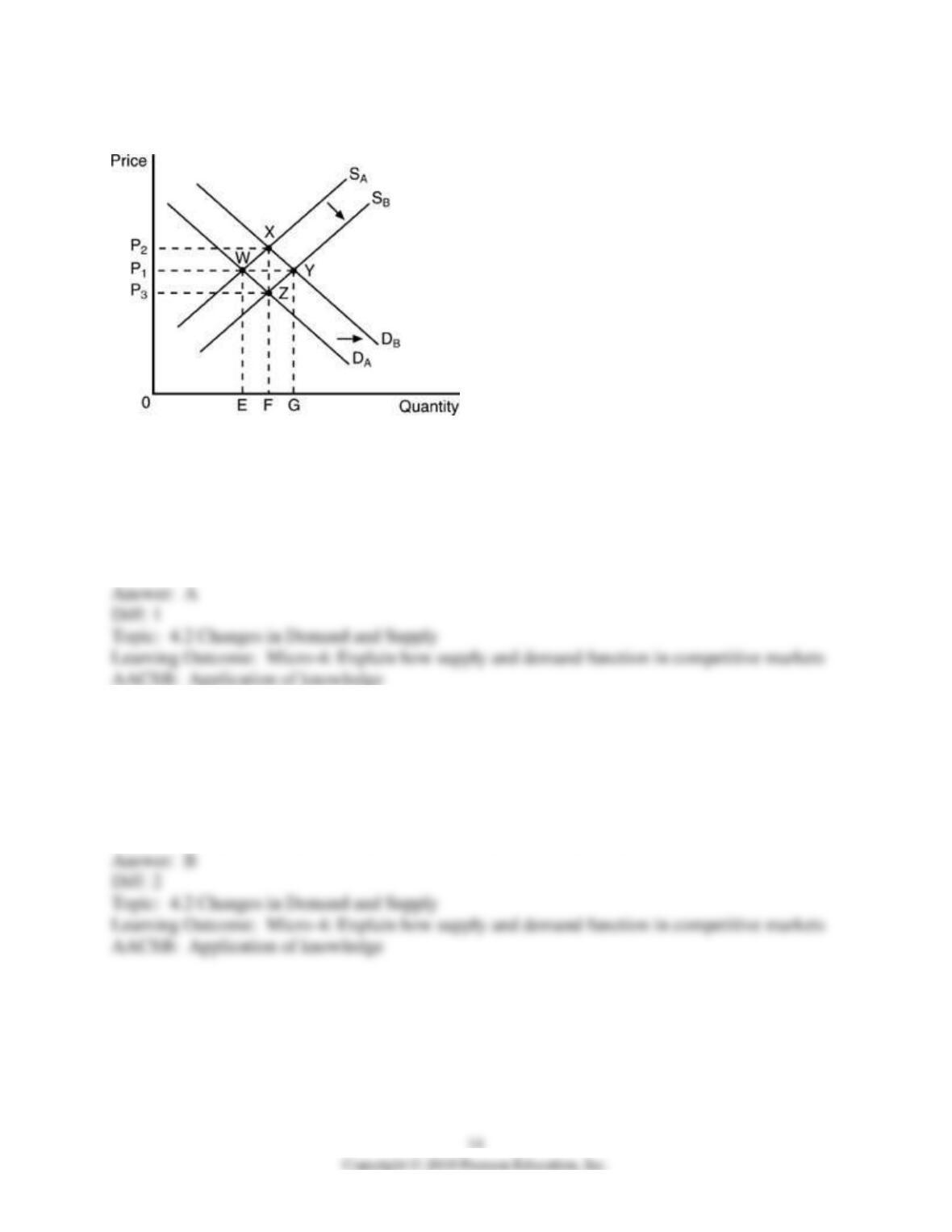
1) Assume that the initial demand and supply curves in the above figure are DA and SA,
respectively. The initial equilibrium price and quantity are
A) P1 and E.
B) P3 and F.
C) P1 and G.
D) P2 and F.
2) Refer to the above figure. Suppose the demand curve shifts from DA to DB, while the supply
curve remains at SA. Which of the following statements is FALSE?
A) There has been an increase in demand.
B) Supply has increased.
C) More consumers in the market might have caused the demand curve to shift.
D) The new equilibrium price is P2, and the new equilibrium quantity is F.
15
3) Refer to the above figure. Suppose that the supply curve shifts from SA to SB while the
demand curve shifts from DA to DB. Which of the following is TRUE about the results of the
shifts in the supply and demand curves?
A) The equilibrium price increases while the equilibrium quantity remains unchanged.
B) Both the equilibrium price and equilibrium quantity increase.
C) The equilibrium price remains unchanged while the equilibrium quantity increases.
D) Both the equilibrium price and equilibrium quantity remain unchanged.
4) Refer to the above figure. Suppose that the supply curve shifts from SA to SB while the
demand curve remains at DA. Which of the following is TRUE?
A) Only quantity supplied has increased.
B) Only quantity demanded has decreased.
C) Supply has increased.
D) Supply has decreased.
5) Other things being equal, suppose that the demand for wheat in constant quality units
increases. The increase in demand will cause
A) a surplus of wheat.
B) a higher equilibrium price and higher equilibrium quantity of wheat.
C) fall in the market clearing price of corn, a substitute for wheat.
D) a higher equilibrium quantity, but a lower equilibrium price of wheat.
6) Suppose that consumer income increases and that ground meat is an inferior good. Which of
the following will occur in the market for ground meat?
A) Market clearing price will rise, and equilibrium quantity will rise.
B) Market clearing price will fall, and equilibrium quantity will fall.
C) Market clearing price will rise, and equilibrium quantity will fall.
D) Market clearing price will fall, and equilibrium quantity will rise.
7) Suppose that there is an improvement in technology in the market for Samsung phones. Which
of the following is TRUE?
A) Supply will increase and the market clearing price will fall.
B) Supply will increase and the market clearing price will rise.
C) Demand will increase and the market clearing price will rise.
D) Demand will increase and the market clearing price will fall.
8) Suppose that demand for portable power banks increases, and simultaneously, the supply of
portable power banks increases. Which of the following would you conclude definitely will
occur in the market for portable power banks?
A) The market clearing price will rise.
B) The market clearing price will fall.
C) The equilibrium quantity will rise.
D) The equilibrium quantity will fall.
9) Suppose there is a simultaneous increase in the demand for rice and increase in the supply of
rice. Which of the following will occur as a result of these simultaneous events?
A) Both the market clearing price and equilibrium quantity will rise.
B) The market clearing price will fall, but the equilibrium quantity will rise.
C) The market clearing price may rise, fall, or stay the same, but the equilibrium quantity will
rise.
D) The market clearing price will fall, but the equilibrium quantity may rise, fall, or stay the
same.
10) Suppose you are told that the equilibrium price of bananas has increased, while the
equilibrium quantity of bananas has fallen. You are also told that either the demand changed or
supply changed, but not both. Which of the following must have occurred?
A) Demand increased.
B) Demand decreased.
C) Supply increased.
D) Supply decreased.
11) Which of the following will cause, other things being equal, a movement along the supply
curve for HDTVs?
A) an improvement in the technology of producing HDTVs
B) an increase in resource costs for producing HDTVs
C) a reduction in the price of HDTVs
D) an expectation that the price of HDTVs will be lower in the future
12) Suppose we observe the following two simultaneous events in the market for fish. First, there
is a decrease in the demand for fish due to changes in consumer tastes. And second, there is a
reduction in seafood supply due to oil spills in the oceans. We know with certainty that these two
simultaneous events will cause which of the following?
A) no change in the equilibrium quantity and a reduction in the equilibrium price
B) an increase in the equilibrium quantity and in the equilibrium price
C) a decrease in the equilibrium quantity and an indeterminate change in the equilibrium price
D) a decrease in the equilibrium quantity and an increase in the equilibrium price
13) Suppose Brad Pitt and Angelina Jolie wear matching platinum jewelry in their new movie.
After the movie is released, suppose that consumers increase their demand for the jewelry and at
the same time manufacturers increase the supply of the jewelry. As a result
A) the equilibrium quantity will increase, and there is an indeterminate change in the equilibrium
price.
B) the equilibrium quantity and price are both indeterminate.
C) the equilibrium quantity will decrease, and the equilibrium price will increase.
D) the equilibrium price and quantity will both decrease.
14) As demand for phone apps increases, other things being equal, we can expect
A) a decrease in both the relative price and quantity of phone apps.
B) a decrease in the supply of phone apps.
C) more phone apps to be produced.
D) an excess number of phone apps in the market.
15) If both the demand for and the supply of computers are increasing, which of the following
statements is TRUE?
A) The consumer should buy a computer now since the price will be higher in the future.
B) The consumer should wait and buy a computer later since the price will be lower in the future.
C) The price of a computer will be the same in the future as it is now.
D) It is impossible to know, given only this information, whether the prices of computers will go
up or down in the future.
16) If demand increases while supply decreases, then the equilibrium price
A) always increases.
B) always decreases.
C) may increase, decrease, or stay the same.
D) never changes.
17) If demand increases while supply simultaneously decreases, then the equilibrium quantity
A) always increases.
B) always decreases.
C) can never change.
D) none of the above
18) If other factors remain unchanged, technological progress in producing good A definitely
will lead to
A) an increase in the market clearing price of good A and a decrease in the equilibrium quantity
of good A.
B) an increase in both the market clearing price and the equilibrium quantity of good A.
C) a decrease in the market clearing price of good A and an increase in the equilibrium quantity
of good A.
D) a decrease in both the market clearing price and the equilibrium quantity of good A.
19) With respect to the market clearing price and the equilibrium quantity of good B, increases in
the demand for and the supply of good B will definitely
A) increase the market clearing price of good X but have an uncertain impact on the equilibrium
quantity of B.
B) reduce the market clearing price and the equilibrium quantity of good B.
C) increase the market clearing price and the equilibrium quantity of good B.
D) increase the equilibrium quantity of good X but have an uncertain impact on the market
clearing price of B.
20) With respect to the market clearing price and the equilibrium quantity for good X, an
increase in the demand for and a decrease in supply of the good definitely will
A) increase the market clearing price and the equilibrium quantity of good X.
B) decrease the market clearing price and the equilibrium quantity of good X.
C) increase the market clearing price of good X but lower the equilibrium quantity of X.
D) increase the market clearing price of good X but have an uncertain impact on the equilibrium
quantity of X.