CHAPTER 04—ANALYSIS OF FINANCIAL STATEMENTS
To keep this chapter from involving too much memorization, we provide our students with a formula sheet for use on
exams. That makes a few of the questions trivially easy, but most require some thought, and some are downright
challenging. Even the very easy ones make students think about the ratios. The challenging questions are labeled
CHALLENGING, and most students will agree with that designation.
Some of these questions are just definitions, but others require real thought about the make-up of the ratios and
relationships among the ratios. We tell our students that to answer some of these questions it is useful (1) to write out the
relevant ratio or ratios, (2) then to think about how the ratios would change if the accounting data changed, and (3)
occasionally to make up illustrative data to test their conclusions.
Note that there is some overlap between the True/False and the multiple choice questions, as some T/F statements are
used in the MC questions.
1. Ratio analysis involves analyzing financial statements to help appraise a firm’s financial position and strength.
a.
True
b.
False
True
EASY
2. The current and quick ratios both help us measure a firm’s liquidity. The current ratio measures the relationship of the
firm’s current assets to its current liabilities, while the quick ratio measures the firm’s ability to pay off short-term
obligations without relying on the sale of inventories.
a.
True
b.
False
True
EASY
3. Although a full liquidity analysis requires the use of a cash budget, the current and quick ratios provide fast and easy–
to-use estimates of a firm’s liquidity position.
a.
True
b.
False
True
CHAPTER 04—ANALYSIS OF FINANCIAL STATEMENTS
4. High current and quick ratios always indicate that the firm is managing its liquidity position well.
a.
True
b.
False
False
EASY
5. If a firm sold some inventory for cash and left the funds in its bank account, its current ratio would probably not change
much, but its quick ratio would decline.
a.
True
b.
False
False
EASY
6. If a firm sold some inventory on credit, its current ratio would probably not change much, but its quick ratio would
increase.
a.
True
b.
False
True
EASY
CHAPTER 04—ANALYSIS OF FINANCIAL STATEMENTS
7. If a firm sold some inventory on credit as opposed to cash, there is no reason to think that either its current or quick
ratio would change.
a.
True
b.
False
False
EASY
8. The inventory turnover ratio and days sales outstanding (DSO) are two ratios that are used to assess how effectively a
firm is managing its current assets.
a.
True
b.
False
True
EASY
9. A decline in a firm’s inventory turnover ratio suggests that it is improving both its inventory management and its
liquidity position, i.e., that it is becoming more liquid.
a.
True
b.
False
EASY
CHAPTER 04—ANALYSIS OF FINANCIAL STATEMENTS
False
EASY
10. In general, it’s better to have a low inventory turnover ratio than a high one, as a low ratio indicates that the firm has
an adequate stock of inventory relative to sales and thus will not lose sales as a result of running out of stock.
a.
True
b.
False
False
EASY
11. The days sales outstanding tells us how long it takes, on average, to collect after a sale is made. The DSO can be
compared with the firm’s credit terms to get an idea of whether customers are paying on time.
a.
True
b.
False
True
EASY
12. If a firm’s fixed assets turnover ratio is significantly higher than its industry average, this could indicate that it uses its
fixed assets very efficiently or is operating at over capacity and should probably add fixed assets.
a.
True
b.
False
CHAPTER 04—ANALYSIS OF FINANCIAL STATEMENTS
True
EASY
13. Debt management ratios show the extent to which a firm’s managers are attempting to magnify returns on owners’
capital through the use of financial leverage.
a.
True
b.
False
True
EASY
14. The more conservative a firm’s management is, the higher its total debt to total capital ratio [measured as (Short-term
debt + Long-term debt)/(Debt + Preferred stock + Common equity)] is likely to be.
a.
True
b.
False
False
EASY
15. Other things held constant, the higher a firm’s total debt to total capital ratio [measured as (Short-term debt + Long-
term debt)/(Debt + Preferred stock + common equity)], the higher its TIE ratio will be.
a.
True
b.
False
CHAPTER 04—ANALYSIS OF FINANCIAL STATEMENTS
16. The times-interest-earned ratio measures the extent to which operating income can decline before the firm is unable to
meet its annual interest costs.
a.
True
b.
False
True
EASY
17. Profitability ratios show the combined effects of liquidity, asset management, and debt management on a firm’s
operating results.
a.
True
b.
False
True
EASY
18. The basic earning power ratio (BEP) reflects the earning power of a firm’s assets after giving consideration to financial
leverage and tax effects.
a.
True
b.
False
False
EASY
CHAPTER 04—ANALYSIS OF FINANCIAL STATEMENTS
False
EASY
19. The operating margin measures operating income per dollar of assets.
a.
True
b.
False
False
EASY
20. The profit margin measures net income per dollar of sales.
a.
True
b.
False
True
EASY
21. The return on invested capital measures the total return that a company has provided for its investors.
a.
True
b.
False
True
CHAPTER 04—ANALYSIS OF FINANCIAL STATEMENTS
22. The “apparent,” but not necessarily the “true,” financial position of a company whose sales are seasonal can change
dramatically during a given year, depending on the time of year when the financial statements are constructed.
a.
True
b.
False
True
EASY
4-10 Uses and Limitations of Ratios
FOFM.BRIG.16.04.10 – Uses and Limitations of Ratios
United States – OH – DISC.FOFM.BRIG.16.05 – Financial analysis and cash flows
Balance sheet changes
Bloom’s: Comprehension
23. Significant variations in accounting methods among firms make meaningful ratio comparisons between firms more
difficult than if all firms used the same or similar accounting methods.
a.
True
b.
False
True
EASY
4-10 Uses and Limitations of Ratios
FOFM.BRIG.16.04.10 – Uses and Limitations of Ratios
United States – OH – DISC.FOFM.BRIG.16.05 – Financial analysis and cash flows
Ratio limitations
24. The inventory turnover and current ratio are related. The combination of a high current ratio and a low inventory
turnover ratio, relative to industry norms, suggests that the firm has an above-average inventory level and/or that part of
the inventory is obsolete or damaged.
EASY
4-5 Profitability Ratios
FOFM.BRIG.16.04.05 – Profitability Ratios
United States – OH – DISC.FOFM.BRIG.16.05 – Financial analysis and cash flows
CHAPTER 04—ANALYSIS OF FINANCIAL STATEMENTS
a.
True
b.
False
True
MODERATE
25. It is appropriate to use the fixed assets turnover ratio to appraise firms’ effectiveness in managing their fixed assets if
and only if all the firms being compared have the same proportion of fixed assets to total assets.
a.
True
b.
False
False
MODERATE
26. Other things held constant, the more debt a firm uses, the lower its profit margin will be.
a.
True
b.
False
True
MODERATE
CHAPTER 04—ANALYSIS OF FINANCIAL STATEMENTS
27. Suppose you are analyzing two firms in the same industry. Firm A has a profit margin of 10% versus a profit margin
of 8% for Firm B. Firm A’s total debt to total capital ratio [measured as (Short-term debt + Long-term debt)/(Debt +
Preferred stock + Common equity)] is 70% versus one of 20% for Firm B. Based only on these two facts, you cannot
reach a conclusion as to which firm is better managed, because the difference in debt, not better management, could be the
cause of Firm A’s higher profit margin.
a.
True
b.
False
False
MODERATE
28. Other things held constant, a decline in sales accompanied by an increase in financial leverage must result in a lower
profit margin.
a.
True
b.
False
False
MODERATE
29. Other things held constant, the more debt a firm uses, the lower its operating margin will be.
a.
True
b.
False
False
CHAPTER 04—ANALYSIS OF FINANCIAL STATEMENTS
30. The advantage of the basic earning power ratio (BEP) over the return on total assets for judging a company’s operating
efficiency is that the BEP does not reflect the effects of debt and taxes.
a.
True
b.
False
True
MODERATE
31. Other things held constant, the more debt a firm uses, the lower its return on total assets will be.
a.
True
b.
False
True
MODERATE
32. Since the ROA measures the firm’s effective utilization of assets without considering how these assets are financed,
two firms with the same EBIT must have the same ROA.
a.
True
b.
False
False
MODERATE
CHAPTER 04—ANALYSIS OF FINANCIAL STATEMENTS
33. The return on common equity (ROE) is generally regarded as being less significant, from a stockholder’s viewpoint,
than the return on total assets (ROA).
a.
True
b.
False
False
MODERATE
34. The return on invested capital (ROIC) differs from the return on assets (ROA). First, ROIC is based on total invested
capital rather than total assets. Second, the numerator of the ROIC is after-tax operating income rather than net income.
a.
True
b.
False
True
MODERATE
MODERATE

CHAPTER 04—ANALYSIS OF FINANCIAL STATEMENTS
35. Market value ratios provide management with an indication of how investors view the firm’s past performance and
especially its future prospects.
a.
True
b.
False
True
MODERATE
36. In general, if investors regard a company as being relatively risky and/or having relatively poor growth prospects, then
it will have relatively high P/E and M/B ratios.
a.
True
b.
False
False
MODERATE
37. The price/earnings (P/E) ratio tells us how much investors are willing to pay for a dollar of current earnings. In
general, investors regard companies with higher P/E ratios as being less risky and/or more likely to enjoy higher growth in
the future.
a.
True
b.
False
True
MODERATE
CHAPTER 04—ANALYSIS OF FINANCIAL STATEMENTS
United States – OH – DISC.FOFM.BRIG.16.05 – Financial analysis and cash flows
38. The market/book (M/B) ratio tells us how much investors are willing to pay for a dollar of accounting book value. In
general, investors regard companies with higher M/B ratios as being less risky and/or more likely to enjoy higher growth
in the future.
a.
True
b.
False
True
MODERATE
4-6 Market Value Ratios
FOFM.BRIG.16.04.06 – Market Value Ratios
United States – OH – DISC.FOFM.BRIG.16.05 – Financial analysis and cash flows
M/B ratio
Bloom’s: Comprehension
39. Suppose all firms follow similar financing policies, face similar risks, have equal access to capital, and operate in
competitive product and capital markets. However, firms face different operating conditions because, for example, the
grocery store industry is different from the airline industry. Under these conditions, firms with high profit margins will
tend to have high asset turnover ratios, and firms with low profit margins will tend to have low turnover ratios.
a.
True
b.
False
False
MODERATE
4-7 Tying the Ratios Together: The DuPont Equation
FOFM.BRIG.16.04.07 – Tying the Ratios Together: The DuPont Equation
United States – OH – DISC.FOFM.BRIG.16.05 – Financial analysis and cash flows
DuPont equation
Bloom’s: Comprehension
40. Klein Cosmetics has a profit margin of 5.0%, a total assets turnover ratio of 1.5 times, no debt and therefore an equity
multiplier of 1.0, and an ROE of 7.5%. The CFO recommends that the firm borrow funds using long-term debt, use the
CHAPTER 04—ANALYSIS OF FINANCIAL STATEMENTS
funds to buy back stock, and raise the equity multiplier to 2.0. The size of the firm (assets) would not change. She thinks
that operations would not be affected, but interest on the new debt would lower the profit margin to 4.5%. This would
probably be a good move, as it would increase the ROE from 7.5% to 13.5%.
a.
True
b.
False
True
MODERATE
41. Determining whether a firm’s financial position is improving or deteriorating requires analyzing more than the ratios
for a given year. Trend analysis is one method of examining changes in a firm’s performance over time.
a.
True
b.
False
True
MODERATE
42. Even though Firm A’s current ratio exceeds that of Firm B, Firm B’s quick ratio might exceed that of A. However, if
A’s quick ratio exceeds B’s, then we can be certain that A’s current ratio is also larger than B’s.
a.
True
b.
False
False
CHAPTER 04—ANALYSIS OF FINANCIAL STATEMENTS
43. Firms A and B have the same current ratio, 0.75, the same amount of sales, and the same amount of current liabilities.
However, Firm A has a higher inventory turnover ratio than B. Therefore, we can conclude that A’s quick ratio must be
smaller than B’s.
a.
True
b.
False
False
CHALLENGING
44. Suppose a firm wants to maintain a specific TIE ratio. It knows the amount of its debt, the interest rate on that debt,
the applicable tax rate, and its operating costs. With this information, the firm can calculate the amount of sales required
to achieve its target TIE ratio.
CHALLENGING
CHAPTER 04—ANALYSIS OF FINANCIAL STATEMENTS
a.
True
b.
False
True
CHALLENGING
45. Suppose Firms A and B have the same amount of assets, total assets are equal to total invested capital, pay the same
interest rate on their debt, have the same basic earning power (BEP), finance with only debt and common equity, and have
the same tax rate. However, Firm A has a higher debt to capital ratio. If BEP is greater than the interest rate on debt, Firm
A will have a higher ROE as a result of its higher debt ratio.
a.
True
b.
False
True
CHAPTER 04—ANALYSIS OF FINANCIAL STATEMENTS
46. If a firm’s ROE is equal to 9% and its ROA is equal to 6%, its equity multiplier must be 1.5.
a.
True
b.
False
True
Equity multiplier = ROE/ROA = 9%/6% = 1.5. Thus, the statement is true.
CHALLENGING
47. A firm’s ROE is equal to 9% and its ROA is equal to 6%. The firm finances only with short-term debt, long-term debt,
and common equity, so assets equal total invested capital. The firm’s total debt to total capital ratio must be 50%.
a.
True
b.
False
False
CHALLENGING
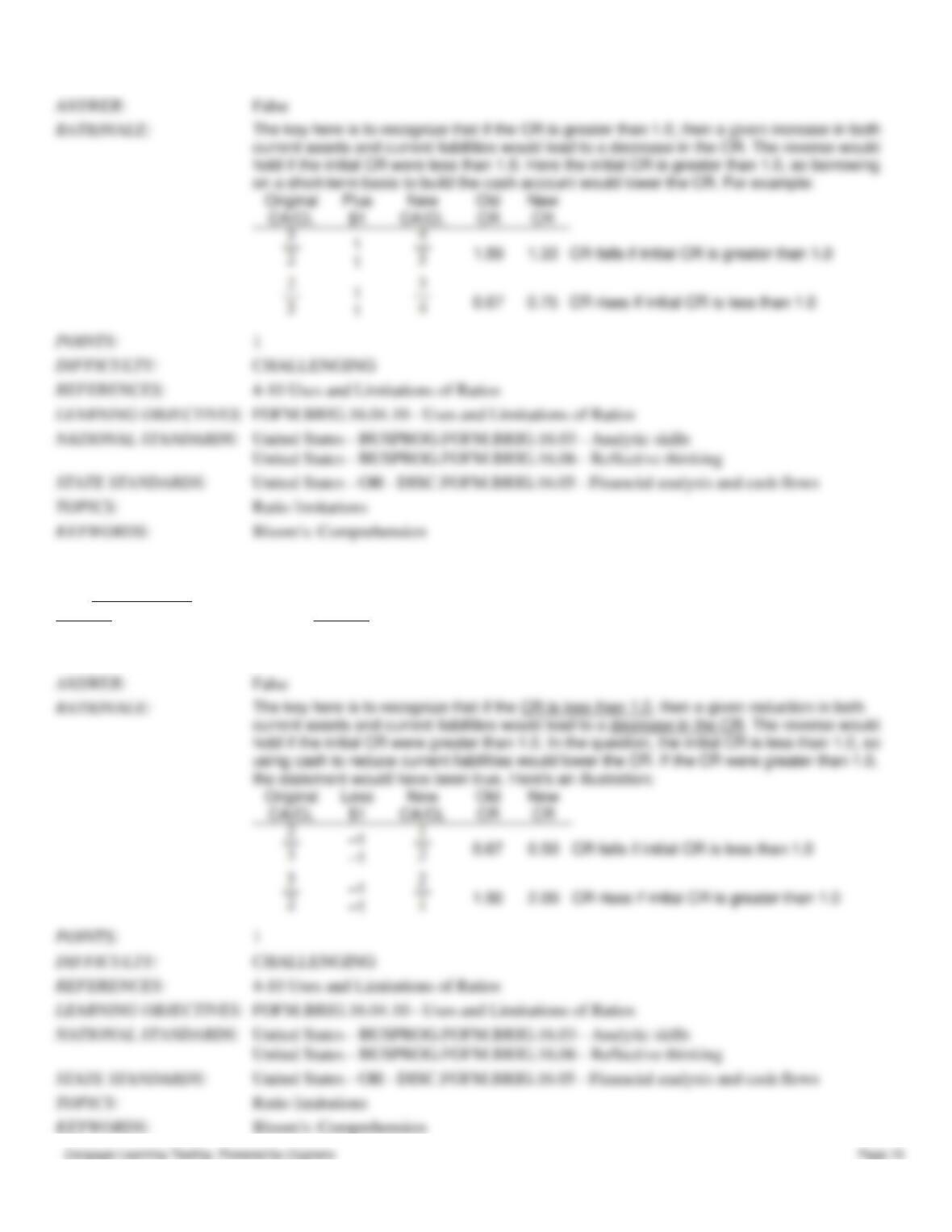
48. One problem with ratio analysis is that relationships can sometimes be manipulated. For example, if our current ratio
is greater than 1.5, then borrowing on a short-term basis and using the funds to build up our cash account would cause the
current ratio to INCREASE.
a.
True
b.
False
CHAPTER 04—ANALYSIS OF FINANCIAL STATEMENTS
False
CHALLENGING
4-10 Uses and Limitations of Ratios
49. One problem with ratio analysis is that relationships can be manipulated. For example, we know that if our current
ratio is less than 1.0, then using some of our cash to pay off some of our current liabilities would cause the current ratio to
increase and thus make the firm look stronger.
a.
True
b.
False
False
CHALLENGING
4-10 Uses and Limitations of Ratios
CHAPTER 04—ANALYSIS OF FINANCIAL STATEMENTS
Multiple Choice: Conceptual
50. Considered alone, which of the following would increase a company’s current ratio?
a.
An increase in net fixed assets.
b.
An increase in accrued liabilities.
c.
An increase in notes payable.
d.
An increase in accounts receivable.
e.
An increase in accounts payable.
4-2 Liquidity Ratios
FOFM.BRIG.16.04.02 – Liquidity Ratios
United States – BUSPROG.FOFM.BRIG.16.06 – Reflective thinking
United States – OH – DISC.FOFM.BRIG.16.05 – Financial analysis and cash flows
Current ratio
Bloom’s: Comprehension
Multiple Choice: Conceptual
51. Which of the following would, generally, indicate an improvement in a company’s financial position, holding other
things constant?
a.
The TIE declines.
b.
The DSO increases.
c.
The quick ratio increases.
d.
The current ratio declines.
e.
The total assets turnover decreases.
4-2 Liquidity Ratios
FOFM.BRIG.16.04.02 – Liquidity Ratios
United States – BUSPROG.FOFM.BRIG.16.06 – Reflective thinking
United States – OH – DISC.FOFM.BRIG.16.05 – Financial analysis and cash flows
Current ratio
Bloom’s: Comprehension
Multiple Choice: Conceptual
52. A firm wants to strengthen its financial position. Which of the following actions would increase its current ratio?
a.
Reduce the company’s days’ sales outstanding to the industry average and use the resulting cash savings to
purchase plant and equipment.
b.
Use cash to repurchase some of the company’s own stock.