28
CHAPTER 4 CLASSICAL MACROECONOMICS (II): MONEY,
PRICES, AND INTEREST
Additional Questions
Problems and/or Essay Questions:
1. Explain the intuition behind why the aggregate demand curve is downward sloping. Why
does an increase in the money supply shift the aggregate demand curve to the right?
2. Briefly explain why changes in government spending or taxes do not have independent
effects on aggregate demand. What does shift the aggregate demand curve in the classical
model?
3. Two countries are experiencing 10% money growth a year. However, country A is growing
at 2% and country B is growing at 5%. Which country will have the higher inflation rate?
4. Assume that in a given time frame, the value of transactions in current dollars is $14 trillion
and the money stock amounts to $400 billion.
a. What is the transactions velocity of money? Show your work.
c. According to Irving Fisher and other quantity theorists, how was the equilibrium level
of velocity determined?
5. Consider the impact of an increase in labor-enhancing technology within the classical
model. Provide graphs to illustrate what happens to real wages, labor, output, and the price
level.
6. Why do people hold money in the classical model?
7. Discuss the meaning of the phrase of supply-side economics, discussing how it is similar
and different from the traditional classical model. Make sure to discuss the role of the
Laffer curve in supply-side theory.
8. What is the difference between savings and investment?
9. Contrast the Cambridge and Fisher versions of the quantity theory. Explain why the
Cambridge version of the quantity theory represents a more modern monetary theory when
compared to Fisher’s version.
10. What does the Classical model predict about the relationship between a country’s budget
balance (total revenue minus total spending) and a country’s level of real interest rates and
investment in a closed economy? Use a graph of the capital market to illustrate.
11. During the recession of 2008, the U.S.experienced lower real interest rates at the same time
investment and GDP were falling. How would a Classical economist explain this recession?
Provide a graph of the Classical capital market to illustrate your arguments.
12. Let M = 36, k = 3, Ls = W/P, MPN = L-1/2 and Y = 2L1/2. Calculate the labor demand curve,
the aggregate demand curve, and the equilibrium values of the real wage, labor, output, and
the price level.
Additional Problems and/or Essay Questions:
13. Illustrate graphically the determination of the equilibrium interest rate in the classical
system. Explain how the schedules you use in your graph are derived. Explain what factors
shift the savings and investment curves.
14. You are given the following information that pertains to a classical macroeconomic model:
y = real output =1,000
M = the money stock = 400
V = income velocity of money = 25
a. Plot the aggregate demand and supply schedules.
b. Find the value of the aggregate price level.
c. Find the value of nominal income.
15. Within the classical economic theory, suppose there is an increase in the output that could
be produced for a given labor input due to a technological advance. You may also assume
that the technological advance is such that the marginal productivity of labor is unchanged
at a given level of employment. Evaluate the effects of this shift on employment, output,
nominal income, and the price level. Use the appropriate graphs where useful.
16. Within the classical model, suppose that there is a lump-sum increase in taxes, for example,
$5 per person. Analyze the effects of such a tax increase. Consider effects on real output,
the price level and the rate of interest.
17. What happened to interest rates during the 2008 global financial crisis in the US? Can you
use the classical loanable funds market to derive an explanation for this behavior? Provide
graphs to explain.
18. During the global financial crisis, government tax receipts fell dramatically as the economy
slowed and as tax rates were lowered to stimulate the economy. At the same time,
government spending increased. According to the classical loanable funds market, what
should have happened to interest rates? Explain. Can you reconcile this with your answer to
the previous question?
Multiple-Choice Questions:
1. According to the quantity theory of money, the quantity of money determines the
2. The quantity theory of money implies that if the money stock were to double, the price
level would
3. In the equilibrium version of the classical model, the velocity of money
4. According to the classical model, a 10-percent increase in the money supply, holding
everything else constant, will lead to
5. The definition of the velocity of money is
6. The Fisherian version of the quantity theory equation is
7. The classical model predicts that, in the short-run, a tax cut financed by an increase in the
money supply would
8. In the classical model, a rise in the marginal income tax rate would
9. In the classical model, an increase in saving is assumed to increase
10. In the classical model, the level of business investment was a function of
11. According to the quantity theory of money, a 10-percent increase in the money stock would
lead to a 10-percent rise in the
12. If the quantity of investment has fallen but interest rates have risen, then
13. Assume there are 75 transactions a year in an economy with a money supply of $300. If the
average value of each transaction is $20, then the velocity of money is
14. The quantity theory assumes that
15. The equation of exchange is a(n)
16. Which of the following is (are) correct? In the classical system, the suppliers of bonds were
the
17. If the money supply increases 10-percent, velocity decreases 5-percent, and the price level
increases 6-percent, then the change in real GDP is
18. The difference between savings and investment is that
Figure 4.1
19. According to the classical model shown in Figure 4.1, an autonomous decline in investment
shifts the investment schedule to the left. Furthermore, the equilibrium interest rate
declines. Distance B describes an interest rate induced
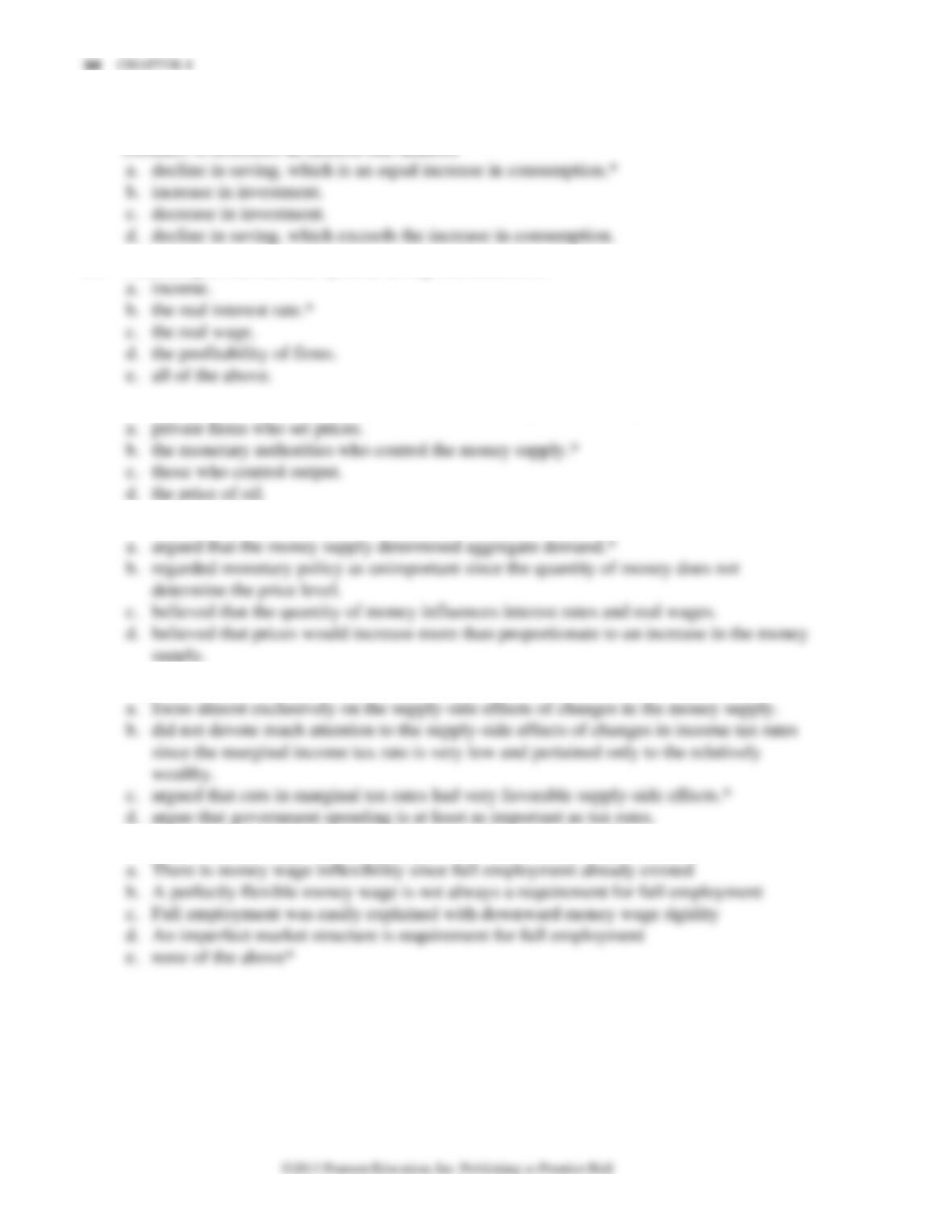
20. According to the classical model shown above, an autonomous decline in investment shifts
the investment schedule to the left. Furthermore, the equilibrium interest rate declines.
Distance A describes an interest rate induced
21. According to the classical system, saving is a function of
22. According to the quantity theory, inflation is ultimately controlled by
23. Classical economists
24. Supply-side economists
25. Which of the following statements applies to the classical system?
26. In the classical theory of aggregate demand, a decrease in the velocity of money leads to
27. Which of the following is not a characteristic of the classical system?
28. According to the Laffer curve, an increase in marginal tax rates
29. In the classical system, output and employment are primarily dependent on
30. In the classical model, less consumption and more savings would
31. If the propensity to hold money is 6 and the money supply is 12, then the classical
aggregate demand curve is
32. According to the classical model, changes in aggregate demand are driven by
33. The Cambridge and Fischer versions of the quantity theory are identical if
34. In the classical model the interest rate is determined by
35. According to the classical model, money influences
36. Hyperinflation is a period of time when
37. Suppose that there is an increase in technology. The classical model predicts that
38. In the classical model, people hold money because
39. In the classical system, the quantity of money
40. In the classical theory of aggregate demand, a decrease in the propensity to hold money will
41. The equilibrium real wage is 25, the money supply equals 15, and k equals 3. If equilibrium
output is 10 then the equilibrium nominal wage is
42. In the classical model, an increase in government spending shifts the
43. According to classical economists,
44. Assuming that, over a given period, the value of transactions in current dollars is $8 trillion
and the money stock is $500 billion. What is the transaction velocity of money?
45. If there is an increase in government spending that is financed by issuing bonds, then
46. Which of the following statements is correct?
47. Which of the following statements is (are) correct? The equilibrium interest rate is the rate
that
48. Hyperinflations are caused by
49. The increased willingness of women to enter the workforce has most likely lead to
50. In the classical model, a tax on labor supply will
51. If the nominal money supply rises by 6 percent, the price level rises by 4 percent, and
output rises by 3 percent, then according to the quantity theory equation, income velocity
must rise by:
52. In the classical model, a 20 percent increase in the money growth rate leads to:
53. In the classical model, if money growth and velocity are constant, then:
54. According to the Cambridge approach to the quantity theory, people hold money:
55. If government spending and tax collections both increase by the same amount, then
according to the classical loanable funds market: