18) To affect the market outcome, a price floor
A) must be set above the black market price.
B) must be set above the legal price.
C) must be set above the price ceiling.
D) must be set above the equilibrium price.
19) Government intervention in agricultural markets in the U.S. began
A) during World War II to ensure that enough food was available for domestic consumption.
B) after World War I in order to assist farmers to adjust from a war-time economy to a peace-time
economy.
C) during the Great Depression.
D) during the Korean War.
20) A black market is a market where buying and selling take place
A) at prices that violate government price regulations.
B) in non-licensed shops and warehouses.
C) after regular office hours.
D) on foreign soil.
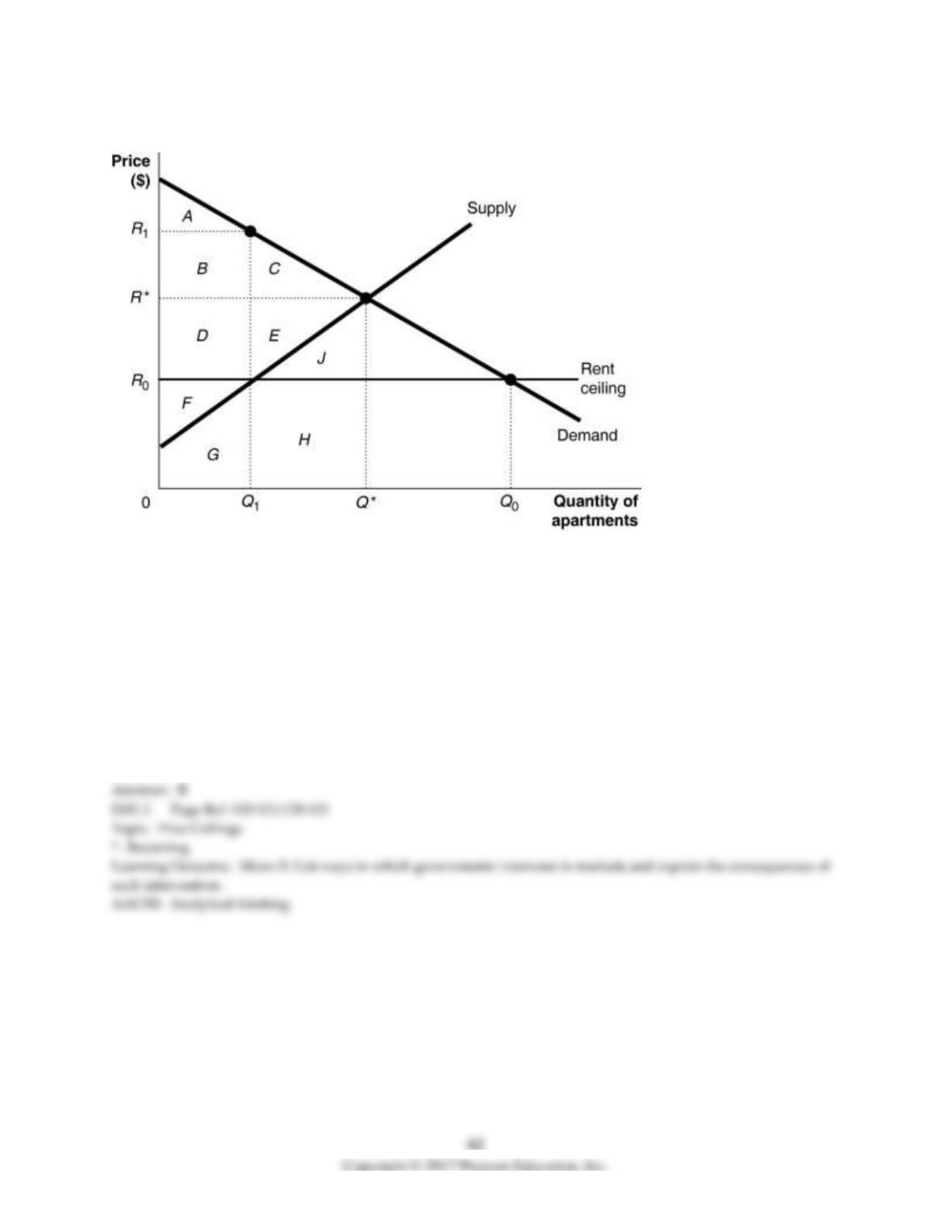
Figure 4-5
Figure 4-5 shows the market for apartments in Bay City. Recently, the government imposed a rent
ceiling at R0.
21) Refer to Figure 4-5. With rent control, the quantity supplied is Q1. Suppose apartment owners
ignore the law and rent this quantity for the highest rent they can get. What is the highest rent they can
get?
A) R*
B) R1
C) R0
D) more than R1
22) Refer to Figure 4-5. What is the area that represents consumer surplus after the imposition of the
ceiling?
A) A + B+ D
B) A + B + C
C) A + B + D + F
D) A + B + D + F + G
23) Refer to Figure 4-5. What is the area that represents the producer surplus after the imposition of the
ceiling?
A) F + G
B) F
C) D + F + G
D) A + B + D + F + G
24) Refer to Figure 4-5. What is the area that represents the portion of producer surplus transferred to
consumers as a result of the rent ceiling?
A) D + E
B) D + F
C) D
D) F
25) Refer to Figure 4-5. What area represents the deadweight loss after the imposition of the ceiling?
A) G + H
B) J + H
C) C + E + J + H
D) C + E
26) Refer to Figure 4-5. Suppose that instead of a price ceiling, the government imposed a price floor of
R1. What is the quantity of apartments demanded at the new price?
A) 0
B) Q1
C) Q*
D) Q0
27) Refer to Figure 4-5. Suppose that instead of a price ceiling, the government imposed a price floor of
R1. What is the area representing consumer surplus after the imposition of the price floor?
A) A
B) A+ B + D
C) C + E
D) B + C + D + E
28) Refer to Figure 4-5. Suppose that instead of a price ceiling, the government imposed a price floor of
R1. What is the area representing producer surplus after the imposition of the price floor?
A) A
B) B + D + F
C) C + E
D) B + C + D + E + F
29) Refer to Figure 4-5. Suppose that instead of a price ceiling, the government imposed a price floor of
R1. What is the area representing the portion of consumer surplus transferred to producers as a result of
the price floor?
A) A
B) B
C) B + C
D) A + B
30) Refer to Figure 4-5. Suppose that instead of a price ceiling, the government imposed a price floor of
R1. What area represents the deadweight loss after the imposition of the price floor?
A) G + H
B) J + H
C) C + E + J + H
D) C + E
31) Which term refers to a legally established maximum price that firms may charge?
A) a price ceiling
B) a subsidy
C) a price floor
D) a tariff
46
32) In order to be binding, a price floor
A) must lie above the free-market equilibrium price.
B) must lie below the free-market equilibrium price.
C) must coincide with the free-market equilibrium price.
D) must be high enough for firms to earn a profit.
33) ________ dictates the lowest wage that firms may pay for labor.
A) A maximum wage requirement
B) A minimum wage law
C) The black-market wage
D) A price-ceiling wage
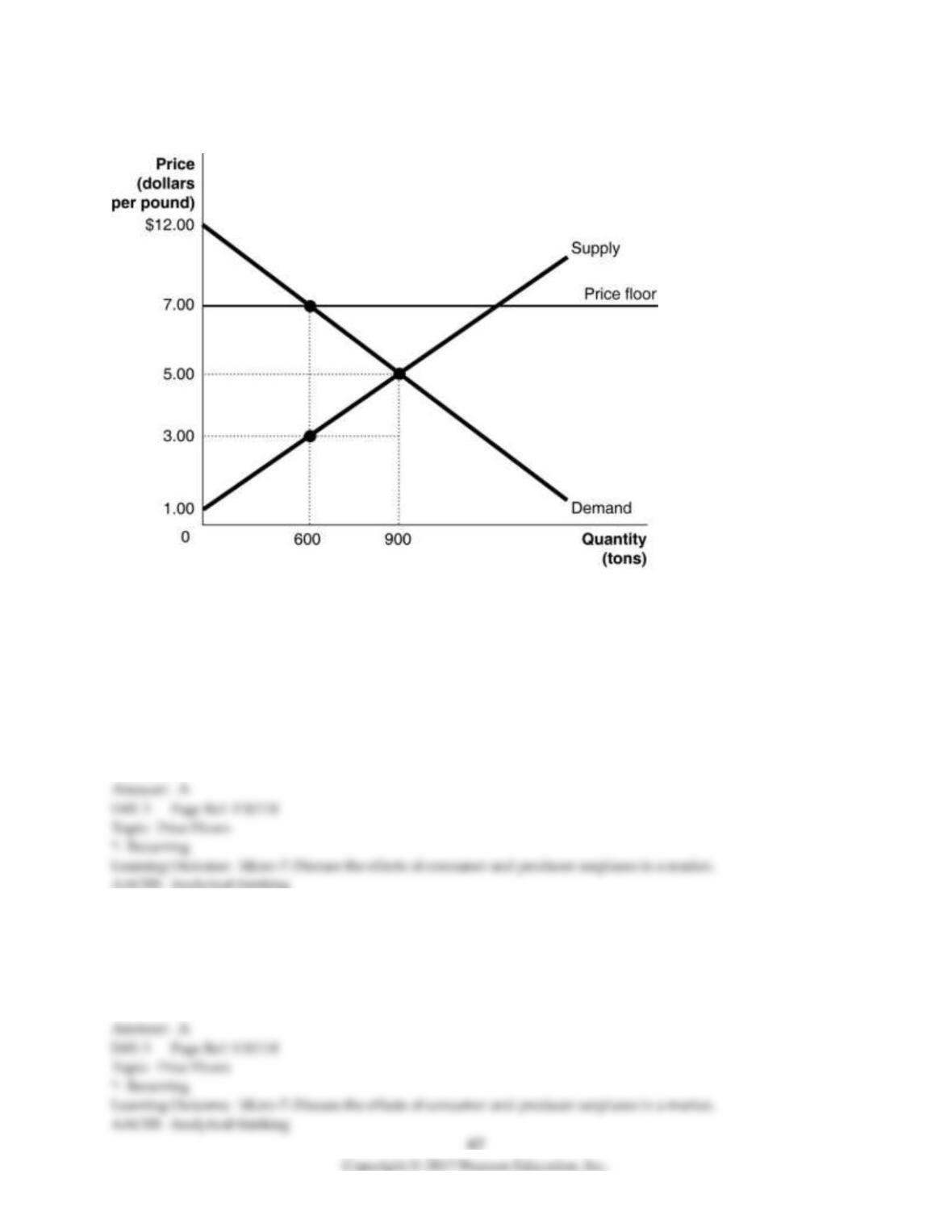
Figure 4-6
Figure 4-6 shows the demand and supply curves for the coffee market. The government believes that
the equilibrium price is too low and tries to help almond growers by setting a price floor at $7.00.
34) Refer to Figure 4-6. What is the value of consumer surplus after the imposition of the price floor?
A) $1,500
B) $2,700
C) $4,500
D) $5,700
35) Refer to Figure 4-6. What is the value of producer surplus after the imposition of the price floor?
A) $3,000
B) $3,600
C) $4,200
D) $4,500
36) Refer to Figure 4-6. What is the value of the portion of consumer surplus that has been transferred to
producer surplus as a result of the price floor?
A) $1,200
B) $1,500
C) $1,800
D) $3,000
37) Refer to Figure 4-6. What is the value of the deadweight loss after the imposition of the price floor?
A) $600
B) $1,800
C) $2,700
D) $3,300
38) Congress passed the Freedom to Farm Act in 1996. What was the purpose of this Act?
A) to encourage more people to become farmers
B) to grant free land to farmers in order to produce crops that were particularly scarce
C) to phase out the use of price ceilings in agricultural markets
D) to phase out price floors and return to a free market in agriculture
39) Because minimum wage is a price floor
A) it will be set below the market equilibrium price.
B) it will create a deadweight loss.
C) it will increase the number of jobs available in the labor market.
D) it will maximize consumer surplus.
40) Increases in the minimum wage are intended to raise the incomes of low-income workers. Many
economists favor a different policy to achieve this goal, a policy that avoids the deadweight losses that
result from the minimum wage. What is this policy?
A) distribution of food stamps to low-income consumers
B) distribution of vouchers that can be used for rent or mortgage payments
C) the Alternative Minimum Tax
D) the earned income tax credit
41) Which of the following is a result of imposing a rent ceiling?
A) Some consumer surplus is converted to producer surplus.
B) There is an increase in the quantity of apartments supplied.
C) There is an increase in the quantity of apartments demanded.
D) The marginal benefit of the last apartment rented is less than the marginal cost of supplying it.
42) Which of the following describes the difference between “scarcity” and “shortage”?
A) There is no difference; either word can be used to describe the situation that exists when there is less
of a good or service available than people want.
B) In the economic sense, almost everything is scarce. A shortage of a good or service occurs when the
quantity demanded is greater than the quantity supplied at the current market price.
C) There is a shortage of almost everything. Scarcity occurs only if the quantity demanded of a good or
service is greater than the quantity supplied at the current market price.
D) In the economic sense, almost everything is scarce. A shortage of a good or service occurs when the
quantity demanded is greater than the quantity supplied at the equilibrium price.
43) In cities with rent controls, the actual rents paid can be ________ than the legal maximum. One
explanation for this is because there is a ________ of apartments, tenants are ________.
A) higher; shortage; often willing to pay rents higher than the law allows
B) higher; surplus; often forced to pay rents higher than the law allows
C) lower; surplus; never willing to pay rents below the legal maximum
D) lower; shortage; rarely willing to pay rents lower than the law allows
44) Which of the following is a result of government price controls?
A) Some people win and some people lose.
B) Price controls benefit poor consumers but harm producers and wealthy consumers.
C) Price controls increase economic efficiency.
D) The deadweight loss from price ceilings is greater than the deadweight loss from price floors.
45) Economists ________ that price controls are desirable.
A) are in agreement
B) are reluctant to state
C) never believe
D) only recently agree
46) If the government implements a price ceiling on insulin, this will
A) increase the price consumers will pay for insulin.
B) decrease the quantity of insulin the manufacturers will be willing to supply.
C) have to be set above the market equilibrium price to be effective.
D) encourage manufacturers to produce and sell more insulin to increase their profits.
47) If the government implements a price ceiling on insulin, this will have all of the following effects on
the market for insulin except
A) a decrease in economic surplus.
B) a decrease in producer surplus.
C) an increase in deadweight loss.
D) a more efficient equilibrium.
48) Compared to prices charged by Uber, traditional taxi companies charge government-regulated
prices. These government-regulated prices ________ in the market for shared rides.
A) decrease consumer surplus
B) increase consumer surplus
C) decrease deadweight loss
D) decrease producer surplus
49) When Airbnb customers in Malibu start paying hotel taxes, this will have the potential to ________
the equilibrium price in this market and, therefore, ________ efficiency.
A) raise; increase
B) raise; decrease
C) lower; increase
D) lower; decrease
50) Government intervention in agriculture began in the United States in the 1890s.
51) Rent control is an example of a price floor.
52) Price floors are illegal in the United States.
53) Price ceilings result in shortages.
54) All renters benefit from rent control and all landlords lose.
55) There is a shortage of every good that is scarce.
56) Explain how both renters and landlords could be either winners or losers with the imposition of rent
control.
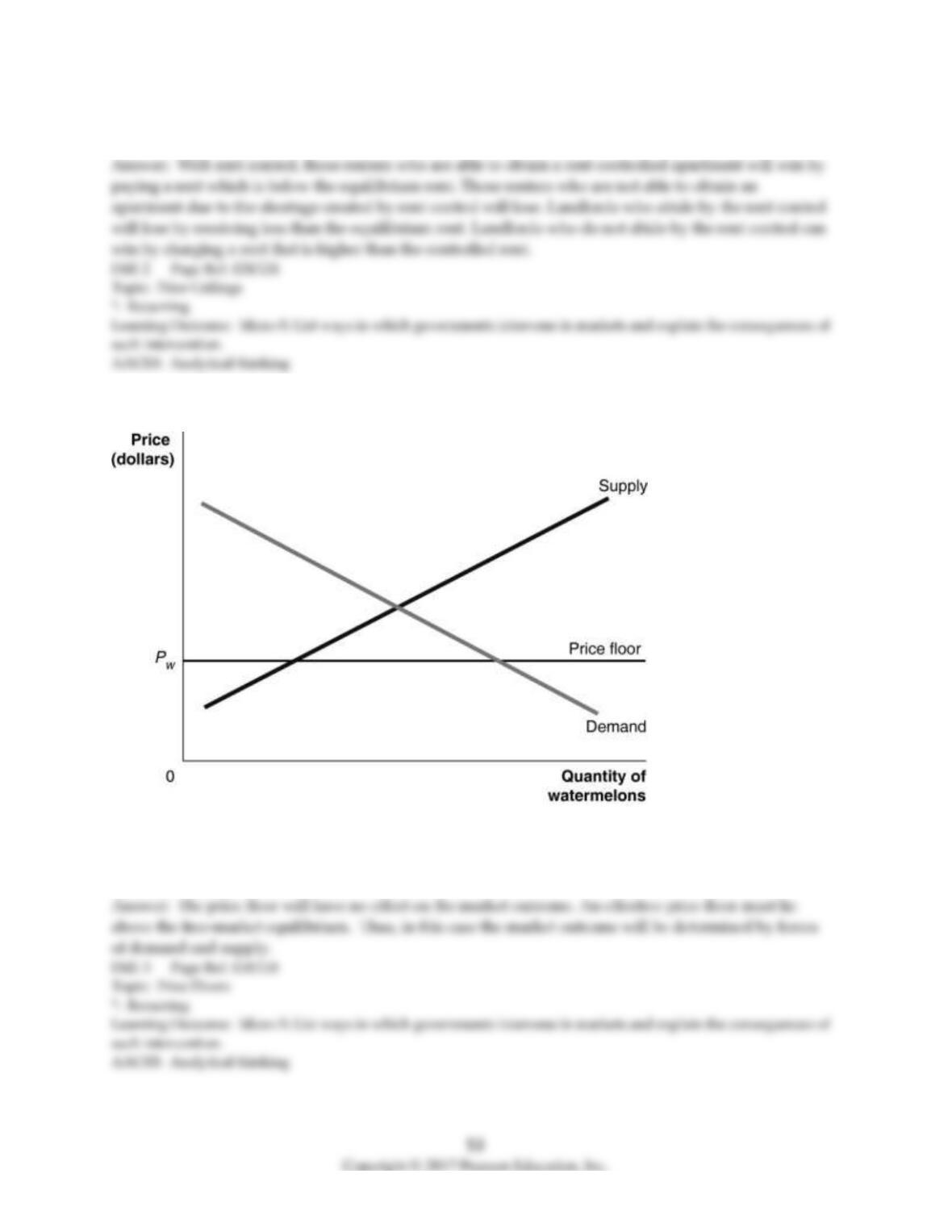
Figure 4-7
57) Refer to Figure 4-7 which shows the market for watermelons. Suppose the government imposes a
price floor of Pw. How will the price floor affect the quantity supplied, quantity demanded, and
quantity exchanged?
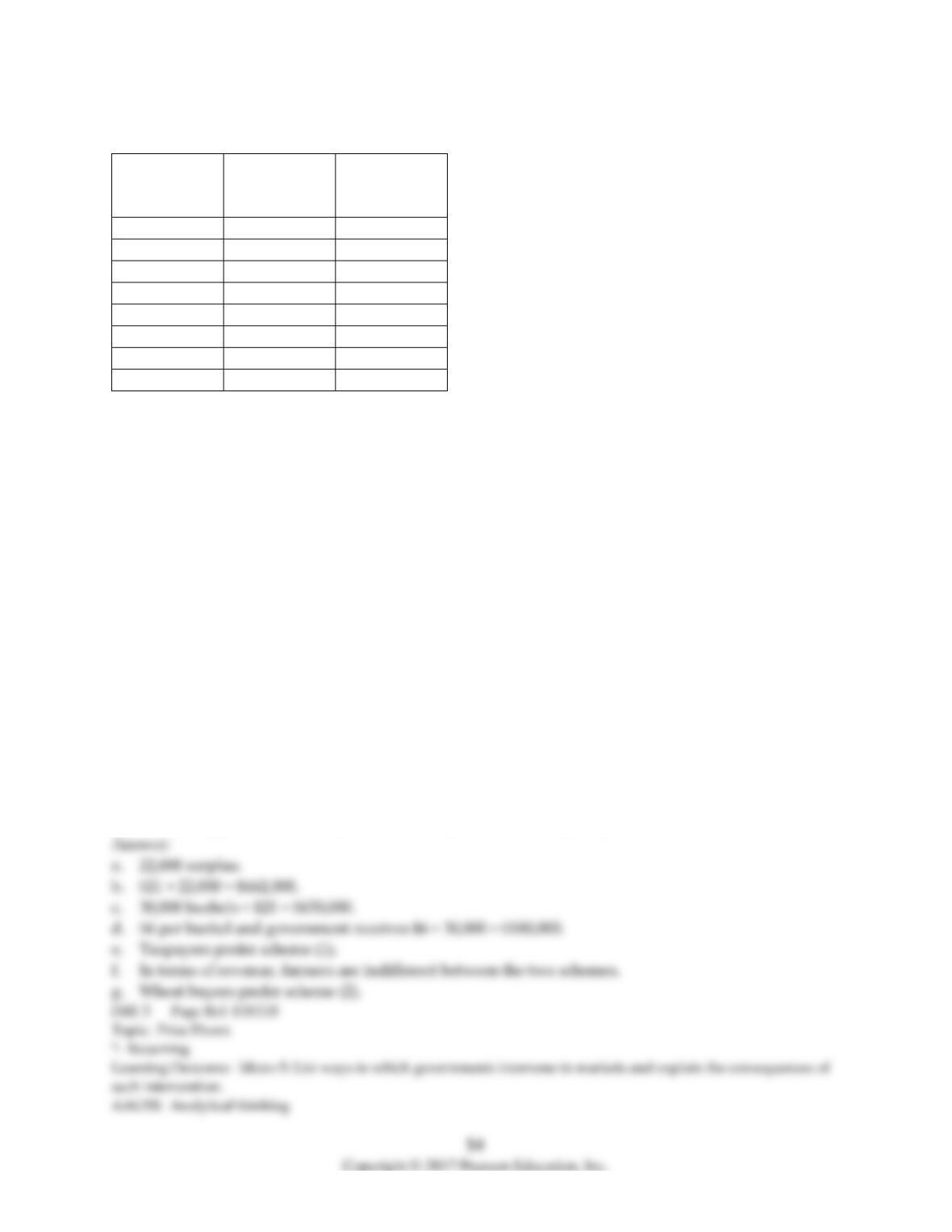
Table 4-5
Price Per
Bushel
(dollars)
Quantity
Demanded
(bushels)
Quantity
Supplied
(bushels)
$3
36,000
0
6
30,000
2,000
9
25,000
5,000
12
20,000
10,000
15
16,000
16,000
18
13,000
23,000
21
8,000
30,000
24
3,000
36,000
Table 4-5 above contains information about the wheat market. Answer the following questions based on
this table.
58) Refer to Table 4-5. An agricultural price floor is a price that the government guarantees farmers will
receive for a particular crop. Suppose the federal government sets a price floor for wheat at $21 per
bushel.
a. What is the amount of shortage or surplus in the wheat market as result of the price floor?
b. If the government agrees to purchase any surplus output at $21, how much will it cost the
government?
c. If the government buys all of the farmers’ output at the floor price, how many bushels of wheat will
it have to purchase and how much will it cost the government?
d. Suppose the government buys up all of the farmers’ output at the floor price and then sells the
output to consumers at whatever price it can get. Under this scheme, what is the price at which the
government will be able to sell off all of the output it had purchased from farmers? What is the revenue
received from the government’s sale?
e. In this problem we have considered two government schemes: (1) a price floor is established and
the government purchases any excess output and (2) the government buys all the farmers’ output at the
floor price and resells at whatever price it can get. Which scheme will taxpayers prefer?
f. Consider again the two schemes. Which scheme will the farmers prefer?
g. Consider again the two schemes. Which scheme will wheat buyers prefer?
55
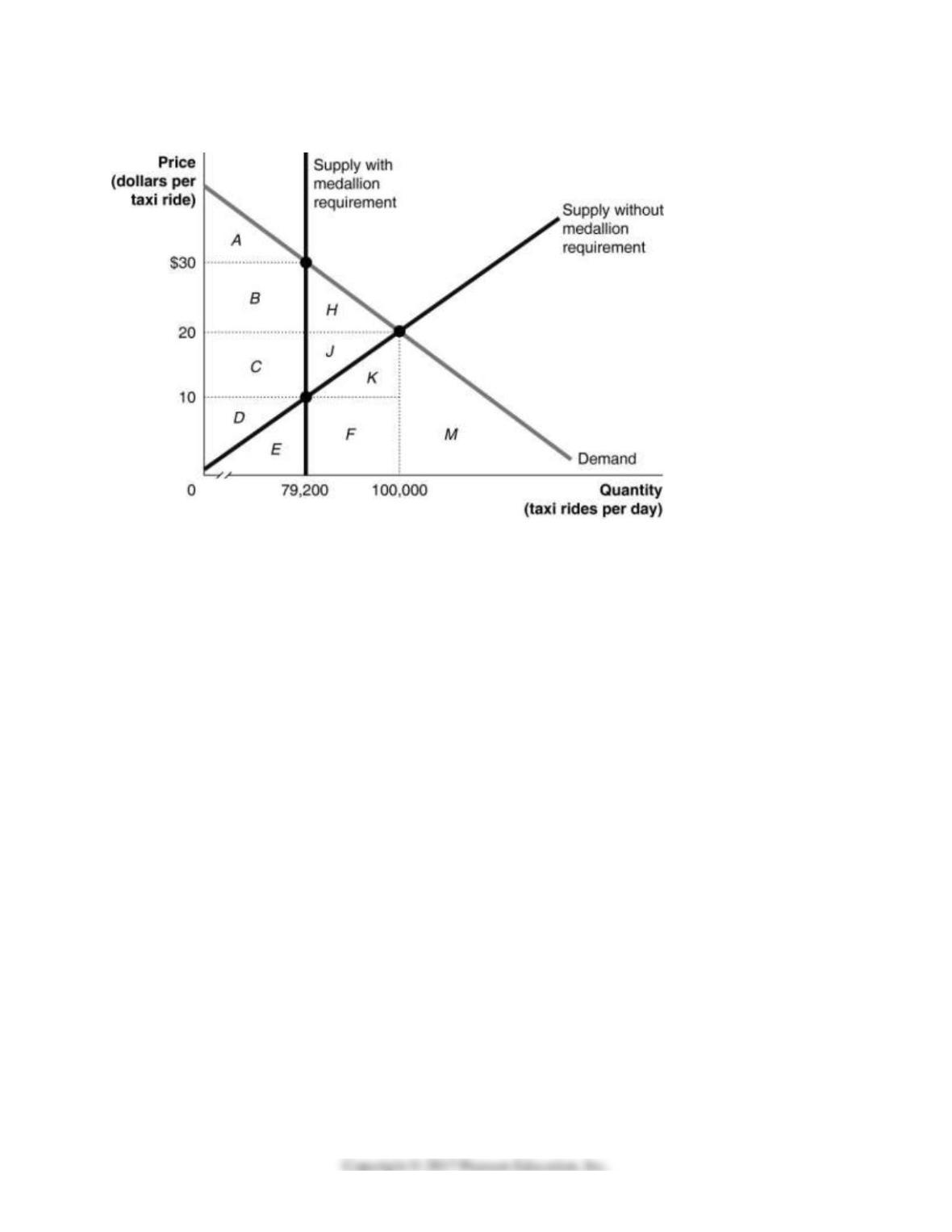
Figure 4-8
Figure 4-8 shows the market for taxi rides. The following question(s) are based on this figure.
59) Refer to Figure 4-8. To legally drive a taxicab in New York City, you must have a medallion issued
by the city government. Assume that only 13,200 medallions have been issued. Let’s also assume this
puts an absolute limit on the number of taxi rides that can be supplied in New York City on any day,
because no one breaks the law by driving a taxi without a medallion. Assume as well that each taxi
provides 6 trips per day. In that case, the quantity of taxi rides supplied is 79,200 (or 6 rides per taxi ×
13,200 taxis). This is shown in the diagram with a vertical line at this quantity. Assume that there are no
government controls on the prices that drivers can charge for rides.
a. What would the equilibrium price and quantity be in this market if there was no medallion
requirement?
b. If there was no medallion requirement, indicate the area that represents consumer surplus.
c. If there was no medallion requirement, indicate the area that represents producer surplus.
d. If there was no medallion requirement, indicate the area that represents economic surplus.
e. What are the price and quantity with the medallion requirement?
f. With a medallion requirement in place, what area represents consumer surplus?
g. With a medallion requirement in place, what area represents producer surplus?
h. With a medallion requirement in place, what area represents the deadweight loss?
i. Based on your answers to parts (c) and (g), are taxicab drivers better off with the medallion
requirement for taxicabs than without?
j. Are consumers better off with or without the medallion requirement for taxicabs?
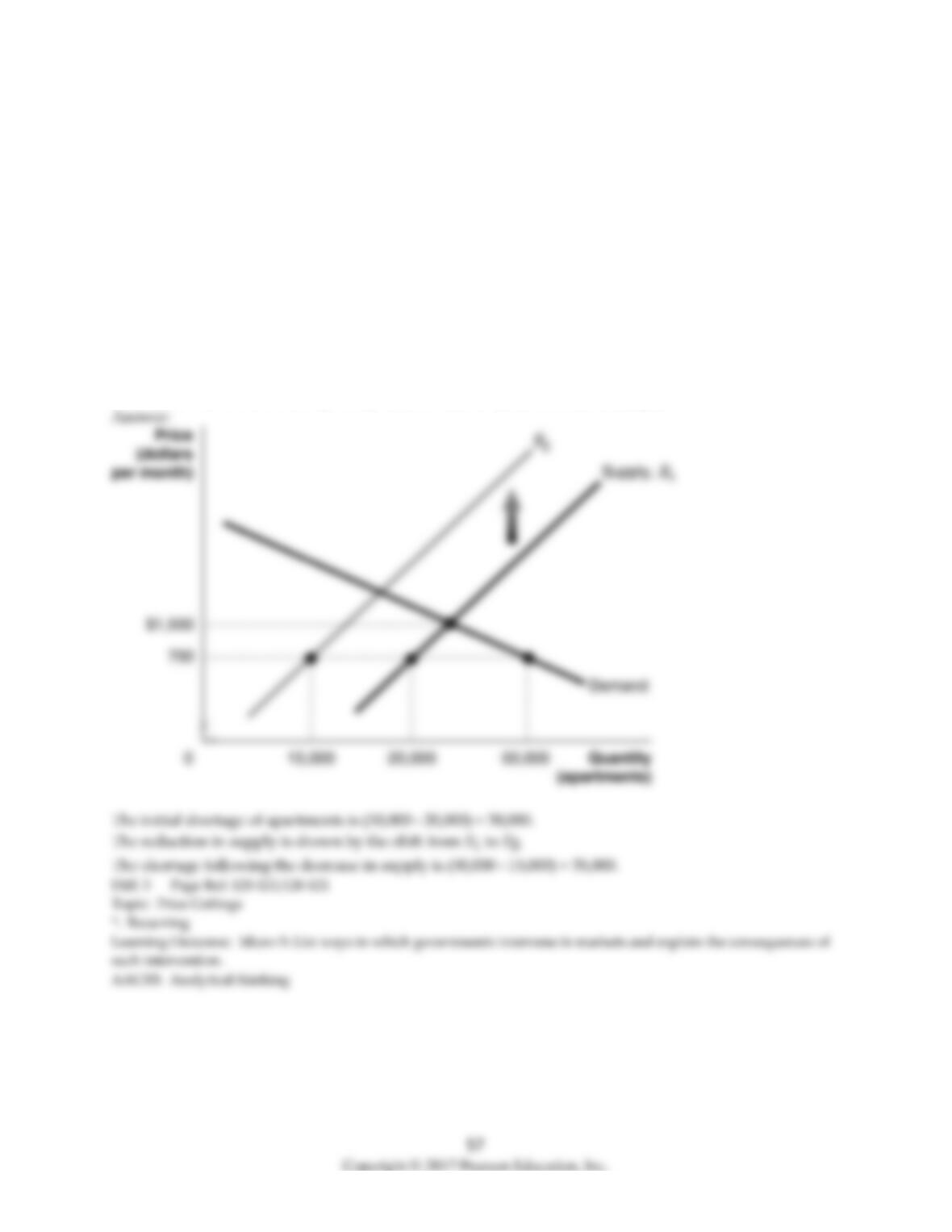
60) Using a supply and demand graph, illustrate the market for rent-controlled apartments with the
following data:
Equilibrium rent without rent control: $1,500
Rent with rent control: $700
Quantity of apartments demanded with rent control: 50,000
Quantity of apartments supplied with rent control: 20,000
What is the value of the initial shortage of apartments with rent control?
Now assume rent control leads to a reduction in the supply of apartments, and the new quantity
supplied is now 15,000. Illustrate this on your graph.
What is the value of the shortage of apartments following the decrease in supply?
4.4 The Economic Effect of Taxes
1) Tax incidence is the actual division of the
A) burden of the tax between buyers and sellers in a market.
B) tax revenues between government agencies.
C) tax revenues between the federal government and state governments.
D) population into different tax brackets.
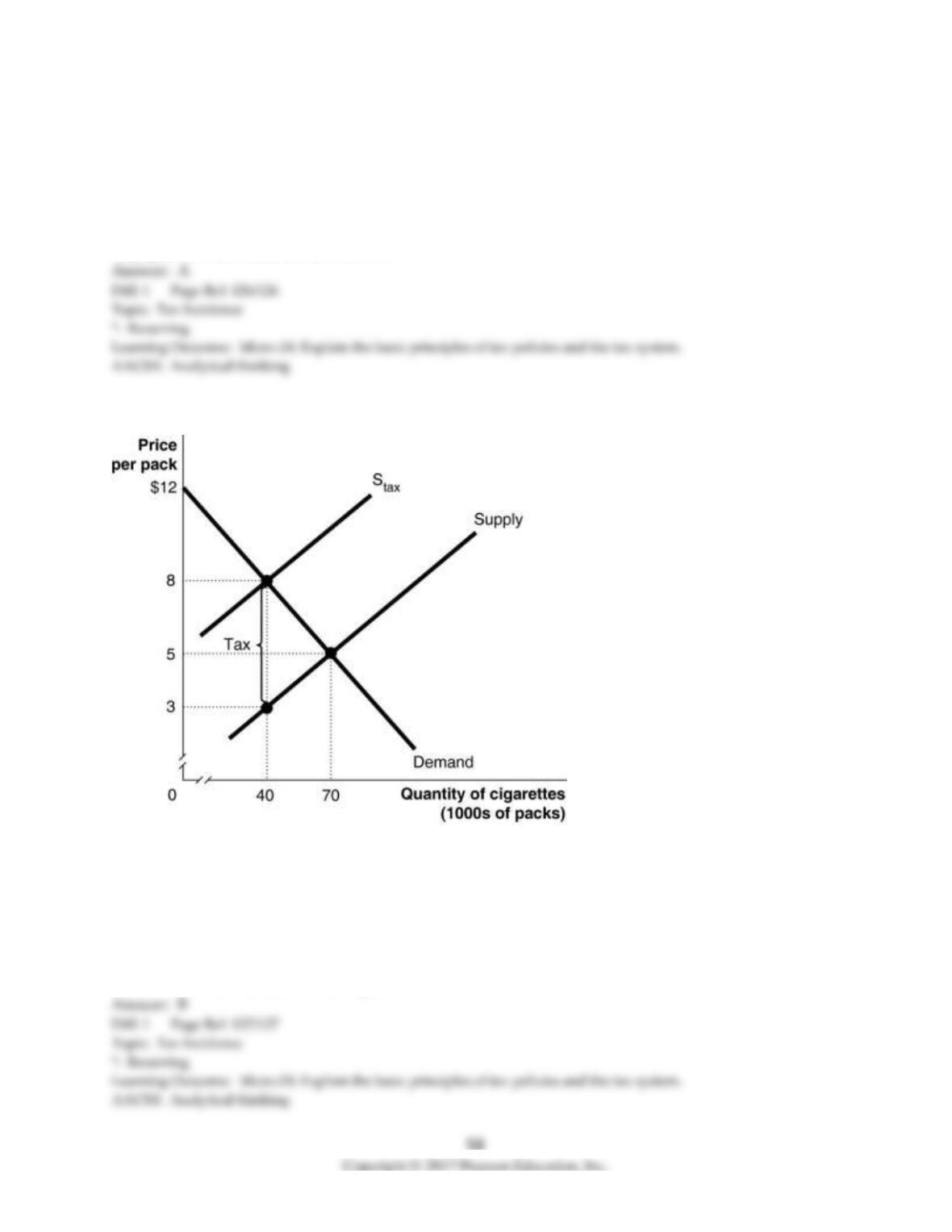
Figure 4-9
Figure 4-9 shows the market for cigarettes. The government plans to impose a unit tax in this market.
2) Refer to Figure 4-9. What is the size of the unit tax?
A) $8
B) $5
C) $3
D) cannot be determined from the figure