20) The four parts of the business cycle occur in the following order
A) recession, trough, peak, expansion.
B) expansion, trough, peak, recession.
C) recession, trough, expansion, peak.
D) expansion, trough, recession, peak.
21) Which of the following are parts of the business cycles?
A) peak and potential GDP
B) real GDP and potential GDP
C) recession and expansion
D) inflation and recession
22) Which of the following is TRUE regarding business cycles?
I. Cycles are predictable.
II. In each cycle, a peak follows an expansion.
III. Potential GDP fluctuates around real GDP.
A) I and II
B) I and III
C) II and III
D) II only
23) A common definition of a recession is a time with
A) a decline in the price level.
B) a decline in interest rates.
C) a decrease in real GDP for two or more successive quarters.
D) a decrease in real GDP for two or more successive years.
24) A recession is commonly defined as a period with
A) negative growth rate in real GDP that lasts at least one quarter.
B) positive growth rate in real GDP that lasts at least one quarter.
C) positive growth rate in real GDP that lasts at least two quarters.
D) negative growth rate in real GDP that lasts at least two quarters.
25) A common definition of a recession is a period of time
A) of at least 6 months during which real GDP decreases.
B) with an increase in real economic output from the previous period.
C) with no change in real GDP.
D) with no change in the dollar (money) value of economic output.
26) A recession is commonly defined as occurring when
A) real GDP decreases for a period of 12 or more months.
B) real GDP decreases for a period of 6 or more months.
C) the unemployment rate rises above 7.5 percent for 6 or more months.
D) the unemployment rate rises above 5.0 percent for 12 or more months.
27) By common definition, a recession occurs when
A) the international deficit worsens for at least two successive quarters.
B) the government budget deficit exceeds the national debt.
C) the inflation rate exceeds 3.5 percent.
D) real GDP decreases for at least two successive quarters.
28) Recessions are commonly defined to occur
A) whenever unemployment increases.
B) when growth in real GDP decreases for two consecutive quarters.
C) when growth in real GDP is negative for two consecutive quarters.
D) when the unemployment rate exceeds 6 percent.
29) Real GDP decreases during
A) the movement from trough to peak.
B) the movement from below potential GDP back to potential GDP.
C) the movement from peak to trough.
D) a decrease in unemployment.
30) When a recession ends, the turning point that immediately follows is called a
A) trough.
B) peak.
C) depression.
D) None of the above answers is correct.
31) The low point of economic activity during a business cycle is called the
A) trough.
B) recession.
C) peak.
D) failure.
32) What term is used to describe the lowest point of a business cycle?
A) peak
B) trough
C) expansion
D) recession
33) A trough is the
A) lower turning point of a business cycle when an expansion begins.
B) lower turning point of a business cycle when a recession begins.
C) upper turning point of a business cycle when an expansion begins.
D) upper turning point of a business cycle when a recession begins.
34) An expansion occurs when the level of real GDP is
A) increasing.
B) decreasing.
C) at a cyclical peak.
D) at a cyclical trough.
35) An expansion
A) follows a peak.
B) is defined as a period of negative real GDP growth.
C) comes just before a trough.
D) is defined as a period of real GDP increases.
36) An expansion ends when the economy
A) hits a trough and then enters a recession.
B) hits a peak and then enters a recession.
C) begins to grow following a peak.
D) has grown for two quarters in a row.
37) The times during which real GDP increases are referred to as
A) contractions.
B) expansions.
C) anti-cycles.
D) corrections.
38) Suppose the country of Dingo experienced an economic trough in January 2011. We can
conclude that
A) real GDP in Dingo was increasing in January 2011.
B) an expansion occurred after January 2011.
C) Dingo did not experience a recession in 2010.
D) Dingo’s potential GDP fell in 2011.
39) An economy recovering from a recession
A) moves up from its trough to a period of expansion.
B) moves up from its peak to a period of expansion.
C) moves down from its trough to a period of depression.
D) moves down from its peak to a period of expansion.
40) An economic expansion rather than a recession occurs
A) when the federal budget is balanced.
B) when the unemployment rate falls below 5 percent.
C) when growth in real GDP is positive.
D) when the unemployment rate is not changing.
41) A peak is the
A) lower turning point of a business cycle when an expansion ends.
B) lower turning point of a business cycle when a recession ends.
C) upper turning point of a business cycle when an expansion ends.
D) upper turning point of a business cycle when a recession ends.
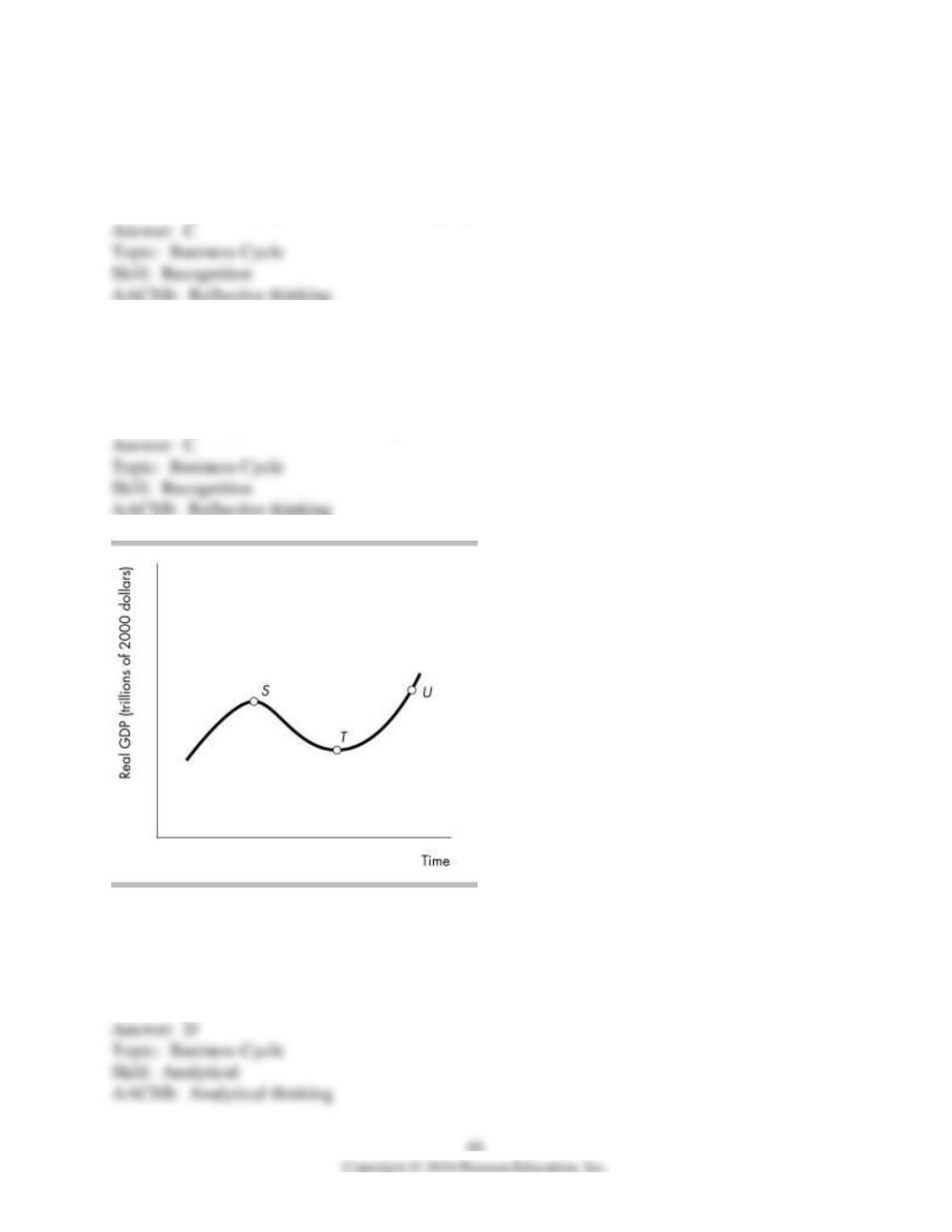
42) In the above figure, the distance between points S and T represents
A) an expansion.
B) a trough.
C) a peak.
D) a recession.
43) In the above figure, the distance between points T and U represents
A) an expansion.
B) a trough.
C) a peak.
D) a recession.
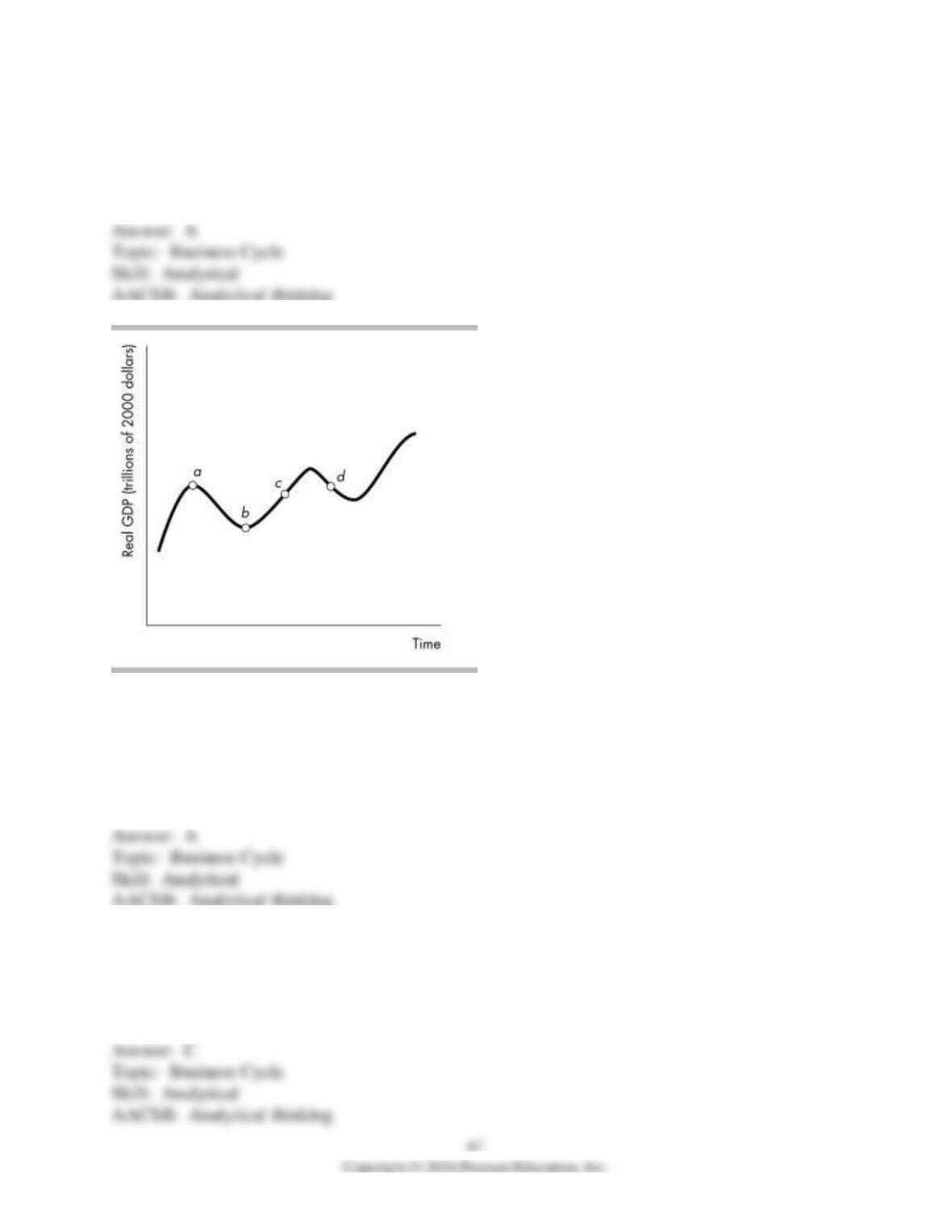
44) In the above figure, a recession begins at point ________ and an expansion begins at point
________.
A) a; b
B) b; c
C) b; a
D) d; c
45) In the above figure, a trough is at point ________ and a peak is at point ________.
A) a; b
B) b; c
C) b; a
D) d; c
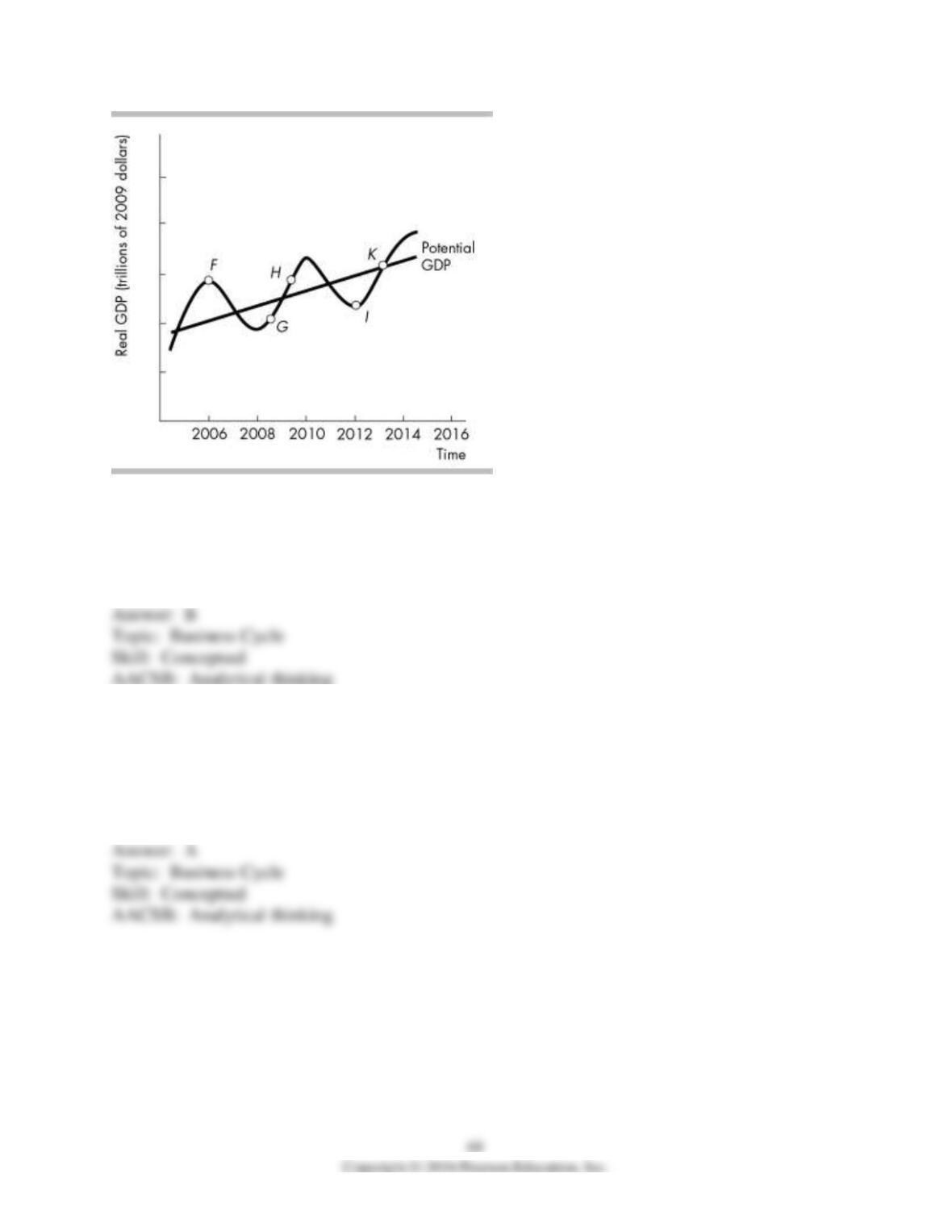
46) In the above figure, which point represents the under use of resources?
A) point F
B) point G
C) point H
D) point K
47) In the above figure, which point represents a situation with significant shortages of labor,
capital, and other resources?
A) point F
B) point G
C) point I
D) point K
48) In the above figure, which point represents an economy which is at the peak part of a
business cycle?
A) point F
B) point G
C) point I
D) point K
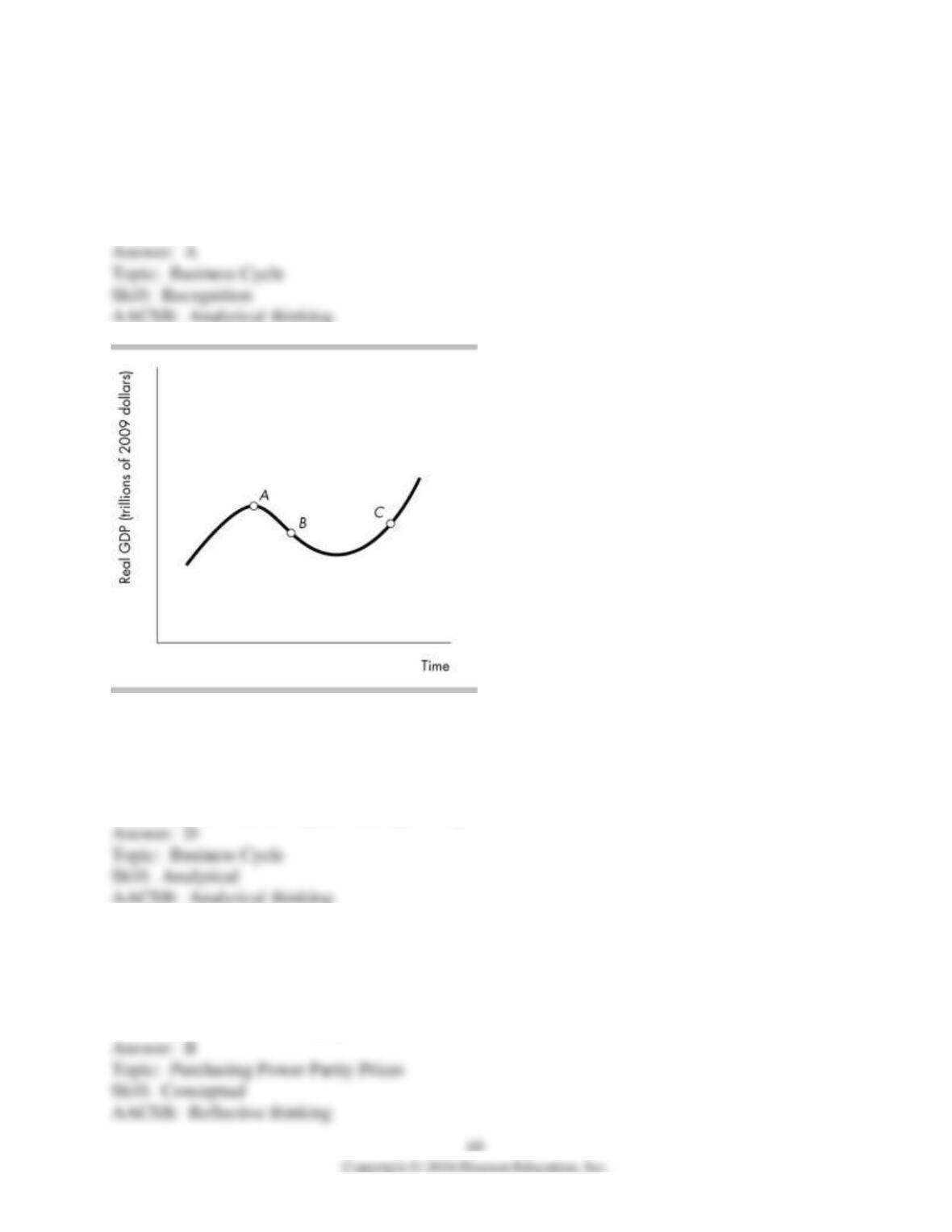
49) In the above figure, the letters A, B, and C represent which positions in the business cycle?
A) peak, expansion, and recession, respectively
B) recession, expansion, and peak, respectively
C) expansion, peak, and recession, respectively
D) peak, recession, and expansion, respectively
50) Purchasing power parity prices are used to construct GDP data that
A) do not omit the underground economy.
B) can be used to make more valid comparisons between one country and another.
C) is a proper measure of economic welfare.
D) adjust for differences in population.
51) If we compare the U.S. GDP and the Chinese GDP
A) real GDP per person is about the same in the two countries.
B) U.S. real GDP per person is less than China’s real GDP per person once we adjust for
currency differences.
C) China’s real GDP per person is less than real GDP per person in the United States.
D) real U.S. GDP per person was much larger than China’s real GDP per person when
purchasing power parity prices are used but is less than China’s real GDP per person when
exchange rate prices are used.
52) The use of purchasing power parity prices
A) decreases the real GDP per person statistics published by the International Monetary Fund.
B) weakens the validity of cross country comparisons of economic welfare.
C) increases the amount by which U.S. GDP is larger than that of any other nation.
D) accounts for differences in the prices of the same goods in different countries when
measuring real GDP.
53) Real GDP is not a perfect indicator of economic welfare because ________.
A) it includes the underground economy
B) it includes a direct measure of health and life expectancy
C) it underestimates inflation
D) economic welfare depends on many factors not measured or not measured accurately by real
GDP
54) Real GDP does not show the state of economic welfare in a country in part because GDP
omits
I. household production.
II. leisure time available.
III. the quality of the environment.
A) I only
B) I and III
C) II and III
D) I, II and III
55) Real GDP can be criticized as a measure of economic welfare because it
A) does not include the value of products produced in the household.
B) does not take account of the degradation of environmental quality.
C) does not include leisure time available to a society.
D) All of the above answers are correct.
56) Which, if any, of the following causes a country’s reported GDP to be less than its total
economic production?
A) the exclusion of household production
B) the exclusion of government transfers
C) the inclusion of government expenditures
D) None of the above cause reported GDP to be less than total production.
57) In calculating GDP, household production is
A) included as part of consumption.
B) ignored because it is not a large amount.
C) not included because there is no market transaction.
D) included under employee compensation.
58) Which of the following is NOT included in real GDP?
A) production of services, such as the services of doctors
B) production of goods that last more than one year, such as television sets
C) production of goods that do not last more than one year, such as gasoline
D) production in the home
59) If a larger fraction of the adult population is working in the marketplace, household
production
A) counted in real GDP increases.
B) not counted in real GDP increases.
C) counted in real GDP decreases.
D) not counted in real GDP decreases.
60) Reported GDP increases when, in fact, total production is unchanged when
I. there is a shift from household production to market production.
II. a previously illegal activity is legalized.
A) I only
B) II only
C) neither I nor II
D) both I and II
61) When calculating GDP, underground economic activity is
A) the production of goods and services in the home.
B) that portion of the time when we are enjoying leisure activities and not producing marketable
goods.
C) the part of the economy purposely hidden.
D) an aspect of the quality of life, such as health and life expectancy.
62) Which of the following is NOT included in real GDP?
A) production of services, such as the services of hair dressers
B) production of goods that last less than a year, such as production of hot dogs
C) production that takes place in the underground economy
D) production of goods that last more than a year, such as a pair of roller blades
63) Because pollution reduces economic welfare, on this count real GDP as measured
A) decreases as pollution increases.
B) increases to take into account the expenditures that will be made in the future to clean up the
pollution.
C) overstates economic welfare.
D) understates economic welfare.
64) In the post-World War II period, considerable growth in total production took place in the
United States. But at the same time, businesses were dumping their waste into the Great Lakes
with minimal cost to themselves, significantly polluting the bodies of water as a result. This
occurrence is an example where
A) real GDP gives an overly positive view of economic welfare.
B) real GDP gives an overly negative view of economic welfare.
C) investment would have been a better measure of total production.
D) the pollution counts as a final good.
65) Which of the following would lead GDP to overstate economic welfare?
A) the existence of home-cooked meals
B) restaurant workers that under-report tip income
C) a self-employed CPA who takes a longer than normal vacation
D) electric utilities that switch to burning coal because of higher natural gas prices and thereby
create more acid rain pollution
66) Pollution is a by-product of some production processes, so on this count real GDP as
measured
A) is adjusted downward to take into account the pollution.
B) is adjusted upward to take into account the expenditures that will be made in the future to
clean up the pollution.
C) tends to overstate economic welfare.
D) tends to understate economic welfare.
67) Which of the following is NOT a reason that real GDP is a poor measure of a nation’s
economic welfare?
A) Real GDP omits measures of political freedom.
B) Real GDP does not take into account the value of people’s leisure time.
C) Real GDP does not include the underground economy.
D) Real GDP overvalues household production.
68) Which of the following statements about the comparison between GDP in China and in the
United States is CORRECT?
A) Using the exchange rate to value China’s GDP in dollars shows that China’s GDP per person
exceeds the GDP per person in the United States.
B) Using purchasing power parity prices to value China’s GDP in dollars shows that China’s
GDP per person exceeds the GDP per person in the United States.
C) China’s GDP per person is higher using purchasing power parity prices rather than the
exchange rate when valuing China’s GDP in dollars.
D) None of the above answers are correct because they are all false statements.
69) What we produce during our working time is ________ as part of GDP and the enjoyment
we gain from our leisure time is ________ as part of GDP.
A) included; not included
B) included; included
C) not included; included
D) not included; not included
4 News Based Questions
“As the credit crisis unfolded over the past year, one of the few certainties in the global economy
seemed to be China’s ability to plough on regardless of double-digit growth rates…The …crisis
has also focused …on the need to update a growth model that…is still dependent on assembling
goods for export without adding much value and on heavy industries that create pollution.
Chinese companies have continued to find new foreign markets for their products…several other
factors point to a slowing property market…production of steel, cement and air conditioners was
down… Retail sales have risen by 23 per cent in each of the last two months”.
Beijing’s Burden, www.FT.com, by Geoff Dyer, Sept. 23, 2008
1) According to the article, ________ are expected to contribute ________ to China’s real GDP
in 2008.
A) exports and consumption; positively
B) consumption and government spending; negatively
C) exports and investment; negatively
D) rental income and investment; negatively
2) According to the article, ________ can be expected to ________ this year.
A) exports; increase
B) consumption; decrease
C) imports; decrease
D) net interest income; decrease
3) According to the article, ________ is expected to increase and add to China’s ________
component of GDP.
A) retail sales; consumption
B) retail sales; investment
C) rental income; investment
D) rental income; exports
Canada’s economy expanded by…0.1 percent in the second quarter…further evidence that the
economy has stalled…following a first quarter slip in gross domestic product. The second quarter
figures fell well below forecasts of a 0.7 per cent growth in real GDP. Exports….fell for the
fourth consecutive quarter. The accumulating gloom is increasingly discouraging business
investment. Consumer spending remains strong and corporate profits were at their highest since
2004. “The sources of strength in the second quarter are clearly unsustainable,” said Sal Gautieri,
senior economist at BMO capital markets.
Canada Avoids Fall into Recession, www.FT.com, by Christopher Mason,
August 30, 2008
4) According to the article, the best description of Canada’s position in the business cycle is
A) at a peak.
B) at a trough.
C) in an expansion.
D) in a recession.
5) According to the article, ________ in ________ have contributed to Canada’s ________
change in real GDP.
A) increases; consumption and exports; expected
B) decreases; exports and investment; unexpected
C) increases; consumption and investment; unexpected
D) decreases; exports and government spending; expected
6) It is estimated that in 2007, Mexico had a population of 110 million and Brazil had a
population of 190 million. At the same time, Mexico’s GDP was $1 trillion while Brazil’s was
$1.31 trillion. These data show that
A) Brazil had a healthier economy than did Mexico.
B) Mexico’s GDP per person was lower than was Brazil’s GDP per person in 2007.
C) Mexico’s GDP per person was $9090 in 2007.
D) Brazil’s GDP per person was $5300 in 2007.
7) It is estimated that in 2007, Mexico had a population of 110 million and GDP of $1 trillion. In
2006, Mexico’s population was 104 million and GDP was $839 billion. Per GDP person
________ by ________ between 2006 and 2007 in Mexico.
A) increased; $1038
B) increased; 5 percent
C) decreased; $2013
D) decreased; 5 percent
8) The following data describe Mexico’s economy in 2007.
Government spending $210 billion
Investment $210 billion
Exports $272 billion
Imports $283 billion
GDP 1 trillion
Population 110 million
From the data, we can conclude that ________ in Mexico in 2007.
A) consumption totaled $591 billion
B) net exports totaled -$11 billion
C) GDP per person equaled $2000
D) imports were the largest component of GDP
9) The following data describe France’s economy in 2008.
Consumption 234 billion euros
Government expenditure 93 billion euros
Investment 88 billion euros
Exports 128 billion euros
Imports 137 billion euros
From the data, we can conclude that in France
A) net exports totaled -11 billion euros.
B) GDP equaled 424 billion euros.
C) GDP equaled 680 billion euros.
D) Net exports totaled 265 billion euros.
10) The following data are estimates describing Ireland’s economy in 2006 and 2007 (in millions
of euros, in constant prices):
2006 2007
Consumption 84,000 89,000
Government expenditure 24,000 26,000
Investment 48,000 48,000
Exports 142,000 151,000
Imports 123,000 128,000
Subsidies 1,800 1,900
Taxes 500 500
Ireland’s real GDP in 2007 was ________ million euros.
A) 442,000
B) 186,000
C) 188,400
D) 163,000
11) The following data are estimates describing Ireland’s economy in 2006 and 2007 (in millions
of euros, in constant prices):
2006 2007
Consumption 84,000 89,000
Government expenditure 24,000 26,000
Investment 48,000 48,000
Exports 142,000 151,000
Imports 123,000 128,000
Subsidies 1,800 1,900
Taxes 500 500
In 2007, Ireland’s net exports was ________ million euros.
A) 23,000
B) -23,000
C) 279,000
D) 149,100
12) The following data are estimates describing Ireland’s economy in 2006 and 2007 (in millions
of euros, in constant prices):
2006 2007
Consumption 84,000 89,000
Government expenditure 24,000 26,000
Investment 48,000 48,000
Exports 142,000 151,000
Imports 123,000 128,000
Subsidies 1,800 1,900
Taxes 500 500
Which of the following is TRUE regarding Ireland’s economy?
A) The change in GDP from 2006 to 2007 represented a peak in the business cycle.
B) GDP decreased from 2006 to 2007.
C) Net exports decreased from 2006 to 2007.
D) Consumption was 48 percent of Ireland’s GDP in 2007.
“Life expectancy is exceptionally high in Japan. Scores for political freedom and civil liberties
approach those of peer countries in Europe…equality of opportunity is extremely weak. The
country also possesses one of the longer working weeks.” Japan’s GDP was estimated to be $4.2
trillion (purchasing power parity) and the population was 127.4 million.
“Driven by its attractive climate, Brazil performs substantially better on Life Satisfaction than
Material Wealth. High international demand for Brazil’s commodities and raw materials has
produced a sustained economic expansion since 2004, which in turn has led to job creation, wage
growth and relatively low inflation. Brazilians report that they control their own lives to a
substantial degree.” Brazil’s GDP was estimated to be $1.7 trillion (purchasing power parity) and
190 million in 2006.
www.prosperity.com
13) According to the article, we can conclude that the standard of living
A) is higher in Brazil because its citizens feel more control over their lives and have experienced
job and wage growth.
B) is higher in Japan because their life expectancy is longer.
C) is higher in Japan because its GDP is higher.
D) might be higher in Japan because it has a higher per capita real GDP but other factors such as
Brazilians’ satisfaction with their lives and economic growth should be considered when
determining economic well-being.
14) According to the information, Japan’s real GDP per person
A) is higher than Brazil’s and therefore we can definitely conclude that economic well-being is
higher in Japan.
B) is $33,000.
C) is lower than Brazil’s, but its real GDP is higher which makes standard of living higher in
Japan.
D) cannot be expected to change much given the other factors affecting GDP growth including
political freedom and life expectancy.
15) “German economic growth slowed … Economic growth slowed to 0.3 percent from 0.5
percent. Expansion was driven by exports… (and) household consumption added …to growth. As
unemployment declines and disposable incomes increase, household spending may also gain
momentum.
www.bloomberg.com, August 23, 2007
We can conclude that the German economy
A) is at the peak of the business cycle.
B) has entered the expansion phase of the business cycle.
C) has slowed due to a decline in investment or government spending.
D) is in the recession phase of the business cycle.
16) The data show Argentina’s GDP (using purchasing power parity) in billions of dollars.
Year 1990 1991 1992 1993 1994 1995 1996 1997 1998 1999 2000 2001 2002
GDP($) 182 209 235 255 277 274 294 324 340 333 338 330 300
Year 2003 2004 2005 2006
GDP($) 333 373 420 470
The data show that
A) Argentina’s economy was in a recession from 2004 through 2006.
B) Argentina’s economy was in a recession in 2001 and 2002.
C) GDP per person more than doubled between 1990 and 2006.
D) Argentina’s economy reached a peak in 1996.