78) If your annual income rose by 10 percent and you increased your purchases of shoes from 2
pairs to 3 pairs each year, then your demand for shoes is
A) income inelastic and equal to 0.50.
B) income elastic and equal to 1.50.
C) income inelastic.
D) income elastic.
79) As Mary’s income increases by 20 percent, her demand for tickets to National Hockey
League games increases by 10 percent. Mary’s demand for tickets is income ________; for
Mary, hockey tickets are ________ good.
A) elastic; a normal
B) inelastic; a normal
C) elastic; an inferior
D) inelastic; an inferior
80) If when income increases by 2 percent and the price does not change, the quantity of airplane
travel demanded increases by 6 percent, then the income elasticity of demand of airplane travel is
________.
A) 0.33
B) 0
C) negative
D) 3.00
81) The income elasticity of demand for vacations is 5. If incomes increase by 3 percent next
year, the quantity of vacations demanded at today’s price will increase by ________ percent.
A) 3
B) 5/3
C) 15
D) 5
82) Fred’s income has just risen from $940 per week to $1,060 per week. As a result, he decides
to purchase 9 percent more steak per week. The income elasticity of Fred’s demand for steak is
A) 0.75.
B) 0.90.
C) 1.00.
D) 1.33.
83) Joan’s income has just risen from $940 per week to $1,060 per week. As a result, she decides
to purchase 12 percent more lettuce per week. The income elasticity of Joan’s demand for lettuce
is
A) 0.75.
B) 0.90.
C) 1.00.
D) 1.33.
84) A 10 percent increase in income increases the quantity of orange juice demanded from
19,200 to 20,800 gallons. The income elasticity of demand for orange juice is
A) 0.5.
B) 0.8.
C) 1.0.
D) 1.2.
85) A 10 percent increase in income increases the quantity of apple juice demanded from 18,800
to 21,200 gallons. The income elasticity of demand for apple juice is
A) 0.5.
B) 0.8.
C) 1.0.
D) 1.2.
86) In the nation of Transporta, the income elasticity of demand for used cars is -2.66. So when
incomes in this nation increase by 10 percent
A) the quantity of used cars demanded will increase by 26.6 percent.
B) used cars will be normal goods.
C) the quantity of used cars demanded will decrease by 26.6 percent.
D) the demand curve for used cars will shift rightward.
87) Duke increased his spending on steak from $7 to $11 per week because of a 12 percent salary
increase, so his
A) income elasticity of demand for steak is 1.37.
B) price elasticity of demand for steak is 1.37.
C) income elasticity of demand for steak is 3.7.
D) price elasticity of demand for steak is 3.7.
88) Last year, after Shirley received a 14 percent pay increase, she increased the quantity of pork
chops she purchased by 6 percent. Hence, her income elasticity of demand for pork chops equals
A) 0.43.
B) -0.43.
C) 2.33.
D) -2.33
89) If income increases by 2.0 percent, and quantity demanded of a good increases by 0.2
percent, the income elasticity for the good is
A) 0.22.
B) 0.002.
C) 0.10.
D) 1.00.
90) The income elasticity of demand for restaurant meals is 1.61. So
A) if income increases by 16.1 percent, the quantity demanded of restaurant meals will increase
by 10 percent.
B) if income increases by 10 percent, the quantity demanded of restaurant meals will increase by
16.1 percent.
C) restaurant meals are an income elastic normal good.
D) Both answers B and C are correct.
91) Last year when John graduated and received a 20 percent pay increase, the average number
of restaurant meals he consumed rose from one a week to three a week. Hence his income
elasticity for restaurant meals is
A) 0.50.
B) -0.50.
C) 5.00.
D) -5.00.
92) If a 10 percent increase in income results in an 8 percent increase in the quantity demanded
of a good, the income elasticity of demand equals ________ and the good is ________ good.
A) 0.80; an inferior
B) 1.2; a normal
C) 0.80; a normal
D) -1.2; an inferior
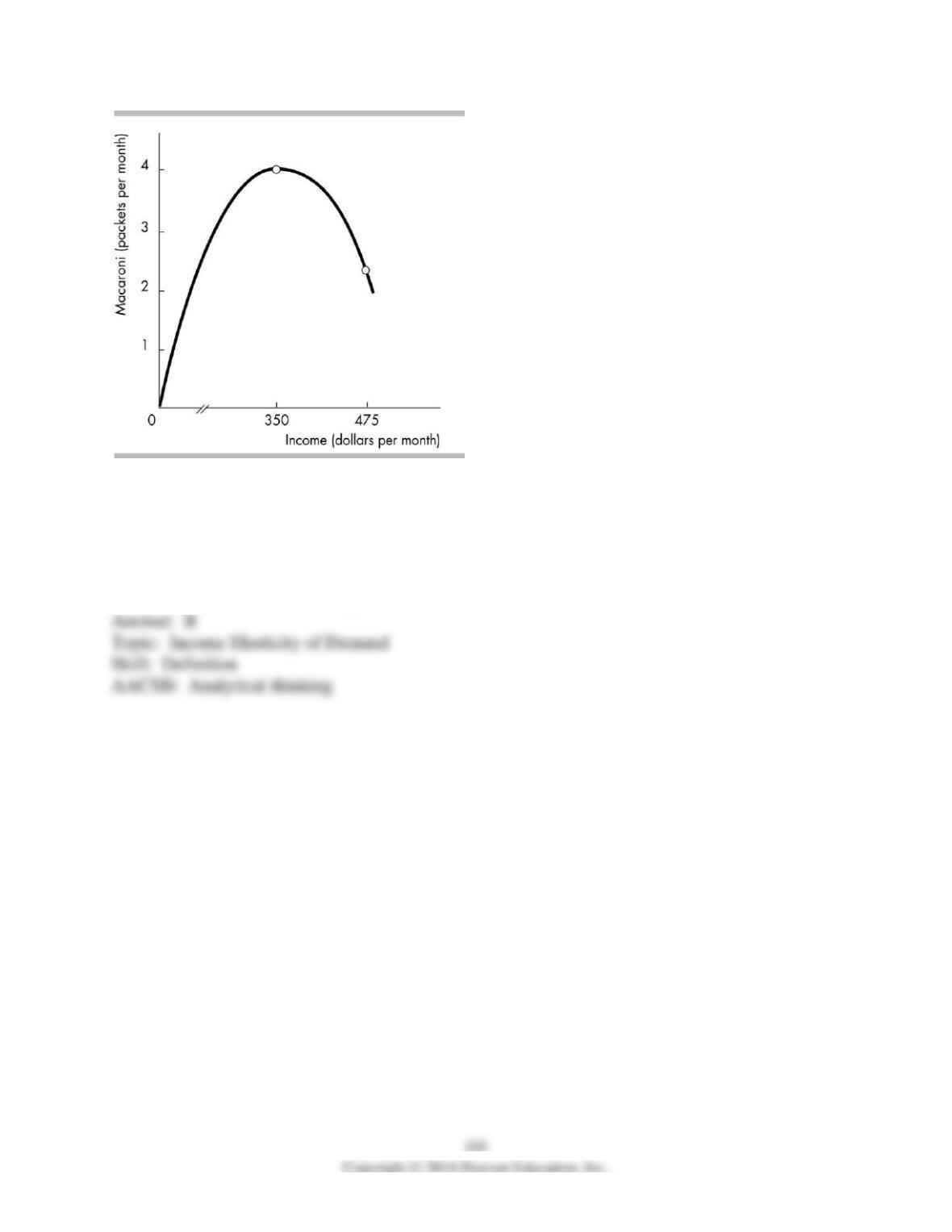
93) The figure shows the relationship between Moira’s income and the quantity of macaroni that
she demands. When income is less than $350 per month, macaroni ________.
A) is an inferior good
B) is a normal good
C) has many substitutes
D) has negative income elasticity
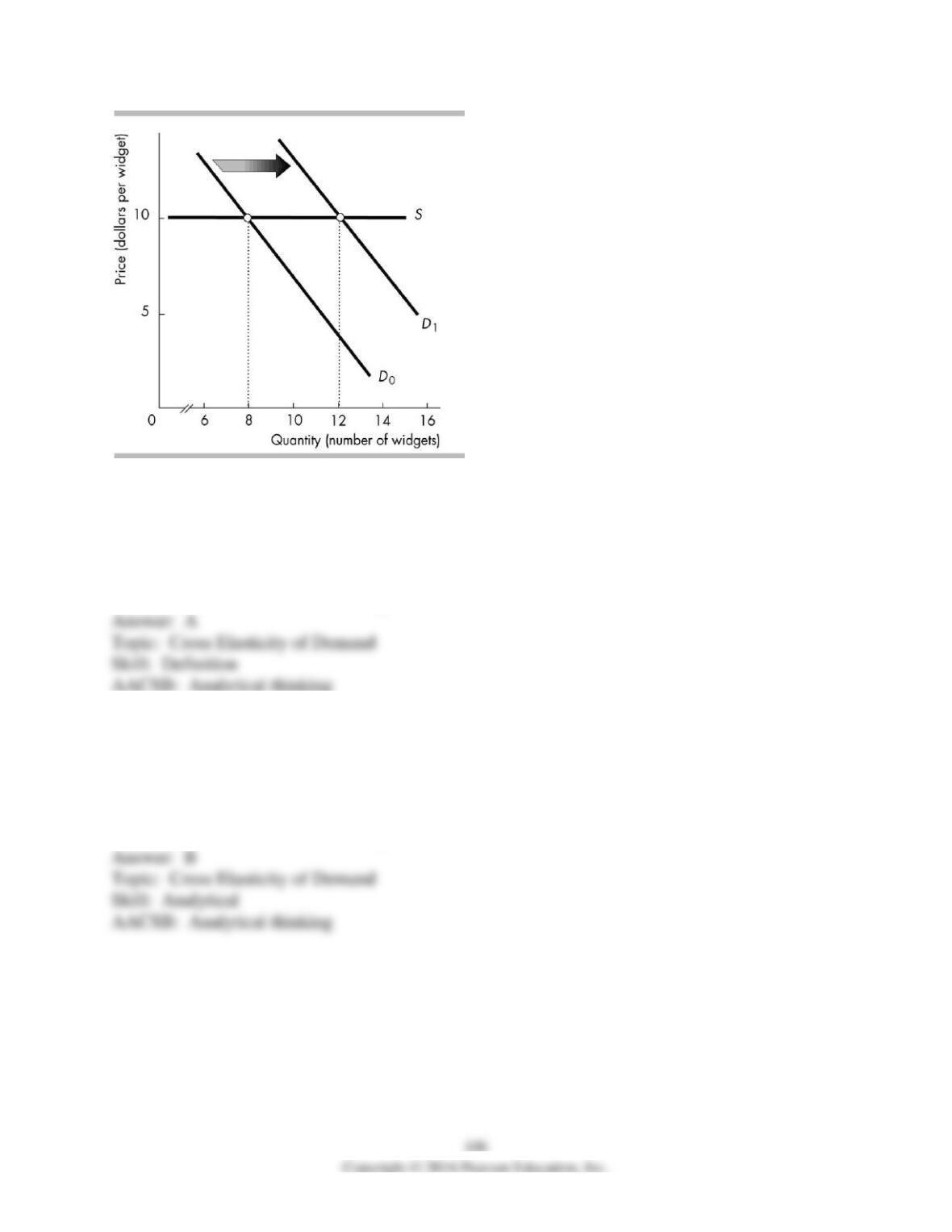
94) The increase in the demand for widgets, shown in the figure above, is the result of an
increase in the price of McBoover devices. Therefore
A) widgets and McBoover devices are substitutes.
B) widgets and McBoover devices are complements.
C) widgets are a normal good.
D) McBoover devices are a normal good.
95) The increase in the demand for widgets, shown in the figure above, is the result of a decrease
in the price of McBoover devices. Therefore
A) widgets and McBoover devices are substitutes.
B) widgets and McBoover devices are complements.
C) widgets are a normal good.
D) McBoover devices are a normal good.
96) The increase in the demand for widgets, shown in the figure above, is the result of an
increase in the price of McBoover devices from $9 to $11. Therefore, the cross-price elasticity
for these two products is
A) -2.0.
B) -0.5.
C) 0.5.
D) 2.0.
97) The increase in the demand for widgets, shown in the figure above, is the result of a decrease
in the price of McBoover devices from $11 to $9. Therefore, the cross-price elasticity for these
two products is
A) -2.0.
B) -0.5.
C) 0.5.
D) 2.0.
98) The increase in the demand for widgets, shown in the figure above, is the result of an
increase in income. Therefore, widgets
A) are a normal good.
B) are an inferior good.
C) are elastically demanded.
D) are inelastically demanded.
99) The increase in the demand for widgets, shown in the figure above, is the result of an
increase in people’s incomes from $28,500 per year to $31,500 per year. Therefore, the income
elasticity of demand for widgets is
A) 0.25.
B) 0.75.
C) 1.33.
D) 4.00.
100) As income rises, the share of income spent on food in the United States
A) falls.
B) remains constant at 15 percent.
C) remains constant at 33 percent.
D) rises.
101) For which of the following pairs of goods is the cross elasticity of demand positive?
A) tennis balls and tennis rackets
B) videotapes and laundry detergent
C) airline trips and textbooks
D) beef and chicken
102) A 10 percent decrease in the price of a Pepsi decreases the demand for a Coca-Cola by 50
percent. The cross elasticity of demand between a Pepsi and Coca-Cola is
A) 50.
B) 10.
C) 5.
D) 0.20.
103) A fall in the price of X from $12 to $8 causes an increase in the quantity of Y demanded
from 900 to 1,100 units. What is the cross elasticity of demand between X and Y?
A) 0.5
B) -0.5
C) 2
D) -2
104) A 10 percent decrease in income decreases the quantity demanded of pizza by 3 percent.
The income elasticity of demand for pizza is
A) -0.3.
B) 0.3.
C) 3.3.
D) 10.0.
105) All normal goods have
A) income elasticities of demand greater than 1.0.
B) price elasticities of demand greater than 1.0.
C) negative price elasticities of demand.
D) positive income elasticities of demand.
106) Suppose Target decided to lower the price on all shirts as part of its Back to School
promotion. The cross elasticity of demand between pants and shirts is negative. Lowering the
price on shirts will ________ the demand for pants because shirts and pants are ________.
A) increase; substitutes
B) decrease; substitutes
C) increase; complements
D) decrease; complements
1) The concept of elasticity of supply measures the responsiveness of the
A) quantity supplied to a change in the price.
B) price to a change in the quantity supplied.
C) quantity supplied to a change in the quantity demanded.
D) quantity demanded to a change in the quantity supplied.
2) The elasticity of supply measures the sensitivity of
A) supply to changes in costs.
B) quantity supplied to quantity demanded.
C) quantity supplied to a change in price.
D) price to changes in supply.
3) The price elasticity of supply is calculated as the
A) quantity supplied divided by the per unit cost of production.
B) quantity supplied divided by the percentage change in quantity demanded.
C) percentage change in quantity supplied divided by the percentage change in price.
D) percentage change in price divided by the percentage change in quantity demanded.
4) The demand for corn increases. As a result, the price of corn will ________, and the less
elastic the supply of corn, the ________ will be the effect on the price.
A) fall; smaller
B) fall; greater
C) rise; smaller
D) rise; greater
5) On most days the price of a rose is $1 and 80 roses are purchased. On Valentine’s Day the
demand increases so that the price of a rose rises to $2 and 320 roses are purchased. Therefore,
the price elasticity of
A) demand for roses is about 1.8.
B) demand for roses is about 0.55.
C) supply of roses is about 1.8.
D) supply of roses is about 0.55.
6) Supply is elastic if
A) a 1 percent change in price leads to a larger percentage change in quantity supplied.
B) a 1 percent change in price leads to a smaller percentage change in quantity supplied.
C) the slope of the supply curve is positive.
D) the good in question is a normal good.
7) If a 1 percent decrease in the price of a pound of oranges results in a smaller percentage
decrease in the quantity supplied
A) demand is elastic.
B) demand is inelastic.
C) supply is elastic.
D) supply is inelastic.
8) If a 1 percent decrease in the price of a pound of squash results in a larger percentage decrease
in the quantity supplied
A) demand is elastic.
B) demand is inelastic.
C) supply is elastic.
D) supply is inelastic.
9) If at a given moment, no matter what the price, producers cannot change the quantity supplied,
the momentary supply
A) has zero elasticity.
B) has unit elasticity.
C) has infinite elasticity.
D) does not exist.
10) If a rise in the price of oranges from $7 to $9 a bushel increases the quantity of bushels
supplied from 4,500 to 5,500 bushels, the
A) supply of oranges is elastic.
B) supply of oranges is inelastic.
C) demand for oranges is elastic.
D) demand for oranges is inelastic.
11) If the price of oil is $60 per barrel, the quantity of oil supplied is 70 million barrels per day.
If the price is $40 per barrel, the quantity of oil supplied is 69 million barrels per day. This
implies that the
A) supply of oil is elastic.
B) supply of oil is inelastic.
C) demand for oil is inelastic.
D) demand for oil is elastic.
12) If a shift in the demand curve that raises the price of oranges from $7 to $9 a bushel increases
the quantity of oranges supplied from 4,000 bushels to 6,000 bushels, the
A) supply of oranges is elastic.
B) supply of oranges is inelastic.
C) demand for oranges is elastic.
D) demand for oranges is inelastic.
13) A rise in the price of cabbage from $14 to $18 per bushel increases the quantity supplied
from 4,000 to 6,000 bushels. The elasticity of supply is
A) 0.6.
B) 0.8.
C) 1.0.
D) 1.6.
14) If a 5 percent increase in the price results in a 9 percent increase in quantity supplied, the
elasticity of supply is
A) 0.30.
B) 0.55.
C) 1.20.
D) 1.80.
15) If a 5 percent increase in price results in a 3 percent increase in the quantity supplied, the
elasticity of supply is
A) 0.30.
B) 0.60.
C) 1.20.
D) 1.66.
16) If the elasticity of supply of TV sets is equal to 3, then a 10 percent increase in the price of a
TV will
A) increase the quantity supplied by 3.33 percent.
B) increase the quantity supplied by 30.0 percent.
C) increase the quantity supplied by 0.33 percent.
D) decrease the quantity supplied by 30.0 percent.
17) An 18 percent increase in the price of a small car results in a 10 percent increase in the
quantity supplied. The price elasticity of supply is equal to
A) 1.80.
B) 0.55.
C) 0.75.
D) 0.40.
18) The price elasticity of supply of laptop computers equals 1.5 if
A) a rightward shift of the demand curve for laptops causes the quantity supplied to increase by
1.5 percent.
B) a rightward shift of the demand curve for laptops causes a 1.5 percent increase in their price.
C) for every 1 percent that laptop prices increase, computer makers produce another 1.5 percent
laptops.
D) for every $1.00 that laptops increase in price, computer makers produce another 150 laptops.
19) When the price of perfume changes from $24 to $26, the quantity supplied increases from
100 jars to 150 jars. What is the elasticity of supply of perfume?
A) 0.04
B) 25.0
C) 5.0
D) 0.2
20) If a 3 percent increase in the price of tennis shoes leads to a 7 percent increase in the number
of tennis shoes supplied
A) the elasticity of supply equals 0.43.
B) the elasticity of supply equals 2.33.
C) income elasticity equals 2.33.
D) supply is inelastic.
21) Suppose tennis shoes cost $50 per pair and firms supply 50,000 pairs of shoes. If the price
decreases to $45 and firms decide to supply 48,000, the elasticity of supply equals
A) 0.0025.
B) 0.04.
C) 2.63.
D) 0.39.
22) If the elasticity of supply is 4, a 10 percent increase in the price of a good leads to a
A) 40 percent increase in the quantity of supply.
B) 4 percent decrease in the quantity demanded.
C) 2.5 percent increase in the quantity supplied.
D) 2.5 percent decrease in the quantity demanded.
23) On December 10 the price of a Christmas tree is $50 and 100 trees are purchased. On
December 20 the demand for Christmas trees decreases so that the price falls to $30 and 20 trees
are purchased. From this set of facts, the
A) demand for Christmas trees is price inelastic.
B) demand for Christmas trees is price elastic.
C) supply of Christmas trees is inelastic.
D) supply of Christmas trees is elastic.
Price
(dollars per dozen)
Quantity supplied
(dozens per day)
30
8
50
12
24) The table gives some data on the supply of roses in a small town. When the price rises from
$15 a dozen to $25 a dozen, the elasticity of supply is ________.
A) 1.25
B) 5.00
C) 0.20
D) 0.80
25) If a 5 percent change in the price of a good leads to a 10 percent change in the quantity
supplied, then the supply of the good is ________ and the elasticity of supply is ________.
A) inelastic; 0.5
B) inelastic; 2.0
C) elastic; 0.5
D) elastic; 2.0
26) The elasticity of supply equals ________ if the supply curve is vertical.
A) 0
B) 1
C) infinity
D) -1
27) If the supply curve is vertical, then supply is
A) relatively elastic.
B) perfectly elastic.
C) perfectly inelastic.
D) relatively inelastic.
28) The elasticity of supply for paintings by Monet is
A) perfectly elastic.
B) perfectly inelastic.
C) unit elastic.
D) inelastic.
29) For baseball card collectors, Babe Ruth baseball cards from 1927 would most likely have a
perfectly
A) inelastic demand.
B) inelastic supply.
C) elastic demand.
D) elastic supply.
30) Which of the following goods has a perfectly inelastic supply?
A) insulin
B) Diet Pepsi
C) the original portrait of “Whistler’s Mother”
D) compact discs by Bush
31) If the elasticity of supply of a good is zero, then its
A) supply curve is vertical.
B) supply curve is horizontal.
C) demand curve must be vertical.
D) supply curve is positively sloped.
32) The elasticity of supply equals ________ if the supply curve is horizontal.
A) 0
B) 1
C) infinity
D) -1
33) A supply curve that is horizontal reflects a supply that
A) is elastic.
B) is inelastic.
C) is unit elastic.
D) has a zero elasticity.
34) If the supply for a good is elastic, that means that when price increases, the
A) supply will increase.
B) quantity supplied will decrease.
C) quantity supplied will increase by a smaller percentage than the price increased.
D) quantity supplied will increase by a greater percentage than the price increased.
35) If a small percentage decrease in the price of chocolate causes a larger percentage decrease in
the quantity supplied, the
A) demand for chocolate is elastic.
B) demand for chocolate is inelastic.
C) supply of chocolate is elastic.
D) supply of chocolate is inelastic.
36) Last year in the United States, the price of snowboards rose by 5 percent and the price rise
resulted in a 15 percent increase in the quantity supplied. This outcome is an indication that
A) the supply curve of snowboards shifted rightward.
B) the supply of snowboards is price elastic.
C) some firms entered into the snowboard industry.
D) All of the above answers are correct.
37) In 2012, Canadian farmers did not suffer from drought conditions that affected the United
States, but they did enjoy the higher corn prices. Canadian farmers reacted to the higher price by
planting more corn. Suppose that the price of corn increased by 30 percent and the Canadian
farmers increased the quantity of corn they supply by 20 percent. The supply of corn is
A) perfectly inelastic.
B) unit elastic.
C) elastic.
D) inelastic.
38) The supply of lettuce in the short run will be ________ than the supply in the long run and
________ than the supply today.
A) more elastic; less elastic
B) more elastic; more elastic
C) less elastic; more elastic
D) less elastic; less elastic
39) Which of the following represents a price elastic supply?
A) The quantity demanded increases 18 percent as a result of a decrease in the price of 8 percent.
B) The price rises by 8 percent causing the quantity demanded to fall by 10 percent.
C) The quantity supplied increases by 21 percent as a result of an increase in the price of 12
percent.
D) The price rises by 22 percent causing the quantity supplied to increase by 3 percent.
40) When the price of milk goes up as a result of a rightward shift of the demand curve for milk,
the total revenue collected by milk producers will
A) increase only if milk is inelastic in supply.
B) decrease only if milk is elastic in supply.
C) remain constant only if milk has a unitary price elasticity of supply.
D) none of the above
41) If the price of milk increased by 5 percent because of an increase in the demand for milk, and
the quantity of milk supplied increased by 7 percent
A) the supply curve of milk has shifted rightward.
B) the price elasticity of supply of milk is greater than one.
C) milk is more of a luxury than a necessity.
D) milk is more of a necessity than a luxury.
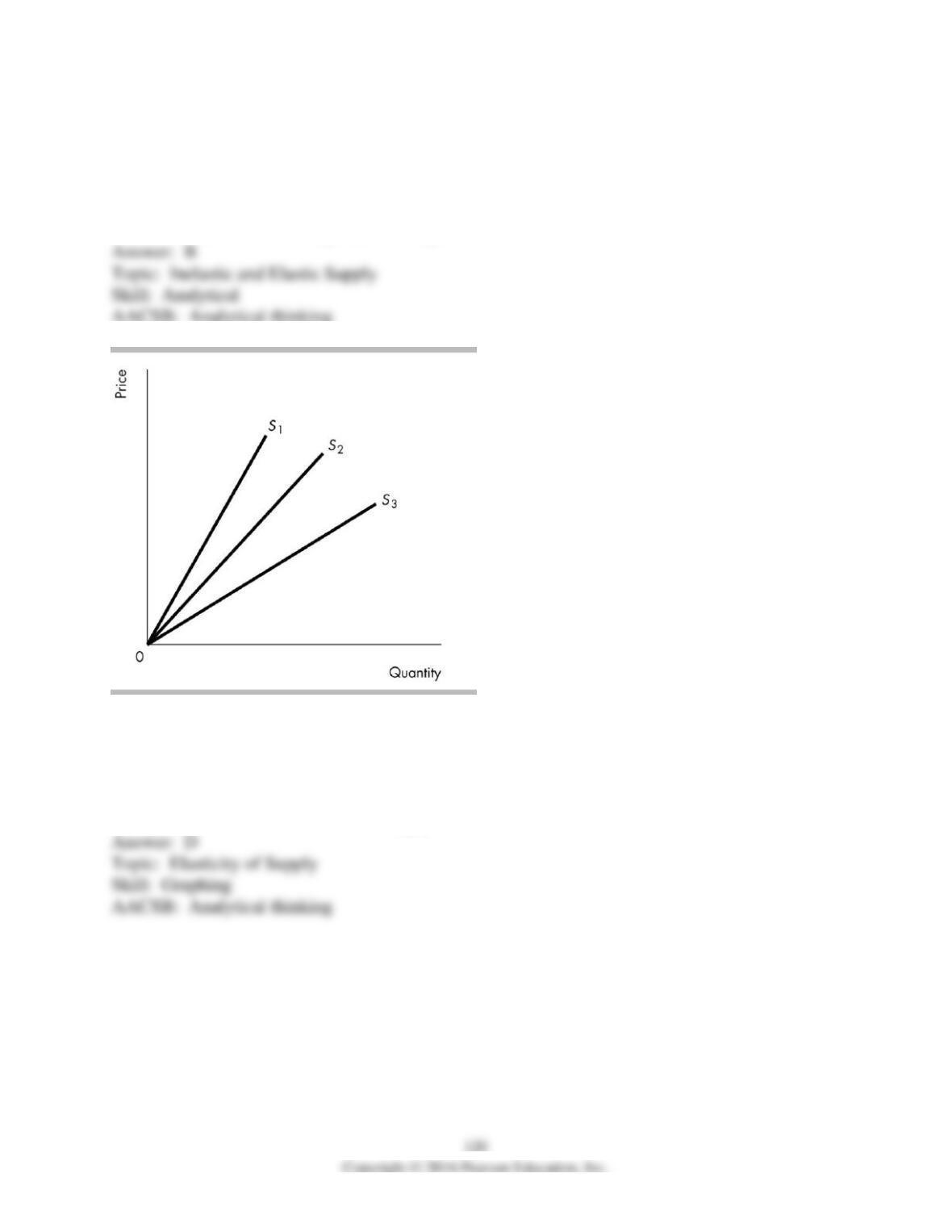
42) In the above figure, the price elasticity of supply at any given quantity is
A) highest along S1, next highest along S2, and lowest along S3.
B) highest along S3, next highest along S2, and lowest along S1.
C) equal to zero on each of the three supply curves.
D) equal to one on each of the three supply curves.