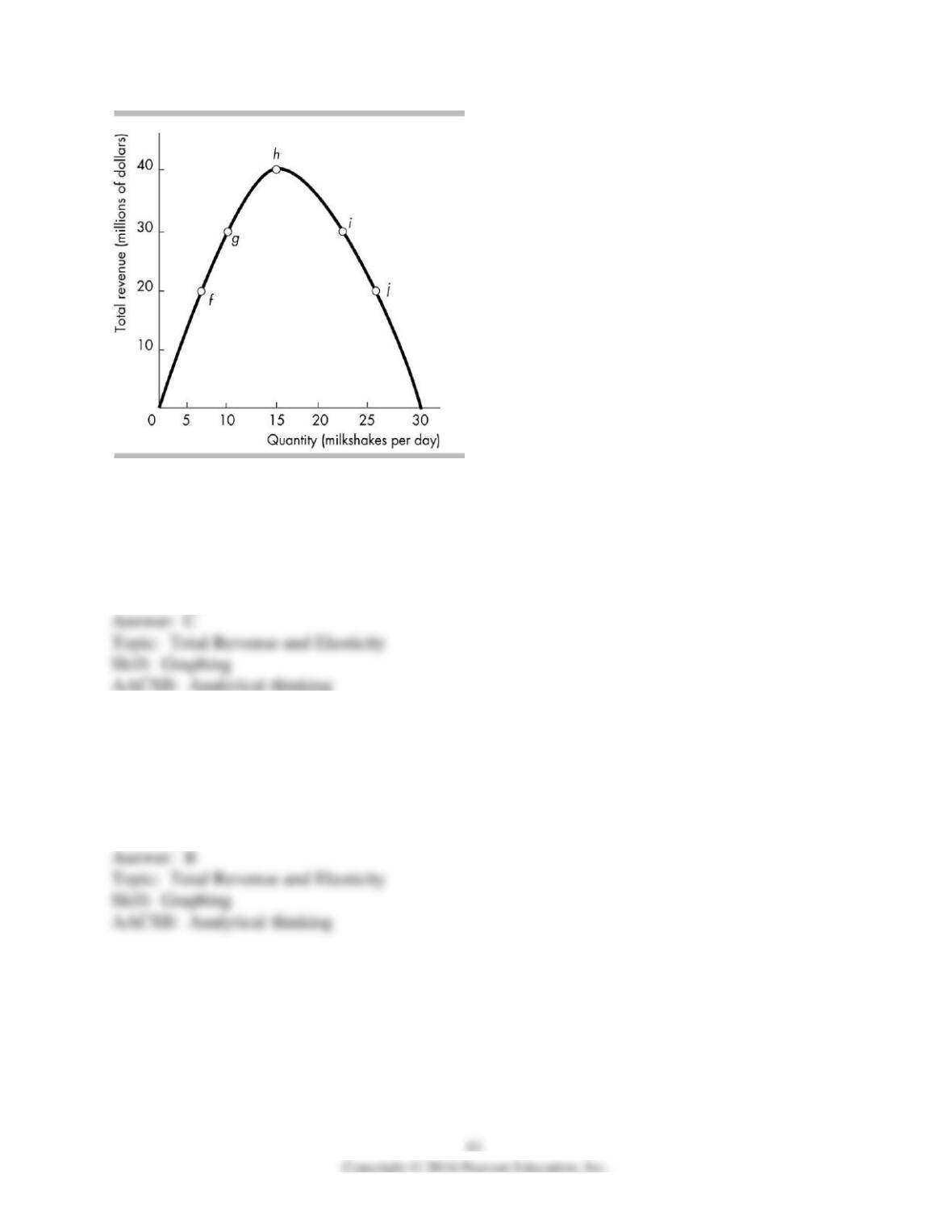
190) The figure above represents the behavior of total revenue as price falls along a straight-line
demand curve. What is the price elasticity of demand if total revenue is given by point f?
A) Demand is inelastic.
B) Demand is unit elastic.
C) Demand is elastic.
D) It is impossible to determine.
191) The figure above represents the behavior of total revenue as price falls along a straight-line
demand curve. Unit elasticity of demand occurs at
A) point g.
B) point h.
C) point i.
D) point j.
192) As the price of cell phones fell during the last decade, consumers’ total expenditures on cell
phones increased. If the demand curve for cell phones did not shift, this fact means that the
demand for cell phones
A) must have shifted leftward.
B) must be upward sloping.
C) is elastic.
D) is inelastic.
193) If your demand for gasoline is inelastic, when the price of gasoline falls, which of the
following occurs?
A) Your demand curve for gasoline will shift leftward.
B) Your demand curve for gasoline will shift rightward.
C) Your total expenditure on gasoline will increase.
D) Your total expenditure on gasoline will decrease.
194) Starting at the top of a straight-line downward sloping demand curve, as the price falls, total
expenditures will
A) initially increase and then decrease.
B) initially decrease and then increase.
C) increase along the entire demand curve.
D) decrease along the entire demand curve.
195) If a price decrease results in your expenditure on a good decreasing, your demand must be
A) inelastic.
B) unit.
C) elastic.
D) linear.
196) An increase in subway fares in New York City will boost your expenditures on subway
rides if
A) the supply of subway rides is elastic.
B) the supply of subway rides is inelastic.
C) your demand for subway rides is elastic.
D) your demand for subway rides is inelastic.
197) If your demand for a good is ________, then a 1 percent fall in its price will lead you to
________ your expenditures on the good.
A) inelastic; increase
B) inelastic; decrease
C) elastic; increase
D) elastic; decrease
198) If the price of gasoline rose from $2.85 to $2.95 per gallon, your expenditure on gasoline
would increase if your price elasticity of demand for gasoline equals
A) 1.25.
B) 1.00.
C) 0.75.
D) Total revenue would increase at all of the above elasticities.
199) If the price of gasoline fell from $2.95 to $2.85 per gallon, your expenditure on gasoline
would increase if your price elasticity of demand for gasoline equals
A) 1.1.
B) 1.0.
C) 0.9.
D) Total revenue would increase at all of the above elasticities.
200) If students’ expenditures on airline travel increase as a consequence of more heavily
discounted fares, students’ demand for airline travel must be
A) income elastic.
B) income inelastic.
C) price elastic.
D) price inelastic.
201) Which goods have more elastic demands?
A) goods with many substitutes
B) goods which are necessities
C) goods with few substitutes
D) goods whose purchase represents a small percentage of income
202) The closer the substitutes for a good, the
A) more elastic is the demand for the good.
B) less elastic is the demand for the good.
C) smaller the degree of substitutability between the goods.
D) larger the proportion of income that is spent on the good.
203) The more substitutes available for a product, the
A) larger is its price elasticity of demand.
B) smaller is its income elasticity of demand.
C) smaller is its price elasticity of demand.
D) larger is its income elasticity of demand.
204) The demand for a good is more price elastic
A) if closer substitutes are available.
B) if the good is a necessity rather than a luxury.
C) if the share of the good in the average consumer’s budget is smaller.
D) in the short run than in the long run.
205) Most corn produced in the United States is used for animal feed. The demand for corn is
inelastic. These facts mean that
A) there are many substitutes for corn in feeding animals.
B) there are few substitutes for corn in feeding animals.
C) there are no substitutes for corn in feeding animals.
D) animals are not buying the corn themselves, so we cannot learn anything from these facts.
206) For many goods, the price elasticity of demand increases over time because
A) people’s incomes tend to increase over time.
B) inflation increases all prices and incomes over time.
C) the ability to find substitutes for a good whose price has risen increases over time.
D) None of the above answers is correct.
207) The amount of time elapsed since a price change impacts the elasticity of demand because
as more time passes,
A) people can find more substitutes, and so the elasticity of demand decreases.
B) people can find more substitutes, and so the elasticity of demand increases.
C) people’s incomes will increase, and so the elasticity of demand decreases.
D) the good’s price will have a chance to return to its previous level.
208) For many goods, the price elasticity of demand increases over time after a price hike
because
A) consumer incomes tend to increase over time.
B) inflation increases all prices and incomes over time.
C) the ability to find good substitutes for the product whose price rose increases over time.
D) All of the above answers are correct.
209) The demand for Honda Accords is probably
A) inelastic but more elastic than the demand for automobiles.
B) elastic and more elastic than the demand for automobiles.
C) inelastic and less elastic than the demand for automobiles.
D) elastic but less elastic than the demand for automobiles.
210) Which of the following statements is FALSE?
A) Goods or services that have few close substitutes generally have a less elastic demand.
B) Goods or services for which a greater proportion of income is spent on the item generally
have a more elastic demand.
C) A narrowly defined good or service generally has a less elastic demand.
D) The longer the time that has elapsed since a price change, the more elastic the demand.
211) Which of the following makes demand less elastic?
A) the existence of many close substitutes for the good
B) spending a large proportion of income on the good
C) a short time elapsing since the product’s price changed
D) All of the above answers are correct.
212) The price elasticity of demand depends on the
A) proportion of consumers’ budgets spent on the good.
B) number of available substitutes.
C) extent to which the commodity is a luxury.
D) all of the above.
213) A determinant of the price elasticity of demand is
A) whether the good is a durable or a nondurable.
B) the availability of resources used in the production of the product.
C) how well consumers like the good.
D) the proportion of the consumer’s total budget spent on the good.
214) The ________ the portion of your income spent on a good, the ________ is your demand
for the good.
A) larger; more income elastic
B) larger; more price elastic
C) smaller; less price elastic
D) smaller; more income elastic
215) Of the following, demand is likely to be the least elastic for
A) Ford automobiles.
B) Toyota automobiles.
C) compact disc players.
D) toothpicks.
216) If a product has very few substitutes, demand elasticity is likely to be
A) 1.
B) elastic.
C) infinitely elastic.
D) inelastic.
217) Because there are numerous choices for fast food purchases, the price elasticity of demand
for Taco Bell food is likely
A) inelastic.
B) unitary elastic.
C) perfectly inelastic.
D) elastic.
218) The demand for ________ is more elastic than the demand for ________.
A) chewing gum; cars
B) all personal computers; Dell computers
C) Pepsi; all soft beverages
D) food; exotic vacations
219) The price elasticity of demand for a specific model of a luxury car is likely to be
A) elastic.
B) inelastic.
C) 0.
D) infinite.
220) Which of the following items has the largest price elasticity of demand?
A) food
B) fruit
C) oranges
D) oranges from a Wal-Mart SuperCenter
221) The price elasticity of demand for meat in general is inelastic while the price elasticity of
demand for turkey or chicken is more elastic. Why?
A) Turkey and chicken are not red meat. Because they are not the same as other meats, they
should have different elasticities.
B) Turkey and chicken have many substitutes, such as fish or beef, while meat in general has
fewer substitutes.
C) Turkey and chicken are inferior goods.
D) Turkey and chicken are normal goods.
222) The demand for ________ is more elastic than the demand for ________.
A) chewing gum; cars
B) gasoline; professional services
C) all soft beverages; lemonade
D) motor vehicles; food
223) Of the following, demand is likely to be the most elastic for
A) food.
B) cars.
C) Sony Blu-ray players.
D) personal computers.
224) Pizza Hut pizza has more close substitutes than does food in general. The price elasticity of
demand for Pizza Hut pizza is ________ the price elasticity of demand for food in general.
A) not comparable to
B) greater than
C) less than
D) the same as
225) Suppose that accountants increase the price for calculating income taxes owed by 20
percent. The short-run demand for their service is less elastic than the long-run demand because
in the long run consumers will ________.
A) spend less on this service
B) experience an increase in income
C) try to avoid paying their income tax
D) find other ways to calculate the income tax they must pay
226) Which of the following goods would have the smallest elasticity of demand?
A) Exxon brand premium unleaded gasoline
B) insulin sold to diabetics
C) an education at Harvard Law School sold to recent college graduates
D) a bottle of Bayer Aspirin sold to someone without a headache
227) For electricity, natural gas, or other forms of energy, it is very likely that the price elasticity
of demand
A) is zero.
B) is infinite.
C) will decrease in magnitude as more time passes after a price change.
D) will increase in magnitude as more time passes after a price change.
228) The price of gasoline rises by 33 percent to $3.50 a gallon and stays at that price for the
next two years. The quantity of gasoline demanded two years from now will be
A) the same as one month after the price hike.
B) greater than one month after the price hike.
C) less than one month after the price hike.
D) the same as it would be if the price hike had never occurred.
229) Which of the following factors will make the demand for a product more elastic?
A) The product has no close substitutes.
B) A very small proportion of income is spent on the good.
C) A long time period has elapsed since the product’s price changed.
D) The change in the product’s price was unexpected.
230) Of the following, demand is likely to be the least elastic for
A) diamonds.
B) insulin for diabetics.
C) iceberg lettuce.
D) pink grapefruit.
231) The demand for food is most elastic in countries
A) with low income levels.
B) with intermediate income levels.
C) with high income levels.
D) that are highly urbanized.
232) The demand for a good is less price elastic
A) if closer substitutes are available.
B) if the good is a luxury rather than a necessity.
C) if the share of the good in the average consumer’s budget is smaller.
D) in the long run than in the short run.
233) The air route from Dallas to Mexico City is served by more than one airline. The demand
for tickets from American Airlines for that route is probably
A) inelastic but more elastic than the demand for all tickets for that route.
B) elastic and more elastic than the demand for all tickets for that route.
C) inelastic and less elastic than the demand for all tickets for that route.
D) elastic but less elastic than the demand for all tickets for that route.
234) The elasticity of demand for Dell computers is probably
A) inelastic and smaller than the elasticity of demand for computers overall.
B) elastic and smaller than the elasticity of demand for computers overall.
C) inelastic but larger than the elasticity of demand for computers overall.
D) elastic and larger than the elasticity of demand for computers overall.
235) Aglets are the metal or plastic tips on shoelaces that make it easier to lace your shoes. The
demand for aglets is probably
A) inelastic.
B) unit elastic.
C) elastic but not perfectly elastic.
D) perfectly elastic.
236) The demand for food in poor countries is
A) inelastic and more inelastic than in rich countries.
B) inelastic but more elastic than in rich countries.
C) elastic but less elastic than in rich countries.
D) elastic and more elastic than in rich countries.
237) Suppose a 10 percent increase in the price of textbooks decreases the quantity demanded by
20 percent. The elasticity of demand for textbooks is
A) 0.2.
B) 2.0.
C) 5.0.
D) 10.0.
238) The quantity of new cars increases by 10 percent. If the price elasticity of demand for new
cars is 1.25, the price of new cars will fall by
A) 2.5 percent.
B) 8 percent.
C) 10 percent.
D) 12.5 percent.
239) Along a perfectly vertical demand curve, the price elasticity of demand
A) equals 0.
B) is greater than 0 but less than 1.0.
C) equals 1.0.
D) is negative.
240) Perfectly elastic demand is represented by a demand curve that
A) is vertical.
B) is horizontal.
C) has a 45° slope.
D) is a rectangular hyperbola.
241) Business people often speak about price elasticity without actually using the term. Which
statement describes a good with an elastic demand?
A) “A price cut won’t help me. It won’t increase my sales, and I’ll just get less money for each
unit.”
B) “I don’t think a price cut will help my bottom line any. Sure, I‘ll sell a bit more, but I’ll more
than lose because the price will be lower.”
C) “My customers are real shoppers. After I cut my prices just a few cents below those my
competitors charge, customers have been flocking to my store and sales are booming.”
D) “The economic expansion has done wonders for my sales. With more people back at work,
my sales are taking off!”
242) A product is likely to have a price elasticity of demand that exceeds 1 when
A) its price falls.
B) the percentage of income spent on it decreases.
C) it is a necessity.
D) it has close substitutes.
243) The demand for a good is more price inelastic if
A) its price is higher.
B) the percentage of income spent on it is larger.
C) it is a luxury good.
D) it has no close substitutes.
244) Which of the following is likely to have the smallest price elasticity of demand?
A) an automobile
B) a new automobile
C) a new Ford automobile
D) a new Ford Mustang
245) Moving up (to the left) along a linear demand curve, the price elasticity of demand
A) decreases.
B) does not change.
C) increases.
D) at first increases and then decreases.
246) If the price elasticity of demand equals 1.0, then as the price falls, the
A) quantity demanded decreases.
B) total revenue falls.
C) quantity demanded does not change.
D) total revenue does not change.
247) A rise in the price of a product lowers the total revenue from the product if the
A) income elasticity of demand exceeds 1.
B) good is an inferior product.
C) demand for the product is inelastic.
D) demand for the product is elastic.
248) By reviewing its sales records, Dell economists discover that when Dell lowers the price of
its personal computers, the total revenue Dell obtains from the sale of its personal computers
rises. Hence
A) supply of Dell personal computers is elastic.
B) demand for Dell personal computers is elastic.
C) supply of Dell personal computers is inelastic.
D) demand for Dell personal computers is inelastic.
249) If a 4 percent rise in the price of peanut butter lowers the total revenue received by the
producers of peanut butter by 4 percent, the demand for peanut butter
A) is elastic.
B) is inelastic.
C) is unit elastic.
D) has an elasticity of 2.0.
250) If the price elasticity of demand for a product equals 1, as its price rises the
A) quantity demanded increases.
B) total revenue increases.
C) quantity demanded does not change.
D) total revenue does not change.
251) When the price of a hot dog rises 10 percent, your expenditure on hot dogs increases.
Hence, it is certain that
A) hot dogs are a normal good for you.
B) hot dogs are an inferior good for you.
C) your demand for hot dogs is elastic.
D) your demand for hot dogs is inelastic.
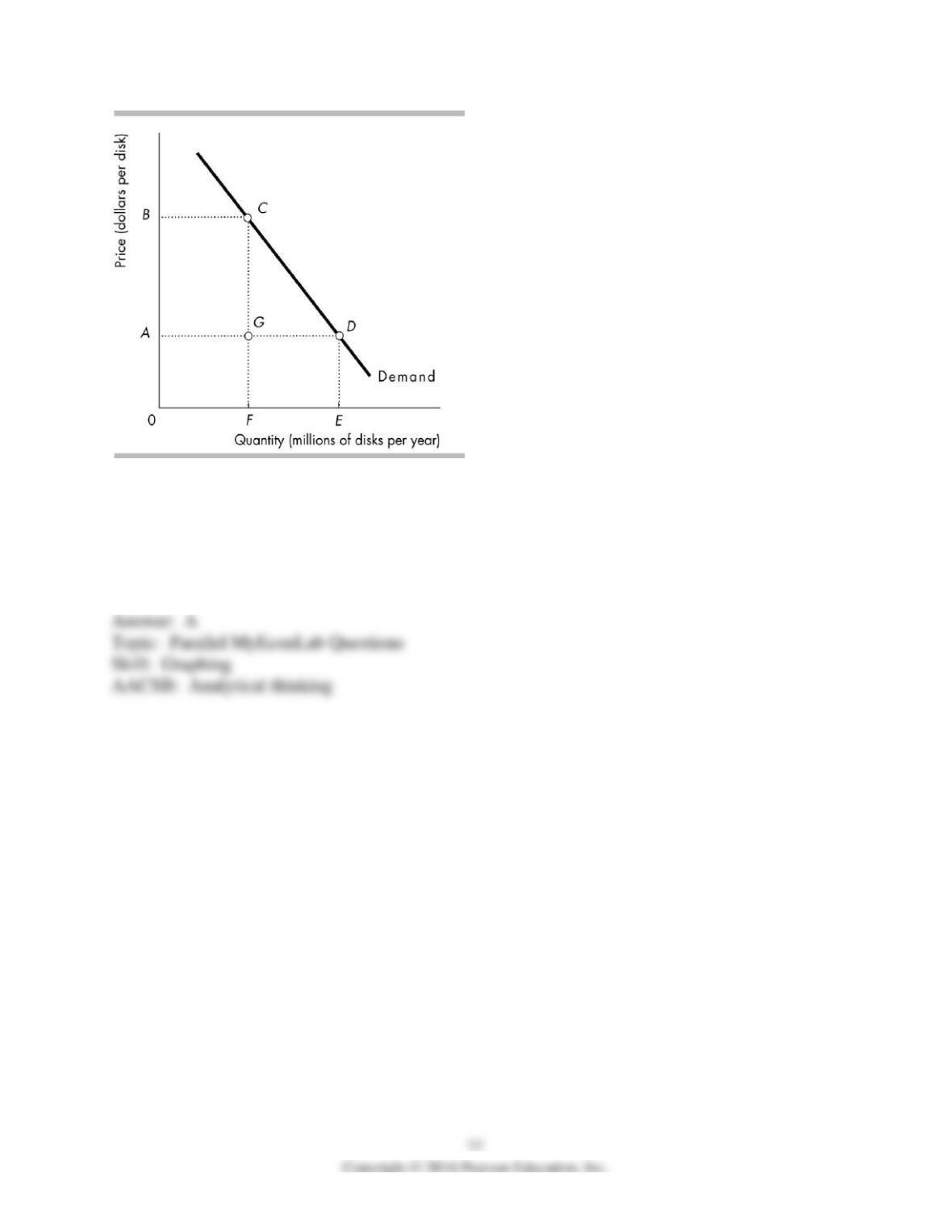
252) In the figure above, when the price of a disk is $B, total revenue is shown in the graph by
area
A) BCF0.
B) AGF0.
C) FCDE.
D) ADE0.
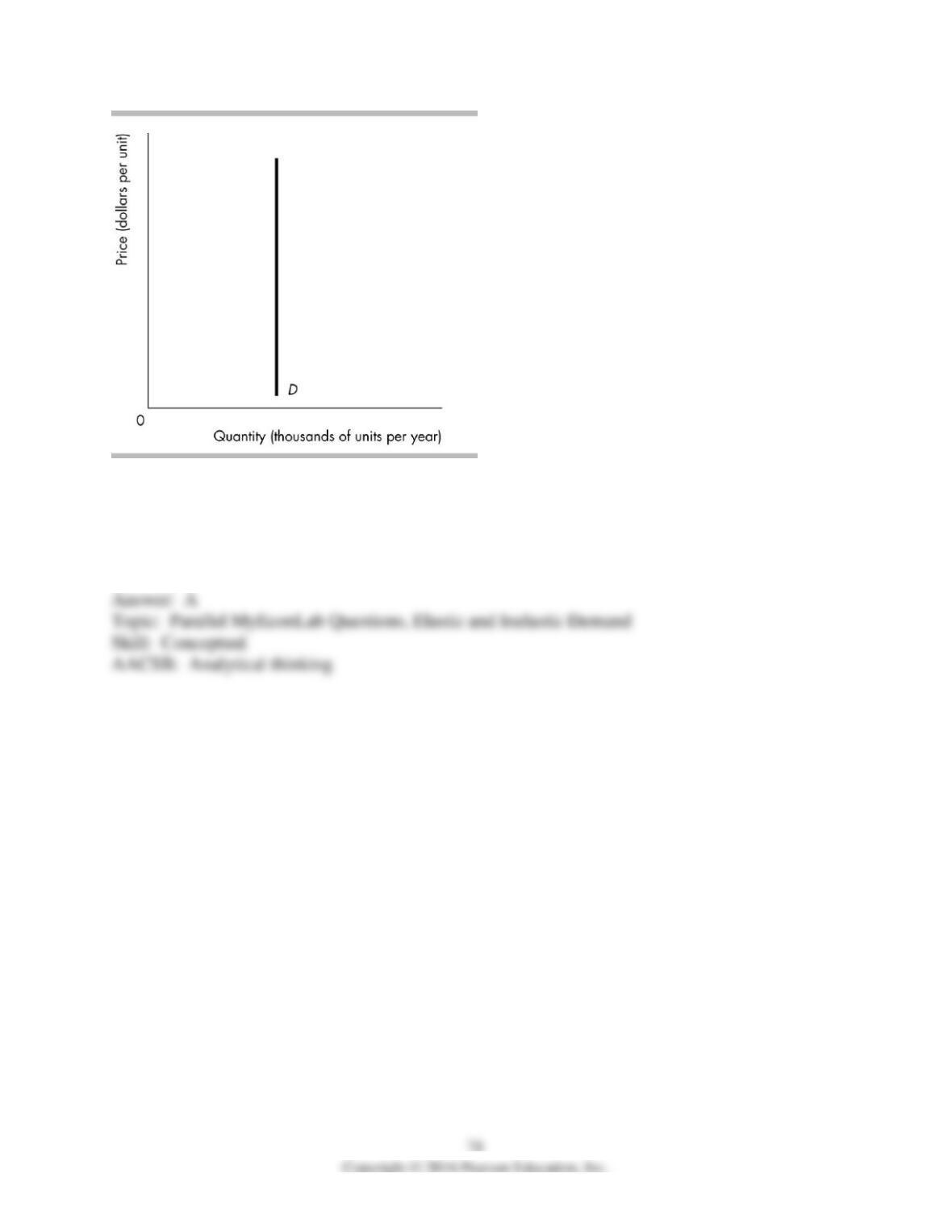
253) The above figure illustrates the demand curve for a good. The good has
A) no substitutes.
B) only one substitute.
C) only a few substitutes.
D) many substitutes.
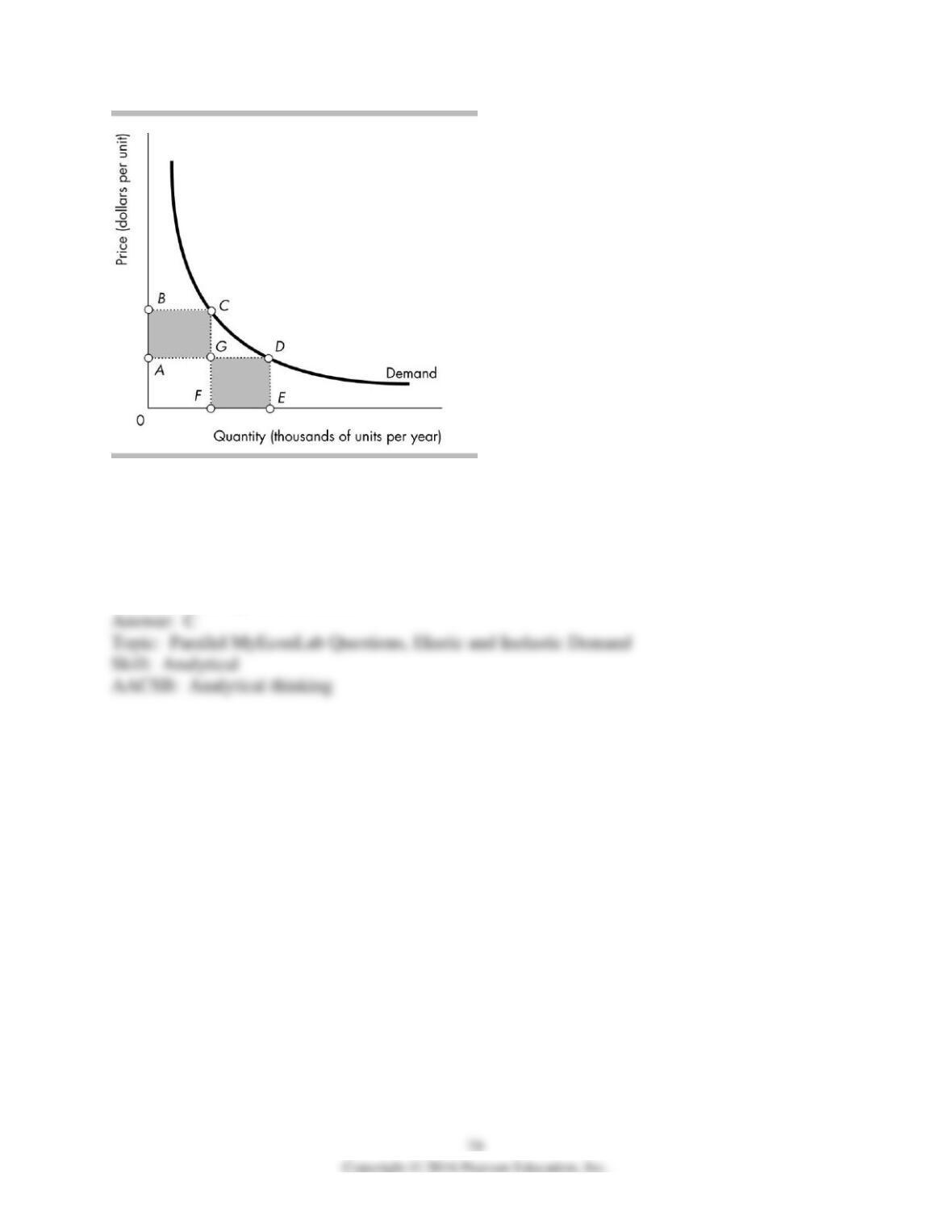
254) The elasticity of demand along the demand curve shown in the above figure is constant and
equal to 1. Thus
A) area 0BCF equals area 0AGF.
B) area 0BCF equals area FGDE.
C) area 0BCF equals area 0ADE.
D) area ABCG equals area 0AGF.
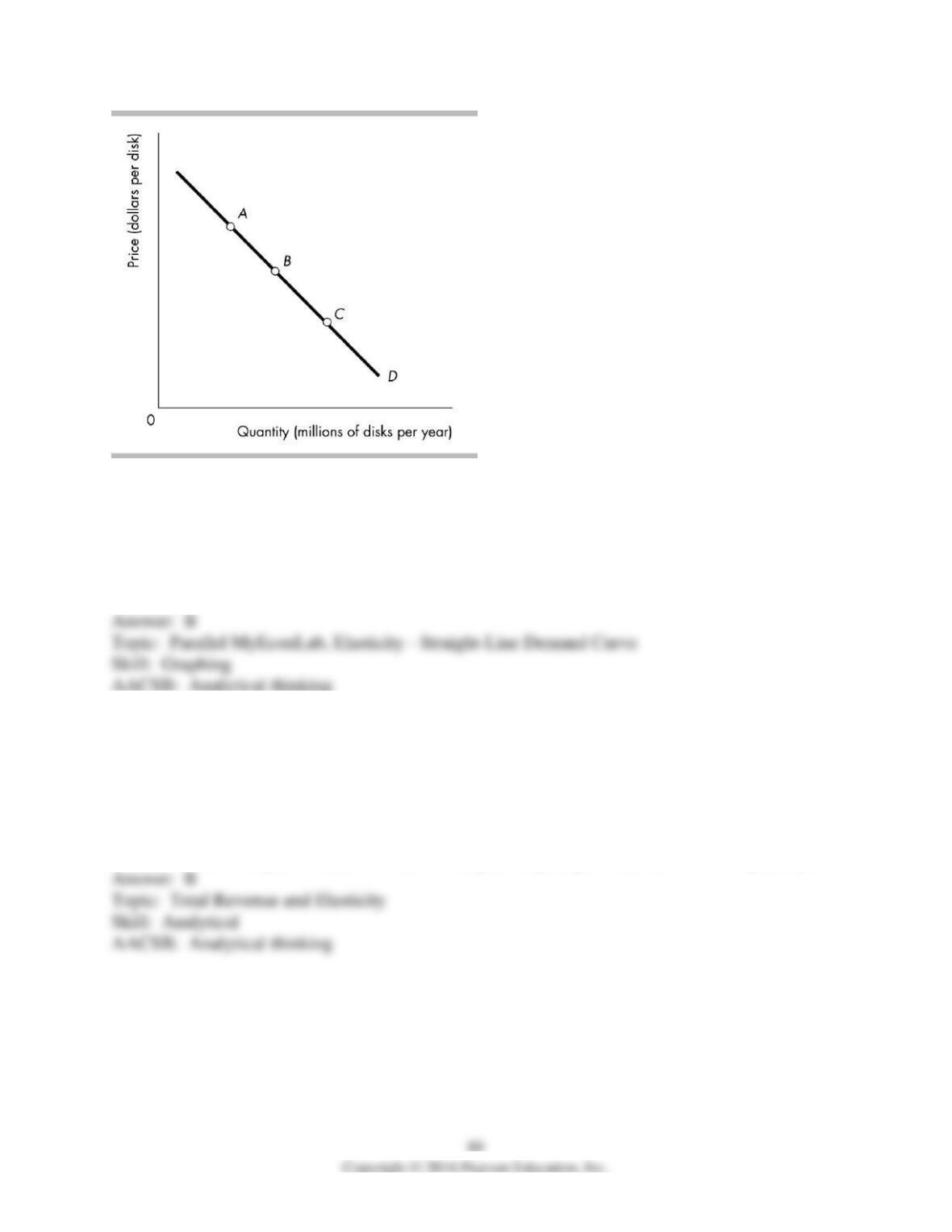
255) The above figure shows a linear (straight-line) demand curve. Starting at point A and then
moving to point B and then point C, the price elasticity of demand
A) increases.
B) decreases.
C) increases and then decreases.
D) decreases and then increases.
256) In the summer 2012 the lobster catch in Maine was especially large, but instead of
celebrating the fisherman were suffering from a lower total revenue. (Source: New York Times,
July 28, 2012) As the lobster catch increases, there is
A) a movement along the demand curve, resulting in a higher price and a decreased quantity.
B) a movement along the demand curve, resulting in a lower price and an increased quantity.
C) no change in either the price or the quantity.
D) a movement along the demand curve, resulting in a higher price and an increased quantity.