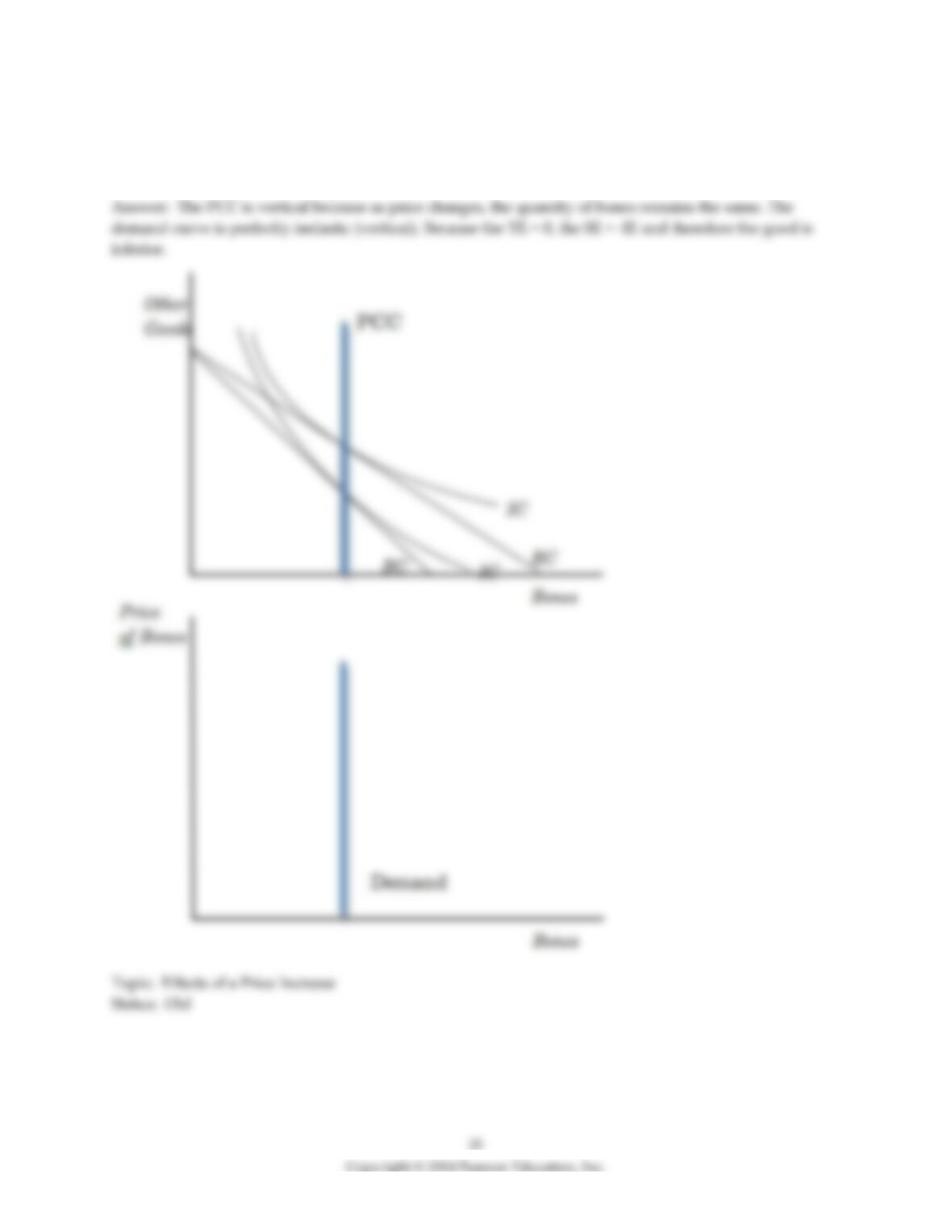
36) Louie purchases the same quantity of Bones even after the price of bones rises. Draw Louie’s price–
consumption curve and demand curve (two separate graphs!) based on this information. Discuss
directions and magnitudes of the income and substitution effects (or graph them clearly). Are Bones
normal or inferior for Louie? Explain.
37) Borem is a big fan of wine from Trader Moes. Moe’s sells a high-quality expensive wine and a cheap
low-quality wine. Borem buys both types but tends to buy more bottles of the cheaper wine. Borem later
moves to a new city where he must drive a long distance to get his wine at Trader Moe’s. Assuming the
income effect is small, and that Borem still buys his wine from Moe’s, how is he going to change his
relative consumption of the expensive and cheap wines?
38) Bob’s winery sells bottles of their expensive, high-quality wine and a cheaper low-quality wine.
Visitors have to drive 45 minutes to get to Bob’s winery. Bob also sells his wine at a shop in the city where
consumers don’t have to drive a long distance and charges the same prices. Assuming the preferences of
the clients that come to the winery and the city store are the same, explain why Bob tends to sell the
expensive wine in a greater proportion in the winery than the urban store.
4.4 Cost-of-Living Adjustment
1) Due to inflation, nominal prices are usually
A) equal to real prices.
B) smaller than real prices.
C) larger than real prices.
D) a constant proportion different from real prices.
2) A Consumer Price Index adjustment overcompensates for inflation because it ignores
A) the income effect when relative prices change.
B) the substitution effect when relative prices change.
C) that some goods are inferior.
D) that the substitution effect may offset the income effect.
3) Employing a fixed-weight index like the Consumer Price Index to adjust a person’s salary in response
to inflation will overcompensate this person because doing so will allow this person to
A) buy the same bundle of goods as he did before the inflation.
B) achieve a higher level of utility than he did before the inflation.
C) achieve the same level of utility as before the inflation.
D) buy more of all goods.
4) Under which of the following conditions will there be no substitution bias in the CPI?
A) Indifference curves are convex.
B) Indifference curves are L-shaped.
C) Indifference curves are linear.
D) Indifference curves are downward sloping.
5) Under which of the following conditions will there be no substitution bias in the CPI?
A) Lower-priced goods increase in price by a greater percentage than do higher-priced goods.
B) Higher-price goods increase in price by a greater percentage than do lower-priced goods.
C) All goods change in price by the same amount.
D) All goods change in price by the same percentage.
6) A true cost-of-living adjustment in response to a change in prices would compensate consumers so that
they would be able to
A) purchase the same bundle they purchased before prices changed.
B) achieve the same level of utility they did before prices changed.
C) face the same choices they did before prices changed.
D) achieve an increase in utility that is equal to the rate of inflation.
7) Richard receives government transfer payments and currently consumes five guns and six goose livers.
Assume the price of guns decreases by 10% and the price of goose liver increases by 20%. The
government raises Richard’s transfer payments so he can still afford five guns and six goose livers. Does
this constitute a true cost-of–living adjustment?
A) No. Richard is overcompensated.
B) No. Richard is undercompensated.
C) Yes. The payment just achieves the right level of compensation.
D) Not enough information.
8) Before an uneven rise in prices Allan consumed five bread and six juice. After the price increase and
with an increased welfare payment from the government Allan consumes four bread and seven juice.
Does the government payment represent a true cost-of-living adjustment?
A) Yes, if the two consumption bundles lie on the same indifference curve.
B) Yes, if the second bundle yields more utility than the first.
C) No, the first bundle is clearly preferred.
D) Not enough information.
For the following, please answer “True” or “False” and explain why.
9) Inflation over time necessarily makes consumers worse off.
10) Using the CPI to compensate workers for inflation is appropriate because, in the face of a change in
relative prices, people should be allowed to purchase the same bundle as they did before the price
changes.
11) Suppose the typical consumer only purchases food and clothing, and her utility can be expressed as
U = F ∗ C. Currently, food costs $5 per unit and clothing costs $2 per unit. Her income is $70. If the price
of food increases to $6, compare the resulting Laspyre’s price index with a true cost of living index.
12) A consumer’s utility function is given by:
U(x,y) = 10xy
Currently, the prices of goods x and y are $3 and $5, respectively, and the consumer’s income is $150.
a. Find the MRS for this consumer for any given bundle (x,y).
b. Find the optimal consumption bundle for this consumer.
c. Suppose the price of good x doubles. How much income is required so that the consumer is able to
purchase the original consumption bundle (if you were unable to solve d., then take a guess at what the
optimal bundle is before solving this)
d. Now that the price of good x has doubled, how much income is needed for the consumer to reach the
original level of utility? Is this more or less that what you found in e.?
13) A Californian student consumes Internet services (I) and books (B). Her preferences are represented
by a Cobb-Douglas utility function of the type: U(I,B) = I.5B.5. Initially Y = 100, PI = PB = 1. Lately,
however, because of the electricity shortage, the price of the Internet services has increased to 2. The
government has decided to give a transfer to the student so that she can recover her initial welfare. In
order to determine the transfer the government has hired three consultants who have made the following
suggestions:
Consultant A: The transfer should allow the student to buy her initial bundle.
Consultant B: The transfer should allow the student to get her initial level of utility.
Consultant C: The government should give her a transfer of 20.
a. Using the expenditure function, find the amount of the transfer implied by consultant A.
b. Find the amount of the transfer implied by consultant B.
c. Determine whether the consumer is better or worse off from Consultant C’s suggestion than before
the price increases.
14) Suppose Ian consumes bread and mustard with his income. He views these goods to be Perfect
Complements. He currently consumes 15 units of each good each week. Suppose that the price of
Mustard increases by $1/unit and bread increases by $2/unit. Ian’s union automatically provides him with
a CPI adjustment in his income amounting to an increase by $45. Is Ian better off, worse off, the same or is
it uncertain as compared to previously? Explain and provide a graph to demonstrate your answer.
42
15) Suppose the only two goods you consume are wine and roses. On Tuesday, the price of wine goes up
and at the same time your income increases by just enough so that you are equally happy as you were on
Monday. What happens to the amount of wine you consume? Are you able to afford the same bundle as
you did on Monday? Use a graph of budget constraints and indifference curves to illustrate your answer.
16) Many elderly people have Social Security payments as their sole source of income. Because of this,
there have been attempts to adjust these payments so as to keep up with changing prices. This process is
called “indexing”; this question will lead you through the process.
Suppose that in the year 2000, a typical Social Security recipient consumed only Food and Housing. The
price of housing was $15/unit and the price of food was $5/unit. Denote the quantities of food and
housing per month by F and H respectively. This consumer received $150/month and consumed five
units of housing and 15 units of food.
a. Write down the algebraic representation of this consumer’s budget constraint.
b. Show that the bundle (5,15) is just affordable. Identify another bundle on the budget constraint where
both goods are consumed in positive amounts. Suppose that in 2004 the price of food rose to $10/unit and
housing rose to $20/unit.
c. How much additional income is required such that the original bundle is just affordable at the new
prices.
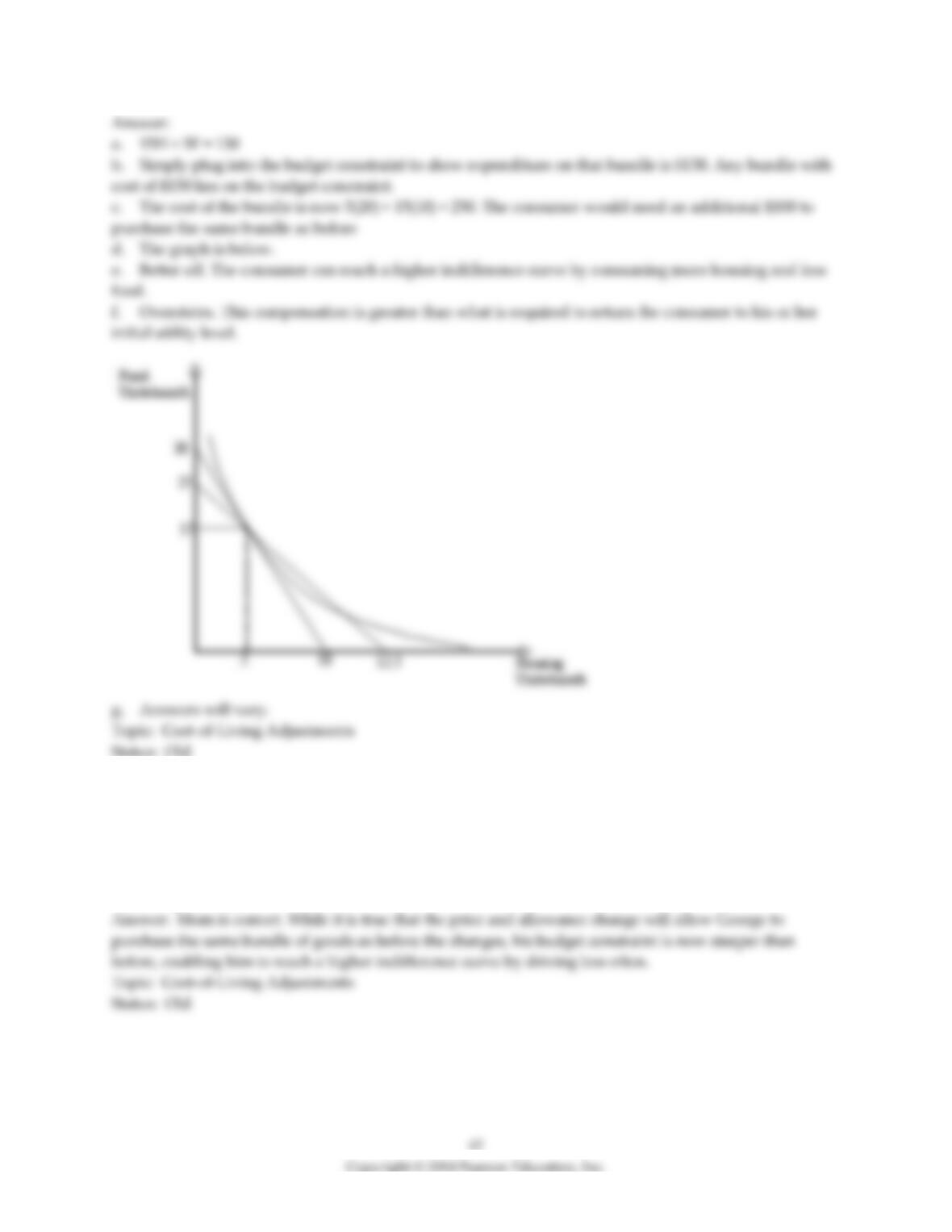
d. On the graph with Housing on the horizontal axis and food on the vertical axis, depict the original
budget constraint and the new budget constraint after income is compensated according to c. Include the
indifference curve going through the point (5,15).
f. Is the consumer better, worse, or equally well off in 2004 relative to 2000 following the compensation?
Explain. What will happen to the consumer’s choice of food and housing consumption? How can you
tell?
g. The Laspeyres Price Index, as we have been describing above, measures inflation by looking at how the
cost of a particular bundle of goods a consumer purchases in a previous year changes. Critics claim that
this measure of inflation overstates changes in the cost of living. Do you agree or disagree? Explain.
17) George’s parent’s let him use the family car whenever he wants, but require that he pays for all gas he
uses. George has been driving the car 100 miles per week. His parents want to limit how much he drives
the family car, but don’t want to impose a major burden on his finances. Mom’s plan is to charge him a
dollar for each ten miles he drives the car (per week), but to increase his allowance by $10. Dad thinks this
plan will have no effect on his driving since he is going to get the money back at the end of the week.
Who is right? Explain.
18) A Californian student consumes Internet services (I) and books (B). Her preferences are represented
by a Cobb-Douglas utility function:
U(I,B) = I1/4B1/4
The prices of each good is $2 and the student has an income of $200. Over the course of the past year, the
price of internet services has risen to $4, but the price of books has remained the same. The government
has decided provide this student with additional money to compensate for the higher price of internet
services. In order to determine the transfer the government has three consultants who have made the
following suggestions:
Consultant A: The student’s income should be increased by a percentage found using a consumer price
index (CPI).
Consultant B: The additional income should allow the student to get her initial level of utility.
a. Find the consumer’s optimal bundle before the increase in price occurs.
b. Find the consumer‘s optimal bundle after the increase in price occurs with income still at $200.
c. Find the amount of the transfer implied by consultant A.
d. Is the student necessarily better or worse off than before from such a transfer implied by consultant
A? Explain why.
e. Is the transfer implied by consultant B more or less than the amount implied by A? Explain.
What is the precise dollar amount implied by consultant B?
19) A consumer purchases housing (H) and spends the remainder of income on the composite good (C).
The government is considering one of two policies. Policy A taxes housing by $50 per unit consumed.
With the tax in place, the consumer purchases 100 units of housing. Policy B collects a lump-sum tax of
$5,000 from the consumer’s income. Compare the effects of the policies on the consumer’s utility/well–
being and the amount of housing and composite goods purchased.
20) Andrew’s union has signed a new wage contract for the coming year. It promises to increase
Andrew’s wages in the next year so that he can keep on consuming the same bundle of goods when the
prices go up. Should Andrew anticipate being happier this year (before prices rise) or next year (after
prices rise)? Use a graph to demonstrate how you can tell this. Be clear!
4.5 Revealed Preference
1) According to Revealed Preferences, if a Consumer chooses a more expensive bundle of goods over a
cheaper bundle of goods, we can conclude
A) the consumer prefers the more expensive bundle of goods.
B) the consumer is behaving irrationally.
C) the consumer is unaware of the cheaper bundle of goods.
D) the consumer has convex preferences.
2) When Trina can afford bundles A and B but not C, she purchases bundle A. When Trina can afford
bundles A and C, but not B, she purchases bundle C. We can conclude her preference ordering of the
three bundles is (in order from most preferred to least)
A) C, A, B.
B) B, A, C.
C) A, C, B.
D) A, B, C.
3) Suppose you have $400,000 saved up and purchase a medium-sized house for $200,000. Consider the
following 2 scenarios:
i. The very next day, the prices of all houses, including the one you have just bought, double.
ii. The very next day, the prices of all houses, including the one you bought, fall by half.
Show that both scenarios increase your utility.
4) Show that the following preferences are not consistent for a rational individual.
i. An individual when confronted with prices of p1 = $4 and p2 = $8 chooses q1 = 1 and q2 = 5.
ii. The same individual facing prices of p1 = $6 and p2 = $9 chooses q1 = 5 and q2 = 3.
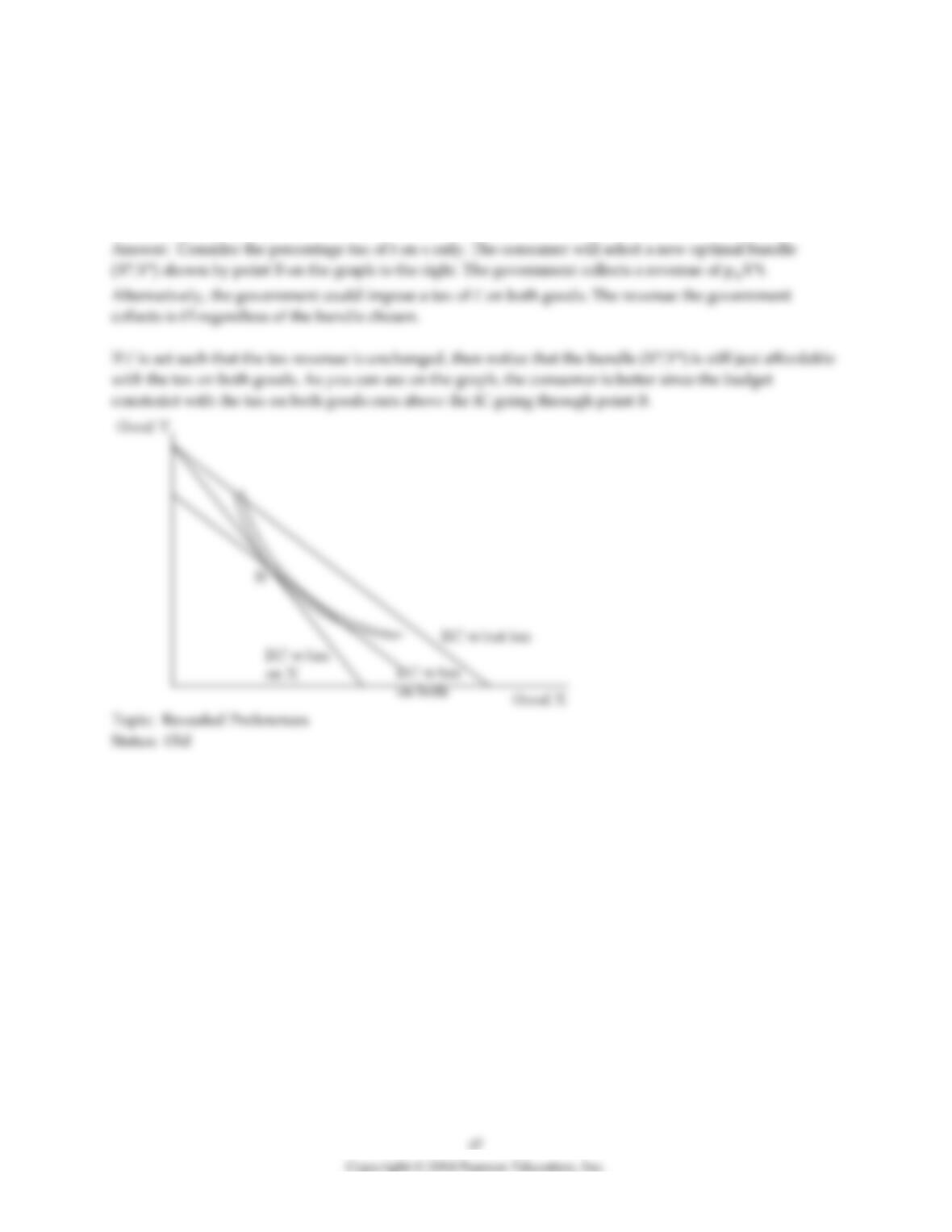
5) Consider a consumer that only purchases two goods, X and Y. The government wishes to collect
revenue from taxing this consumer and is considering two policies. The first policy is to only tax good X.
The second policy will tax both goods by the same percentage. Assume that the tax rates in each policy
are selected such that they collect the same amount of revenue. Which policy will have a smaller
reduction in the consumer‘s well-being? (Use a graph of indifference curves and budget constraints to
illustrate your answer)