Chapter 04 – Firm Production, Cost, and Revenue
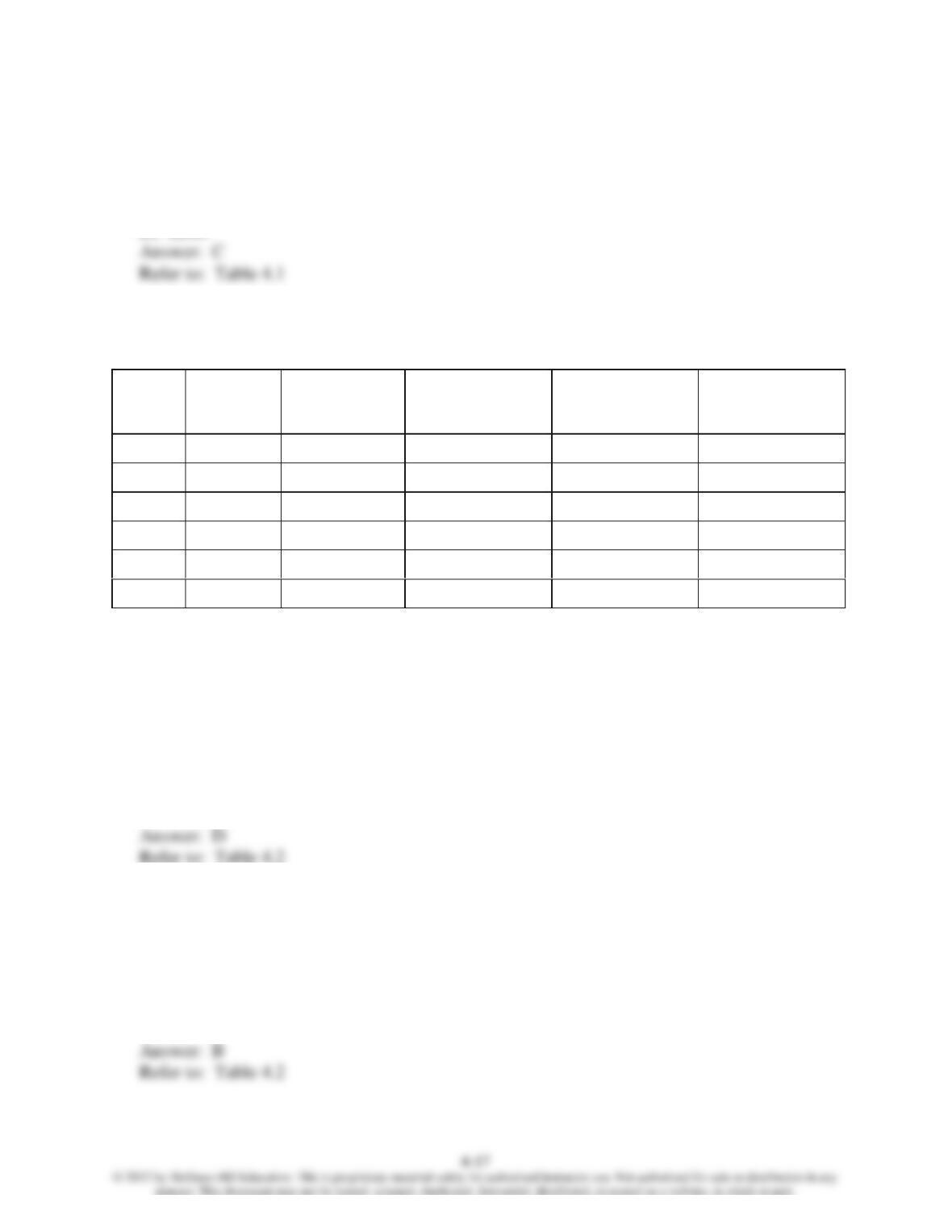
74) Refer to Table 4.1, Box I should be filled with
A) $0.
B) $115.
C) $150.
Use the following to answer questions 75-92:
Output Total
Variable
Cost
Total Cost Marginal Cost Average Variable
Cost
Average Total Cost
0 $0 $10 Box A Box G Box M
1 $10 $20 Box B Box H Box N
2 $15 $25 Box C Box I Box O
3 $17 $27 Box D Box J Box P
4 $20 $30 Box E Box K Box Q
5 $30 $40 Box F Box L Box R
Table 4.2
75) Refer to Table 4.2, Box A should be filled with
A) $0.
B) $10.
C) $20.
D) nothing.
76) Refer to Table 4.2, Box B should be filled with
A) $0.
B) $10.
C) $20.
D) $30.
Chapter 04 – Firm Production, Cost, and Revenue
77) Refer to Table 4.2, Box C should be filled with
A) $0.
B) $5
C) $1
D) $2
78) Refer to Table 4.2, Box D should be filled with
A) $0
B) $2.
C) $17.
D) $27.
79) Refer to Table 4.2, Box E should be filled with
A) $0.
B) $3.
C) $20.
D) $30.
80) Refer to Table 4.2, Box F should be filled with
A) $0.
B) $10.
C) $30.
D) $40.
81) Refer to Table 4.2, Box G should be filled with
A) $0.
B) $10.
C) $20.
D) undefined.
Chapter 04 – Firm Production, Cost, and Revenue
82) Refer to Table 4.2, Box H should be filled with
A) $0.
B) $10.
C) $20.
D) $30.
83) Refer to Table 4.2, Box I should be filled with
A) $0.
B) $7.50.
C) $12.50.
D) $2
84) Refer to Table 4.2, Box J should be filled with
A) $0.
B) $5.67.
C) $9.00.
D) $17.
85) Refer to Table 4.2, Box K should be filled with
A) $5.00.
B) $7.50.
C) $12.50.
D) $2
86) Refer to Table 4.2, Box L should be filled with
A) $6.00.
B) $8.00.
C) $12.50.
D) $30.
Chapter 04 – Firm Production, Cost, and Revenue
87) Refer to Table 4.2, Box M should be filled with
A) $0.
B) $10.
C) $20.
D) undefined.
88) Refer to Table 4.2, Box N should be filled with
A) $0.
B) $10.
C) $20.
D) $30.
89) Refer to Table 4.2, Box O should be filled with
A) $0.
B) $7.50.
C) $12.50.
D) $2
90) Refer to Table 4.2, Box P should be filled with
A) $0.
B) $67.
C) $9.00.
D) $17.
91) Refer to Table 4.2, Box Q should be filled with
A) $00.
B) $7.50.
C) $12.50.
D) $2
Chapter 04 – Firm Production, Cost, and Revenue
92) Refer to Table 4.2, Box R should be filled with
A) $6.00.
B) $8.00.
C) $12.50.
D) $30.
93) The shape of the firm’s marginal revenue curve depends ultimately on whether the firm is
A) a monopolist or a perfect competitor.
B) a revenue maximizer or a profit maximizer.
C) a market share maximizer or a sales maximizer.
D) owned by a man or a woman.
94) The shape of the firm’s marginal revenue curve depends on
A) how high its costs are.
B) how high production is.
C) how many competitors it has.
D) whether the firm is a profit maximizer.
95) Whether marginal revenue is constant or decreasing depends on
A) whether the firm is benefiting from the division of labor.
B) whether the firm is dealing with diminishing returns.
C) how much the firm sells.
D) whether the firm faces competition.
96) The assumption we usually make about all firms is that they wish to
A) maximize market share.
B) minimize costs.
C) maximize sales.
D) maximize profits.
Chapter 04 – Firm Production, Cost, and Revenue
97) If the market price for a good produced by a price taking firm is $5, the firm’s total revenue
is
A) a flat line at P=$5.
B) parabolic.
C) downward sloping.
D) an upward sloping line beginning at the origin and having a slope of 5.
98) If the market price for a good produced by a price taking firm is $6, the firm’s total revenue
is
A) a flat line at P=$6.
B) parabolic.
C) downward sloping.
D) an upward sloping line beginning at the origin and having a slope of 6
99) If the market price for a good produced by a price taking firm is $7, the firm’s total revenue
is
A) a flat line at P=$7.
B) parabolic.
C) downward sloping.
D) an upward sloping line beginning at the origin and having a slope of 7
100) If the market price for a good produced by a price taking firm is $8, the firm’s total revenue
is
A) a flat line at P=$8.
B) parabolic.
C) downward sloping.
D) an upward sloping line beginning at the origin and having a slope of 8.
101) Which type of firm has no control over its price
A) price taker.
B) price maker.
C) price setter.
D) zero price setter.
Chapter 04 – Firm Production, Cost, and Revenue
102) If a price taker attempts to raise its price by a small amount, the quantity that its customers
will buy will
A) increase.
B) decrease by a small amount.
C) decrease to zero.
D) remain constant.
103) If a price maker raises its price by a small amount, the quantity that its customers will buy
will
A) increase.
B) decrease but not to zero.
C) decrease to zero.
D) remain constant.
104) Suppose a firm is a price taker, the demand for that firm’s product is
A) is flat line at the market price.
B) a downward sloping line with the negative of the market price as its slope.
C) an upward sloping line with the market price as the slope.
D) parabolic.
105) Suppose the market price for a price taking firm is known to be $5, the total revenue
accruing to it if it sells 100 is ____ and the total revenue accruing to it if it sells 200 is ____.
A) $5, $5
B) $100, $200
C) $500, $1000
D) $500, $500
106) Suppose the market price for a price taking firm is known to be $2, the total revenue
accruing to it if it sells 100 is ____ and the total revenue accruing to it if it sells 200 is ____.
A) $2, $2
B) $100, $200
C) $200, $200
D) $200, $400
Chapter 04 – Firm Production, Cost, and Revenue
107) Suppose the market price for a price taking firm is known to be $10, the total revenue
accruing to it if it sells 100 is ____ and the total revenue accruing to it if it sells 200 is ____.
A) $10, $10
B) $100, $200
C) $1000, $2000
D) $1000, $1000
108) If the firm has no competitors, the marginal revenue curve is
A) flat (horizontal).
B) vertical.
C) upward sloping.
D) downward sloping.
109) If the firm has many competitors, the marginal revenue curve is
A) flat (horizontal).
B) vertical.
C) upward sloping.
D) downward sloping.
110) Marginal Revenue is
A) the extra revenue associated with one additional unit of sales.
B) the extra cost associated with one additional unit of output.
C) the revenue associated with the first unit of sales.
D) the revenue associated with the sale of the average unit.
111) If you see that a firm’s marginal revenue curve is downward sloping, you can infer that it is
a
A) price taker.
B) price maker.
C) price setter.
D) zero price setter.
112) If the demand curve for a firm’s output is P=100-Q, the marginal revenue curve will be
A) MR=100-2Q
B) MR=50-Q
Chapter 04 – Firm Production, Cost, and Revenue
C) MR=50-2Q
D) MR=P*
113) If the demand curve for a firm’s output is P=100-2Q, the marginal revenue curve will be
A) MR-100-2Q
B) MR=50-Q
C) MR=100-4Q
D) MR*=P*
114) If the demand curve for a firm’s output is P=200-10Q, the marginal revenue curve will be
A) MR=200-20Q
B) MR=200-5Q
C) MR=20-Q
D) MR=P*
115) If the demand curve for a firm’s output is P=100-5Q, the marginal revenue curve will be
A) MR=100-5Q
B) MR=100-10Q
C) MR=20-Q
D) MR=20-5Q
116) If the demand curve for a firm’s output is P=100-Q, the total revenue curve will be
A) TR=100-2Q
B) TR=100Q-Q2
C) TR=100Q-2Q2
D) TR=P*Q
117) If the demand curve for a firm’s output is P=100-2Q, the total revenue curve will be
A) TR=100-2Q
B) TR=100Q-Q2
C) TR=100Q-2Q2
D) TR=2P*Q
118) If the demand curve for a firm’s output is P=200-10Q, the total revenue curve will be
Chapter 04 – Firm Production, Cost, and Revenue
A) TR=200-2Q
B) TR=200Q-10Q2
C) TR=200Q-200Q2
D) TR=10P*Q
119) An increase in the demand for a good that is produced by many firms will
A) increase all of their respective marginal cost curves.
B) increase all of their respective marginal revenue curves.
C) decrease all of their respective marginal cost curves.
D) decrease all of their respective marginal revenue curves.
120) A decrease in the demand for a good that is produced by many firms will
A) increase all of their respective marginal cost curves.
B) increase all of their respective marginal revenue curves.
C) decrease all of their respective marginal cost curves.
D) decrease all of their respective marginal revenue curves.
121) If price is greater than average variable cost, a profit maximizing firm will always
A) produce where Marginal Cost is minimized.
B) produce where Average Total Cost is minimized.
C) where Total Revenue is maximized.
D) produce where Marginal Cost equals Marginal Revenue.
122) To maximize profit a firm will find the
A) Quantity where TR=TC
B) Quantity where MR=MC (with no other consideration)
C) Quantity where MR=MC unless P<AVC in which case Q=0
D) Price where MR=MC
123) If MC>MR the firm should produce
A) At this quantity.
B) Fewer than this quantity.
C) More than this quantity.
D) Zero.
124) If MR<MC the firm should produce
Chapter 04 – Firm Production, Cost, and Revenue
A) At this quantity.
B) Fewer than this quantity.
C) More than this quantity.
D) Zero.
125) If MR=MC and P>AVC the firm should produce
A) At this quantity.
B) Fewer than this quantity.
C) More than this quantity.
D) Zero.
126) If MR=MC and P<AVC the firm should produce
A) At this quantity.
B) Fewer than this quantity but not zero.
C) More than this quantity.
D) Zero.
127) The quantity where MC=MR is also the quantity where
A) TC is minimized.
B) TR is maximized.
C) TC and TR have the same slope.
D) TC=TR.
128) The quantity where TR-TC is the greatest is also the quantity where
A) TC is minimized.
B) TR is maximized.
C) TC and TR have the same slope.
D) TC=TR.
129) The quantity where TR-TC is the greatest is also the quantity where
A) TC is minimized
B) TR is maximized
C) MC=MR
D) TC=TR
Chapter 04 – Firm Production, Cost, and Revenue
130) When the firm is a price taker, at the quantity where profit is maximized
A) MC>P>MR
B) MC<P<MR
C) MC=P<MR
D) MC=P=MR
131) When the firm is a price maker, at the quantity where profit is maximized
A) MC>P>MR
B) MC<P<MR
C) MC=MR<P
D) MC=P=MR
132) If you know that the price where MC=MR at a point that is between ATC and AVC, you
A) Need to know whether the firm is a price taker or a price maker to determine whether
they are making a profit.
B) Know the firm is making a profit.
C) Know the firm is making a loss.
D) Know the firm is breaking even.
133) To an economist, quitting
A) Makes sense if at the quantity where MC=MR the price is less than ATC.
B) Makes sense if at the quantity where MC=MR the price is less than AVC.
C) Makes sense if at the quantity where MC=MR the firm loses money.
D) Never makes sense.
134) If the price is less than the average variable cost the firm should produce
A) Zero
B) Where MC=MR
C) Where ATC is minimized
D) Where AVC is minimized
135) If the price is greater than the average variable cost the firm should produce
A) Zero
B) Where MC=MR
C) Where ATC is minimized
D) Where AVC is minimized
Chapter 04 – Firm Production, Cost, and Revenue
136) If the price is less than the average variable cost then
A) The loss the firm makes from shutting down (its TFC) is less than the loss they make as
a result of producing.
B) The loss the firm makes from shutting down (its TFC) is greater than the loss they make
as a result of producing.
C) The firm should produce where MC=MR.
D) The firm should produce where AVC is minimized.
137) If the price is greater than the average variable cost the firm should produce
A) The loss the firm makes from shutting down (its TFC) is less than the loss they make as
a result of producing.
B) The loss the firm makes from shutting down (its TFC) is greater than the loss they make
as a result of producing.
C) Where MC=MR.
D) Where AVC is minimized.
138) The shutdown condition for a firm is to
A) shutdown if losses are made.
B) shutdown if price is less than Average Total Cost.
C) shutdown if price is less than marginal revenue.
D) shutdown if price is less than Average Variable Cost.
139) When a firm chooses to shutdown, it is
A) making a poor decision because it should always produce where marginal cost equals
marginal revenue.
B) making a poor decision because it should always produce where average costs exceed
average revenue.
C) making a good decision as long as the price it is getting is less than its average total
costs.
D) making a good decision as long as the price it is getting is less than its average variable
costs.
140) The result that a firm should produce where MC=MR except when the shutdown condition
Chapter 04 – Firm Production, Cost, and Revenue
is met is based on the assumption that it is attempting to
A) maximize profit.
B) minimize marginal costs.
C) maximize market share.
D) minimize average costs
141) When a firm has many competitors selling the same good, in order to sell more of the good
A) it only need produce more of the good
B) it must, ironically, increase prices
C) it must reduce the price it charges
D) it must advertise
142) If a firm can increase output by hiring more workers then
A) it will always do so.
B) it will never do so.
C) it will do so only if the cost of hiring the workers (and purchasing the materials) is less
than the increase in revenues associated with the increase in sales.
D) it will do so only if the cost of hiring the workers (and purchasing the materials) is more
than the increase in revenues associated with the increase in sales.
143) When a firm has no competitors, in order to sell more of the good
A) it only need produce more of the good.
B) it must, ironically, increase prices.
C) it must reduce the price it charges.
D) it must keep prices steady.
144) When a firm shuts down because the market price of its product is less than its average
variable cost of producing that product, it suffers a loss equal to
A) its total revenue.
B) its total variable cost.
C) its total fixed cost.
D) all of the options are correct.
145) When a firm shuts down because the market price of its product is less than the average
variable cost of producing that product, the loss it suffers is
A) equal to its total revenue.
B) equal to its total variable cost.
Chapter 04 – Firm Production, Cost, and Revenue
C) equal to zero.
D) less than the loss it would earn from continuing to operate.
146) When a firm shuts down because the market price of its product is less than the average
variable cost of producing that product, the shut-down decision is
A) made for the long run.
B) made only for the short run.
C) followed by declaration of bankruptcy.
D) made just before it sells all of its fixed assets.
147) If a firm’s marginal cost is greater than its average total cost, its average total cost is
A) increasing.
B) constant.
C) decreasing.
D) not U-shaped.
148) If a firm’s marginal cost is smaller than its average total cost, its average total cost is
A) increasing.
B) constant.
C) decreasing.
D) not U-shaped.
149) If a firm’s average total cost is at its minimum possible value, its marginal cost is
A) constant.
B) equal to its average total cost.
C) decreasing.
D) not U-shaped.
150) If a firm’s average total cost is always a constant, its marginal cost is
A) greater than its average total cost.
B) less than its average total cost.
C) equal to its average total cost.
D) decreasing
151) If the total cost of producing 19 wizzbies is $38,000 and the total cost of producing 20
Chapter 04 – Firm Production, Cost, and Revenue
wizzbies is $39,000, the marginal cost of producing the 20th wizzbie is approximately
A) $1,000
B) $2,000
C) $19,000
D) $38,000
152) If the total cost of producing 19 wizzbies is $38,000 and the total cost of producing 20
wizzbies is $39,000, the average total cost of producing the 19th wizzbie is approximately
A) $1,000
B) $2,000
C) $19,000
D) $38,000