(income = $20,000/year)
$1 5 9
$2 4 8
$3 3 7
$4 2 6
$5 1 5
a. 0.67. d. 0.83.
b. 1.20. e. 0.50.
c. 1.33.
106. The introduction of new gaming systems that can compete effectively with the Nintendo console
will make the demand for the Nintendo console become
a. more price elastic. d. perfectly price inelastic.
b. more price inelastic. e. unchanged.
c. perfectly price elastic.
107. Demand for which of the following goods or services is likely to be the LEAST elastic in cold
weather?
a. a blue hooded sweatshirt with fur-lined pockets
b. a blue hooded sweatshirt
c. a hooded sweatshirt
d. a blue sweatshirt
e. a sweatshirt
108. When two goods are substitutes for each other, what will the cross-price elasticity be?
a. The cross-price elasticity will initially be positive but eventually become negative.
b. It is unaffected by goods being substitutes.
c. It will be zero.
d. It will be positive.
e. It will be negative.
109. The cross-price elasticity is measured by
a. percentage change in the price of one good divided by the percentage change in the demand
for the other good.
b. percentage change in the demand for one good divided by the percentage change in the price
of the other good.
c. percentage change in the demand for one good divided by the percentage change in the
demand for the other good.
d. percentage change in the price of one good divided by the percentage change in the price of the
other good.
e. the change in the price of one good divided by the change in demand for the other good.
110. When two goods are unrelated then
a. cross-price elasticity of demand will be zero.
b. cross-price elasticity of demand will be positive.
c. cross-price elasticity of demand will be negative.
d. the demand for both goods will be elastic.
e. cross-price elasticity of demand will be infinite.
111. The measure of the responsiveness of the demand for one good to the percentage change in the
price of the other good is
a. slope. d. cross-price elasticity.
b. price elasticity of supply. e. income elasticity.
c. price elasticity of demand.
112. When you change your quantity demanded of one good because of a change in price of another
good, you are acting according to the principle of
a. price elasticity of demand. d. price elasticity of supply.
b. cross-price elasticity of demand. e. income elasticity of supply.
c. income elasticity of demand.
113. Cross-price elasticity measures the relationship between
a. normal goods and inferior goods. d. two goods and services.
b. complements and inferior goods. e. income and substitute goods.
c. necessities and luxuries.
114. If the cross-price elasticity of demand is −5, Good A and Good B are
a. inferior goods. d. normal goods.
b. complements. e. luxury goods.
c. substitutes.
115. If the cross-price elasticity of demand is 6, Good A and Good B are
a. inferior goods. d. normal goods.
b. complements. e. luxury goods.
c. substitutes.
116. Which one of the following pairs of goods is likely to have a positive cross-price elasticity of
demand?
a. pancakes and waffles d. potatoes and sausage
b. fruit and bacon e. milk and coffee
c. butter and toast
117. Which one of the following pairs of goods is likely to have a positive cross-price elasticity of
demand?
a. chocolate ice cream and sprinkles d. Pepsi and Coke
b. ice cream shakes and hamburgers e. onion rings and chicken strips
c. fries and ketchup
118. Which one of the following pairs of goods is likely to have a negative cross-price elasticity of
demand?
a. tea and coffee d. tennis shoes and flip-flops
b. soda and water e. coffee and cream
c. spaghetti and ravioli
119. Which one of the following pairs of goods is likely to have a negative cross-price elasticity of
demand?
a. purses and backpacks d. shoes and socks
b. sofas and dining room tables e. trucks and sedans
c. manicures and pedicures
120. If the percentage change in quantity demanded of Good B is 2 percent and the percentage change
in the price of Good A is −10 percent, what is the cross-price elasticity of demand?
a. 0.20 d. 5
b. −5 e. −0.20
c. 1
121. We would expect to see a positive cross-price elasticity between
a. peanut butter and jelly. d. sneakers and socks.
b. ice cream and frozen yogurt. e. computers and iPods.
c. basketballs and steak.
122. When the price of pencils increases from $1.50 to $2.50, there is an increase in quantity demanded
of pens from 100 to 150. The cross-price elasticity of demand between pencils and pens is
a. 1.25. d. 0.80.
b. 0.50. e. 0.75.
c. 0.40.
123. A local bakery gives information on consumer purchasing habits for muffins and cupcakes. It says
that when the price of a muffin is $1, people buy 55 cupcakes. When the price of a muffin is raised
to $2, cupcake purchases go up to 65 cupcakes. The cross-price elasticity of demand is
a. 0.50. d. 2.00.
b. 0.25. e. 4.00.
c. 0.67.
124. If the cross-price elasticity of demand between Good A and Good B is 2 and the percentage change
in price of Good A is 5 percent, what is the percentage change in quantity demanded of Good B?
a. 3 percent d. 1.50 percent
b. 10 percent e. −3 percent
c. −1.25 percent
125. When the price of erasers increases from $1.50 to $2.50, the quantity demanded of pencils is
unchanged. The cross-price elasticity of demand between erasers and pencils is ________ because
erasers and pencils are ________.
a. 1; substitutes d. 0; unrelated
b. ; complements e. ; complements
c. 0; normal goods
126. If the cross-price elasticity of demand between Good A and Good B is 3, the price of Good B
increases, and the price elasticity of demand for Good B is inelastic, we can expect to see a(n)
________ change in the quantity demanded for Good A.
a. zero d. one-for-one
b. small e. large
c. infinite
127. If the cross-price elasticity of demand between Good A and Good B is 3, the price of Good B
increases, and the price elasticity of demand for Good B is inelastic, we can expect to see a
________ change in the quantity demanded for Good A.
a. positive, zero d. negative, one-for-one
b. positive, small e. positive, large
c. negative, infinite
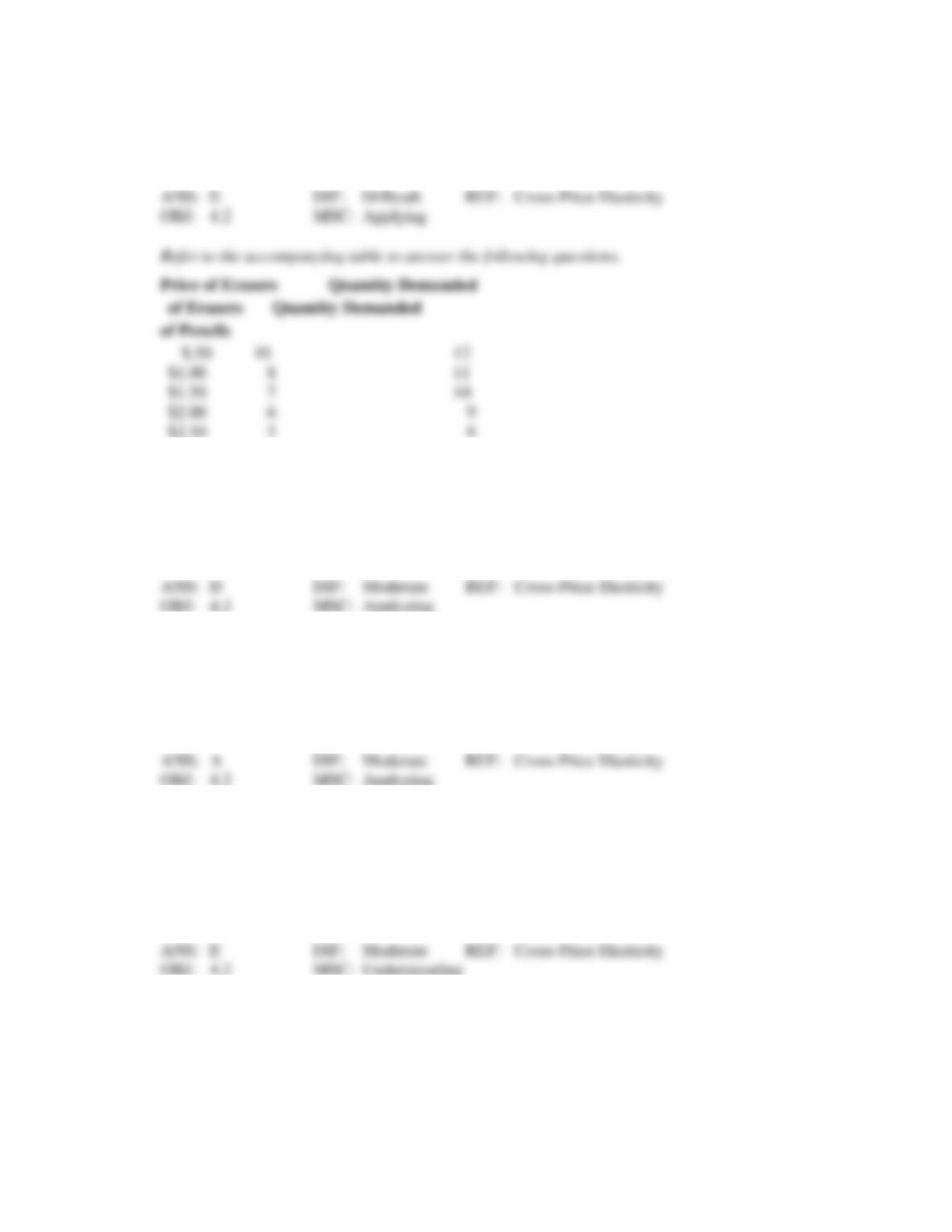
128. If the cross-price elasticity of demand between Good A and Good B is 2, the price of Good B
increases, and the price elasticity of demand for Good B is elastic, we can expect to see a
________ change in the quantity demanded for Good A.
a. positive, zero d. negative, one-for-one
b. positive, small e. negative, large
c. negative, infinite
129. The price of erasers increases from $0.50 to $1.00 per eraser. By what percentage does the quantity
demanded of pencils change? (Use the midpoint method.)
a. 8.70 percent d. −8.70 percent
b. 22.22 percent e. 6.67 percent
c. −22.22 percent
130. The price of erasers increases from $0.50 to $1.00 per eraser. Using the midpoint method, what is
the cross-price elasticity of demand between pencils and erasers?
a. − 0.13 d. 0.13
b. 7.67 e. −3
c. −7.67
131. When two goods are complements to each other, the cross-price elasticity will
a. begin by being positive but becomes negative over time.
b. be unaffected by goods being complements.
c. be zero.
d. be positive.
e. be negative.
132. If the supply of a good is perfectly inelastic, then the price elasticity of supply will equal
a. zero.
b. one.
c. greater than zero but less than one.
d. greater than one but less than infinity.
e. negative one.
133. The price elasticity of supply is
a. constant across the short run and long run.
b. the percentage change in the quantity supplied divided by the percentage change in price.
c. always negative.
d. the slope of the supply curve.
e. the percentage change in the price divided by the percentage change in quantity supplied.
134. Which of the following statements is FALSE?
a. The flexibility of producers helps determine the supply elasticity.
b. The time frame helps determine the supply elasticity.
c. The perfectly inelastic supply curve is vertical.
d. The perfectly elastic supply curve is horizontal.
e. Price elasticity of supply can never equal one.
135. A vertical supply curve can be described as
a. perfectly elastic. d. relatively elastic.
b. perfectly inelastic. e. relatively inelastic.
c. unitary elastic.
136. A perfectly elastic supply curve
a. is vertical. d. is backward bending.
b. is horizontal. e. has an infinite slope.
c. is downward sloping.
137. A professional hockey arena has a maximum seating capacity of 20,000 people. The price
elasticity of supply is
a. perfectly inelastic. d. relatively elastic.
b. perfectly elastic. e. elastic.
c. inelastic.
138. If the owner of Kuji’s Treats finds that, in the long run, he can trade one type of input for another,
the price elasticity of supply is
a. relatively elastic. d. perfectly inelastic.
b. relatively inelastic. e. unitary elastic.
c. perfectly elastic.
139. A local sandwich shop can quickly place an order for food with its local vendors if it uses up its
existing resources quickly. This indicates that the price elasticity of supply is
a. unitary elastic. d. relatively elastic.
b. perfectly elastic. e. relatively inelastic.
c. perfectly inelastic.
140. Over time, the price elasticity of supply for sunglasses will become more
a. inelastic. d. elastic.
b. unitary elastic. e. perfectly elastic.
c. unchanged.
141. As price elasticity of supply becomes more elastic over time, the overall shape of the supply curve
a. becomes more vertical.
b. remains unchanged.
c. becomes closer to 45 degrees from the origin.
d. becomes completely vertical.
e. becomes more horizontal.
142. Masielle’s Furniture produces high-quality wooden bedroom sets that take approximately four
months to make, from start to finish. The price elasticity of supply for these bedroom sets in the
short term is
a. unitary elastic. d. relatively elastic.
b. relatively inelastic. e. perfectly elastic.
c. perfectly inelastic.
143. The price elasticity supply of doctors could be considered ________ because it takes a minimum
of four to six years of training to be able to work as a physician.
a. perfectly elastic d. relatively elastic
b. unitary elastic e. perfectly inelastic
c. relatively inelastic
144. If the price elasticity of supply is 2.5, we know that it is
a. perfectly elastic. d. relatively inelastic.
b. perfectly inelastic. e. relatively elastic.
c. unitary elastic.
145. When the price of a basketball is $15, the quantity supplied is 5,000. When the price increases to
$20, the quantity supplied is 10,000. The price elasticity of supply is
a. 2.33. d. 0.43.
b. 0.67. e. 0.29.
c. 0.33.
146. The percentage change in price is 5 percent, while the price elasticity of supply is 0. The
percentage change in quantity supplied
a. is 1.5 percent. d. is −3 percent.
b. does not change. e. is −7 percent.
c. is 2 percent.
147. The initial price of picture frames is $6 and suppliers offer 20 frames. When the price falls to $4,
suppliers offer only 10. The price elasticity of supply is
a. 0.33. d. 0.60.
b. 0.67. e. 0.40.
c. 1.67.
148. Firms supplying twisty-ties decrease the quantity supplied of inputs by 10 percent when the price
decreases by 5 percent. The price elasticity of supply for twisty-ties is
a. 4.0. d. 0.2.
b. 0.4. e. 1.0.
c. 2.0.
149. Consider two labor markets. In the first, the elasticity of supply is relatively elastic, while it is
relatively inelastic in the latter. Imposing a minimum wage in each market would result in
________ unemployment in the first market and ________ unemployment in the second.
a. lower; lower d. lower; higher
b. higher; higher e. higher; lower
c. unchanged; unchanged
150. If the price elasticity of supply is 1.5, we know that supply is
a. relatively elastic. d. unitary elastic.
b. relatively inelastic. e. perfectly elastic.
c. perfectly inelastic.
SHORT ANSWER
1. What is the price elasticity of demand? How is it calculated?
2. Explain whether you agree or disagree with the following statement: “The slope of the demand
curve also tells us about the elasticity of demand.”
3. Explain why you agree or disagree with the following statement: “Higher prices always yield
higher revenues.”
4. The government is exploring ways to increase revenues through taxation. Lisette is an economic
adviser to public policy makers, and they pose to her the following question: Should the
government tax yachts or should it tax gasoline? Explain your answer using price elasticity of
demand.
5. For each of the following situations, explain whether the demand for Gatorade would become
more elastic or less elastic and why.
a. Competitors introduce new brands of sports drinks into the market.
b. A study finds that Gatorade consumption improves player performance.
c. Consumer spending studies show that people spend a small proportion of their budgets on
Gatorade.
6. The makers of academic books find that when they raise the price of the average book from $50 to
$75, quantity demanded among students drops from 100 to 90. Among casual readers, quantity
demanded drops from 80 to 40.
a. Calculate the price elasticity of demand for each group.
b. Is demand price elastic or price inelastic for each group?
c. Using the determinants of demand, explain why there is a difference in elasticity for each group.
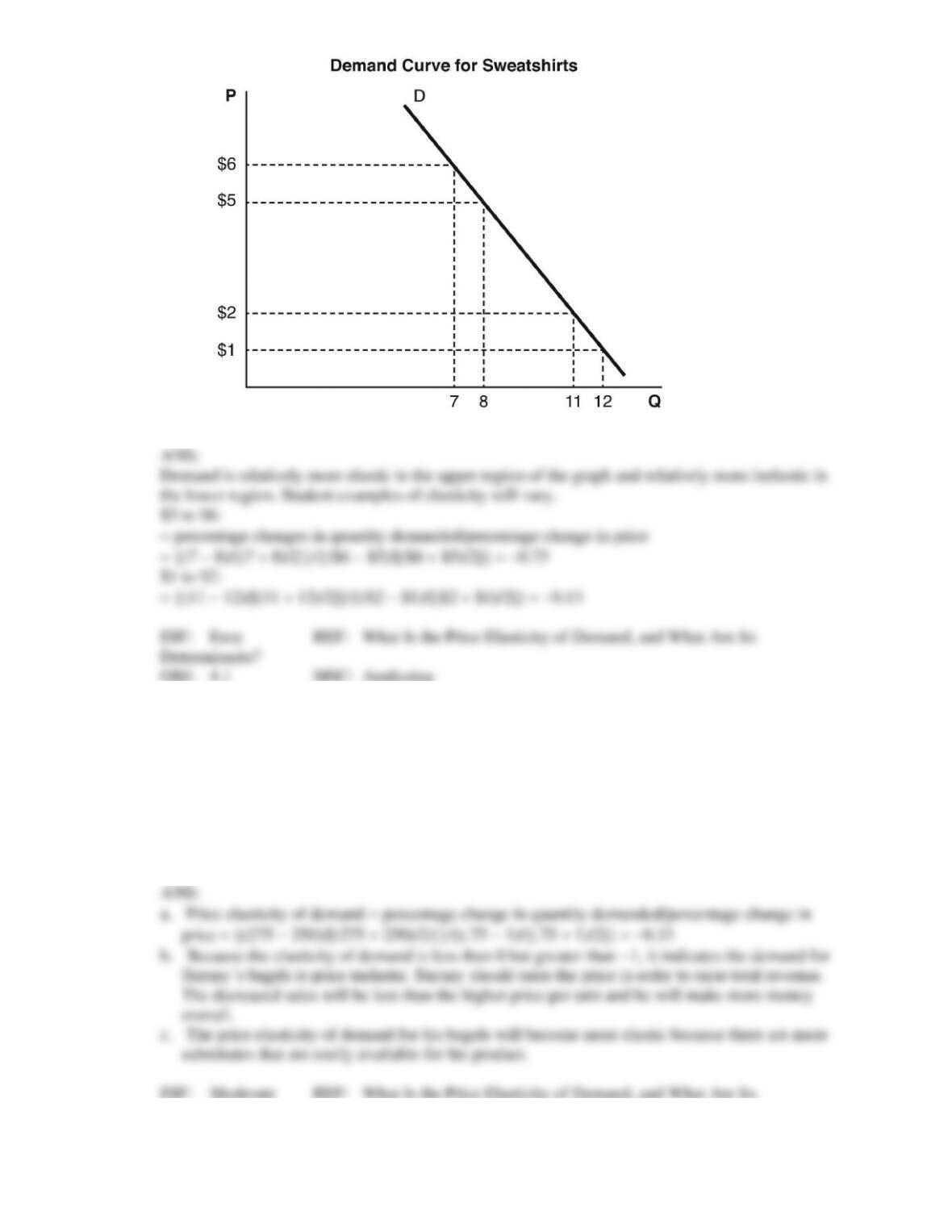
7. How does the price elasticity of demand at relatively high prices compare to the price elasticity of
demand at relatively low prices? Calculate the price elasticity from $5 to $6 and the price elasticity
from $1 to $2 in the accompanying graph.
8. Barney owns a bagel business in New York City and he wants to increase his total revenue. He
knows that when bagels are $1, he sells 250 an hour, and when he lowers the price to $0.75, he
sells 275 an hour.
a. Calculate the price elasticity of demand for Barney’s bagels.
b. Using the price elasticity of demand for Barney’s bagels, explain whether he should raise or
lower the price to generate more revenue.
c. A bakery moves in across the street from Barney’s shop. Explain what is likely to happen to the
price elasticity of demand for Barney’s bagels.
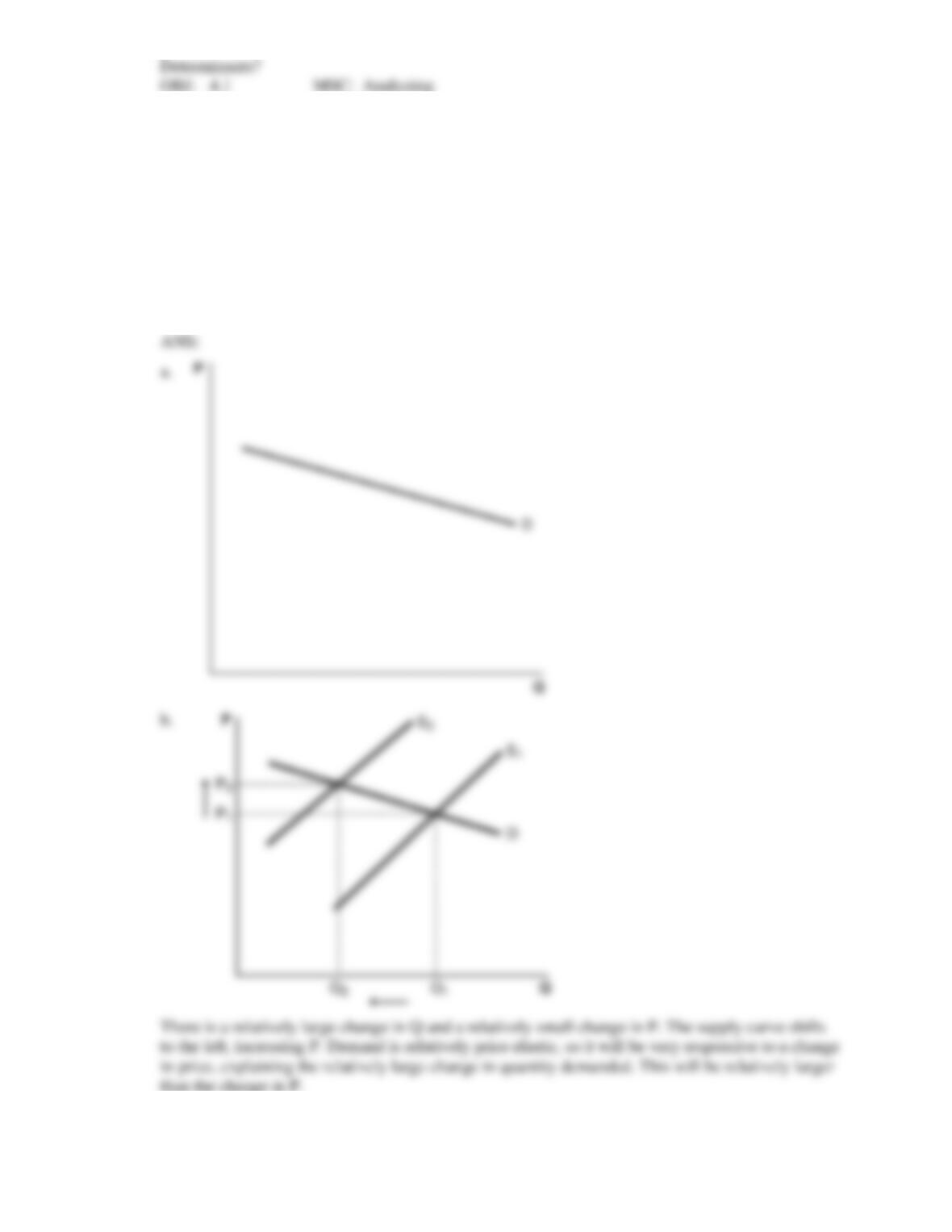
9. Assume that the demand for Choco Candy Bites is price elastic.
a. Draw a demand curve for Choco Candy Bites. Label each axis and curve.
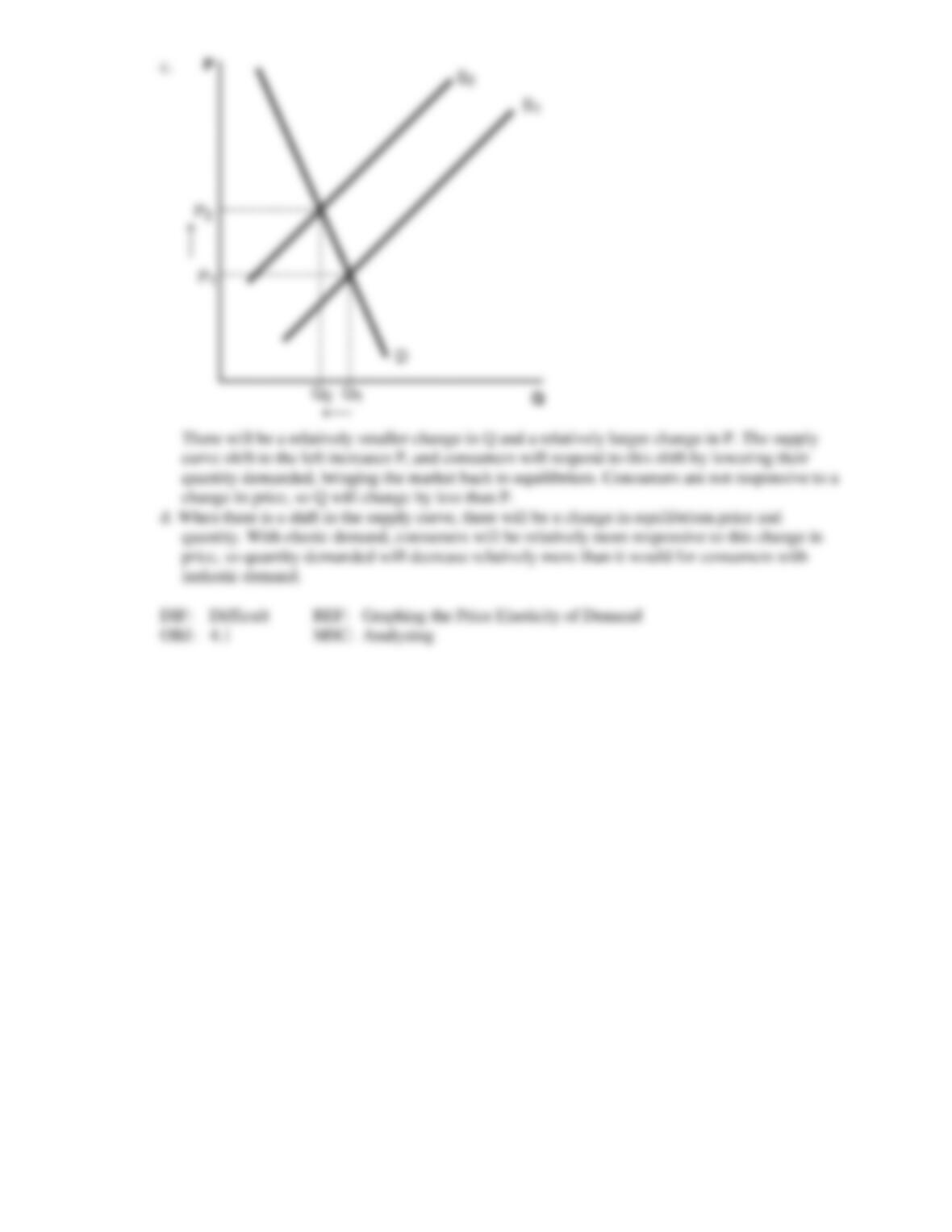
b. Use the relatively price elastic demand curve from (a) and draw the entire market graph for
Choco Candy Bites. Label the equilibrium price P1 and the equilibrium quantity Q1. If the
supply curve for Choco Bites shifts to the left, will there be a relatively large or small change in
P and Q? Indicate this on your graph. Label the new equilibrium price P2 and the equilibrium
quantity Q2.
c. Compare this change in P and Q to the changes that would result with a relatively price
inelastic demand curve.
d. What impact does the price elasticity of demand have on the change in P and Q?
10. The demand for Mariana’s earrings can be represented by the equation: Qd = −2P + 10
a. Graph the demand equation; include the x and y intercepts.
b. If the price = $4.50, what is quantity demanded? If the price decreases to $4.00, what is the
quantity demanded? What is the price elasticity of demand between these two points along the
demand curve?
c. Repeat the calculations in parts (a) and (b) for price = $1.00 and $0.50. Determine the quantity
demanded at each price and the price elasticity of demand at this point on the graph.
ANS: