72) Marvin loves chocolate truffles. As the price of a chocolate truffle increases from $1 to $2 to
$3, Marvin continues to buy a dozen chocolate truffles every week. Marvin’s demand for
chocolate truffles is ________.
A) elastic
B) unit elastic
C) illustrated by a horizontal demand curve
D) perfectly inelastic
73) If the price of a good increases from $3 to $4, and the quantity demand remains unchanged,
then the demand is
A) perfectly inelastic.
B) perfectly elastic.
C) somewhat elastic.
D) infinite.
74) When the price elasticity of demand for a good equals
A) 0, the demand curve is vertical.
B) 0, the demand curve is horizontal.
C) 1, the demand curve is vertical.
D) 1, the demand curve is horizontal.
75) A straight-line demand curve along which the price elasticity of demand equals 0 is one that
A) forms a 45 degree angle with the vertical axis.
B) forms a 60 degree angle with the horizontal axis.
C) is vertical.
D) is horizontal.
76) Demand is perfectly inelastic when
A) shifts in the supply curve results in no change in price.
B) the good in question has perfect substitutes.
C) shifts of the supply curve result in no change in quantity demanded.
D) shifts of the supply curve result in no change in the total revenue from the quantity sold.
77) A good with a vertical demand curve has a price elasticity of demand that ________.
A) is equal to 1
B) is equal to infinite
C) is equal to zero
D) varies between 0 and 1
78) If the demand for a good is elastic, when the price increases, the
A) demand will decrease.
B) quantity demanded will increase.
C) quantity demanded will decrease by a smaller percentage than the price increased.
D) quantity demanded will decrease by a greater percentage than the price increased.
79) If demand is price elastic,
A) a 1 percent decrease in the price leads to an increase in the quantity demanded that exceeds 1
percent.
B) a 1 percent increase in the price leads to an increase in the quantity demanded that exceeds 1
percent.
C) a 1 percent decrease in the price leads to a decrease in the quantity demanded that is less than
1 percent.
D) the price is very sensitive to any shift of the supply curve.
80) A hot dog vendor on a street corner could increase the quantity of hot dogs her customers
demand by 12 percent if she lowers the price of a hot dog 10 percent. The demand for the hot
dogs is
A) cross elastic.
B) arc elastic.
C) unit elastic.
D) elastic.
81) Demand is price elastic if a
A) relatively large price increase leads to a relatively small decrease in the quantity demanded.
B) relatively small price increase leads to a relatively large decrease in the quantity demanded.
C) price increase leads to a decrease in the quantity demanded.
D) price increase leads to an increase in the quantity demanded.
82) If the demand for a good is elastic, the price elasticity of demand is ________.
A) greater than 1
B) equal to 1
C) between 0 and 1
D) less than zero
83) “Last October, due to an early frost, the price of a pumpkin increased by 10 percent
compared to the price in the previous Halloween seasons. As a result, the quantity demanded
county-wide decreased from 2 million to 1.5 million.” Based on this statement, the
A) demand for pumpkins is elastic.
B) demand for pumpkins is inelastic.
C) demand for pumpkins is unit elastic.
D) demand curve for pumpkins shifted rightward.
84) If the price elasticity of demand for peanut butter is 2.4, then peanut butter
A) has an elastic demand.
B) has an inelastic demand.
C) has a unit elastic demand.
D) is a normal good.
85) If the quantity demanded changes by an infinitely large amount for a given change in price,
then demand is
A) perfectly inelastic.
B) perfectly elastic.
C) elastic.
D) inelastic.
86) When the demand for a good is perfectly elastic, ________.
A) total revenue is as large as possible
B) the demand curve for the good is vertical
C) the price elasticity of demand is infinite
D) the price elasticity of demand is zero
87) If the demand for a good is perfectly elastic, the price elasticity of demand is ________ and
the demand curve is ________.
A) infinite; vertical
B) zero; vertical
C) zero; horizontal
D) infinite; horizontal
88) A good with a horizontal demand curve has a demand
A) with an income elasticity of demand equal to 0.
B) with a price elasticity of demand equal to 0.
C) with a price elasticity of demand equal to infinity.
D) for which there are no substitutes.
89) If the price elasticity of demand for gasoline is 0.8 and the price elasticity of demand for
plane tickets is 2.2 then the demand for gasoline is ________ and the demand for plane tickets is
________.
A) elastic; inelastic
B) inelastic; elastic
C) elastic; elastic
D) inelastic; inelastic
90) If the price elasticity of demand for airline travel is 0.52 in the short run and 1.46 in the long
run, then the demand for airline travel is ________ in the short run and ________ in the long run.
A) elastic; elastic
B) elastic; inelastic
C) inelastic; elastic
D) inelastic; inelastic
91) The demand for movies is unit elastic if
A) a 5 percent decrease in the price leads to an infinite increase in the quantity demanded.
B) a 5 percent increase in the price leads to a 5 percent decrease in the quantity demanded.
C) any increase in the price leads to a 1 percent decrease in the quantity demanded.
D) a 5 percent increase in the price leads to a 5 percent increase in total revenue.
92) Unit elastic demand means that the
A) ratio of a change in the quantity demanded to a change in the price equals 1.
B) ratio of a percentage change in the quantity demanded to a percentage change in the price
equals 1.
C) demand curve is vertical.
D) demand curve is horizontal.
93) Freezing temperatures in California have sharply reduced the supply of oranges in the U.S.
You predict that the price of oranges will ________, and the more elastic the demand for
oranges, the ________ will be the effect on the price.
A) fall; smaller
B) fall; greater
C) rise; smaller
D) rise; greater
94) If the elasticity of demand for peaches is 1.76 and the elasticity of demand for apples is 1.59,
then consumers are
A) more sensitive to a change in the price of peaches than they are to a change in the price of
apples.
B) less sensitive to a change in the price of peaches than they are to a change in the price of
apples.
C) more sensitive to a change in the quantity of peaches than they are to a change in the quantity
of apples.
D) less sensitive to a change in the quantity of peaches than they are to a change in the quantity
of apples.
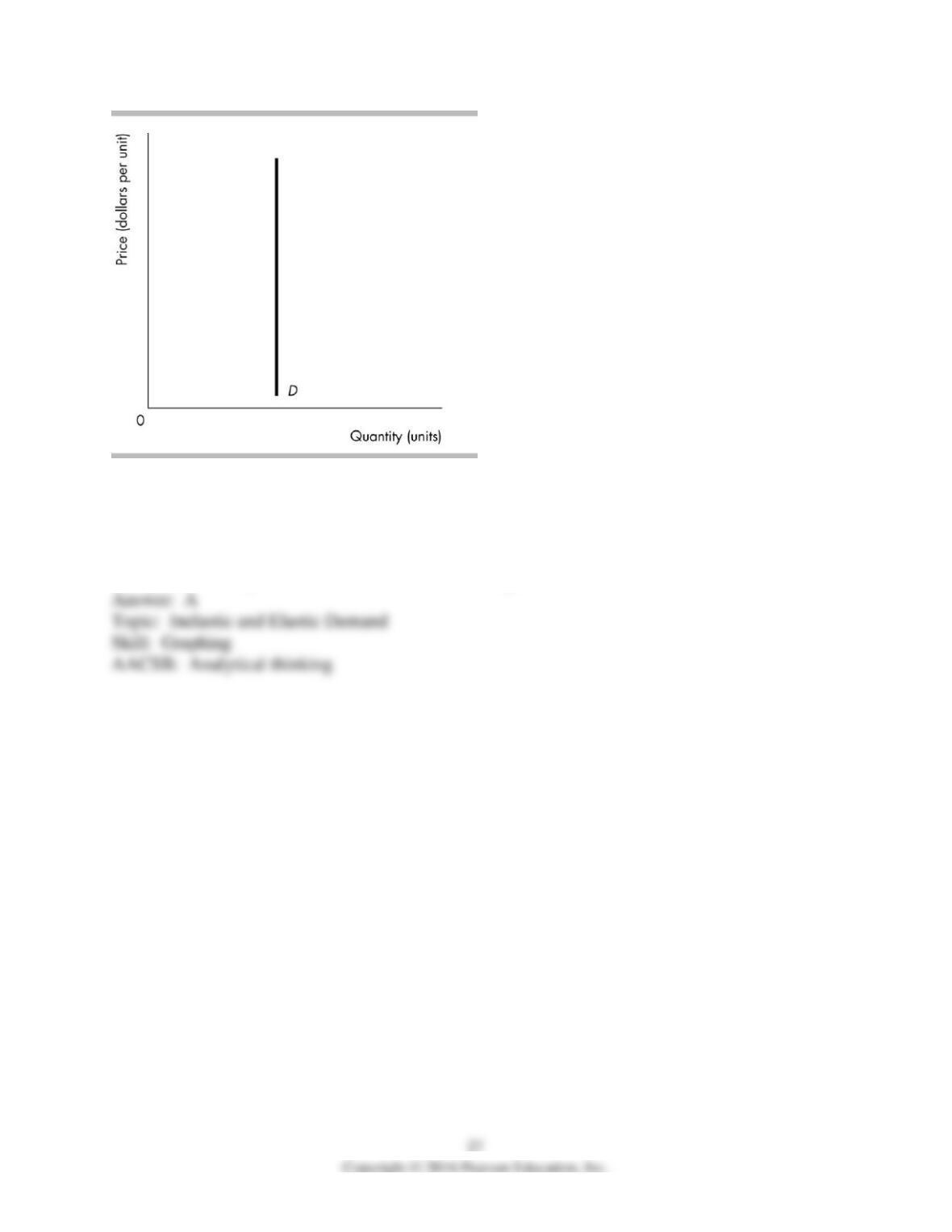
95) The demand curve in the figure above illustrates the demand for a product with
A) zero price elasticity of demand at all prices.
B) infinite price elasticity of demand.
C) unit price elasticity of demand at all prices.
D) a price elasticity of demand that is different at all prices.
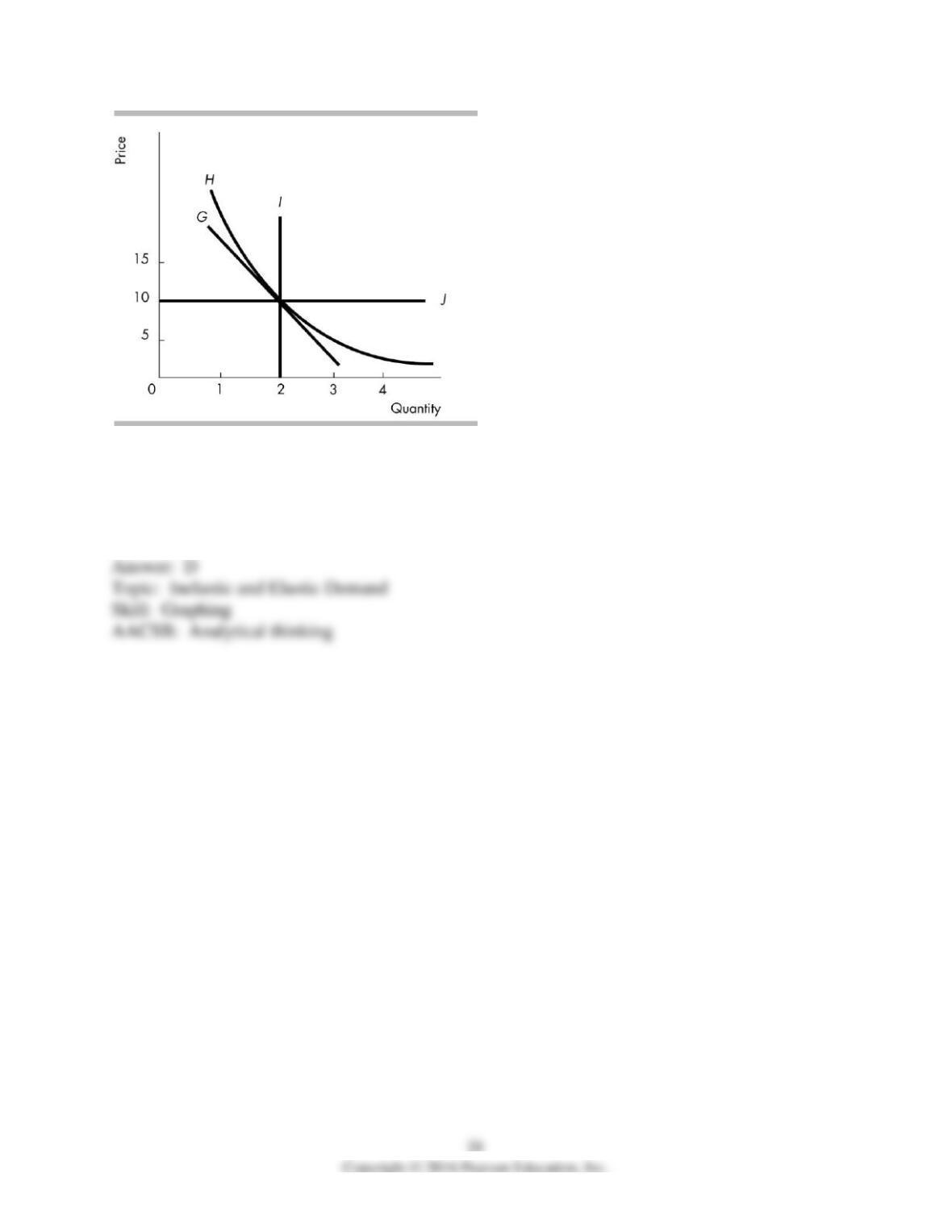
96) In the above figure, which demand curve illustrates perfectly elastic demand?
A) G
B) H
C) I
D) J
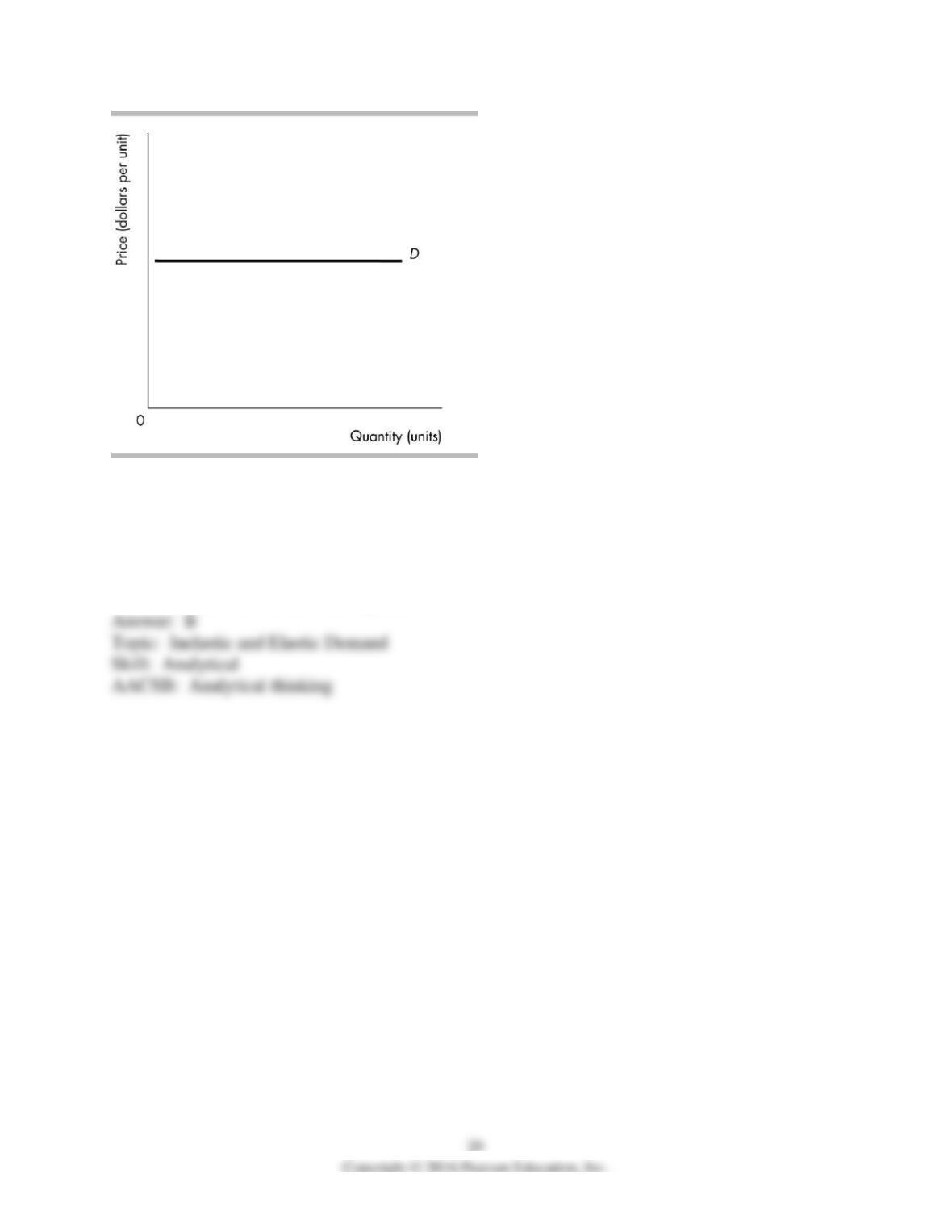
97) The demand curve in the figure above illustrates a product whose demand has a price
elasticity of demand equal to
A) zero at all prices.
B) infinity.
C) one at all prices.
D) a different amount at different prices.
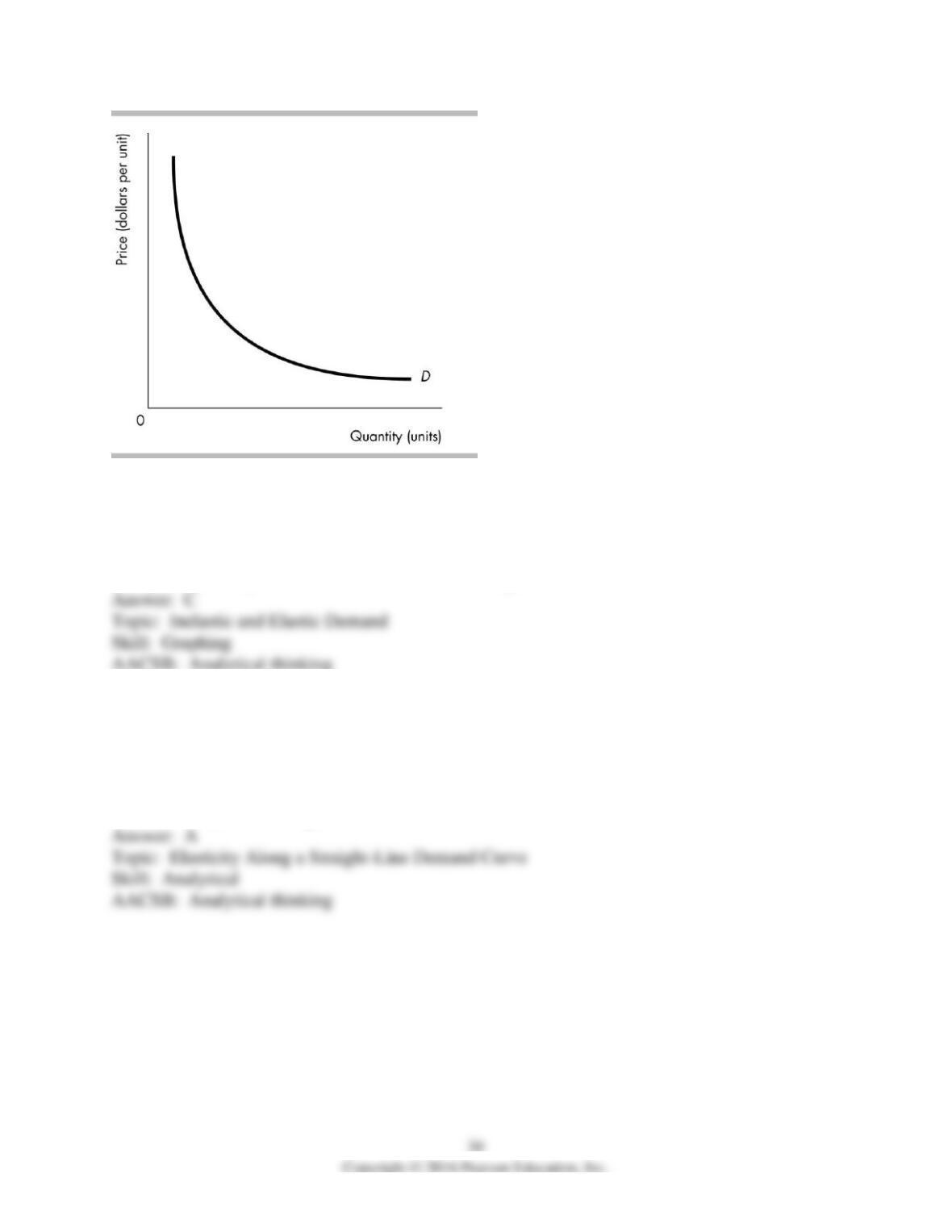
98) The demand curve in the figure above illustrates the demand for a product with
A) zero price elasticity of demand at all prices.
B) infinite price elasticity of demand.
C) unit price elasticity of demand at all prices.
D) a price elasticity of demand that is different at all prices.
99) If the demand curve for oranges is a downward sloping straight line, the price elasticity of
demand will increase the
A) higher the price of oranges.
B) higher the price of other fruits.
C) higher the income level of consumers.
D) lower the price of oranges.
100) If the demand curve is a downward sloping straight line, the price elasticity of demand
always
A) increases as the demand curve shifts rightward.
B) increases as the demand curve shifts leftward.
C) increases with movements upward along the demand curve.
D) decreases with movements upward along the demand curve.
101) Along a straight-line demand curve, as the price falls the
A) demand becomes more elastic.
B) demand becomes less elastic.
C) elasticity of demand is constant.
D) demand is always unitary elastic.
102) The price elasticity of demand ________ in value when moving downward along a
________ line demand curve.
A) falls; straight
B) rises; curved
C) falls, curved
D) rises; straight
103) The demand for bus rides is a downward-sloping straight line demand curve. The price
elasticity of demand for bus rides ________.
A) increases as the price of a bus ride falls
B) decreases as the price of a bus ride falls
C) is the same no matter what the price of a bus ride
D) decreases as the price of a bus ride rises
104) The demand for computer chips is a downward sloping straight line. If there is an increase
in the supply of computer chips, this change will
A) increase the price elasticity of demand for computer chips.
B) decrease the price elasticity of demand for computer chips.
C) have no effect on the price elasticity of demand for computer chips.
D) have an unpredictable effect on the price elasticity of demand for computer chips.
105) At the midpoint of a downward sloping straight-line demand curve, the demand
A) is elastic.
B) is unit elastic.
C) is inelastic.
D) has an elasticity exactly equal to zero.
106) A straight-line demand curve with negative slope intersects the horizontal axis at 200 tons
per week. The point on the demand curve at which the price elasticity of demand is 1
corresponds to a quantity demanded
A) of 0 tons.
B) of 100 tons.
C) of 200 tons.
D) that would be negative if a negative quantity demanded were possible.
107) If the demand curve for a good is a downward sloping straight line, the demand for the
good will be more price elastic the higher is the
A) price of the good.
B) price of complements.
C) income of consumers.
D) income elasticity of demand for that good.
108) The demand curve for microwave popcorn is linear. Which of the following definitely
makes the demand for microwave popcorn more inelastic?
A) a decrease in the price of microwave popcorn
B) an increase in the price of microwave popcorn
C) an increase in income
D) a decrease in income
109) If the demand curve for tacos is a downward sloping straight line, at which of the following
prices is the demand the most elastic?
A) a price of $0.50 per taco
B) a price of $1.00 per taco
C) a price of $1.50 per taco
D) There is not enough information given to determine at which price the demand is most elastic.
110) On a linear demand curve that intersects both axes
A) the elasticity exceeds 1.00 at all prices.
B) the elasticity is less than 1.00 at all prices.
C) the elasticity equals 1.00 at all prices.
D) the elasticity decreases as the price falls and quantity increases.
111) On a straight-line downward-sloping demand curve, the maximum elasticity of demand
occurs
A) at its vertical intercept.
B) at its midpoint.
C) at its horizontal intercept.
D) where it intersects the supply curve.
112) A straight-line demand curve with negative slope intersects the horizontal axis at 100 tons
per week. At the midpoint on the demand curve (corresponding to 50 tons per week) the price
elasticity of demand is
A) 0.
B) 0.5.
C) 1.0.
D) unknown without more information.
113) Which of the following statements is FALSE?
A) A good with a vertical demand curve has a perfectly inelastic demand.
B) A good with a straight line, downward sloping demand curve has a demand whose elasticity
is constant.
C) A good with a horizontal demand curve has a perfectly elastic demand.
D) All of the above statements are false.
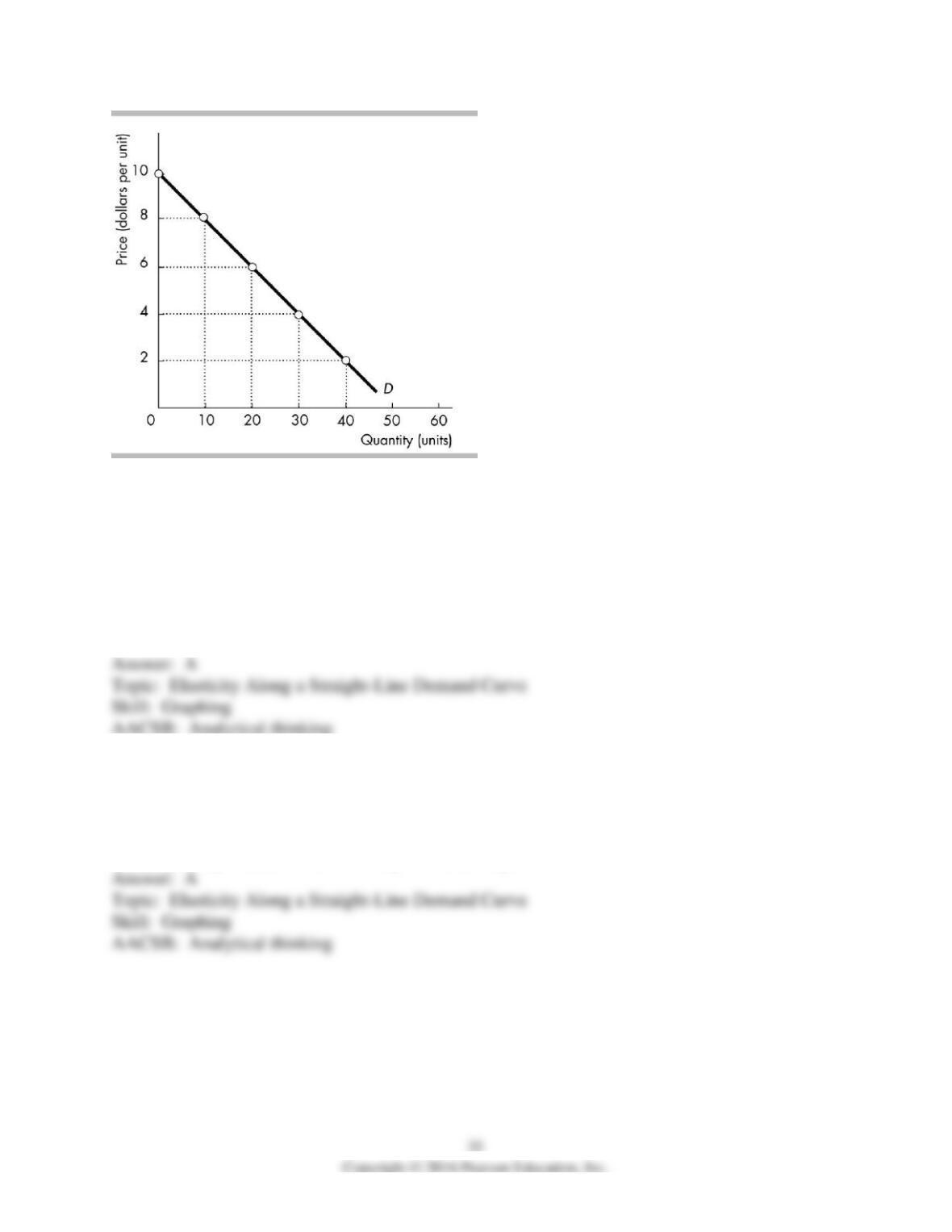
114) The figure above illustrates a linear demand curve. By comparing the price elasticity in the
$2 to $4 price range with the elasticity in the $8 to $10 range, you can conclude that the elasticity
is
A) greater in the $8 to $10 range.
B) greater in the $2 to $4 range.
C) the same in both price ranges.
D) greater in the $8 to $10 range when the price rises but greater in the $2 to $4 range when the
price falls.
115) The figure above illustrates a linear demand curve. If the price falls from $8 to $6
A) total revenue increases.
B) total revenue decreases.
C) total revenue remains unchanged.
D) the quantity demanded increases by less than 20 percent.
116) The figure above illustrates a linear demand curve. In the range from $8 to $6
A) the demand is price elastic.
B) the demand is unit elastic.
C) the demand is price inelastic.
D) more information is needed to determine if the demand is price elastic, unit elastic, or
inelastic.
117) The figure above illustrates a linear demand curve. If the price falls from $6 to $4
A) total revenue increases.
B) total revenue decreases.
C) total revenue remains unchanged.
D) quantity demanded increases by more than 100 percent.
118) The figure above illustrates a linear demand curve. In the price range from $8 to $6,
demand is ________ and in the price range $4 to $2, demand is ________.
A) elastic; elastic
B) elastic; inelastic
C) inelastic; elastic
D) inelastic; inelastic
119) The figure above illustrates a linear demand curve. If the price rises from $6 to $8 demand
is ________ and if the price falls from $8 to $6 demand is ________.
A) elastic; elastic
B) elastic; inelastic
C) inelastic; elastic
D) inelastic; inelastic
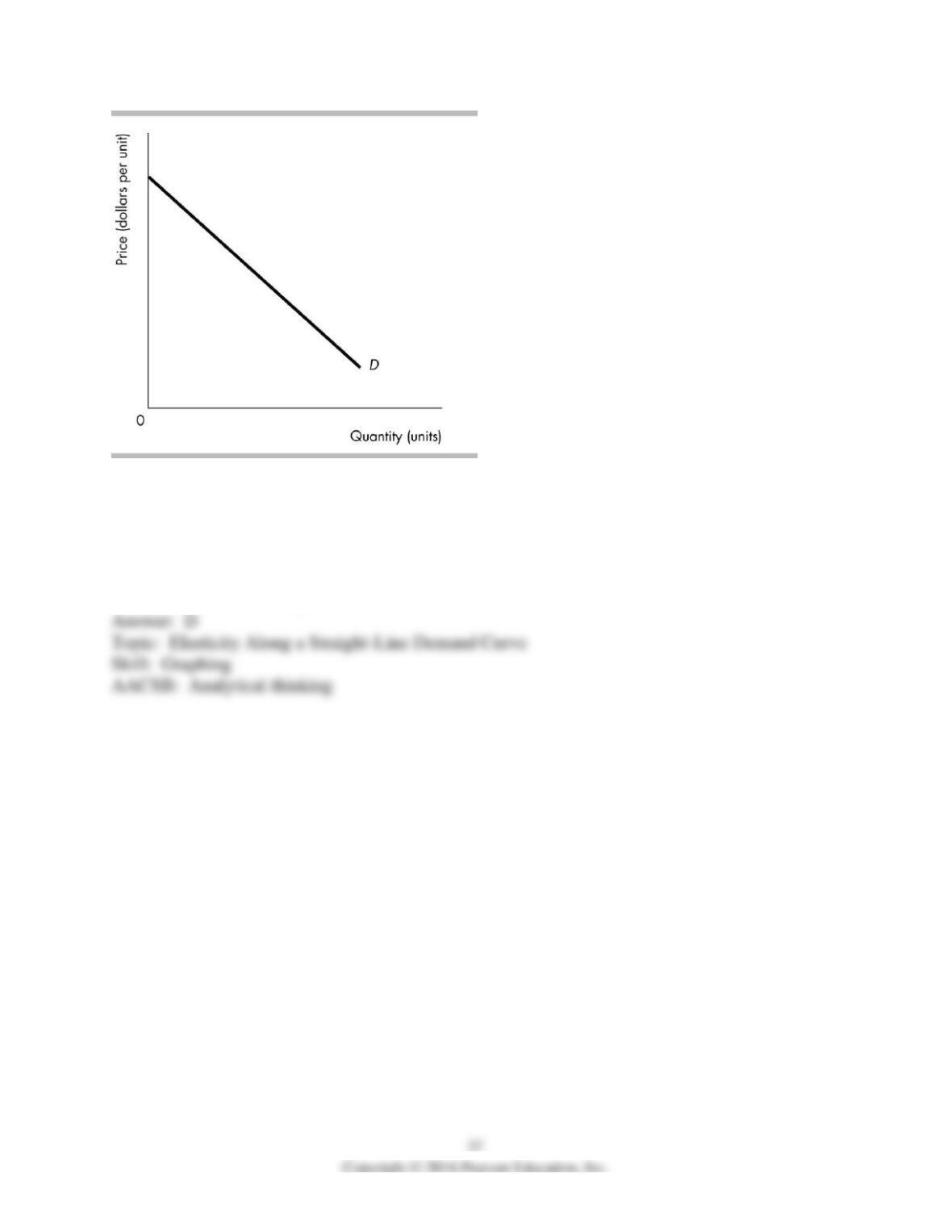
120) The demand curve in the figure above illustrates the demand for a product with a price
elasticity of demand
A) equal to zero at all prices.
B) equal to infinite at all prices.
C) equal to one at all prices.
D) that is different at all prices.
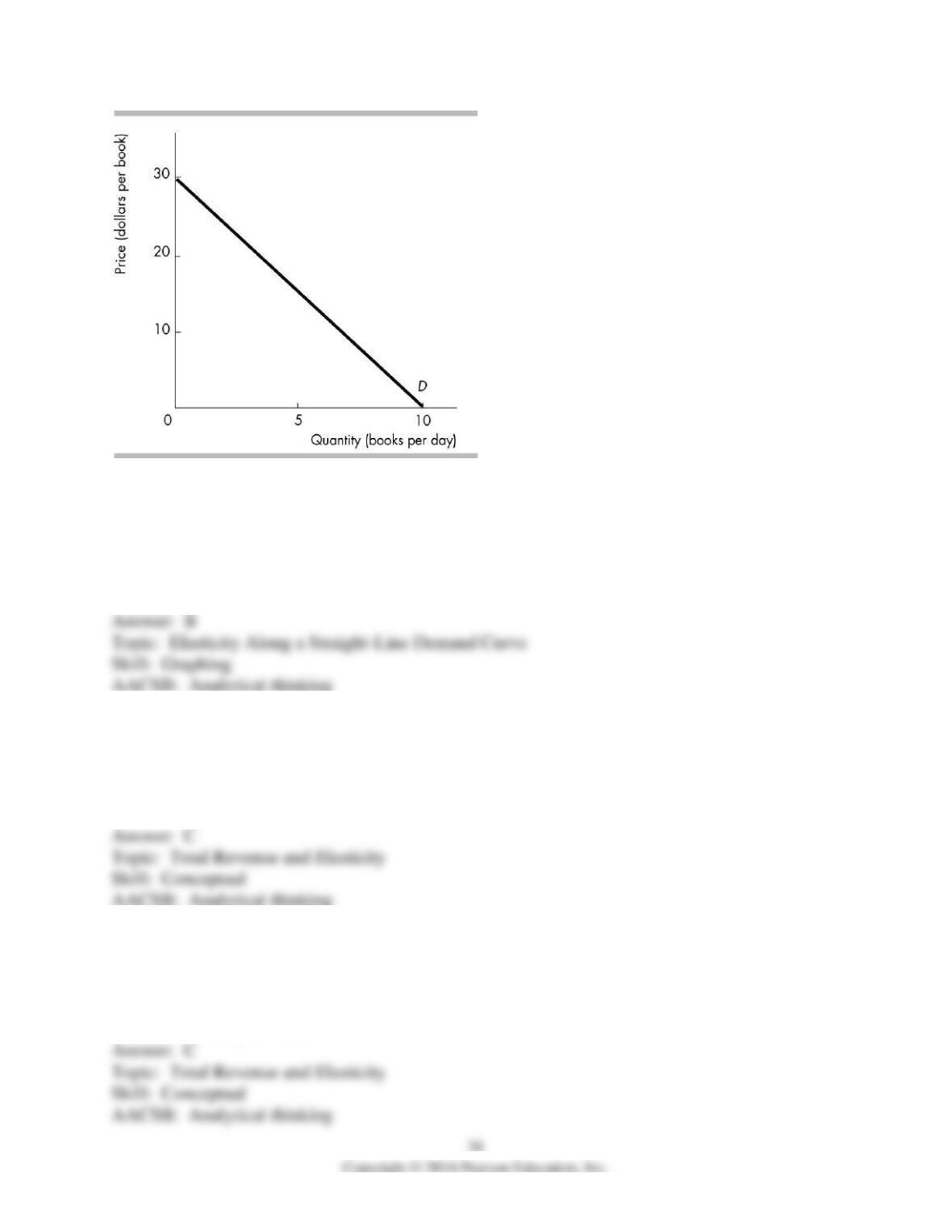
121) The figure illustrates Anne’s demand for books. At ________ a book, Anne’s demand for
books is inelastic.
A) all prices between $15 and $30
B) all prices between $10 and $15
C) all prices between $10 and $20
D) all prices below $30
122) According to the total revenue test, a price cut increases total revenue if demand is
A) inelastic.
B) perfectly inelastic.
C) elastic.
D) unit elastic.
123) Demand is inelastic when a price ________ results in total revenue ________.
A) rise; decreasing
B) fall; increasing
C) rise, increasing
D) fall, remaining the same
124) Demand is elastic when a price ________ results in total revenue ________.
A) rise, decreasing
B) fall, decreasing
C) rise, increasing
D) fall; remaining constant
125) When the demand for a good is inelastic and its price increases, the total revenue from the
sale of the good will ________.
A) increase
B) decrease initially and then increase
C) decrease
D) not change
126) When demand is ________, a decrease in price ________ total revenue.
A) elastic; decreases
B) inelastic; decreases
C) unit elastic; increases
D) elastic; does not change
127) If demand is inelastic, an increase in the price will
A) decrease total revenue.
B) increase total revenue.
C) not change total revenue.
D) increase the quantity demanded.
128) To maximize its revenue
A) a firm facing inelastic demand should always raise its price.
B) a firm facing elastic demand should always raise its price.
C) a firm should always charge the highest price possible regardless of the elasticity of demand.
D) None of the above answers is correct.
129) The demand for a good is elastic if
A) an increase in its price results in an increase in total revenue.
B) a decrease in its price results in a decrease in total revenue.
C) an increase in its price results in a decrease in total revenue.
D) the good is a necessity.
130) Demand is unit elastic when
A) the slope of the demand curve is -1.
B) a shift of the supply curve leads to no change in price.
C) a shift of the supply curve leads to an equal shift of the demand curve.
D) a change in the price of the product leads to no change in the total revenue.
131) Producers’ total revenue will decrease if
A) income increases and the good is a normal good.
B) the price rises and demand is elastic.
C) the price rises and demand is inelastic.
D) income falls and the good is an inferior good.