31) Alison consumes only tea and cookies and consumes them only in equal proportions. What is Alison’s
income elasticity of demand for tea?
4.3 Effects of a Price Increase
1) Median household income is $50,000 per year. The typical household spends about $125 per year on
milk, which has an income elasticity of about 0.07. From this information, we can conclude that
A) milk is a luxury.
B) milk is a Giffen good.
C) the income effect from a change in the price of milk is very large.
D) the income effect from a change in the price of milk is very small.
2) When the price of a good changes, the total effect of the price change on the quantities purchased can
be found by comparing the quantities purchased
A) on the old budget line and the new budget line.
B) on the original indifference curve when faced with the original prices and when faced with the new
prices.
C) on the new budget line and a hypothetical budget line that is a parallel shift back to the original
indifference curve.
D) on the new indifference curve.
3) When the price of a good changes, the substitution effect can be found by comparing the equilibrium
quantities purchased
A) on the old budget line and the new budget line.
B) on the original indifference curve when faced with the original prices and when faced with the new
prices.
C) on the new budget line and a hypothetical budget line that is a shift back to the original indifference
curve parallel to the new budget line.
D) on the new indifference curve.
4) When the price of a good changes, the income effect can be found by comparing the equilibrium
quantities purchased
A) on the old budget line and the new budget line.
B) on the original indifference curve when faced with the original prices and when faced with the new
prices.
C) on the new budget line and a hypothetical budget line that is a shift back to the original indifference
curve parallel to the new budget line.
D) on the new indifference curve.
5) The substitution effect can be measured holding ________ constant.
A) income
B) utility
C) the price of one good
D) the price of all goods
6) Suppose that frozen dinners were once a normal good for John, but now frozen dinners are an inferior
good for him. John’s demand curve for frozen dinners
A) has become steeper as a result.
B) has become flatter as a result.
C) has not changed as a result.
D) has disappeared as a result.
7) One characteristic of a Giffen good is that it
A) is a luxury good.
B) is an inferior good.
C) has an upward-sloping Engel curve.
D) All of the above.
8) A Giffen good has
A) a positive substitution effect.
B) a negative income effect.
C) a larger income effect than substitution effect.
D) All of the above.
9) If a good is an inferior good, then its
A) demand curve will be upward sloping.
B) income effect reinforces the substitution effect.
C) income elasticity is negative.
D) Engel curve cannot be drawn.
10) Suppose Lisa spends all of her money on books and coffee. When the price of coffee decreases, the
A) substitution effect on coffee is positive, and the income effect on coffee is positive.
B) substitution effect on coffee is ambiguous, and the income effect on coffee is ambiguous.
C) substitution effect on coffee is positive, and the income effect on coffee is ambiguous.
D) substitution effect on coffee is ambiguous, and the income effect on coffee is positive.
11) In the case of a normal good,
A) demand curves always slope downward.
B) the income effect and substitution effect are in the same direction.
C) the Engel curve slopes upward.
D) All of the above.
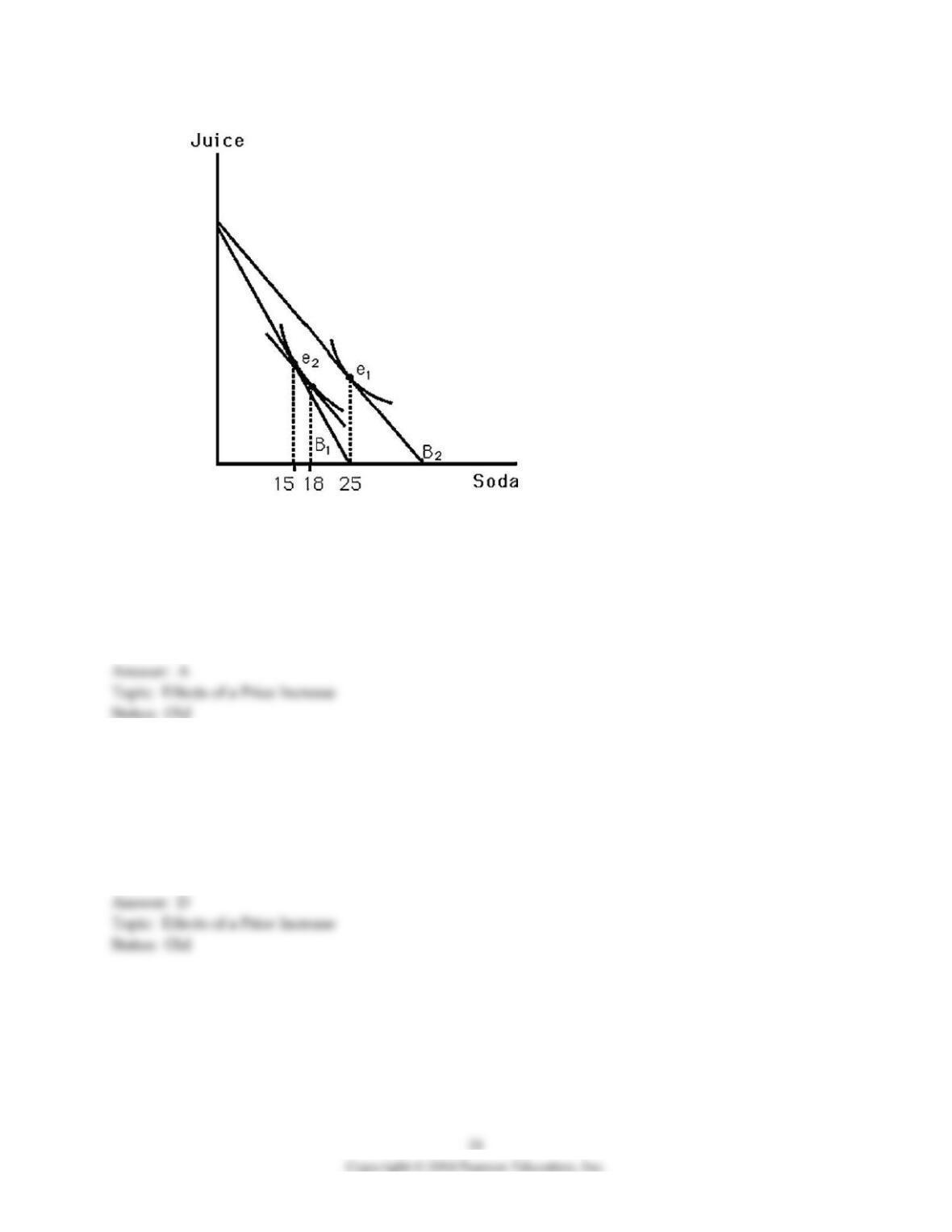
12) The above figure shows Bobby’s indifference map for soda and juice. B1 indicates his original budget
line. B2 indicates his budget line resulting from a decrease in the price of soda. What change in quantity
best represents his substitution effect?
A) 3
B) 10
C) 15
D) 7
13) The above figure shows Bobby’s indifference map for soda and juice. B1 indicates his original budget
line. B2 indicates his budget line resulting from a decrease in the price of soda. What change in quantity
best represents his income effect?
A) 3
B) 10
C) 15
D) 7
14) The above figure shows Bobby’s indifference map for soda and juice. B1 indicates his original budget
line. B2 indicates his budget line resulting from an increase in the price of soda. From the graph, one can
conclude that
A) Bobby views soda as an inferior good.
B) Bobby’s demand for soda is perfectly inelastic.
C) Bobby views soda as a normal good.
D) the income elasticity of demand for soda is one.
15) When measuring the substitution effect, one uses the change along
A) the old indifference curve.
B) the new indifference curve.
C) either the old or the new indifference curve.
D) the budget constraint.
16) The Slutsky equation shows that, holding the total effect constant, the income effect will be larger for
goods that
A) have a smaller substitution effect.
B) make up a larger percentage of a household’s budget.
C) have perfectly inelastic demand curves.
D) All of the above.
17) Suppose that the interest rate paid to savers increases. As a result, Tom wishes to save less. This
suggests that, for Tom,
A) the substitution effect is greater than the income effect.
B) the income effect is greater than the substitution effect.
C) utility maximization is not occurring.
D) future consumption is a luxury.
18) Suppose that the interest rate paid to savers increases. As a result, Tom wishes to save more. This
suggests that, for Tom,
A) the substitution effect is greater than the income effect.
B) the income effect is greater than the substitution effect.
C) utility maximization is not occurring.
D) future consumption is a luxury.
19) To separate the income and substitute effects, the imaginary budget line should be
A) tangent to the new indifference curve and parallel to the new budget line.
B) tangent to the new indifference curve and parallel to the old budget line.
C) tangent to the old indifference curve and parallel to the new budget line.
D) tangent to the old indifference curve and parallel to the old budget line.
20) Suppose hamburger is an inferior good, but not a Giffen good, for Bob. If the price of hamburgers
increases,
A) the income effect is greater than the substitution effect.
B) the income effect is smaller than the substitution effect.
C) consumption of hamburger will increase.
D) We are unable to judge the change of hamburger consumption.
21) If the income elasticity of potatoes is -0.7, then the income effect caused by a price decrease of potatoes
A) tends to increase the consumption of potatoes.
B) tends to decrease the consumption of potatoes.
C) is less than the substitution effect.
D) None of the above.
22) Suppose Lisa spends all of her money on books and bagels, and a bagel is an inferior good for her.
When the price of coffee increases, the
A) consumption of coffee will fall.
B) consumption of coffee will rise.
C) consumption of coffee will not change.
D) Not enough information.
For the following, please answer “True” or “False” and explain why.
23) If a consumer is compensated for the income effect that occurs when the price of a good increases,
then his demand curves can never slope upward.
24) A good may be inferior at some income levels and normal at others.
25) If the Engel curve for a good is upward sloping, the demand curve for that good must be downward
sloping.
26) The compensated demand curve holds the consumer’s utility fixed as the price changes.
27) The compensated demand curve only responds to the income effect from a price change.
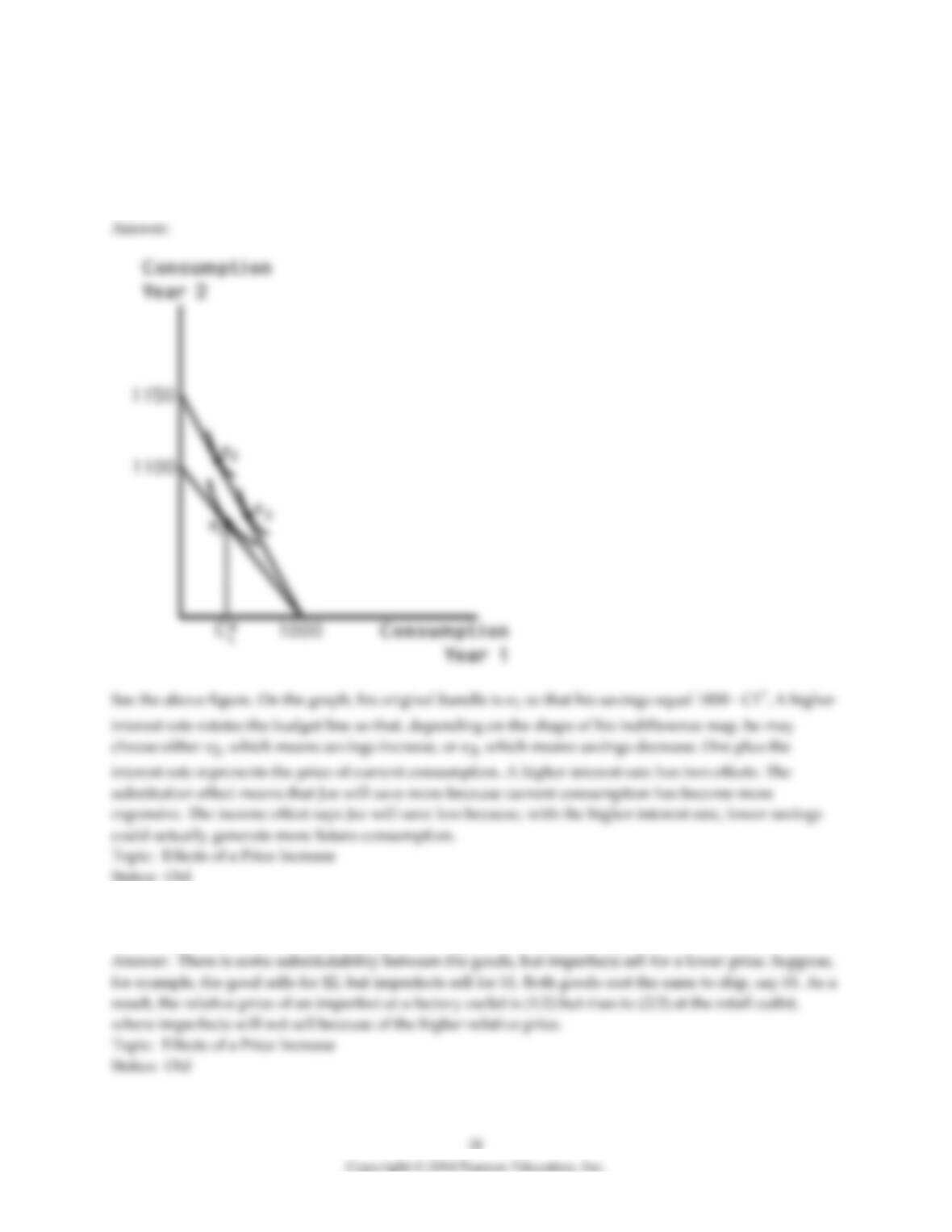
28) Suppose Joe earns $1,000 in year 1 and $0 in year 2. Any amount he saves will earn interest at a rate of
0%. Draw Joe’s budget line. (Hint: He can either consume all $1000 this year or consume nothing this year
and have $1,100 next year.) Assuming convex indifference curves, show that an increase in the rate of
interest can cause Joe‘s savings to either increase or decrease. Explain in terms of income and substitution
effect.
29) Many manufacturers sell products labeled as having imperfections at a discount at their factory
outlets but do not ship these imperfect goods to regular retail outlets. Why?
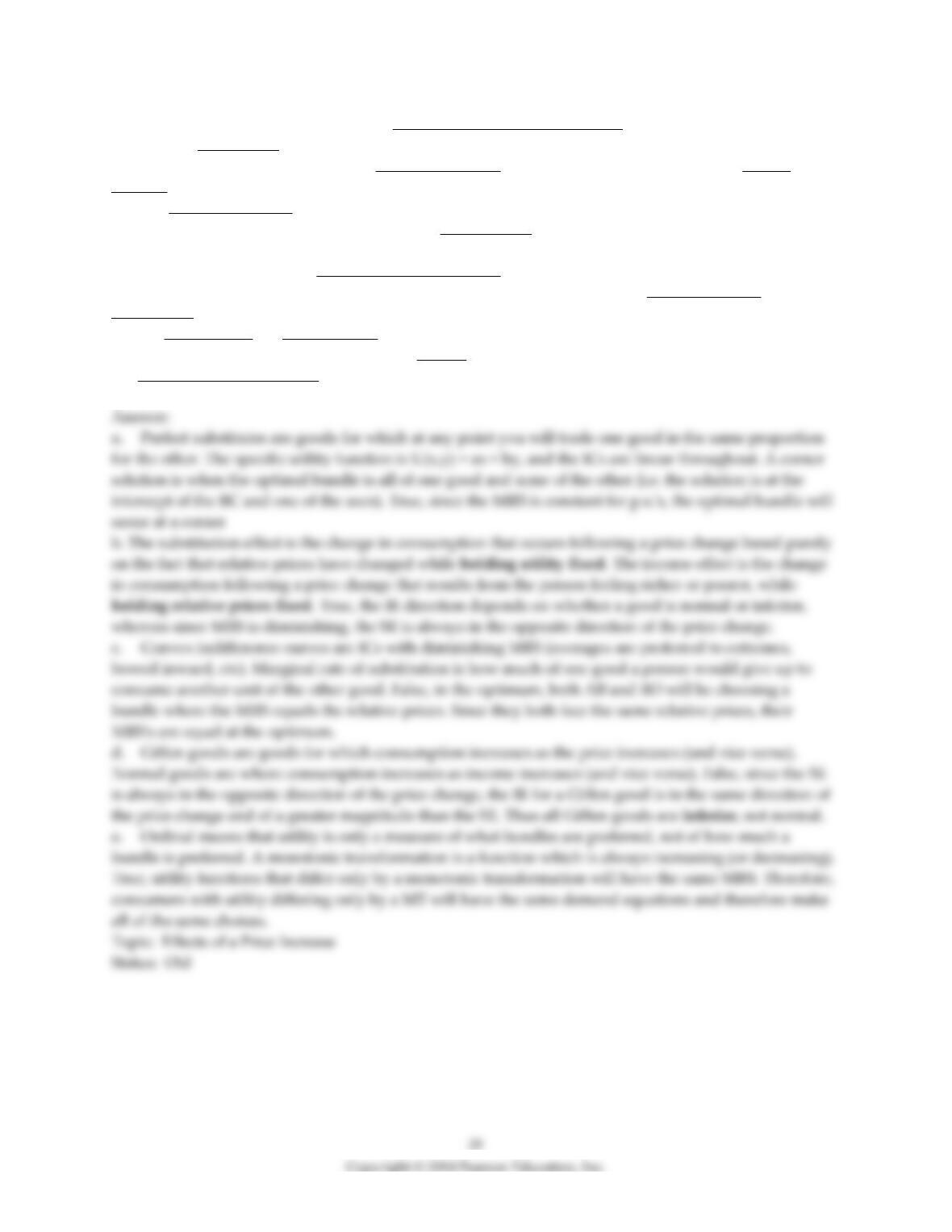
30) For each of the following statements, define all of the underlined terms. Then, explain why the
statement is true or false.
a. If a consumer views two goods as perfect substitutes then their optimal choice will be a corner
solution.
b. The substitution effect from a price increase states that the consumer will always choose a smaller
amount of that good to consume. However, the income effect states that consumption can move in either
direction.
c. Suppose Alf and Bo have convex indifference curves. Alf likes units of “X” more than units of “Y” but
Bo likes units of “Y” much more than units of “X.” Then, in the optimum, Alf’s marginal rate of
substitution will be different from Bo’s even if they face the same prices.
d. All Giffen goods are normal goods, but not all normal goods are Giffen goods.
e. Economists assume that preferences are ordinal. This implies that given two utility functions and one
is a monotonic transformation of the other, then they represent the same preferences over bundles of
goods.
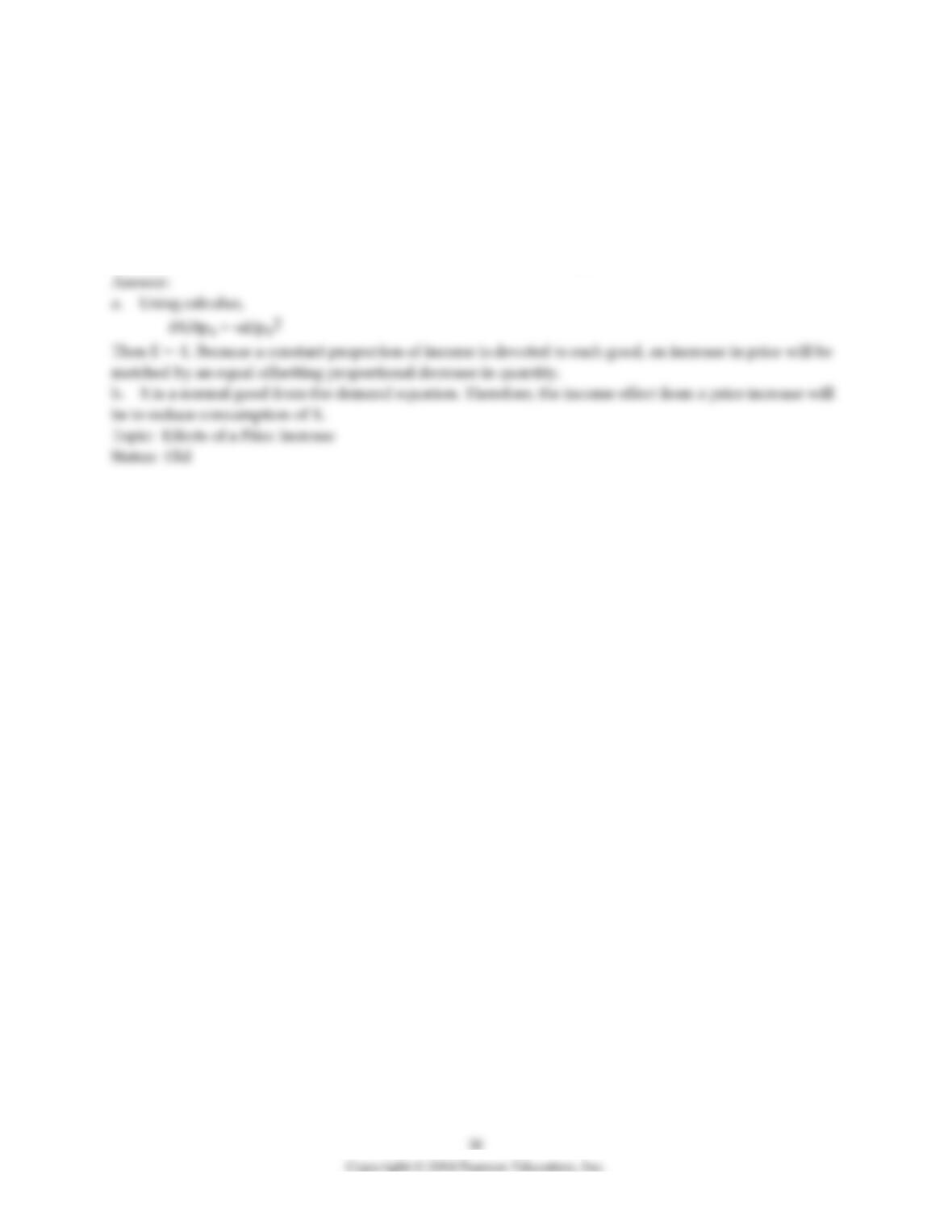
31) Recall that the Cobb-Douglas Utility function U(X,Y) = XaY1-a has the unusual property that the
demand for each good depends only on its own price. Therefore, a consumer will always allocate the
same proportion of income to each good. Specifically, the demand for X is
X* = aI/px
where I is income and px is the price of X.
a. What is the price elasticity of demand for X?
b. What is the direction of the income effect on X of an increase in px?
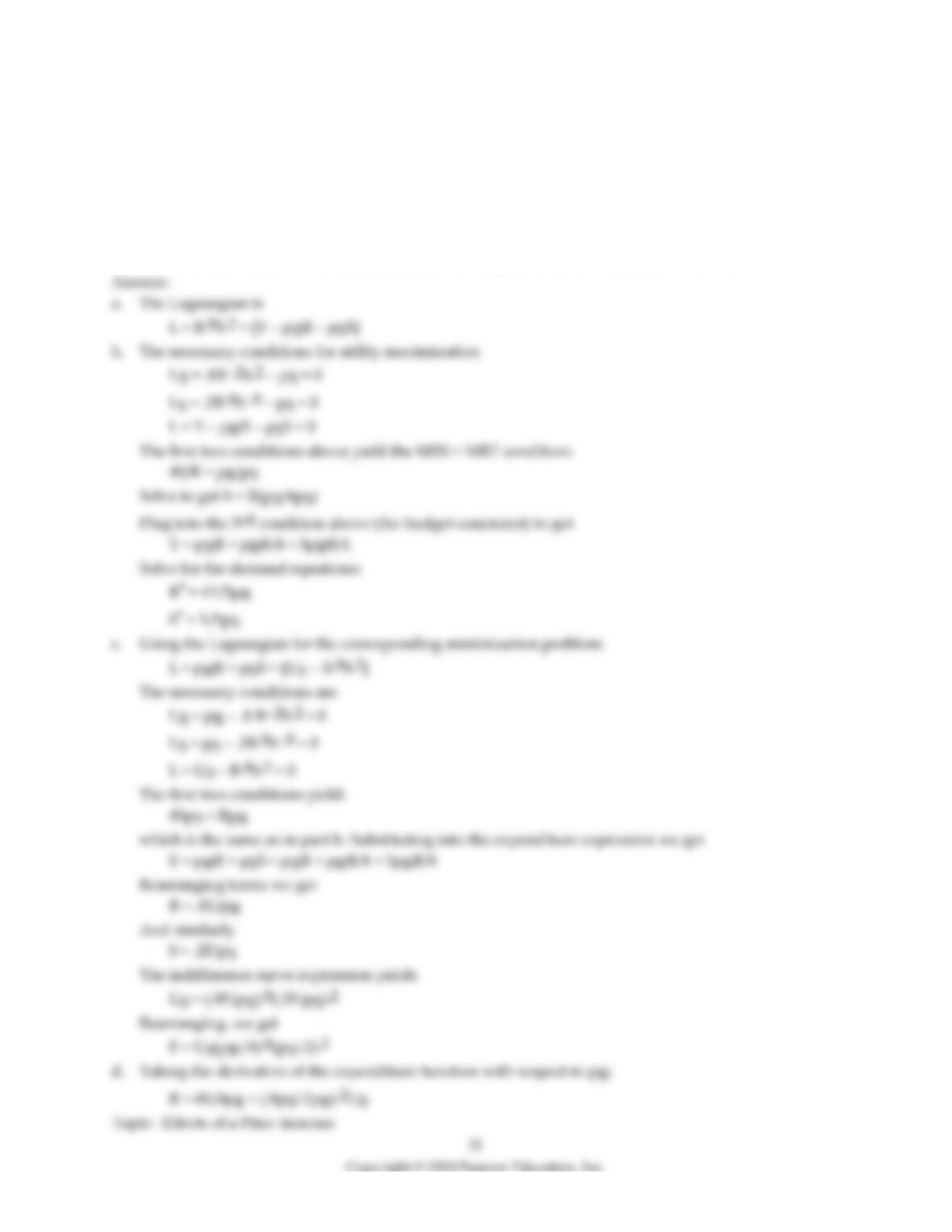
32) Rachel spends her income, Y, on Rock Shows (R) and Sunglasses (S) with prices pR and pS. Rachel’s
preferences are given by the Cobb-Douglas utility function
U(X,Y) = R.8S.2
a. Write out the Lagrangian for Rachel’s utility-maximization problem.
b. Use the Lagrangian to derive Rachel’s optimal choice, (R*,S*).
c. For a given utility level, U0, derive Rachel’s Expenditure function E(pR,pS,U0).
d. Use the Expenditure function to derive Rachel‘s compensated demand for Rock Shows.
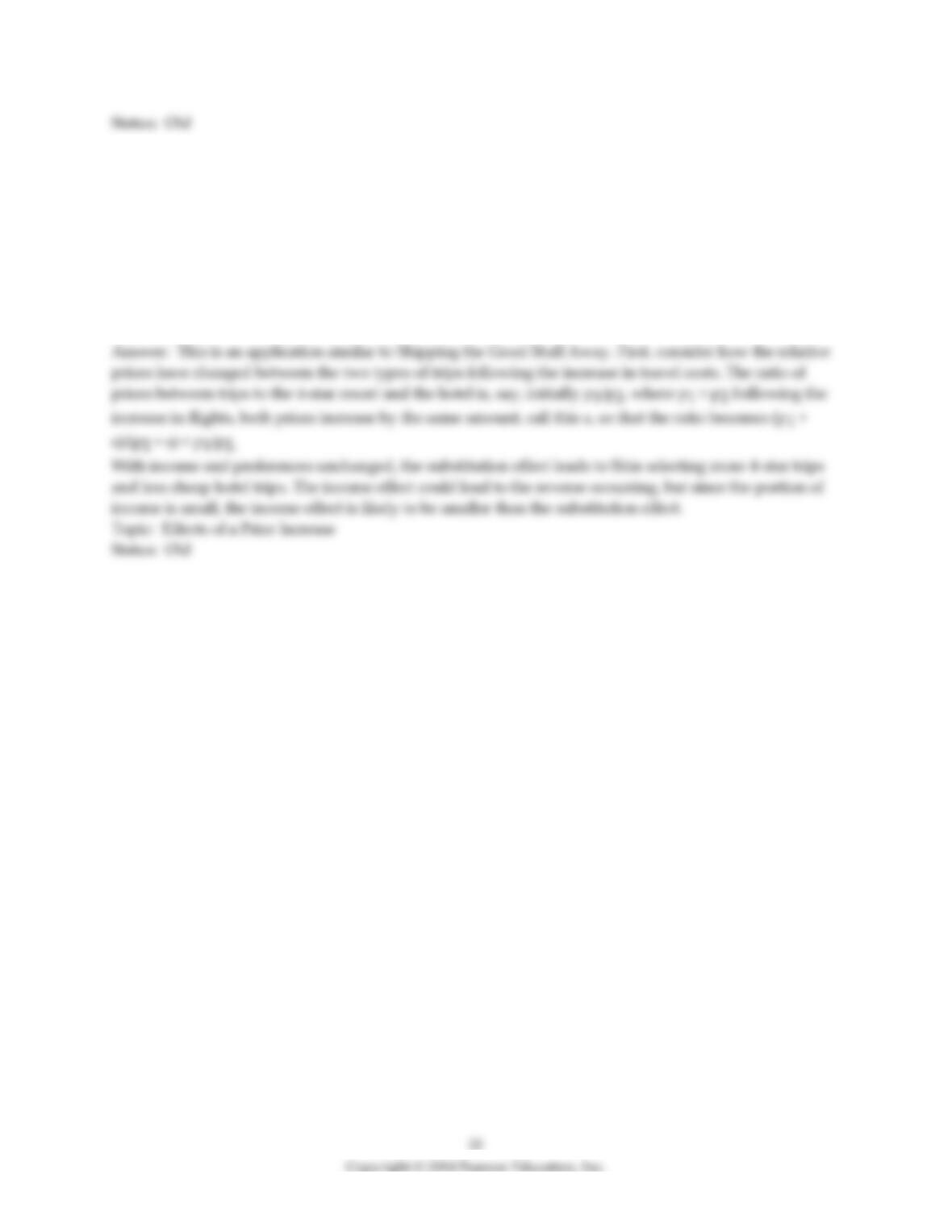
33) Shin likes to spend a (relatively small) portion of his income on vacations to Cabo San Lucas (a
popular resort area in Mexico). On these trips, he either stays at a four star resort with panoramic ocean
views or a more modest, and slightly deteriorating hotel in the noisy part of town. Understandably, the
four star hotel is significantly more expensive. Suppose that the four-star hotel costs $5000/trip while the
hotel costs just $500/trip. In recent years, the price of airfare has risen significantly, a change that effects
the cost of his trips the same regardless of where he stays. Suppose that airfare has increased from
$300/trip to $1000/trip. Why is it that following the higher travels prices, Shin is likely to spend more of
his vacations at the four star resort when he travels. (Assume that the hotel rates and Shin’s preferences
are fixed).
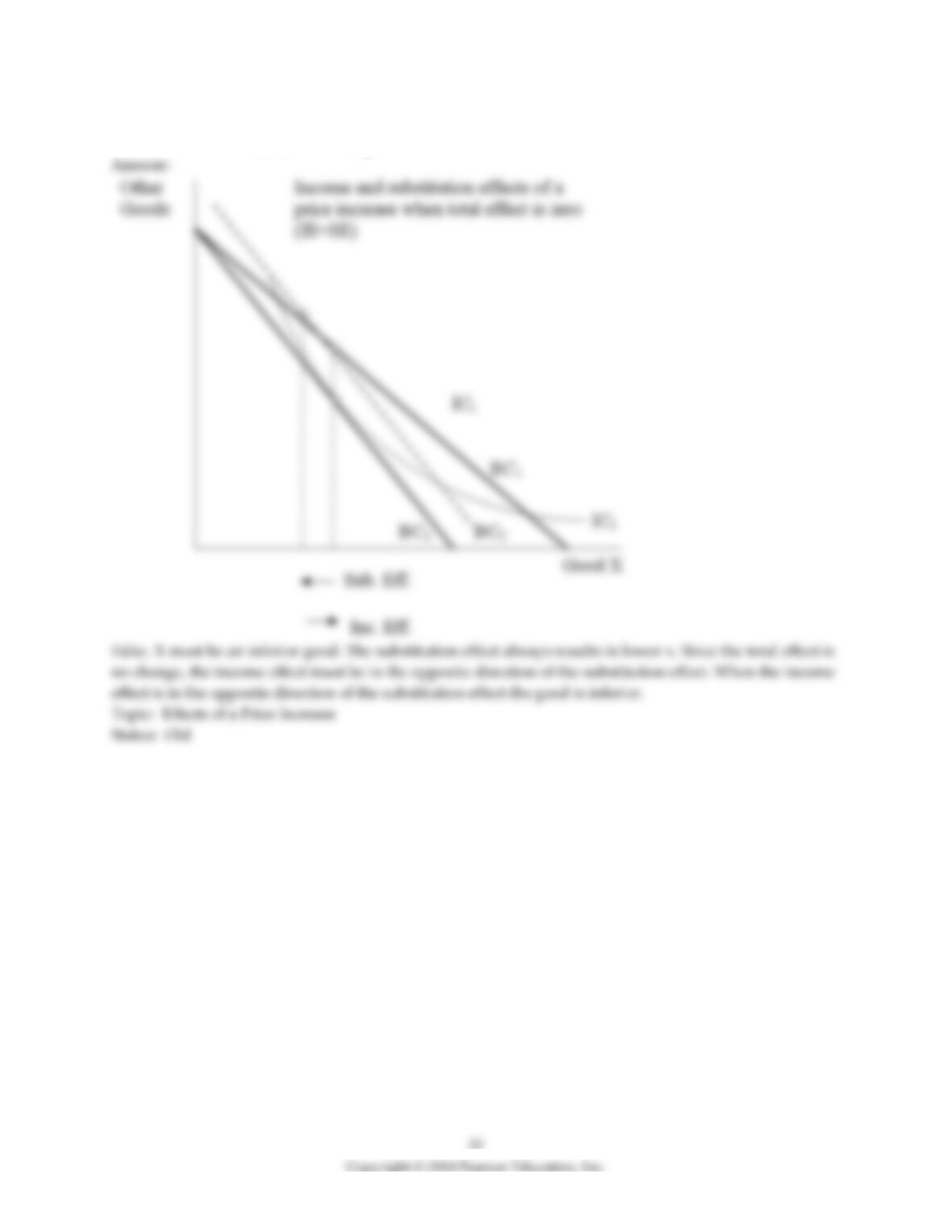
34) Suppose the price of X goes up and a consumer goes on consuming the exact same amount of X as
before. Then X cannot be an inferior good.
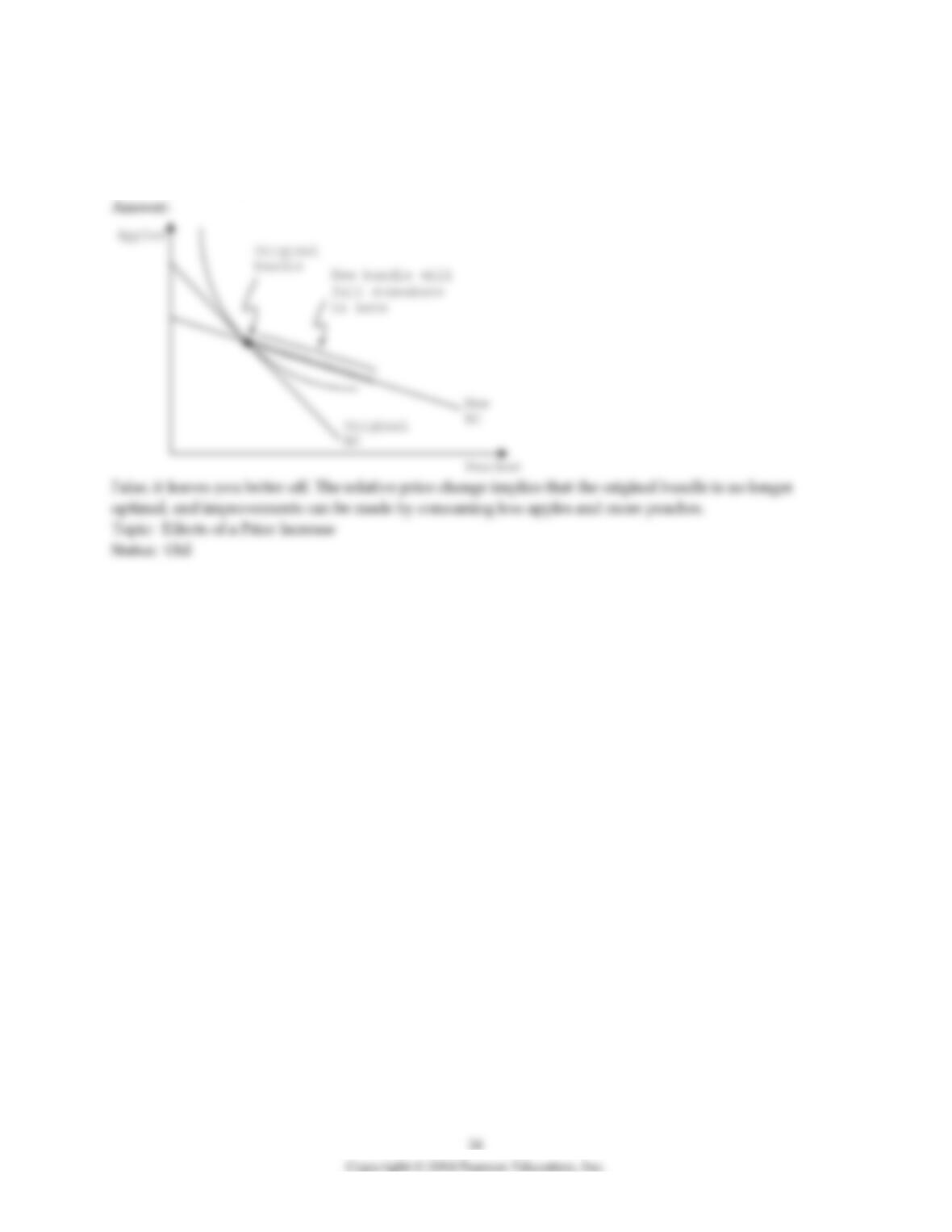
35) Suppose the only goods you consume are apples and peaches. One day the price of apples goes up
and the price of peaches goes down, and you find that you can still just afford to buy the same
combination of peaches and apples that you were buying all along. The price changes leave you neither
better nor worse off.