Microeconomics, 12e (Parkin)
Chapter 4 Elasticity
1 Price Elasticity of Demand
1) Suppose the price of burgers increases from $2 to $3 each. The degree to which quantity
demanded responds to this price increase depends on the
A) price elasticity of demand.
B) the price elasticity of supply.
C) income elasticity of demand.
D) cross elasticity of demand.
2) The price elasticity of demand measures
A) how often the price of a good changes.
B) the slope of a budget curve.
C) how sensitive the quantity demanded is to changes in demand.
D) the responsiveness of the quantity demanded to changes in price.
3) Elasticity measures the
A) percentage change in a variable.
B) slope of a curve.
C) change in a variable.
D) responsiveness of a variable to a change in another variable.
4) The price elasticity of demand for purses is measured in what units?
A) dollars
B) purses
C) dollars per purse
D) The price elasticity of demand is a unitless measure.
5) The price elasticity of demand is defined as the magnitude of the
A) change in quantity demanded divided by the change in price.
B) change in price divided by the change in quantity demanded.
C) percentage change in quantity demanded divided by the percentage change in price.
D) percentage change in price divided by the percentage change in quantity demanded.
6) The price elasticity of demand is calculated as the absolute value of the
A) percentage change in quantity demanded divided by the percentage change in price.
B) percentage change in price divided by the percentage change in quantity demanded.
C) change in quantity demanded divided by the change in price.
D) change in price divided by the change in quantity demanded.
7) The price elasticity of demand equals magnitude of the
A) change in the price divided by the change in quantity demanded.
B) change in the quantity demanded divided by the change in price.
C) percentage change in the price divided by the percentage change in the quantity demanded.
D) percentage change in the quantity demanded divided by the percentage change in the price.
8) The price elasticity of demand is equal to the ________ in the ________ divided by the
________ in the ________.
A) percentage change; price; percentage change; quantity demanded
B) change; price; change; quantity demanded
C) percentage change; quantity demanded; percentage change; price
D) change; quantity demanded; change; price
9) The price elasticity of demand depends on
A) the units used to measure price and the units used to measure quantity.
B) the units used to measure price but not the units used to measure quantity.
C) the units used to measure quantity but not the units used to measure price.
D) neither the units used to measure price nor the units used to measure quantity.
10) When the quantity of coal is measured in kilograms instead of pounds, the demand for coal
becomes
A) more elastic.
B) less elastic.
C) neither more nor less elastic.
D) undefined.
11) The price elasticity of demand for oranges ________ change if the units of the quantity was
changed from pounds to kilograms and ________ change if the units of the price was changed
from dollars to cents.
A) would; would
B) would; would not
C) would not; would
D) would not; would not
12) Suppose the quantity of gasoline is measured in gallons and the price of gasoline is measured
in dollars. The price elasticity of demand is 0.67. If the price of gasoline was now measured in
cents rather than dollars, the price elasticity of demand would now be
A) 0.0067.
B) 0.67.
C) 6.7.
D) 67.0.
13) A decrease in the price of eggs from $1.50 to $1.30 per dozen resulted in an increase in egg
purchases in two cities. In Philadelphia, daily egg purchases increased from 6000 to 8000
dozens; in nearby Dover, Delaware, daily egg purchases increased from 300 to 400 dozens. The
price elasticity of demand is therefore
A) lower in the smaller city as would be expected.
B) greater in the smaller city as would be expected.
C) certainly affected by population differences in different markets.
D) the same in Philadelphia as in Dover.
14) Dan sells newspapers. Dan says that a 4 percent increase in the price of a newspaper will
decrease the quantity of newspapers demanded by 8 percent. According to Dan, the demand for
newspapers is ________.
A) inelastic
B) unit elastic
C) perfectly elastic
D) elastic
15) The price elasticity of demand for furniture is estimated at 1.3. This value means a one
percent increase in the
A) price of furniture will increase the quantity of furniture demanded by 1.3 percent.
B) price of furniture will decrease the quantity of furniture demanded by 1.3 percent.
C) quantity of furniture demanded will decrease the price of furniture by 1.3 percent.
D) quantity of furniture demanded will increase the price of furniture by 1.3 percent.
16) The price elasticity of demand for oil is estimated at 0.05. This value means a 10 percent
increase in the
A) quantity of oil demanded will result from a 0.5 percent increase in the price of oil.
B) quantity of oil demanded will result from a 0.5 percent decrease in the price of oil.
C) price of oil will increase the quantity of oil demanded by 0.5 percent.
D) price of oil will decrease the quantity of oil demanded by 0.5 percent.
17) If a 6 percent decrease in the price leads to a 5 percent increase in the quantity demanded, the
price elasticity of demand is
A) 0.30.
B) 0.60.
C) 0.83.
D) 1.20.
18) A 10 percent increase in the quantity of spinach demanded results from a 20 percent decline
in its price. The price elasticity of demand for spinach is
A) 0.5.
B) 2.0.
C) 10.0.
D) 20.0.
19) A 20 percent increase in the quantity of pizza demanded results from a 10 percent decline in
its price. The price elasticity of demand for pizza is
A) 0.5.
B) 2.0.
C) 10.0.
D) 20.0.
20) If a 20 percent increase in the price of a used car results in a 10 percent decrease in the
quantity of used cars demanded, then the price elasticity of demand equals
A) 0.5.
B) 1.0.
C) 2.0.
D) 10.0.
21) If the price of a movie ticket increases by 4 percent and the quantity of movies demanded
falls by 2 percent, the price elasticity of demand is
A) 2.0.
B) 4.0.
C) 0.5.
D) some amount that cannot be determined without more information.
22) If the price of a burger decreases by 5 percent and as a result the quantity of burgers
demanded increases by 8 percent, the price elasticity of demand equals
A) 0.60.
B) 0.40.
C) 1.60.
D) 0.625.
23) If the quantity demanded of hamburgers increases by 20 percent when the price decreases by
5 percent, then the price elasticity of demand is
A) 0.25.
B) 4.0.
C) 20.0.
D) 5.0.
24) Suppose that the quantity of pizza demanded decreased by 15 percent after an increase in
price of 10 percent. What is the price elasticity of demand for pizza?
A) 1.50
B) 0.67
C) -1.50
D) -0.67
25) Suppose a drought increased the price of corn by 25 percent while it decreased the quantity
by 50 percent. The price elasticity of demand equals
A) 2.00.
B) 0.50.
C) 20.0.
D) zero.
26) The worst drought in over 50 years has decimated crops of soy beans and corn in the United
States. (Source: New York Times, August 10, 2012). Because the production of corn has
decreased, prices are expected to increase by 25 percent. These data are insufficient for
calculating the elasticity of demand because we also need to know the
A) percentage increase in income.
B) percentage increase in quantity.
C) percentage decrease in quantity.
D) increase in bushels per acre.
27) When the price of a movie ticket increases from $5 to $7, the quantity of tickets demanded
decreases from 600 to 400 a day. What is the price elasticity of demand for movie tickets?
A) 0.83
B) 1.20
C) 1.00
D) 2.32
28) Suppose a rise in the price of peaches from $5.50 to $6.50 per bushel decreases the quantity
demanded from 12,500 to 11,500 bushels. The price elasticity of demand is
A) 0.5.
B) 1.0.
C) 2.0.
D) 1000.0.
29) Taco Bell’s economists determine that the price elasticity of demand for their tacos is 2.0. So,
if Taco Bell raises the price of its tacos by 6.0 percent, the quantity demanded will decrease by
________ percent.
A) 2.0
B) 3.0
C) 6.0
D) 12.0
30) Using average price and average quantity, calculate the price elasticity of demand if a price
rise from $8 to $10 and decreases the quantity demanded from 20 units to 15 units. The price
elasticity of demand equals
A) 2.5.
B) 1.29.
C) 0.78.
D) 0.06
31) A local pizzeria raised its price from $9 to $11 for each pizza and the sales of its pizza
decreased from 150 to 100 per day. What is the price elasticity of demand in this case?
A) 1/2
B) -2
C) -1/2
D) 2
32) Using the average price and average quantity, what is the elasticity of demand for oranges
when the price of oranges changes from $200 to $160 per bushel and so the quantity demanded
changes from 1000 to 1400 bushels?
A) 1.5
B) 0.1
C) 10.0
D) 0.67
33) If the price of a soda increases from 75¢ to $1.00 and as a result the quantity demanded of
sodas decreases from 10 to 9 per week, the elasticity of demand for sodas equals
A) 2.72.
B) 0.37.
C) 0.83.
D) 1.20.
34) When the price of oranges increases from $4 to $6 per bag, the quantity demanded of
oranges decreases from 800 bags to 700 bags. The price elasticity of demand over this price
range is equal to
A) 3.
B) 3/7 or 0.4286.
C) 1/3 or 0.3333.
D) 1/4 or 0.25.
35) Florida State University has just lowered the price of its season football tickets from $350.00
to $300.00. As a result, there was an increase in the number of season tickets purchased from
43,000 to 47,000. The price elasticity of demand for season tickets equals
A) 1.71.
B) 1.58.
C) 0.71.
D) 0.58.
36) Suppose the quantity demanded is 5 units when the price is $1.00. If the price rises to $2.00,
the quantity demanded falls to 3 units. The price elasticity of demand is
A) 0.5.
B) 0.75.
C) 1.33.
D) 2.00.
37) A fall in the price of lemons from $10.50 to $9.50 per bushel increases the quantity
demanded from 19,200 to 20,800 bushels. The price elasticity of demand is
A) 0.80.
B) 1.20.
C) 1.25.
D) 8.00.
38) Last year the price of corn was $3 per bushel and the quantity of corn demanded was 8
million bushels. This year the price of corn is $4 per bushel and the quantity of corn demanded is
7 million bushels. Assuming that the demand curve has not shifted, what is the price elasticity of
demand for corn? (Use the midpoint formula.)
A) 1
B) 0.47
C) 2.14
D) 0.29
39) A fall in the price of cabbage from $10.50 to $9.50 per bushel increases the quantity
demanded from 18,800 to 21,200 bushels. The price elasticity of demand is
A) 0.80.
B) 1.20.
C) 1.25.
D) 8.00.
40) Suppose that the quantity of root beer demanded declines from 103,000 gallons per week to
97,000 gallons per week as a consequence of a 10 percent increase in the price of root beer. The
price elasticity of demand is
A) 0.60.
B) 1.40.
C) 1.66.
D) 6.00.
41) The price elasticity of demand is 5.0 if a 10 percent increase in the price results in a
________ decrease in the quantity demanded.
A) 2 percent
B) 5 percent
C) 10 percent
D) 50 percent
42) A shift of the supply curve of DVDs raises the price of a DVD from $9.50 to $10.50 a DVD
and reduces the quantity demanded from 41 million to 39 million DVDs a month. The price
elasticity of demand for DVDs is
A) 2 million DVDs a month per dollar.
B) $1 per 2 million barrels a day.
C) 0.5.
D) 2.0.
43) A decrease in the supply of sugar increases the price of sugar from $1.00 a packet to $1.25 a
packet. The quantity decreases from 100 packets a day to 80 packets a day. The price elasticity
of demand of sugar is ________.
A) 0.75
B) 0.5
C) 1.0
D) 1.25
44) Suppose the price elasticity of demand for oil is 0.1. In order to lower the price of oil by 20
percent, the quantity of oil supplied must be increased by
A) 200 percent.
B) 20 percent.
C) 2 percent.
D) 0.2 percent.
45) The price elasticity of demand for cigarettes is 0.4. If government wants to reduce smoking
by 10 percent, by how much should it raise the price of cigarettes by imposing a tax?
A) by 10 percent
B) by 20 percent
C) by 25 percent
D) by 50 percent
46) The price elasticity of demand for DVDs is 2. If the price of a DVD increased by 2 percent,
the quantity demanded will ________.
A) decrease by 2 percent
B) not change
C) decrease by 4 percent
D) decrease by 1 percent
47) Suppose the price elasticity of teenagers’ demand for cigarettes is 2.0. If the government
imposes a tax on cigarettes that raises the price by 10 percent, by how much will it reduce
teenaged smoking?
A) by 5 percent
B) by 10 percent
C) by 15 percent
D) by 20 percent
48) According to one study, the price elasticity of demand for cigarettes is 0.25. To decrease the
consumption of cigarettes by 8 percent, a tax on cigarettes must raise the price of cigarettes by
A) 32 percent.
B) 25 percent.
C) 2 percent.
D) 3.1 percent.
49) The “Economics in Action” in the text mentions that the elasticity of demand for agricultural
products is 0.42. If a drought boosts the price of corn 25 percent, then we can calculate the
quantity of corn demanded ________.
A) increased by 10.5 percent
B) decreased by 10.5 percent
C) increased by 8.4 percent
D) decreased by 8.4 percent
50) Because of an increase in the price of leather, the price of a pair of women’s dress shoes
increased 12 percent. If the price elasticity of demand for women’s dress shoes is 0.85, which of
the following will happen?
A) Total expenditure on women’s dress shoes decreases.
B) The number of pairs of women’s dress shoes demanded decreases by 10.2 percent.
C) Total revenue from the sale of women’s dress shoes decreases.
D) none of the above
51) The price elasticity of demand for new cars is 1.2. Hence, a 10 percent price increase will
A) decrease the quantity of new cars demanded by 1.2 percent.
B) increase consumer expenditure on new cars by 1.2 percent.
C) decrease the quantity of new cars demanded by 12 percent.
D) increase consumer expenditure on new cars by 12 percent.
52) The price of a good rises by 12 percent and the price elasticity of demand for the good is
0.85. Which of the following is a CORRECT interpretation of these facts?
A) When the price rises by 12 percent, the quantity demanded decreased by 0.85 percent.
B) For each 1 percent that the price rose, the quantity demanded decreased by 10.2 percent.
C) For each 0.85 percent that the price rose, the quantity demanded decreased by 1 percent.
D) For each 1 percent that the price rose, the quantity demanded decreased by 0.85 percent.
53) If the price elasticity of demand for clothing is 0.64, this implies that
A) a 6.4 percent increase in price the price of clothing leads to a 10 percent decrease in the
quantity demanded.
B) a 10 percent increase in the price of clothing leads to a 6.4 percent decrease in the quantity
demanded.
C) if there is an increase in the price of clothing the total expenditures on clothing decreases.
D) Both answers A and C are correct.
54) If the price elasticity of demand for a good is 0.8, then a
A) 1 percent rise in the price leads to a 0.8 percent decrease in the quantity demanded.
B) one dollar rise in the price leads to a 0.8 percent decrease in the quantity demanded.
C) 1 percent rise in the price leads to an 80 percent decrease in the quantity demanded.
D) 1 percent rise in the price leads to an 8 percent decrease in the quantity demanded.
Price
(dollars per bushel)
Quantity demanded
(bushels)
8
2,000
7
4,000
6
6,000
5
8,000
4
10,000
3
12,000
55) The table above gives the demand schedule for snow peas. The price elasticity of demand
between $6.00 and $7.00 per bushel is
A) 1.0.
B) 2.0.
C) 2.6.
D) 5.0.
56) The table above gives the demand schedule for snow peas. If the price of snow peas falls
from $4.00 to $3.00 a bushel, total revenue will
A) increase because demand is elastic in this range.
B) decrease because demand is elastic in this range.
C) increase because demand is inelastic in this range.
D) decrease because demand is inelastic in this range.
57) The table above gives the demand schedule for snow peas. The demand curve for snow peas
is a straight line and so the elasticity of demand is
A) 1 at all prices.
B) the same at all prices but not 1.
C) higher at higher prices.
D) lower at higher prices.
Price
(dollars per bushel)
Quantity demanded
(bushels)
A
10
0
B
8
4
C
6
8
D
4
12
E
2
16
58) The table above gives the demand schedule for peas. Between point A and point B, the price
elasticity of demand equals
A) 0.11.
B) 0.50.
C) 0.22.
D) 9.09.
59) The table above gives the demand schedule for peas. Between point C and point D, the price
elasticity of demand is
A) elastic.
B) unit elastic.
C) 0.75.
D) 3.00.
60) The table above gives the demand schedule for peas. Which of the following statements
CORRECTLY describes the price elasticity of demand?
A) The price elasticity of demand is larger at point A than at point B.
B) The price elasticity of demand is larger at point D than at point A.
C) The price elasticity of demand is constant because the slope is constant.
D) The price elasticity of demand increases moving from point A to point B to point C to point D
to point E.
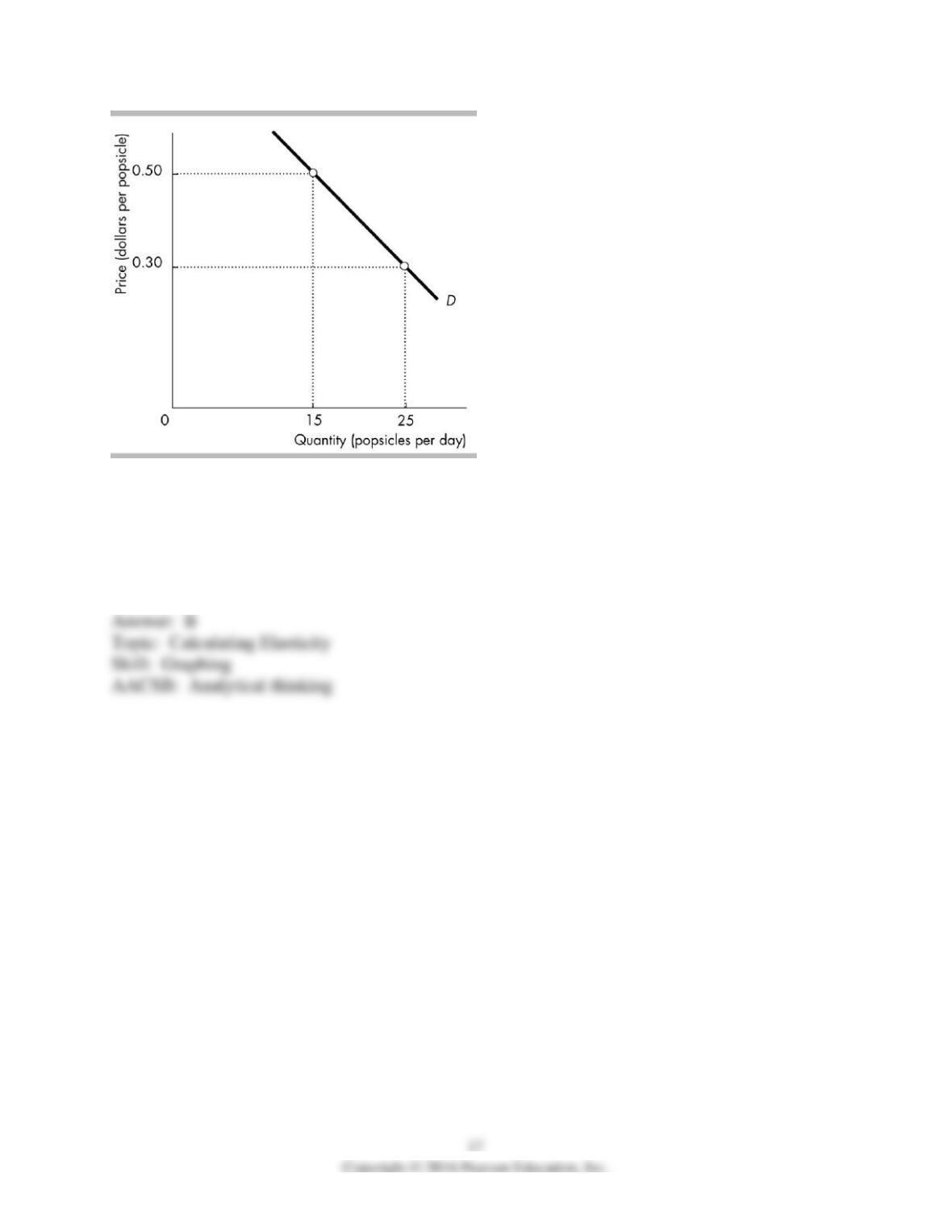
61) The figure shows the demand curve for popsicles. The price elasticity of demand when the
price of a popsicle increases from $0.30 to $0.50 is ________.
A) 0
B) 1
C) 1/2
D) 2
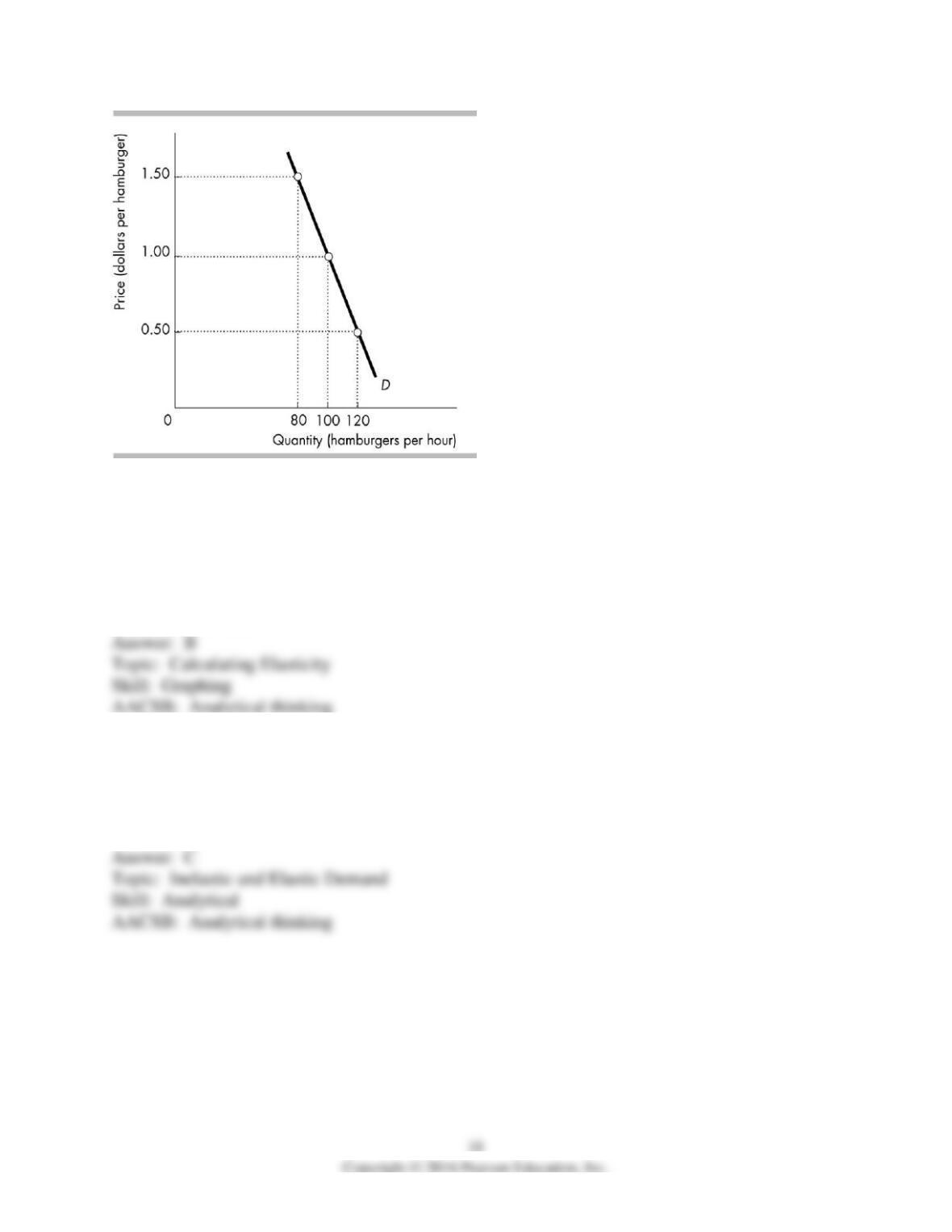
62) The figure illustrates the demand for hamburgers. When the price is $1.00 a hamburger, the
elasticity of demand is ________ and a 1 percent increase in the price will ________ the quantity
of hamburgers demanded by ________ percent.
A) 1.00; decrease; 0.40
B) 0.40; decrease; 0.40
C) 2.50; increase; 2.50
D) 5.00; decrease; 5.00
63) The price elasticity of demand can range between
A) zero and one.
B) negative infinity and infinity.
C) zero and infinity.
D) negative one and one.
64) If the quantity demanded changes by a relatively small amount for a given change in price,
then demand is
A) perfectly inelastic.
B) perfectly elastic.
C) elastic.
D) inelastic.
65) If the price elasticity is between 0 and 1, demand is
A) elastic.
B) inelastic.
C) unit elastic.
D) perfectly elastic.
66) Demand is inelastic if
A) a large change in quantity demanded results in a small change in price.
B) the quantity demanded is very responsive to changes in price.
C) the price elasticity of demand is less than 1.
D) the price elasticity of demand is greater than 1.
67) When the percentage change in quantity demanded is less than the percentage change in
price, the demand for the good is ________.
A) inelastic
B) unit elastic
C) perfectly inelastic
D) elastic
68) If a 20 percent increase in the price of a used car results in a 10 percent decrease in the
quantity of used cars demanded, then the demand for used cars is
A) elastic.
B) inelastic.
C) unit elastic.
D) arc elastic.
69) Demand is price inelastic if a relatively ________ price increase leads to a relatively
________ in the quantity demanded.
A) large; small increase
B) small; large decrease
C) large; small decrease
D) small; large increase
70) If a consumer is relatively insensitive to changes in the price of a good, then the consumer’s
demand for the good is
A) elastic.
B) unit elastic.
C) inelastic.
D) perfectly elastic.
71) If the price of salt increases and the quantity demanded does not change, then
A) the price elasticity of demand is equal to zero.
B) demand is perfectly inelastic.
C) the demand curve for salt is horizontal.
D) Both answers A and B are correct.