Chapter 04 – Firm Production, Cost, and Revenue
Chapter 04 Firm Production, Cost, and Revenue
Multiple Choice
1) A key assumption about the way firms behave is that they
A) minimize costs.
B) maximize profit.
C) maximize market share.
D) maximize revenue.
2) A graph that maps output against the input required to make that output is called a/an
A) average cost function.
B) a production function.
C) a cost function.
D) a marginal cost function.
3) A graph which maps the total costs of production against the amount made is called the
A) average cost function.
B) a production function.
C) a cost function.
D) a marginal cost function.
4) If an input must be increased for output to increase it is called a
A) fixed input.
B) changeable input.
C) variable input.
D) unchangeable input.
5) If the level of an input cannot be increased because there is insufficient time to put them in
place, they are called
A) fixed input.
B) changeable input.
C) variable input.
D) unchangeable input.
Chapter 04 – Firm Production, Cost, and Revenue
6) When workers subdivide the tasks of a job in such a way so as to become more efficient
economists refer to this as
A) the division of labor.
B) the separation of powers.
C) the division of tasks.
D) the degrees of freedom.
7) A production function will begin
A) at the origin.
B) on the vertical axis.
C) on the horizontal axis.
D) in the middle of the diagram (at a positive L and positive output).
8) A production function begins at the origin because
A) A firm can always choose to have no employees.
B) A firm with no employees will have no output.
C) It takes a certain number of employees to produce anything.
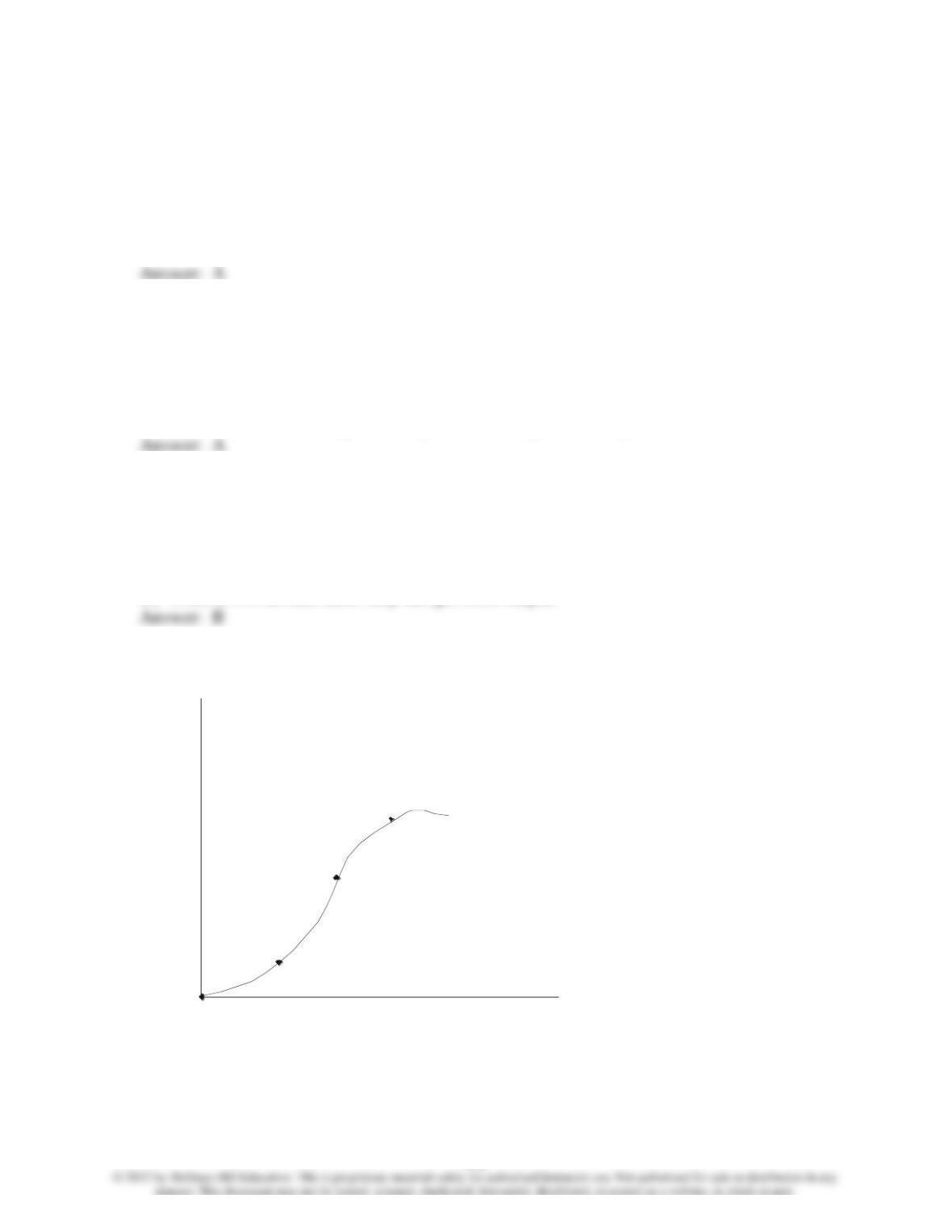
Use the following to answer questions 9-11:
Output
Production Function
A
B
C
D
Workers
Figure 4.1
Chapter 04 – Firm Production, Cost, and Revenue
9) Refer to Figure 4.1, the increase in output from point A to B is less than the increase in
output from point B to C because
A) more workers always produce more.
B) better workers are usually hired after the earlier ones .
C) a small number of workers cannot take as good advantage of the division of labor as a
larger number.
D) eventually workers are up against the fact that there are fixed inputs and more workers do
not add as much.
10) Refer to Figure 4.1, the increase in output from point B to C is greater than the increase in
output from point C to D because
A) more workers always produce more.
B) better workers are usually hired after the earlier ones.
C) a small number of workers cannot take as good advantage of the division of labor as a
larger number.
D) eventually workers are up against the fact that there are fixed inputs and more workers do
not add as much.
11) Refer to Figure 4.1, the increase in output from point A to B and from point B to C happens
because
A) more workers will produce more.
B) better workers are usually hired after the earlier ones.
C) a small number of workers cannot take as good advantage of the division of labor as a
larger number.
D) eventually workers are up against the fact that there are fixed inputs and more workers do
not add as much.
12) The source of the benefits of the division of labor is
A) The efficiency that results from workers specializing in one aspect of production.
B) The fact that anytime you increase labor you get more output.
C) The inefficiency that results from the fact that capital is fixed.
D) The when each worker is equally capable, each worker adds to production exactly the
same as the previous one.
Chapter 04 – Firm Production, Cost, and Revenue
13) The source of diminishing returns is
A) The efficiency that results from workers specializing in one aspect of production.
B) The fact that anytime you increase labor you get more output.
C) The inefficiency that results from the fact that capital is fixed.
D) The when each worker is equally capable, each worker adds to production exactly the
same as the previous one.
14) The average product of labor is
A) The change in output that results from an increase of labor by one unit.
B) Total output divided by total labor.
C) The percentage change in output divided by the percentage change in labor.
D) The output produced by a worker of average quality.
15) The marginal product of labor is
A) The change in output that results from an increase of labor by one unit.
B) Total output divided by total labor.
C) The percentage change in output divided by the percentage change in labor.
D) The output produced by a worker of average quality.
16) When firms add workers and get more efficient they are benefiting from
A) the division of labor.
B) the law of large numbers.
C) diminishing returns.
D) diminishing marginal utility.
17) When firms add workers and find that the additional workers add less to output than their
predecessors did, they are experiencing
A) the division of labor.
B) the law of large numbers.
C) diminishing returns.
D) diminishing marginal utility.
Chapter 04 – Firm Production, Cost, and Revenue
18) When you derive the marginal and average product of labor curve
A) The marginal product of labor cuts the average product labor at the point where the
marginal product of labor is at its maximum.
B) The marginal product of labor cuts the average product labor at the point where the
average product of labor is at its maximum.
C) The marginal product of labor cuts the average product labor at the point where the
marginal product of labor is at its minimum.
D) The marginal product of labor cuts the average product labor at the point where the
average product of labor is at its minimum.
19) When you derive the marginal product of labor curve you use
A) The slope of the ray out of the origin to the production function.
B) The slope of the production function.
C) The vertical distance from the production function to the horizontal axis.
D) The horizontal distance from the production function to the vertical axis.
20) When you derive the average product of labor curve you use
A) The slope of the ray out of the origin to the production function.
B) The slope of the production function.
C) The vertical distance from the production function to the horizontal axis.
D) The horizontal distance from the production function to the vertical axis.
21) Costs which increase with an increase in output are called
A) fixed costs.
B) changeable costs.
C) variable costs.
D) unchangeable costs.
22) Costs which do not increase with an increase in output are called
A) fixed costs.
B) changeable costs.
C) variable costs.
D) unchangeable costs.
Chapter 04 – Firm Production, Cost, and Revenue
23) Suppose you have a firm in which the owner pays $10,000 per month on rent of the plant
and equipment and will pay that regardless of much output they produce, and once they get
going they need $10 in materials and $20 in labor for everyone they produce,
A) Their variable costs are $10,000 plus $10 per unit.
B) Their fixed costs are $10,000 and variable costs are $20 per unit.
C) Their fixed costs are $10,000 and variable costs are $30 per unit.
D) Their fixed costs are $10,000 and $10 per unit.
24) Suppose a lawn-mowing business has a mower for which it paid $1000 and workers for
which they pay $10 per hour. Suppose each mower can mow a lawn per hour.
A) Their total fixed cost is $1000.
B) Their variable cost per lawn is $10 + $1000/lawns mowed.
C) Their total fixed cost is $1000/lawns mowed.
D) Their total fixed cost is $10 per lawn mowed.
25) Suppose a lawn-mowing business has a mower for which it paid $1000 and workers for
which they pay $10 per hour. Suppose each mower can mow a lawn per hour.
A) Their average fixed cost is $1000.
B) Their variable cost per lawn is $10 + $1000/lawns mowed.
C) Their average fixed cost is $1000/lawns mowed.
D) Their average fixed cost is $10 per lawn mowed.
26) Suppose a lawn-mowing business has a mower for which it paid $1000 and workers for
which they pay $10 per hour. Suppose each mower can mow a lawn per hour.
A) Their average fixed cost is $1000.
B) Their variable cost per lawn is $10 + $1000/lawns mowed.
C) Their total fixed cost is $1000/lawns mowed.
D) Their average variable cost is $10 per lawn mowed.
27) A total cost function will start
A) At the origin if there are fixed costs.
B) On the vertical axis if there are no fixed costs.
C) On the vertical axis if there are fixed costs.
D) On the horizontal axis.
Chapter 04 – Firm Production, Cost, and Revenue
28) A total cost function will start
A) At the origin if there are no fixed costs.
B) On the vertical axis if there are no fixed costs.
C) At the origin if there are fixed costs.
D) On the horizontal axis.
29) A total cost function will
A) Never slope up.
B) Never flatten.
C) Never steepen.
D) Never slope down.
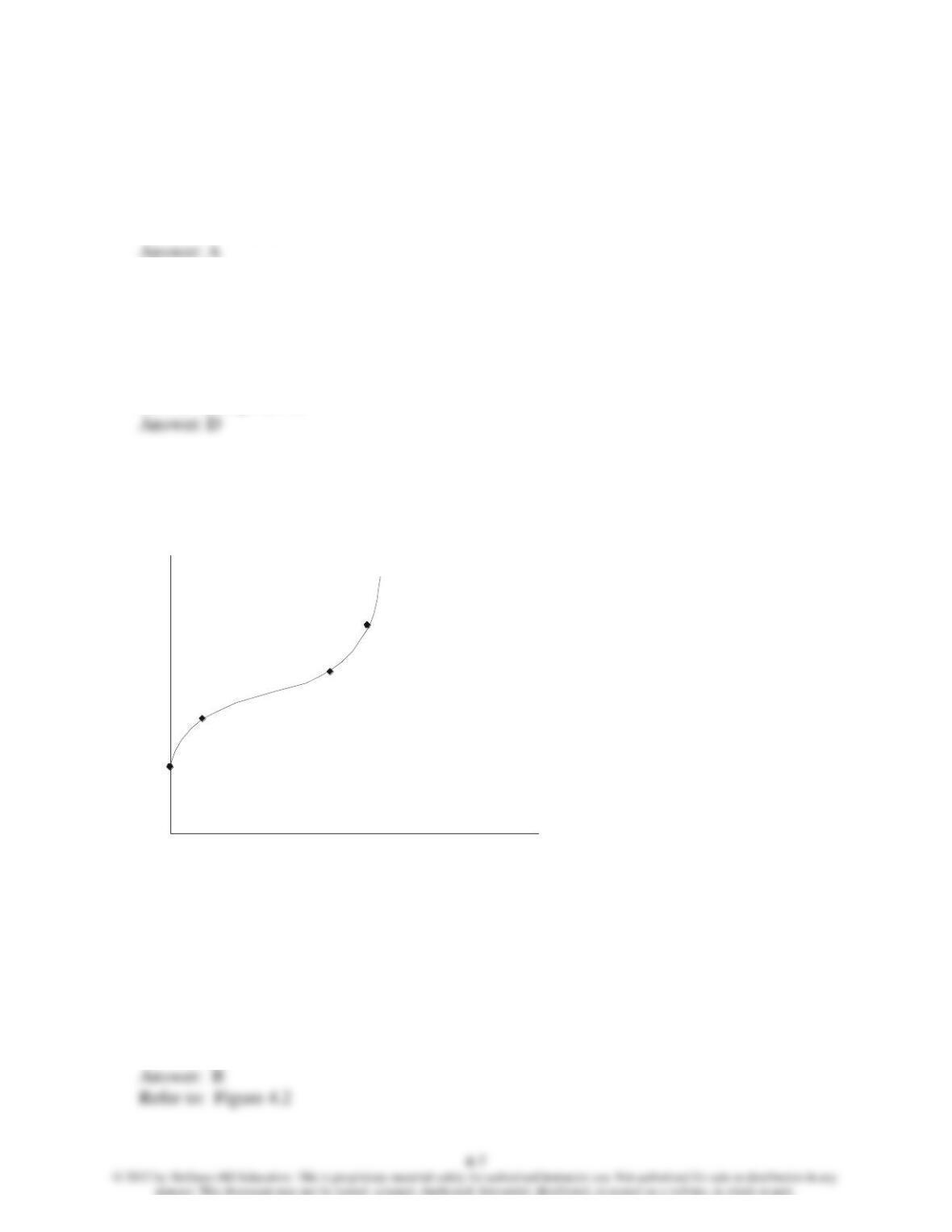
Use the following to answer questions 30-33:
Total Cost
Output
Total Cost Function
A
B
C
D
Figure 4.2
30) In Figure 4.2, the reason that point A is not through the origin but starts up on the vertical
axis is that
A) there are fixed outputs.
B) there are fixed costs.
C) there is no cost associated with producing no output.
D) there is waste.
Chapter 04 – Firm Production, Cost, and Revenue
31) In Figure 4.2 , the reason that point D is higher than point C and C is higher than B is that
A) it always costs more money to increase output.
B) small levels of production are often inefficient and that significant increases in production
can occur thereafter at only a small additional cost.
C) it is very difficult and very expensive to increase output once the capacity of the
machinery has been reached.
D) there is waste.
32) In Figure 4.2, the reason that the increase in output from point A to B is much less than the
increase in output from point B to C is that
A) it always costs more money to increase output.
B) small levels of production are often inefficient and that significant increases in production
can occur thereafter at only a small additional cost.
C) it is very difficult and very expensive to increase output once the capacity of the
machinery has been reached.
D) there is waste.
33) In Figure 4.2, the reason that the increase in output from point B to C is much greater than
the increase in output from point C to D is that
A) it always costs more money to increase output.
B) small levels of production are often inefficient and that significant increases in production
can occur thereafter at only a small additional cost.
C) it is very difficult and very expensive to increase output once the capacity of the
machinery has been reached.
D) there is waste.
34) The Total Cost Function in the book
A) is an up-ward sloping straight line.
B) is U-shaped.
C) is shaped as an upside down U.
D) begins by sharply rising, flattens out then sharply rises again.
Chapter 04 – Firm Production, Cost, and Revenue
35) Marginal Cost is
A) the addition to cost associated with one additional unit of output.
B) the per unit cost of production.
C) the per unit variable cost of production.
D) the per unit fixed cost of production.
36) Average Total Cost is
A) the addition to cost associated with one additional unit of output.
B) the per unit cost of production.
C) the per unit variable cost of production.
D) the per unit fixed cost of production.
37) Average Variable Cost is
A) the addition to cost associated with one additional unit of output.
B) the per unit cost of production.
C) the per unit variable cost of production.
D) the per unit fixed cost of production.
38) Average Fixed Cost is
A) the addition to cost associated with one additional unit of output.
B) the per unit cost of production.
C) the per unit variable cost of production.
D) the per unit fixed cost of production.
39) Which of the following algebraic expressions is inaccurate
A) TC=TVC+TFC
B) ATC=AFC+AVC
C) MC=ATC-AVC
D) AFC=ATC-AVC
40) Which of the following algebraic expressions is inaccurate
A) TC=TVC+TFC
B) ATC=AFC-AVC
C) MC=TC(Q)-TC(Q-1)
D) AFC=ATC-AVC
Chapter 04 – Firm Production, Cost, and Revenue
41) Marginal Cost is
A) the addition to cost associated with one additional unit of output.
B) the per unit cost of production.
C) the per unit variable cost of production.
D) the per unit fixed cost of production.
42) Average Total Cost is
A) the addition to cost associated with one additional unit of output.
B) the per unit cost of production.
C) the per unit variable cost of production.
D) the per unit fixed cost of production.
43) Average Variable Cost is
A) the addition to cost associated with one additional unit of output.
B) the per unit cost of production.
C) the per unit variable cost of production.
D) the per unit fixed cost of production.
44) In the derivation of ATC, to find its minimum you need
A) The minimum-slope ray out of the origin to the TC
B) The minimum-slope ray out of the origin to the ATC
C) The minimum-slope ray out of the origin to the TVC
D) The flattest slope on the TC.
45) In the derivation of AVC, to find its minimum you need
A) The minimum-slope ray out of the origin to the TC
B) The minimum-slope ray out of the origin to the ATC
C) The minimum-slope ray out of the origin to the TVC
D) The flattest slope on the TC.
Chapter 04 – Firm Production, Cost, and Revenue
46) In the derivation of MC, to find its minimum you need
A) The minimum-slope ray out of the origin to the TC
B) The minimum-slope ray out of the origin to the ATC
C) The minimum-slope ray out of the origin to the TVC
D) The flattest slope on the TC.
47) At any particular quantity on the TC, its slope will be
A) The same as the slope of the TVC
B) Greater than the slope at the quantity on the TVC
C) Smaller than the slope at the quantity on the TVC
D) Greater than the slope of the ray out of the origin to that point on the TC
48) The gap between the ATC and AVC curve will
A) Shrink to nearly zero
B) Shrink and go negative
C) Growth
D) Remain the same
49) AFC is the same as
A) ATC
B) AVC
C) MC
D) ATC-AVC
50) In the derivation of TFC, you find
A) The minimum-slope ray out of the origin to the TC.
B) The minimum-slope ray out of the origin to the ATC.
C) The minimum-slope ray out of the origin to the TVC.
D) The vertical intercept of the TC and draw a horizontal line.
Chapter 04 – Firm Production, Cost, and Revenue
51) In the derivation of TVC, you
A) The minimum-slope ray out of the origin to the TC.
B) Move the TC to the right a fixed distance.
C) subtract the amount of the vertical intercept of the TC down from the TC at each
quantity.
D) The vertical intercept of the TC and draw a horizontal line.
52) In order to be drawn correctly the minimum of the ATC is
A) To the right and up from the minimum of the MC.
B) To the right and down of the minimum of the AVC.
C) To the left and down of the minimum of the AVC.
D) Vertically straight up from the minimum of the AVC (neither to the right nor left).
53) In order to be drawn correctly the minimum of the AVC is
A) To the left and up from the minimum of the MC.
B) To the left and down from the minimum of the ATC.
C) To the left and up of the minimum of the ATC.
D) Vertically straight down from the minimum of the ATC (neither to the right nor left).
54) In order to be drawn correctly the gap between ATC and AVC is
A) Constant.
B) Diminishing until they cross at which point they diverge.
C) Diminishing until they cross at which point they quickly reconverge.
D) Shrinking but they never cross.
55) Suppose a firm has $1,000,000 in fixed costs and variable costs equal to $100 for every unit
they produce,
A) their marginal costs are decreasing.
B) their average costs are decreasing.
C) their fixed costs are decreasing.
D) the marginal costs are increasing.
Chapter 04 – Firm Production, Cost, and Revenue
56) The Average Total Cost curve will be cut by the Marginal Cost curve from below as long as
A) fixed costs are rising.
B) marginal costs eventually increase.
C) average costs are decreasing.
D) marginal costs continually decrease.
57) Which of the following is true
A) the average total cost curve is U-shaped.
B) the average variable cost curve is U-shaped.
C) neither option is correct
D) both options are correct
58) The Marginal Cost curve usually
A) is J-shaped.
B) cuts through the minimum of the average variable cost curve.
C) cuts through the minimum of the average total cost curve.
D) all of the options are correct.
59) Given the production function and total cost function shown in Chapter 4, as production
increases, marginal costs
A) decrease constantly.
B) decrease for a while and then increase.
C) increase constantly.
D) increase for a while and then decrease.
60) Given the production function and total cost function shown in Chapter 4, as production
increases, average fixed costs
A) decrease constantly.
B) decrease for a while and then increase.
C) increase constantly.
D) increase for a while and then decrease.
61)
Chapter 04 – Firm Production, Cost, and Revenue
Given the production function and total cost function shown in Chapter 4, as production
increases, average variable costs
A) decrease constantly.
B) decrease for a while and then increase.
C) increase constantly.
D) increase for a while and then decrease.
62) Given the production function and total cost function shown in Chapter 4, as production
increases, average total costs
A) decrease constantly.
B) decrease for a while and then increase.
C) increase constantly.
D) increase for a while and then decrease.
63) Given the production function and total cost function shown in Chapter 4, as production
increases, total costs
A) decrease constantly.
B) decrease for a while and then increase.
C) increase constantly.
D) increase for a while and then decrease.
64) Given the production function and total cost function shown in Chapter 4, as production
increases, total variable costs
A) decrease constantly.
B) decrease for a while and then increase.
C) increase constantly.
D) increase for a while and then decrease.
65) Given the production function and total cost function shown in Chapter 4, as production
increases, total fixed costs
A) decrease constantly.
B) remain constant.
C) increase constantly.
D) increase for a while and then decrease.
Use the following to answer questions 66-74:
Output Total Fixed Costs Total Variable Cost Total Cost
0 $100 $0 Box E
1 Box A $10 Box F
2 Box B $15 Box G
3 Box C $25 Box H
4 Box D $50 Box I
Table 4.1
66) Refer to Table 4.1, Box A should be filled with
A) $0.
B) $10.
C) $100.
D) $200.
67) Refer to Table 4.1, Box B should be filled with
A) $0.
B) $1
C) $100.
D) $200.
68) Refer to Table 4.1, Box C should be filled with
A) $0.
B) $2.
C) $100.
D) $200.
Chapter 04 – Firm Production, Cost, and Revenue
69) Refer to Table 4.1, Box D should be filled with
A) $0.
B) $1.
C) $100.
D) $200.
70) Refer to Table 4.1, Box E should be filled with
A) $0.
B) $10.
C) $100.
D) $200.
71) Refer to Table 4.1, Box F should be filled with
A) $0.
B) $10.
C) $100.
D) $110.
72) Refer to Table 4.1, Box G should be filled with
A) $0.
B) $110.
C) $115.
D) $125.
73) Refer to Table 4.1, Box H should be filled with
A) $0.
B) $110.
C) $125.
D) $150.