Chapter 38 – Energy Prices
Chapter 38 Energy Prices
Multiple Choice
1. Proven oil reserves in the world amount to
A) between 1100 and 1400 barrels.
B) between 1100 and 1400 million barrels.
C) between 1100 and 1400 billion barrels.
D) between 1100 and 1400 trillion barrels.
2. World oil consumption runs approximately
A) 84 barrels a day.
B) 84 thousand barrels a day.
C) 84 million barrels a day.
D) 84 billion barrels a day.
3. At the current pace of oil consumption and given what oil is known to exist and what oil is
expected to be discovered, oil reserves are likely to
A) never run out.
B) run out sometime between 2050 and 2100.
C) run out sometime between 2025 and 2050.
D) run out before 2025.
4. OPEC stands for
A) Oil and Petroleum Exporting Companies.
B) Organization of Petrol Exploiting Companies.
C) Organization of Petroleum Exporting Countries.
D) Oil Producing and Exploiting Countries.
5. If gas prices today were $1.00 per gallon, in terms of history this would be
A) an all-time low in inflation adjusted terms.
B) an all-time low in nominal terms.
C) not an all-time low but rather low in inflation adjusted terms.
D) about the long term historical average in inflation adjusted terms.
Chapter 38 – Energy Prices
6. If gas prices today were $1.50 per gallon, in terms of history this would be
A) an all-time low in inflation adjusted terms.
B) an all-time low in nominal terms.
C) not an all-time low but rather low in inflation adjusted terms.
D) about the long term historical average in inflation adjusted terms.
7. If gas prices today were $2.00 per gallon, in terms of history this would be
A) an all-time high in inflation adjusted terms.
B) an all-time high in nominal terms.
C) not an all-time high but rather high in inflation adjusted terms.
D) about the long term historical average in inflation adjusted terms.
8. If gas prices today were $2.50 per gallon, in terms of history this would be
A) an all-time high in inflation adjusted terms.
B) an all-time high in nominal terms.
C) not an all-time high but rather high in inflation adjusted terms.
D) about the long term historical average in inflation adjusted terms.
9. If gas prices today were $3.00 per gallon, in terms of history this would be
A) an all-time high in inflation adjusted terms.
B) near an all-time high in nominal terms.
C) not an all-time high but rather high in inflation adjusted terms.
D) about the long term historical average in inflation adjusted terms.
10. If gas prices today were $4.00 per gallon, in terms of history this would be
A) an all-time high in inflation adjusted terms, but not nominal terms.
B) an all-time high in nominal terms and inflation adjusted terms.
C) not an all-time high, but rather high in inflation adjusted terms.
D) about the long term historical average in inflation adjusted terms.
11. The majority of proven world oil reserves are
A) in the Persian Gulf region.
B) held by non-Persian Gulf OPEC members.
C) under Alaska.
D) in the former Soviet Union.
Chapter 38 – Energy Prices
12. High oil prices in the 1970’s motivated _______ to look for oil, which was found in _______.
A) the Soviet Union, the Ural Mountains
B) the United Kingdom, the North Sea
C) the United States, Oklahoma
D) Saudi Arabia, their desert
13. The Iran-Iraq War of the 1980’s generally contributed to
A) oil conservation efforts in the west.
B) high oil and gasoline prices in the west.
C) a rapid expansion of alternative fuels exploration in the west.
D) dramatically falling world oil prices.
14. In 1998, adjusted for inflation, crude oil and gasoline prices were
A) quite high.
B) about average.
C) quite low.
D) slightly above average
15. The run up in gasoline prices during 1999 and 2000
A) put them much above their long term inflation adjusted average.
B) put them about the same as their long term inflation adjusted average.
C) still had them much below their long term inflation adjusted average.
D) put them well above their all-time high
16. The run up in gasoline prices between 1999 and 2005
A) put them much above their long term inflation adjusted average.
B) put them about the same as their long term inflation adjusted average.
C) still had them much below their long term inflation adjusted average.
D) still had them slightly below their long term inflation adjusted average.
Chapter 38 – Energy Prices
17. OPEC is an example of a
A) perfect competitor.
B) natural monopolist.
C) complete competitor.
D) cartel.
18. Which of the following nations is NOT part of OPEC?
A) Kuwait
B) Iran
C) Indonesia
D) Mexico
19. A cartel is formed when
A) monopolists in different industries merge into one.
B) perfect competitors in the same industry collude to form a monopoly.
C) perfect competitors in different industries merge into one company.
D) a company spins off a low profit unit.
20. Oil price changes are best explained using a model of
A) supply and demand and the effect of expectations.
B) the cartel effect.
C) the collusive behavior of the big oil companies.
D) supply and demand and the effect of expectations and the cartel effect.
21. Which of the following are true about cartels
A) they are stable because once they set a high price no one has a motive to increase
production.
B) prices are high because perfect competition supplants monopoly.
C) prices are high because monopoly supplants perfect competition.
D) high prices encourage reduced competitor production.
Chapter 38 – Energy Prices
22. In order to maintain high prices a cartel must get its members to
A) reduce production.
B) increase production.
C) to leave production unchanged.
D) develop new sources.
23. The stability of cartel prices is challenged because
A) cartels never exist.
B) though they increase profits they are vulnerable to egalitarian interests.
C) they never increase the profitability of their members.
D) though they increase profits, they are vulnerable to those that seek to make more profit by
breaking the agreements that generated them.
24. Cartel members are motivated to increase production beyond their quotas because they are at
a point where, if they can increase their own production without affecting the cartel price,
A) they are making a profit.
B) they are making a loss.
C) their marginal cost exceeds their marginal revenue.
D) their marginal revenue exceeds their marginal costs.
25. Cartels are not stable because it is in the interest of each of the members to ____ beyond
what is in the cartel’s general interest.
A) reduce production
B) raise prices
C) raise production
D) lower prices
26. If the expected price of oil rises then
A) the current equilibrium price and quantity will both rise.
B) the current equilibrium price will rise and the current equilibrium quantity will fall.
C) the equilibrium price and quantity will not change.
D) the equilibrium price will rise but the change in the equilibrium quantity will depend on
whether the demand change outweighs the supply change.
Chapter 38 – Energy Prices
27. If the expected future price of oil falls, then
A) the current equilibrium price and quantity will both fall.
B) the current equilibrium price will fall and the current equilibrium quantity will fall.
C) the equilibrium price and quantity will not change.
D) the equilibrium price will fall but the change in the equilibrium quantity will depend on
whether the demand change outweighs the supply change.
28. The underlying reason why the expected future price of gasoline plays an important role in
the current price of gasoline is because
A) along the supply chain firms want to hold onto gasoline when they think the price is
about to rise and sell it quickly when they think the price is about to fall.
B) the market is overly regulated.
C) the market is governed by two major players.
D) the government is in complete control of the energy market.
29. Although crude oil prices fell briefly below $55 per barrel in late 2006, they quickly
rebounded and throughout much of 2007 remained well above
A) $60 per barrel.
B) $80 per barrel.
C) $100 per barrel.
D) $125 per barrel.
30. The underlying reason why gasoline prices at neighboring stations is usually identical is that
A) collusion is legal in the energy sector.
B) collusion is prevalent in the energy sector.
C) because under oligopoly, it can be in each firms best interest to independently charge a
price equal to their competition’s price.
D) these operators are usually friends and benefit from the other’s presence.
31. When prices are the same at two neighboring gas stations, economists attribute this to the
market forces of
A) perfect competition.
B) monopoly.
C) oligopoly.
D) monopolistic competition.
Chapter 38 – Energy Prices
32. Energy prices rose during 2005 largely because of
A) increased demand in Central America.
B) increased demand in China.
C) weather related (hurricanes) in the Gulf of Mexico.
D) increased demand in China and weather related (hurricanes) in the Gulf of Mexico.
33. The key reason hurricanes affect gasoline prices is
A) demand for gasoline spikes as people drive to safety.
B) a significant portion of U.S. refining capacity is located along the Gulf of Mexico.
C) all U.S. gasoline is produced from oil coming out of the Gulf of Mexico.
D) oil companies have an excuse to raise prices.
34. During the 1999-2005 period gasoline prices
A) quintupled (went up 5 times) in price.
B) tripled in price.
C) remained relatively constant in inflation adjusted terms.
D) fell.
35. Refining capacity in the United States is
A) rather evenly spread out across the country.
B) concentrated in the industrial mid-west.
C) concentrated on the coasts.
D) located almost entirely in Alaska.
36. Which geographic coincidence affected gasoline prices the most during 2005
A) two major hurricanes affected the refining intensive areas of New Orleans and Houston.
B) a tsunami hit the one area in the world most responsible for producing U.S. gasoline,
Indonesia.
C) an earthquake happened to hit the energy sensitive areas in and around Iran.
D) there were tornado related electrical outages in the industrial mid-west.
Chapter 38 – Energy Prices
37. The residential electricity market is characterized by
A) unregulated simple monopoly.
B) unregulated natural monopoly.
C) regulated (usually natural) monopoly.
D) unregulated perfect competition.
38. A natural monopoly occurs when
A) there are high fixed costs.
B) continuously decreasing average total costs.
C) continuously increasing marginal costs.
D) there are high fixed costs and continuously decreasing average total costs.
39. With a natural monopoly, a potentially insurmountable barrier to entry can be the
A) decreasing average total costs.
B) decreasing marginal costs.
C) high fixed costs.
D) low profit margins.
40. The California Electricity crisis was borne from a failed version of deregulation that had
A) free-floating residential prices.
B) free-floating wholesale prices.
C) regulated wholesale prices.
D) free-floating residential prices and free-floating wholesale prices.
41. The California Electricity crisis was borne from a failed version of deregulation that had
A) free-floating residential prices.
B) free-floating wholesale prices.
C) regulated residential prices.
D) free-floating wholesale prices and regulated residential prices.
Chapter 38 – Energy Prices
42. The California Electricity crisis was borne from a failed version of deregulation that had
A) limits upon the prices distributors could charge to residential consumers.
B) limits upon the prices distributors might be charged by their suppliers.
C) stringent restrictions imposed upon residential consumers to discourage their use of
electricity.
D) limits upon the prices distributors could charge to residential consumers and stringent
restrictions imposed upon residential consumers to discourage their use of electricity.
43. Whether in a natural monopoly or a simple monopoly, the regulated price of electricity is
theoretically supposed to be set where
A) marginal cost equals zero.
B) there is no economic profit.
C) there is no accounting profit.
D) marginal revenue is zero.
44. In the natural monopoly case, the regulated price will be where the
A) ATC crosses demand.
B) the MC equals MR.
C) the MC crosses D.
D) MR is zero.
45. If regulators were to force a natural monopoly to set the price of its product equal to its
marginal cost of production (in order to encourage economically efficient use of the product),
the natural monopoly will
A) shut down immediately.
B) earn a normal profit.
C) earn an economic loss.
D) understate its true costs of production.
46. Non-inflation-adjusted (“nominal”) gasoline prices reached their all-time highs in
A) 1982.
B) 1991.
C) 2001.
D) 2008.
Chapter 38 – Energy Prices
47. Between July, 2008 and January, 2009, U.S. gasoline prices fell from
A) $6.50 per gallon to $5.00 per gallon.
B) $4.00 per gallon to $1.30 per gallon.
C) $4.00 per gallon to $2.00 per gallon.
D) $3.20 per gallon to $1.65 per gallon.
48. An event driving gasoline prices higher from 2006 to 2008 was
A) growing energy use in China and India.
B) Hurricanes Katrina and Rita.
C) conflict in Nigeria.
D) all of the answers are correct.
49. A main factor determining gasoline demand between 2002 and 2008 was
A) Americans’ increased use of more fuel-efficient vehicles.
B) shrinking demand in both India and China.
C) Americans’ increased use of less fuel efficient vehicles.
D) a significant decrease in miles driven by the typical American.
50. Other things unchanged, purchase of a Toyota Prius makes less economic sense when
A) interest rates increase.
B) all automobiles tend to last longer and the number of miles driven increases.
C) the social status of environmentally-friendly (or “green”) lifestyles grows.
D) all of the answers are correct.
51. A state that has a large pool of oil embedded in porous rock deep below its surface is
A) North Dakota.
B) Florida.
C) Delaware.
D) Kansas.
Chapter 38 – Energy Prices
52. To get at the large pool of oil embedded in porous rock deep below North Dakota a process
known as ____ is employed.
A) Hydraulic fracturing (fracking).
B) Explosive mining.
C) Compressive extraction.
D) Chemical immersion.
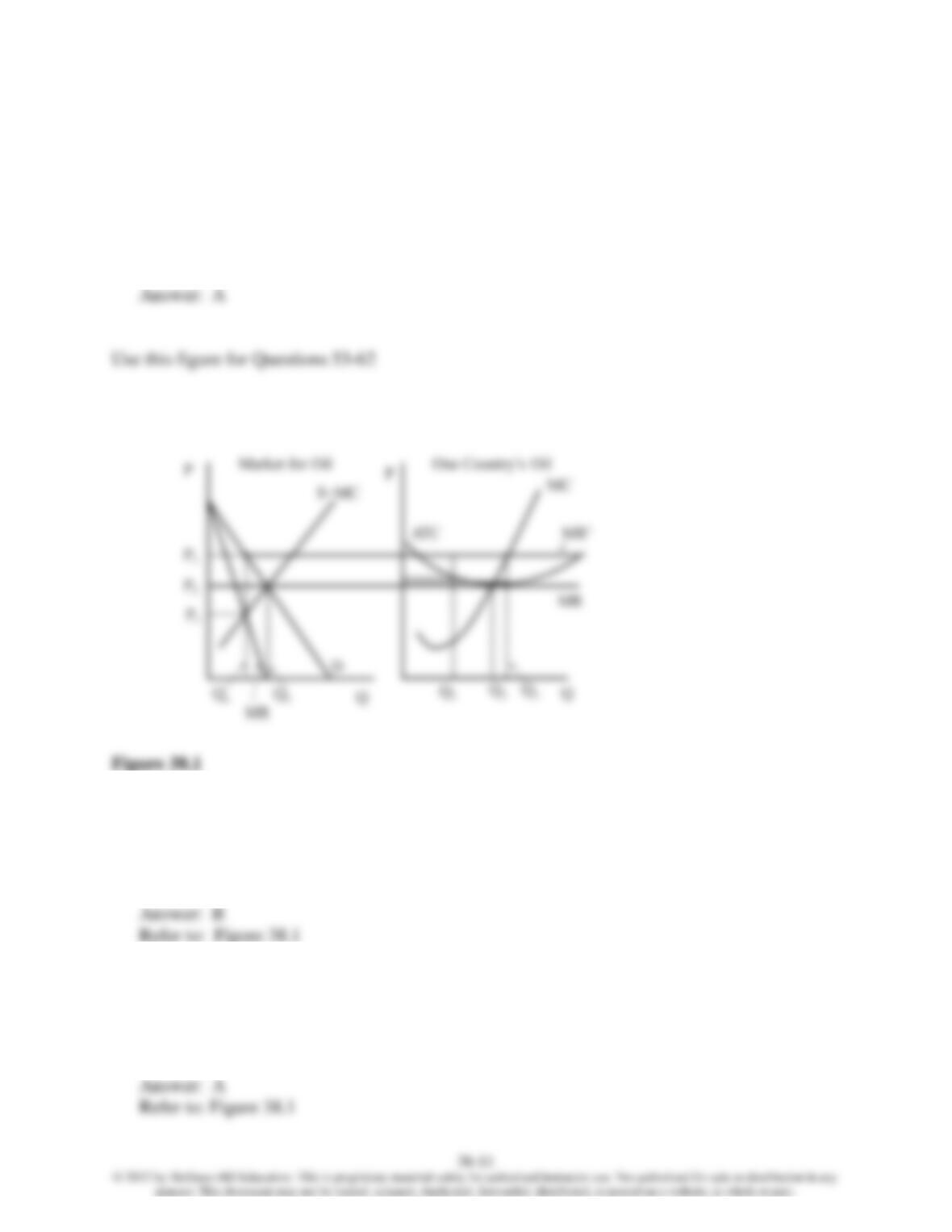
53. Under perfect competition the price is
A) P1
B) P2
C) P3
D) 0
54. Under the cartel the price is
A) P1
B) P2
C) P3
D) 0
Chapter 38 – Energy Prices
55. Under perfect competition the market quantity is
A) Q1
B) Q2
C) Qa
D) Qb
56. Under the cartel the market quantity is
A) Q1
B) Q2
C) Qa
D) Qb
57. Under perfect competition the individual firm’s quantity is
A) Q1
B) Q2
C) Qa
D) Qb
58. Under the cartel the individual firm’s quantity is (assuming it obeys its quota)
A) Q1
B) Q2
C) Qa
D) Qb
59. Under the cartel the individual firm’s quantity is (assuming that it wants to cheat on its quota)
A) Q1
B) Q2
C) Q3
D) Qb
Chapter 38 – Energy Prices
60. Under perfect competition the individual firm’s economic profit is
A) zero.
B) the smaller of the dashed line boxes.
C) the larger of the dashed line boxes.
D) between the size of the two dashed line boxes.
61. Under the cartel the individual firm’s economic profit is (assuming it obeys its quota)
A) zero.
B) the smaller of the dashed line boxes
C) the larger of the dashed line boxes
D) between the size of the two dashed line boxes.
62. Under the cartel the individual firm’s economic profit is (assuming that it wants to cheat on
its quota)
A) zero.
B) the smaller of the dashed line boxes.
C) the larger of the dashed line boxes.
D) between the size of the two dashed line boxes.
True False
63. Cartel prices are inherently stable.
A) True
B) False