DISC: Aggregate demand and aggre – DISC: Aggregate demand and aggregate supply
United States – BPROG: Analytic
Aggregate demand and aggregate s – Aggregate demand and aggregate supply
International Trade, Exchange Rates, and Aggregate Demand
71. If Mexico experiences a period of stable prices while the United States experiences rapid inflation, what will happen
in the United States?
a.
an increase in U.S. imports
b.
an increase in U.S. exports
c.
a decrease in U.S. imports
d.
an increase in U.S. net exports
a
1
Moderate
DISC: International trade and fi – DISC: International trade and finance
United States – BPROG: Analytic
International trade and finance
International Trade, Exchange Rates, and Aggregate Demand
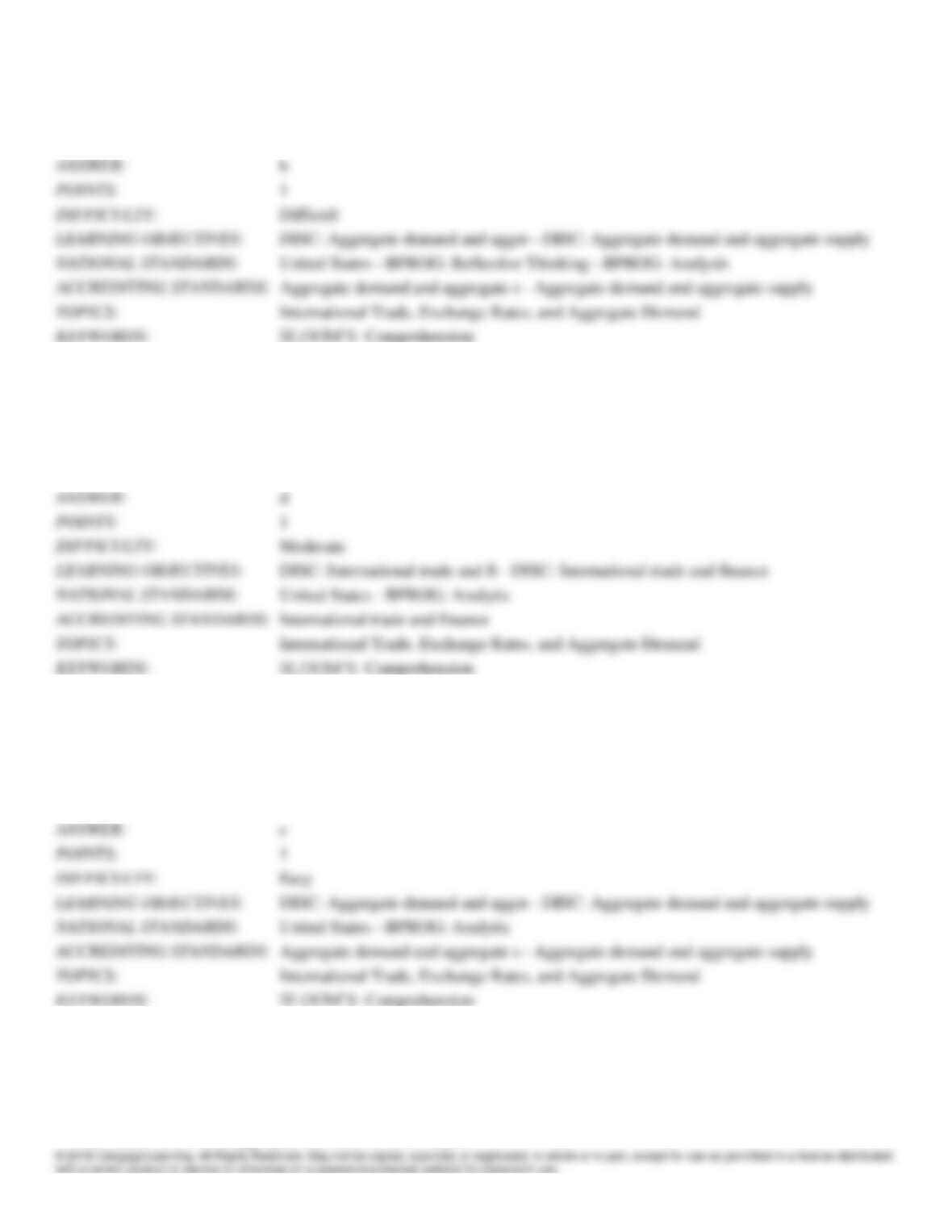
Figure 20-3
72. Which of the situations illustrated in Figure 20-3 shows the effects of a currency appreciation leading to a recession?
a.
1
b.
2
c.
3
d.
4
a
1
Difficult
DISC: Aggregate demand and aggre – DISC: Aggregate demand and aggregate supply
United States – BPROG: Reflective Thinking – BPROG: Analysis
Aggregate demand and aggregate s – Aggregate demand and aggregate supply
International Trade, Exchange Rates, and Aggregate Demand
73. Which of the situations illustrated in Figure 20-3 shows the effects of a currency appreciation leading to real GDP
growth?
a.
1
b.
2
c.
3
d.
4
b
1
DISC: Aggregate demand and aggre – DISC: Aggregate demand and aggregate supply
United States – BPROG: Reflective Thinking – BPROG: Analysis
Aggregate demand and aggregate s – Aggregate demand and aggregate supply
International Trade, Exchange Rates, and Aggregate Demand
74. Theoretically, when a currency depreciates one can predict that
a.
the price level will rise and real GDP will rise.
b.
the price level will fall and real GDP will fall.
c.
real GDP will rise, but price change is not predictable.
d.
the price level will rise, but real GDP change is not predictable.
d
1
DISC: International trade and fi – DISC: International trade and finance
United States – BPROG: Analytic
International trade and finance
75. When the U.S. dollar appreciates,
a.
U.S. exports rise.
b.
U.S. imports decline.
c.
aggregate demand shifts inward.
d.
aggregate demand shifts outward.
1
DISC: Aggregate demand and aggre – DISC: Aggregate demand and aggregate supply
United States – BPROG: Analytic
Aggregate demand and aggregate s – Aggregate demand and aggregate supply
International Trade, Exchange Rates, and Aggregate Demand
76. Depreciation of the Japanese Yen would lead to
a.
outward shift in the aggregate supply curve for Japan.
b.
upward shift in the aggregate demand curve for Japan.
c.
downward shift in the aggregate supply curve for Japan.
d.
inward shift in the aggregate demand curve for Japan.
DISC: Aggregate demand and aggre – DISC: Aggregate demand and aggregate supply
United States – BPROG: Analytic
Aggregate demand and aggregate s – Aggregate demand and aggregate supply
International Trade, Exchange Rates, and Aggregate Demand
77. Appreciation of the Japanese Yen would lead to
a.
outward shift in the aggregate supply curve for Japan.
b.
upward shift in the aggregate demand curve for Japan.
c.
downward shift in the aggregate supply curve for Japan.
d.
downward shift in the aggregate demand curve for Japan.
DISC: Aggregate demand and aggre – DISC: Aggregate demand and aggregate supply
United States – BPROG: Analytic
Aggregate demand and aggregate s – Aggregate demand and aggregate supply
International Trade, Exchange Rates, and Aggregate Demand
78. Suppose the dollar depreciates from 89 Japanese yen to 79 Japanese yen. One would expect
a.
U.S. imports to increase
b.
U.S. exports to increase.
c.
Japanese exports to increase.
d.
Japanese net exports to increase.
DISC: Aggregate demand and aggre – DISC: Aggregate demand and aggregate supply
United States – BPROG: Analytic
Aggregate demand and aggregate s – Aggregate demand and aggregate supply
International Trade, Exchange Rates, and Aggregate Demand
79. Which of the following would lead to a depreciating dollar?
a.
a higher federal deficit
b.
lower interest rates
c.
higher interest rates
d.
contractionary monetary policy
DISC: Aggregate demand and aggre – DISC: Aggregate demand and aggregate supply
United States – BPROG: Analytic
Aggregate demand and aggregate s – Aggregate demand and aggregate supply
International Trade, Exchange Rates, and Aggregate Demand
80. What effect did the decrease in the value of the dollar have on the U.S. trade deficit in the period from 2006 to 2009?
a.
It decreased the trade deficit as Americans bought more U.S. capital goods.
b.
It decreased the trade deficit as foreigners were attracted to the increased value of U.S. products and
Americans bought fewer imports.
c.
It increased the trade deficit as U.S. investors bought more domestic financial assets.
d.
It increased the trade deficit as Americans bought more imports and foreigners bought fewer U.S. products.
DISC: International trade and fi – DISC: International trade and finance
United States – BPROG: Analytic
International trade and finance
International Trade, Exchange Rates, and Aggregate Demand
81. In an open economy, aggregate supply consists of domestic production
a.
plus imports.
b.
plus exports.
c.
minus imports.
d.
minus exports.
DISC: Aggregate demand and aggre – DISC: Aggregate demand and aggregate supply
United States – BPROG: Analytic
Aggregate demand and aggregate s – Aggregate demand and aggregate supply
Aggregate Supply in an Open Economy
82. If the dollar rises in value compared to other currencies, what will happen in the United States?
a.
an increase in aggregate demand
b.
an increase in aggregate supply
c.
a decrease in aggregate supply
d.
an increase in the U.S. price level
DISC: Aggregate demand and aggre – DISC: Aggregate demand and aggregate supply
United States – BPROG: Analytic
Aggregate demand and aggregate s – Aggregate demand and aggregate supply
Aggregate Supply in an Open Economy
83. If the dollar falls in value compared to other currencies, what will happen in the United States?
a.
a decrease in aggregate demand
b.
an increase in aggregate supply
c.
a decrease in aggregate supply
d.
a decrease in the U.S. price level
DISC: Aggregate demand and aggre – DISC: Aggregate demand and aggregate supply
United States – BPROG: Analytic
Aggregate demand and aggregate s – Aggregate demand and aggregate supply
Aggregate Supply in an Open Economy
84. When the dollar depreciates, the prices of imported inputs
a.
fall and aggregate supply shifts outward.
b.
fall and aggregate supply shifts inward.
c.
rise and aggregate supply shifts outward.
d.
rise and aggregate supply shifts inward.
DISC: Aggregate demand and aggre – DISC: Aggregate demand and aggregate supply
United States – BPROG: Analytic
Aggregate demand and aggregate s – Aggregate demand and aggregate supply
Aggregate Supply in an Open Economy
85. When the dollar appreciates, the prices of imported inputs
a.
fall and aggregate supply shifts outward.
b.
fall and aggregate supply shifts inward.
c.
rise and aggregate supply shifts outward.
d.
rise and aggregate supply shifts inward.
DISC: Aggregate demand and aggre – DISC: Aggregate demand and aggregate supply
United States – BPROG: Analytic
Aggregate demand and aggregate s – Aggregate demand and aggregate supply
Aggregate Supply in an Open Economy
86. When the dollar depreciates, the cost to Americans of foreign goods
a.
rises and the CPI falls.
b.
rises and the CPI rises.
c.
falls and the CPI rises.
d.
falls and the CPI falls.
DISC: Aggregate demand and aggre – DISC: Aggregate demand and aggregate supply
United States – BPROG: Analytic
Aggregate demand and aggregate s – Aggregate demand and aggregate supply
Aggregate Supply in an Open Economy
87. When the dollar appreciates, the cost to Americans of foreign goods
a.
rises and the CPI falls.
b.
rises and the CPI rises.
c.
falls and the CPI rises.
d.
falls and the CPI falls.
DISC: Aggregate demand and aggre – DISC: Aggregate demand and aggregate supply
United States – BPROG: Analytic
Aggregate demand and aggregate s – Aggregate demand and aggregate supply
Aggregate Supply in an Open Economy
88. The main input into the production of Starbuck’s coffee is imported coffee beans. If the dollar depreciates, how will
this affect the U.S. retail coffee market?
a.
Input prices will fall and supply will decrease.
b.
Input prices will fall and supply will increase.
c.
Input prices will rise and supply will decrease.
d.
Input prices will rise and supply will increase.
DISC: Aggregate demand and aggre – DISC: Aggregate demand and aggregate supply
United States – BPROG: Analytic
Aggregate demand and aggregate s – Aggregate demand and aggregate supply
Aggregate Supply in an Open Economy
89. A currency appreciation should
a.
reduce net exports and therefore increase aggregate demand.
b.
raise net exports and therefore decrease aggregate demand.
c.
reduce net exports and therefore decrease aggregate demand.
d.
raise net exports and therefore increase aggregate demand.
DISC: Aggregate demand and aggre – DISC: Aggregate demand and aggregate supply
United States – BPROG: Analytic
Aggregate demand and aggregate s – Aggregate demand and aggregate supply
The Macroeconomic Effects of Exchange Rates
90. A main reason why the U.S. trade deficit grew so large from 1997 to 2000 was that
a.
Congress removed all tariffs and trade restrictions on imports.
b.
NAFTA was introduced and Mexican exports flooded the United States.
c.
the international value of the dollar fell during the 1990s, which encouraged U.S. exports.
d.
the international value of the dollar rose in the last half of the 1990s, which encouraged U.S. imports and
damaged U.S. exports.
DISC: International trade and fi – DISC: International trade and finance
United States – Analytic – BB-Legal
International trade and finance
The Macroeconomic Effects of Exchange Rates
91. If the international value of the dollar rises, the
a.
aggregate demand curve will shift inward.
b.
aggregate supply curve will shift outward.
c.
U.S. price level will fall.
d.
All of the above are correct.
DISC: Aggregate demand and aggre – DISC: Aggregate demand and aggregate supply
United States – BPROG: Analytic
Aggregate demand and aggregate s – Aggregate demand and aggregate supply
The Macroeconomic Effects of Exchange Rates
92. If the demand effect dominates during a currency depreciation, then
a.
real GDP should fall.
b.
real GDP should increase.
c.
the price level should fall.
d.
net exports should decrease.
DISC: International trade and fi – DISC: International trade and finance
United States – BPROG: Analytic
International trade and finance
The Macroeconomic Effects of Exchange Rates
93. A currency appreciation is disinflationary and contractionary if the
a.
inward shift of the aggregate demand curve due to the fall in exports exceeds the outward shift of the
aggregate supply curve due to lower input prices.
b.
outward shift of the aggregate demand curve due to the rise in exports exceeds the outward shift of the
aggregate supply curve due to lower input prices.
c.
outward shift of the aggregate demand curve due to the fall in exports exceeds the inward shift of the
aggregate supply curve due to higher input prices.
d.
inward shift of the aggregate demand curve due to lower input prices exceeds the outward shift of the
aggregate supply curve due to the rise in exports.
DISC: Aggregate demand and aggre – DISC: Aggregate demand and aggregate supply
United States – BPROG: Analytic
Aggregate demand and aggregate s – Aggregate demand and aggregate supply
The Macroeconomic Effects of Exchange Rates
94. Which of the following usually leads to currency appreciation?
a.
galloping inflation
b.
relatively low interest rates
c.
declining real GDP
d.
fixed exchange rates
DISC: International trade and fi – DISC: International trade and finance
United States – BPROG: Analytic
International trade and finance
The Macroeconomic Effects of Exchange Rates
Figure 20-4
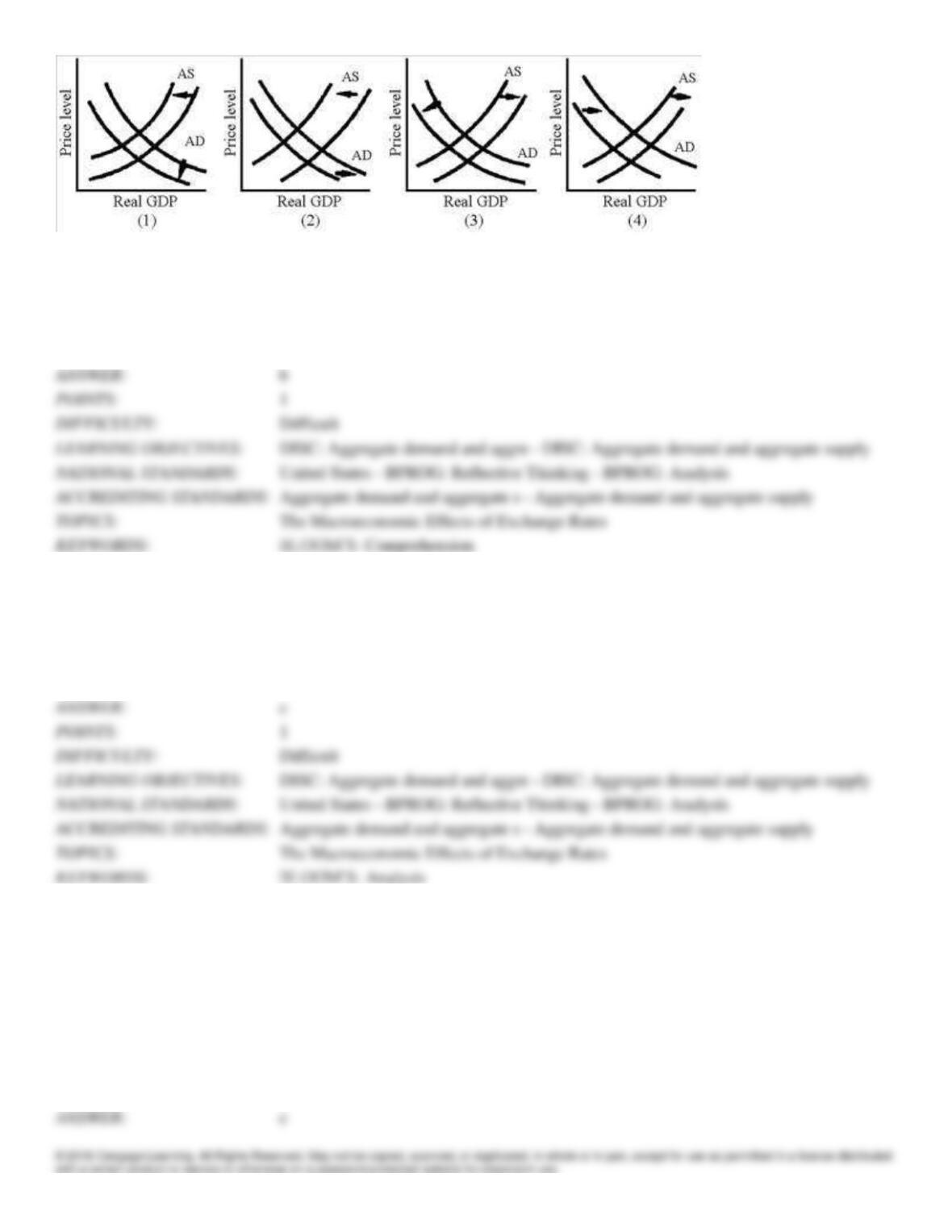
95. Which of the situations illustrated in Figure 20-4 shows a currency depreciation leading to inflation?
a.
1
b.
2
c.
3
d.
4
b
1
96. Which of the situations illustrated in Figure 20-4 shows a currency appreciation leading to disinflation?
a.
1
b.
2
c.
3
d.
4
1
97. What are the economic effects of a currency depreciation?
a.
It will decrease aggregate demand and aggregate supply, so that output will certainly fall, and prices may fall
as well.
b.
It will increase aggregate demand and aggregate supply, so that output will certainly rise, and prices may rise
as well.
c.
It will increase aggregate demand and decrease aggregate supply, so that prices will certainly rise and output
may rise as well.
d.
It will decrease aggregate demand and increase aggregate supply, so that prices will certainly fall and output
may fall as well.
DISC: Aggregate demand and aggre – DISC: Aggregate demand and aggregate supply
United States – BPROG: Analytic
Aggregate demand and aggregate s – Aggregate demand and aggregate supply
The Macroeconomic Effects of Exchange Rates
98. What are the economic effects of a currency appreciation?
a.
It will decrease aggregate demand and aggregate supply, so that output will certainly fall, and prices may fall
as well.
b.
It will increase aggregate demand and aggregate supply, so that output will certainly rise, and prices may rise
as well.
c.
It will increase aggregate demand and decrease aggregate supply, so that prices will certainly rise and output
may rise as well.
d.
It will decrease aggregate demand and increase aggregate supply, so that prices will certainly fall and output
may fall as well.
DISC: Aggregate demand and aggre – DISC: Aggregate demand and aggregate supply
United States – BPROG: Analytic
Aggregate demand and aggregate s – Aggregate demand and aggregate supply
The Macroeconomic Effects of Exchange Rates
99. Following the economic crisis in 1994-1995, the Mexican peso fell sharply in value. What will be the main economic
effects in Mexico of such an exchange rate change?
a.
It will decrease aggregate demand and aggregate supply, so that output will certainly fall, and prices may fall
as well.
b.
It will increase aggregate demand and aggregate supply, so that output will certainly rise, and prices may rise
as well.
c.
It will increase aggregate demand and decrease aggregate supply, so that prices will certainly rise and output
may rise as well.
d.
It will decrease aggregate demand and increase aggregate supply, so that prices will certainly fall and output
may fall as well.
DISC: Aggregate demand and aggre – DISC: Aggregate demand and aggregate supply
United States – BPROG: Analytic
Aggregate demand and aggregate s – Aggregate demand and aggregate supply
The Macroeconomic Effects of Exchange Rates
100. The principal danger to Japan in 2001 when the yen was appreciating was that this would
a.
increase aggregate demand and make inflation worse.
b.
decrease aggregate demand and make the recession worse.
c.
decrease aggregate demand and make inflation worse.
d.
increase aggregate demand and make the recession worse.
b
1
DISC: Aggregate demand and aggre – DISC: Aggregate demand and aggregate supply
United States – BPROG: Analytic
Aggregate demand and aggregate s – Aggregate demand and aggregate supply
The Macroeconomic Effects of Exchange Rates
101. If U.S. interest rates rise while foreign interest rates remain unchanged,
a.
GDP will not change since the shift in aggregate supply cancels the positive effects on aggregate demand.
b.
the dollar will depreciate and thus reduce prices and output.
c.
foreign capital will be attracted to the United States and the dollar will appreciate.
d.
net exports will increase and the economy will expand.
1
DISC: Aggregate demand and aggre – DISC: Aggregate demand and aggregate supply
United States – BPROG: Analytic
Aggregate demand and aggregate s – Aggregate demand and aggregate supply
The Macroeconomic Effects of Exchange Rates
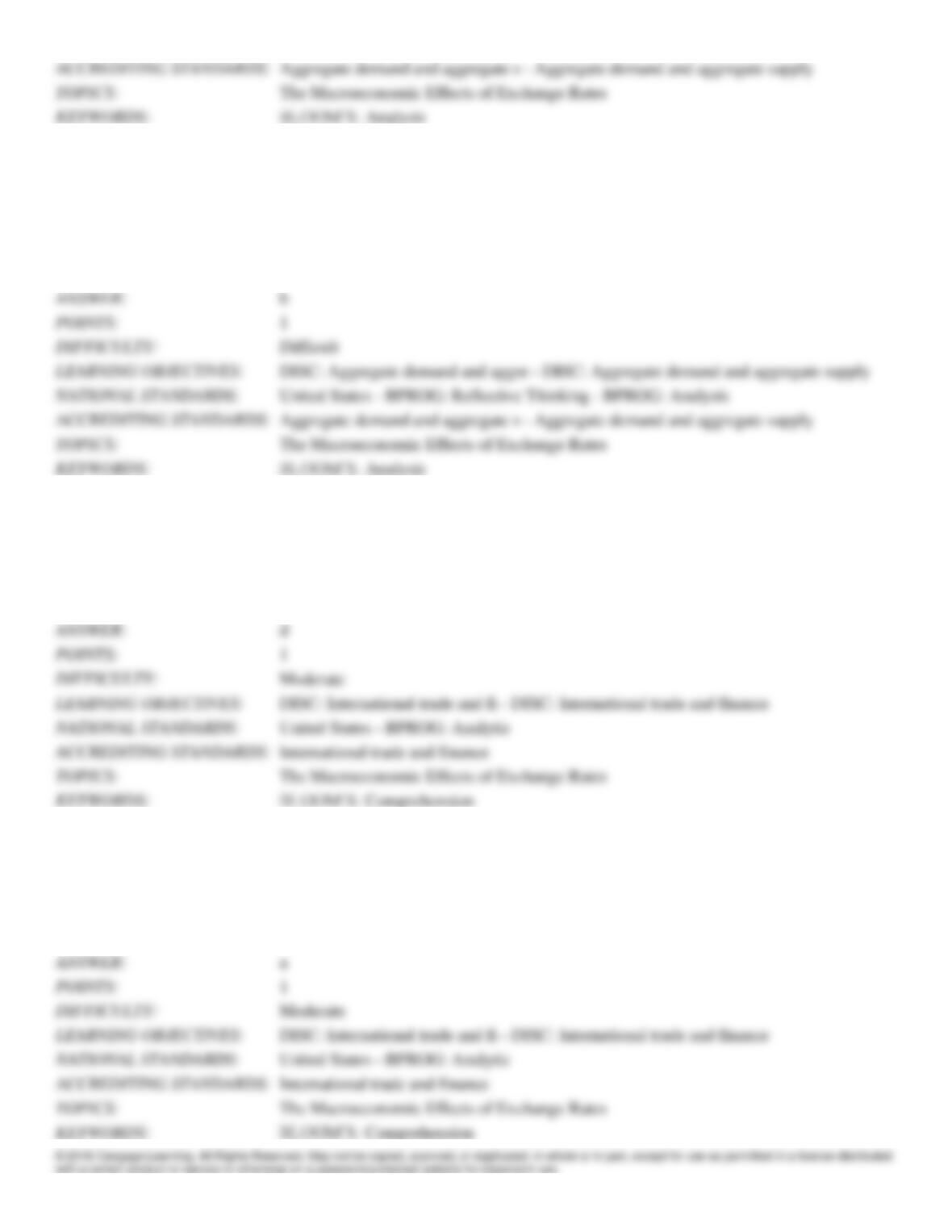
102. Which of the graphs in Figure 20-5 are consistent with an appreciation of the U.S. dollar caused by an increase in
U.S. interest rates?
a.
1
b.
2
c.
3
d.
4
1
DISC: Aggregate demand and aggre – DISC: Aggregate demand and aggregate supply
United States – BPROG: Reflective Thinking – BPROG: Analysis
Aggregate demand and aggregate s – Aggregate demand and aggregate supply
The Macroeconomic Effects of Exchange Rates
103. Which of the graphs in Figure 20-5 are consistent with a depreciation of the U.S. dollar and an increase in net exports
caused by a decrease in U.S. interest rates?
a.
1
b.
2
c.
3
d.
4
b
1
DISC: Aggregate demand and aggre – DISC: Aggregate demand and aggregate supply
United States – BPROG: Reflective Thinking – BPROG: Analysis
Aggregate demand and aggregate s – Aggregate demand and aggregate supply
The Macroeconomic Effects of Exchange Rates
104. For a major country with extensive capital flows, what is the effect of an increase in interest rates?
a.
a currency depreciation and increased net exports
b.
a currency depreciation and reduced net exports
c.
a currency appreciation and increased net exports
d.
a currency appreciation and reduced net exports
d
1
DISC: International trade and fi – DISC: International trade and finance
United States – BPROG: Analytic
International trade and finance
The Macroeconomic Effects of Exchange Rates
105. For a major country with extensive capital flows, what is the effect of a decrease in interest rates?
a.
a currency depreciation and increased net exports
b.
a currency depreciation and reduced net exports
c.
a currency appreciation and increased net exports
d.
a currency appreciation and reduced net exports
1
DISC: International trade and fi – DISC: International trade and finance
United States – BPROG: Analytic
International trade and finance
The Macroeconomic Effects of Exchange Rates
106. Because the United States is highly integrated with the international capital market, international capital flows tend to
a.
counteract the negative effect on aggregate demand of lower interest rates.
b.
counteract the positive effect on aggregate demand of higher interest rates.
c.
strengthen the negative effects on aggregate demand of higher interest rates.
d.
strengthen the negative effects on aggregate demand of lower interest rates.
c
Moderate
DISC: Aggregate demand and aggre – DISC: Aggregate demand and aggregate supply
United States – BPROG: Analytic
Aggregate demand and aggregate s – Aggregate demand and aggregate supply
The Macroeconomic Effects of Exchange Rates
107. The reason that higher interest rates reduce aggregate demand in an open economy with capital flows is that
investment
a.
increases generated by higher interest rates are offset by net export decreases.
b.
decreases generated by higher interest rates are coupled with net export decreases.
c.
decreases generated by higher interest rates are offset by net export increases.
d.
increases generated by higher interest rates are coupled with net export increases.
Moderate
DISC: Aggregate demand and aggre – DISC: Aggregate demand and aggregate supply
United States – BPROG: Analytic
Aggregate demand and aggregate s – Aggregate demand and aggregate supply
The Macroeconomic Effects of Exchange Rates
108. International capital flows are purchases and sales of ____ across national borders.
a.
goods
b.
financial assets
c.
services
d.
commodities
Easy
DISC: Aggregate demand and aggre – DISC: Aggregate demand and aggregate supply
United States – BPROG: Analytic
Aggregate demand and aggregate s – Aggregate demand and aggregate supply
The Macroeconomic Effects of Exchange Rates
109. A decline in interest rates tends to expand the economy by
a.
encouraging private investment and decrease in bank lending.
b.
appreciating the currency and lowering the profitability criterion for investments.
c.
decreasing the cost of capital and reducing net exports.
d.
depreciating the currency and raising net exports.
DISC: Aggregate demand and aggre – DISC: Aggregate demand and aggregate supply
United States – BPROG: Analytic
Aggregate demand and aggregate s – Aggregate demand and aggregate supply
The Macroeconomic Effects of Exchange Rates
110. A rise in the domestic interest rate leads to capital
a.
outflows and exchange rate appreciation.
b.
outflows and exchange rate depreciation.
c.
inflows and exchange rate depreciation.
d.
inflows and exchange rate appreciation.
DISC: International trade and fi – DISC: International trade and finance
United States – BPROG: Analytic
International trade and finance
Fiscal and Monetary Policies in an Open Economy
111. A closed economy is one that
a.
uses tariffs.
b.
uses quotas to restrict trade.
c.
uses exchange controls.
d.
does not trade with other nations.
DISC: International trade and fi – DISC: International trade and finance
United States – BPROG: Analytic
International trade and finance
Fiscal and Monetary Policies in an Open Economy
112. A fall in the domestic interest rate leads to capital
a.
outflows and exchange rate appreciation.
b.
outflows and exchange rate depreciation.
c.
inflows and exchange rate depreciation.
d.
inflows and exchange rate appreciation.
DISC: International trade and fi – DISC: International trade and finance
United States – BPROG: Analytic
International trade and finance
Fiscal and Monetary Policies in an Open Economy
113. The anticipated effect of contractionary monetary policy is
a.
increase in aggregate demand.
b.
fall in interest rates.
c.
increased capital outflow.
d.
appreciation of the currency.
DISC: Aggregate demand and aggre – DISC: Aggregate demand and aggregate supply
United States – BPROG: Analytic
Aggregate demand and aggregate s – Aggregate demand and aggregate supply
Fiscal and Monetary Policies in an Open Economy
114. A currency appreciation
a.
reduces aggregate demand and increases aggregate supply.
b.
reduces aggregate demand and aggregate supply.
c.
increases aggregate demand and reduces aggregate supply.
d.
increases aggregate demand and aggregate supply.
DISC: Aggregate demand and aggre – DISC: Aggregate demand and aggregate supply
United States – BPROG: Analytic
Aggregate demand and aggregate s – Aggregate demand and aggregate supply
Fiscal and Monetary Policies in an Open Economy
115. A currency depreciation
a.
reduces aggregate demand and increases aggregate supply.
b.
reduces aggregate demand and aggregate supply.
c.
increases aggregate demand and reduces aggregate supply.
d.
increases aggregate demand and aggregate supply.
DISC: Aggregate demand and aggre – DISC: Aggregate demand and aggregate supply
United States – BPROG: Analytic
Aggregate demand and aggregate s – Aggregate demand and aggregate supply
Fiscal and Monetary Policies in an Open Economy
116. Expansionary fiscal policy in an open economy
a.
leads to a balance of trade surplus.
b.
decreases America’s capital account surplus and the current account deficit by the same amount.
c.
increases both America’s capital account surplus and current account deficit by equal amounts.
d.
increases America’s capital account surplus more than it increases the current account deficit.
DISC: Monetary and fiscal policy
United States – BPROG: Analytic
Monetary and fiscal policy
Fiscal and Monetary Policies in an Open Economy
117. What important lesson did American economists learn in the 1980s and again in 2001-2003?
a.
Large tax cuts can lead to a balance of trade surplus.
b.
Large government budget deficits can crowd out consumption.
c.
Large government budget deficits can bankrupt the nation.
d.
Large government budget deficits can crowd out net exports.
DISC: Monetary and fiscal policy
United States – BPROG: Analytic
Monetary and fiscal policy
Fiscal and Monetary Policies in an Open Economy
118. International trade tends to lower the value of the multiplier because
a.
imports fall as GDP increases.
b.
net exports fall as GDP increases.
c.
net exports tend to rise as GDP increases.
d.
exports fall as GDP increases.
DISC: Monetary and fiscal policy
United States – BPROG: Analytic
Monetary and fiscal policy
Fiscal and Monetary Policies in an Open Economy
119. In an open economy, an increase in (G − T) will
a.
decrease (X − IM).
b.
increase (X − IM).
c.
leave (X − IM) unchanged.
d.
have an unpredictable effect on (X − IM).
DISC: Monetary and fiscal policy
United States – BPROG: Analytic
Monetary and fiscal policy
Fiscal and Monetary Policies in an Open Economy
120. Expansionary fiscal policy in an open economy has a
a.
greater effect than in a closed economy.
b.
similar effect in a closed economy.
c.
smaller effect than in a closed economy.
d.
greater effect than monetary policy.
DISC: Monetary and fiscal policy
United States – BPROG: Analytic
Monetary and fiscal policy
Fiscal and Monetary Policies in an Open Economy
121. Between 1981 and 1986, as the federal budget deficit increased,
a.
consumption spending fell.
b.
investment spending was crowded out.
c.
net exports increased.
d.
net exports were crowded out.
DISC: Monetary and fiscal policy
United States – BPROG: Analytic
Monetary and fiscal policy
Fiscal and Monetary Policies in an Open Economy
122. The growing federal budget deficit in the 1980s was accompanied by a
a.
growing trade surplus.
b.
growing trade deficit.
c.
shrinking trade deficit.
d.
shrinking capital account surplus.
DISC: Monetary and fiscal policy
United States – BPROG: Analytic
Monetary and fiscal policy
Fiscal and Monetary Policies in an Open Economy
123. The sequence of events following an increase in the federal deficit would be higher interest rates, a(n)
a.
depreciating dollar, and a larger current account deficit.
b.
depreciating dollar, and a smaller current account deficit.
c.
appreciating dollar, and a larger current account deficit.
d.
appreciating dollar, and a smaller current account deficit.
DISC: Monetary and fiscal policy
United States – BPROG: Analytic
Monetary and fiscal policy
Fiscal and Monetary Policies in an Open Economy
124. An expansionary fiscal policy will lead to
a.
higher interest rates, an appreciated dollar, and reduced net exports.
b.
higher interest rates, an appreciated dollar, and increased net exports.
c.
reduced interest rates, an appreciated dollar, and reduced net exports.
d.
reduced interest rates, an appreciated dollar, and increased net exports.
DISC: Monetary and fiscal policy
United States – BPROG: Analytic
Monetary and fiscal policy
Fiscal and Monetary Policies in an Open Economy
125. International capital flows in an open economy have the effect of
a.
increasing the power of fiscal policy.
b.
reducing the power of fiscal policy.
c.
reducing the power of fiscal policy in an expansion, and increasing it in a contraction.
d.
increasing the power of fiscal policy in an expansion, and reducing it in a contraction.
DISC: Monetary and fiscal policy
United States – BPROG: Analytic
Monetary and fiscal policy
Fiscal and Monetary Policies in an Open Economy
126. If a country tries to stimulate the economy with fiscal policy, the effects will be exchange rate
a.
depreciation, lower interest rates, and a small increase in aggregate demand.
b.
depreciation, higher interest rates, and a small decrease in aggregate demand.
c.
appreciation, lower interest rates, and a small increase in aggregate demand.
d.
appreciation, higher interest rates, and a small increase in aggregate demand.
DISC: Monetary and fiscal policy
United States – BPROG: Analytic
Monetary and fiscal policy
Fiscal and Monetary Policies in an Open Economy
127. Why is fiscal policy less effective in an open economy than in a closed economy?
a.
Expansionary fiscal policy raises demand for imports, which reduces aggregate demand.
b.
Expansionary fiscal policy raises interest rates, which raises the value of the currency, and reduces aggregate
demand.
c.
Expansionary fiscal policy raises the value of the currency, which reduces demand for exports.
d.
Expansionary fiscal policy has all the above effects.
DISC: Monetary and fiscal policy
United States – BPROG: Analytic
Monetary and fiscal policy
Fiscal and Monetary Policies in an Open Economy
128. Did the large U.S. budget deficits in the 1980s “crowd out” investment as some economists had predicted?
a.
Yes, investment dropped as predicted.
b.
Yes, although investment did not fall nearly as much as some had feared.
c.
No, investment was not crowded out, but net exports dropped.
d.
No, no crowding out at all occurred.
DISC: Monetary and fiscal policy
United States – BPROG: Analytic
Monetary and fiscal policy
Fiscal and Monetary Policies in an Open Economy
129. What are the results of a contractionary monetary policy in an open economy with floating exchange rates and
internationally mobile capital?
a.
The dollar appreciates, which leads to an increase in exports and a decrease in imports. The country therefore
winds up with a deficit in capital and a surplus in its balance of trade.
b.
The dollar appreciates, which attracts foreign capital. Also, imports rise and exports decline. The country
therefore winds up with a surplus in capital and an increase in its trade deficit.
c.
The dollar depreciates, which attracts foreign capital. Also, exports rise and imports decline. The country
therefore winds up with a deficit in capital and a surplus in its balance of trade.
d.
The dollar depreciates, which leads to a larger real GDP and a larger trade surplus.
DISC: Monetary and fiscal policy
United States – BPROG: Reflective Thinking – BPROG: Analysis
Monetary and fiscal policy
Fiscal and Monetary Policies in an Open Economy
130. International capital flows strengthen
a.
monetary policy and have no effect on fiscal policy.
b.
monetary policy but weaken fiscal policy.
c.
monetary and fiscal policy.
d.
fiscal policy but weaken monetary policy.
DISC: Monetary and fiscal policy
United States – BPROG: Analytic
Monetary and fiscal policy
Fiscal and Monetary Policies in an Open Economy
131. The main international repercussion of either a fiscal expansion or monetary contraction is to
a.
raise interest rates and the exchange rate, thereby crowding out net exports.
b.
raise interest rates and lower the exchange rate, thereby crowding in net exports.
c.
lower interest rates and the exchange rate, thereby crowding in net exports.
d.
lower interest rates and raise the exchange rate, thereby crowding out net exports.
DISC: Monetary and fiscal policy
United States – BPROG: Analytic
Monetary and fiscal policy