Fiscal and Monetary Policies in an Open Economy
132. The sequence of events following a contractionary monetary policy would be higher interest rates followed by dollar
a.
depreciation, higher exports, and lower imports.
b.
depreciation, lower exports, and higher imports.
c.
appreciation, lower exports, and higher imports.
d.
appreciation, higher exports, and lower imports.
DISC: Monetary and fiscal policy
United States – BPROG: Analytic
Monetary and fiscal policy
Fiscal and Monetary Policies in an Open Economy
133. Following an expansionary monetary policy, we would expect lower interest rates, dollar
a.
depreciation, and an increase in the current account deficit.
b.
depreciation, and a decrease in the current account deficit.
c.
appreciation, and an increase in the current account deficit.
d.
appreciation, and a decrease in the current account deficit.
DISC: Monetary and fiscal policy
United States – BPROG: Analytic
Monetary and fiscal policy
Fiscal and Monetary Policies in an Open Economy
134. The dramatic rise in the dollar between 1981 and 1986 was the result of a(n)
a.
a tight monetary and a tight fiscal policy.
b.
an expansive monetary and an expansive fiscal policy.
c.
an expansive monetary and a tight fiscal policy.
d.
a tight monetary and an expansive fiscal policy.
DISC: Monetary and fiscal policy
United States – BPROG: Analytic
Monetary and fiscal policy
Fiscal and Monetary Policies in an Open Economy
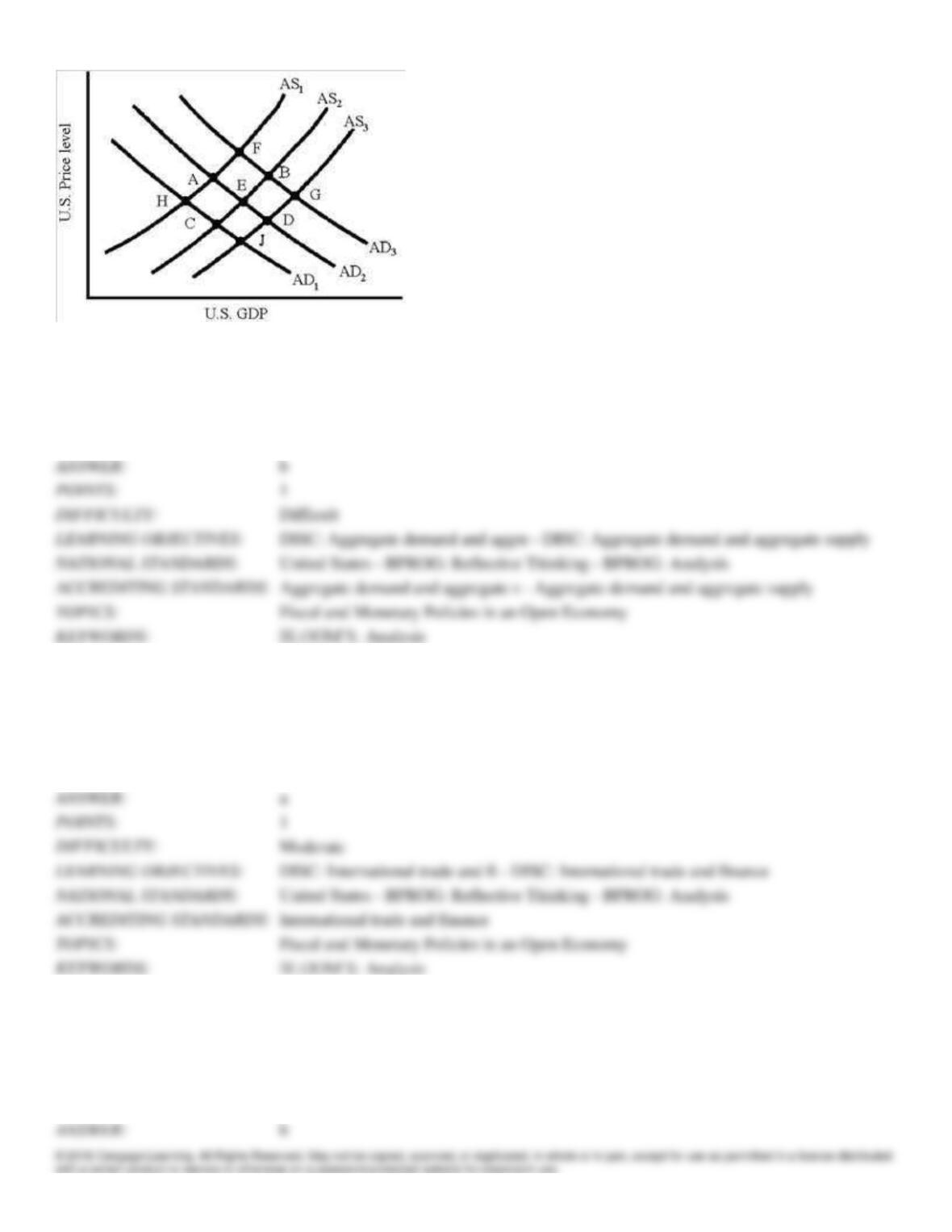
135. In Figure 20–6, which point represents equilibrium at the lowest exchange rate?
a.
E
b.
F
c.
G
d.
H
Difficult
DISC: Aggregate demand and aggre – DISC: Aggregate demand and aggregate supply
United States – BPROG: Reflective Thinking – BPROG: Analysis
Aggregate demand and aggregate s – Aggregate demand and aggregate supply
Fiscal and Monetary Policies in an Open Economy
136. In Figure 20–6, which of the following will cause a movement from equilibrium at point A to equilibrium at point C?
a.
an appreciation of the dollar
b.
a depreciation of the dollar
c.
an appreciation of the Japanese yen
d.
an increase in the U.S. price level
a
Moderate
DISC: International trade and fi – DISC: International trade and finance
United States – BPROG: Reflective Thinking – BPROG: Analysis
International trade and finance
Fiscal and Monetary Policies in an Open Economy
137. In Figure 20–6, which of the following will cause a movement from equilibrium at point D to equilibrium at point B?
a.
an appreciation of the dollar
b.
a depreciation of the dollar
c.
a depreciation of the Japanese yen
d.
an increase in the U.S. price level
138. In Figure 20–6, an expansive fiscal policy in a closed economy results in an equilibrium at point E. In an open
economy, allowing for the effects of the induced change in the currency value, the final equilibrium would be point
a.
B.
b.
F.
c.
J.
d.
H.
139. In Figure 20–6, an expansive monetary policy in a closed economy results in an equilibrium at point E. In our open
economy, allowing for the induced change in the currency exchange rate, the final equilibrium will be at a point like
a.
B.
b.
F.
c.
J.
d.
H.
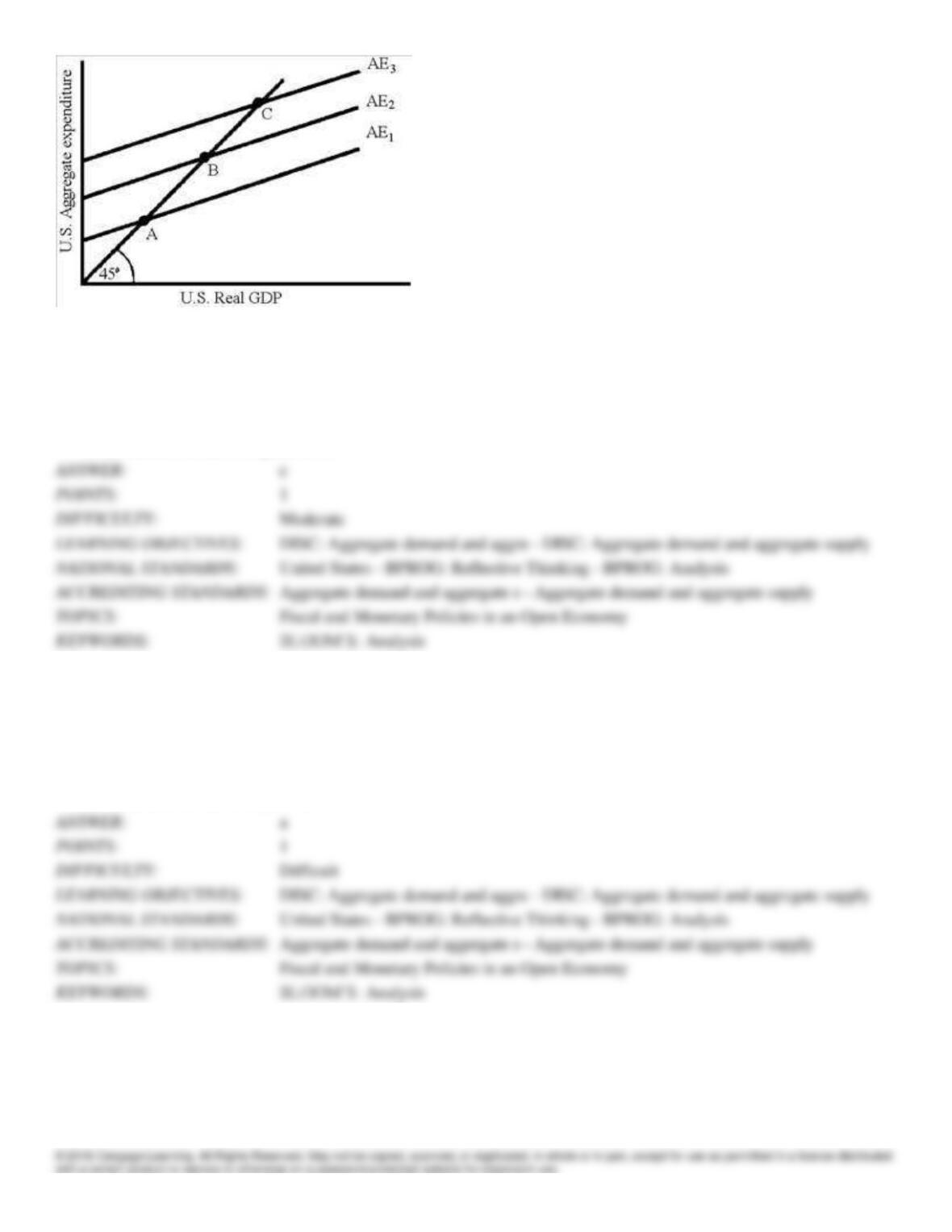
140. In Figure 20–7, there are three aggregate expenditure functions (C + I + G + X − IM) for an open economy. Which of
the following would cause a movement from A to B?
a.
an increase in interest rates
b.
an appreciation of the dollar
c.
a depreciation of the dollar
d.
an increase in the U.S. price level
DISC: Aggregate demand and aggre – DISC: Aggregate demand and aggregate supply
United States – BPROG: Reflective Thinking – BPROG: Analysis
Aggregate demand and aggregate s – Aggregate demand and aggregate supply
Fiscal and Monetary Policies in an Open Economy
141. In Figure 20–7, there are three aggregate expenditure functions (C + I + G + X − IM) for an open economy. Which of
the following would cause a movement from A to B?
a.
a European economic expansion
b.
a decrease in the money supply
c.
an increase in the interest rate
d.
an increase in the U.S. price level
DISC: Aggregate demand and aggre – DISC: Aggregate demand and aggregate supply
United States – BPROG: Reflective Thinking – BPROG: Analysis
Aggregate demand and aggregate s – Aggregate demand and aggregate supply
Fiscal and Monetary Policies in an Open Economy
142. In Figure 20–7, there are three aggregate expenditure functions (C + I + G + X − IM) for an open economy. Which of
the following would cause a movement from C to B?
a.
a European economic expansion
b.
an appreciation of the dollar
c.
a depreciation of the dollar
d.
an increase in the money supply
DISC: Aggregate demand and aggre – DISC: Aggregate demand and aggregate supply
United States – BPROG: Reflective Thinking – BPROG: Analysis
Aggregate demand and aggregate s – Aggregate demand and aggregate supply
Fiscal and Monetary Policies in an Open Economy
143. In Figure 20–7, there are three aggregate expenditure functions (C + I + G + X − IM) for an open economy. Which of
the following would cause a movement from B to A?
a.
a recession in Southeast Asia
b.
an economic expansion in Japan
c.
a depreciation of the dollar
d.
an increase in the interest rate
DISC: Aggregate demand and aggre – DISC: Aggregate demand and aggregate supply
United States – BPROG: Reflective Thinking – BPROG: Analysis
Aggregate demand and aggregate s – Aggregate demand and aggregate supply
Fiscal and Monetary Policies in an Open Economy
144. An expansionary monetary policy will
a.
increase imports.
b.
decrease exports.
c.
increase a current account deficit.
d.
decrease a capital account surplus.
DISC: Monetary and fiscal policy
United States – BPROG: Analytic
Monetary and fiscal policy
Fiscal and Monetary Policies in an Open Economy
145. The international trade response to a contractionary monetary policy will cause aggregate demand to shift ____ and
aggregate supply to shift ____.
a.
outward, outward
b.
inward, outward
c.
outward, inward
d.
inward, inward
DISC: Monetary and fiscal policy
United States – BPROG: Analytic
Monetary and fiscal policy
Fiscal and Monetary Policies in an Open Economy
146. Suppose that the Fed decides to increase the growth rate of the money supply in the United States. What is most
likely to happen to the U.S. trade deficit and to GDP?
a.
The trade deficit will fall; GDP will fall.
b.
The trade deficit will rise; GDP will rise.
c.
The trade deficit will fall; GDP will rise.
d.
The trade deficit will rise; GDP will fall.
DISC: Monetary and fiscal policy
United States – BPROG: Analytic
Monetary and fiscal policy
Fiscal and Monetary Policies in an Open Economy
147. Suppose that the Fed decides to decrease the growth rate of the money supply in the United States. What is most
likely to happen to the U.S. trade deficit and to GDP?
a.
The trade deficit will fall; GDP will fall.
b.
The trade deficit will rise; GDP will rise.
c.
The trade deficit will fall; GDP will rise.
d.
The trade deficit will rise; GDP will fall.
DISC: Monetary and fiscal policy
United States – BPROG: Analytic
Monetary and fiscal policy
Fiscal and Monetary Policies in an Open Economy
Figure 20-8
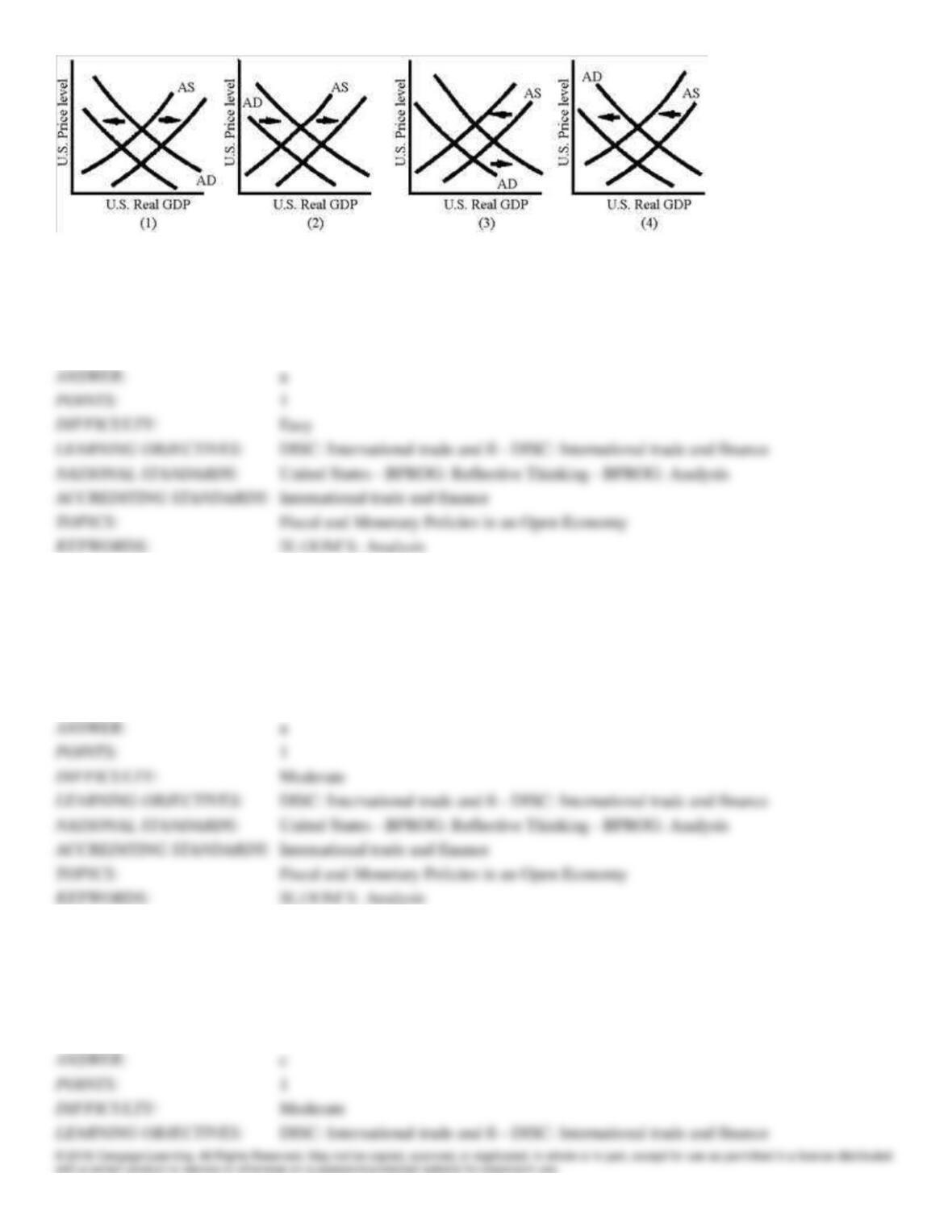
148. Which of the graphs in Figure 20-8 represents the effects of a currency appreciation?
a.
1
b.
2
c.
3
d.
4
1
149. Which of the graphs in Figure 20-8 illustrates the AD–AS shifts induced by the foreign sector following an increase
in the U.S. federal deficit?
a.
1
b.
2
c.
3
d.
4
1
150. Which of the graphs in Figure 20-8 illustrates the AD–AS shifts associated with an expansionary monetary policy?
a.
1
b.
2
c.
3
d.
4
1
United States – BPROG: Reflective Thinking – BPROG: Analysis
International trade and finance
Fiscal and Monetary Policies in an Open Economy
151. Which of the graphs in Figure 20-8 illustrates the AD–AS shifts associated with a currency depreciation?
a.
1
b.
2
c.
3
d.
4
1
DISC: International trade and fi – DISC: International trade and finance
United States – BPROG: Reflective Thinking – BPROG: Analysis
International trade and finance
Fiscal and Monetary Policies in an Open Economy
152. International capital flows in an open economy have the effect of
a.
reducing the power of monetary policy.
b.
increasing the power of monetary policy.
c.
increasing the power of monetary policy in an expansion and reducing it in a contraction.
d.
reducing the power of monetary policy in an expansion and increasing it in a contraction.
b
1
DISC: Monetary and fiscal policy
United States – BPROG: Analytic
Monetary and fiscal policy
Fiscal and Monetary Policies in an Open Economy
153. Why is monetary policy more effective in an open economy than in a closed economy?
a.
Trade deficits affect exchange rates, which can offset adverse interest rate effects.
b.
Borrowers can choose to use foreign capital, so that interest rate effects are stronger than expected.
c.
Interest rate changes affect exchange rates, so that capital flows reinforce the effect of monetary policy.
d.
Banks can choose to lend to foreigners, so that interest rate effects are essentially nullified.
1
DISC: Monetary and fiscal policy
United States – BPROG: Analytic
Monetary and fiscal policy
Fiscal and Monetary Policies in an Open Economy
154. The different effects of fiscal and monetary policy in an open economy with mobile capital hinges on their different
effect on
a.
price levels.
b.
interest rates.
c.
the money supply.
d.
real GDP.
Moderate
DISC: Monetary and fiscal policy
United States – BPROG: Analytic
Monetary and fiscal policy
Fiscal and Monetary Policies in an Open Economy
Table 20-1
Suppose the economy of Macroland is described by the following:
C = 200 + .8DI (DI = disposable income)
I = 300 + .2Y − 50r (Y = GDP)
(r, the interest rate, is measured in percentage points. For example, a 9 percent interest rate is r = 9).
For this economy, assume that the Federal Reserve uses its monetary policy to peg the interest rate at
r = 5
G = 750
T = .25Y
X = 200
M = 150 + .2Y
Hint: DI = Y − T
155. From Table 20–1, compute equilibrium GDP for Macroland.
a.
3,000
b.
2,950
c.
2,625
d.
2,525
c
Moderate
DISC: International trade and fi – DISC: International trade and finance
United States – BPROG: Reflective Thinking – BPROG: Analysis
International trade and finance
International Aspects of Deficit Reduction
156. From Table 20–1, find the budget deficit or surplus for Macroland.
a.
125.50
b.
−93.75
c.
−126.25
d.
−154.75
DISC: International trade and fi – DISC: International trade and finance
United States – BPROG: Reflective Thinking – BPROG: Analysis
International trade and finance
International Aspects of Deficit Reduction
157. From Table 20–1, find the trade deficit or surplus.
a.
475 deficit
b.
75 deficit
c.
75 surplus
d.
475 surplus
DISC: International trade and fi – DISC: International trade and finance
United States – BPROG: Analytic
International trade and finance
International Aspects of Deficit Reduction
158. If the United States increased its budget deficit, and it is at or near full employment, the most likely effect is to crowd
a.
in investment and crowd out net exports.
b.
out investment and crowd in net exports.
c.
in investment and crowd in net exports.
d.
out investment and crowd out net exports.
DISC: International trade and fi – DISC: International trade and finance
United States – BPROG: Analytic
International trade and finance
International Aspects of Deficit Reduction
159. What does macroeconomic theory predict as the main economic effect of a reduction in the budget deficit?
a.
lower real interest rates
b.
a drop in the exchange rate
c.
an increase in net exports
d.
All of the above are correct.
DISC: International trade and fi – DISC: International trade and finance
United States – BPROG: Analytic
International trade and finance
International Aspects of Deficit Reduction
160. In the 1990s the United States eliminated its budget deficit and expanded the money supply. This should have led to
a.
lower real interest rates and a depreciation of the dollar.
b.
lower real interest rates and an appreciation of the dollar.
c.
higher real interest rates and a depreciation of the dollar.
d.
higher real interest rates and an appreciation of the dollar.
DISC: International trade and fi – DISC: International trade and finance
United States – BPROG: Analytic
International trade and finance
International Aspects of Deficit Reduction
161. In the mid-1990s, real interest rates fell in the United States. This was the result of budget deficit
a.
increases and tighter monetary policy.
b.
increases and looser monetary policy.
c.
reductions and looser monetary policy.
d.
reductions and tighter monetary policy.
DISC: International trade and fi – DISC: International trade and finance
United States – BPROG: Analytic
International trade and finance
International Aspects of Deficit Reduction
162. The expected effects of fiscal contraction are
a.
higher real interest rates.
b.
exchange rate depreciation.
c.
increased trade deficit.
d.
All of the above are correct.
DISC: International trade and fi – DISC: International trade and finance
United States – BPROG: Analytic
International trade and finance
International Aspects of Deficit Reduction
163. The expected effects of monetary expansion are
a.
lower real interest rates.
b.
exchange rate depreciation.
c.
higher inflation.
d.
All of the above are correct.
DISC: International trade and fi – DISC: International trade and finance
United States – BPROG: Analytic
International trade and finance
International Aspects of Deficit Reduction
164. The expected effects of an increased budget deficit are
a.
higher real interest rates.
b.
exchange rate depreciation.
c.
lower inflation.
d.
All of the above are correct.
DISC: Monetary and fiscal policy
United States – BPROG: Analytic
Monetary and fiscal policy
International Aspects of Deficit Reduction
165. The expected effects of a tighter monetary policy are
a.
lower real interest rates.
b.
exchange rate depreciation.
c.
lower inflation.
d.
All of the above are correct.
DISC: Monetary and fiscal policy
United States – BPROG: Analytic
Monetary and fiscal policy
International Aspects of Deficit Reduction
166. The combined effects of a fiscal contraction and a monetary expansion are
a.
higher real interest rates.
b.
exchange rate depreciation.
c.
increased current account deficit.
d.
All of the above are correct.
DISC: Monetary and fiscal policy
United States – BPROG: Analytic
Monetary and fiscal policy
International Aspects of Deficit Reduction
167. The expected effect of the Bush tax cuts would be a(n)
a.
lower real interest rate.
b.
exchange rate depreciation.
c.
increased current account deficit.
d.
All of the above are correct.
DISC: Monetary and fiscal policy
United States – BPROG: Analytic
Monetary and fiscal policy
International Aspects of Deficit Reduction
168. From 1992, America’s trade performance was marked by a(n)
a.
reduced current account deficit.
b.
increased current account deficit.
c.
reduced capital account surplus.
d.
increase in the growth of exports.
DISC: Monetary and fiscal policy
United States – BPROG: Analytic
Monetary and fiscal policy
International Aspects of Deficit Reduction
169. Since the U.S. economy expanded rapidly from 1992 to 2000, it must be true that
a.
fiscal contraction overwhelmed monetary expansion.
b.
monetary expansion overwhelmed fiscal contraction.
c.
monetary expansion exactly offset fiscal contraction.
d.
monetary contraction overwhelmed fiscal expansion.
DISC: Monetary and fiscal policy
United States – BPROG: Analytic
Monetary and fiscal policy
International Aspects of Deficit Reduction
170. Despite the monetary expansion of the 1992-2000 period, the inflation rate
a.
rose due to adverse supply shocks.
b.
rose due to large increases in aggregate demand.
c.
fell despite adverse supply shocks.
d.
fell due to favorable supply shocks.
DISC: Monetary and fiscal policy
United States – BPROG: Analytic
Monetary and fiscal policy
International Aspects of Deficit Reduction
171. Because monetary stimulus overwhelmed fiscal contraction in the United States during the 1992- 2000 period,
a.
real GDP grew.
b.
real GDP decreased.
c.
the rate of inflation increased.
d.
the budget deficit increased.
DISC: Monetary and fiscal policy
United States – BPROG: Analytic
Monetary and fiscal policy
International Aspects of Deficit Reduction
172. The accounting relationship between the budget deficit and the trade deficit may be expressed as ____.
a.
G + T = (S + I) + (X − IM)
b.
G − T = (S + I) + (X + IM)
c.
(X – IM) = (S – I) − (G – T)
d.
(X – IM) = (S + I) − (G – T)
DISC: International trade and fi – DISC: International trade and finance
United States – BPROG: Analytic
International trade and finance
International Aspects of Deficit Reduction
173. The trade deficit is the mirror image of the required capital inflows. So why worry about these capital inflows?
a.
Trade deficits automatically cause larger budget deficits.
b.
Before long, the Germans, Japanese, and other foreigners will own the United States and will be dictating
policy to the U.S. government.
c.
These capital inflows create debts on which interest and principal payments will have to be made in the future.
d.
During the period of trade deficits, personal consumption must be reduced to build up wealth to repay the debt
created.
c
Moderate
DISC: International trade and fi – DISC: International trade and finance
United States – BPROG: Analytic
International trade and finance
International Aspects of Deficit Reduction
Table 20-2
Domestic
GDP
Expenditure
Exports
Imports
Total Expenditures
Y
C + I + G
X
IM
C + I + G + (X − IM)
$2,500
$3,100
$650
$250
_____
3,000
3,400
650
300
_____
3,500
3,700
650
350
_____
4,000
4,000
650
400
_____
4,500
4,300
650
450
_____
5,000
4,600
650
500
_____
5,500
4,900
650
550
_____
174. In Table 20–2, what is equilibrium GDP?
a.
$2,500
b.
$3,500
c.
$4,500
d.
$5,500
c
Easy
DISC: International trade and fi – DISC: International trade and finance
United States – BPROG: Reflective Thinking – BPROG: Analysis
International trade and finance
International Aspects of Deficit Reduction
175. In Table 20–2, what are net exports when GDP = 3,500?
a.
400
b.
300
c.
200
d.
100
b
1
Easy
176. From Table 20–2, what can you conclude about net exports as GDP rises?
a.
Net exports rise and then fall as GDP rises.
b.
Net exports are constant as GDP rises.
c.
Net exports rise as GDP rises.
d.
Net exports fall as GDP rises.
d
1
Easy
177. In Table 20–2, assume that exports rise to $900. What is the new equilibrium GDP?
a.
$5,000
b.
$4,500
c.
$4,000
d.
$3,500
a
1
Easy
178. In Table 20–2, assume that exports rise to $900. How large is the multiplier?
a.
5
b.
4
c.
2.5
d.
2
d