DISC: International trade and fi – DISC: International trade and finance
United States – BPROG: Reflective Thinking – BPROG: Analysis
International trade and finance
International Aspects of Deficit Reduction
179. If the U.S. government runs a budget deficit (G − T), that deficit must be financed by an excess of
a.
T over G.
b.
C over T plus G.
c.
investment by American businesses and individuals.
d.
S over I by American businesses and individuals, or by borrowing from foreigners.
DISC: International trade and fi – DISC: International trade and finance
United States – BPROG: Reflective Thinking – BPROG: Analysis
International trade and finance
International Aspects of Deficit Reduction
Figure 20-9
180. Figure 20-9 shows aggregate expenditures when net exports are fixed and aggregate expenditures are variable. The
autonomous spending multiplier is
a.
smaller when net exports are fixed.
b.
smaller when net exports are variable.
c.
larger when net exports are variable.
d.
the same whether net exports are fixed or variable.
DISC: Aggregate demand and aggre – DISC: Aggregate demand and aggregate supply
Aggregate demand and aggregate s – Aggregate demand and aggregate supply
International Aspects of Deficit Reduction
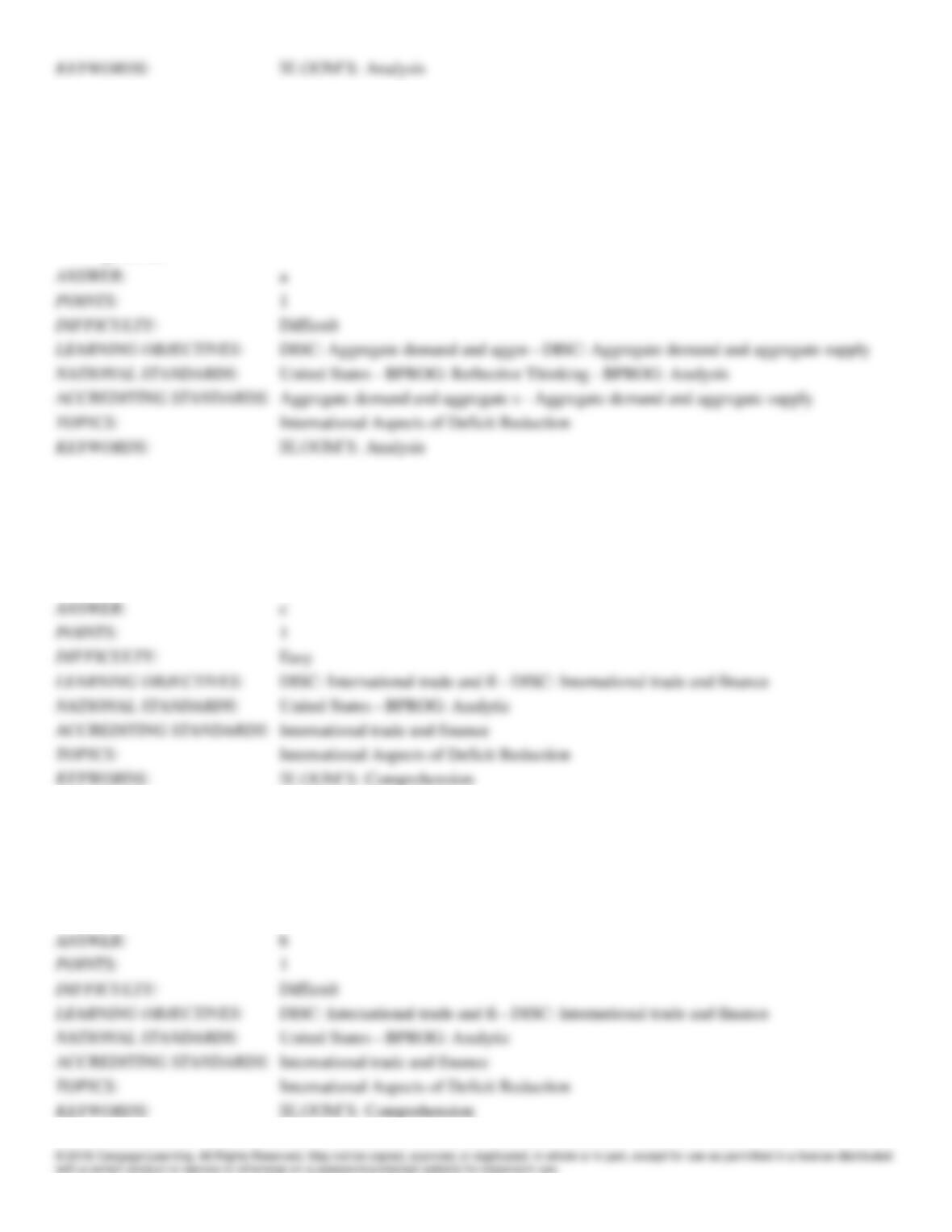
181. In Figure 20–9, the C + I + G + (X − IM)1 line is flatter than the C + I + G + (X − IM)0 line because the
a.
(X − IM)1 line indicates that net exports decline as GDP rises.
b.
(X − IM)1 line indicates that net exports rise as GDP rises.
c.
multiplier is greater for the (X − IM)1 line.
d.
(X − IM)1 line indicates that tariffs, quotas, and other trade barriers are keeping net exports below their full
potential.
DISC: Aggregate demand and aggre – DISC: Aggregate demand and aggregate supply
United States – BPROG: Reflective Thinking – BPROG: Analysis
Aggregate demand and aggregate s – Aggregate demand and aggregate supply
International Aspects of Deficit Reduction
182. Which of the following is correct?
a.
Current account surplus + capital account surplus = 1
b.
Current account surplus − capital account surplus = 0
c.
Current account surplus + capital account surplus = 0
d.
Current account surplus − capital account surplus = 1
DISC: International trade and fi – DISC: International trade and finance
United States – BPROG: Analytic
International trade and finance
International Aspects of Deficit Reduction
183. If (T − G) = (X − IM), then (S − I)
a.
is greater than zero.
b.
is zero.
c.
is less than zero.
d.
cannot be calculated.
DISC: International trade and fi – DISC: International trade and finance
United States – BPROG: Analytic
International trade and finance
International Aspects of Deficit Reduction
184. If the government budget is balanced, and saving is greater than investment, then the
a.
current account must be in surplus.
b.
current account must be in deficit.
c.
current account balance must be zero.
d.
capital account must be in surplus.
DISC: International trade and fi – DISC: International trade and finance
United States – BPROG: Analytic
International trade and finance
International Aspects of Deficit Reduction
185. If (X − IM) < 0, then capital inflows
a.
will be zero.
b.
will be greater than zero.
c.
will be less than zero.
d.
can be zero, positive, or negative.
DISC: International trade and fi – DISC: International trade and finance
United States – BPROG: Reflective Thinking – BPROG: Analysis
International trade and finance
International Aspects of Deficit Reduction
186. If the federal government has a deficit, and the current account is in balance, then
a.
I = S.
b.
I > S.
c.
S > I.
d.
S + I = 0.
DISC: International trade and fi – DISC: International trade and finance
United States – BPROG: Reflective Thinking – BPROG: Analysis
International trade and finance
International Aspects of Deficit Reduction
187. In an open economy, the government deficit is 400 and investment exceeds saving by 300, so in equilibrium the trade
deficit (IM − X) must be
a.
100.
b.
200.
c.
300.
d.
700.
DISC: International trade and fi – DISC: International trade and finance
United States – BPROG: Reflective Thinking – BPROG: Analysis
International trade and finance
International Aspects of Deficit Reduction
188. In an open economy, the government deficit is 600 and saving exceeds investment by 500, so in equilibrium the trade
deficit (IM − X) must be
a.
100.
b.
200.
c.
300.
d.
700.
DISC: International trade and fi – DISC: International trade and finance
United States – BPROG: Reflective Thinking – BPROG: Analysis
International trade and finance
International Aspects of Deficit Reduction
189. Economic theory shows that the current account deficit is always equal to the capital account surplus. This means
that
a.
the federal budget must always be in balance.
b.
when a country exports more goods and services than it imports, it also imports assets equal to the difference.
c.
current account deficits should be avoided.
d.
trade deficits tend to be eliminated automatically.
DISC: International trade and fi – DISC: International trade and finance
United States – BPROG: Analytic
International trade and finance
International Aspects of Deficit Reduction
190. Under a floating exchange rate system with mobile international capital, it is always true that current account
a.
deficit + capital account surplus = trade deficit.
b.
surplus − capital account surplus = trade deficit.
c.
surplus + capital account deficit = 0.
d.
surplus − capital account surplus = 0.
DISC: International trade and fi – DISC: International trade and finance
United States – BPROG: Reflective Thinking – BPROG: Analysis
International trade and finance
International Aspects of Deficit Reduction
191. The government budget deficit must be equal to the surplus
a.
of saving over investment.
b.
in the current account in international trade.
c.
of saving over consumption.
d.
of saving over investment plus the trade deficit.
DISC: International trade and fi – DISC: International trade and finance
United States – BPROG: Analytic
International trade and finance
International Aspects of Deficit Reduction
192. Despite the elimination of the federal budget deficit in the late 1990s, the trade deficit increased due to
a.
increased household saving.
b.
decreased household saving.
c.
a depreciation of the dollar.
d.
an increase in inflation rates.
DISC: International trade and fi – DISC: International trade and finance
United States – BPROG: Analytic
International trade and finance
International Aspects of Deficit Reduction
193. To eliminate the trade deficits in the late 1990s would have required, in addition to the reduction of the federal
budget deficit, an increase in
a.
investment spending.
b.
the exchange value of the dollar.
c.
the U.S. price level.
d.
the saving rate.
DISC: International trade and fi – DISC: International trade and finance
United States – BPROG: Analytic
International trade and finance
International Aspects of Deficit Reduction
194. How does a budget deficit lead to a trade deficit?
a.
The trade deficit triggers higher interest rates, which increase the budget deficit.
b.
The budget deficit leads to higher interest rates and exchange rates, which shrink net exports.
c.
The trade deficit causes lower interest rates, which leads to economic recession and a budget deficit.
d.
The budget deficit causes lower exchange rates, which decrease net exports.
DISC: International trade and fi – DISC: International trade and finance
United States – BPROG: Analytic
International trade and finance
International Aspects of Deficit Reduction
195. The trade deficits of the 1980s and 1990s reflects American desire for foreign
a.
assets and foreign desire for American goods and services.
b.
goods and services and foreign assets.
c.
goods and services and foreign desire for American assets.
d.
assets now and foreign goods and services in the future.
DISC: International trade and fi – DISC: International trade and finance
United States – BPROG: Analytic
International trade and finance
Should We Worry About the Trade Deficit?
196. The U.S. trade deficits of the 1980s and 1990s may represent a problem because they will require
a.
higher consumption in the future in order to increase imports.
b.
lower consumption in the future in order to repay interest and principal to foreigners.
c.
lower consumption in the future in order to finance increased investment.
d.
higher budget deficits in the future in order to increase the trade surplus.
DISC: International trade and fi – DISC: International trade and finance
United States – BPROG: Analytic
International trade and finance
Should We Worry About the Trade Deficit?
197. One of the principal factors behind the U.S. trade deficits of the 1990s has been
a.
slow growth and recession in many important trading partners.
b.
rapid growth and inflation in many important trading partners.
c.
significant depreciation of the dollar.
d.
rising real interest rates in the United States.
DISC: International trade and fi – DISC: International trade and finance
United States – BPROG: Analytic
International trade and finance
198. The saving rate in the United States fell to nearly zero in the early 2000s. One of the contributing factors to this
development was the
a.
decrease in consumer confidence in the late 1990s.
b.
declining real incomes of most American households.
c.
increased housing wealth.
d.
rising real interest rates in the United States.
DISC: International trade and fi – DISC: International trade and finance
United States – BPROG: Analytic
International trade and finance
199. One unpleasant cure for the U.S. trade deficit of the 1990s would be for foreigners who hold U.S. financial assets to
demand
a.
lower interest rates to stimulate U.S. growth rates.
b.
higher interest rates and generate a recession in the United States.
c.
higher interest rates and generate an appreciation of the dollar.
d.
lower interest rates and generate a depreciation of the dollar.
DISC: International trade and fi – DISC: International trade and finance
United States – BPROG: Analytic
International trade and finance
200. The worst remedy for curing the U.S. trade deficit is to
a.
increase U.S. personal saving.
b.
reduce the budget deficit.
c.
encourage all nations to lower trade barriers.
d.
limit imports by imposing tariffs, quotas, and other trade restrictions.
DISC: International trade and fi – DISC: International trade and finance
United States – BPROG: Analytic
International trade and finance
201. Which of the following would be cures for the U.S. trade deficit?
a.
Americans saving less and spending more
b.
a severe recession in Europe and Asia
c.
a severe recession in the United States
d.
a tax cut
e.
All of the above are correct.
DISC: International trade and fi – DISC: International trade and finance
United States – BPROG: Analytic
International trade and finance
202. Protectionism may reduce imports, and it will also
a.
appreciate the dollar, reducing exports.
b.
appreciate the dollar, increasing exports.
c.
depreciate the dollar, increasing exports.
d.
depreciate the dollar, reducing exports.
DISC: International trade and fi – DISC: International trade and finance
United States – BPROG: Analytic
International trade and finance
203. Protectionism may fail to reduce a current account deficit because it
a.
depreciates the dollar.
b.
invites retaliation, which hurts exports.
c.
encourages exports.
d.
does not reduce imports.
DISC: International trade and fi – DISC: International trade and finance
United States – BPROG: Analytic
International trade and finance
204. The principal reason why Thailand, Indonesia, and South Korea feared the effects of appreciation of the U.S. dollar
in 1995-1997 was that
a.
it would increase exports from these countries and worsen Japanese.
b.
it would increase exports from these countries and worsen unemployment.
c.
it would decrease exports from these countries since their currencies were tied to the dollar.
d.
it would decrease imports to these countries since their currencies were tied to the dollar.
DISC: International trade and fi – DISC: International trade and finance
United States – BPROG: Analytic
International trade and finance
Conclusion: No Nation is an Island
205. Because of their effect on interest rates:
a.
capital flows weaken monetary policy but strenghen fiscal policy
b.
capital flows strengthen monetary policy but weaken fiscal policy
c.
the initial effects of a fiscal expansion on aggregate demand are strengthened
d.
the initial effects of a monetary contraction are weakened
DISC: Monetary and fiscal policy
United States – BPROG: Analytic
Monetary and fiscal policy
Fiscal and Monetary Policies in an Open Economy
206. If currency depreciates:
a.
net exports rise and the aggregate demand curve shifts inward
b.
net exports rise and the aggregate demand curve shifts outward
c.
net exports fall and the aggregate demand curve shifts inward
d.
net exports fall and the aggregate demand curve shifts outward
DISC: International trade and fi – DISC: International trade and finance
United States – BPROG: Analytic
International trade and finance
International Trade, Exchange Rates, and Aggregate Demand
207. Define the following terms and explain their importance to the study of macroeconomics:
a.
open economy
b.
closed economy
c.
budget deficits and trade deficits
d.
international capital flows
powerful fiscal policy and more powerful monetary policy than closed economies.
are integrated into the international economy.
United States – BPROG: Analytic
The study of economics, and defi – The study of economics, and definitions of economics
International Trade, Exchange Rates, and Aggregate Demand
208. Explain how exchange rate changes affect aggregate demand.
209. How do the fluctuations in the exchange rate influence the domestic price level?
210. Explain how exchange rates affect the level of aggregate economic activity and the price level. Use appropriate
AS/AD diagrams to illustrate your answer.
211. Do you agree that currency depreciation will lead to an increase in the debt burden of the companies that borrow in
foreign currency? Explain with an example.
212. A rise in interest rates tends to contract the economy by appreciating the currency and reducing net exports. Provide
the reasoning behind this conclusion.
213. What is the impact of expansionary fiscal policy on the exchange rate? Explain the process through which
expansionary fiscal policy affects the exchange rate
214. Compare the effectiveness of monetary policy in an open economy with mobile international capital to monetary
policy in a closed economy. Why is it different? Use an appropriate diagram to illustrate your answer.
215. Compare the effectiveness of fiscal policy in an open economy with mobile international capital to fiscal policy in a
closed economy. Why is it different? Use an appropriate diagram to illustrate your answer.
216. Discuss the opposing points of view on U.S. trade deficit.
217. What are some of the suggested remedies for the U.S. trade deficits? What remedies have been attempted? What
remedies are left to try?
218. Explain how and why economic events in the U.S. affected the economies of Thailand, South Korea, and Indonesia
and vice-versa.
219. In the spring of 2002, the United States imposed tariffs on imported steel to protect the jobs of American steel
workers and protect the production of the American steel industry. Why might this policy not work to increase overall
employment in the United States?