True / False
1. In an open economy net exports must always be positive.
a.
True
b.
False
False
Moderate
DISC: International trade and fi – DISC: International trade and finance
United States – BPROG: Analytic
International trade and finance
International Trade, Exchange Rates, and Aggregate Demand
2. Currently, the United States imports more than it exports.
a.
True
b.
False
True
Easy
DISC: International trade and fi – DISC: International trade and finance
United States – BPROG: Analytic
International trade and finance
International Trade, Exchange Rates, and Aggregate Demand
3. Booms and recessions are transmitted to other countries.
a.
True
b.
False
True
Easy
DISC: International trade and fi – DISC: International trade and finance
United States – BPROG: Analytic
International trade and finance
International Trade, Exchange Rates, and Aggregate Demand
4. A recession abroad would cause U.S. net exports to rise.
a.
True
b.
False
False
DISC: International trade and fi – DISC: International trade and finance
United States – BPROG: Analytic
5. An economic boom in the United States would cause the aggregate demand curve in other countries to shift outward.
a.
True
b.
False
True
Moderate
6. A decrease in the price level in Japan will shift the U.S. aggregate demand curve outward.
a.
True
b.
False
True
Moderate
7. An increase in the U.S. price level will increase U.S. net exports.
a.
True
b.
False
False
Moderate
8. If the dollar appreciates, American consumers will buy more foreign goods and services.
a.
True
b.
False
True
Moderate
9. An exchange rate depreciation appears to consumers as a markdown on foreign products.
a.
True
b.
False
False
Moderate
10. An exchange rate appreciation will shift the aggregate demand curve inward.
a.
True
b.
False
True
Moderate
11. An exchange rate depreciation acts to reduce inflation.
a.
True
b.
False
False
Moderate
12. Appreciation of the dollar will make imported goods more expensive and shift the aggregate demand curve outward.
a.
True
b.
False
False
Difficult
13. A currency depreciation will put upward pressure on the price level.
a.
True
b.
False
True
Moderate
14. Appreciation of the Japanese yen will lead to a significant balance of trade surplus.
a.
True
b.
False
False
Moderate
15. A Japanese recession will be counteracted by an appreciation of the Japanese yen.
a.
True
b.
False
False
Moderate
16. A depreciation of the U.S. dollar has the same effect on aggregate supply as an increase in foreign prices.
a.
True
b.
False
True
Moderate
17. The appreciation of the dollar in the late 1990s shifted the U.S. aggregate supply curve outward.
a.
True
b.
False
True
Moderate
18. A depreciating currency makes foreign inputs cheaper and shifts the aggregate supply curve outward.
a.
True
b.
False
False
Moderate
19. A depreciation of the dollar will cause an increase in the Consumer Price Index.
a.
True
b.
False
True
Easy
20. In an open economy, aggregate supply consists of domestic production plus imports.
a.
True
b.
False
True
Moderate
21. As the international value of the dollar rises, AS shifts outward and AD shifts inward.
a.
True
b.
False
True
Moderate
22. If the dollar depreciates, both the aggregate demand curve and the aggregate supply curve shift inward.
a.
True
b.
False
False
Moderate
23. A currency depreciation is usually inflationary.
a.
True
b.
False
True
Easy
24. The depreciation of the Japanese yen in 2002 would ease their problems with regard to recession.
a.
True
b.
False
True
Moderate
25. An appreciation of the Japanese yen would shift the Japanese aggregate demand curve inward.
a.
True
b.
False
True
Moderate
26. Interest rate increases lead to currency appreciation and increases in net exports.
a.
True
b.
False
False
Moderate
27. International capital flows tend to strengthen the effects of interest rate changes on aggregate demand.
a.
True
b.
False
True
Easy
28. A rise in the domestic interest rate leads to capital outflows and makes the currency depreciate.
a.
True
b.
False
False
Easy
29. A currency appreciation reduces aggregate demand and increases aggregate supply.
a.
True
b.
False
True
Easy
30. An expansionary fiscal policy makes the exchange rate appreciate.
a.
True
b.
False
True
Easy
31. A large tax cut in the United States should lead to an increase in the trade deficit.
a.
True
b.
False
True
Moderate
32. International capital flows tend to reduce the impact of fiscal policy.
a.
True
b.
False
True
Easy
33. International capital flows tend to reduce the impact of monetary policy.
a.
True
b.
False
False
Easy
34. The elimination of the federal budget deficit in the 1990s put downward pressure on real interest rates.
a.
True
b.
False
True
Moderate
35. The monetary expansion of the mid-1990s was expected to lead to a currency appreciation.
a.
True
b.
False
False
Moderate
36. The U.S. trade deficits of the late 1990s were due primarily to low saving rates.
a.
True
b.
False
True
Moderate
37. The sum of capital inflows and the trade balance must be zero.
a.
True
b.
False
True
Easy
38. The U.S. trade deficit is made possible, in part, because of foreigners’ demand for U.S. financial assets.
a.
True
b.
False
True
Moderate
39. Increases in stock market wealth have caused Americans to increase their saving rate.
a.
True
b.
False
False
Moderate
DISC: International trade and fi – DISC: International trade and finance
United States – BPROG: Analytic
International trade and finance
40. The United States can reduce its trade deficit by limiting imports through tariffs.
a.
True
b.
False
False
Easy
United States – Analytic – BB-Legal
International trade and finance
Conclusion: No Nation is an Island
41. The trade deficit is the mirror image of required capital inflows.
a.
True
b.
False
True
Difficult
DISC: Monetary and fiscal policy
United States – BPROG: Reflective Thinking – BPROG: Analysis
Monetary and fiscal policy
Should We Worry about the Trade Deficit?
42. One possible cure for the trade deficit is protectionism.
a.
True
b.
False
True
Moderate
DISC: Monetary and fiscal policy
United States – BPROG: Analytic
Monetary and fiscal policy
43. For those nations who fixed their currencies’ exchange rates to the U.S. dollar, the rise of the dollar during the 90’s was
very good news,
a.
True
b.
False
False
Moderate
DISC: International trade and fi – DISC: International trade and finance
United States – BPROG: Analytic
International trade and finance
Conclusion: No Nation Is an Island
Multiple Choice
44. The major difference between a closed economy and an open economy is that a(n)
a.
closed economy balances budget, while an open economy does not.
b.
open economy is a market economy, while a closed economy relies on planning.
c.
open economy interacts with the rest of the world, while a closed economy does not.
d.
closed economy keeps political affairs secret, while an open economy does not.
c
Easy
United States – BPROG: Analytic
The study of economics, and defi – The study of economics, and definitions of economics
Fiscal and Monetary Policies in an Open Economy
45. A rise in net exports shifts the aggregate
a.
demand curve inward.
b.
demand curve outward.
c.
supply curve outward.
d.
supply curve inward.
Easy
DISC: Aggregate demand and aggre – DISC: Aggregate demand and aggregate supply
United States – BPROG: Analytic
Aggregate demand and aggregate s – Aggregate demand and aggregate supply
International Trade, Exchange Rates, and Aggregate Demand
46. A reduction in net exports shifts the aggregate
a.
demand curve inward.
b.
demand curve outward.
c.
supply curve outward.
d.
supply curve inward.
DISC: Aggregate demand and aggre – DISC: Aggregate demand and aggregate supply
United States – BPROG: Analytic
Aggregate demand and aggregate s – Aggregate demand and aggregate supply
International Trade, Exchange Rates, and Aggregate Demand
47. A recession abroad would
a.
increase U.S. net exports and increase aggregate demand.
b.
increase U.S. net exports and increase aggregate supply.
c.
reduce U.S. net exports and reduce aggregate demand.
d.
reduce U.S. net exports and increase aggregate demand.
DISC: Aggregate demand and aggre – DISC: Aggregate demand and aggregate supply
United States – BPROG: Analytic
Aggregate demand and aggregate s – Aggregate demand and aggregate supply
International Trade, Exchange Rates, and Aggregate Demand
48. A favorable supply shock abroad would
a.
increase U.S. imports and decrease aggregate demand.
b.
decrease U.S. net exports and reduce aggregate supply.
c.
decrease U.S. net exports and decrease national income.
d.
increase U.S. net exports and increase aggregate demand.
DISC: Aggregate demand and aggre – DISC: Aggregate demand and aggregate supply
United States – BPROG: Analytic
Aggregate demand and aggregate s – Aggregate demand and aggregate supply
International Trade, Exchange Rates, and Aggregate Demand
49. An increase in the U.S. price level relative to the price level of other countries would
a.
increase U.S. net exports and increase aggregate demand.
b.
increase U.S. net exports and increase aggregate supply.
c.
reduce U.S. net exports and reduce aggregate demand.
d.
reduce U.S. net exports and increase aggregate demand.
DISC: Aggregate demand and aggre – DISC: Aggregate demand and aggregate supply
United States – BPROG: Analytic
Aggregate demand and aggregate s – Aggregate demand and aggregate supply
International Trade, Exchange Rates, and Aggregate Demand
50. An increase in the price level in Japan relative to the price level in the United States would
a.
increase U.S. net exports and increase aggregate demand.
b.
increase U.S. net exports and increase aggregate supply.
c.
reduce U.S. net exports and reduce aggregate demand.
d.
reduce U.S. net exports and increase aggregate demand.
1
DISC: Aggregate demand and aggre – DISC: Aggregate demand and aggregate supply
United States – BPROG: Analytic
Aggregate demand and aggregate s – Aggregate demand and aggregate supply
International Trade, Exchange Rates, and Aggregate Demand
51. Foreign trade will have no impact on real GDP when
a.
exports exceed imports.
b.
exports equal imports.
c.
imports exceed exports.
d.
exports equal zero.
b
1
DISC: Aggregate demand and aggre – DISC: Aggregate demand and aggregate supply
United States – BPROG: Analytic
Aggregate demand and aggregate s – Aggregate demand and aggregate supply
International Trade, Exchange Rates, and Aggregate Demand
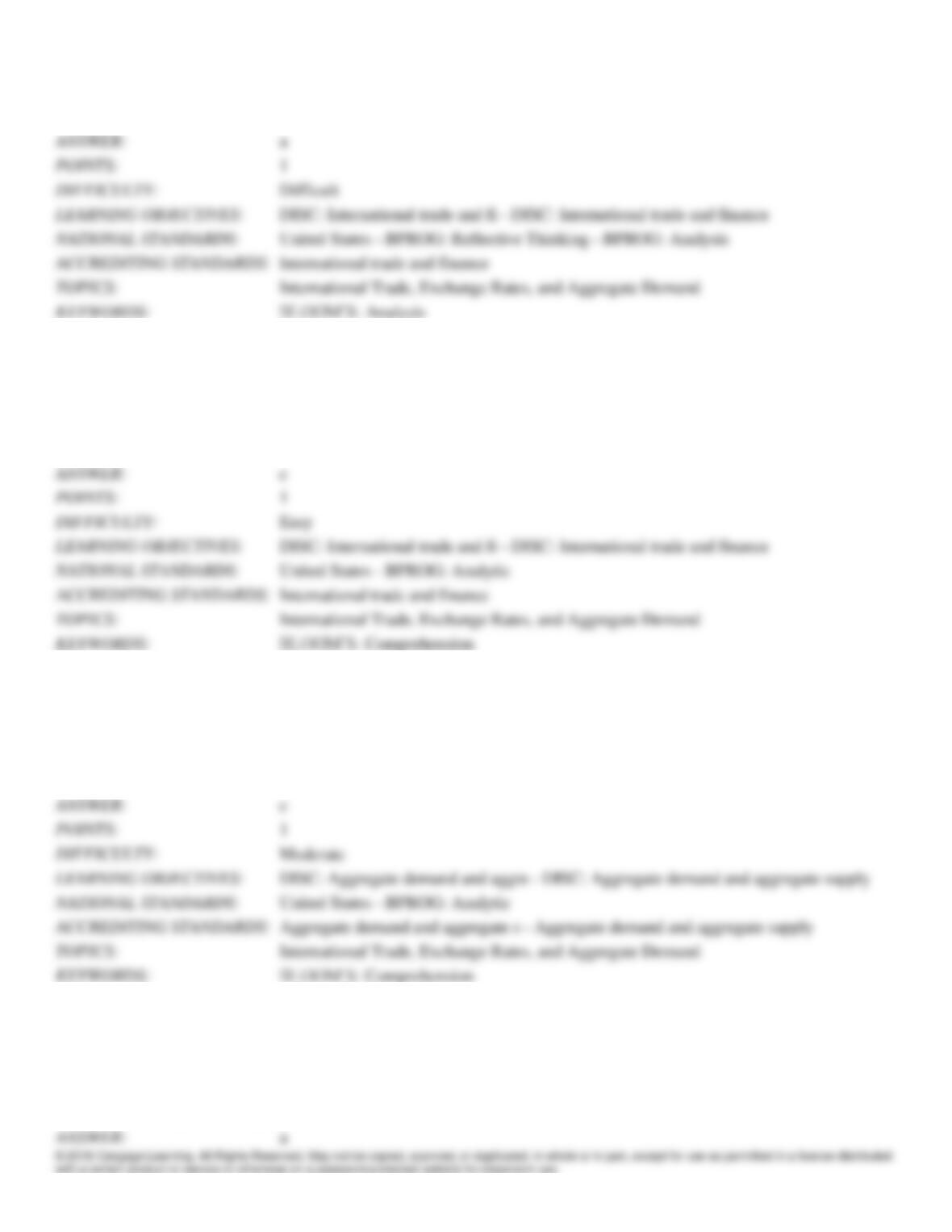
52. Which of the graphs in Figure 20-1 best illustrates the behavior of exports and imports in relation to U.S. real GDP?
a.
1
b.
2
c.
3
d.
4
1
DISC: International trade and fi – DISC: International trade and finance
United States – BPROG: Reflective Thinking – BPROG: Analysis
International trade and finance
International Trade, Exchange Rates, and Aggregate Demand
53. Which of the following is correct?
a.
IM + X = G − T
b.
I + G + T = S + X − M
c.
I + G + X = S + T + IM
d.
I + T + G = S − X − IM
1
DISC: International trade and fi – DISC: International trade and finance
United States – BPROG: Analytic
International trade and finance
International Trade, Exchange Rates, and Aggregate Demand
54. An increase in the value of the U.S. dollar relative to the Japanese yen will
a.
increase aggregate demand in the United States.
b.
decrease aggregate supply in the United States.
c.
increase aggregate demand in Japan.
d.
increase aggregate supply in Japan.
1
DISC: Aggregate demand and aggre – DISC: Aggregate demand and aggregate supply
United States – BPROG: Analytic
Aggregate demand and aggregate s – Aggregate demand and aggregate supply
International Trade, Exchange Rates, and Aggregate Demand
55. An appreciation of the Japanese yen relative to the U.S. dollar will
a.
increase aggregate demand in the United States.
b.
increase aggregate supply in the United States.
c.
increase aggregate demand in Japan.
d.
decrease aggregate supply in Japan.
DISC: Aggregate demand and aggre – DISC: Aggregate demand and aggregate supply
United States – BPROG: Analytic
Aggregate demand and aggregate s – Aggregate demand and aggregate supply
International Trade, Exchange Rates, and Aggregate Demand
56. If a currency depreciates, a country’s net exports
a.
fall and AD increases.
b.
rise and AD increases.
c.
fall and AD decreases.
d.
rise and AD decreases.
DISC: International trade and fi – DISC: International trade and finance
United States – BPROG: Analytic
International trade and finance
International Trade, Exchange Rates, and Aggregate Demand
57. If a currency appreciates, a country’s net exports
a.
fall and AD increases.
b.
rise and AD increases.
c.
fall and AD decreases.
d.
rise and AD decreases.
DISC: International trade and fi – DISC: International trade and finance
United States – BPROG: Analytic
International trade and finance
International Trade, Exchange Rates, and Aggregate Demand
58. A sizable appreciation of the U.S. dollar in the mid-1980s
a.
raised U.S. exports and imports.
b.
raised U.S. exports and reduced imports.
c.
reduced U.S. exports and imports.
d.
reduced U.S. exports and raised imports.
DISC: International trade and fi – DISC: International trade and finance
United States – BPROG: Analytic
International trade and finance
International Trade, Exchange Rates, and Aggregate Demand
59. If Asian economies suffer a serious economic slump, U.S. net exports will
a.
increase and AD will shift outward.
b.
increase and AD will shift inward.
c.
decrease and AD will shift inward.
d.
decrease and AD will shift outward.
DISC: International trade and fi – DISC: International trade and finance
United States – BPROG: Analytic
International trade and finance
International Trade, Exchange Rates, and Aggregate Demand
60. If European economies experience a strong economic recovery, U.S. net exports will
a.
increase and AD will shift outward.
b.
increase and AD will shift inward.
c.
decrease and AD will shift inward.
d.
decrease and AD will shift outward.
DISC: International trade and fi – DISC: International trade and finance
United States – BPROG: Analytic
International trade and finance
International Trade, Exchange Rates, and Aggregate Demand
61. Assume that Country X and Country Y are trading partners and the exchange rates are fixed. If prices in Country Y
rise, all of the following are expected to happen except
a.
Country X will export more.
b.
Country Y will import more.
c.
Net exports will rise for Country X.
d.
Trade will boost Country Y GDP.
DISC: International trade and fi – DISC: International trade and finance
United States – BPROG: Analytic
International trade and finance
International Trade, Exchange Rates, and Aggregate Demand
62. Assume that Country X and Country Y are trading partners and the exchange rates are fixed. If prices in Country Y
fall, which of the following is expected to happen?
a.
Country X will export more.
b.
Economy of Country X will be depressed.
c.
Net exports will rise for Country X.
d.
Country Y will import more.
DISC: International trade and fi – DISC: International trade and finance
United States – BPROG: Analytic
International trade and finance
International Trade, Exchange Rates, and Aggregate Demand
63. One of the results of the strong economic growth in the United States relative to the rest of the world is a
a.
U.S. trade surplus.
b.
U.S. trade deficit.
c.
growing U.S. net exports.
d.
trade deficit for U.S. trading partners.
DISC: International trade and fi – DISC: International trade and finance
United States – BPROG: Analytic
International trade and finance
International Trade, Exchange Rates, and Aggregate Demand
64. An increase in the price level in the economies of U.S. trading partners will cause the aggregate expenditures function
in the United States to
a.
shift up.
b.
shift down.
c.
get flatter.
d.
get steeper.
DISC: International trade and fi – DISC: International trade and finance
United States – BPROG: Analytic
International trade and finance
International Trade, Exchange Rates, and Aggregate Demand
65. An increase in the U.S. price level relative to the price level of U.S. trading partners will cause the aggregate
expenditures function in the United States to
a.
shift up.
b.
shift down.
c.
get flatter.
d.
get steeper.
DISC: International trade and fi – DISC: International trade and finance
United States – BPROG: Analytic
International trade and finance
International Trade, Exchange Rates, and Aggregate Demand
66. If European economies experience a period of sustained recession and the United States does not, what will happen in
the United States?
a.
an increase in aggregate supply
b.
a decrease in aggregate supply
c.
a decrease in aggregate demand
d.
an increase in aggregate demand
DISC: Aggregate demand and aggre – DISC: Aggregate demand and aggregate supply
United States – BPROG: Analytic
Aggregate demand and aggregate s – Aggregate demand and aggregate supply
International Trade, Exchange Rates, and Aggregate Demand
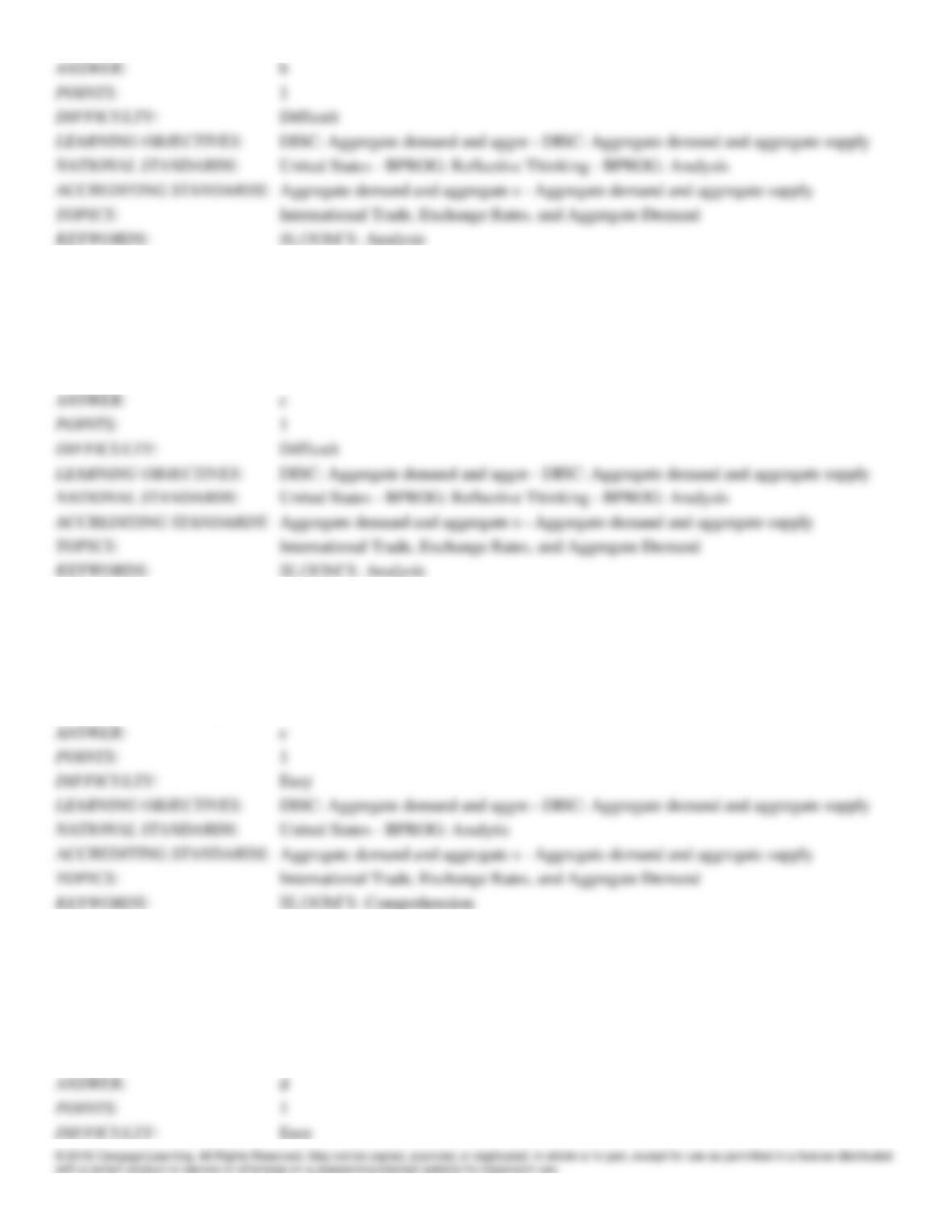
Figure 20-2
67. Which of the following explains the movements in Figure 20–2?
a.
an increase in the U.S. price level
b.
a decrease in the U.S. price level
c.
an appreciation of the U.S. dollar
d.
an expansionary monetary policy
DISC: Aggregate demand and aggre – DISC: Aggregate demand and aggregate supply
United States – BPROG: Reflective Thinking – BPROG: Analysis
Aggregate demand and aggregate s – Aggregate demand and aggregate supply
International Trade, Exchange Rates, and Aggregate Demand
68. Which of the following explains the movements in Figure 20–2?
a.
an increase in U.S. imports
b.
a decrease in U.S. exports
c.
an increase in U.S. exports
d.
a decrease in U.S. net exports
DISC: Aggregate demand and aggre – DISC: Aggregate demand and aggregate supply
United States – BPROG: Reflective Thinking – BPROG: Analysis
Aggregate demand and aggregate s – Aggregate demand and aggregate supply
International Trade, Exchange Rates, and Aggregate Demand
69. If Japan experiences a period of deflation and the United States does not, what will happen in the United States?
a.
an increase in aggregate supply
b.
a decrease in aggregate supply
c.
a decrease in aggregate demand
d.
an increase in aggregate demand
DISC: Aggregate demand and aggre – DISC: Aggregate demand and aggregate supply
United States – BPROG: Analytic
Aggregate demand and aggregate s – Aggregate demand and aggregate supply
International Trade, Exchange Rates, and Aggregate Demand
70. If Mexico experiences a period of stable prices while the United States experiences rapid inflation, what will happen
in Mexico?
a.
an increase in aggregate supply
b.
a decrease in aggregate supply
c.
a decrease in aggregate demand
d.
an increase in aggregate demand