d.
euro would be in equilibrium.
DISC: Supply and demand
United States – BPROG: Analytic
Supply and demand
Exchange Rate Determination in a Free Market
72. If the quantity of euro demanded were greater than the quantity supplied, then the price of the
a.
euro would rise.
b.
euro would fall.
c.
dollar would rise.
d.
euro would be in equilibrium.
DISC: Supply and demand
United States – BPROG: Analytic
Supply and demand
Exchange Rate Determination in a Free Market
73. Why does anyone demand foreign currency?
a.
international trade in goods and services
b.
international trade in financial assets
c.
purchases of physical assets overseas
d.
All of the above are correct.
DISC: International trade and fi – DISC: International trade and finance
United States – BPROG: Analytic
International trade and finance
Exchange Rate Determination in a Free Market
74. The demand for euros would come from
a.
American exports to Europe.
b.
European demand for U.S. government bonds.
c.
American demand for European real estate.
d.
All of the above are correct.
DISC: International trade and fi – DISC: International trade and finance
United States – BPROG: Analytic
International trade and finance
Exchange Rate Determination in a Free Market
75. The supply of euros would come from
a.
American demand for European real estate.
b.
European demand for U.S. government bonds.
c.
Americans vacationing in Barcelona, Spain.
d.
French supplies of wine to U.S. importers.
DISC: International trade and fi – DISC: International trade and finance
United States – BPROG: Analytic
International trade and finance
Exchange Rate Determination in a Free Market
76. Can the U.S. dollar and the European euro both appreciate relative to each other?
a.
Yes, both countries can gain in this manner.
b.
Yes, provided the central banks permit it.
c.
No, unless there is a system of fixed exchange rates.
d.
No, if one currency appreciates, the other must depreciate.
DISC: International trade and fi – DISC: International trade and finance
United States – BPROG: Analytic
International trade and finance
Exchange Rate Determination in a Free Market
77. Americans needing foreign currencies get those currencies from a bank. The ultimate source of these currencies is
a.
U.S. investments abroad.
b.
U.S. exports to foreign countries.
c.
U.S. imports of foreign goods and services.
d.
the International Monetary Fund.
DISC: International trade and fi – DISC: International trade and finance
United States – BPROG: Analytic
International trade and finance
Exchange Rate Determination in a Free Market
78. Which of the following companies would gain from foreign currency depreciation?
a.
companies which borrow in foreign currency.
b.
companies which export goods and services.
c.
companies which invest in the foreign equity markets.
d.
companies which buy bonds issued by the foreign government.
DISC: International trade and fi – DISC: International trade and finance
United States – BPROG: Analytic
International trade and finance
Exchange Rate Determination in a Free Market
79. Who among the following is most likely to favor an appreciation of the U.S. dollar?
a.
a German professor visiting Chicago
b.
an American farmer who depends on exports
c.
an American professor on a tour of Austrian universities
d.
Disney World in Orlando, Florida, a popular destination for foreign tourists
DISC: International trade and fi – DISC: International trade and finance
United States – BPROG: Analytic
International trade and finance
Exchange Rate Determination in a Free Market
80. If the dollar appreciates relative to other currencies, which of the following is true?
a.
It takes more foreign currency to buy a dollar.
b.
It takes more dollars to buy a foreign currency.
c.
U.S. exports will increase.
d.
Foreign purchases of U.S. goods will increase.
DISC: International trade and fi – DISC: International trade and finance
United States – BPROG: Analytic
International trade and finance
Exchange Rate Determination in a Free Market
81. If the dollar depreciates relative to other currencies, which of the following is true?
a.
It takes more foreign currency to buy a dollar.
b.
It takes more dollars to buy a foreign currency.
c.
U.S. exports will decrease.
d.
Foreign purchases of U.S. goods will decrease.
DISC: International trade and fi – DISC: International trade and finance
United States – BPROG: Analytic
International trade and finance
Exchange Rate Determination in a Free Market
82. An economic boom in America should increase the
a.
demand for U.S. dollars.
b.
demand for U.S. goods and services.
c.
demand for foreign currencies.
d.
supply of foreign currencies.
DISC: Markets, market failure, a – DISC: Markets, market failure, and externalities
United States – BPROG: Analytic
Markets, market failure, and ext – Markets, market failure, and externalities
Exchange Rate Determination in a Free Market
83. A prolonged recession in Europe should decrease the
a.
supply of U.S. dollars.
b.
demand for U.S. dollars.
c.
supply of U.S. goods and services.
d.
demand by Americans for euros.
DISC: Markets, market failure, a – DISC: Markets, market failure, and externalities
United States – BPROG: Analytic
Markets, market failure, and ext – Markets, market failure, and externalities
Exchange Rate Determination in a Free Market
84. Which of the following would cause a decrease in the demand for U.S. dollars?
a.
an economic boom in the United States
b.
an economic boom in Europe
c.
increased vacations in the United States by Europeans
d.
a recession in Europe
DISC: Markets, market failure, a – DISC: Markets, market failure, and externalities
United States – BPROG: Analytic
Markets, market failure, and ext – Markets, market failure, and externalities
Exchange Rate Determination in a Free Market
85. Which of the following would cause an increase in the demand for U.S. dollars?
a.
an interest rate cut in the United States
b.
an interest rate cut in Europe
c.
an interest rate increase in Europe
d.
a recession in Europe
DISC: Markets, market failure, a – DISC: Markets, market failure, and externalities
United States – BPROG: Analytic
Markets, market failure, and ext – Markets, market failure, and externalities
Exchange Rate Determination in a Free Market
86. If exchange rates are determined in a floating rate system, what determines the value of a U.S. dollar in terms of
euros?
a.
government exchange rate policies
b.
IMF rules and policies
c.
demand and supply
d.
central bank interventions
DISC: Supply and demand
United States – BPROG: Analytic
Supply and demand
Exchange Rate Determination in a Free Market
87. If the U.S. exports passenger jet aircraft, what is the effect in the foreign exchange market?
a.
It will increase demand for U.S. dollars.
b.
It will decrease demand for U.S. dollars.
c.
It will increase supply of U.S. dollars.
d.
It will decrease supply of U.S. dollars.
DISC: Markets, market failure, a – DISC: Markets, market failure, and externalities
88. If Japanese tourists visit Yellowstone Park, what is the effect in the foreign exchange market?
a.
It will increase demand for U.S. dollars.
b.
It will decrease demand for U.S. dollars.
c.
It will increase supply of U.S. dollars.
d.
It will decrease supply of U.S. dollars.
89. If Japanese tourists visit Yellowstone Park, what is the effect in the foreign exchange market?
a.
It will increase demand for Japanese yen.
b.
It will decrease demand for Japanese yen.
c.
It will increase supply of Japanese yen.
d.
It will decrease supply of Japanese yen.
90. If a Mexican pension fund decides to purchase U.S. government bonds, what is the effect in the foreign exchange
market?
a.
It will increase demand for U.S. dollars.
b.
It will decrease demand for U.S. dollars.
c.
It will increase supply of U.S. dollars.
d.
It will decrease supply of U.S. dollars.
91. If the U.S. purchases oil from Venezuela, what is the effect in the foreign exchange market?
a.
It will increase demand for U.S. dollars.
b.
It will decrease demand for U.S. dollars.
c.
It will increase supply of U.S. dollars.
d.
It will decrease supply of U.S. dollars.
92. If Americans decide to buy more South African diamonds, what is the effect in the foreign market?
a.
It will increase demand for U.S. dollars.
b.
It will decrease demand for U.S. dollars.
c.
It will increase supply of U.S. dollars.
d.
It will decrease supply of U.S. dollars.
93. The purchasing power parity theory of exchange rate determination states that
a.
in the short run, rates will adjust to parity.
b.
in the long run, the rate reflects differences in price levels between the two countries.
c.
in the long run, a government agency sets the rate at parity.
d.
in the short run, the cost of labor really sets the exchange rate.
94. Prices of European goods are rising faster than prices of similar goods in the United States. Consequently Europeans
substitute American goods for European goods and the euro depreciates. This phenomenon is the basis of
a.
Ricardo’s Law.
b.
comparative advantage.
c.
absolute advantage.
d.
purchasing power parity.
Moderate
DISC: Markets, market failure, a – DISC: Markets, market failure, and externalities
United States – BPROG: Analytic
Markets, market failure, and ext – Markets, market failure, and externalities
Exchange Rate Determination in a Free Market
95. Everything else being equal, one can expect the euro to appreciate relative to the dollar if
a.
Americans decrease their travel to Germany.
b.
the Germans add to their holdings of U.S. Treasury bills.
c.
Americans purchase land in Germany and build factories.
d.
American exports to Germany increase.
c
Moderate
DISC: Markets, market failure, a – DISC: Markets, market failure, and externalities
United States – BPROG: Analytic
Markets, market failure, and ext – Markets, market failure, and externalities
96. In the long run, the chief determinant of exchange rate changes is a change in
a.
interest rates.
b.
real GDP.
c.
the price of gold.
d.
price levels.
Easy
DISC: Markets, market failure, a – DISC: Markets, market failure, and externalities
United States – BPROG: Analytic
Markets, market failure, and ext – Markets, market failure, and externalities
Exchange Rate Determination in a Free Market
97. It presently costs 50 Canadian dollars for a lift ticket at Whistler Ski Resort in British Columbia. If the current value of
the Canadian dollar is 0.68 U.S. dollars, how many U.S. dollars does it cost to ski at Whistler?
a.
$16.00
b.
$34.00
c.
$73.50
d.
$156.25
Difficult
DISC: International trade and fi – DISC: International trade and finance
United States – BPROG: Analytic
International trade and finance
Exchange Rate Determination in a Free Market
98. The exchange rate between yen and dollars at one point in 2010 was 83 yen per dollar. If a Big Mac, fries, and a Coke
cost $3.91 in San Francisco, how much should the same order cost in yen in Osaka?
a.
0.03
b.
325
c.
392
d.
422
Difficult
DISC: International trade and fi – DISC: International trade and finance
United States – BPROG: Analytic
International trade and finance
Exchange Rate Determination in a Free Market
BLOOMS: Application
99. If the exchange rate of the Swiss franc is 1.61 francs per dollar, then the Swiss franc is worth about
a.
15 cents.
b.
57 cents
c.
62 cents.
d.
$15.70.
c
Difficult
DISC: International trade and fi – DISC: International trade and finance
United States – BPROG: Analytic
International trade and finance
Exchange Rate Determination in a Free Market
BLOOMS: Application
100. According to the purchasing power parity theory, which of the following is most likely to affect exchange rates?
a.
differences in inflation rates
b.
differences in interest rates
c.
differences in income levels
d.
differences in real GDP growth rates
a
DISC: Markets, market failure, a – DISC: Markets, market failure, and externalities
United States – BPROG: Analytic
Markets, market failure, and ext – Markets, market failure, and externalities
Exchange Rate Determination in a Free Market
101. If nations erect tariffs and quotas to restrict trade, what is likely to happen to predicted values of currencies drawn
from the purchasing power parity theory?
a.
They will be understated for tariffs and overstated for quotas.
b.
They will be overstated for tariffs and understated for quotas.
c.
They will be the correct values.
d.
They will be incorrect.
DISC: International trade and fi – DISC: International trade and finance
United States – BPROG: Analytic
International trade and finance
Exchange Rate Determination in a Free Market
102. The purchasing power parity theory of exchange rate determination maintains that
a.
the exchange rate between two nations’ currencies is determined by the percent of gold that backs each nation’s
currency.
b.
the exchange rate between two nations’ currencies adjusts to reflect differences in the price levels in the two
nations.
c.
in the short run, exchange rates are determined by central bank intervention in the currency markets.
d.
the exchange rate between two currencies is determined by the debt that each nation owes to the World Bank.
DISC: International trade and fi – DISC: International trade and finance
United States – BPROG: Analytic
International trade and finance
Exchange Rate Determination in a Free Market
American Coal
British Coal
Cost per Ton
Cost per Ton
$150
£75
103. From Table 19–1, what is the exchange rate between the dollar and the pound?
a.
One dollar is worth two pounds.
b.
One pound is worth two dollars.
c.
One pound is worth one dollar.
d.
One pound is worth 50 cents.
DISC: International trade and fi – DISC: International trade and finance
United States – BPROG: Analytic
International trade and finance
Exchange Rate Determination in a Free Market
BLOOMS: Application
104. Assume that the information in Table 19-1 applies to the cost per ton of coal in 1998. Assume that also over a 10–
year period prices rise 100 percent in Great Britain and 200 percent in the United States. According to the purchasing
power parity theory, the exchange rate between the dollar and the pound in the year 2008 will be
a.
one dollar = two pounds.
b.
one pound = two dollars.
c.
one pound = three dollars.
d.
one dollar = three pounds.
DISC: International trade and fi – DISC: International trade and finance
United States – BPROG: Analytic
International trade and finance
Exchange Rate Determination in a Free Market
BLOOMS: Application
105. Assuming free trade between countries, exchange rates will change so that goods cost the same in all countries. This
concept is known as the
a.
long-run equilibrium theory.
b.
exchange rate equalization theory.
c.
interest rate parity theory.
d.
purchasing power parity theory.
DISC: International trade and fi – DISC: International trade and finance
United States – BPROG: Analytic
International trade and finance
Exchange Rate Determination in a Free Market
106. If Wisconsin cheddar cheese sells for $3.00 per pound in the United States and for 27.90 pesos in Mexico, what is the
exchange rate between the dollar and the peso (assuming PPP holds)?
a.
$1 = 2.79 pesos
b.
$1 = 7.90 pesos
c.
$1 = 9.30 pesos
d.
$1 = 27.90 pesos
c
Moderate
DISC: International trade and fi – DISC: International trade and finance
United States – BPROG: Analytic
International trade and finance
Exchange Rate Determination in a Free Market
BLOOMS: Application
107. The purchasing power parity theory is useful in making ____ predictions about exchange rates and their fluctuations.
a.
long-run
b.
intermediate-run
c.
medium-run
d.
short-run
a
Easy
DISC: International trade and fi – DISC: International trade and finance
United States – BPROG: Analytic
International trade and finance
Exchange Rate Determination in a Free Market
108. If inflation in the United States is higher than in Japan, what will happen to the exchange rate between the U.S. dollar
and the Japanese yen?
a.
The dollar and yen will both depreciate.
b.
The dollar and yen will both appreciate.
c.
The dollar will depreciate and the yen will appreciate.
d.
The dollar will appreciate and the yen will depreciate.
c
Easy
DISC: Markets, market failure, a – DISC: Markets, market failure, and externalities
United States – BPROG: Analytic
Markets, market failure, and ext – Markets, market failure, and externalities
Exchange Rate Determination in a Free Market
109. One major reason why the purchasing power parity theory does not always predict exchange rates accurately is that
the theory focuses on trade in
a.
monies.
b.
goods and services.
c.
stocks and bonds.
d.
physical assets.
DISC: International trade and fi – DISC: International trade and finance
United States – BPROG: Analytic
International trade and finance
Exchange Rate Determination in a Free Market
110. The idea behind the “Big Mac index” is a test of
a.
interest rate parity theory.
b.
long-run equilibrium theory.
c.
purchasing power parity theory.
d.
exchange rate equalization theory.
DISC: International trade and fi – DISC: International trade and finance
United States – BPROG: Analytic
International trade and finance
Exchange Rate Determination in a Free Market
111. Exchange rates in what is termed the “medium run”
a.
will be altered by an economic upswing because consumers buy more goods including imports when
disposable income goes up.
b.
will be unaffected by economic changes in personal income or consumption spending.
c.
will appreciate for a country having an economic boom when others are not.
d.
All of the above are correct.
DISC: International trade and fi – DISC: International trade and finance
United States – BPROG: Analytic
International trade and finance
Exchange Rate Determination in a Free Market
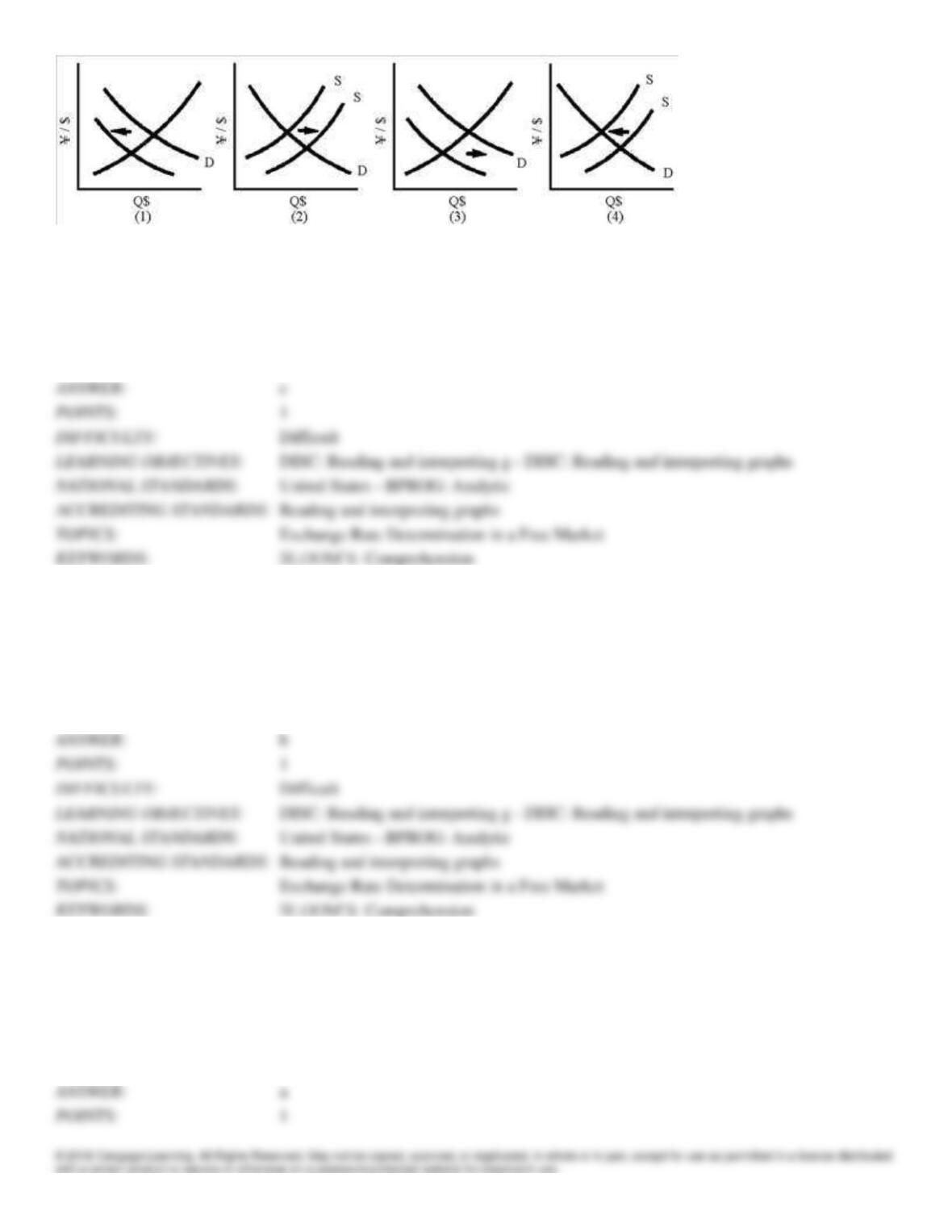
112. Of the graphs in Figure 19–1, which one shows that an expansion of the Japanese economy leads to a depreciation of
the yen?
a.
1
b.
2
c.
3
d.
4
1
113. Of the graphs in Figure 19–1, which one shows the effects of an economic boom in the United States and a
depreciation of the dollar?
a.
1
b.
2
c.
3
d.
4
b
1
114. Of the graphs in Figure 19–1, which one shows the effects of an increase in interest rates in Japan and a depreciation
of the dollar?
a.
1
b.
2
c.
3
d.
4
1
DISC: Reading and interpreting g – DISC: Reading and interpreting graphs
United States – BPROG: Analytic
Reading and interpreting graphs
Exchange Rate Determination in a Free Market
115. The prospect of a recession in the United States would probably cause the dollar to
a.
depreciate because interest rates would be expected to rise.
b.
depreciate because imports would be expected to rise.
c.
appreciate because imports would be expected to fall.
d.
appreciate because interest rates would be expected to decrease.
DISC: Markets, market failure, a – DISC: Markets, market failure, and externalities
United States – BPROG: Analytic
Markets, market failure, and ext – Markets, market failure, and externalities
Exchange Rate Determination in a Free Market
116. If the United States experiences an economic boom, compared to other countries, how will this affect the value of the
U.S. dollar?
a.
It will fall because other nations would be forced to raise their interest rates.
b.
It will fall because the United States will import more goods and services, leading to an increased supply of
dollars.
c.
It will rise because U.S. GDP would be rising faster than other countries.
d.
It will rise because the Fed will have to lower U.S. interest rates.
DISC: Markets, market failure, a – DISC: Markets, market failure, and externalities
United States – BPROG: Analytic
Markets, market failure, and ext – Markets, market failure, and externalities
Exchange Rate Determination in a Free Market
117. A recession in the United States will tend to cause recessions in other countries because as U.S. GDP falls, U.S.
a.
tariffs will automatically rise.
b.
exports will rise.
c.
imports will fall.
d.
exports will fall.
DISC: Markets, market failure, a – DISC: Markets, market failure, and externalities
United States – BPROG: Analytic
Markets, market failure, and ext – Markets, market failure, and externalities
Exchange Rate Determination in a Free Market
118. An economic boom in the United States will tend to cause booms in other countries because as U.S. GDP rises, U.S.
a.
tariffs will automatically fall.
b.
exports will rise.
c.
imports will rise.
d.
exports will fall.
c
Moderate
DISC: Markets, market failure, a – DISC: Markets, market failure, and externalities
United States – BPROG: Analytic
Markets, market failure, and ext – Markets, market failure, and externalities
Exchange Rate Determination in a Free Market
119. If a country is in a strong upward phase of the business cycle, one can expect that its currency will
a.
revalue.
b.
devalue.
c.
appreciate.
d.
depreciate.
Moderate
DISC: Markets, market failure, a – DISC: Markets, market failure, and externalities
United States – BPROG: Analytic
Markets, market failure, and ext – Markets, market failure, and externalities
Exchange Rate Determination in a Free Market
120. If a country is in a major recessionary phase of the business cycle, one can expect that its currency will
a.
revalue.
b.
devalue.
c.
appreciate.
d.
depreciate.
c
Moderate
DISC: Markets, market failure, a – DISC: Markets, market failure, and externalities
United States – BPROG: Analytic
Markets, market failure, and ext – Markets, market failure, and externalities
121. If U.S. securities pay 6 percent interest, and if Great Britain’s securities pay 8 percent interest, then
a.
pounds depreciate relative to dollars.
b.
pounds appreciate relative to dollars.
c.
Great Britain’s imports will fall.
d.
Great Britain’s exports will rise.
DISC: Markets, market failure, a – DISC: Markets, market failure, and externalities
United States – BPROG: Analytic
Markets, market failure, and ext – Markets, market failure, and externalities
Exchange Rate Determination in a Free Market
122. If U.S. securities pay 7 percent interest, and if Great Britain’s securities pay 5 percent interest, then
a.
pounds depreciate relative to dollars.
b.
pounds appreciate relative to dollars.
c.
Great Britain’s imports will rise.
d.
Great Britain’s exports will fall.
DISC: Markets, market failure, a – DISC: Markets, market failure, and externalities
United States – BPROG: Analytic
Markets, market failure, and ext – Markets, market failure, and externalities
Exchange Rate Determination in a Free Market
123. The chief cause of short-run changes in exchange rates is
a.
the world’s political situation.
b.
“hot money” chasing high interest rates.
c.
changes in consumer tastes.
d.
central bank interventions.
DISC: International trade and fi – DISC: International trade and finance
United States – BPROG: Analytic
International trade and finance
Exchange Rate Determination in a Free Market
124. A federal deficit that raises interest rates will, everything else being equal,
a.
lead to a dollar depreciation.
b.
decrease imports.
c.
reduce exports.
d.
reduce the balance of trade deficit.
DISC: International trade and fi – DISC: International trade and finance
United States – BPROG: Analytic
International trade and finance
Exchange Rate Determination in a Free Market
125. In 2008-2009, Iceland and several Baltic states increased their interest rates. One would expect which of the
following?
a.
U.S. bond prices will fall and the dollar will appreciate.
b.
U.S. bond prices will rise and the dollar will appreciate.
c.
U.S. bond prices will fall and the dollar will depreciate.
d.
U.S. bond prices will rise and the dollar will depreciate.
DISC: Markets, market failure, a – DISC: Markets, market failure, and externalities
United States – BPROG: Analytic
Markets, market failure, and ext – Markets, market failure, and externalities
Exchange Rate Determination in a Free Market
126. If gold and the dollar are substitutes, a cut in the Japanese discount rate can be expected to
a.
appreciate the dollar and decrease the price of gold.
b.
depreciate the dollar and increase the price of gold.
c.
depreciate the dollar and decrease the price of gold.
d.
appreciate the dollar and increase the price of gold.
DISC: Markets, market failure, a – DISC: Markets, market failure, and externalities
United States – BPROG: Analytic
Markets, market failure, and ext – Markets, market failure, and externalities
Exchange Rate Determination in a Free Market
127. The U.S. Secretary of the Treasury met with the Japanese Finance Minister to discuss possible cuts in the Japanese
discount rate. The likely outcome of currency speculation in response to this news is that
a.
the dollar will depreciate.
b.
the dollar will appreciate.
c.
the yen will appreciate.
d.
both the dollar and yen will appreciate.
DISC: Markets, market failure, a – DISC: Markets, market failure, and externalities
United States – BPROG: Analytic
Markets, market failure, and ext – Markets, market failure, and externalities
Exchange Rate Determination in a Free Market
128. If interest rates in the United States are higher than interest rates in Europe, what is most likely to happen?
a.
Supply of dollars will increase, causing appreciation of the dollar.
b.
Supply of euros will increase, causing appreciation of the euro.
c.
Demand for dollars will increase causing appreciation of the dollar.
d.
Demand for dollars will decrease, causing depreciation of the dollar.
DISC: Markets, market failure, a – DISC: Markets, market failure, and externalities
United States – BPROG: Analytic
Markets, market failure, and ext – Markets, market failure, and externalities
Exchange Rate Determination in a Free Market
129. Many experts believe that the major determinant of exchange rates in the short run is relative
a.
price levels.
b.
income levels.
c.
money supplies.
d.
interest rates.
DISC: Markets, market failure, a – DISC: Markets, market failure, and externalities
United States – BPROG: Analytic
Markets, market failure, and ext – Markets, market failure, and externalities
Exchange Rate Determination in a Free Market
130. The most important single factor in determining the exchange rate in the short run is
a.
inflation differentials.
b.
interest rate differentials.
c.
monetary growth differentials.
d.
price differentials.
DISC: Markets, market failure, a – DISC: Markets, market failure, and externalities
United States – BPROG: Analytic
Markets, market failure, and ext – Markets, market failure, and externalities
Exchange Rate Determination in a Free Market
131. Which of the following statements is correct?
a.
In the short run, interest rate differentials have the greatest impact on exchange rates.
b.
In the medium run, differences in growth rates of aggregate demand have the greatest impact on exchange
rates.
c.
In the long run, price and inflation differentials have the greatest impact on exchange rates.
d.
All of the above are correct.
Easy
DISC: International trade and fi – DISC: International trade and finance
United States – BPROG: Analytic
International trade and finance
Exchange Rate Determination in a Free Market
132. When exchange rates are set by government decree,
a.
appreciation is called devaluation.
b.
depreciation is called devaluation.
c.
depreciation is called deflation.
d.
appreciation is called inflation.
Easy
DISC: Markets, market failure, a – DISC: Markets, market failure, and externalities
United States – BPROG: Analytic
Markets, market failure, and ext – Markets, market failure, and externalities
When Governments Fix Exchange Rate: The Balance Of Payments
133. The exchange rate of Country X is set by government decisions and maintained by government actions. Country X
follows a
a.
floating exchange rate policy.
b.
free market exchange rate policy.
c.
pegged exchange rate policy.
d.
fixed exchange rate policy.
Easy
DISC: Markets, market failure, a – DISC: Markets, market failure, and externalities
United States – BPROG: Analytic
Markets, market failure, and ext – Markets, market failure, and externalities