When Governments Fix Exchange Rate: The Balance Of Payments
134. A balance of payments deficit is defined as the amount by which
a.
a country’s exports exceed its imports.
b.
a currency must appreciate in order to reach equilibrium.
c.
quantity supplied of a country’s currency exceeds quantity demanded.
d.
quantity demanded of a country’s currency exceeds quantity supplied.
c
Moderate
DISC: International trade and fi – DISC: International trade and finance
United States – BPROG: Analytic
International trade and finance
When Governments Fix Exchange Rate: The Balance Of Payments
135. In the winter of 2001-2002, Argentina’s overvalued currency reflected a(n)
a.
balance of payments surplus.
b.
balance of payments deficit.
c.
surplus of exports over imports.
d.
excess demand for Thai currency.
Moderate
DISC: International trade and fi – DISC: International trade and finance
United States – BPROG: Analytic
International trade and finance
When Governments Fix Exchange Rate: The Balance Of Payments
136. What happened to the peso when the Argentine government succumbed to the market forces in 2002?
a.
Revalued
b.
Devalued
c.
Depreciated
d.
Appreciated
c
Moderate
DISC: International trade and fi – DISC: International trade and finance
United States – BPROG: Analytic
International trade and finance
When Governments Fix Exchange Rate: The Balance Of Payments
137. When a country decreases the official value of its currency, for example, Russia changes the value of the ruble from
$.16 to $.04, it is said to have ____ its currency.
a.
floated
b.
revalued
c.
devalued
d.
depreciated
c
Easy
DISC: International trade and fi – DISC: International trade and finance
United States – BPROG: Analytic
International trade and finance
When Governments Fix Exchange Rate: The Balance Of Payments
138. If a country has a balance of payments deficit and wishes to maintain the fixed value of its currency, it will generally
a.
sell its own currency for foreign currencies.
b.
buy its own currency with foreign reserves.
c.
decrease taxes to increase domestic disposable income.
d.
increase the money supply to keep interest rates down.
Easy
DISC: International trade and fi – DISC: International trade and finance
United States – BPROG: Analytic
International trade and finance
When Governments Fix Exchange Rate: The Balance Of Payments
139. Fixed exchange rates are fixed by
a.
international speculators who manipulate the world’s currencies.
b.
international demand and supply.
c.
national governments.
d.
All of the above are correct.
c
Easy
DISC: Markets, market failure, a – DISC: Markets, market failure, and externalities
United States – BPROG: Analytic
Markets, market failure, and ext – Markets, market failure, and externalities
When Governments Fix Exchange Rate: The Balance Of Payments
140. A fixed exchange rate can be maintained by a government as long as it has sufficient
a.
supplies of its own currency.
b.
foreign reserves.
c.
gold and other precious metals.
d.
tax revenues.
Moderate
DISC: Markets, market failure, a – DISC: Markets, market failure, and externalities
United States – BPROG: Analytic
Markets, market failure, and ext – Markets, market failure, and externalities
When Governments Fix Exchange Rate: The Balance Of Payments
141. A country running a balance of payments surplus in a fixed exchange rate system may have to ____ its currency.
a.
depreciate
b.
devalue
c.
revalue
d.
appreciate
c
Moderate
DISC: International trade and fi – DISC: International trade and finance
United States – BPROG: Analytic
International trade and finance
When Governments Fix Exchange Rate: The Balance Of Payments
142. Which of the following do most economists consider to be the most basic measure of a nation’s international
transactions?
a.
balance on current account
b.
balance on capital account
c.
balance of merchandise trade
d.
balance on long-term capital
a
Easy
DISC: International trade and fi – DISC: International trade and finance
United States – BPROG: Analytic
International trade and finance
When Governments Fix Exchange Rate: The Balance Of Payments
143. An area in which the United States has had a sizable surplus in its balance of payments is sales of ____ to foreigners.
a.
goods
b.
energy
c.
assets
d.
automobiles
c
DISC: International trade and fi – DISC: International trade and finance
United States – BPROG: Analytic
International trade and finance
When Governments Fix Exchange Rate: The Balance Of Payments
144. Because the United States has had substantial deficits in goods and services, it has also necessarily had surpluses in
a.
the federal budget.
b.
the sales of assets.
c.
the sales of military goods.
d.
its gold supplies.
DISC: International trade and fi – DISC: International trade and finance
United States – BPROG: Analytic
International trade and finance
When Governments Fix Exchange Rate: The Balance Of Payments
145. Under a gold standard,
a.
with a balance of payments deficit, interest rates would fall and attract foreign capital.
b.
a deficit in the balance of payments increased a nation’s money supply automatically.
c.
all currencies were defined in terms of gold.
d.
when a nation had a deficit in its balance of payments, more gold was flowing in than was flowing out.
e.
All of the above are correct.
DISC: International trade and fi – DISC: International trade and finance
United States – BPROG: Analytic
International trade and finance
A Bit of History: The Gold Standard and the Bretton Woods System
146. Under the gold standard,
a.
no nation had control of its domestic monetary policy, and therefore no nation could control its aggregate
demand.
b.
the world’s commerce was at the mercy of gold discoveries.
c.
discoveries of gold meant higher prices in the long run and higher real economic activity in the short run.
d.
All of the above are correct.
DISC: International trade and fi – DISC: International trade and finance
United States – BPROG: Analytic
International trade and finance
A Bit of History: The Gold Standard and the Bretton Woods System
147. Under a gold standard, a discovery of gold will
a.
decrease the general price level.
b.
increase the general price level.
c.
cause increased unemployment.
d.
cause decreased rates of economic growth.
DISC: International trade and fi – DISC: International trade and finance
United States – BPROG: Analytic
International trade and finance
A Bit of History: The Gold Standard and the Bretton Woods System
148. Under a gold standard, a balance of payments surplus automatically
a.
raised interest rates.
b.
increased exports.
c.
increased domestic prices.
d.
decreased imports.
DISC: International trade and fi – DISC: International trade and finance
United States – BPROG: Analytic
International trade and finance
A Bit of History: The Gold Standard and the Bretton Woods System
149. Under a gold standard, a balance of payments deficit automatically
a.
raised interest rates.
b.
decreased exports.
c.
increased domestic prices.
d.
increased imports.
DISC: International trade and fi – DISC: International trade and finance
United States – BPROG: Analytic
International trade and finance
A Bit of History: The Gold Standard and the Bretton Woods System
150. Under the gold standard,
a.
each nation had discretion over its monetary policy.
b.
trade-deficit nations had less control over their money supply than trade-surplus nations.
c.
trade-surplus nations had less control over their money supply than trade-deficit nations.
d.
no nation had control over its domestic monetary policy.
DISC: International trade and fi – DISC: International trade and finance
United States – BPROG: Analytic
International trade and finance
A Bit of History: The Gold Standard and the Bretton Woods System
151. Adhering to a strict gold standard necessarily means that
a.
each nation can vary its money supply in response to domestic economic conditions.
b.
no country will experience inflation.
c.
no country will have control over its monetary policy.
d.
no country will experience deflation.
DISC: International trade and fi – DISC: International trade and finance
United States – BPROG: Analytic
International trade and finance
A Bit of History: The Gold Standard and the Bretton Woods System
152. Under the gold standard of a century ago, the world’s commerce
a.
nearly collapsed before the beginning of World War I.
b.
was at the mercy of gold discoveries.
c.
grew steadily without interruption from monetary disturbances.
d.
grew when the gold stock grew slowly, and shrank when gold discoveries increased.
DISC: International trade and fi – DISC: International trade and finance
United States – BPROG: Analytic
International trade and finance
A Bit of History: The Gold Standard and the Bretton Woods System
153. The Bretton Woods agreements
a.
established a system of fixed exchange rates based on the free convertibility of the U.S. dollar into gold.
b.
established a system of fixed exchange rates based on the gold standard.
c.
permitted countries with a balance of payments deficit to make regular devaluations of their currencies.
d.
established GATT to police and manage exchange rates.
DISC: International trade and fi – DISC: International trade and finance
United States – BPROG: Analytic
International trade and finance
A Bit of History: The Gold Standard and the Bretton Woods System
154. The Bretton Woods agreements in 1944
a.
established the International Monetary Fund.
b.
sanctioned world trade on the gold-exchange system.
c.
allowed nations to devalue their currencies under certain conditions.
d.
All of the above are correct.
DISC: International trade and fi – DISC: International trade and finance
United States – BPROG: Analytic
International trade and finance
A Bit of History: The Gold Standard and the Bretton Woods System
155. The Bretton Woods system worked fairly well for a number of years, but it finally broke down over
a.
lack of agreement on how to settle the problems of the surplus nations.
b.
its inability to devalue the U.S. dollar.
c.
the huge debts of the IMF to less-developed countries.
d.
the controversies generated by surplus nations wanting to devalue their currencies.
DISC: International trade and fi – DISC: International trade and finance
United States – BPROG: Analytic
International trade and finance
A Bit of History: The Gold Standard and the Bretton Woods System
156. Under the Bretton Woods agreements,
a.
the IMF was created to punish countries that did not maintain fixed exchange rates.
b.
a system of fixed exchange rates based on gold was established.
c.
each country agreed to buy and sell its currency to maintain a fixed exchange rate.
d.
All of the above are correct.
DISC: International trade and fi – DISC: International trade and finance
United States – BPROG: Analytic
International trade and finance
A Bit of History: The Gold Standard and the Bretton Woods System
157. Under the Bretton Woods system, a country with a balance of payments deficit
a.
could get loans from the U.S. government.
b.
could devalue if deflationary policies failed to eliminate the deficit.
c.
was not allowed to devalue under any circumstance.
d.
was required to devalue its currency immediately.
DISC: International trade and fi – DISC: International trade and finance
United States – BPROG: Analytic
International trade and finance
A Bit of History: The Gold Standard and the Bretton Woods System
158. The Bretton Woods agreements were ended when the
a.
European Common Market was formed.
b.
OPEC countries raised the price of oil.
c.
United States was forced to devalue its currency.
d.
United States recognized Red China.
DISC: International trade and fi – DISC: International trade and finance
United States – BPROG: Analytic
International trade and finance
A Bit of History: The Gold Standard and the Bretton Woods System
159. Under the Bretton Woods system of fixed exchange rates,
a.
devaluations were frequent and small.
b.
devaluations were usually unforeseen.
c.
the IMF ensured that exchange rates were never changed.
d.
speculators could profit from an attack on a weak currency.
DISC: International trade and fi – DISC: International trade and finance
United States – BPROG: Analytic
International trade and finance
A Bit of History: The Gold Standard and the Bretton Woods System
160. A country, such as Argentina in 2002, that is buying its own currency to maintain a given exchange rate
a.
has a balance of payments surplus.
b.
has an undervalued currency.
c.
has an overvalued currency.
d.
need not fear a “run” on its currency.
DISC: International trade and fi – DISC: International trade and finance
United States – BPROG: Analytic
International trade and finance
Adjustment Mechanisms under Fixed Exchange Rates
161. A deficit nation in a fixed exchange rate system can improve its balance of payments by increasing
a.
its money supply.
b.
its interest rates.
c.
its level of real GDP.
d.
aggregate demand.
DISC: International trade and fi – DISC: International trade and finance
United States – BPROG: Analytic
International trade and finance
Adjustment Mechanisms under Fixed Exchange Rates
162. Suppose that a nation has adopted a fixed exchange rate with another country, and has a persistent trade deficit. What
is most likely to happen?
a.
a gradual increase in the value of its currency
b.
a gradual decrease in the value of its currency
c.
a “run” on its currency and a sudden appreciation
d.
a “run” on its currency and a sudden devaluation
DISC: International trade and fi – DISC: International trade and finance
United States – BPROG: Analytic
International trade and finance
Adjustment Mechanisms under Fixed Exchange Rates
163. One method for a deficit country to correct the situation under a fixed exchange rate system is to
a.
increase aggregate demand with stimulative monetary policy.
b.
increase aggregate supply with tax cuts.
c.
decrease aggregate demand with restrictive fiscal and monetary policy.
d.
decrease aggregate supply with restrictive fiscal policy.
DISC: International trade and fi – DISC: International trade and finance
United States – BPROG: Analytic
International trade and finance
Adjustment Mechanisms under Fixed Exchange Rates
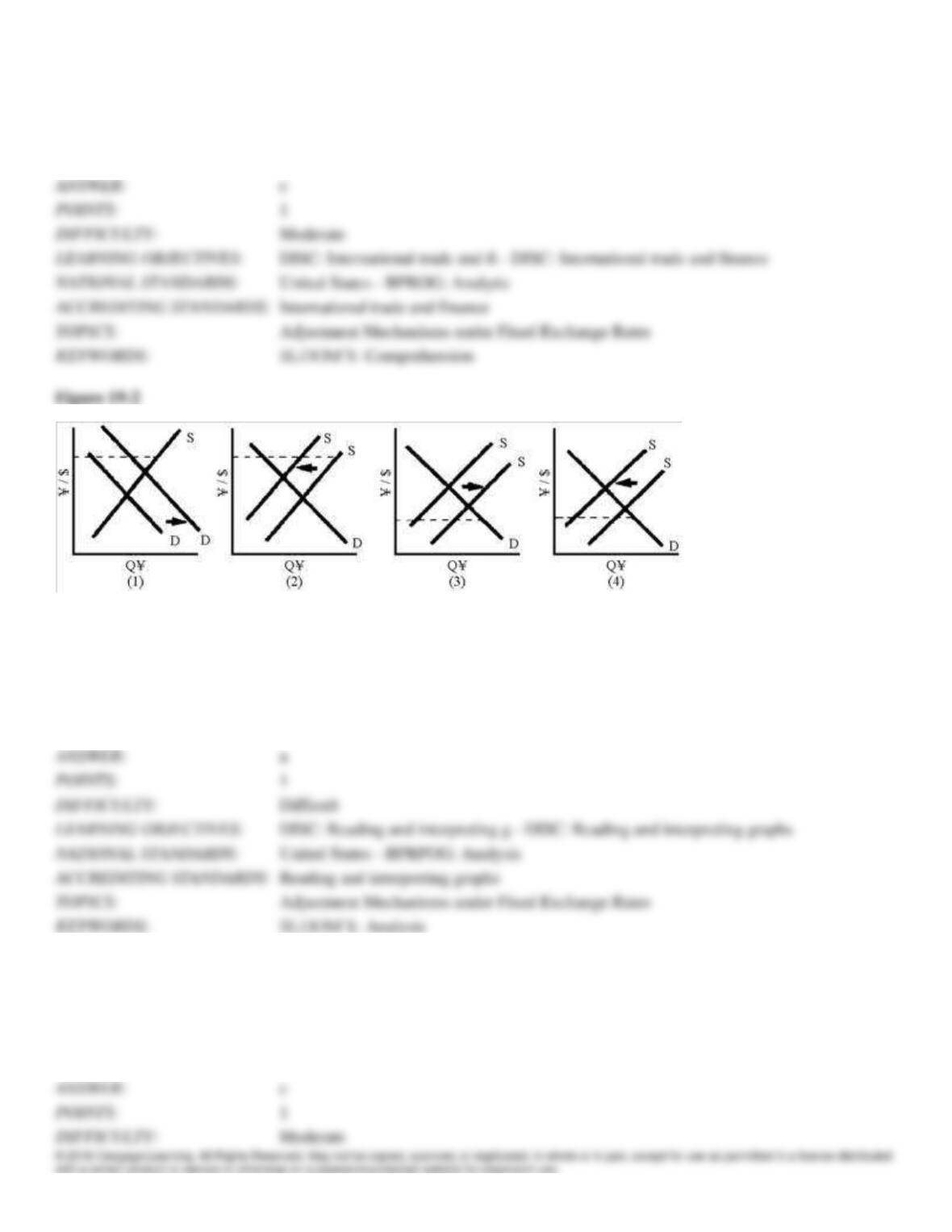
164. Of the graphs in Figure 19–2, where the broken line represents the fixed exchange rate, which one shows a reduction
in the price level in Japan that would reduce a balance of payments deficit?
a.
1
b.
2
c.
3
d.
4
1
DISC: Reading and interpreting g – DISC: Reading and interpreting graphs
United States – BPRPOG: Analysis
Reading and interpreting graphs
Adjustment Mechanisms under Fixed Exchange Rates
165. Of the graphs in Figure 19–2, which one shows the effects on the exchange rate of an expansion in Japan?
a.
1
b.
2
c.
3
d.
4
1
166. Of the graphs in Figure 19–2, which one shows Japan practicing “dirty” floating to keep an undervalued currency?
a.
1
b.
2
c.
3
d.
4
1
167. Of the graphs in Figure 19–2, which one shows the effect of an increase in interest rates in Japan?
a.
1
b.
2
c.
3
d.
4
1
168. Of the graphs in Figure 19–2, where the broken line represents the fixed exchange rates, which one shows how a
balance of payments deficit could be reduced through a recession in Japan?
a.
1
b.
2
c.
3
d.
4
b
1
Adjustment Mechanisms under Fixed Exchange Rates
169. The appropriate “medicine” for correcting payments imbalances under a fixed exchange rate system is
a.
inflation for deficit countries and recessions for surplus countries.
b.
no change for surplus countries, tax cuts for deficit countries.
c.
inflation for surplus countries and recessions for deficit countries.
d.
sales of gold for deficit countries and revaluations for surplus countries.
c
Difficult
DISC: International trade and fi – DISC: International trade and finance
United States – BPROG: Reflective Thinking – BPROG: Analysis
International trade and finance
Adjustment Mechanisms under Fixed Exchange Rates
170. To try and stave off a devaluation of its fixed currency, Argentina was required to
a.
lower interest rates.
b.
reduce tax levels.
c.
increase their money supplies.
d.
increase interest rates.
Moderate
DISC: Markets, market failure, a – DISC: Markets, market failure, and externalities
United States – BPROG: Analytic
Markets, market failure, and ext – Markets, market failure, and externalities
Adjustment Mechanisms under Fixed Exchange Rates
171. To “cure” their balance of payments deficits without altering exchange rates, Southeast Asian countries in 1997 were
forced to create
a.
more inflation.
b.
recessions.
c.
faster economic growth.
d.
money at an accelerated rate.
Moderate
DISC: International trade and fi – DISC: International trade and finance
United States – BPROG: Analytic
International trade and finance
Adjustment Mechanisms under Fixed Exchange Rates
172. Adhering to a strict fixed exchange rate system means that
a.
no country will experience inflation or recession.
b.
each nation improves control over its money supply.
c.
each nation loses some control of its monetary policy and its domestic economy.
d.
each nation improves control over its fiscal policy and aggregate demand.
DISC: International trade and fi – DISC: International trade and finance
United States – BPROG: Analytic
International trade and finance
Adjustment Mechanisms under Fixed Exchange Rates
173. Why did the Bretton Woods system ultimately break down?
a.
The refusal of OPEC countries to accept payment for oil in gold.
b.
The refusal of surplus countries to devalue as required by law.
c.
An inability to devalue the U.S. dollar despite chronic payments deficits.
d.
An inability to adequately measure balance of payments surpluses and deficits.
DISC: International trade and fi – DISC: International trade and finance
United States – BPROG: Analytic
International trade and finance
Adjustment Mechanisms under Fixed Exchange Rates
174. In order to “defend” its overvalued currency, Argentina in 2002 had to reduce its
a.
interest rates.
b.
tax levels.
c.
holdings of foreign reserves.
d.
balance of payments surpluses.
DISC: International trade and fi – DISC: International trade and finance
United States – BPROG: Analytic
International trade and finance
Adjustment Mechanisms under Fixed Exchange Rates
175. Domestic monetary policy is essentially useless under
a.
a floating exchange rate system.
b.
a fixed exchange rate system.
c.
the gold standard.
d.
conditions of balance of payments surpluses.
DISC: Monetary and fiscal policy
United States – BPROG: Analytic
Monetary and fiscal policy
Why Try to Fix Exchange Rates?
176. A country with an undervalued currency
a.
will have a balance of payments deficit.
b.
will accumulate reserves of foreign currencies.
c.
will suffer losses of foreign reserves.
d.
must intervene in the foreign exchange market to buy its own currency.
DISC: International trade and fi – DISC: International trade and finance
United States – BPROG: Analytic
International trade and finance
Why Try to Fix Exchange Rates?
177. A country with an overvalued currency
a.
will have a balance of payments deficit.
b.
will suffer losses of foreign reserves.
c.
must intervene in the foreign exchange market to buy its own currency.
d.
All of the above are correct.
DISC: International trade and fi – DISC: International trade and finance
United States – BPROG: Analytic
International trade and finance
Why Try to Fix Exchange Rates?
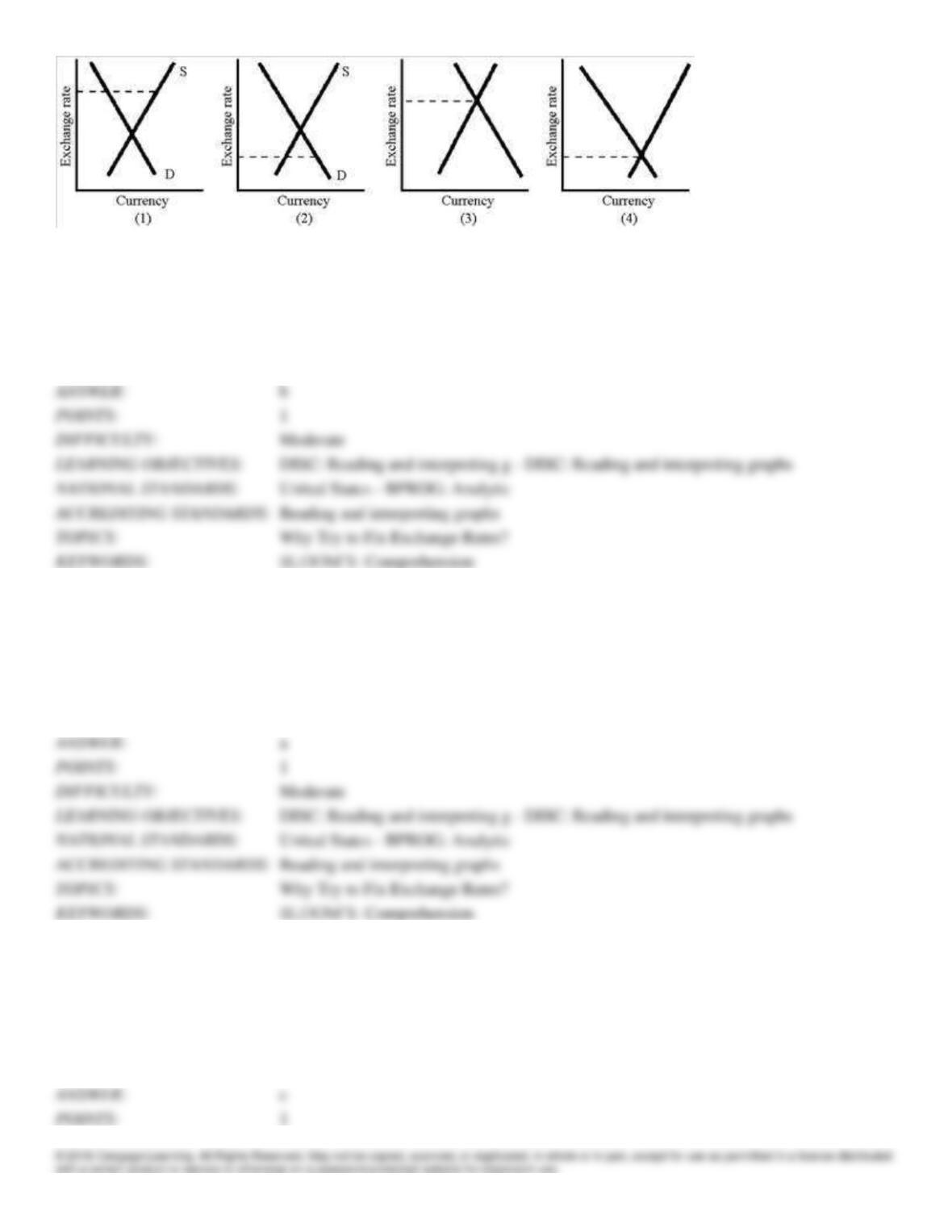
178. Of the graphs in Figure 19–3, where the dotted line shows the actual exchange rate, which one shows a country with
an undervalued currency and a balance of trade surplus?
a.
1
b.
2
c.
3
d.
4
b
1
DISC: Reading and interpreting g – DISC: Reading and interpreting graphs
United States – BPROG: Analytic
Reading and interpreting graphs
Why Try to Fix Exchange Rates?
179. Of the graphs in Figure 19–3, where the dotted line shows the actual exchange rate, which one shows a country with
an overvalued currency and a balance of trade deficit?
a.
1
b.
2
c.
3
d.
4
1
DISC: Reading and interpreting g – DISC: Reading and interpreting graphs
United States – BPROG: Analytic
Reading and interpreting graphs
Why Try to Fix Exchange Rates?
180. Speculation in exchange markets is often thought of as conducive to wild fluctuations in exchange rates. In practice it
appears that speculators
a.
have destabilized several currencies that were at sustainable equilibrium levels.
b.
have no effect in fixed rate systems.
c.
in fact tend to stabilize exchange rates rather than destabilize them.
d.
All of the above are correct.
1