148. As a result of pure free trade in a commodity the
a.
price of the commodity must be the same in all countries.
b.
total quantity imported will exceed the total quantity exported.
c.
price of the commodity will be higher in the producing country.
d.
price of the commodity will be lower in the producing country.
149. If a country produces a commodity in the range of decreasing returns to scale, and the country begins to export more
in a pure free trade system, the domestic price of the commodity will
a.
fall.
b.
rise.
c.
exceed the price in foreign countries.
d.
be below the price in foreign countries.
e.
One cannot predict the impact on the price of the commodity.
150. If a country begins to import more of a commodity, one can normally expect the price of the commodity to
a.
remain unchanged in that nation.
b.
rise and then fall below where it was originally.
c.
rise in that nation.
d.
drop in that nation.
151. Why does equilibrium in the market for a traded good not occur where that country’s quantity demanded equals
quantity supplied?
a.
Because equilibrium occurs where demand equals supply.
b.
Because markets are never in equilibrium.
c.
Because some of the good is imported or exported.
d.
Because there are several demand curves, and the market can’t choose between them.
e.
All of the above are correct.
152. In a situation of free trade
a.
countries with comparative advantage will export more than countries with comparative disadvantage import.
b.
the total quantity of an item exported will be greater than the total quantity imported.
c.
importing countries will always produce some good, so that total quantity imported is less than total quantity
exported.
d.
the total quantity of an item exported will equal the total quantity imported.
153. ____ is a doctrine that holds that exports are good for a country, whereas imports are harmful.
a.
Supply-side economics
b.
Mercantilism
c.
Free trade
d.
Monetarism
154. According to the ____ view, a nation’s wealth consists of the amount of gold or other monies at its command.
a.
Keynesian
b.
free trade
c.
mercantilist
d.
monetarist
155. Which of the following positions would a mercantilist support?
a.
Trade in manufacturing goods is good for the US.
b.
Imports to the U.S. from Japan are beneficial to the U.S.
c.
Exports from Japan to the U.K. are beneficial to Japan.
d.
Movement of labor from UK to US is beneficial to US.
156. A tariff is
a.
a tax on imports.
b.
a tax on exports.
c.
a payment by the government to an exporter.
d.
a legal limit on the amount of a good that may be imported.
157. Tariffs are different from quotas because they
a.
increase government revenue.
b.
increase profits.
c.
increase the quantity traded.
d.
place all the burden on foreigners.
158. If a nation imposes a tariff on imports, the portion of the tax paid by citizens depends upon
a.
elasticity of demand.
b.
elasticity of supply.
c.
how important the good is.
d.
income elasticity.
e.
cross elasticity of demand with domestic products.
159. A quota is
a.
a tax on exported items.
b.
a tax on imported items.
c.
a limit on the amount of imports.
d.
a subsidy to export.
160. A country has a comparative advantage over another in the production of gadgets if it can produce
a.
more gadgets than can the other country.
b.
more gadgets than can any other country.
c.
gadgets more efficiently than it can produce any other good.
d.
gadgets at lower opportunity cost than can the other country.
161. How extensively does the United States use quotas?
a.
Very little; there are few quotas on imports.
b.
Selectively; there are more quotas than most people realize.
c.
Widely; quotas are extensive and cover a wide range of goods.
d.
Widely; although the United States prefers to use tariffs, which cover a wide range of goods.
162. An example of a quota that protects an American industry is the quota on
a.
tourists entering the country.
b.
sugar imports.
c.
sales of oil products to foreign countries.
d.
purchases of military hardware to foreign dictators.
e.
All of the above are examples of protective quotas.
163. The effect of a tariff or a quota is to
a.
raise the price of a commodity in the exporting country above the price in an importing country.
b.
raise the price of a commodity in an importing country above the price in the exporting country.
c.
lower the price of the commodity in all countries.
d.
raise the price of the commodity in all countries.
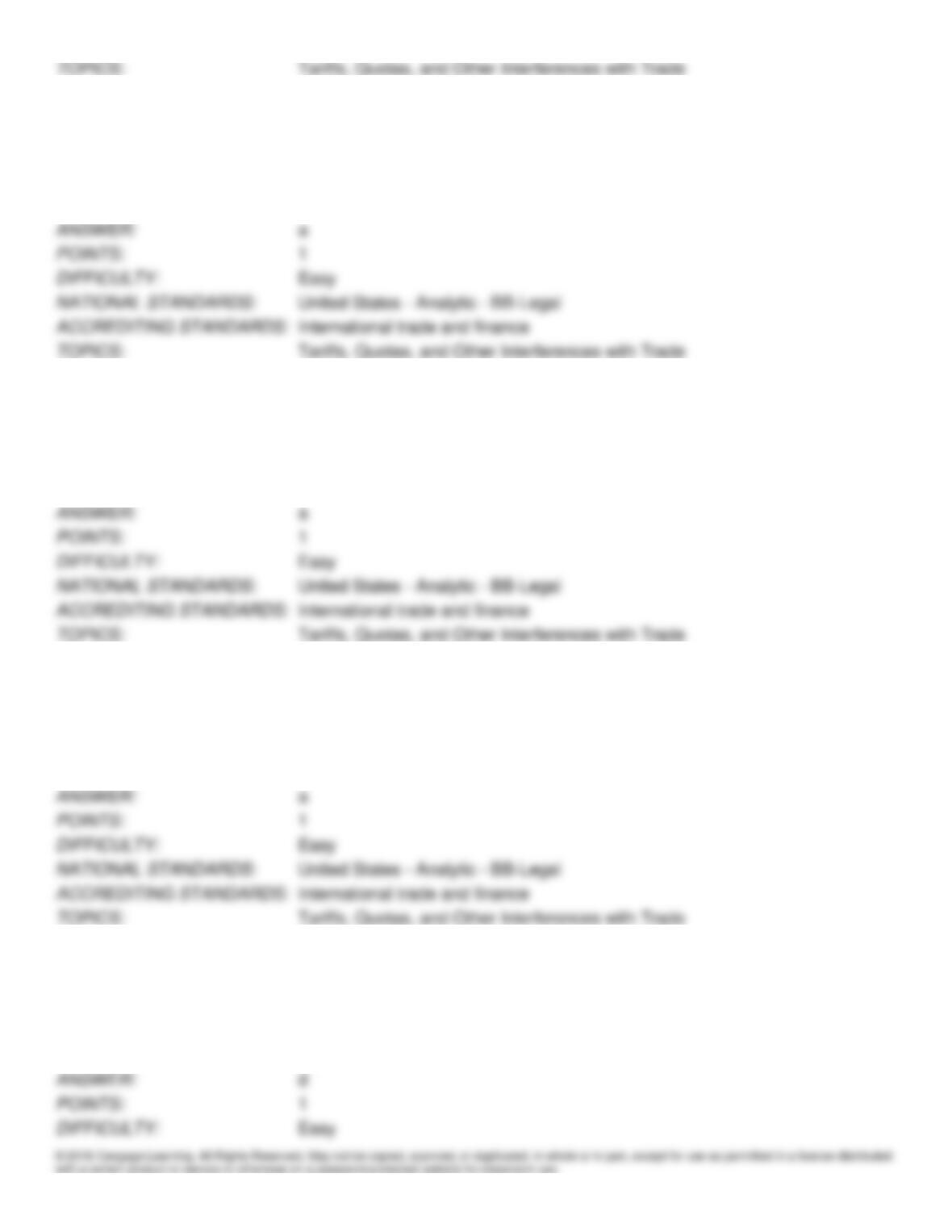
Figure 22–10
164. Figure 22–10 shows the effect on the market for disk drives of a(n)
a.
quota.
b.
tariff.
c.
export subsidy.
d.
import subsidy.
e.
export tax.
165. If the United States imposed a 25 percent tariff on imports of minivans, the effect would be to
a.
raise the price and reduce the quantity of imports.
b.
raise the price and the quantity of imports.
c.
lower the price and the quantity of imports.
d.
raise the quantity and reduce the price of imports.
166. The effect of an import quota is to
a.
raise the price and reduce the quantity of imports.
b.
raise the price and the quantity of imports.
c.
lower the price and the quantity of imports.
d.
raise the quantity and reduce the price of imports.
167. Generally, if a nation imposes a tariff on imports,
a.
part of the tax is paid by foreign exporters.
b.
the entire tax is paid by foreign exporters.
c.
none of the tax is paid by foreign exporters.
d.
the tax has no impact on the profits of foreign exporters.
168. A tariff affects imports
a.
by limiting quantity and raising price to a higher level.
b.
by reducing quantity demanded so that supply falls.
c.
by increasing supply, raising price, and reducing demand.
d.
by raising price and reducing quantity demanded.
169. If Japan imposes a quota on imports of rice, the effect will be
a.
less rice and higher price in Japan, lower rice prices in exporting countries.
b.
more rice and higher price in Japan, higher rice prices in exporting countries.
c.
less rice and lower price in Japan, higher rice prices in exporting countries.
d.
more rice and lower price in Japan, lower rice prices in exporting countries.
e.
less rice and higher price in Japan, higher rice prices in exporting countries.
170. A restriction of imports that is accomplished by a quota normally
a.
can be accomplished also by a tariff.
b.
cannot be replicated exactly by imposing a tariff.
c.
can be accomplished also by an export subsidy.
d.
can be accomplished also by negotiations within GATT.
171. A country that must inhibit imports should give preference to
a.
quotas over tariffs because quotas are less likely to distort trade patterns between nations.
b.
tariffs over quotas because, unlike quotas, tariffs offer no special benefits to inefficient exporters.
c.
export subsidies over quotas or tariffs because export subsidies can protect a nation’s domestic producers.
d.
an embargo wherever possible because an embargo can serve as a political weapon in addition to being a
“trade stopper.”
172. A tariff is better than a quota because
a.
it does not distort trade as much.
b.
quotas are inflexible.
c.
tariffs produce tax revenue.
d.
quotas hurt domestic producers; tariffs hurt foreign producers.
173. If the United States imposes a tariff on the import of Japanese cars instead of a quota, the price
a.
increase in Japanese cars goes into the revenue of U.S. automakers.
b.
increase in Japanese cars goes into the revenue of Japanese automakers.
c.
increase in Japanese cars goes into the revenue of the U.S. government.
d.
decrease in Japanese cars comes out of the revenue of U.S. automakers.
e.
decrease in Japanese cars comes out of the revenue of the U.S. government.
174. A tariff on imports affects foreign suppliers ____; a quota affects foreign suppliers ____.
a.
effectively, ineffectively
b.
haphazardly, carefully
c.
equally, capriciously
d.
unfairly, fairly
e.
unequally, unequally
175. The two primary reasons to adopt measures to restrict trade are that
a.
they help keep real wages high in the importing country, and they also permit small businesses to compete in
international markets.
b.
they may help the importing country improve its educational system, and they keep high-technology products
from being stolen by foreign competitors.
c.
they may help the importing country get better prices for its goods, and they protect certain industries from
foreign competition.
d.
they may help advance the political goals of the nation, and they encourage productivity in domestic
industries.
176. Ideally, a free trade policy should be accompanied by
a.
a public education program to make the benefits known.
b.
open borders and amnesty for all undocumented workers.
c.
programs to ensure no one loses a job as a result of foreign competition.
d.
programs to assist workers who lose their jobs to foreign competition.
177. Trade adjustment assistance in the United States began in 1962. The program
a.
was designed to provide assistance to firms or workers who suffer idle facilities, unprofitability, and
unemployment because of sharp increases in imports.
b.
provided little assistance to victims of free trade before the 1970s.
c.
was enlarged and worker benefits were extended in 1981 by the Reagan administration.
d.
All of the above are correct.
178. A nation can gain from imposing a tariff on imports if it forces exporting countries
a.
to raise their prices to pay the tariff.
b.
to lower their prices to avoid stocks of unsold goods.
c.
to produce at diseconomies of scale.
d.
to accept some imports from the tariff-imposing nation.
179. Tariffs and quotas are effective in protecting industry
a.
but at very high cost per job saved.
b.
and at very low cost per job saved.
c.
but have not saved any jobs in the industries.
d.
and do not distort the economy in the process.
180. How does the imposition of a tariff reduce the price of imports?
a.
At the lower quantity supplied, the price to the importer is lower than if there were free trade.
b.
At the lower quantity demanded, the price to the importer is lower than if there were free trade.
c.
Supply of the product is increased from domestic production, reducing the price of the imports.
d.
Demand for the product is decreased, so that price must fall.
181. Assume that a country imposes a tariff in order to gain a price advantage on an item. What is the typical response
from the exporting country?
a.
It accepts the situation, and does nothing about it.
b.
It seeks greater efficiency in order to offset the tariff.
c.
It refuses to sell to the country that imposes the tariff.
d.
It retaliates by imposing tariffs or quotas on items from the other country.
182. When can a country gain a price advantage on imports by imposing a tariff?
a.
when it is the largest country with absolute advantage in all goods
b.
when it has a comparative advantage in the production of all goods
c.
when it can do so without other countries retaliating with tariffs
d.
when trade agreements prohibit quotas but permit tariffs
183. A program of protection that results in preserving jobs in certain industries
a.
maintains full employment at lower cost than any other program or policy.
b.
lowers average pay in the protected industries.
c.
improves living standards for the average person in that country.
d.
often does so at a cost that is much higher than the average income of persons in those industries.
184. “Protection” is designed to help
a.
firms whose relative inefficiency does not permit successful competition with imports.
b.
workers who have very high productivity, and cannot survive against low-paid foreign workers.
c.
government that needs revenue from tariffs and quotas to cover government spending.
d.
firms that are highly efficient, and cannot survive against low-price foreign imports.
185. A program of protection that results in preserving jobs in certain industries
a.
raises average productivity in all sectors of the economy.
b.
does so at very high cost to consumers of the products from those industries.
c.
is an efficient way to preserve employment, and is cheaper than other forms of maintaining full employment.
d.
is an effective way of encouraging innovation and improvement in production.
186. The Trade Adjustment Assistance program is intended to help
a.
businesses that seek to expand exports into protected foreign markets.
b.
local governments that are harmed when businesses fail as imports increase.
c.
protected industries obtain improved technology in order to increase productivity.
d.
workers and businesses that lose markets because of increases in imports.
187. The danger of using the national defense argument to protect domestic industries necessary to wage war is that
a.
it has no validity on non-economic grounds.
b.
it is unrelated to the United States’ ability to wage war.
c.
other nations will retaliate with tariffs against U.S. producers of war material.
d.
industries with only the most peripheral relationship to defense are likely to invoke this argument on their
behalf.
188. The infant industry argument is valid when
a.
a new industry is suffering financial losses.
b.
a new industry is less efficient than foreign competitors.
c.
the industry’s prospective gains are sufficient to repay the social losses incurred while it is being protected.
d.
the industry is not likely to be profitable in the future.
189. For many years the U.S. government imposed quotas on cheap, Middle Eastern oil imports. The U.S. consumer
consequently paid $3 billion more per year for oil products. A likely rationale for such a policy is
a.
people in the oil industry deserved the transfer.
b.
conservation.
c.
one cannot be dependent on foreign supplies of so crucial a resource.
d.
American oil was of higher quality and deserved a higher price.
190. Opening trade between a nation that has “cheap labor” and one that has “expensive labor” will
a.
lower the standard of living in both countries.
b.
raise the standard of living in both countries.
c.
make some workers less efficient.
d.
lead to an inappropriate allocation of resources.