True / False
1. Inflation can come from the demand side or from the supply side of the economy.
a.
True
b.
False
True
Easy
DISC: Aggregate demand and aggre – DISC: Aggregate demand and aggregate supply
United States – BPROG: Analytic
Aggregate demand and aggregate s – Aggregate demand and aggregate supply
Demand-Side Inflation Versus Supply-Side Inflation: A Review
2. The cure for inflation can come only from changes on the demand side.
a.
True
b.
False
False
Easy
DISC: Aggregate demand and aggre – DISC: Aggregate demand and aggregate supply
United States – BPROG: Analytic
Aggregate demand and aggregate s – Aggregate demand and aggregate supply
Demand-Side Inflation Versus Supply-Side Inflation: A Review
3. A stimulus to aggregate demand will normally pull prices up but cause a reduction in output.
a.
True
b.
False
False
Moderate
DISC: Aggregate demand and aggre – DISC: Aggregate demand and aggregate supply
United States – BPROG: Analytic
Aggregate demand and aggregate s – Aggregate demand and aggregate supply
Demand-Side Inflation Versus Supply-Side Inflation: A Review
4. Supply-side inflation will increase the price level and reduce real GDP.
a.
True
b.
False
True
DISC: Aggregate demand and aggre – DISC: Aggregate demand and aggregate supply
United States – BPROG: Analytic
5. Every year from 1954 to 1984, the U.S. economy was characterized by higher output and lower prices.
a.
True
b.
False
False
Moderate
6. In 2010 the U.S. economy’s inflation rate was higher than its unemployment rate.
a.
True
b.
False
False
Moderate
7. If aggregate demand grows faster than aggregate supply, the equilibrium price level will rise.
a.
True
b.
False
True
Moderate
8. The Phillips curve explains the trade-off between inflation and unemployment.
a.
True
b.
False
True
Easy
9. If the U.S. economy had grown faster than it actually did from 2009 to 2010, the unemployment rate would have been
higher.
a.
True
b.
False
False
Moderate
10. An economy eliminates a recessionary gap by reducing wages and prices.
a.
True
b.
False
True
Moderate
11. Demand-side inflation is usually accompanied by increasing real GDP, while supply-side inflation is usually
accompanied by falling real GDP.
a.
True
b.
False
True
Moderate
12. The supply-side shocks of the 1970s shifted the aggregate supply curve inward.
a.
True
b.
False
True
Easy
13. The U.S. economy in the 1990s benefited from an aggregate supply curve shifting outward.
a.
True
b.
False
True
Easy
14. The Phillips curve shows the relationship between the rate of inflation and the rate of growth of real GDP.
a.
True
b.
False
False
Easy
15. The economy’s self-correcting mechanism ensures that neither recessionary nor inflationary gaps will be eliminated
eventually.
a.
True
b.
False
True
Moderate
16. The Phillips curve assumes that shocks to the economy come from the demand side.
a.
True
b.
False
True
Moderate
17. An inflationary gap will eliminate itself through a process of price increases.
a.
True
b.
False
True
Moderate
18. In December of 2007, with an unemployment rate of 5.0 percent, most economists believed this was above the natural
rate.
a.
True
b.
False
False
Moderate
19. The natural rate of unemployment corresponds to what is sometimes called the full employment unemployment rate.
a.
True
b.
False
True
20. Expansionary fiscal and monetary policy from 2008 to 2010, took the risk of being inflationary for the sake of
avoiding additional unemployment.
a.
True
b.
False
True
Moderate
21. Fiscal and monetary policy can reduce unemployment with no negative side effects.
a.
True
b.
False
False
Moderate
22. European governments accepted prolonged periods of unemployment in the 1990s in order to reduce inflation.
a.
True
b.
False
True
Moderate
23. Most economists and policy makers decided in 2007-2010 that reducing unemployment was the main national
priority.
a.
True
b.
False
True
Moderate
24. An increase in aggregate demand will reduce the unemployment rate only if the ensuing inflation is anticipated.
a.
True
b.
False
False
Moderate
25. Inflation targeting requires monetary policy makers to rely heavily on the Phillips curve.
a.
True
b.
False
True
Easy
26. Workers expecting inflation will expect wage increases to be built into their wage contracts.
a.
True
b.
False
True
Moderate
27. If nominal wages increase at the same rate as inflation, then the aggregate supply curve will be a horizontal line.
a.
True
b.
False
False
Difficult
28. The aggregate supply curve slopes upward when the real wage falls initially as the price level rises.
a.
True
b.
False
True
Moderate
29. The rational expectations theory claims that workers and firms will not make systematic errors when they forecast
inflation.
a.
True
b.
False
True
Moderate
30. To make rational forecasts, your predictions do not have to be correct all of the time.
a.
True
b.
False
True
Moderate
31. According to rational expectations theory, a long period of unemployment is necessary to reduce inflation.
a.
True
b.
False
False
Moderate
32. If expectations are rational, the difference between the actual rate of inflation and the expected rate of inflation will be
zero.
a.
True
b.
False
False
Moderate
33. If rational expectations are assumed, inflation can be reduced with no corresponding increase in unemployment.
a.
True
b.
False
True
Moderate
34. The rational expectations hypothesis is impeccably logical, but inconsistent with the facts.
a.
True
b.
False
True
35. Keynesian economists generally agree that unemployment is more costly than inflation.
a.
True
b.
False
True
Easy
36. Monetarists typically favor strong policy measures to fight recession.
a.
True
b.
False
False
Moderate
economics
37. The government can fight inflation by manipulating both aggregate demand and aggregate supply.
a.
True
b.
False
False
Moderate
38. If the short-run Phillips curve is fairly horizontal, attempts to fight inflation will generate considerable unemployment.
a.
True
b.
False
True
Moderate
39. One explanation for the increase in the natural rate of unemployment in 2010 was a mismatch between the skills of the
American labor force and the skills that the modern job market demanded.
a.
True
b.
False
True
Moderate
40. An example of indexing is a “cost of living” adjustment clause in a wage contract.
a.
True
b.
False
True
Moderate
41. Favorable supply shocks should produce rapid economic growth with falling inflation.
a.
True
b.
False
True
Easy
42. If the short-run Phillips curve is steep, the inflationary costs of using expansionary policy to reduce unemployment
would be substantial.
a.
True
b.
False
True
Moderate
United States – BPROG: Analytic
Monetary and fiscal policy
What Should Be Done?
43. A Keynesian economist would propose strong actions to prevent or reduce inflation.
a.
True
b.
False
False
Moderate
DISC: Monetary and fiscal policy
United States – BPROG: Analytic
Monetary and fiscal policy
Why Economists (and Politicians) Disagree
Multiple Choice
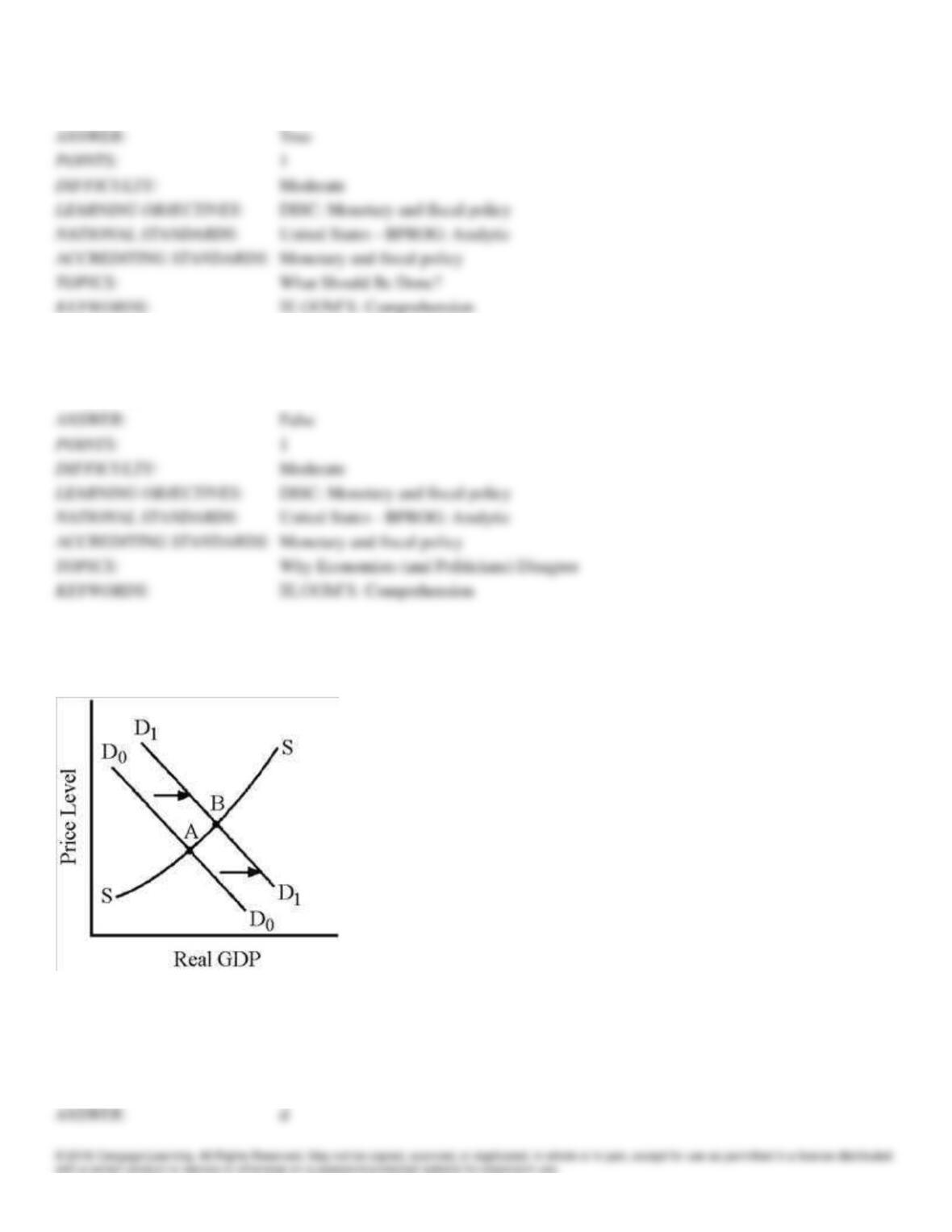
Figure 17-1
44. Which of the following is true about the economy depicted in Figure 17–1?
a.
It is experiencing supply-side inflation.
b.
Policy makers have chosen to fight inflation rather than unemployment.
c.
The increase in aggregate demand has increased prices but not real GDP.
d.
The slope of the aggregate supply curve embodies the trade-off between unemployment and inflation.
DISC: Aggregate demand and aggre – DISC: Aggregate demand and aggregate supply
United States – BPROG: Reflective Thinking – BPROG: Analysis
Aggregate demand and aggregate s – Aggregate demand and aggregate supply
Demand-Side Inflation Versus Supply-Side Inflation: A Review
45. Which of the following is true about the economy depicted in Figure 17–1?
a.
Tax incentives are being used to stimulate aggregate supply.
b.
Policy makers believe the costs of unemployment are higher than the costs of inflation.
c.
Contractionary monetary policy is being enacted to fight inflation.
d.
Prices are rising but real GDP is falling.
DISC: Aggregate demand and aggre – DISC: Aggregate demand and aggregate supply
United States – BPROG: Reflective Thinking – BPROG: Analysis
Aggregate demand and aggregate s – Aggregate demand and aggregate supply
Demand-Side Inflation Versus Supply-Side Inflation: A Review
46. What is the crucial difference between inflation generated on the demand side versus inflation generated on the supply
side?
a.
Demand-side inflation is short-lived, while supply-side inflation lasts for a long time.
b.
Demand-side inflation leads to budget surpluses, while supply-side inflation contributes to budget deficits.
c.
Supply-side inflation is subject to control of policy makers, while demand-side inflation is beyond their reach.
d.
Demand-side inflation is normally accompanied by rising real GDP, while supply-side inflation may be
accompanied by falling real GDP.
DISC: Aggregate demand and aggre – DISC: Aggregate demand and aggregate supply
United States – BPROG: Analytic
Aggregate demand and aggregate s – Aggregate demand and aggregate supply
Demand-Side Inflation Versus Supply-Side Inflation: A Review
47. The economy’s self-correcting mechanism
a.
tends to push unemployment toward a specific point called the natural rate of unemployment.
b.
works better at correcting inflationary gaps than recessionary gaps.
c.
cannot work if the Phillips curve is vertical.
d.
ensures that the economy will not have to endure a long period of high unemployment.
DISC: Aggregate demand and aggre – DISC: Aggregate demand and aggregate supply
United States – BPROG: Analytic
Aggregate demand and aggregate s – Aggregate demand and aggregate supply
Demand-Side Inflation Versus Supply-Side Inflation: A Review
48. The economy’s self-correcting mechanism to eliminate a recessionary gap relies on
a.
falling interest rates that shift the aggregate demand curve outward.
b.
falling wage rates that shift the aggregate supply curve outward.
c.
rising wage rates that shift the aggregate supply curve inward.
d.
increases in the price level that shift the aggregate supply curve inward.
DISC: Aggregate demand and aggre – DISC: Aggregate demand and aggregate supply
United States – BPROG: Analytic
Aggregate demand and aggregate s – Aggregate demand and aggregate supply
Demand-Side Inflation Versus Supply-Side Inflation: A Review
49. If economic fluctuations originate on the supply side,
a.
there will be no relationship between unemployment and inflation.
b.
real wage increases will be necessary to eliminate unemployment.
c.
inflation and unemployment will be negatively related.
d.
inflation and unemployment will be positively related.
DISC: Aggregate demand and aggre – DISC: Aggregate demand and aggregate supply
United States – BPROG: Analytic
Aggregate demand and aggregate s – Aggregate demand and aggregate supply
Demand-Side Inflation Versus Supply-Side Inflation: A Review
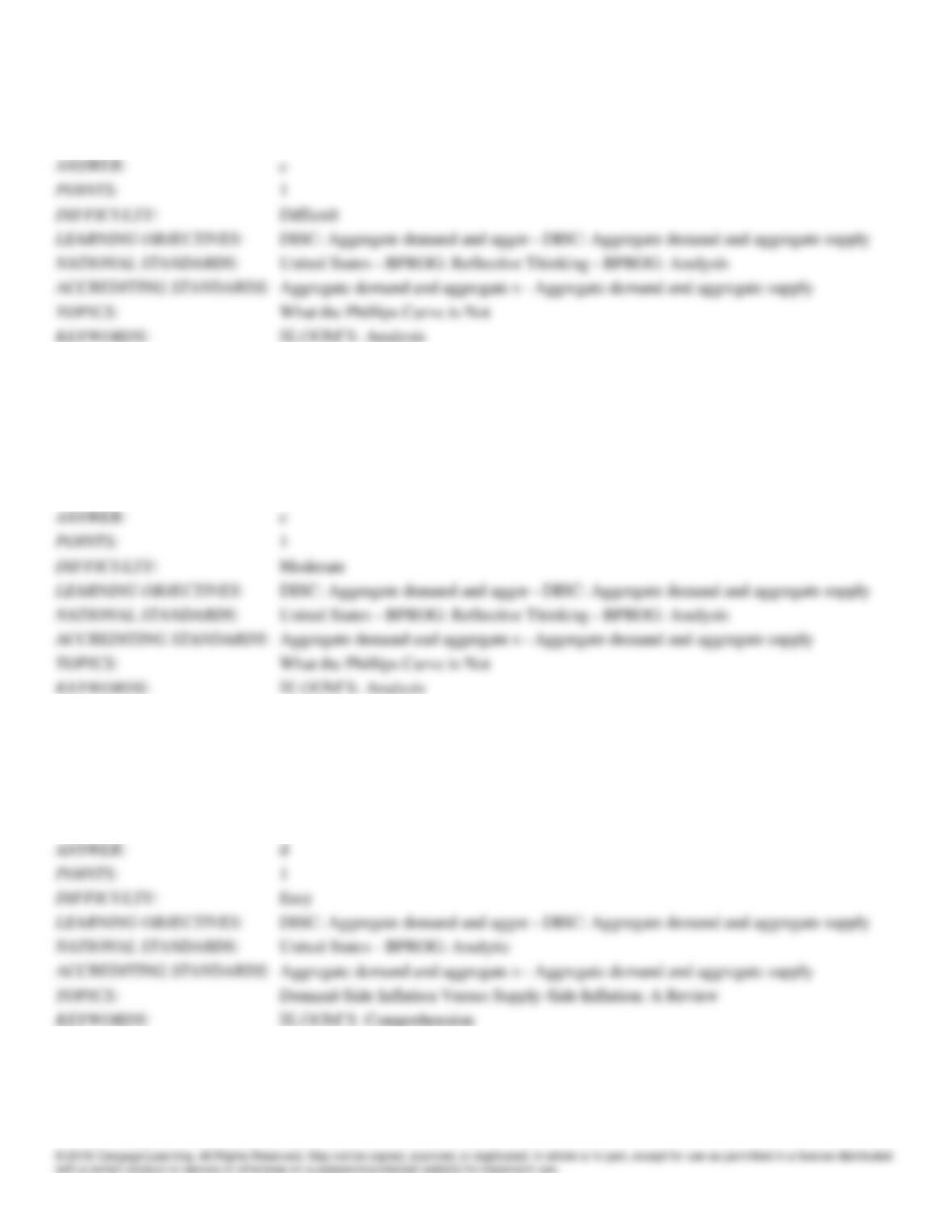
Figure 17-2
50. Given the situation in graph (1) in Figure 17–2, what movement would be expected in graph (2) from the economy’s
self-correcting mechanism?
a.
A to B
b.
A to D
c.
C to E
d.
D to C
c
Difficult
DISC: Aggregate demand and aggre – DISC: Aggregate demand and aggregate supply
United States – BPROG: Reflective Thinking – BPROG: Analysis
Aggregate demand and aggregate s – Aggregate demand and aggregate supply
What the Phillips Curve is Not
51. Given the situation in graph (1) in Figure 17–2, what action could be expected from the economy’s self-correcting
mechanism?
a.
an increase in aggregate demand
b.
a decrease in aggregate demand
c.
an increase in aggregate supply
d.
a decrease in aggregate supply
c
Moderate
DISC: Aggregate demand and aggre – DISC: Aggregate demand and aggregate supply
United States – BPROG: Reflective Thinking – BPROG: Analysis
Aggregate demand and aggregate s – Aggregate demand and aggregate supply
What the Phillips Curve is Not
52. A reduction in aggregate demand will normally reduce
a.
prices.
b.
real GDP.
c.
employment.
d.
All of the above are correct.
Easy
DISC: Aggregate demand and aggre – DISC: Aggregate demand and aggregate supply
United States – BPROG: Analytic
Aggregate demand and aggregate s – Aggregate demand and aggregate supply
Demand-Side Inflation Versus Supply-Side Inflation: A Review
53. Stagflation can be defined as a situation characterized by
a.
rising prices and rising output.
b.
rising prices and falling output.
c.
falling prices and falling output.
d.
falling prices and rising output.
DISC: Aggregate demand and aggre – DISC: Aggregate demand and aggregate supply
United States – BPROG: Analytic
Aggregate demand and aggregate s – Aggregate demand and aggregate supply
Demand-Side Inflation Versus Supply-Side Inflation: A Review
54. Which of the following could trigger demand-side inflation?
a.
a decrease in the money supply
b.
an increase in taxes
c.
an increase in government spending
d.
an increase in interest rates
DISC: Aggregate demand and aggre – DISC: Aggregate demand and aggregate supply
United States – BPROG: Analytic
Aggregate demand and aggregate s – Aggregate demand and aggregate supply
Demand-Side Inflation Versus Supply-Side Inflation: A Review
55. Demand-side inflation differs from supply-side inflation in the following way:
a.
demand-side inflation has higher output; supply-side inflation has lower output.
b.
demand-side inflation has lower output; supply-side inflation has higher output.
c.
demand-side inflation is always followed by stagflation; supply-side inflation is always followed by demand-
side inflation.
d.
demand-side inflation has a self-correcting mechanism; supply-side inflation does not.
DISC: Aggregate demand and aggre – DISC: Aggregate demand and aggregate supply
United States – BPROG: Analytic
Aggregate demand and aggregate s – Aggregate demand and aggregate supply
Demand-Side Inflation Versus Supply-Side Inflation: A Review
Figure 17-3
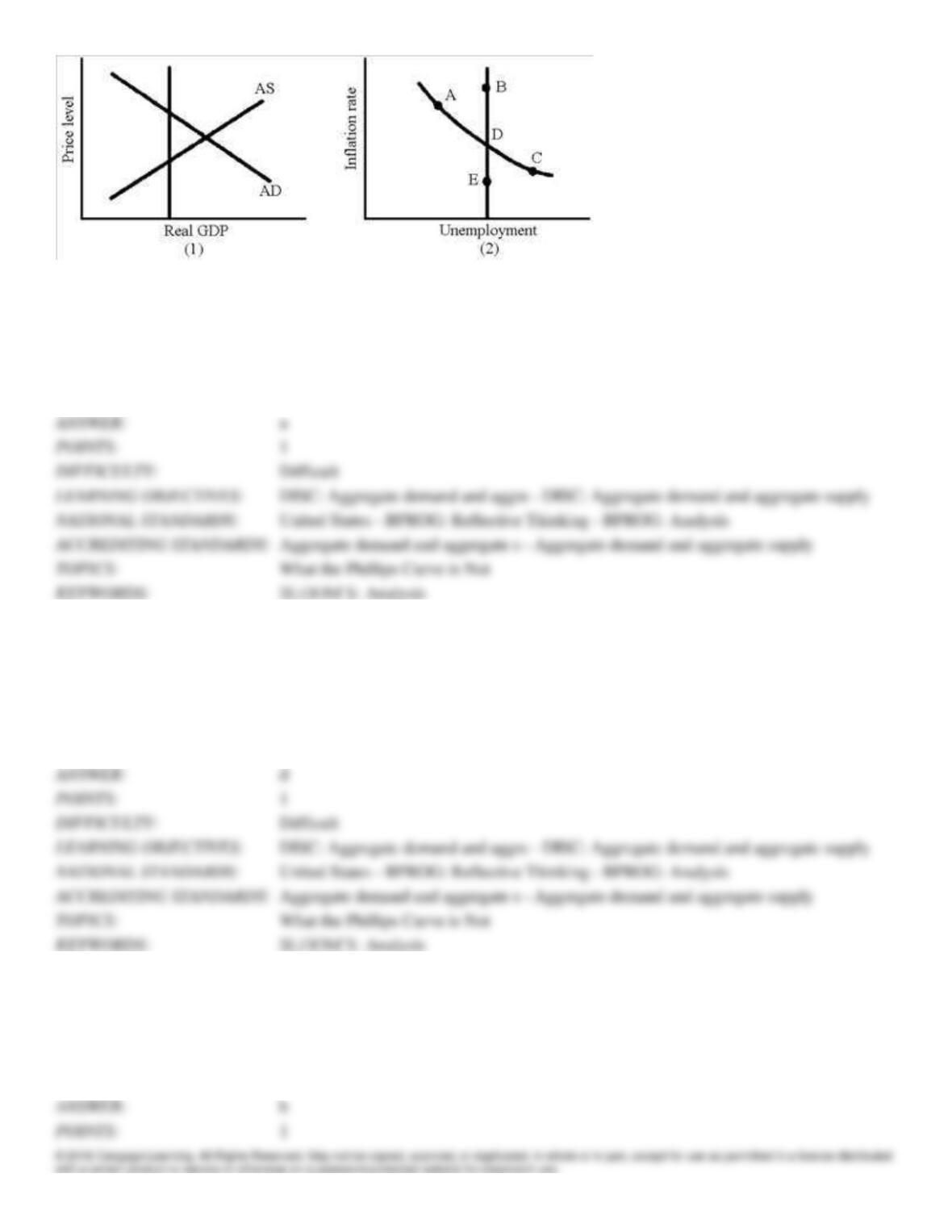
56. Given the situation in graph (1) in Figure 17–3, what movement would be expected in graph (2) from the economy’s
self-correcting mechanism?
a.
A to B
b.
A to D
c.
C to E
d.
D to C
DISC: Aggregate demand and aggre – DISC: Aggregate demand and aggregate supply
United States – BPROG: Reflective Thinking – BPROG: Analysis
Aggregate demand and aggregate s – Aggregate demand and aggregate supply
What the Phillips Curve is Not
57. Given the situation in graph (1) in Figure 17–3, what can be expected to change in graph (1) when the economy’s self-
correcting mechanism operates?
a.
aggregate demand increases
b.
aggregate demand decreases
c.
aggregate supply increases
d.
aggregate supply decreases
DISC: Aggregate demand and aggre – DISC: Aggregate demand and aggregate supply
United States – BPROG: Reflective Thinking – BPROG: Analysis
Aggregate demand and aggregate s – Aggregate demand and aggregate supply
What the Phillips Curve is Not
58. Which of the following could trigger supply-side inflation?
a.
a decrease in the wage rate for all workers
b.
an increase in raw materials’ prices
c.
an increase in productivity of capital
d.
an increase in the labor force
59. An increase in AD will trigger more inflation under which of the following conditions?
a.
AD is relatively steep.
b.
AD is relatively flat.
c.
AS is relatively steep.
d.
AS is relatively flat.
60. A decrease in AS will trigger more inflation under which of the following conditions?
a.
AD is relatively steep.
b.
AD is relatively flat.
c.
AS is relatively steep.
d.
AS is relatively flat.
61. An increase in AD will trigger less inflation under which of the following conditions?
a.
AD is relatively steep.
b.
AD is relatively flat.
c.
AS is relatively steep.
d.
AS is relatively flat.
Origins of the Phillips Curve
62. A decrease in AS will trigger less inflation under which of the following conditions?
a.
AD is relatively steep.
b.
AD is relatively flat.
c.
AS is relatively steep.
d.
AS is relatively flat.
DISC: Aggregate demand and aggre – DISC: Aggregate demand and aggregate supply
United States – BPROG: Reflective Thinking – BPROG: Analysis
Aggregate demand and aggregate s – Aggregate demand and aggregate supply
Origins of the Phillips Curve
63. A decrease in the price of foreign oil will affect the U.S. economy by
a.
increasing aggregate demand.
b.
decreasing aggregate demand.
c.
increasing aggregate supply.
d.
decreasing aggregate supply.
DISC: Aggregate demand and aggre – DISC: Aggregate demand and aggregate supply
United States – BPROG: Analytic
Aggregate demand and aggregate s – Aggregate demand and aggregate supply
Origins of the Phillips Curve
64. A study of the U.S. price level and real GDP from 1972 to 2007 reveals a clear upward march toward higher prices
and greater output. What explains this?
a.
Both the aggregate demand curve and the aggregate supply curve have shifted to the left year after year.
b.
Both the aggregate demand curve and the aggregate supply curve have shifted to the right year after year.
c.
The aggregate supply curve has shifted to the right while the aggregate demand curve has shifted to the left.
d.
The aggregate supply curve has shifted to the left while the aggregate demand curve has shifted to the right.
DISC: Aggregate demand and aggre – DISC: Aggregate demand and aggregate supply
United States – BPROG: Reflective Thinking – BPROG: Analysis
Aggregate demand and aggregate s – Aggregate demand and aggregate supply
Origins of the Phillips Curve
65. Aggregate demand grows because
a.
patent laws protect and stimulate new inventions.
b.
there is more machinery and technology improves.
c.
the government increases its spending, a growing population increases consumer spending, and the Fed
increases the money supply.
d.
All of the above are correct.
c
Easy
DISC: Aggregate demand and aggre – DISC: Aggregate demand and aggregate supply
United States – BPROG: Analytic
Aggregate demand and aggregate s – Aggregate demand and aggregate supply
Origins of the Phillips Curve
66. A scatter diagram of the position of the U.S. economy from 1972 through 2007 with the price level on the vertical axis
and real GDP on the horizontal axis would show a movement generally toward the
a.
northwest.
b.
northeast.
c.
southwest.
d.
southeast.
Moderate
DISC: Aggregate demand and aggre – DISC: Aggregate demand and aggregate supply
United States – BPROG: Analytic
Aggregate demand and aggregate s – Aggregate demand and aggregate supply
Origins of the Phillips Curve
67. If AD and AS increase at exactly the same rate, the result will be
a.
demand-side inflation.
b.
supply-side inflation.
c.
falling prices.
d.
stable prices.
Easy
DISC: Aggregate demand and aggre – DISC: Aggregate demand and aggregate supply
United States – BPROG: Analytic
Aggregate demand and aggregate s – Aggregate demand and aggregate supply
Origins of the Phillips Curve
68. If AS increases at a faster rate than AD, the result will be
a.
demand-side inflation.