Aggregate demand and aggregate s – Aggregate demand and aggregate supply
What the Phillips Curve is Not
130. The main process by which a recessionary gap is eliminated is a(n)
a.
increase in wages that shifts the aggregate supply curve inward.
b.
drop in wages that shifts the aggregate demand curve inward.
c.
increase in wages that shifts the aggregate demand curve outward.
d.
drop in wages that shifts the aggregate supply curve outward.
DISC: Aggregate demand and aggre – DISC: Aggregate demand and aggregate supply
United States – BPROG: Analytic
Aggregate demand and aggregate s – Aggregate demand and aggregate supply
What the Phillips Curve is Not
131. Most economists now agree that the Phillips curve demonstrates that there is
a.
an unemployment-inflation trade-off in the long run, but not in the short run.
b.
an unemployment-inflation trade-off in both the short run and the long run.
c.
an unemployment-inflation trade-off in the short run, but not the long run
d.
no unemployment-inflation trade-off in either the short run or the long run.
DISC: Aggregate demand and aggre – DISC: Aggregate demand and aggregate supply
United States – BPROG: Analytic
Aggregate demand and aggregate s – Aggregate demand and aggregate supply
What the Phillips Curve is Not
132. The economy’s self-correcting mechanism always tends to push the unemployment rate back toward a specific rate of
unemployment called
a.
the ideal rate of unemployment.
b.
the natural rate of unemployment.
c.
the full rate of unemployment.
d.
the mature rate of unemployment.
DISC: Aggregate demand and aggre – DISC: Aggregate demand and aggregate supply
United States – BPROG: Analytic
Aggregate demand and aggregate s – Aggregate demand and aggregate supply
What the Phillips Curve is Not
133. All points on the long run Phillips curve that are sustainable in the long run due to economy’s self correcting
mechanism correspond to
a.
the mature rate of unemployment.
b.
the natural rate of unemployment.
c.
the seasonal rate of unemployment.
d.
the cyclical rate of unemployment.
DISC: Aggregate demand and aggre – DISC: Aggregate demand and aggregate supply
United States – BPROG: Analytic
Aggregate demand and aggregate s – Aggregate demand and aggregate supply
What the Phillips Curve is Not
134. In what way do policy makers have to face a trade-off between inflation and unemployment?
a.
The cost of reducing inflation by restrictive fiscal and monetary policies is a temporary increase in
unemployment.
b.
The cost of reducing inflation by restrictive fiscal and monetary policies is a permanent increase in
unemployment.
c.
The cost of reducing unemployment by expansionary fiscal and monetary policies is virtually nonexistent.
d.
The cost of reducing unemployment by expansionary fiscal and monetary policies involves higher inflation
during recessions.
DISC: Aggregate demand and aggre – DISC: Aggregate demand and aggregate supply
United States – BPROG: Analytic
Aggregate demand and aggregate s – Aggregate demand and aggregate supply
What the Phillips Curve is Not
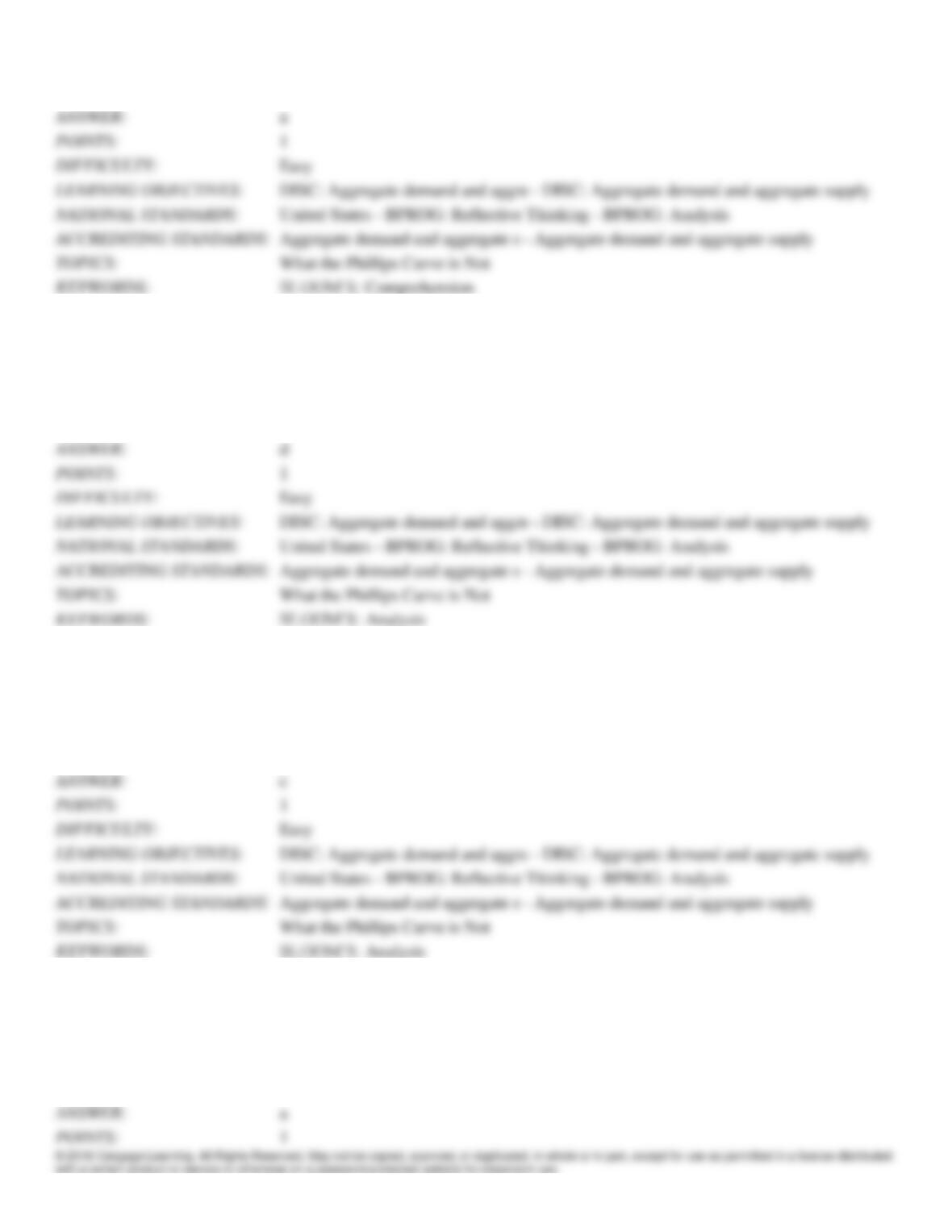
Figure 17-7
135. In Figure 17–7, the case for expansionary monetary policy and fiscal policy is strongest at point
a.
A.
b.
B.
c.
C.
d.
D.
DISC: Aggregate demand and aggre – DISC: Aggregate demand and aggregate supply
United States – BPROG: Reflective Thinking – BPROG: Analysis
Aggregate demand and aggregate s – Aggregate demand and aggregate supply
What the Phillips Curve is Not
136. In Figure 17–7, the case for restrictive monetary and fiscal policy is strongest at point
a.
A.
b.
B.
c.
C.
d.
D.
DISC: Aggregate demand and aggre – DISC: Aggregate demand and aggregate supply
United States – BPROG: Reflective Thinking – BPROG: Analysis
Aggregate demand and aggregate s – Aggregate demand and aggregate supply
What the Phillips Curve is Not
137. In Figure 17–7, the only sustainable long-run equilibrium position is at point
a.
A.
b.
B.
c.
C.
d.
D.
DISC: Aggregate demand and aggre – DISC: Aggregate demand and aggregate supply
United States – BPROG: Reflective Thinking – BPROG: Analysis
Aggregate demand and aggregate s – Aggregate demand and aggregate supply
What the Phillips Curve is Not
138. In the fall of 2007, most economists felt that the
a.
unemployment was at the natural rate.
b.
unemployment rate was below the natural rate.
c.
inflation rate was above the natural rate.
d.
inflation rate was below the natural rate.
DISC: Measuring the Economy
United States – BPROG: Analytic
Measuring the Economy
Fighting Unemployment With Fiscal And Monetary Policy
139. In 2008-2010, American policy makers decided to risk
a.
higher inflation for the sake of decreasing unemployment.
b.
higher unemployment to hold down inflation.
c.
increasing taxes for the sake of reducing the budget deficit.
d.
reducing government spending for the sake of balancing the budget.
DISC: Monetary and fiscal policy
United States – BPROG: Analytic
Monetary and fiscal policy
Fighting Unemployment With Fiscal And Monetary Policy
140. In the face of the 2007-2009 recession, the President, Congress, and the Fed
a.
decided to rely on the self-correcting mechanism of the economy to eliminate inflation.
b.
decided to rely on the self-correcting mechanism of the economy to reduce unemployment.
c.
pursued an active policy to balance the budget and fight inflation.
d.
pursued an active policy to expand aggregate demand.
DISC: Monetary and fiscal policy
United States – BPROG: Analytic
Monetary and fiscal policy
Fighting Unemployment With Fiscal And Monetary Policy
141. If policy makers do nothing in response to a recessionary gap, what will happen?
a.
a rapid movement toward lower unemployment and higher inflation
b.
a rapid movement toward lower unemployment and lower inflation
c.
a slow movement toward lower unemployment and higher inflation
d.
a slow movement toward lower unemployment and lower inflation
DISC: Monetary and fiscal policy
United States – BPROG: Analytic
Monetary and fiscal policy
Fighting Unemployment With Fiscal And Monetary Policy
142. If strong fiscal policy stimulus is used to combat a recessionary gap, what will happen?
a.
a rapid movement toward lower unemployment and higher inflation
b.
a rapid movement toward lower unemployment and lower inflation
c.
a slow movement toward lower unemployment and higher inflation
d.
a slow movement toward lower unemployment and lower inflation.
DISC: Monetary and fiscal policy
United States – BPROG: Analytic
Monetary and fiscal policy
Fighting Unemployment With Fiscal And Monetary Policy
143. If strong monetary policy stimulus is used to combat a recessionary gap, what will happen?
a.
a rapid movement toward lower unemployment and higher inflation
b.
a rapid movement toward lower unemployment and lower inflation
c.
a slow movement toward lower unemployment and higher inflation
d.
a slow movement toward lower unemployment and lower inflation
DISC: Monetary and fiscal policy
United States – BPROG: Analytic
Monetary and fiscal policy
Fighting Unemployment With Fiscal And Monetary Policy
144. If policy makers do nothing in response to an inflationary gap, what will happen?
a.
a rapid movement toward lower unemployment and higher inflation
b.
a rapid movement toward lower unemployment and lower inflation
c.
a slow movement toward higher unemployment and higher inflation
d.
a slow movement toward lower unemployment and lower inflation
DISC: Monetary and fiscal policy
United States – BPROG: Analytic
Monetary and fiscal policy
Fighting Unemployment With Fiscal And Monetary Policy
145. When deciding on an appropriate course of action to counter a recessionary gap, which of the following do policy
makers consider?
a.
the slope of the short-run Phillips curve
b.
the costs of inflation and unemployment
c.
the efficiency of the economy’s self-correcting mechanism
d.
All of the above are correct.
DISC: Aggregate demand and aggre – DISC: Aggregate demand and aggregate supply
United States – BPROG: Analytic
Aggregate demand and aggregate s – Aggregate demand and aggregate supply
What Should Be Done?
146. Most economists today believe that the Phillips curve is
a.
vertical in the short run but downward sloping in the long run.
b.
upward sloping in the short run but vertical in the long run.
c.
downward sloping in the short run but vertical in the long run.
d.
vertical in the short run but upward sloping in the long run.
DISC: Aggregate demand and aggre – DISC: Aggregate demand and aggregate supply
United States – BPROG: Analytic
Aggregate demand and aggregate s – Aggregate demand and aggregate supply
What Should Be Done?
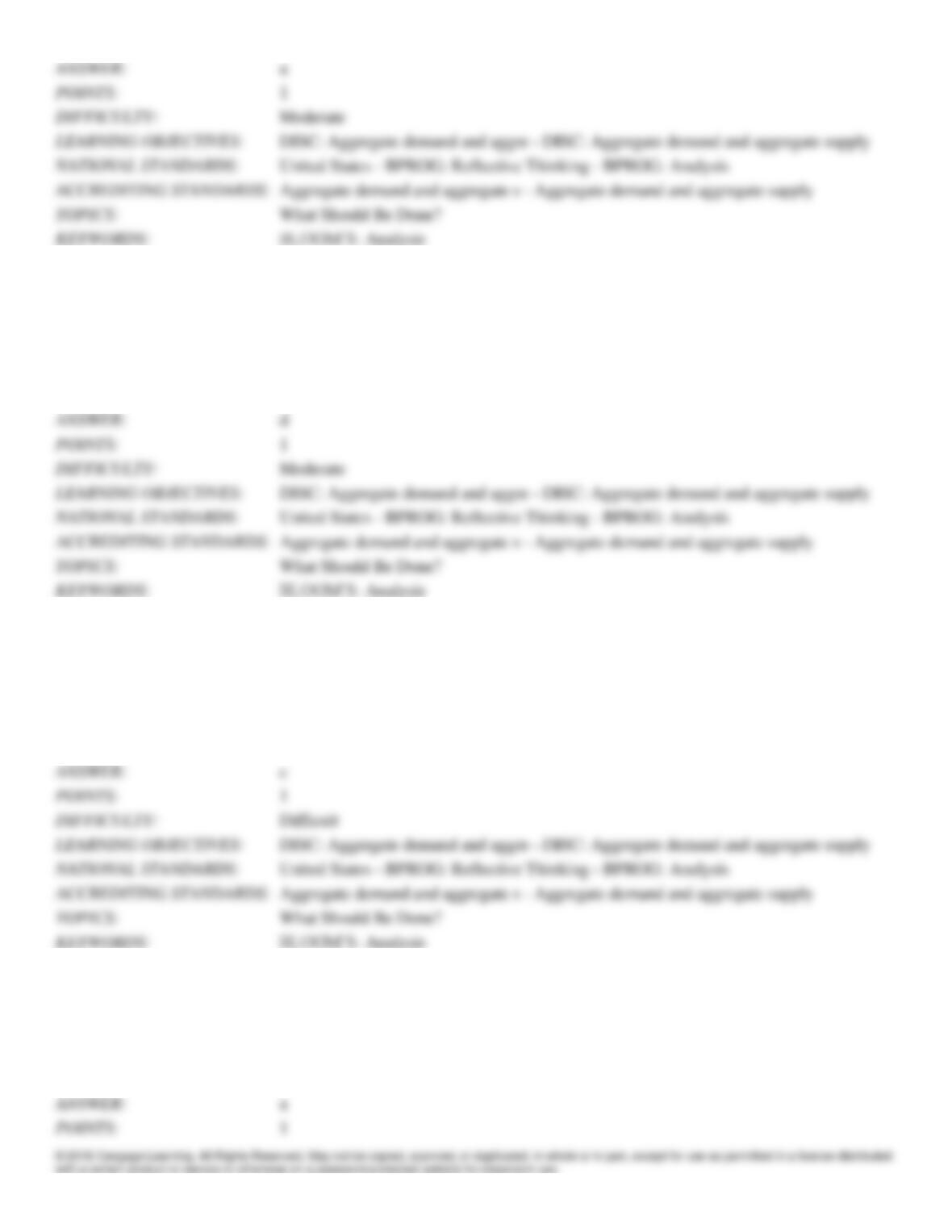
Figure 17-8
147. In Figure 17–8, which of the following movements reflects the closing of an inflationary gap through the economy’s
automatic adjustment mechanism?
a.
A to B
b.
A to C
c.
C to E
d.
D to E
DISC: Aggregate demand and aggre – DISC: Aggregate demand and aggregate supply
United States – BPROG: Reflective Thinking – BPROG: Analysis
Aggregate demand and aggregate s – Aggregate demand and aggregate supply
What Should Be Done?
148. In Figure 17–8, which of the following movements reflects the closing of a recessionary gap through the economy’s
self-correcting mechanism?
a.
A to B
b.
A to C
c.
C to E
d.
D to E
DISC: Aggregate demand and aggre – DISC: Aggregate demand and aggregate supply
United States – BPROG: Reflective Thinking – BPROG: Analysis
Aggregate demand and aggregate s – Aggregate demand and aggregate supply
What Should Be Done?
149. In Figure 17–8, which of the following movements reflects the Fed’s anti-inflationary policy of the early 1980s and
the following market adjustment?
a.
A to B to C
b.
E to A to B
c.
C to D to E
d.
D to E to C
DISC: Aggregate demand and aggre – DISC: Aggregate demand and aggregate supply
United States – BPROG: Reflective Thinking – BPROG: Analysis
Aggregate demand and aggregate s – Aggregate demand and aggregate supply
What Should Be Done?
150. In Figure 17–8, which of the following movements would you associate with a “negative supply shock”?
a.
A to B
b.
A to C
c.
C to E
d.
D to E
DISC: Aggregate demand and aggre – DISC: Aggregate demand and aggregate supply
United States – BPROG: Reflective Thinking – BPROG: Analysis
Aggregate demand and aggregate s – Aggregate demand and aggregate supply
What Should Be Done?
151. In Figure 17–8, policy makers can choose any of the following points as sustainable inflation-unemployment
combinations:
a.
only E.
b.
A or B.
c.
A, B, C, D, E.
d.
B, E, C.
DISC: Aggregate demand and aggre – DISC: Aggregate demand and aggregate supply
United States – BPROG: Reflective Thinking – BPROG: Analysis
Aggregate demand and aggregate s – Aggregate demand and aggregate supply
What Should Be Done?
152. In Figure 17–8, which of the following movements reflects the closing of a recessionary gap with an expansionary
monetary and fiscal policy?
a.
C to B
b.
D to C
c.
C to E
d.
D to E
DISC: Aggregate demand and aggre – DISC: Aggregate demand and aggregate supply
United States – BPROG: Reflective Thinking – BPROG: Analysis
Aggregate demand and aggregate s – Aggregate demand and aggregate supply
What Should Be Done?
153. In Figure 17–8, which of the following movements illustrates the response of the economy to a stimulation of
aggregate demand when workers systematically underpredict inflation?
a.
C to A
b.
C to B
c.
C to D
d.
C to E
DISC: Aggregate demand and aggre – DISC: Aggregate demand and aggregate supply
United States – BPROG: Reflective Thinking – BPROG: Analysis
Aggregate demand and aggregate s – Aggregate demand and aggregate supply
What Should Be Done?
154. In Figure 17–8, which of the following movements illustrates the response of the economy to an increase in aggregate
demand when expectations are “rational”?
a.
C to A
b.
C to B
c.
C to D
d.
C to E
Difficult
DISC: Aggregate demand and aggre – DISC: Aggregate demand and aggregate supply
United States – BPROG: Reflective Thinking – BPROG: Analysis
Aggregate demand and aggregate s – Aggregate demand and aggregate supply
What Should Be Done?
155. In Figure 17–8, which of the following points cannot be observed in the long run?
a.
A
b.
B
c.
C
d.
E
a
Moderate
DISC: Aggregate demand and aggre – DISC: Aggregate demand and aggregate supply
United States – BPROG: Reflective Thinking – BPROG: Analysis
Aggregate demand and aggregate s – Aggregate demand and aggregate supply
What Should Be Done?
156. In Figure 17–8, the aggregate supply curve is shifting inward as we move from
a.
A to C.
b.
C to E.
c.
A to B.
d.
D to C.
c
Difficult
DISC: Aggregate demand and aggre – DISC: Aggregate demand and aggregate supply
United States – BPROG: Reflective Thinking – BPROG: Analysis
Aggregate demand and aggregate s – Aggregate demand and aggregate supply
What Should Be Done?
157. In Figure 17–8, which of the following points illustrate the expansionary monetary policies of the mid-1990s and the
accompanying favorable supply shocks?
a.
A to B to C
b.
B to C to E
c.
C to B to A
d.
D to C to E
DISC: Aggregate demand and aggre – DISC: Aggregate demand and aggregate supply
United States – BPROG: Reflective Thinking – BPROG: Analysis
Aggregate demand and aggregate s – Aggregate demand and aggregate supply
What Should Be Done?
158. If policy makers do nothing in a recessionary gap, the most likely outcome is a
a.
drop in the inflation rate and a rise in the unemployment rate.
b.
drop in the inflation rate and a drop in the unemployment rate.
c.
rise in the inflation rate and a drop in the unemployment rate.
d.
rise in the inflation rate and a rise in the unemployment rate.
DISC: Aggregate demand and aggre – DISC: Aggregate demand and aggregate supply
United States – BPROG: Analytic
Aggregate demand and aggregate s – Aggregate demand and aggregate supply
What Should Be Done?
159. In 2010, dissenters were worried that the effects of policies to reduce unemployment would create
a.
the conditions for higher long-term inflation.
b.
the conditions for a more horizontal Phillips curve.
c.
conditions for higher long-term unemployment.
d.
conditions for larger budget surpluses and, thus, higher interest rates.
DISC: Aggregate demand and aggre – DISC: Aggregate demand and aggregate supply
United States – BPROG: Analytic
Aggregate demand and aggregate s – Aggregate demand and aggregate supply
What Should Be Done?
160. Policy makers who believe that the costs of unemployment are very high will tend to favor which of the following
during a recessionary gap?
a.
moderate fiscal stimulus, no monetary stimulus
b.
fiscal and monetary tightness
c.
moderate monetary stimulus, fiscal tightness
d.
strong fiscal and monetary stimulus
DISC: Monetary and fiscal policy
United States – BPROG: Analytic
Monetary and fiscal policy
What Should Be Done?
161. Policy makers who believe that the costs of inflation are very high will tend to favor which of the following during
an inflationary gap?
a.
moderate fiscal stimulus, no monetary stimulus
b.
fiscal and monetary tightness
c.
moderate monetary stimulus, fiscal tightness
d.
strong fiscal and monetary stimulus
DISC: Monetary and fiscal policy
United States – BPROG: Analytic
Monetary and fiscal policy
What Should Be Done?
162. If the short-run Phillips curve has a very flat slope, the
a.
structural deficit will grow during inflation.
b.
structural deficit will fall during recession.
c.
inflation costs of reducing unemployment are relatively low.
d.
inflation costs of reducing unemployment are relatively high.
DISC: Aggregate demand and aggre – DISC: Aggregate demand and aggregate supply
United States – BPROG: Analytic
Aggregate demand and aggregate s – Aggregate demand and aggregate supply
What Should Be Done?
163. If the short-run Phillips curve has a very steep slope, the
a.
structural deficit will grow during inflation.
b.
structural deficit will fall during recession.
c.
inflation costs of reducing unemployment are relatively low.
d.
inflation costs of reducing unemployment are relatively high.
DISC: Aggregate demand and aggre – DISC: Aggregate demand and aggregate supply
United States – BPROG: Analytic
Aggregate demand and aggregate s – Aggregate demand and aggregate supply
What Should Be Done?
164. If the self-correcting mechanism operates quickly,
a.
direct intervention is less necessary to close a recessionary gap.
b.
fiscal stimulus is far more useful in closing a recessionary gap than monetary policy.
c.
monetary policy is far more useful in closing a recessionary gap than fiscal policy.
d.
fiscal stimulus is ineffective and inflation will occur.
DISC: Aggregate demand and aggre – DISC: Aggregate demand and aggregate supply
United States – BPROG: Analytic
Aggregate demand and aggregate s – Aggregate demand and aggregate supply
What Should Be Done?
165. Based on the evidence, most economists believe that the self-correcting mechanism operates
a.
slowly with prices, but quickly with wages.
b.
slowly with wages, but quickly with prices.
c.
very slowly with wages.
d.
efficiently, so that stabilization policy is not necessary.
DISC: Aggregate demand and aggre – DISC: Aggregate demand and aggregate supply
United States – BPROG: Analytic
Aggregate demand and aggregate s – Aggregate demand and aggregate supply
What Should Be Done?
166. If workers and firms forecast inflation accurately,
a.
the aggregate supply curve will be vertical.
b.
the real wage will not decline as the price level rises.
c.
workers will not lose from inflation, and firms will not gain.
d.
All of the above are correct.
DISC: Aggregate demand and aggre – DISC: Aggregate demand and aggregate supply
United States – BPROG: Analytic
Aggregate demand and aggregate s – Aggregate demand and aggregate supply
Inflationary Expectations and the Phillips Curve
167. If workers demand wage compensation in advance of inflation, the economy’s aggregate supply curve will
a.
have a positive slope.
b.
have a negative slope.
c.
be vertical.
d.
be horizontal.
DISC: Aggregate demand and aggre – DISC: Aggregate demand and aggregate supply
United States – BPROG: Analytic
Aggregate demand and aggregate s – Aggregate demand and aggregate supply
Inflationary Expectations and the Phillips Curve
168. If workers always see inflation coming, and if they demand wage increases in advance so that inflation does not
erode real wages, then the economy’s aggregate supply curve on the AD–AS diagram will
a.
be a vertical line corresponding to potential GDP.
b.
be a horizontal line corresponding to potential GDP.
c.
slope downward.
d.
slope upward.
DISC: Aggregate demand and aggre – DISC: Aggregate demand and aggregate supply
United States – BPROG: Analytic
Aggregate demand and aggregate s – Aggregate demand and aggregate supply
Inflationary Expectations and the Phillips Curve
169. If inflationary expectations are quite sluggish (that is, they do not adapt quickly), then the short-run Phillips curve
will
a.
be vertical.
b.
be horizontal.
c.
slope downward.
d.
slope upward.
DISC: Aggregate demand and aggre – DISC: Aggregate demand and aggregate supply
United States – BPROG: Analytic
Aggregate demand and aggregate s – Aggregate demand and aggregate supply
Inflationary Expectations and the Phillips Curve
170. Many economists think that, in the long run, the Phillips curve is
a.
a horizontal line.
b.
a vertical line.
c.
the same as the short-run curve.
d.
a 45-degree line from the origin.
DISC: Aggregate demand and aggre – DISC: Aggregate demand and aggregate supply
United States – BPROG: Analytic
Aggregate demand and aggregate s – Aggregate demand and aggregate supply
Inflationary Expectations and the Phillips Curve
171. What will tend to happen to wages if workers and employers foresee inflation?
a.
Both parties will seek to reduce nominal wages and therefore keep real wages the same.
b.
Nominal wages will remain constant but real wages will increase to avoid the effects of inflation.
c.
Inflation erodes purchasing power of workers, and real wages are unchanged.
d.
Nominal wages will increase by an amount that keeps real wages constant.
DISC: Aggregate demand and aggre – DISC: Aggregate demand and aggregate supply
United States – BPROG: Analytic
Aggregate demand and aggregate s – Aggregate demand and aggregate supply
Inflationary Expectations and the Phillips Curve
172. Many economists think that, in the long run, the economy tends to move toward
a.
the natural or full-employment rate of unemployment.
b.
the natural or full-employment rate of inflation.
c.
a severe slump with high unemployment.
d.
an accelerating rate of inflation.
DISC: Aggregate demand and aggre – DISC: Aggregate demand and aggregate supply
United States – BPROG: Analytic
Aggregate demand and aggregate s – Aggregate demand and aggregate supply
Inflationary Expectations and the Phillips Curve
173. If workers expect inflation, and negotiate wage increases that exactly match price increases, the result is a
a.
horizontal aggregate supply curve at the level of potential GDP.
b.
vertical aggregate supply curve at the level of potential GDP.
c.
horizontal aggregate demand curve at the level of potential GDP.
d.
vertical aggregate demand curve at the level of potential GDP.
Moderate
DISC: Aggregate demand and aggre – DISC: Aggregate demand and aggregate supply
United States – BPROG: Analytic
Aggregate demand and aggregate s – Aggregate demand and aggregate supply
Inflationary Expectations and the Phillips Curve
174. If workers expect inflation, and tend to overestimate actual inflation when they negotiate wage increases, the result
will be a continuing
a.
shift of AD to the left.
b.
shift of AD to the right.
c.
recessionary gap.
d.
inflationary gap.
c
Moderate
DISC: Aggregate demand and aggre – DISC: Aggregate demand and aggregate supply
United States – BPROG: Analytic
Aggregate demand and aggregate s – Aggregate demand and aggregate supply
Inflationary Expectations and the Phillips Curve
175. If workers underestimate inflation, the aggregate supply curve will tend to be
a.
upward sloping.
b.
downward sloping.
c.
vertical.
d.
horizontal.
a
Easy
DISC: Aggregate demand and aggre – DISC: Aggregate demand and aggregate supply
United States – BPROG: Analytic
Aggregate demand and aggregate s – Aggregate demand and aggregate supply
Inflationary Expectations and the Phillips Curve
176. If employees and employers always accurately predict inflation, what is the shape of the Phillips curve?