DISC: Monetary and fiscal policy
United States – BPROG: Analytic
Monetary and fiscal policy
Why is the National Debt Considered a Burden?
135. In contrast to Argentina in 2001, the United States debt is less of a burden because the U.S. debt is
a.
an obligation to pay over a longer period of time.
b.
owed entirely to U.S. citizens and banks.
c.
an obligation to pay in domestic currency.
d.
an obligation to pay in foreign currency.
DISC: Monetary and fiscal policy
United States – BPROG: Analytic
Monetary and fiscal policy
Why is the National Debt Considered a Burden?
136. If the national debt is owned by domestic citizens:
a.
the debt will not have to be repaid.
b.
future interest payments transfer funds from one group of Americans to another.
c.
the debt will have to be repaid first to domestic creditors, then to foreign creditors.
d.
future interest payments will go to pay foreign debt first, then debt owed to American citizens.
DISC: Monetary and fiscal policy
United States – BPROG: Analytic
Monetary and fiscal policy
Why is the National Debt Considered a Burden?
137. Argentina in 2001 faced a debt problem more serious than the U.S. debt problem because Argentina was obligated to
repay its debt in
a.
U.S. dollars.
b.
their own currencies.
c.
a relatively short period of time.
d.
large installments.
DISC: Monetary and fiscal policy
United States – BPROG: Analytic
Monetary and fiscal policy
Why is the National Debt Considered a Burden?
138. The policy mix that the Clinton administration sought in early 1993 was a
a.
smaller budget deficit and tighter monetary policy.
b.
smaller budget deficit and looser monetary policy.
c.
larger budget deficit and looser monetary policy.
d.
larger budget deficit and tighter monetary policy.
DISC: Monetary and fiscal policy
United States – BPROG: Analytic
Monetary and fiscal policy
Budget Deficits and Inflation
139. Which of the following is true regarding the effect of deficits from 1980-2005 in the U.S.?
a.
They did not lead to substantial inflation because the Fed did not monetize the deficits.
b.
They did not lead to substantial inflation because the Fed did monetize the deficits.
c.
They led to substantial inflation because the Fed did not monetize the deficits.
d.
They led to substantial inflation because the Fed did monetize the deficits.
DISC: Monetary and fiscal policy
United States – BPROG: Analytic
Monetary and fiscal policy
Budget Deficits and Inflation
140. Budget deficits are inflationary when
a.
the Federal Reserve contracts the money supply.
b.
the economy has lots of slack and the aggregate supply curve is horizontal.
c.
the economy is at full employment and the aggregate supply curve is vertical.
d.
private citizens buy the bonds to finance the debt.
DISC: Monetary and fiscal policy
United States – BPROG: Analytic
Monetary and fiscal policy
Budget Deficits and Inflation
141. The central bank is said to monetize the deficit when it
a.
prints Federal Reserve notes to satisfy the increased demand for money.
b.
sells government bonds from its own portfolio of government securities.
c.
requires member banks to buy the bonds to finance the deficit.
d.
purchases the bonds that the government issues.
DISC: Monetary and fiscal policy
United States – BPROG: Analytic
Monetary and fiscal policy
Budget Deficits and Inflation
142. “Budget deficits are inflationary.” The truth of this statement depends on
a.
aggregate demand in the economy.
b.
the shape of the aggregate supply curve.
c.
the size of the national debt.
d.
existing debt as a percentage of GDP.
DISC: Monetary and fiscal policy
United States – BPROG: Analytic
Monetary and fiscal policy
Budget Deficits and Inflation
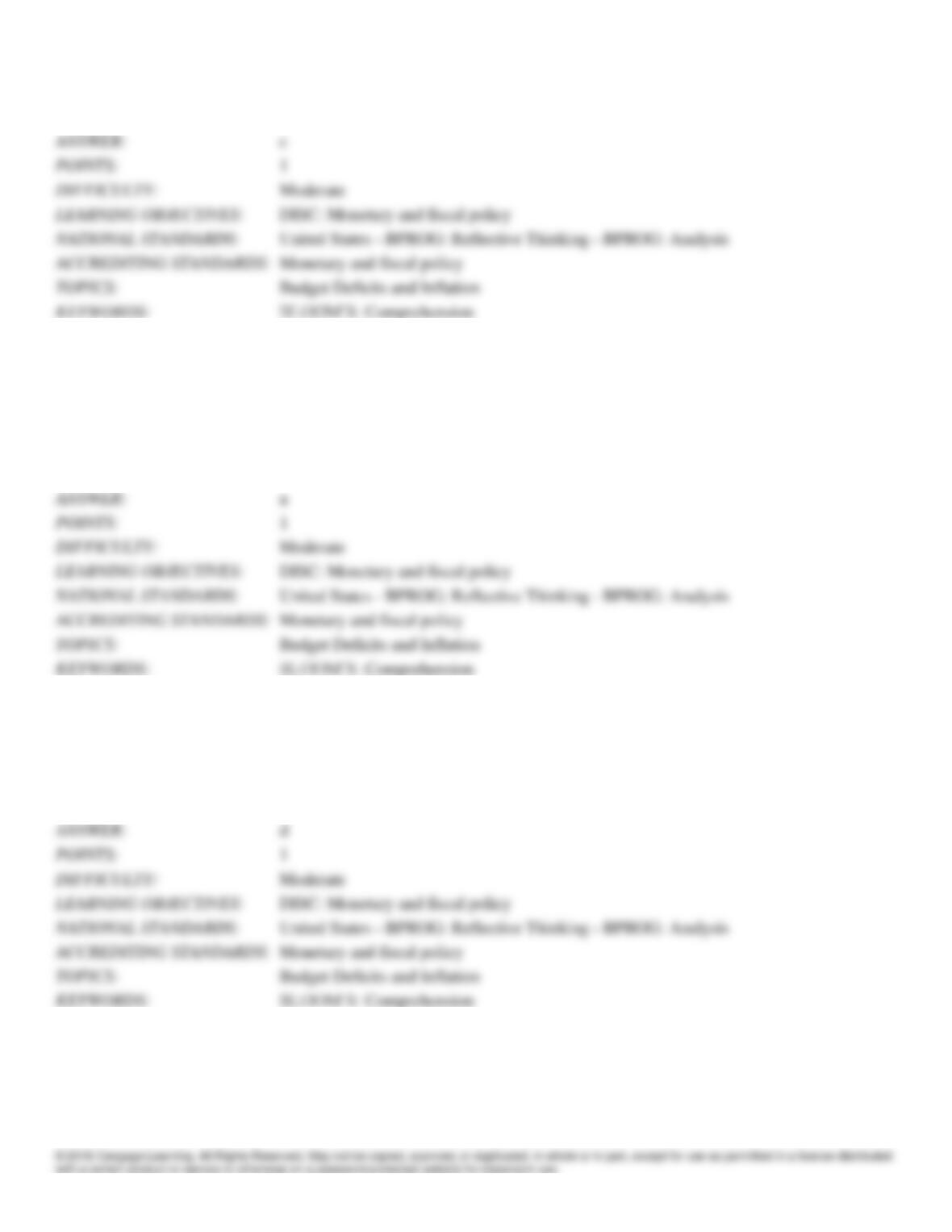
Figure 16-2
143. Assume that a contractionary monetary policy has shifted the aggregate demand curve in Figure 16-2 from D0D0 to
D1D1. Fiscal authorities who wish to restore real GDP to the full-employment level will
a.
run a budget surplus by increasing taxes or cutting government spending.
b.
run a balanced budget to prevent the interest rate from rising and cutting off investment.
c.
run a budget deficit by cutting taxes or increasing government spending.
d.
ignore the change in monetary policy since it has no effect on fiscal policy.
DISC: Monetary and fiscal policy
United States – BPROG: Reflective Thinking – BPROG: Analysis
Monetary and fiscal policy
Budget Deficits and Inflation
144. Suppose that Figure 16-2 shows the effects of reducing the budget deficit by raising taxes. If authorities do not want
real GDP to fall, monetary policy must
a.
become sufficiently more expansionary to restore the aggregate demand curve to D0D0.
b.
contract aggregate demand to be consistent with deficit-reducing fiscal policy.
c.
not lower interest rates and thwart the goal of a balanced budget.
d.
become more contractionary to lower the interest rate and spur investment.
DISC: Monetary and fiscal policy
United States – BPROG: Reflective Thinking – BPROG: Analysis
Monetary and fiscal policy
145. If the aggregate supply curve has its normal shape, deficit spending will increase
a.
both GDP and the price level at about the same rate.
b.
the price level before it increases real GDP.
c.
the price level but decrease real GDP.
d.
real GDP before it increases the price level.
DISC: Monetary and fiscal policy
United States – BPROG: Reflective Thinking – BPROG: Analysis
Monetary and fiscal policy
Budget Deficits and Inflation
146. The Federal Reserve may choose to monetize the debt in order to
a.
reduce the burden of the national debt.
b.
shift the supply curve of money outward.
c.
shift the demand curve for money inward.
d.
reduce the volume of reserves in commercial banks.
DISC: Monetary and fiscal policy
United States – BPROG: Analytic
Monetary and fiscal policy
Budget Deficits and Inflation
147. If the Fed is increasing its holdings of government bonds at the same time the federal deficit is increasing,
a.
the Fed and the Treasury are, as usual, coordinating activities.
b.
crowding out is more likely to occur.
c.
the debt is being monetized.
d.
the Fed is attempting to increase interest rates.
DISC: Monetary and fiscal policy
United States – BPROG: Analytic
Monetary and fiscal policy
Budget Deficits and Inflation
148. The appropriate fiscal policy stance depends, at least partly, on the
a.
stance of trade policy.
b.
stance of monetary policy.
c.
party in power in Congress.
d.
party in power in the presidency.
DISC: Monetary and fiscal policy
United States – BPROG: Analytic
Monetary and fiscal policy
Budget Deficits and Inflation
149. If the economy is in an inflationary gap, which of the following is the least appropriate policy mix?
a.
a budget surplus and expansionary monetary policy
b.
a budget deficit and expansionary monetary policy
c.
a budget deficit and contractionary monetary policy
d.
a budget surplus and contractionary monetary policy
DISC: Monetary and fiscal policy
United States – BPROG: Analytic
Monetary and fiscal policy
Budget Deficits and Inflation
150. Analysis indicates that the economy is in a recessionary gap. Which of the following is the most appropriate policy
mix in this situation?
a.
a budget surplus and expansionary monetary policy
b.
a budget deficit and expansionary monetary policy
c.
a budget deficit and contractionary monetary policy
d.
a budget surplus and contractionary monetary policy
Moderate
DISC: Monetary and fiscal policy
United States – BPROG: Analytic
Monetary and fiscal policy
Budget Deficits and Inflation
151. The decisions on the part of the government to increase spending by $5 billion will have the largest impact on
aggregate demand when the spending is financed by the sale of bonds to
a.
the member banks.
b.
the public.
c.
the Fed.
d.
foreigners.
c
Moderate
DISC: Monetary and fiscal policy
United States – BPROG: Analytic
Monetary and fiscal policy
Budget Deficits and Inflation
152. The argument that budget deficits are inflationary is
a.
always correct.
b.
correct only when the deficit is monetized.
c.
correct only when the aggregate supply curve is horizontal.
d.
correct only when the aggregate supply curve is upward sloping.
Easy
DISC: Monetary and fiscal policy
United States – BPROG: Analytic
Monetary and fiscal policy
Budget Deficits and Inflation
153. If the level of government spending increases at the same time the Fed is pursuing contractionary monetary policy,
we know that
a.
incomes will fall.
b.
the interest rate will rise.
c.
incomes will rise.
d.
the interest rate will fall.
DISC: Monetary and fiscal policy
United States – BPROG: Analytic
Monetary and fiscal policy
Budget Deficits and Inflation
154. Analysis indicates that the economy is in a recessionary gap. Which of the following is the least appropriate policy
mix in this situation?
a.
a budget surplus and expansionary monetary policy
b.
a budget deficit and expansionary monetary policy
c.
a budget deficit and contractionary monetary policy
d.
a budget surplus and contractionary monetary policy
DISC: Monetary and fiscal policy
United States – BPROG: Analytic
Monetary and fiscal policy
Budget Deficits and Inflation
155. If the Fed decides to keep interest rates low when there is a large budget deficit, economists conclude that the Fed is
a.
monetizing the debt.
b.
neutralizing the effects of the deficit.
c.
correcting the deficit for inflation.
d.
resisting the effects of the deficit.
DISC: Monetary and fiscal policy
United States – BPROG: Analytic
Monetary and fiscal policy
Budget Deficits and Inflation
156. When (if at all) are budget deficits inflationary?
a.
when AS is perfectly horizontal
b.
when AS has a very steep slope
c.
when AS has a downward slope
d.
when AS intersects AD
DISC: Monetary and fiscal policy
United States – BPROG: Analytic
Monetary and fiscal policy
Budget Deficits and Inflation
157. Monetization of the deficit (or debt) means that
a.
the government uses monetary policy to control the economy rather than fiscal policy.
b.
inflation accounting corrects for price increases.
c.
the Fed buys newly issued debt and increases the money supply.
d.
the amount of money in circulation is equal to the size of the debt.
DISC: Monetary and fiscal policy
United States – BPROG: Analytic
Monetary and fiscal policy
Budget Deficits and Inflation
158. Monetizing the debt has what effect on the economy?
a.
slow increase in AS with steady inflation
b.
rapid increase in AD with an increase in inflation
c.
rapid increase in AS with a drop in inflation
d.
decrease in AD with an increase in inflation
DISC: Monetary and fiscal policy
United States – BPROG: Analytic
Monetary and fiscal policy
Budget Deficits and Inflation
159. Why might the Fed decide to monetize the deficit?
a.
to keep inflation low
b.
to reduce the structural deficit
c.
to reduce the budget deficit
d.
to keep interest rates low
Easy
DISC: Monetary and fiscal policy
United States – BPROG: Analytic
Monetary and fiscal policy
Budget Deficits and Inflation
160. In actual practice, does the Fed monetize the debt?
a.
No, it did not do so even with large deficits in the 1980s and early 2000s.
b.
No longer, although it monetized much of the deficit in the 1980s.
c.
Yes, although it monetizes less now than in the 1980s.
d.
Yes, it has monetized the deficit steadily since the early 1970s.
a
Moderate
DISC: Monetary and fiscal policy
United States – BPROG: Analytic
Monetary and fiscal policy
Budget Deficits and Inflation
161. Monetizing deficits has lead to serious inflation in
a.
the United States.
b.
Canada.
c.
the United Kingdom.
d.
Russia, Latin America, and Israel.
e.
All of the above are correct.
Easy
DISC: Monetary and fiscal policy
United States – BPROG: Analytic
Monetary and fiscal policy
Budget Deficits and Inflation
162. Crowding out occurs when
a.
increased taxes force higher levels of national saving.
b.
deficit spending by the government forces private investment spending to contract.
c.
local businesses cannot get government contracts because of the higher bids of large corporations.
d.
foreign investors are willing to pay higher prices for U.S. bonds than American citizens will pay.
DISC: Monetary and fiscal policy
United States – BPROG: Analytic
Monetary and fiscal policy
Debts, Interest Rates, and Crowding Out
163. The fallacy in the strict crowding-out argument comes from supposing that
a.
the Federal Reserve always accommodates the U.S. Treasury in its financing of the deficit.
b.
corporations always outbid small businesses for government contracts.
c.
the economy’s flow of saving is fixed.
d.
investors will spend more when G increases.
DISC: Monetary and fiscal policy
United States – BPROG: Analytic
Monetary and fiscal policy
Debts, Interest Rates, and Crowding Out
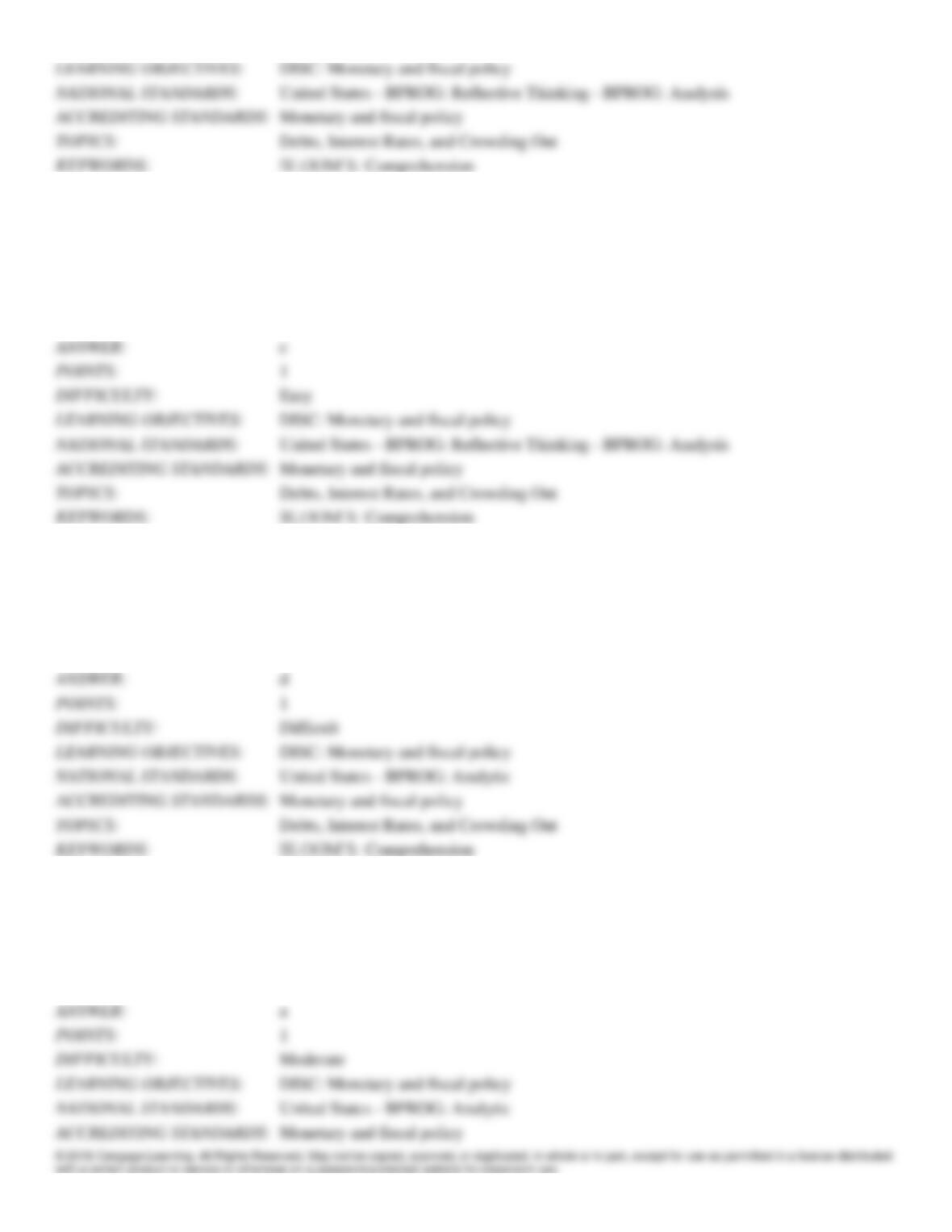
Figure 16-3
164. Figure 16-3 shows the impact of deficit spending and the corresponding economic expansion on the demand curve
for money. If the Federal Reserve does not want interest rates to rise, it will
a.
shift the money supply curve to the right by monetizing the deficit.
b.
shift the money supply curve to the left by open market sales of government securities.
c.
maintain the current targets for both M1 and M2 money stocks.
d.
engage in contractionary monetary policy, such as increases in the discount rate.
DISC: Monetary and fiscal policy
United States – BPROG: Reflective Thinking – BPROG: Analysis
Monetary and fiscal policy
Debts, Interest Rates, and Crowding Out
165. If budget deficits shift the money demand curve as is illustrated in Figure 16–3, which component of total
expenditures will be affected the most?
a.
consumption spending
b.
government spending
c.
private investment spending
d.
net exports
DISC: Monetary and fiscal policy
United States – BPROG: Reflective Thinking – BPROG: Analysis
Monetary and fiscal policy
Debts, Interest Rates, and Crowding Out
166. The crowding-out effect is more likely to dominate the crowding-in effect when investment is relatively
a.
insensitive to interest rates and to GDP.
b.
insensitive to interest rates but sensitive to GDP.
c.
sensitive to interest rates and to GDP.
d.
sensitive to interest rates and insensitive to GDP.
DISC: Monetary and fiscal policy
United States – BPROG: Analytic
Monetary and fiscal policy
Debts, Interest Rates, and Crowding Out
167. Many economists believe that if fiscal policy turns contractionary to reduce the deficit,
a.
monetary policy can turn expansionary to counteract the effects on aggregate demand.
b.
monetary policy must be contractionary to reinforce the good effects of contractionary fiscal policy.
c.
foreign investment in the United States must be encouraged.
d.
taxes on the earnings from stock market gains should be increased.
DISC: Monetary and fiscal policy
United States – BPROG: Analytic
Monetary and fiscal policy
Debts, Interest Rates, and Crowding Out
168. If the economy is near full employment and Congress cuts taxes, the proper monetary policy should be
a.
expansionary to keep the economy fully employed.
b.
expansionary to counteract the increased deficit.
c.
contractionary to shift the aggregate demand curve outward.
d.
contractionary to counteract the effects of fiscal policy.
DISC: Monetary and fiscal policy
United States – BPROG: Analytic
Monetary and fiscal policy
Debts, Interest Rates, and Crowding Out
169. The crowding-in effect depends on the sensitivity of investment to
a.
GDP, as does the crowding-out effect.
b.
interest rates, whereas the crowding-out effect depends on the sensitivity of investment to GDP.
c.
interest rates, as does the crowding-out effect.
d.
GDP, whereas the crowding–out effect depends on the sensitivity of investment to interest rates.
DISC: Monetary and fiscal policy
United States – BPROG: Analytic
Monetary and fiscal policy
Debts, Interest Rates, and Crowding Out
170. The crowding-in effect results from
a.
a low MPS.
b.
induced investment.
c.
induced consumption.
d.
rising interest rates.
DISC: Monetary and fiscal policy
United States – BPROG: Analytic
Monetary and fiscal policy
Debts, Interest Rates, and Crowding Out
171. The crowding-in effect depends on the fact that often a decrease in taxes causes a(n)
a.
decrease in interest rates and an increase in the price of existing bonds.
b.
increase in output, which induces more investment.
c.
increase in interest rates and a decrease in the price of existing bonds.
d.
decrease in interest rates and the price of existing bonds.
Difficult
DISC: Monetary and fiscal policy
United States – BPROG: Analytic
Monetary and fiscal policy
Debts, Interest Rates, and Crowding Out
172. The crowding-out effect is likely to be the strongest during periods of
a.
recession.
b.
large budget surpluses.
c.
high employment.
d.
expanding money supply.
c
Moderate
DISC: Monetary and fiscal policy
United States – BPROG: Analytic
Monetary and fiscal policy
173. The crowding-out effect of higher interest rates can be avoided by
a.
expansionary monetary policy.
b.
expansionary fiscal policy.
c.
contractionary monetary policy.
d.
decreasing taxes.
a
Difficult
DISC: Monetary and fiscal policy
United States – BPROG: Analytic
Monetary and fiscal policy
Debts, Interest Rates, and Crowding Out
174. The strict crowding-out argument relies on the assumption that
a.
the government must raise taxes to pay for spending, and the tax increase crowds out the stimulative effect of
increased spending.
b.
the total flow of saving is a fixed amount.
c.
investment is invariant to interest rates, but very dependent on aggregate spending.
d.
consumption will rise to absorb most of an increase in income, and investment will accordingly fall.
Difficult
DISC: Monetary and fiscal policy
United States – BPROG: Analytic
Monetary and fiscal policy
Debts, Interest Rates, and Crowding Out
175. Crowding out can best be defined as
a.
higher interest rates caused by restrictive monetary policy, which reduces investment.
b.
higher interest rates caused by restrictive monetary policy, which increases saving and reduces consumption
spending.
c.
government budget deficits causing a drop in private borrowing because of higher interest rates.
d.
government budget deficits causing a drop in interest rates, which reduces private saving.
c
Difficult
DISC: Monetary and fiscal policy
United States – BPROG: Analytic
Monetary and fiscal policy
Debts, Interest Rates, and Crowding Out
176. “Crowding-out” refers to the process by which
a.
high consumption leads to low saving and investment.
b.
the Fed prevents “runs” on banks.
c.
Fed sales of bonds reduce the ability of corporations to buy bonds.
d.
increased government spending raises interest rates, thus lowering investment spending.
Easy
DISC: Monetary and fiscal policy
United States – BPROG: Analytic
Monetary and fiscal policy
Debts, Interest Rates, and Crowding Out
177. The Fed and the government are working against each other if, as the government cuts taxes to promote economic
growth, the Fed
a.
sells government securities.
b.
buys government securities.
c.
lowers the discount rate.
d.
lowers the prime rate.
a