7) Assume that $1 equals 100 yen (¥). A Japanese visitor to the United States wants to pay her
$400 hotel bill. How many yen should she exchange in order to have enough dollars to pay the
bill?
A) ¥4
B) ¥40
C) ¥4,000
D) ¥40,000
8) Checking exchange rates, you find $1 equals 0.75 euros. Then the price of 1 euro is
A) $0.25.
B) $0.75.
C) $1.33.
D) $4.30.
9) Every transaction concerning the exportation of U.S. goods constitutes a
A) demand for dollars, with no effect on markets for foreign currencies.
B) supply of foreign currency, with no effect on the market for dollars.
C) supply of foreign currency and demand for dollars.
D) demand for foreign currency and a supply of dollars.
10) Flexible exchange rates exist when
A) no one knows what the true value of a currency is.
B) governments and central banks spend foreign reserves to prop up an exchange rate at a certain
level.
C) exchange rates are determined by forces of supply and demand.
D) speculators bet that a currency will soon be depreciated.
11) Exchange rates that are allowed to fluctuate in the open market in response to changes in
supply and demand are known as
A) fixed exchange rates.
B) gold exchange rates.
C) flexible exchange rates.
D) IMF exchange rates.
12) Assume there is an increased demand in the United States for Australian wines. If all other
factors are held constant, this will result in
A) an increase in the U.S. dollar exchange rate for Australian dollars.
B) an appreciation of the U.S. dollar.
C) a movement along the demand curve for Australian wine.
D) a decrease in the par value of the Australian dollar.
13) One source of the supply of dollars in the foreign exchange market is
A) U.S. companies importing foreign goods.
B) foreign citizens buying U.S. goods.
C) SDRs being converted into dollars.
D) the U.S. Mint buying dollars from the Bank of England.
14) Flexible exchange rates are determined by
A) the government of the exporting country.
B) the government of the importing country.
C) the forces of supply and demand.
D) the IMF.
15) Under a flexible exchange rate system, a decrease in the value of a domestic currency in
terms of foreign currencies is referred to as
A) an appreciation.
B) a depreciation.
C) a devaluation.
D) a revaluation.
16) The demand for foreign currency in the United States is a
A) direct demand.
B) derived demand based on the demand for U.S. products.
C) derived demand based on the demand for foreign products.
D) direct demand based on the demand for U.S. dollars.
17) Suppose the exchange rate was $0.50 for one British pound. If the exchange rate falls to
$0.20 for one pound, we would expect to see
A) more exports to the U.K. since the price of the pound has risen.
B) fewer exports to the U.K. since the price of the pound has risen.
C) more U.S. imports from the U.K. since the price of the pound has fallen.
D) more U.S. exports since the price of the dollar has fallen.
18) In a flexible exchange rate system, which of the following would NOT cause the U.S. dollar
to depreciate relative to the British pound?
A) a decrease in demand for British goods in the United States
B) an increase in demand for British goods in the United States
C) a decrease in British demand for U.S. exports
D) a shift to the left in the supply of British goods to the United States
19) An increase in the value of a domestic currency in terms of other currencies is known as
A) an appreciation.
B) a depreciation.
C) a flexible exchange rate.
D) a discount rate.
20) The supply of U.S. dollars on foreign exchange markets is
A) determined directly by open market operations at the Federal Reserve Bank.
B) derived from the demand for U.S. products by foreigners.
C) derived from the supply of U.S. goods.
D) derived from the demand by United States for imported goods and services.
21) What happens if the Brazilian real appreciates relative to the U.S. dollar?
A) Brazilians will buy fewer U.S. goods, which generates an increase in the quantity supplied of
dollars.
B) The quantity demanded of reals increases as U.S. residents want to buy more Brazilian
products.
C) The quantity of reals supplied increases because the lower price (in reals) for U.S. goods
induces Brazilians to buy more U.S. products.
D) The U.S. Federal Reserve Bank increases the supply of dollars to the world economy.
22) Under a flexible exchange rate system, an increase in the value of the U.S. dollar in terms of
other currencies is referred to as
A) a depreciation of the U.S. dollar.
B) an appreciation of the U.S. dollar.
C) a monetizing of the U.S. dollar.
D) a devaluation of the U.S. dollar.
23) Which of the following would NOT increase German exports to the United States?
A) an appreciation of the U.S. dollar
B) a depreciation of the euro
C) an appreciation of the euro
D) an increase in German demand for U.S. exports
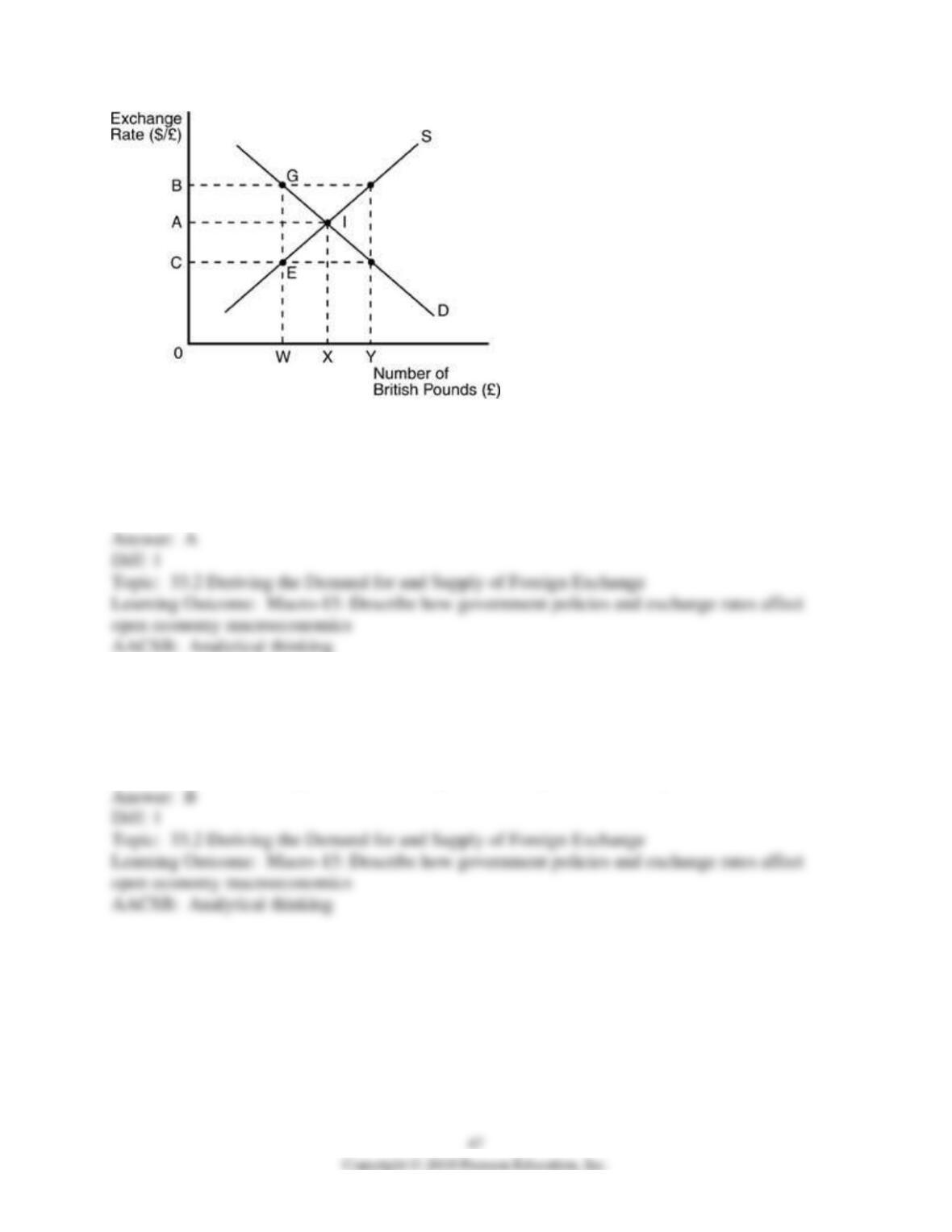
24) In the above figure, the equilibrium exchange rate between U.S. dollars and British pounds is
A) A.
B) B.
C) C.
D) W.
25) A depreciation of the U.S. dollar relative to the euro would tend to
A) increase U.S. imports from Germany.
B) increase U.S. exports to Germany.
C) decrease U.S. exports to Germany.
D) increase both U.S. imports from Germany and U.S. exports to Germany.
26) As the dollar price of a euro falls
A) U.S. residents will purchase fewer French imports.
B) the quantity of euros supplied will increase.
C) French goods will be less expensive to U.S. residents.
D) French residents will increase their purchases of U.S. assets.
27) As the dollar price of the euro increases
A) the demand for euros will increase.
B) the price of French goods will fall for U.S. residents.
C) French residents will purchase more U.S. goods.
D) U. S. residents will increase their travel to France.
28) When the dollar price of a British pound is $0.80, it is correct to state that an American
traveling in England will receive ________ pounds per dollar.
A) 1.25
B) 8
C) 80
D) 125
29) When a dinner in Bulgaria costs 150 Bulgarian levas, it will cost a U.S. resident ________
dollars, if the exchange rate is 1.5 Bulgarian levas to the dollar.
A) $10
B) $100
C) $120
D) $150
30) Under a flexible exchange rate system, an increase in the value of a domestic currency in
terms of other currencies is referred to as
A) an appreciation.
B) a depreciation.
C) a devaluation.
D) a revaluation.
31) If the foreign exchange rate for 1 Hungarian forint is 0.5 cent, then
A) a dinner priced at 400 forints will cost $20.
B) a wine that sells for 600 forints will cost $3,000.
C) a Big Mac hamburger priced at 50 forints will cost $1.
D) a hotel room renting for 40,000 forints will cost $200.
32) Demand for the Brazilian real is
A) determined by how well the real maintains its value.
B) a function of the Brazilian banking system.
C) derived from the supply of U.S. dollars.
D) derived from the demand for Brazilian goods.
33) An increase in the U.S. interest rate will most likely
A) reduce the attractiveness of investment in the United States.
B) lead to a decrease in the value of the U.S. dollar.
C) lead to an inflow of funds to the United States and an appreciation of the dollar.
D) provide a stimulus to U.S. export industries.
34) The market in which households, firms and governments buy and sell national currencies is
known as
A) the foreign exchange market.
B) standard drawing rights.
C) the exchange rate.
D) flexible exchange rates.
35) The foreign exchange market is
A) a market in which exchange rates are allowed to fluctuate in the open market in response to
changes in supply and demand.
B) the increase in the exchange value of one nation’s currency in terms of an other nation.
C) a market in which households, firms, and governments buy and sell national currencies.
D) the decrease in the exchange value of one nation’s currency in terms of another nation.
36) Caitlin has just decided to order a computer that is made in Japan. She needs to convert U.S.
dollars for Japanese yen. This conversion takes place in the
A) International Monetary Fund.
B) target zone.
C) foreign exchange markets.
D) SDRs.
37) Exchange rates that are allowed to fluctuate in response to changes in supply and demand is
known as
A) the foreign exchange markets.
B) standard drawing rights.
C) fixed exchange rates.
D) flexible exchange rates.
38) The price of one currency in terms off another currency is called
A) foreign reserves.
B) the foreign exchange rate.
C) the foreign trade deficit.
D) the balance of payments.
39) The price of one currency in terms of another is the
A) price of gold.
B) price of a SDR.
C) foreign exchange rate.
D) price of foreign stock.
40) If the foreign exchange rate is 70 cents for one Swiss franc, then
A) a car that costs 40,000 francs will cost $7,143.00.
B) a wine that costs 200 francs will cost $14.00.
C) a clock that costs 500 francs will cost $350.00.
D) a house that costs 100,000 francs will cost $700,000.00.
41) If the foreign exchange rate is one dollar for 10 South African rand, then how many dollars
are needed to purchase an item that costs 400 rand?
A) 10
B) 40
C) 400
D) 4,000
42) The demand for Canadian cheese by a U.S. store is also a
A) demand for Canadian dollars.
B) demand for SDRs.
C) supply of U.S. dollars.
D) supply of Canadian dollars.
43) Every transaction concerning the importation of goods into the United States constitutes a
A) supply of foreign currency with no effect on the market for the dollar.
B) demand for dollars with no effect on markets for foreign currencies.
C) supply of foreign currencies and a demand for dollars.
D) demand for foreign currencies and a supply of dollars.
44) Every transaction concerning the exportation of goods from the United States constitutes a
A) supply of foreign currency with no effect on the market for the dollar.
B) demand for dollars with no effect on markets for foreign currencies.
C) supply of foreign currencies and a demand for dollars.
D) demand for foreign currencies and a supply of dollars.
45) If the price of the Brazilian real is 60 cents and a U.S. resident purchases a Brazilian-
manufactured item for 60,000 real, there will be
A) a quantity demanded of 60,000 real and a quantity supplied of $60,000.
B) a quantity demanded of 60,000 real and a quantity supplied of $36,000.
C) a quantity demanded of 60,000 real, but we cannot determine the effect in the market for
dollars.
D) a quantity supplied of 60,000 real and a quantity demanded of 60,000 yen.
46) The term “flexible exchange rates” refers to
A) a situation in which exchange rates are allowed to fluctuate in the open market in response to
changes in supply and demand.
B) the increase in the exchange value of one nation’s currency in terms of an other nation.
C) a nation in which households, firms, and governments buy and sell national currencies.
D) the decrease in the exchange value of one nation’s currency in terms of another nation.
47) Under flexible exchange rates, the exchange rate is set by
A) the International Monetary Fund.
B) the U.S. Federal Reserve’s Board of Governors.
C) the intersection of demand and supply curves in the currency markets.
D) negotiations among central banks of the major industrial powers.
48) Flexible exchange rates occur when
A) speculators bet that a currency will soon depreciate.
B) governments and central banks spend foreign exchange to prop an exchange rate at a certain
level.
C) no one knows the true value of a currency.
D) exchange rates are determined by forces of supply and demand.
49) Suppose the U.S. dollar price of the Japanese yen decreases. Given this information, which
of the following is correct?
A) The dollar has appreciated.
B) The dollar has depreciated.
C) The yen has appreciated.
D) The yen price of the dollar decreased.
50) An appreciation of a nation’s currency is
A) a situation in which exchange rates are allowed to fluctuate in the open market in response to
changes in supply and demand.
B) the increase in the exchange value of one nation’s currency in terms of an other nation.
C) a nation in which households, firms, and governments buy and sell national currencies.
D) the decrease in the exchange value of one nation’s currency in terms of another nation.
51) A depreciation of a nation’s currency is
A) a situation in which exchange rates are allowed to fluctuate in the open market in response to
changes in supply and demand.
B) the increase in the exchange value of one nation’s currency in terms of an other nation.
C) a nation in which households, firms, and governments buy and sell national currencies.
D) the decrease in the exchange value of one nation’s currency in terms of another nation.
52) A U.S. automobile dealer has ordered a fleet of Japanese cars worth 10 million yen. The
terms of payment is C.O.D. (cash on delivery). At the time the order was placed, the exchange
rate was 100 yen per U.S. dollar. When the fleet arrived the exchange rate had become 200 yen
per U.S. dollar.
A) This change in the foreign exchange rate will hurt the U.S. importer.
B) This change in the foreign exchange rate will hurt the Japanese exporter.
C) This change in the foreign exchange rate will benefit the U.S. importer.
D) This change in the foreign exchange rate will benefit the Japanese exporter.
53) The supply of dollars in foreign exchange markets is
A) determined by the Federal Reserve’s Board of Governors.
B) determined by the demand for U.S. goods.
C) determined by the U.S. demand for foreign goods.
D) a function of the international banking system.
54) If the dollar used to buy 360 yen and now buys 100 yen, there has been
A) a decrease in the demand for yen.
B) depreciation of the yen.
C) depreciation of the dollar.
D) appreciation of the dollar.
55) If the dollar used to buy 100 yen and now buys 360 yen, there has been
A) appreciation of the dollar.
B) depreciation of the dollar.
C) appreciation of the yen.
D) an increase in special drawing rights.
56) If people in the United States buy more of a foreign good when its price falls, then
A) the demand curve for U.S. dollars will slope up.
B) the supply curve for U.S. dollars will slope up.
C) the exchange rate will increase when there is inflation.
D) fixed exchange rates will make foreign exchange markets more efficient.
57) An appreciation of the U.S. dollar relative to the Japanese yen causes
A) a lower dollar-price of Japanese goods which induces the U.S. to increase their purchasing of
Japanese goods.
B) the quantity demanded of U.S. dollars to increase because the Japanese want to buy more U.S.
goods.
C) the Japanese to buy more U.S. goods, causing the dollars to appreciate further.
D) the U.S. to buy less Japanese goods, causing the U.S. to depreciate.
58) An increase in the U.S. demand for Japanese yen causes
A) an increase in the dollar price of a yen.
B) an increase in the yen price of a dollar.
C) an increase in the demand for U.S. goods.
D) a decrease in the supply of yens.
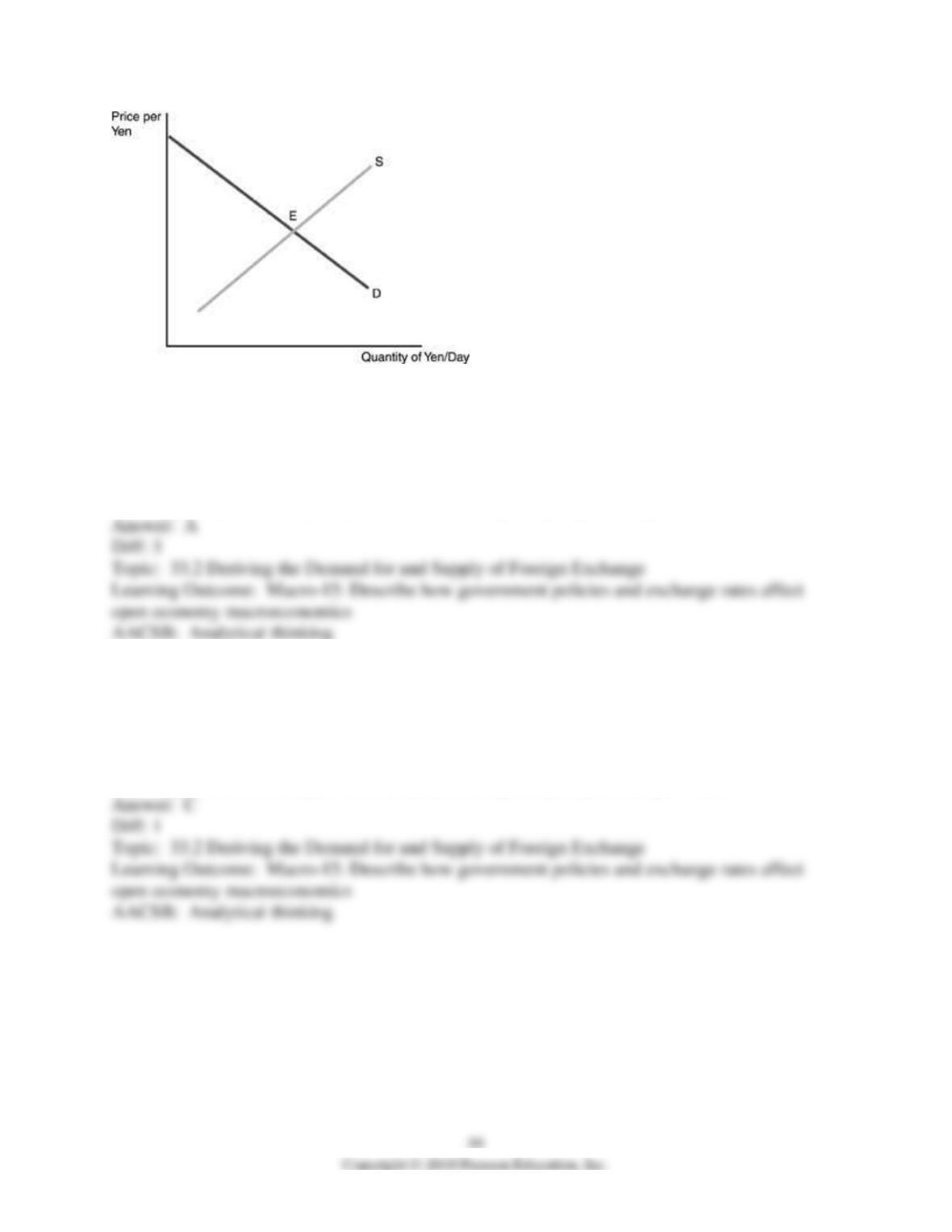
59) Refer to the above figure. Suppose E is the original equilibrium. An increase in the U.S.
demand for Japanese-made goods will lead to
A) a depreciation of the yen and an increase in the quantity of yen sold per week.
B) a depreciation of the yen and a decrease in the quantity of yen sold per week.
C) an appreciation of the yen and an increase in the quantity of yen sold per week.
D) an appreciation of the yen and a decrease in the quantity of yen sold per week.
60) Refer to the above figure. Suppose E is the original equilibrium. Japanese residents have
increased their demand for U.S. goods. This will lead to
A) a depreciation of the yen and an increase in the quantity of yens sold per week.
B) a depreciation of the yen and a decrease in the quantity of yens sold per week.
C) an appreciation of the yen and an increase in the quantity of yens sold per week.
D) an appreciation of the yen and a decrease in the quantity of yens sold per week.
61) Refer to the above figure. Suppose E is the original equilibrium. An increase in the demand
for dollars will be reflected in this figure by
A) an increase in the demand for yen as both imports and exports increase.
B) a decrease in the demand for yen as the U.S. balance of payments improves.
C) an increase in the supply of yen as Japan tries to buy more U.S. goods.
D) a decrease in the supply of yen as Japan is able to pay less for U.S. goods.
62) Which of the following will cause an increase in the demand for the Venezuelan currency,
the Venezuelan bolivar?
A) real interest rates in Venezuela fall
B) U.S. residents change preferences in favor of goods produced in the United States
C) real interest rates in the United States increase
D) none of the above
63) If the U.S. interest rate, adjusted for people’s expectation of inflation, increases sharply
relative to the rest of the world, then
A) there will be a decrease in the demand for dollars in foreign exchange markets.
B) there will be no change in the demand for dollars in foreign exchange markets but there will
be an increase in demand for foreign currency.
C) the dollar will appreciate.
D) the dollar will depreciate.