63) Which of the following statements is TRUE about the role that service exports and imports
have in the balance of payments?
A) Service exports and imports are not included in the balance of payments because it is
impossible to transport a service to another country.
B) Service exports and imports are included in the balance of payments in the labor account.
C) Service exports and imports are included in the balance of payments in the official reserve
transactions account.
D) Service exports and imports are included in the balance of payments in the current account.
64) Unilateral transfers are
A) transactions that take place across national boundaries but in which both transactions are
citizens of the same country.
B) government transactions that use gold and other official reserves.
C) gifts from a resident of one country to a resident in a foreign country.
D) the payments of interest to residents of another country.
65) Jane has just sent a gift that was made in the U.S. to her relatives in Italy. As far as the
balance of payments is concerned this gift will
A) have no influence on the balance of payments since it was made in the U.S.
B) be part of the capital account since the gift is a physical item.
C) be considered an export since it has left the U.S.
D) be part of the current account as a unilateral transfer.
66) When there is a negative entry for unilateral transfers in the balance of payments, it means
that
A) there must be an offsetting positive sign in the financial account.
B) U.S. residents gave more to foreign residents than foreign residents gave to U.S. residents.
C) U.S. residents purchased less services from foreign countries than foreign countries purchased
from U.S. residents.
D) U.S. residents purchased more services from foreign countries than foreign countries
purchased from U.S. residents.
67) Which of the following statements is TRUE about the role of gifts given to U.S. citizens
from foreign residents?
A) Gifts are not included in the balance of payments because of the nature of the gift.
B) Gifts are only included in the balance of payments if the gift is given to a government official.
C) Gifts are included in the balance of payments.
D) Gifts given to U.S. citizens are not included in the balance of payments but gifts given to
foreigners are included.
68) The effect that a gift given to a U.S. citizen from a foreign resident will have on the balance
of payments is to
A) increase the current account balance.
B) have no effect on the balance of payments if the gift was made in the U.S.
C) have no effect on the balance of payments if the gift was made by a foreign country.
D) decrease the balance of payments.
69) In the balance of payments, the buying and selling of real and financial assets is represented
in
A) current account.
B) financial account.
C) labor account.
D) official reserve transactions account.
70) The financial account is
A) the reserve assets created by the International Monetary Fund for countries to use in settling
international payment obligations.
B) the price of one nation’s currency in term of the currency of another country.
C) a category of the balance of payments transactions that measures flows of real and financial
assets.
D) a category of the balance of payments transactions that measures the exchange of
merchandise, the exchange of services, and unilateral transfers.
71) Financial account transactions occur
A) when an U.S. company purchases goods from a foreign company.
B) because of cross-border flows of financial assets.
C) when you move money from one U.S. bank to another U.S. bank.
D) when an U.S. citizen purchases stock in an U.S. corporation.
72) A resident of the U.S. just purchased a share of stock on the London stock market. As far as
the U.S. balance of payments this purchase will
A) have no influence on the balance of payments since stock is not a good or service.
B) be entered as a unilateral transfer in the current account.
C) be entered in the financial account.
D) require special drawing rights.
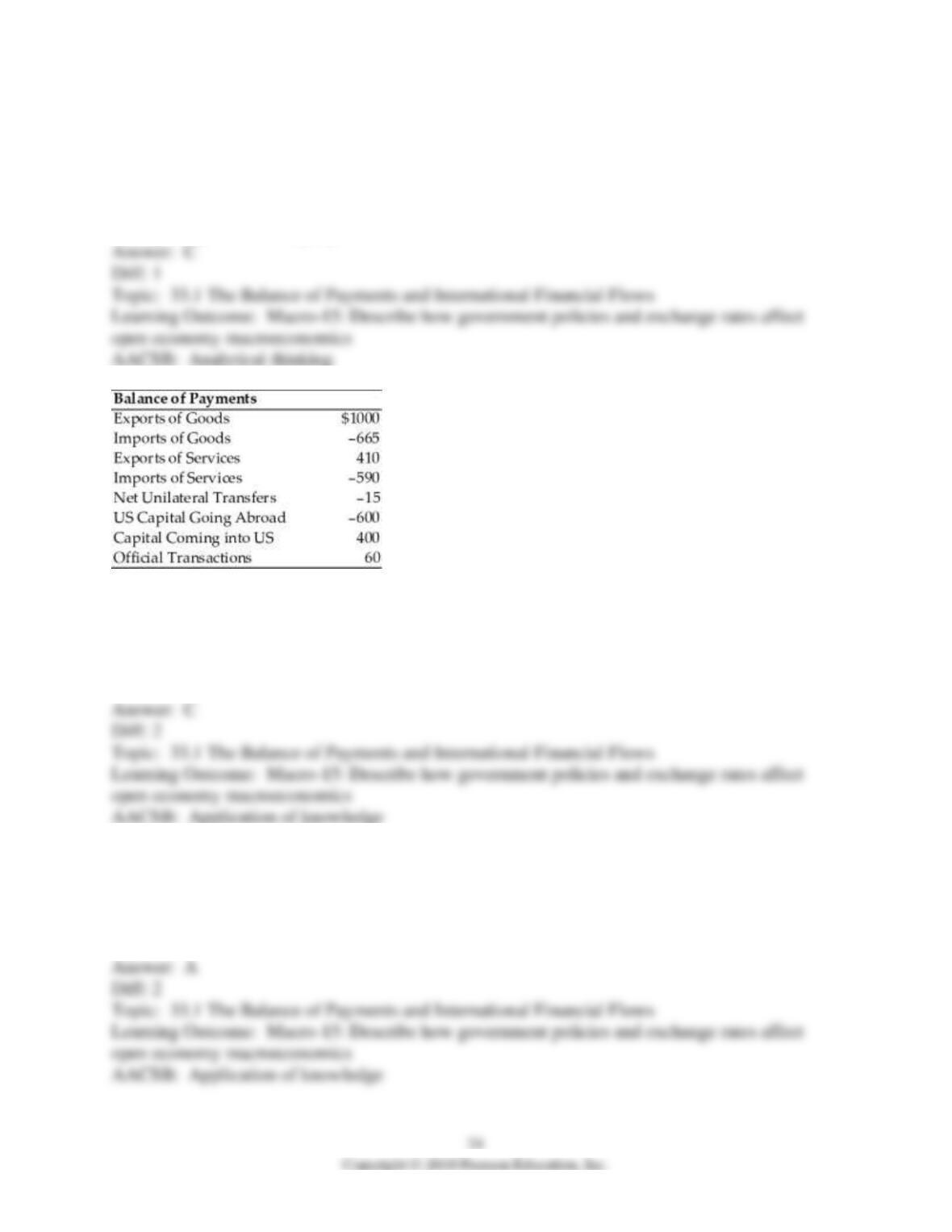
73) Refer to the above table. The balance of trade is
A) $1000.
B) -$665.
C) +$335.
D) -$155.
74) Refer to the above table. The current account balance is
A) $140.
B) $155.
C) $170.
D) -$45.
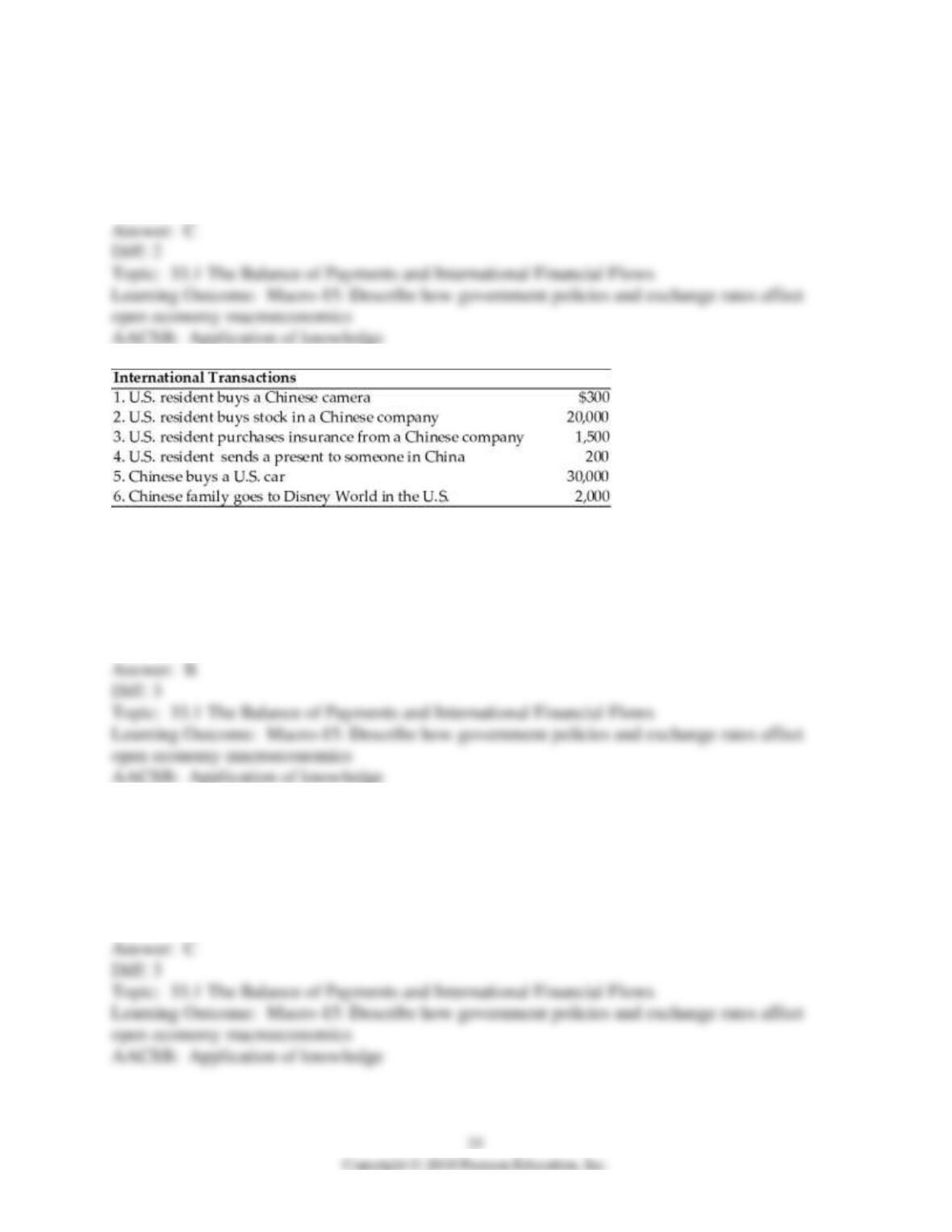
75) Refer to the above table. The financial account balance is
A) 0.
B) -$260.
C) -$200.
D) -$155.
76) Based on the transactions in the above table, what is the change in the U.S. balance of
merchandise trade?
A) $11,000
B) $29,700
C) -$30,000
D) -$31,000
77) Based on the transactions in the above table, what is the change in the U.S. financial
account?
A) $9,800
B) $10,000
C) -$20,000
D) -$20,200
78) Based on the transactions in the above table, what is the change in the U.S. current account
balance?
A) $30,000
B) $31,000
C) -$32,500
D) -$32,700
79) Suppose the current account of a country is initially in balance. A new transaction occurs so
that the current account is now in surplus. Official reserve balance is maintained before and after
the transaction occurs. From this, we know that
A) the balance of trade is now in surplus.
B) the balance of goods and services is now in surplus.
C) the financial account is now in deficit.
D) the government must make official reserve transactions.
80) If there are no interventions by finance ministers or control banks in the international market,
then
A) the current account and the capital account must sum to zero.
B) the current account will be greater than the financial market.
C) the capital market will be greater than the current account.
D) the capital market will equal the current account.
81) An increase in the inflation rate of one country relative to another country will probably
cause
A) an increase in exports for the inflating country.
B) a balance of trade deficit for the inflating country.
C) a current account surplus for the inflating country.
D) an increase in the amount of official reserves held by the inflating country’s central bank.
82) The United States’ balance of payments is likely to improve when
A) there is an increase in political instability in other countries.
B) the inflation rate in the United States rises relative to other countries.
C) the American government increases its spending on foreign aid.
D) American people want to invest more in foreign countries.
83) When there is political instability in another country, the United States can expect
A) an increase in the financial account balance due to an increase in the current account.
B) an increase in the financial account balance due to the movement of assets to the U.S.
C) a decrease in the balance of payments due to a decrease in official reserve transactions.
D) a decrease in the balance of payments due to a decrease in the demand for goods and services.
84) The difference between the exports and imports of goods in a country is referred to as the
A) balance of payments.
B) balance of trade.
C) balance of power.
D) exchange rate.
85) The difference between exports and imports of goods is the
A) balance of trade.
B) balance of payments.
C) balance of accounts.
D) balance of paying.
86) If the United States exports $250 billion worth of goods and imports $420 billion worth of
goods
A) the balance of payments will be -$170 billion.
B) the balance of trade will be -$170 billion.
C) the balance of trade will be $670 billion.
D) the official reserve transaction will be $170 billion.
87) The total of all economic transactions between a nation and the rest of the world is referred
to as the
A) balance of payments.
B) balance of trade.
C) balance of power.
D) exchange rate.
88) Which of the following items is NOT a deficit item in the balance of payments?
A) imports of merchandise
B) sales of domestic assets to foreigners
C) purchases of gold from foreigners
D) military spending abroad
89) The balance of payments consists of the
A) current account, capital account, and gold flows.
B) current account, official reserve transactions account, and monetary account.
C) current account, capital account, and official reserve transactions account.
D) capital account, official reserve transactions account, and recent account.
90) If the inflation rate in Japan is higher than the inflation rate in the United States
A) there will be an increase in U.S. imports from Japan.
B) there will be an increase in Japanese exports to the United States.
C) there will be no change is U.S. imports from Japan.
D) there will be a decrease in U.S. imports from Japan.
91) Which of the following is NOT a deficit item on the international accounts balance sheet for
a country?
A) imports of merchandise
B) military spending abroad
C) purchases of foreign currency
D) exports of merchandise
92) If residents of the United States give more gifts to relatives abroad than they receive,
unilateral transfers will be
A) positive.
B) unaffected.
C) negative.
D) zeroed out.
93) All of the following are surplus items in the balance of payments EXCEPT
A) purchases of foreign assets.
B) exports of merchandise.
C) foreign tourist expenditures.
D) funds deposited in this country by foreign residents.
94) All of the following are deficit items in the balance of payments EXCEPT
A) purchases of foreign assets.
B) imports of merchandise.
C) foreign tourist expenditures.
D) purchases of foreign currency.
95) The sum of the current account, the capital account, and the official reserve transaction
account is
A) always positive.
B) always negative.
C) positive when exports are greater than imports.
D) zero.
96) If you go to Europe to work and send funds home to your family living in the United States,
this is known as a
A) service import.
B) merchandise import.
C) service export.
D) unilateral transfer.
97) The financing of U.S. export transactions, ceteris paribus
A) reduces U.S. interest rates.
B) reduces the amount of foreign currency held by the Fed.
C) reduces U.S. GDP.
D) increases the amount of foreign currency held by U.S. banks.
98) The financing of U.S. import transactions, ceteris paribus
A) reduces U.S. interest rates.
B) increases the amount of foreign currency held by the Fed.
C) increases U.S. GDP.
D) decreases the amount of foreign currency held by U.S. banks.
99) In a nation’s balance of payments, the current account includes
A) the changes in the official reserve transaction account.
B) the purchases of foreign assets.
C) the balance of the trade account, the balance of the services account, and net unilateral
transfers.
D) all of the above.
100) A nation’s official reserve transaction account
A) is always a positive number.
B) is always a negative number.
C) is always equal to zero.
D) compensates for the differences in the current and capital accounts.
101) Which of the following combinations is plausible for a nation’s balance of payments? (All
numbers in billions.)
A) current account = 10, capital account = 40, official reserve transaction account = 50
B) current account = 40, capital account = 20, official reserve transaction account = -50
C) current account = 50, capital account = -30, official reserve transaction account = 20
D) current account = 30, capital account = -20, official reserve transaction account = -10
102) Which of the following is a surplus item in the U.S. current account?
A) The U.S. government reduces the tariff rates on some imported goods.
B) IBM pays dividends to British shareholders.
C) Finn vodka becomes more popular in the United States.
D) The U.S. government cuts back on military personnel stationed in S. Korea.
103) Which of the following is a deficit item in the U.S. current account?
A) Toyota builds a new plant in California.
B) Many U.S. residents who previously had not traveled abroad decide to make Mexico a tourist
destination.
C) A Saudi Arabian prince builds six new homes in California.
D) Sony buys a new film studio in Florida.
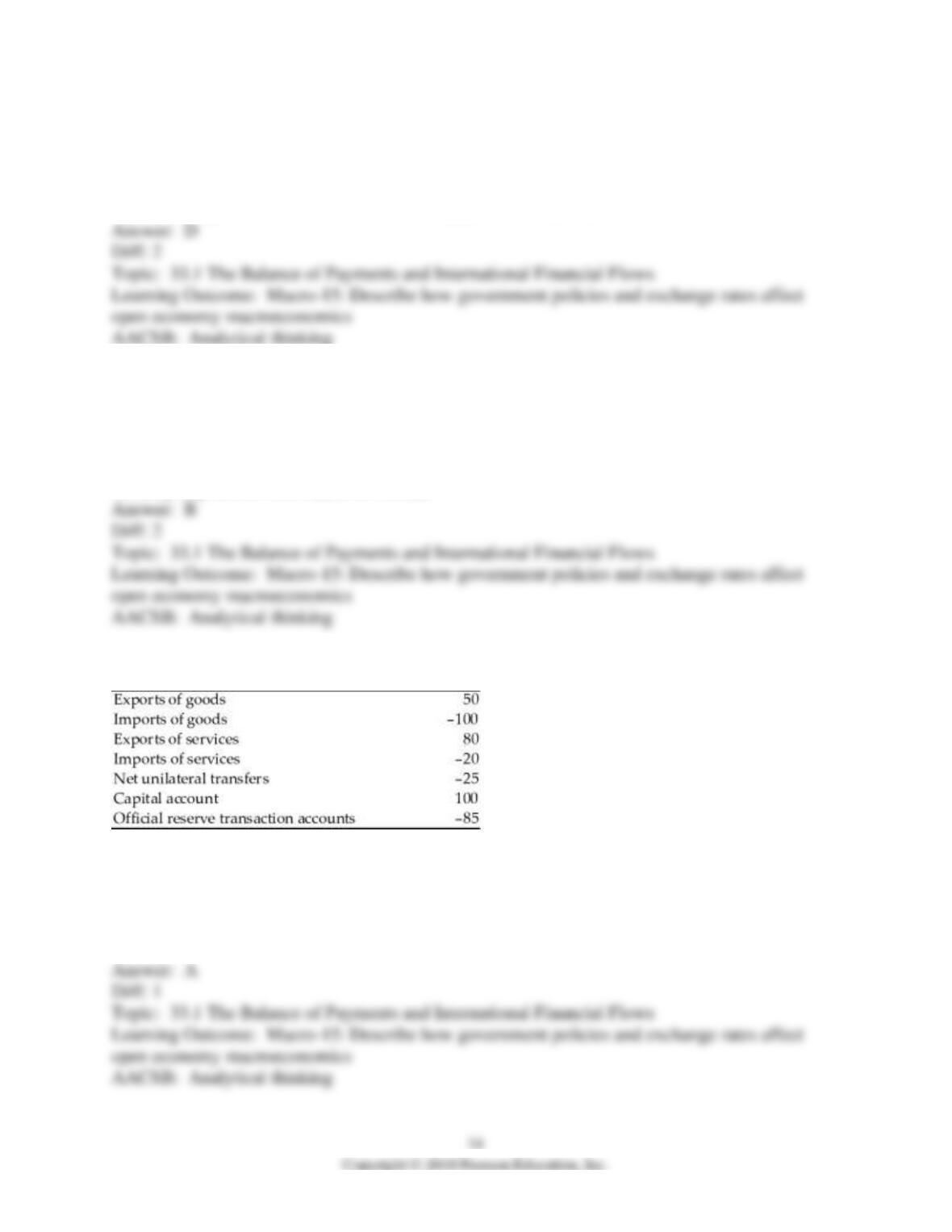
Hypothetical Data for Nation “A” in Billions of Local Currency
104) Refer to the above table. Nation “A” has a balance of trade
A) deficit of 50.
B) surplus of 50.
C) deficit of 10.
D) surplus of 10.
105) Refer to the above table. Nation “A” has a current account
A) deficit of 15.
B) surplus of 15.
C) deficit of 60.
D) surplus of 60.
106) Refer to the above table. The overall balance of payments of Nation “A” is
A) +85.
B) – 85.
C) 0.
D) +25.
107) Suppose that there is a current account deficit of $250 billion and a financial account
surplus of $260 billion. It may be concluded that the
A) overall balance of payments is +10.
B) overall balance of payments is -10.
C) official reserve transaction account balance is +10.
D) official reserve transaction account balance is -10.
108) If the United States has a trade deficit with China, then China must have
A) a trade surplus with countries other than the United States.
B) a trade surplus with the United States.
C) a trade deficit with countries other than the United States.
D) a trade deficit with the United States.
109) All of the following are surplus items on the balance of payments accounts EXCEPT
A) U.S. residents purchases of gold from foreign residents.
B) foreign tourists spending funds in the United States.
C) exports of merchandise.
D) sales of U.S. dollars to foreign residents.
110) All of the following are deficit items in the balance of payments accounts EXCEPT
A) U.S. residents purchases of gold from foreign residents.
B) U.S. tourists spending funds in Europe.
C) exports of merchandise.
D) U.S. purchases of foreign companies’ stocks and bonds.
111) Suppose U.S. interest rates fall. This reduction in U.S. interest rates will cause which of the
following to occur?
A) an outflow of capital from the United States
B) no change in foreign investment in the United States
C) an increase in the value (appreciation) of the U.S. dollar
D) an inflow of capital to the United States
112) How are deficit and surplus items determined in the balance of payments?
113) Distinguish between the balance of payments and the balance of trade.
114) “When the balance of payments sums to zero is the only situation in which there is an
equilibrium.” Do you agree or disagree? Why?
38
115) Suppose there was a substantial increase in political instability in the rest of the world.
What would be the effects on the U.S. current account? Explain.
116) Explain the three categories of balance of payments transactions.
117) Suppose the U.S. inflation rate falls while the inflation rate among the members of the
European Monetary Union (EMU) holds constant. Other things equal, what will happen in the
balance of payments accounts?
39
33.2 Deriving the Demand for and Supply of Foreign Exchange
1) Exchanging dollars for euros to pay a computer manufacturer in Belgium would occur
A) in the foreign exchange market.
B) at the Federal Reserve.
C) at the European Central Bank.
D) in the letter of credit market.
2) The foreign exchange rate describes the
A) balance of trade.
B) balance of payments.
C) law of comparative advantage.
D) price of foreign currency in terms of domestic currency.
3) Changes in which of the following will cause a change in exchange rates?
A) real interest rates
B) consumer preferences
C) perceptions of economic and political stability
D) all of the above
4) If the exchange rate is such that $1 equals 10 Mexican pesos, then the price of a peso is
A) $10.
B) $1.
C) $0.20.
D) $0.10.
5) Suppose that the current exchange rate between the dollar and peso is $1 equals 10 pesos. If a
firm in Mexico wanted to purchase $100,000 worth of U.S. televisions, how many pesos must
they exchange?
A) 10,000 pesos
B) 100,000 pesos
C) 1,000,000 pesos
D) 11,000,000 pesos
6) Suppose that the current exchange rate between the dollar and peso is $1 equals 10 pesos. If
the exchange rate changes to $1 equals 8 pesos, which of the following is TRUE?
A) The dollar depreciates and U.S. exports become cheaper.
B) The dollar appreciates and U.S. exports become cheaper.
C) The peso depreciates and imports from Mexico become cheaper.
D) The peso appreciates and imports from Mexico become cheaper.