64) A market in which national currencies are traded by households, firms and governments, is
referred to as a(n)
A) foreign exchange market.
B) fed funds market.
C) international reserves market.
D) gold certificate market.
65) The price of one nation’s currency in terms of the currency of another nation is called the
A) IMF rate.
B) fed funds ratio.
C) exchange rate.
D) discount rate.
66) If the exchange rate measured in euros per dollar increases, then
A) the dollar depreciates relative to the euro.
B) the euro appreciates relative to the dollar.
C) the euro depreciates relative to the dollar.
D) neither currency appreciates or depreciates.
67) A market in which businesses, households, and governments buy and sell national currencies
is
A) the foreign exchange market.
B) the currency exchange market.
C) the money exchange market.
D) the dollar exchange market.
68) Assume the following exchange rates for today: $1=140 yen and 1 Danish krone = $0.10.
We can conclude
A) 1 yen = 280 kr.
B) 1 yen = 14 kr.
C) 1 kr. = 28 yen.
D) 1 kr. = 14 yen.
69) One source of the supply of dollars in the world is
A) the purchase of U.S. exports by foreign residents.
B) the sale of U.S. domestic assets to foreigner residents.
C) U.S. imports of foreign merchandise.
D) U.S. sales of gold to foreigner residents.
70) The exchange rate for a foreign currency that is determined by supply and demand is
A) a fixed exchange rate.
B) a controlled exchange rate.
C) a constrained exchange rate.
D) a flexible exchange rate.
71) An increase in the market clearing exchange value of the home nation’s currency in terms of
the currency of another nation is a home currency
A) appreciation.
B) depreciation.
C) devaluation.
D) revaluation.
72) A decrease in the market clearing exchange value of the home nation’s currency in terms of
the currency of another nation is a home currency
A) appreciation.
B) revaluation.
C) depreciation.
D) devaluation.
73) If the Mexican peso appreciates against the U.S. dollar
A) Mexican exports will become cheaper in the United States.
B) Mexican exports will become more expensive in the United States.
C) U.S. exports will become more expensive in Mexico.
D) there will be no change in the price of Mexican imports in the United States.
74) If the Japanese yen depreciates against the U.S. dollar
A) the price of Japanese imports to the United States decreases.
B) the price of United States exports to Japan decreases.
C) the price of Japanese imports from the United States will decrease.
D) there is no change in the price of Japanese exports to the United States.
75) In July 2011, $1 was worth 45 Indian rupees and in July 2012, $1 was worth 55 Indian
rupees. We can therefore conclude that
A) the Indian rupee depreciated.
B) the Indian rupee appreciated.
C) the U.S. dollar has depreciated.
D) the value of the U.S. dollar has fluctuated.
76) In the market for euros, the demand for euros (€) is
A) downward sloping, because at lower dollar prices for the euro, U.S. residents will buy more
European goods and services.
B) upward sloping, because at higher dollar prices for the euro, U.S. residents will buy more
European goods and services.
C) upward sloping, because at higher dollar prices for the euro, Europeans will buy more U.S.
goods and services.
D) horizontal, because dollar prices of euros and euro prices of dollars are directly related.
77) In the market for euros, the supply of euros (€) is
A) downward sloping, because lower dollar prices of euros mean that U.S. goods are cheaper to
Europeans.
B) downward sloping, because higher dollar prices of euros mean that U.S. goods are cheaper to
Europeans.
C) upward sloping, because higher dollar prices of euros means that U.S. goods are cheaper to
Europeans.
D) upward sloping, because lower dollar prices of euros means that U.S. goods are cheaper to
Europeans.
78) In foreign exchange markets, who demands dollars and who supplies dollars?
79) Why does the demand curve for Japanese yen slope down?
80) What does it mean when the dollar appreciates? What does it mean when the dollar
depreciates?
81) Why does the supply curve of Japanese yen slope up?
33.3 Determining Foreign Exchange Rates
1) An increase in the demand for the Brazilian real induces
A) an increase in the demand for Brazilian goods.
B) a decrease in the supply of dollars.
C) an increase in the real price of a dollar.
D) an increase in the dollar price of a real.
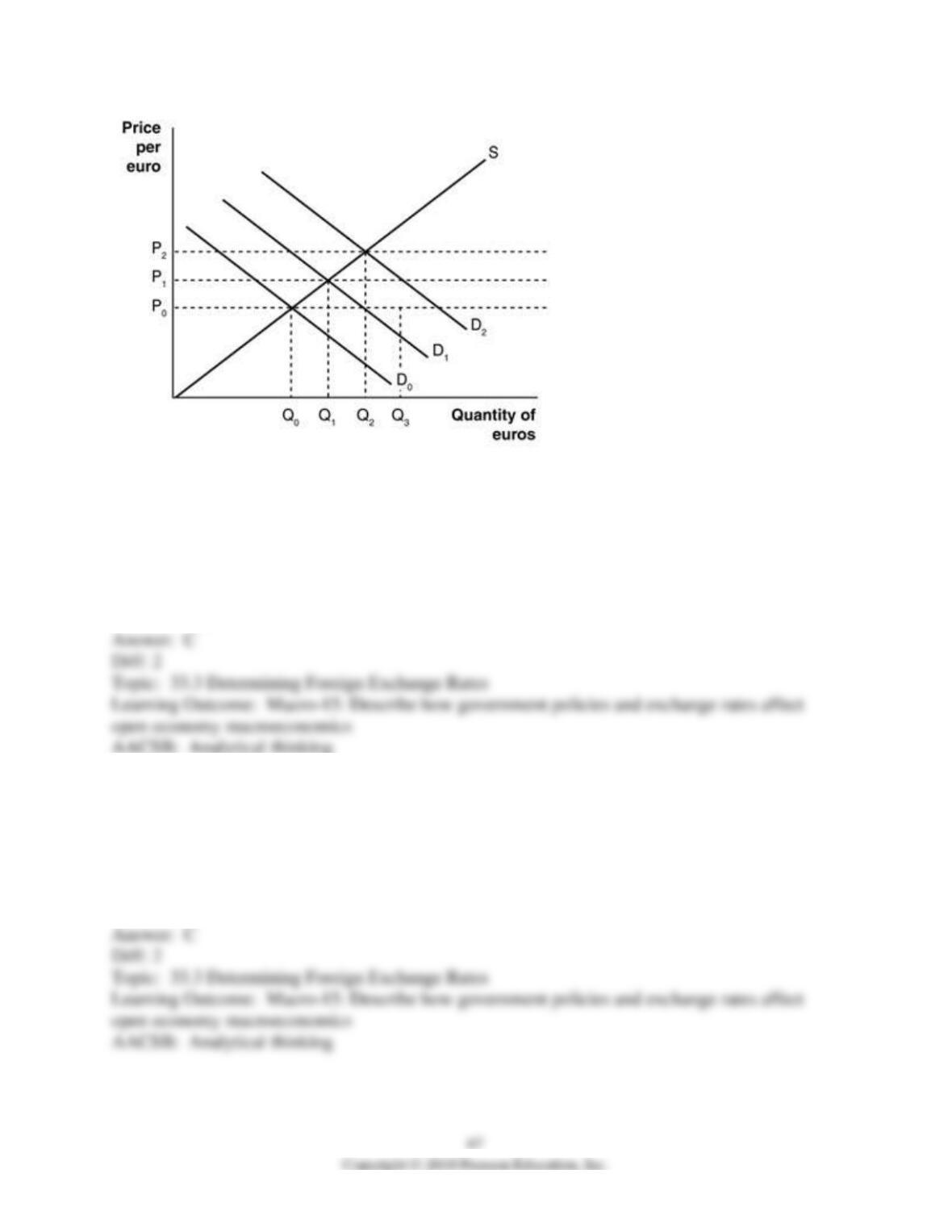
2) In the above figure, which of the following is a possible explanation for the reduction in the
equilibrium value of the European euro from P2 to P1?
A) an increase in demand for French automobiles
B) the European central bank’s decision to buy euros on the world market
C) a decrease in the price of California wines, assuming that French wines and California wines
are substitutes
D) an increase in the price of California wines, assuming that French wines and California wine
are substitutes
3) In the above figure, suppose the value of the European euro is P1 and U.S. demand for French
wine declines. The effect on the euro can be shown by
A) an increase in the value of the euro to P2.
B) the excess demand of euro equal to Q3 – Q1.
C) the decrease in the value of the euro to P0.
D) a shift in the demand for euros from D1 to D0, but no change in the value of the euro.
4) The Japanese yen will appreciate against the dollar if
A) U.S. residents demand more Japanese goods.
B) U.S. residents demand fewer Japanese goods.
C) Japanese residents demand more U.S. goods.
D) none of the above.
5) If there is an outward shift in U.S. demand for French goods, the result will be
A) a decrease in the dollar price of a euro.
B) an inward shift in French demand for U.S. goods.
C) a decrease in euros traded.
D) an increase in the dollar price of a euro.
6) Which of the following will lead to a depreciation of the U.S. dollar against the British pound?
A) an increase in British demand for U.S. imports
B) an increase in U.S. interest rates
C) a decrease in British demand for U.S. assets
D) a decrease in U.S. demand for British goods
7) If U.S. residents boycotts French goods, this will
A) reduce the demand for euros in the foreign exchange market.
B) increase the demand for euros in the foreign exchange market.
C) cause the euro to appreciate.
D) have no effect on the euro.
8) Which of the following will lead to an appreciation of the U.S. dollar against the British
pound?
A) an increase in British demand for U.S. imports
B) an increase in U.S. demand for British imports
C) an increase in British interest rates
D) a decrease in British demand for U.S. assets
9) Under a flexible exchange rate system, one factor that does NOT directly affect rates of
exchange is
A) changes in the inflation rate in each country.
B) changes in productivity in each country.
C) changes in gold holdings in each country.
D) changes in economic stability in each country.
10) All of the following are market determinants of exchange rates EXCEPT
A) changes in productivity in one country relative to another.
B) changes in real interest rates in one country relative to another.
C) changes in product preferences between countries.
D) changes in the relative prices of goods and services within a country.
11) If the United States looks more economically and politically stable relative to the rest of the
world, this will
A) decrease the demand for dollars.
B) increase the demand for dollars.
C) have no effect on the demand for dollars.
D) stop all trading between the currencies of the United States and other countries.
12) Other things being constant, if the U.S. real rate of interest exceeds that of its trading
partners, we expect
A) political instability in the United States.
B) a worsening of the U.S. balance of payments.
C) an appreciation of U.S. currency.
D) that a “dirty float” will emerge.
13) The demand for dollars will increase when
A) real interest rates in the United States fall.
B) U.S. labor productivity increases relative to the world.
C) the world is perceived as more stable than it used to be.
D) U.S. residents develop a taste for more imported products.
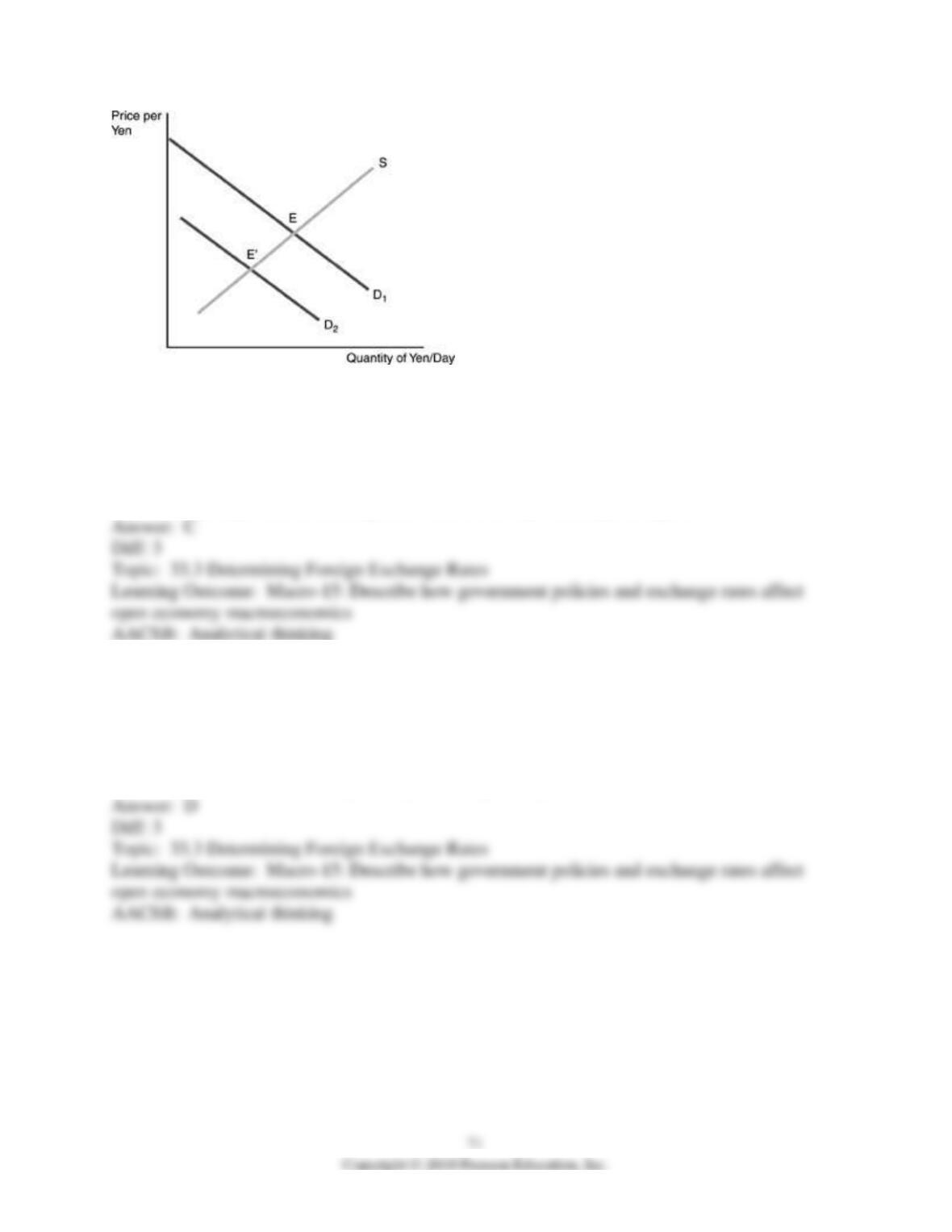
14) In the diagram above, which of the following could cause a movement from point E’ to point
E?
A) Japanese residents’ incomes rise, so they increase their purchases of U.S. goods.
B) The dollar depreciates, inducing Japanese residents to buy more U.S. goods.
C) U.S. residents’ incomes rise, so they increase their purchases of Japanese goods.
D) The dollar depreciates, inducing U.S. residents to buy more Japanese goods.
15) Refer to the above figure. Suppose the equilibrium moves from E’ to point E. An event that
could have caused this movement is
A) an increase in the real interest rate in the United States.
B) an increase in U.S. productivity.
C) an increase in the perceived stability of the U.S. economy.
D) an increase in demand for Japanese-produced goods by U.S. residents.
16) The demand curve for Japanese yen will shift to the right when
A) there is a decrease in demand for Japanese-made goods in the United States.
B) there is no change in the demand for Japanese-made goods in the United States.
C) there is a decrease in the demand for U.S.-made goods in Japan.
D) there is an increase in the demand for Japanese-made goods in the United States.
17) When a Mexican resident buys a ukulele from a U.S. producer, there is a(n)
A) increase in the supply of dollars in the foreign exchange market.
B) decrease in the supply of dollars in the foreign exchange market.
C) increase in the demand for dollars in the foreign exchange market.
D) decrease in the demand for dollars in the foreign exchange market.
18) When a Japanese resident buys a good or service from a U.S. producer, there is a(n)
A) increase in the supply of yen in the foreign exchange market.
B) decrease in the supply of yen in the foreign exchange market.
C) increase in the demand for yen in the foreign exchange market.
D) decrease in the demand for yen in the foreign exchange market.
19) When numerous Japanese companies buy $100,000,000 worth of goods or services from
U.S. producers, ceteris paribus, there will be
A) appreciation in the value of the yen against the dollar.
B) depreciation in the value of the yen against the dollar.
C) depreciation of the dollar against the yen.
D) no change in values of the currencies.
20) If interest rates in Sweden go up relative to the rest of the world, the
A) demand for Swedish currency will fall.
B) demand for Swedish currency will rise.
C) supply of Swedish currency will fall.
D) supply of Swedish currency will rise.
21) Which of the following will cause a change in the exchange rate?
A) changes in real interest rates
B) changes in consumer preferences
C) changes in the perception of economic stability
D) all of the above
22) If there is an increase in the demand for U.S. automobiles, the
A) demand for dollars will fall.
B) demand for dollars will rise.
C) supply of dollars will fall.
D) supply of dollars will rise.
23) If there is an unrest in Europe that threatens the economic stability of Turkey, the
A) demand for the Turkish currency will fall.
B) demand for the Turkish currency will rise.
C) supply of the Turkish currency will fall.
D) supply of the Turkish currency will rise.
24) If there is an unrest in Turkey, and Turkish investors purchase U.S. securities, the
A) demand for the Turkish currency will fall.
B) demand for the Turkish currency will rise.
C) supply of the Turkish currency will fall.
D) supply of the Turkish currency will rise.
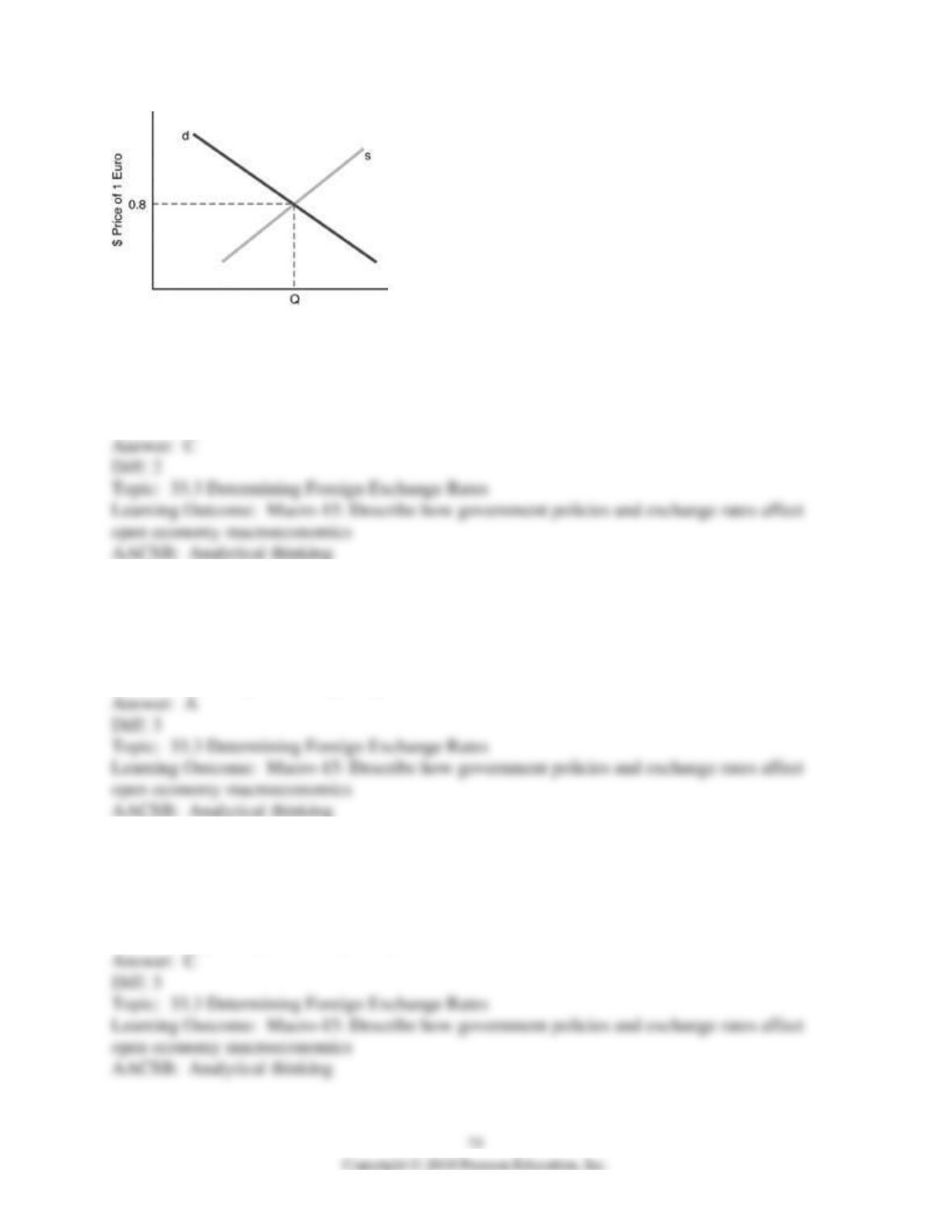
25) Use the above figure. At equilibrium, the exchange rate is
A) 1 euro = $1.25.
B) $0.80 = 1.25 euro.
C) $1 = 1.25 euro.
D) $1 = 8 euros.
26) Use the above figure. A rightward shift of the demand curve, ceteris paribus, would result in
A) dollar depreciation.
B) dollar appreciation.
C) euro depreciation.
D) reducing the equilibrium quantity of euros.
27) Use the above figure. A leftward shift of the supply curve, ceteris paribus, would result in
A) euro depreciation.
B) dollar appreciation.
C) dollar depreciation.
D) increasing the equilibrium quantity of euros.
28) Use the above figure. A leftward shift in the demand curve, ceteris paribus, would result in
A) a dollar appreciation.
B) a dollar depreciation.
C) a euro appreciation.
D) increasing the equilibrium quantity of the euro.
29) Using the above figure. A rightward shift of the supply curve, ceteris paribus, would result
in
A) dollar appreciation.
B) euro appreciation.
C) dollar depreciation.
D) decreasing the equilibrium quantity of euros.
30) Suppose economic stability in the United States increases. This will tend to cause which of
the following to occur?
A) The demand for U.S. dollars will rise in the foreign exchange market.
B) The supply of U.S. dollars will rise in the foreign exchange market.
C) The demand for euros will rise in the foreign exchange market.
D) Nothing will change in the foreign exchange market.
31) If interest rates in the European Union decrease
A) the demand for U.S. dollars will fall in the foreign exchange market.
B) the supply of U.S. dollars will fall in the foreign exchange market.
C) the demand for euros will fall in the foreign exchange market.
D) nothing will change in the foreign exchange market.
32) Suppose the foreign exchange market is in equilibrium. Then, the U.S. government increases
borrowing, causing American interest rates to increase. What will happen to the price of the
Japanese yen? Why?
33.4 Fixed Versus Floating Exchange Rates
1) Under the gold standard, because all currencies had values fixed in units of gold
A) exchange rates were effectively fixed.
B) there were no exchange rates.
C) exchange rates were set to a crawling peg.
D) none of the above
2) With a pure gold standard
A) a nation may not pursue an independent monetary policy.
B) an inflow of gold will reduce the money supply of a country.
C) there will be a tendency for reducing world trade.
D) a balance of payments deficit or surplus does not occur.
3) The gold standard is
A) a type of floating exchange rate system.
B) a type of managed flexible exchange rate system.
C) a type of fixed exchange rate system.
D) a currency exchange system without exchange rates.
4) An important problem with the gold standard was that
A) it was too complicated and restricted business activity.
B) a country did not have control of its domestic monetary policy.
C) exchange rates tended to fluctuate a great deal, making it difficult for businesses to make
long-run plans.
D) one country could easily manipulate the system to its advantage and the disadvantage of other
countries.