Economics Today, 19e (Miller)
Chapter 33 Exchange Rates and the Balance of Payments
33.1 The Balance of Payments and International Financial Flows
1) The balance of payments is
A) the value of goods and services bought and sold in the world market.
B) a summary record of a country’s economic transactions with foreign residents and
governments.
C) a summary record of a country’s purchases and sales of goods and services in the world
market.
D) the value of merchandise goods bought and sold in the world market.
2) A system of accounts that measures the transactions of goods, services, income, and financial
assets between domestic households, businesses, and governments and residents of the rest of the
world during a specific time period is the
A) capital account.
B) current account.
C) balance of payments.
D) balance of trade.
3) Net unilateral transfers would appear in a nation’s
A) current account.
B) capital account.
C) official reserve transaction account.
D) financial account.
4) A country’s balance of payments shows a
A) detailed record of the import and export of services for the country.
B) detailed record of the country’s imports.
C) summary record of international financial assistance received by the country.
D) summary record of a country’s economic transactions with foreign residents and governments
over a year.
5) The balance of trade is defined as
A) the difference between the value of goods and services exported and the value of goods and
services imported.
B) the difference between the value of goods exported and the value of goods imported.
C) the difference between the value of services exported and the value of services imported.
D) none of the above.
6) Which of the following is NOT a deficit item on a country’s balance of payments?
A) gold sales to foreigners
B) imports
C) a personal gift to a foreign individual
D) none of the above
7) Which of the following is an example of a surplus item on the balance of payments?
A) private gifts to foreign residents
B) public gifts to foreign residents
C) interest receipts from foreign residents
D) purchases of gold from foreign residents
8) Which of the following is a deficit item on the balance of payments?
A) exports of merchandise
B) foreign tourist dollars spent domestically
C) sales of gold to foreigners
D) purchases of foreign assets
9) In the balance of payments, any transaction that leads to a receipt by a resident of a country is
a
A) minus item.
B) debit item.
C) surplus item.
D) deficit item.
10) An example of a transaction that will be a surplus item on the U.S. balance of payments is
A) a U.S. resident purchasing French wine.
B) a French subsidiary’s plant in New Jersey purchasing parts from the main plant in Paris.
C) a gift of wheat from the U.S. government to India.
D) a tourist from Germany buying a ticket to fly from New York to Chicago on American
Airlines.
11) An example of a deficit item on the U.S. balance of payments is
A) the sale of a spark plug made by a U.S. firm in Michigan to a Nissan plant in Tennessee.
B) the purchase of Japanese yen by a U.S. firm.
C) a deposit in a bank in Chicago by the government of Saudi Arabia.
D) the payment of a dividend by a British firm to a U.S. family.
12) Which of the following is a deficit item on the U.S. balance of payments accounts?
A) A U.S. firm sells a product to a Mexican firm.
B) An Italian tourist in Miami purchases a beach ball.
C) A Spaniard buys 100 shares of Ford stock.
D) A U.S. resident buys a smartphone in Japan.
13) In the balance of payments, which of the following is TRUE of the sum of the capital
account balance, the current account balance, and the official reserve transactions account
balance?
A) This sum is either positive or negative, depending on whether the sum of all surplus and
deficit items associated with cross-border transactions is positive or negative.
B) This sum must always be zero, because the sum of all surplus and deficit items associated
with cross-border transactions must equal zero.
C) This sum is positive only if the U.S. government operates with a budget surplus.
D) This sum is positive only if the U.S. government operates with a budget deficit.
14) Suppose a country has a current account surplus and that there is no intervention by finance
ministries or central banks. This current account surplus indicates that the country has
A) a deficit in its financial account.
B) a surplus in its financial account.
C) the official reserve transactions balance is positive.
D) the official reserve transactions balance is negative.
15) The largest portion of any nation’s current account is typically
A) imports and exports.
B) gold sales.
C) the sale of U.S. assets.
D) foreign currency reserves.
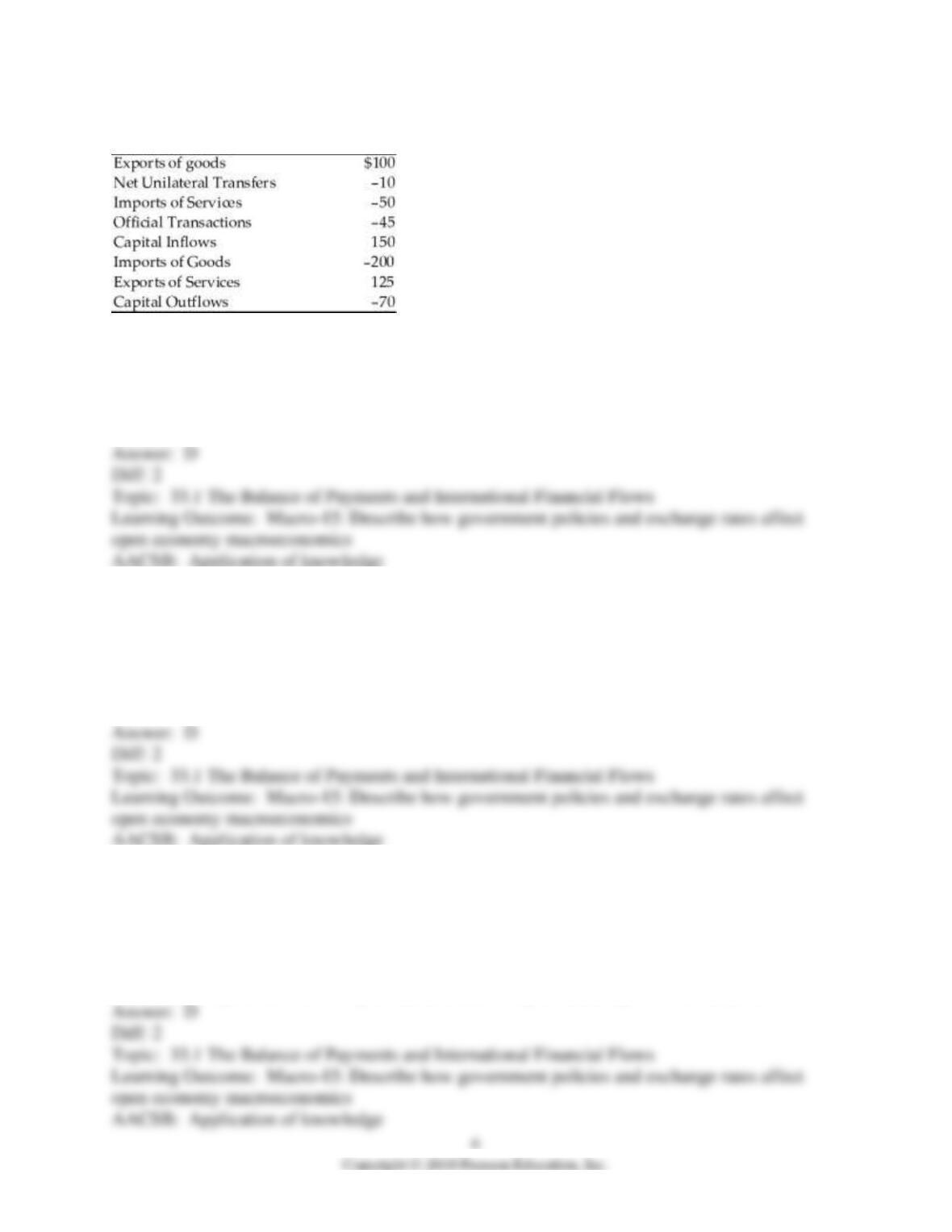
Country X—2017 Transactions (billions of dollars)
16) In the above table, the merchandise trade balance for Country X is ________ billion dollars.
A) +100
B) -150
C) +150
D) -100
17) In the above table, the trade balance on goods and services for Country X is ________ billion
dollars.
A) +25
B) -100
C) +100
D) -25
18) In the above table, the fact that there is a minus sign before the number for unilateral
transfers means that
A) Country X has significant inflation.
B) Country X imported more goods than it exported.
C) Country X received more in foreign aid than it gave in foreign aid.
D) Country X gave more to foreign residents than foreign residents gave to Country X.
19) In the above table, the balance on the current account for Country X is ________ billion
dollars.
A) -35
B) -75
C) +75
D) -200
20) In the above table, the balance on the financial account for Country X is ________ billion
dollars.
A) -80
B) +35
C) +80
D) -35
21) All of the following would be considered a current account transaction EXCEPT the
A) importing of services.
B) exporting of goods.
C) importing of capital.
D) importing of goods.
22) Which of the following would contribute to a positive trade balance for a country?
A) having tourists visit the country
B) importing textiles
C) having foreign residents buy the government bonds of the country
D) importing financial services
23) When there is a current account deficit, it is likely that
A) exports exceed imports for the country.
B) the country is an exporter of capital.
C) the financial account has a surplus.
D) the country has a budget surplus.
24) Current account transactions are payments that are related to the purchase or sale of
A) financial instruments only.
B) both goods and services.
C) goods only.
D) services only.
25) Unilateral transfers are
A) transactions that take place within the geographic boundaries of a country.
B) gifts from residents of one country to foreign residents.
C) transactions that take place across geographic boundaries but in which both participants are
citizens of the same country.
D) government transactions that involve reserves.
26) If the current account is in deficit, we know that
A) the merchandise trade balance is also in deficit.
B) the merchandise trade balance is in surplus.
C) the financial account is in surplus.
D) there is a statistical discrepancy in the surplus.
27) When a Chinese company builds an auto plant in the United States, the immediate result of
this Chinese investment in the United States is a ________ item in the U.S. ________ account.
A) surplus; current
B) surplus; financial
C) deficit; current
D) deficit; financial
28) Which of the following transactions leads to an inflow of funds on the U.S. financial
account?
A) A U.S. resident purchases a share of stock on the Hong Kong exchange.
B) A U.S. resident sells wheat to an African nation.
C) A resident of China purchases U.S. government bonds.
D) A resident of Mexico visits the United States.
29) The major factor affecting a nation’s balance of payments is
A) an increase in its rate of unemployment.
B) its rate of inflation relative to the rate of inflation of its trading partners.
C) a change in the productivity of its labor.
D) its stock market movements.
30) An increase in a country’s rate of inflation is apt to
A) reduce its imports and improve its trade balance.
B) lower its nominal rate of interest and encourage an inflow of capital.
C) worsen its balance of trade and balance of payments.
D) decrease demand for the country’s currency.
31) A reduction in a country’s rate of inflation should
A) increase its imports.
B) increase its exports.
C) lead to a negative trade balance.
D) lead to an outflow of SDRs.
32) The U.S. balance of payments status may improve when
A) the inflation rate increases in the United States relative to other countries.
B) political instability in other countries increases.
C) the world demand for U.S. products falls.
D) the American government increases its spending on foreign aid.
33) A nation’s balance of payments can be affected by
A) the country’s inflation rate relative to other nations’ inflation rates.
B) the country’s population increases relative to other nations’ populations.
C) per capita GDP relative to other nations’ per capita GDP.
D) none of the above.
34) The balance of trade is
A) the difference between exports and imports of goods and services.
B) the difference between exports and imports of services.
C) the summary record of a country’s economic transactions with foreigners in a year.
D) none of the above.
35) When the balance of trade is in balance, we know with certainty that
A) the value of all debit transactions equals the value of all credit transactions.
B) the value of exports of goods equals the value of imports of goods.
C) the value of capital exports equals the value of capital imports.
D) the value of exports of goods and services equals the value of imports of goods and services.
36) When the value of exports exceeds the value of imports then
A) changes in productivity will occur.
B) international trade is in balance.
C) the country is running a trade deficit.
D) the country is running a trade surplus.
37) For the United States, suppose the value of exported goods is greater than the value of
imported goods. This implies that
A) the domestic currency will depreciate.
B) the dollar price of foreign currency will increase.
C) the country is running a deficit in its balance of trade.
D) the country is running a surplus in its balance of trade.
38) A summary of a country’s economic transactions with foreign residents and governments is
called the
A) current account balance.
B) financial account balance.
C) balance of trade.
D) balance of payments.
39) The balance of payments is
A) a summary record of the financial transactions of a country’s government with foreign
governments.
B) a summary record of a country’s imports and exports of goods with foreign residents and
governments.
C) a summary record of a country’s economic transactions with foreign residents and
governments.
D) a summary record of a country’s purchases and sales of goods and services in the world
market.
40) A record of all transactions between households, firms, and the government of one country
and the rest of the world is the
A) balance of trade.
B) balance of payments.
C) International Monetary Fund.
D) government budget.
41) A U.S. family flies from Boston to Shanghai on a China Airlines plane. This transaction is
A) considered an export of service in the U.S balance of payment accounts.
B) a deficit item in the balance of payment accounts of China.
C) Both of the above are correct.
D) none of the above.
42) Which of the following is included in both the balance of trade and the balance of payments?
A) exports
B) earnings on domestic assets owned by foreign residents
C) international capital movements
D) earnings by domestic residents on assets located abroad
43) Any transaction that leads to a payment by a country’s residents or government is a(n)
A) debt.
B) asset.
C) deficit item.
D) surplus item.
44) In the balance of payments, a deficit item is any transaction
A) that leads to a receipt by a resident of a country or its government.
B) that leads to a payment by a resident of a country or its government.
C) that is an export of a good or service.
D) that makes residents of a country worse off.
45) In the balance of payments, any transaction that leads to a receipt by a resident of a country
or its government is a(n)
A) asset.
B) minus item.
C) deficit item.
D) surplus item.
46) Judy has just bought a car that is made in Germany. As far as the U.S. balance of payments is
concerned this purchase is a(n)
A) accounting identity.
B) special draw.
C) surplus item.
D) deficit item.
47) A citizen of Mexico who has lived in El Paso during the past three years has just sent $100 to
relatives in Mexico for Christmas. This transaction is
A) counted in the U.S. balance of payments as a current account item.
B) counted in the U.S. balance of payments as a surplus item.
C) counted in the U.S. balance of payments as an export item.
D) none of the above.
48) A surplus item is
A) the import of goods or services that is not needed by residents of a country.
B) the import or export of products that are by-products of the manufacturing of export goods.
C) any transaction that leads to a receipt by a resident of a country or its government.
D) any transaction that leads to a payment by a resident of a country or its government.
49) Someone in Germany has just ordered a U.S. car to be exported to Germany. In the U.S.
balance of payments, this purchase is a(n)
A) accounting identity.
B) special draw.
C) surplus item.
D) deficit item.
50) In the balance of payments, all of the following are deficit items EXCEPT
A) imports of merchandise.
B) funds placed in foreign depository institutions.
C) sales of dollars to foreigners.
D) tourism expenditures abroad.
51) An example of a transaction that will be a surplus item on the U.S. balance of payments is
A) the purchase of General Motors stock by a German resident.
B) the purchase of a Mercedes-Benz by an American.
C) a Nissan plant in Tennessee buying parts from the main plant in Japan.
D) a gift of wheat from the United States government to Egypt.
52) An example of a deficit item on the U.S. balance of payments is
A) the sale of a carburetor made in Michigan to a Honda plant in Ohio.
B) a deposit in a bank in New York by a British firm.
C) a U.S. resident flies from New York to Rome on British Airways.
D) the payment of a dividend from a Canadian firm to an American living in Maine.
53) An accounting identity
A) ensures that all balances will be in equilibrium.
B) is useless in analyzing balance of payments since one cannot tell from the identity whether an
equilibrium exists or not.
C) ensures a balance but does not ensure an equilibrium.
D) applies only to plans of economic agents and not to their actual actions.
54) An accounting identity is
A) when the balance of payments is running a surplus or deficits.
B) when the balance of trade is in surplus or deficit.
C) an expression of values that are equivalent by definition.
D) special drawing rights.
55) Ahmed is working and is spending more than he is earning by using his savings to make up
the difference. Which of the following statements is TRUE?
A) Ahmed is in equilibrium since he pays all of his bills.
B) Ahmed is in disequilibrium.
C) By using savings Ahmed is using special drawing rights.
D) By using savings Ahmed has caused the balance of payments to go into a deficit situation.
56) To know whether a particular situation for a family, business, or government involves an
equilibrium or not, one must
A) understand the circumstances fully.
B) determine whether the accounts are in balance.
C) determine whether the credits equal the debits.
D) determine whether a particular portion of the accounts are in balance or not.
57) Which of the following is NOT a category in the U.S. balance of payments account?
A) current account
B) past-due account
C) financial account
D) official reserve transactions account
58) In international trade, all payments and gifts that are related to the purchase or sale of both
goods and services are referred to as the
A) current account.
B) financial account.
C) labor account.
D) official reserve transactions account.
59) The current account is
A) the reserve assets created by the International Monetary Fund for countries to use in settling
international payment obligations.
B) the price of one nation’s currency in term of the currency of another country.
C) a category of the balance of payments transactions that measures flows of real and financial
assets.
D) a category of the balance of payments transactions that measures the exchange of
merchandise, the exchange of services, and unilateral transfers.
60) Current account transactions are all payments that are related to the purchase or sale of
A) goods only.
B) services only.
C) goods and services only.
D) goods and services excluding government purchases.
61) The largest portion of any nation’s balance of payments current account is the
A) importing and exporting of merchandise goods.
B) importing and exporting of services.
C) importing and exporting of gold.
D) importing and exporting of capital goods.
62) An example of an import of a service in the U.S. balance of payments would be when
A) an U.S. resident purchases a Japanese stereo.
B) a Norwegian traveling in the United States rides a trolley car in San Francisco.
C) a U.S. resident buying insurance from a firm in Toronto.
D) a U.S. firm purchases 100 shares of a Dutch firm.