KEYWORDS:
BLOOM’S: Comprehension
71. Deficit is to debt as
a.
responsible is to irresponsible.
b.
increase is to decrease.
c.
flow is to stock.
d.
important is to unimportant.
ANSWER:
POINTS:
DIFFICULTY:
DISC: Monetary and fiscal policy
United States – BPROG: Analytic
Monetary and fiscal policy
TOPICS:
Deficits and Debt: Terminology and Facts
KEYWORDS:
BLOOM’S: Comprehension
72. Debt is to deficit as
a.
money is to income.
b.
flow is to stock.
c.
rent is to dividend.
d.
property is to wealth.
ANSWER:
POINTS:
DIFFICULTY:
DISC: Monetary and fiscal policy
United States – BPROG: Analytic
Monetary and fiscal policy
TOPICS:
Deficits and Debt: Terminology and Facts
KEYWORDS:
BLOOM’S: Comprehension
73. A budget surplus is defined as the amount that the
a.
government owes to lenders at any moment in time.
b.
government spends in any time period.
c.
government’s expenditures exceed receipts in any time period.
d.
government’s receipts exceed expenditures in any time period.
ANSWER:
POINTS:
DIFFICULTY:
DISC: Monetary and fiscal policy
United States – BPROG: Analytic
Monetary and fiscal policy
TOPICS:
Deficits and Debt: Terminology and Facts
KEYWORDS:
BLOOM’S: Comprehension
74. The national debt is defined as the total
a.
amount that U.S. citizens owe to foreigners.
b.
value that U.S. citizens borrow from foreigners during any time period.
c.
value of government’s indebtedness at any moment in time.
d.
amount by which government’s expenditures exceed receipts during any time period.
c
Moderate
DISC: Monetary and fiscal policy
United States – BPROG: Analytic
Monetary and fiscal policy
Deficits and Debt: Terminology and Facts
75. The national debt is the
a.
result of previous budget deficits.
b.
result of rising interest rates.
c.
result of previous budget surpluses.
d.
result of efficient balancing.
a
Moderate
DISC: Monetary and fiscal policy
United States – BPROG: Analytic
Monetary and fiscal policy
Deficits and Debt: Terminology and Facts
76. Until the 1980s, most of the national debt was
a.
owned by foreigners.
b.
acquired either during wars, especially World War II, or during recessions.
c.
owned by banks.
d.
financed by printing money.
Easy
DISC: Monetary and fiscal policy
United States – BPROG: Analytic
Monetary and fiscal policy
Deficits and Debt: Terminology and Facts
77. At the end of 2014, the net national debt per person in the United States was approximately
a.
$14 trillion.
b.
$142 billion.
c.
$56,000.
d.
$86,000.
c
United States – Analytic – BB-Legal
Monetary and fiscal policy
Deficits and Debt: Terminology and Facts
78. The U.S. national debt at the end of fiscal year 2014 was almost
a.
$13.5 trillion.
b.
$9.0 trillion.
c.
$18 trillion.
d.
$1.3 trillion.
United States – Analytic – BB-Legal
Monetary and fiscal policy
Deficits and Debt: Terminology and Facts
79. Compared to the size of GDP in 2014, the net national debt was approximately
a.
10% as large.
b.
33% as large.
c.
60% as large.
d.
about twice as large.
United States – Analytic – BB-Legal
Monetary and fiscal policy
Deficits and Debt: Terminology and Facts
80. A chart of the ratio of national debt to GDP from 1915 to 2014 would show
a.
a continuous decline.
b.
sharp increases from 1945 to 1975.
c.
significant increases from 1983 to 1994.
d.
significant decreases from 2003 to 2010.
United States – Analytic – BB-Legal
Monetary and fiscal policy
Deficits and Debt: Terminology and Facts
81. A chart of the ratio of national debt to GDP from 1915 to 2014 would show
a.
significant increases from 1945 to 1975.
b.
significant increases during World Wars I and II.
c.
a larger value in 1975 compared to 1945.
d.
significant increases from 1995 to 2003.
DISC: Monetary and fiscal policy
United States – BPROG: Analytic
Monetary and fiscal policy
Deficits and Debt: Terminology and Facts
82. Which of the following statements is incorrect?
a.
Budget deficits raise the national debt.
b.
The concepts of deficit and debt are closely related.
c.
Getting rid of the deficit eliminates accumulated debt.
d.
Budget surpluses lower the national debt.
DISC: Monetary and fiscal policy
United States – BPROG: Analytic
Monetary and fiscal policy
Deficits and Debt: Terminology and Facts
83. National debt is likely to fall when
a.
there is a succession of budget deficits.
b.
government’s expenditure falls short of its receipts.
c.
government’s expenditures exceed its receipts.
d.
government expenditure equals revenue.
DISC: Monetary and fiscal policy
United States – BPROG: Analytic
Monetary and fiscal policy
Deficits and Debt: Terminology and Facts
84. If the economy suffers a recession for reasons unrelated to fiscal policy, the deficit should rise and
a.
inflation should fall.
b.
interest rates should fall.
c.
real GDP should fall.
d.
All of the above are correct.
DISC: Monetary and fiscal policy
United States – BPROG: Analytic
Monetary and fiscal policy
Deficits and Debt: Terminology and Facts
85. During the late 1980s and early 1990s, most of the budget deficits were accounted for by
a.
the decline of foreign investment in the United States.
b.
the downturn in the economy.
c.
deliberate fiscal policy changes.
d.
All of the above are correct.
DISC: Monetary and fiscal policy
United States – BPROG: Analytic
Monetary and fiscal policy
Deficits and Debt: Terminology and Facts
86. In the early 1990s, economists became alarmed over the national debt because it
a.
was larger than three months’ GDP.
b.
was growing faster than GDP.
c.
had reached twice the size of GDP.
d.
was growing faster than private debt.
DISC: Monetary and fiscal policy
United States – BPROG: Analytic
Monetary and fiscal policy
Deficits and Debt: Terminology and Facts
87. One measure of “ability to pay,” the national debt is the debt to
a.
GDP ratio.
b.
tax ratio.
c.
spending ratio.
d.
investment ratio.
DISC: Monetary and fiscal policy
United States – BPROG: Analytic
Monetary and fiscal policy
Deficits and Debt: Terminology and Facts
88. The net national debt is smaller than the gross national debt because
a.
some debt is held by foreigners.
b.
some debt is held by U.S. citizens.
c.
some debt is held by government agencies.
d.
the government does not have to pay all of the debt.
DISC: Monetary and fiscal policy
United States – BPROG: Analytic
Monetary and fiscal policy
Deficits and Debt: Terminology and Facts
89. During the period from 1945 to 1975, the debt to GDP ratio
a.
remained steady.
b.
rose slightly.
c.
increased rapidly.
d.
fell steadily.
DISC: Monetary and fiscal policy
United States – BPROG: Analytic
Monetary and fiscal policy
Deficits and Debt: Terminology and Facts
90. Until about 1983, almost all of the U.S. national debt stemmed from
a.
financing wars.
b.
bank failures.
c.
development assistance programs.
d.
tax cuts.
DISC: Monetary and fiscal policy
United States – BPROG: Analytic
Monetary and fiscal policy
Deficits and Debt: Terminology and Facts
91. Lately, the ratio of debt to GDP has been
a.
rising at a small rate.
b.
rising steadily.
c.
falling modestly.
d.
staying constant.
DISC: Monetary and fiscal policy
United States – BPROG: Analytic
Monetary and fiscal policy
Deficits and Debt: Terminology and Facts
92. With no change in fiscal policy, the budget
a.
will run a surplus during a recession and a deficit during a boom.
b.
deficit will rise during a recession and fall during a boom.
c.
deficit will fall during a recession and rise during a boom.
d.
will remain unchanged by adverse economic conditions.
DISC: Monetary and fiscal policy
United States – BPROG: Analytic
Monetary and fiscal policy
Interpreting the Budget Deficit or Surplus
93. The structural deficit or surplus
a.
shows the government where to make cuts in expenditures to follow the balanced budget requirement.
b.
reveals the complicated structure underlying government spending and tax policy.
c.
is the hypothetical deficit or surplus under current fiscal policies if the economy were operating near full
employment.
d.
includes all government budgets-federal, state, and local.
DISC: Monetary and fiscal policy
United States – BPROG: Analytic
Monetary and fiscal policy
Interpreting the Budget Deficit or Surplus
94. A mathematical formula for the deficit would be
a.
C + I + G − Transfers + Taxes
b.
C + I + G + Transfers − Taxes
c.
I + G + Transfers − Taxes
d.
G + Transfers − Taxes
Moderate
DISC: Monetary and fiscal policy
United States – BPROG: Analytic
Monetary and fiscal policy
Interpreting the Budget Deficit or Surplus
95. To correct the budget deficit for inflation, we should
a.
multiply the budget deficit by the price deflator for GDP.
b.
subtract interest payments from tax revenues.
c.
divide the budget deficit by nominal GDP.
d.
divide the budget deficit by the consumer price index.
c
Easy
DISC: Monetary and fiscal policy
United States – BPROG: Analytic
Monetary and fiscal policy
Interpreting the Budget Deficit or Surplus
96. From 2004 to 2008, the federal budget deficit, on an official fiscal-year basis was
a.
large and growing larger.
b.
“negative,” that is, the budget was in surplus.
c.
declining.
d.
increased by the rising Social Security deficit.
c
Moderate
DISC: Monetary and fiscal policy
United States – BPROG: Analytic
Monetary and fiscal policy
Interpreting the Budget Deficit or Surplus
97. Under a balanced budget policy, a sharp decline in GDP will cause
a.
no serious budget changes.
b.
a tax cut or an increase in expenditures.
c.
a tax increase or expenditure cut.
d.
tax receipts to exceed government expenditures.
c
Difficult
DISC: Monetary and fiscal policy
United States – BPROG: Reflective Thinking – BPROG: Analysis
Monetary and fiscal policy
Interpreting the Budget Deficit or Surplus
98. Under a balanced budget policy, a sharp rise in GDP will cause
a.
no serious budget changes.
b.
a tax cut or an increase in expenditures.
c.
a tax increase or expenditure cut.
d.
tax receipts to exceed government expenditures.
DISC: Monetary and fiscal policy
United States – BPROG: Reflective Thinking – BPROG: Analysis
Monetary and fiscal policy
Interpreting the Budget Deficit or Surplus
99. A recessionary gap causes national debt to increase because
a.
the growth in GDP slows.
b.
interest on previously incurred debt must be paid.
c.
recessionary periods require huge buildups of defense materials.
d.
income tax receipts drop off markedly.
DISC: Monetary and fiscal policy
United States – BPROG: Analytic
Monetary and fiscal policy
Interpreting the Budget Deficit or Surplus
100. The structural deficit/surplus budget
a.
measures the federal budget deficit/surplus as if the economy were at full employment.
b.
measures the federal budget deficit/surplus as if the economy were in recession.
c.
measures the federal budget deficit/surplus as if the economy were suffering from high inflation.
d.
is used when structural unemployment is at a peak.
DISC: Monetary and fiscal policy
United States – BPROG: Analytic
Monetary and fiscal policy
Interpreting the Budget Deficit or Surplus
101. The structural deficit is equal to expenditures
a.
plus transfers less taxes for the fiscal year in government statistics.
b.
less taxes at some hypothetical high employment level.
c.
plus transfers less taxes at some hypothetical high employment level.
d.
less transfers for the fiscal year in government statistics.
DISC: Monetary and fiscal policy
United States – BPROG: Analytic
Monetary and fiscal policy
Interpreting the Budget Deficit or Surplus
102. If you wanted to measure changes in fiscal policy intentions, you should use the
a.
capital budget.
b.
actual deficit.
c.
inflation-accounted deficit.
d.
structural deficit.
DISC: Monetary and fiscal policy
United States – BPROG: Analytic
Monetary and fiscal policy
Interpreting the Budget Deficit or Surplus
103. Proper inflation accounting is necessary to measure the size of the real deficit because
a.
as a lender, the government gains from inflation.
b.
otherwise, the deficit is understated in inflationary times.
c.
the government is a borrower that pays back dollars of less real value in inflationary times.
d.
interest payments tend to fall in inflationary times.
DISC: Monetary and fiscal policy
United States – BPROG: Analytic
Monetary and fiscal policy
Interpreting the Budget Deficit or Surplus
104. Conventional budget accounting practices tend to overstate deficits in inflationary periods because they
a.
ignore the inflation tax.
b.
confuse repayment of principal with real interest expenditures.
c.
double count some expenditures.
d.
understate real interest rates.
DISC: Monetary and fiscal policy
United States – BPROG: Analytic
Monetary and fiscal policy
Interpreting the Budget Deficit or Surplus
105. Between 2009 and 2013:
a.
both the actual and the structural deficit fell substantially.
b.
both the actual and the structural deficit rose subtantially.
c.
the actual deficit rose, while the structural deficit fell substantially.
d.
the structural deficit rose, while the actual deficit fell substantially.
DISC: Monetary and fiscal policy
United States – BPROG: Analytic
Monetary and fiscal policy
Interpreting the Budget Deficit or Surplus
106. E. Carey Brown, an MIT economist, studied government deficits during the Great Depression and found that even
though actual deficits were large, the structural deficit changed very little. Which of the following statements is consistent
with this finding?
a.
Fiscal policy did not work during the Depression.
b.
Fiscal policy made the Depression worse.
c.
Fiscal policy was not tried during the Depression.
d.
Fiscal policy improved the economy during the Depression.
DISC: Monetary and fiscal policy
United States – BPROG: Reflective Thinking – BPROG: Analysis
Monetary and fiscal policy
Interpreting the Budget Deficit or Surplus
Figure 16-1
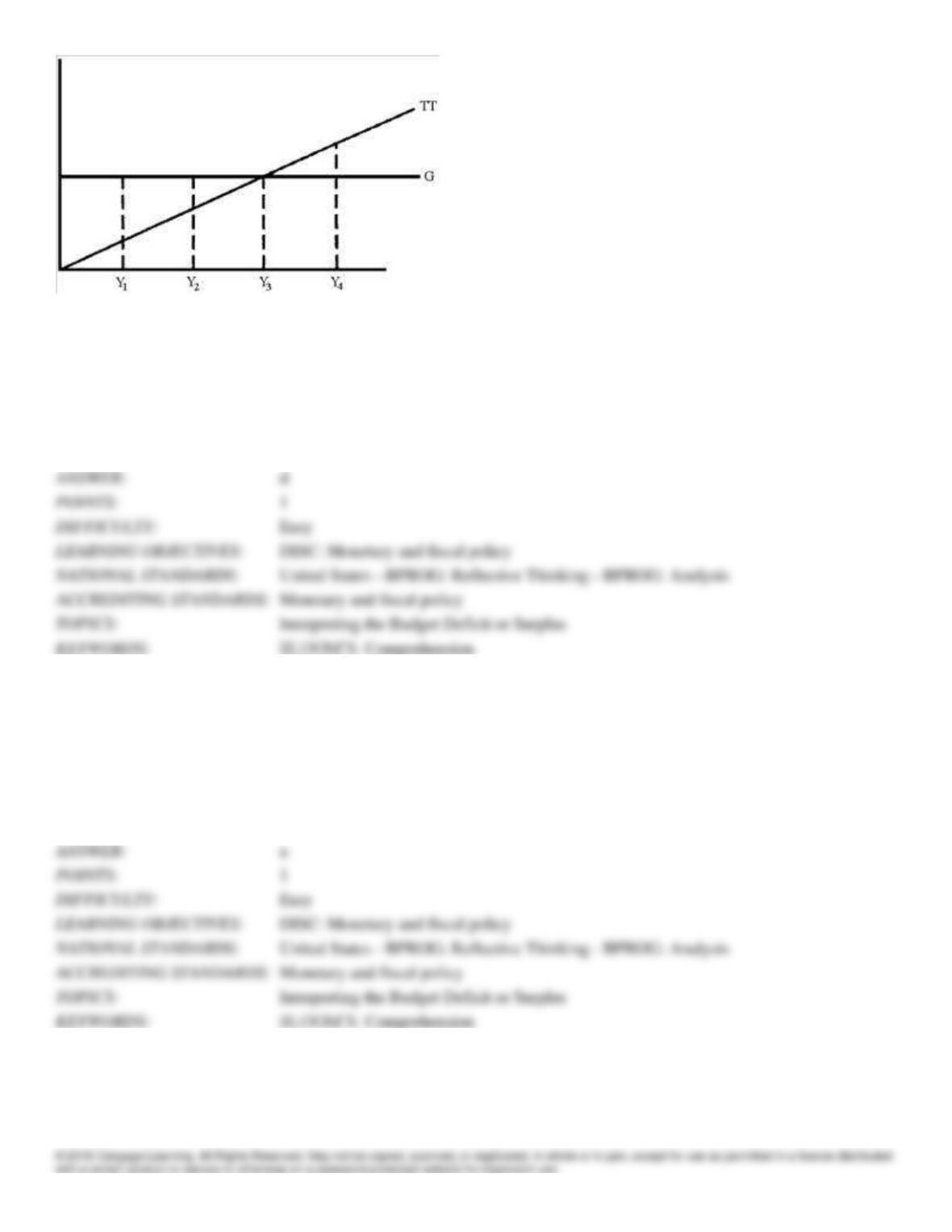
107. In Figure 16–1, there are four levels of income. G is government expenditures and TT is taxes less transfers. At which
level of income is the actual deficit the greatest?
a.
Y4
b.
Y3
c.
Y2
d.
Y1
DISC: Monetary and fiscal policy
United States – BPROG: Reflective Thinking – BPROG: Analysis
Monetary and fiscal policy
Interpreting the Budget Deficit or Surplus
108. In Figure 16–1, there are four levels of income. G is government expenditures and TT is taxes less transfers. At which
level of income does the official budget produce a surplus?
a.
Y4
b.
Y3
c.
Y2
d.
Y1
DISC: Monetary and fiscal policy
United States – BPROG: Reflective Thinking – BPROG: Analysis
Monetary and fiscal policy
Interpreting the Budget Deficit or Surplus
109. In Figure 16–1, there are four levels of income. G is government expenditures and TT is taxes less transfers. Y3 is the
full-employment level of income. At Y3
a.
there is an official deficit but a structural budget balance.
b.
there is a structural deficit but an official budget surplus.
c.
the official and structural deficit are in balance.
d.
both the official and structural budgets show a deficit.
DISC: Monetary and fiscal policy
United States – BPROG: Reflective Thinking – BPROG: Analysis
Monetary and fiscal policy
Interpreting the Budget Deficit or Surplus
110. What happens typically to a budget deficit during a recession?
a.
It increases because of tax changes.
b.
It decreases because of spending decreases.
c.
It decreases automatically.
d.
It increases automatically.
DISC: Monetary and fiscal policy
United States – BPROG: Analytic
Monetary and fiscal policy
Interpreting the Budget Deficit or Surplus
111. For which of the following time periods did the U.S. have a budget surplus?
a.
1990-1993
b.
1998-2001
c.
2003-2006
d.
The U.S. did not have a surplus in any of these time periods.
DISC: Monetary and fiscal policy
United States – BPROG: Analytic
Monetary and fiscal policy
Interpreting the Budget Deficit or Surplus
112. What happens typically to a budget deficit during an economic recovery?
a.
It decreases because of tax changes.
b.
It increases because of spending decreases.
c.
It decreases automatically.
d.
It increases automatically.
DISC: Monetary and fiscal policy
United States – BPROG: Analytic
Monetary and fiscal policy
Interpreting the Budget Deficit or Surplus
113. If the inflation rate falls, what will happen to the budget deficit?
a.
It will rise, because government spending will rise.
b.
It will rise, because interest payments will rise.
c.
It will fall, because tax receipts will increase.
d.
It will fall, because interest payments will fall.
DISC: Monetary and fiscal policy
United States – BPROG: Analytic
Monetary and fiscal policy
Interpreting the Budget Deficit or Surplus
114. The budget deficits of the 1980s and early 1990s differ from others in the post-World War II era in that they were
a.
a result of the Fed rather than a change in fiscal policy.
b.
temporary rather than structural, and pose no threat to the economy.
c.
not contracted to fight a war or end a recession.
d.
contracted as part of a program to plan the economy.
DISC: Monetary and fiscal policy
United States – BPROG: Analytic
Monetary and fiscal policy
Interpreting the Budget Deficit or Surplus
115. The structural deficit can be defined as
a.
the deficit that is structurally obstructing economic recovery to reach level of high employment.
b.
a hypothetical construct that estimates the deficit, given current tax rates and expenditure policies, if the
economy were operating at some fixed high-employment level.
c.
the deficit necessary to restructure the economy and reach a desired high-employment level.
d.
the deficit that would prevail if fiscal policy were structured differently in order to reach a desired high-
employment level.
DISC: Monetary and fiscal policy
United States – BPROG: Analytic
Monetary and fiscal policy
Interpreting the Budget Deficit or Surplus
116. The structural deficit is defined as
a.
that part of the deficit that is so hard to remove that it is never reduced.
b.
the portion of the budget deficit that occurs because the economy is not at full employment.
c.
the hypothetical deficit the economy would have under current fiscal policies if the economy were operating
near full employment.
d.
the actual budget deficit that exists in the economy.
DISC: Monetary and fiscal policy
United States – BPROG: Reflective Thinking – BPROG: Analysis
Monetary and fiscal policy
Interpreting the Budget Deficit or Surplus
117. Because the personal income tax is an automatic stabilizer,
a.
inflationary gaps are impossible.
b.
the budget deficit grows during a recession.
c.
the deficit needed to cure a recessionary gap increases.
d.
the structural deficit grows during a recession.
e.
All of the above are correct.
DISC: Monetary and fiscal policy
United States – BPROG: Analytic
Monetary and fiscal policy
Interpreting the Budget Deficit or Surplus
118. The main reason that the deficit grows in a recession is that
a.
the government reacts quickly and adjusts taxes to compensate.
b.
monetary policy that targets interest rates causes the costs of borrowing to fall.
c.
the deficit causes the recession, and reducing the deficit cures the recession.
d.
many forms of taxes act as automatic stabilizers.
DISC: Monetary and fiscal policy
United States – BPROG: Analytic
Monetary and fiscal policy
Interpreting the Budget Deficit or Surplus
119. How sensitive is the structural deficit to the state of the economy?
a.
It is insensitive to the state of the economy.
b.
The structural deficit changes cyclically with the economy.
c.
Changes in the structural deficit trigger opposite swings in the economy.
d.
The structural deficit changes countercyclically with the economy.
DISC: Monetary and fiscal policy
United States – BPROG: Analytic
Monetary and fiscal policy
Interpreting the Budget Deficit or Surplus
120. Why do economists think that the structural deficit is a good measure of the direction of fiscal policy?
a.
Because it adjusts over the business cycle, and reflects the fiscal stimulus of policy.
b.
Because it changes when policy changes, rather than when the economy changes.
c.
Because it changes when monetary policy changes, reflecting the interest rate cost of debt.
d.
Because it adjusts automatically, rather than requiring specific legislation.
DISC: Monetary and fiscal policy
United States – BPROG: Analytic
Monetary and fiscal policy
Interpreting the Budget Deficit or Surplus
121. Between the years of 2001 and 2003, what happened to the structural deficit?
a.
It declined rapidly.
b.
It fell steadily.
c.
It increased steadily.
d.
It remained fairly constant.
DISC: Monetary and fiscal policy
United States – BPROG: Analytic
Monetary and fiscal policy
Interpreting the Budget Deficit or Surplus
122. When will the difference between the actual deficit and the structural deficit be the largest?
a.
in an inflationary gap
b.
at full employment
c.
at potential real GDP
d.
in a recession
DISC: Monetary and fiscal policy
United States – BPROG: Analytic
Monetary and fiscal policy
Interpreting the Budget Deficit or Surplus
123. When will the difference between the actual deficit and the structural deficit be the smallest?
a.
in a major recession
b.
in a major recession
c.
at full employment
d.
in an inflationary gap
DISC: Monetary and fiscal policy
United States – BPROG: Analytic
Monetary and fiscal policy
Interpreting the Budget Deficit or Surplus
124. Inflation accounting for the debt argues the following:
a.
The change in the value of the debt when inflation occurs complicates income tax codes, and is the reason for
the tax changes of 2003.
b.
The portion of interest payments that compensate lenders for inflation should be considered repayment of debt
rather than interest expense.
c.
The debt represents an inflationary problem, and grows more rapidly when people fear inflation.
d.
The portion of the deficit dedicated to repayment of interest on the debt should not be considered part of the
deficit, because it is a transfer.
DISC: Monetary and fiscal policy
United States – BPROG: Analytic
Monetary and fiscal policy
Interpreting the Budget Deficit or Surplus
125. The primary conclusion of using inflation accounting is that inflation
a.
distorts the tax system, and results in slower economic growth.
b.
reduces the national debt to its nominal value instead of its real value.
c.
causes recessions, and increases the structural deficit.
d.
distorts government budget accounting by exaggerating interest expense.
DISC: Monetary and fiscal policy
United States – BPROG: Analytic
Monetary and fiscal policy
Interpreting the Budget Deficit or Surplus
126. In comparing the changes in actual budget surplus and the structural surplus between 1993 and 1999, it is clear that
the
a.
actual surplus rose less than the structural surplus.
b.
actual surplus and the structural surplus rose about the same.
c.
actual surplus rose much more than the structural surplus.
d.
tax increases of 1993 decreased the structural surplus more than they decreased the actual surplus.
DISC: Monetary and fiscal policy
United States – BPROG: Analytic
Monetary and fiscal policy
Interpreting the Budget Deficit or Surplus
127. The principal difference between conventional accounting and economic analysis of inflation is that
a.
accountants adjust nominal values for inflation.
b.
accountants adjust real values for inflation.
c.
economists adjust nominal values for inflation.
d.
economists adjust real values for inflation.
DISC: Monetary and fiscal policy
United States – BPROG: Analytic
Monetary and fiscal policy
Interpreting the Budget Deficit or Surplus
128. The statement that “repaying our enormous national debt will ruin the nation” is
a.
true, because taxes will have to go up by such large amounts that American citizens will have very little
income to live on.
b.
true, because most of our national debt is owed to foreigners.
c.
false, because the government will take emergency measures to prevent national bankruptcy.
d.
false, because each time the principal on the debt comes due, the U.S. Treasury rolls it over by issuing more
debt.
Moderate
United States – BPROG: Analytic
Monetary and fiscal policy
Why is the National Debt Considered a Burden?
129. Which of the following statements about the national debt has the most validity?
a.
Our large national debt can bankrupt the nation.
b.
If only Americans hold the debt, then payments of interest and principal are simply transfers from some
Americans to other Americans.
c.
Our large national debt can lead to subjection by the people (especially foreigners) who hold the debt.
d.
The national debt represents a burden to future generations who will have to make huge payments of interest
and principal.
Moderate
DISC: Monetary and fiscal policy
United States – BPROG: Analytic
Monetary and fiscal policy
Why is the National Debt Considered a Burden?
130. The United States need never pay off the national debt; it can simply refinance the debt when it comes due. The flaw
in thinking that the government must pay it off is based on the fallacy of
a.
benefit-cost ratio.
b.
post hoc, ergo propter hoc.
c.
composition.
d.
a priori expectations.
c
Difficult
DISC: Monetary and fiscal policy
United States – BPROG: Analytic
Monetary and fiscal policy
Why is the National Debt Considered a Burden?
131. If the national debt is owed entirely to U.S. citizens,
a.
paying off the debt will necessarily stimulate growth.
b.
future interest payments on the debt are not a burden to the nation as a whole.
c.
future economic growth will necessarily be slowed.
d.
the debt constitutes a burden to these citizens.
DISC: Monetary and fiscal policy
United States – BPROG: Analytic
Monetary and fiscal policy
Why is the National Debt Considered a Burden?
132. If the national debt is owed to foreigners,
a.
the debt constitutes a burden to domestic citizens.
b.
economic growth will necessarily be higher than if the debt were owed to domestic citizens.
c.
paying off the debt will involve a transfer of resources within the country.
d.
future interest payments on the debt are not a burden to the nation.
DISC: Monetary and fiscal policy
United States – BPROG: Analytic
Monetary and fiscal policy
Why is the National Debt Considered a Burden?
133. Why does the government not have to repay debt, as do private individuals?
a.
Because the government can ignore creditors and refuse payment.
b.
Because the government, as a dictatorship, is unresponsive to demands for repayment.
c.
Because the government has no debt, it owes it to itself.
d.
Because the government does not have a finite life, as do individuals.
DISC: Monetary and fiscal policy
United States – BPROG: Analytic
Monetary and fiscal policy
Why is the National Debt Considered a Burden?
134. The U.S. government need never default on its debt because
a.
it can easily nationalize banks, who own all the debt, and then owe it to itself.
b.
it can raise the funds it needs to repay by taxation, and it can print money to repay.
c.
it owes the debt to itself, and it can always ignore a demand for repayment.
d.
it can simply reduce spending enough to generate funds to repay its debt.