20) The maximum amount of a good that may be imported during a specified period of time is
A) an infant industry agreement.
B) an import quota.
C) dumping.
D) comparative advantage.
21) The effect of an import quota is
A) to shift the supply curve up by the amount of the quota.
B) to lead to a decrease in demand.
C) to make the supply curve vertical at the amount of the quota.
D) to make the supply curve horizontal at the amount of the quota.
22) The effect of a quota is to
A) increase quantity supplied and lower price.
B) increase quantity supplied and increase price.
C) increase demand for the good and increase price.
D) reduce quantity supplied and raise price.
23) Voluntary restraint agreements are
A) a type of tariff in which the tax is a fixed amount per unit of good imported.
B) a type of tariff in which the tax is based on the value of the good.
C) a type of quota that actually benefits the firms facing the restrictions.
D) a type of quota agreed to “voluntarily” in order to prevent more severe protection of another
type.
24) An official agreement with another country to restrict the quantity of its exports to the U.S. is
A) a regional trade bloc.
B) the quota system.
C) a voluntary import expansion.
D) a voluntary restraint agreement.
25) A voluntary import expansion involves a
A) country agreeing to import more from another country.
B) country agreeing to reduce its trade barriers.
C) country agreeing to an import quota.
D) firm agreeing to expand output.
26) An official agreement with another country in which it agrees to import more from the
United States is
A) a regional trade bloc.
B) the quota system.
C) a voluntary import expansion.
D) a voluntary restraint agreement.
27) A tariff is
A) a government-imposed restriction on the quantity of a specific good that can be imported into
the country.
B) a tax on imported goods.
C) a subsidy on domestically produced goods.
D) a voluntary agreement to restrict exports.
28) The effects of a tariff are
A) reduced quantity supplied overall, reduced quantity supplied by domestic producers, and a
lower price.
B) reduced quantity supplied overall, increased quantity supplied by domestic producers, and a
higher price.
C) reduced quantity supplied overall, decreased quantity supplied by domestic producers, and a
lower price.
D) identical to the effects of a quota, except that the price of the good is higher.
29) A difference between a quota and a tariff is that
A) a tariff generates a higher price than a quota does.
B) a tariff generates a greater reduction in exports.
C) a quota increases profits of domestic producers more than a tariff does.
D) the government collects revenues from a tariff, which does not happen with a quota.
30) A tariff placed on a foreign good will
A) reduce the price of a competing domestic good.
B) increase the price of a competing domestic good.
C) increase the quantity sold of both the foreign and competing domestic good.
D) reduce the quantity sold of both the foreign and competing domestic good.
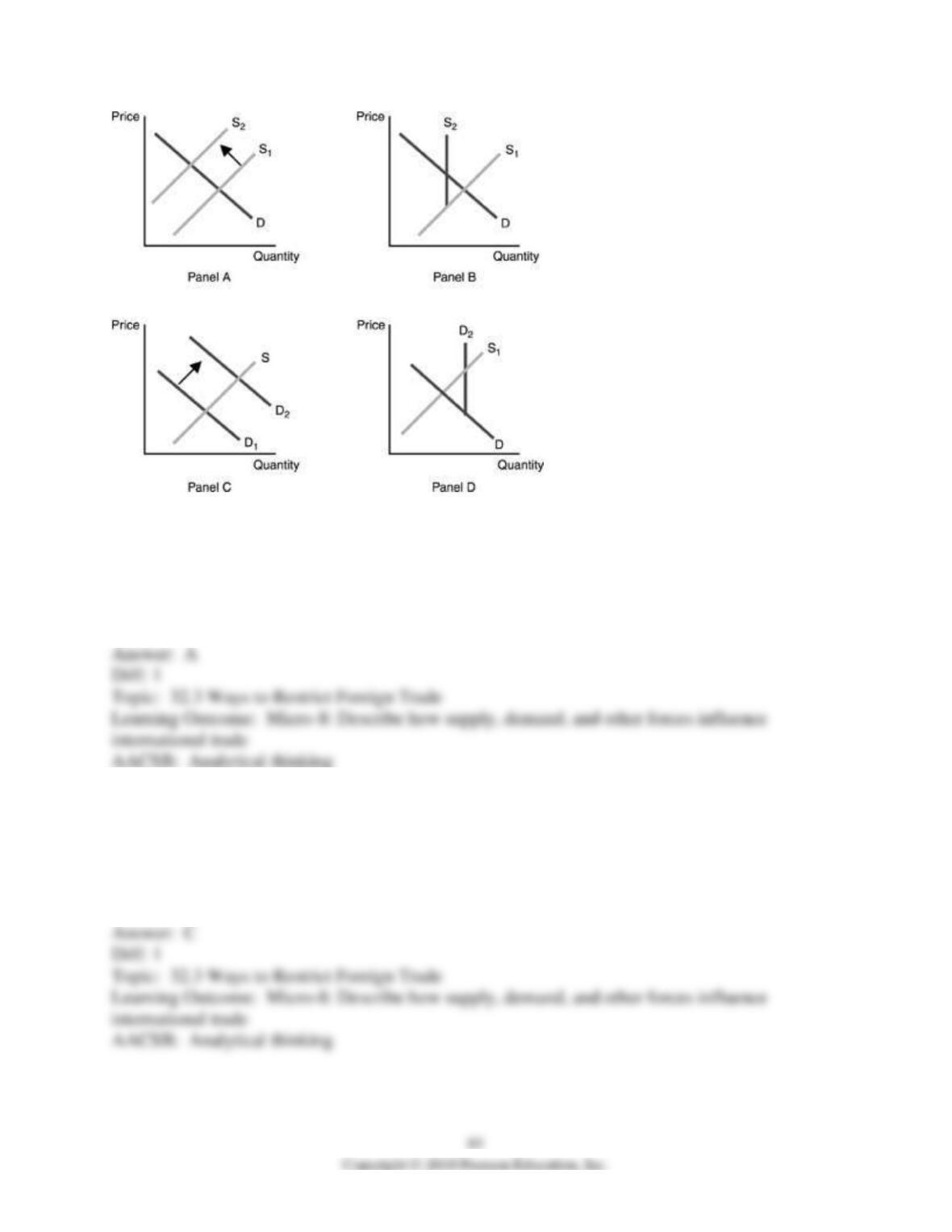
31) Refer to the above figures. A tariff is placed on a foreign good. Which figure represents the
situation in the domestic market for the foreign good?
A) Panel A
B) Panel B
C) Panel C
D) Panel D
32) Refer to the above figures. A tariff is placed on a foreign good. Which figures represents the
situation in the domestic market for a competing domestic good?
A) Panel A
B) Panel B
C) Panel C
D) Panel D
33) Refer to the above figures. A quota is placed on a foreign good. Which figure represents the
situation in the domestic market for a competing domestic good?
A) Panel A
B) Panel B
C) Panel C
D) Panel D
34) The General Agreement on Tariffs and Trade is an international agreement
A) that outlaws all tariffs but permits quotas.
B) to encourage world trade by lowering tariffs and other trade barriers.
C) to encourage world trade by lending resources to developing countries.
D) between the United States and Japan that has never been ratified, resulting in several trade
wars with Japan.
35) An international agreement established in 1947 to further world trade by reducing barriers
and tariffs is the
A) World Trade Organization.
B) European Union.
C) General Agreement on Tariffs and Trade.
D) North American Free Trade Agreement.
36) The trend in current tariff laws is to
A) raise tariffs on foreign goods.
B) keep tariffs the same.
C) lower tariffs on foreign goods.
D) abolish tariffs all together.
37) A tariff is a
A) legal limit on sales of a foreign product in the domestic market.
B) regulation of the quality of a foreign product sold in the domestic market.
C) tax on sales of a foreign product in the domestic market.
D) voluntary limit on sales of a foreign product in the domestic market.
38) A legal limit on the amount of sugar imported into the United States is
A) a tariff.
B) a subsidy.
C) a quota.
D) a voluntary import restriction.
39) A government-imposed restriction on the quantity of a good that can be imported is
A) an embargo.
B) a protective tariff.
C) a quota.
D) a health restriction.
40) An import quota will make the supply curve for the imported good
A) perfectly inelastic.
B) perfectly elastic.
C) unitary elastic.
D) negatively sloped.
41) A legal restriction on the amount of a good that can be imported into a country is known as a
A) voluntary restraint agreement.
B) tariff.
C) quota.
D) Domestic Protection Restraint (DPR).
42) A government-imposed restriction on the quantity of a specific good that may be imported to
and sold in the United States is called a
A) tariff system.
B) quota system.
C) reverse-trade system.
D) union trade system.
43) A VRA is an example of
A) a “voluntary” quota.
B) a tariff.
C) an illegal foreign good.
D) an illegal foreign tariff.
44) A tariff is a tax on
A) all exported goods imposed by the WTO.
B) imported goods.
C) shipping containers.
D) foreign exchange transactions.
45) When a tariff is imposed, the supply curve for the imported good
A) shifts downward and to the right.
B) shifts upward and to the left.
C) does not change.
D) becomes perfectly inelastic.
46) When a tariff is imposed, the demand curve for the domestic good
A) shifts downward and to the right.
B) shifts upward and to the left.
C) shifts upward and to the right.
D) shifts downward and to the left.
47) A tax placed on imports is known as
A) voluntary restraint agreement.
B) tariff.
C) quota.
D) infant industry.
48) Trade restrictions tend to make domestic products
A) cheaper because they do not have to compete with foreign goods.
B) cheaper because they do have to compete with foreign goods.
C) more expensive because they have to compete with foreign goods.
D) more expensive because they do not have to compete with foreign goods.
49) An agreement with another country in which it agrees to import more from the United States
is called a
A) VRA.
B) VIE.
C) VAR.
D) VAT.
50) The highest tariff rates of the twentieth century in the United States arose as a result of which
law?
A) the Robinson-Patman Act
B) the Tariff of Abominations Act
C) the Wheeler-Lea Act
D) the Smoot-Hawley Act
51) The law that created the high level of tariffs in United States in the 1930s is
A) the GATT Act.
B) the World Trade Act.
C) the Smoot-Hawley Act.
D) the Tariffs Agreement Act.
52) In comparing tariffs and quotas, we know that
A) neither raises revenues for the federal government.
B) both raise revenues for the federal government.
C) tariffs raise revenues for the federal government, while quotas do not.
D) quotas raise revenues for the federal government, while tariffs do not.
53) The two groups that benefit the most from quotas are
A) the importers who have the right to import the restricted good and the domestic producers of
the restricted good.
B) the domestic consumers of the restricted good and the domestic producers of the restricted
good.
C) the domestic consumers of the restricted good and the foreign producers of the restricted
good.
D) the importers who have the right to import the restricted good and the domestic consumers of
the restricted good.
54) What is GATT and what happened to tariff rates as a result of GATT?
55) What are the effects of a tariff on a good?