Economics Today, 19e (Miller)
Chapter 32 Comparative Advantage and the Open Economy
32.1 Why We Trade: Comparative Advantage and Mutual Gains from Exchange
1) Since World War II, world trade has
A) decreased in importance as nations turn inward due to security concerns.
B) increased, but not as dramatically as annual world real GDP has climbed.
C) risen sharply, outpacing gains in annual world real GDP.
D) increased in relative importance for most nations, but not for the United States.
2) Today, the share of international trade in U.S. GDP is
A) almost 0 percent.
B) about 10 percent.
C) close to 30 percent.
D) more than 150 percent.
3) The importance of international trade in the U.S. economy
A) has been decreasing and is expected to continue to decrease.
B) has been decreasing but is expected to start to increase.
C) has been increasing and is expected to continue to increase.
D) has been increasing but is expected to decrease in the future.
4) For the United States since 1950, imports as a percentage of GDP has
A) tripled.
B) increased slightly.
C) remained constant.
D) decreased.
5) Since 1950, the balance of trade for United States has
A) gone from a surplus to a deficit.
B) gone from a deficit to a surplus.
C) remained constant.
D) gone from a small deficit to a larger deficit.
6) Since 1950, the volume of world trade and the volume of world real GDP
A) have both increased at roughly the same rate.
B) have both decreased at roughly the same rate.
C) have both increased, but the volume of world trade has increased more slowly than the
volume of world real GDP.
D) have both increased, but the volume of world trade has increased faster than the volume of
world real GDP.
7) Today, in the United States, imports are about
A) 16 percent of GDP.
B) 32 percent of GDP.
C) 8 percent of GDP.
D) 4 percent of GDP.
8) Today, in the United States, exports are about
A) 90 percent of GDP.
B) 12 percent of GDP.
C) 28 percent of GDP.
D) 4 percent of GDP.
9) During the past 40 years, U.S. exports as a percent of GDP and U.S. imports as a percent of
GDP
A) both rose at the same pace.
B) both fell at the same pace.
C) both rose, but U.S. imports as a percent of GDP rose at a faster pace.
D) both rose, but U.S. exports as a percent of GDP rose at a faster pace.
10) Assume that U.S. producers can manufacture cookies at a lower opportunity cost than
Mexican producers. If this is the case
A) it will not be possible for Mexico to have an comparative advantage in the production of any
other products.
B) Mexico could still have the comparative advantage in cookie production.
C) it would still be possible for Mexico to have a comparative advantage in trade for some other
products.
D) Mexico would have the comparative advantage in all products compared to the United States.
11) The ability to produce a good or service at a lower opportunity cost than other producers is
called
A) absolute advantage.
B) comparative advantage.
C) implicit advantage.
D) marginal advantage.
12) Specialization in trade will be economically efficient if it is based upon
A) national security needs.
B) absolute advantage.
C) comparative advantage.
D) government regulations.
13) The principle of comparative advantage essentially states that
A) there are some goods for which the opportunity costs of production are the same regardless of
who produces them.
B) some goods have high opportunity costs and low absolute costs.
C) specialization can reduce output rather than increase it.
D) total output of an economic system is greatest when each good is produced by those who have
the lowest opportunity cost of producing the good.
14) Mason and Chloe each produce two goods. According to the principle of comparative
advantage, the total output produced by these individuals will be greatest
A) if Chloe produces both goods and Mason produces nothing.
B) if each good is produced by the individual who has the lower opportunity cost of producing
that good.
C) if each good is produced by the individual who has the higher absolute cost of producing that
good.
D) if Mason produces both goods and Chloe produces nothing.
15) Suppose Ethan and Ava work in a farm that grows apples and oranges of the same size. In
one hour, Ethan can pick 8 pounds of apples or 1 pound of oranges. Ava can pick 6 pounds of
apples or 1 pound of oranges. It can be concluded that
A) Ava has a comparative advantage in picking apples.
B) Ava has an absolute advantage in picking apples.
C) Ethan has a comparative advantage in picking apples.
D) Ethan has an absolute advantage in picking oranges.
16) Given two economic systems, A and B, if economy A has a comparative advantage in the
production of widgets, then
A) the inputs necessary to produce widgets in economy A cost less than in economy B.
B) economy A must give up less of all other goods to produce widgets than economy B.
C) economy A is less efficient in the production of some goods than economy B.
D) economy A would not benefit from the specialization of production.
17) Given two economic systems, A and B, if economy A has an absolute advantage in the
production of widgets, then
A) fewer inputs are necessary to produce widgets in economy A than in economy B.
B) economy A must give up less of all other goods to produce widgets than economy B.
C) economy A is less efficient in the production of widgets than economy B.
D) economy A would not benefit from the specialization of production.
18) That each individual should engage in economic activities in which he or she is relatively
more efficient is an application of the concept of
A) competition.
B) absolute advantage.
C) scarcity.
D) comparative advantage.
19) According to the principle of comparative advantage, a nation should specialize in economic
activities
A) that incur lower opportunity costs.
B) that incur higher opportunity costs.
C) for which it has an absolute advantage.
D) for which it has no absolute advantage.
20) If Kami can produce 40 portable power banks or 30 cellphones during a month’s time, while
Sally can produce 10 portable power banks or 20 cellphones, then it is correct to state that
A) Kami has a comparative advantage in producing portable power banks.
B) Kami has a comparative advantage in producing both portable power banks and cellphones.
C) Sally has a comparative advantage in producing both portable power banks and cellphones.
D) Sally has an absolute advantage in portable power banks.
21) If Abigail can produce 4 portable power banks or 3 smartphones in a day, while Jacob can
produce 1 portable power bank or 2 smart phones, then it is correct to state that
A) Abigail has a comparative advantage in producing smartphones.
B) Abigail has an absolute advantage in producing portable power banks but not smartphones.
C) Jacob has a comparative advantage in smartphones.
D) Jacob has an absolute advantage in smartphones.
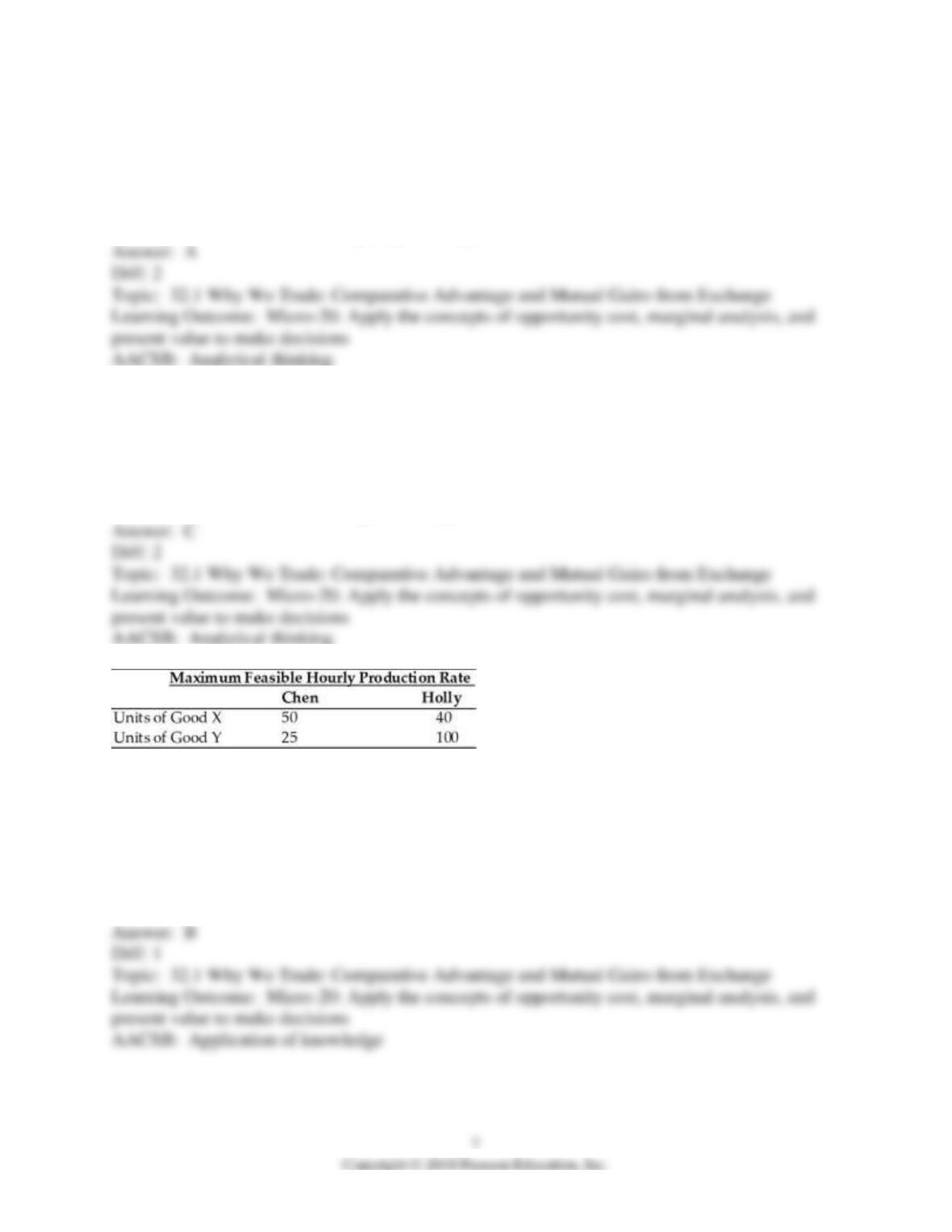
22) According to the above table, which assumes that opportunity costs of producing goods X
and Y are constant, the opportunity cost of producing one unit of Good X is ________ units of
Good Y for Chen and ________ units of Good Y for Holly.
A) 25; 100
B) 0.5; 2.5
C) 2; 0.4
D) 100; 25
23) According to the above table, which assumes that opportunity costs of producing goods X
and Y are constant, the opportunity cost of producing one unit of Good Y is ________ units of
Good X for Chen and ________ units of Good X for Holly.
A) 50; 40
B) 25; 10
C) 2; 2/5
D) 1/2; 2 1/2
24) According to the above table, which assumes that opportunity costs of producing goods X
and Y are constant, Chen has comparative advantage in production of
A) Good X.
B) Good Y.
C) both goods.
D) neither good.
25) According to the above table, which assumes that opportunity costs of producing goods X
and Y are constant, Holly has comparative advantage in production of
A) Good X.
B) Good Y.
C) both goods.
D) neither good.
26) According to the above table, which assumes that opportunity costs of producing goods X
and Y are constant, which of the following statements is TRUE?
A) Chen will be willing to produce only good X and trade units of that good to Holly as long as
he receives more than 0.5 units of good Y from her in exchange.
B) Holly will be willing to produce only good X and trade units of that good to Chen as long as
she receives less than 2.5 units of good Y in exchange.
C) Chen will be willing to produce only good Y and trade units of that good to Holly as long has
he receives less than 2 units of good X from her in exchange.
D) Holly will be willing to produce only good Y and trade units of that good to Chen as long as
she receives less than 0.4 unit of good X in exchange.
27) Suppose that the opportunity cost of producing goods differs between two nations. We can
correctly state that
A) the two nations should not specialize in the production of goods.
B) specialization can lead to a decrease in the production of all goods.
C) specialization can lead to an increase in the production of all goods.
D) neither country has a comparative advantage in the production of any good.
28) A country will specialize in the good for which
A) it has absolute advantage.
B) it has moderate production costs.
C) it can produce at minimum average cost.
D) it has comparative advantage.
29) Specialization and international trade lead to
A) an outward shift in the production possibilities curve.
B) an inward shift in the consumption possibilities frontier.
C) a lower opportunity cost of domestic production of all goods.
D) an enhanced level of consumption.
30) Comparative advantage is defined as
A) producing all goods at lower opportunity costs than other countries can.
B) producing more output of all goods than anyone else can.
C) producing one good at a lower opportunity cost than another country can.
D) the ability to produce more output from given inputs than anyone else can.
31) Consider a world of two countries producing only wheat and cloth. In one hour, residents of
Country A can produce 1 unit of wheat and 0.5 unit of cloth, whereas residents of Country B can
produce 0.3 unit of wheat and 0.4 unit of cloth. Country A should export
A) wheat and cloth; country B should not export anything.
B) wheat and country B should export cloth.
C) nothing and country B should export both wheat and cloth.
D) cloth and country B should export wheat.
32) Consider a world of two countries facing opportunity costs and producing only wheat and
cloth. In one hour, residents of Country A can produce a maximum of either 1 unit of wheat or
0.5 unit of cloth, whereas residents of Country B can produce a maximum of either 0.3 unit of
wheat or 0.4 unit of cloth. Country B should export
A) wheat and cloth; country A should not export anything.
B) wheat and country A should export cloth.
C) nothing and country A should export both wheat and cloth.
D) cloth and country A should export wheat.
33) Suppose Mexico has a comparative advantage relative to the United States in the
manufacture of clothing and the United States has a comparative advantage in producing
agricultural products. Which of the following is most likely to occur?
A) Mexico and the United States will not trade agricultural products or clothing.
B) Mexico will sell clothing to the United States and the United States will sell agricultural
products to Mexico.
C) Mexico will sell agricultural products to the United States and Mexico will buy clothing from
the United States.
D) Mexico will sell clothing to the United States but not buy any agricultural products from the
United States.
34) When the principle of comparative advantage determines trade, then a country will
A) specialize only in that good with the highest opportunity cost.
B) specialize only in goods with the lowest opportunity costs.
C) specialize only in that good where output is less per worker hour than another country.
D) specialize only in that good where production costs are more than average total costs.
35) Consider the following information, and assume that opportunity costs are constant: On one
hand, residents of Country A can produce more corn in a year than residents of Country B, but
they can produce computers at a lower opportunity cost than residents of country B. On the other
hand, residents of country B can produce more computers in a year than residents of Country A,
but they can produce corn at a lower opportunity cost than residents of country A. It can be
concluded that residents of
A) Country A should produce corn and trade it for computers produced in Country B.
B) Country B should produce computers and trade them for corn produced in Country B.
C) Country A should produce computers and trade them for corn produced in Country B.
D) both countries should choose not to trade.
36) If country X can produce a unit of good 1 at a lower opportunity cost than can country Y, it
is correct to state that country X
A) has a comparative advantage in producing good 1.
B) has an absolute advantage in producing good 1.
C) will import good 1 from country Y.
D) will not produce good 1.
37) Consider a world with two countries and two goods. Under which of the following
conditions does comparative advantage NOT exist?
A) One country can produce both goods more cheaply than the other country.
B) One country has more productive resources or inputs than another country.
C) The opportunity cost of producing each good is the same in each country.
D) One country has an absolute advantage in producing one good while the other country has an
absolute advantage in producing the other good.
38) Suppose that opportunity costs are constant in both France and Germany. In France,
maximum feasible hourly production levels are either 3 units of wheat or 5 units of wine. In
Germany, maximum feasible hourly production levels are either 4 units of wheat or 10 units of
wine. It is correct to state that
A) Germany has an comparative advantage in producing both wheat and wine.
B) Germany has a comparative advantage in producing wine.
C) France has a comparative advantage in producing both wheat and wine.
D) France has a comparative advantage in producing wine.
39) Suppose that opportunity costs in India and Australia are constant. In India, maximum
feasible hourly production rates are either 0.3 unit of cloth or 0.2 unit of food. In Australia,
maximum feasible hourly production rates are either 0.5 unit of cloth or 0.5 unit of food. It is
correct to state that
A) India has a comparative advantage in producing cloth.
B) India has a comparative advantage in producing both cloth and wheat.
C) India has no comparative advantage in producing cloth or wheat.
D) Australia has a comparative advantage in producing cloth.
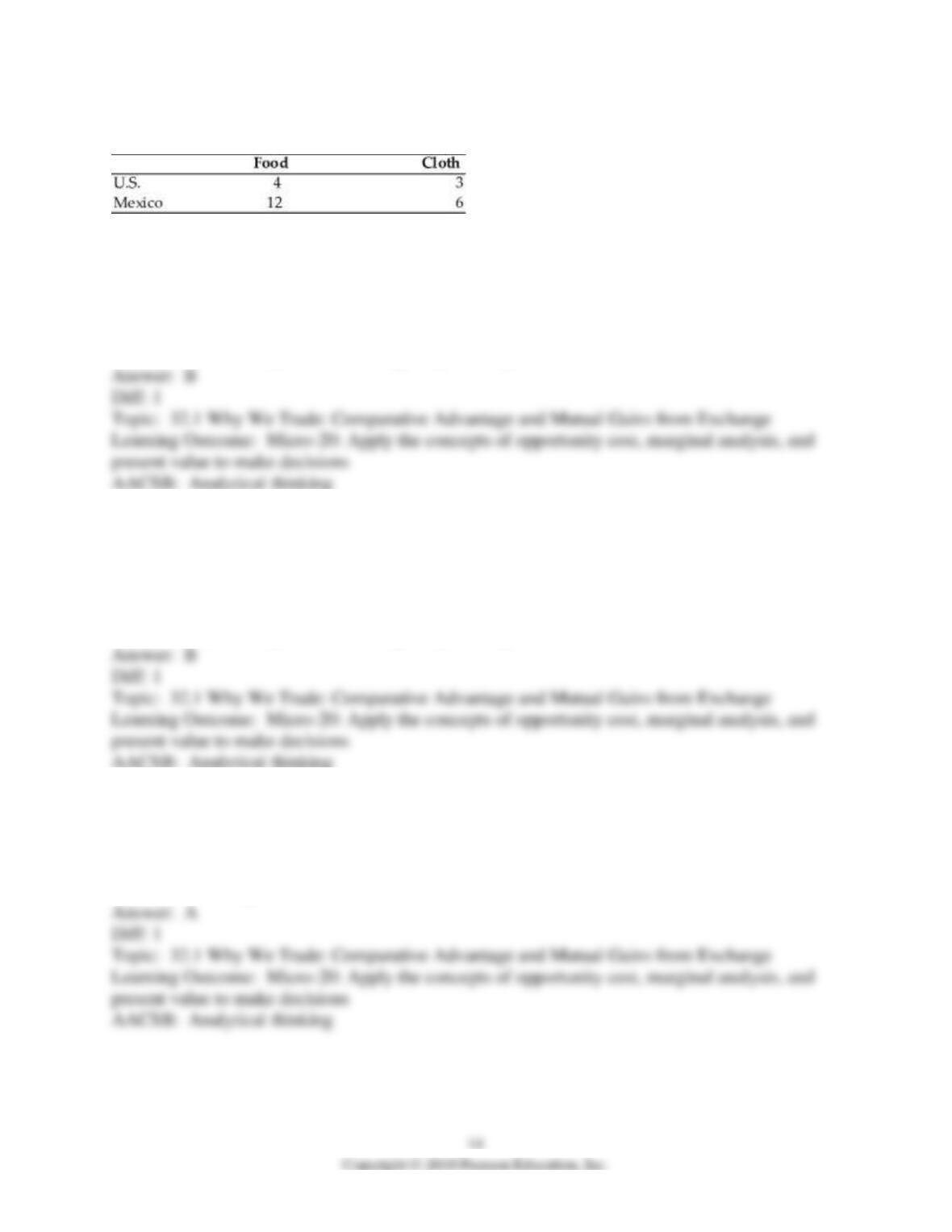
Maximum Feasible Hourly Production Rates for Either
Food or Cloth Using All Available Resources
40) Using the data in the above table and assuming constant opportunity costs, it is correct to
state that
A) the United States has a comparative advantage in producing food.
B) Mexico has an absolute advantage in producing both food and cloth.
C) the United States has a comparative advantage in producing both food and cloth.
D) Mexico has a comparative advantage in producing cloth.
41) Using the data in the above table and assuming constant opportunity costs, it is correct to
state that
A) the United States has an absolute advantage in producing cloth.
B) Mexico has a comparative advantage in producing food.
C) the United States has a comparative advantage in producing both food and cloth.
D) Mexico has a comparative advantage in producing both food and cloth.
42) Using the data in the above table, and assuming constant opportunity costs, it is likely that
A) the United States will import food.
B) Mexico will export cloth.
C) the United States will export both cloth and food.
D) Mexico will export both cloth and food.
43) Using the data in the above table, and assuming constant opportunity costs, it is likely that
A) the United States will export food.
B) Mexico will import cloth.
C) the United States will import both cloth and food.
D) Mexico will import both cloth and food.
44) If country A exports good X to country B and country B exports good Y to country A, it is
most likely that
A) A has an absolute advantage in the production of good X.
B) B has a comparative advantage in the production of good Y.
C) the opportunity cost of domestic production of good Y for country A is lowered with trade.
D) B is producing less of good Y than in the no-trade case.
45) Comparative advantage is defined as
A) the ability to produce more output of one good relative to another good than another country
can.
B) the ability to produce more output from given inputs of resources than others can.
C) the ability to use more input of resources than others can.
D) having a lower average fixed cost in the production of a good than does someone else.
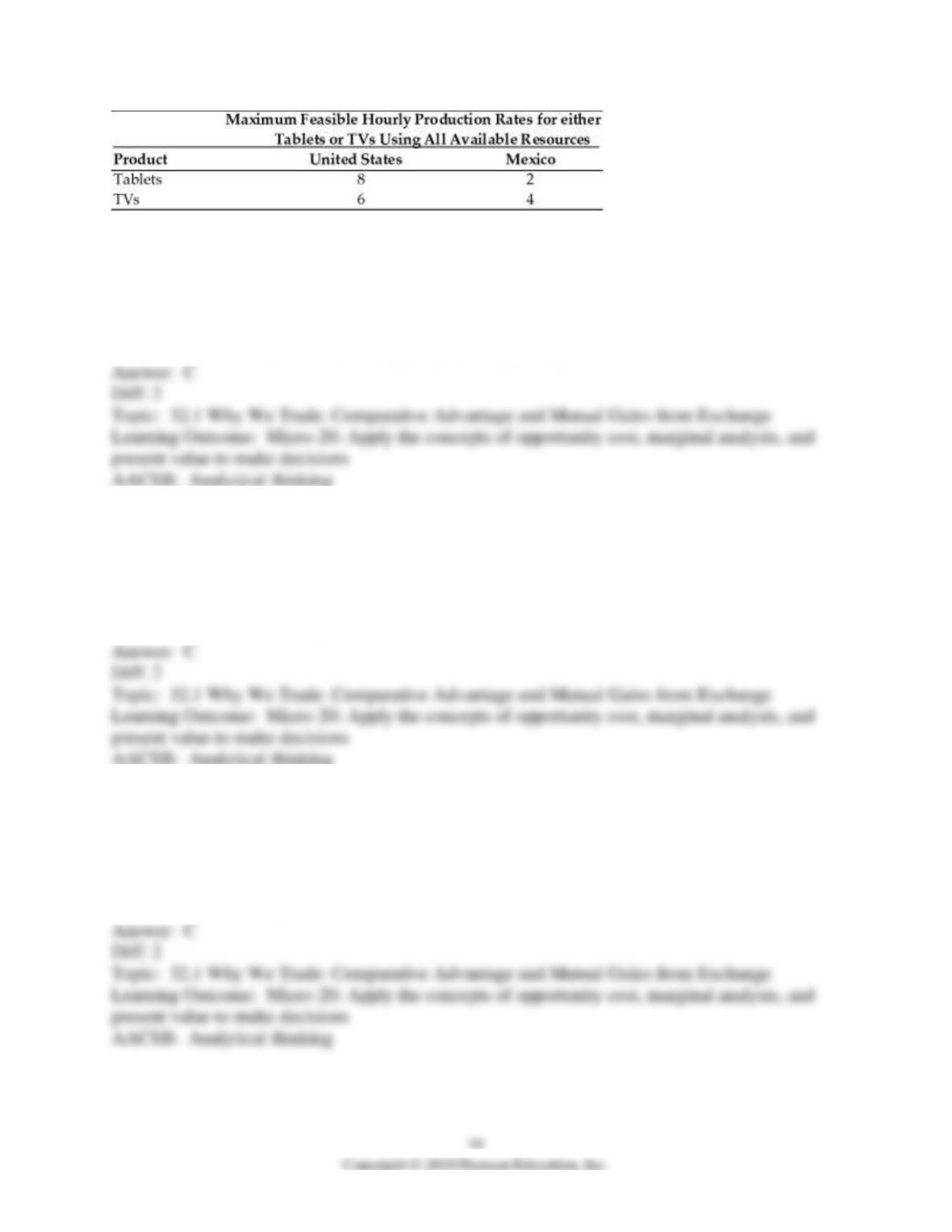
46) Refer to the above table. Assuming that opportunity costs are constant, which of the
following is a correct statement?
A) The United States has a comparative advantage in TV production.
B) The United States has a comparative advantage in producing both goods.
C) Mexico has a comparative advantage in producing TVs.
D) Mexico has a comparative advantage in producing both goods.
47) According to the above table, if these two countries trade
A) Mexico should specialize in tablets and the United States in TVs.
B) the United States should specialize in both tablets and TVs.
C) the United States should specialize in tablets and Mexico should specialize in TVs.
D) we cannot tell which country should specialize in which good without knowing the amount of
labor utilized in each country.
48) According to the above table, if these two countries trade
A) Mexico should export tablets and the United States export TVs.
B) the United States should import tablets and Mexico should import TVs.
C) the United States should export tablets and Mexico should export TVs.
D) we cannot tell which country should export which good without knowing the amount of labor
utilized in each country.
49) According to the above table, if these two countries trade
A) Mexico should import tablets and the United States import TVs.
B) the United States should import tablets and Mexico should import TVs.
C) the United States should export TVs and Mexico should export tablets.
D) we cannot tell which country should export which good without knowing the amount of labor
utilized in each country.
50) According to economic historians, one result of international trade is that it
A) aids in the international transmission of ideas.
B) reduces the world-wide output of goods.
C) reduces the world-wide consumption of goods.
D) causes persistent world-wide inflation.
51) Which of the following is counted as a benefit from international trade?
A) New production processes developed in one nation are transmitted to others.
B) Intellectual property such as music and computer applications is introduced throughout the
world.
C) New goods have been introduced to other parts of the world.
D) All of the above are benefits from international trade.
52) The ability to produce an item at a lower opportunity cost compared with other producers is
known as
A) competitive dominance.
B) productive dominance.
C) comparative advantage.
D) absolute advantage.
53) The ability to produce the same quantity of a good or service using fewer units of labor is
known as
A) competitive dominance.
B) productive dominance.
C) comparative advantage.
D) absolute advantage.
54) Comparative advantage is
A) the ability to produce more output from given inputs than another producer can.
B) the ability to produce a good at a lower opportunity cost than other producers.
C) the ability to produce more output of all goods than anyone else can.
D) the ability to produce all goods at lower costs than anyone else can.
55) Absolute advantage is
A) the ability to produce more output from given inputs than another producer can.
B) the ability to produce a good at a lower opportunity cost than other producers.
C) is always a relative concept.
D) the ability to produce all goods at lower costs than anyone else can.
56) Mary can clean 20 windows per hour or type 30 pages of paper per hour. Tom can clean 18
windows per hour or he can type 25 pages of paper per hour. Based on this
A) Mary has comparative advantages in activities.
B) Tom has comparative advantages in both activities.
C) Tom has a comparative advantage in cleaning windows.
D) Mary has a comparative advantage in cleaning windows.
57) The ability to produce a good or service at a lower opportunity cost than other producers is
A) absolute advantage.
B) the quota system.
C) intellectual property.
D) comparative advantage.
58) When nations specialize according to their comparative advantage
A) Total production and consumption in the world increase.
B) Consumption rises in one country but must fall in all others.
C) Total world production rises but total consumption in the world declines.
D) none of the above
59) If there are two goods and two countries, then one country can have
A) a comparative advantage in only one good.
B) a comparative advantage in both goods.
C) a higher opportunity cost of producing both goods.
D) a lower opportunity cost of producing both goods.
60) If there are two goods and two countries, then one country can have
A) an absolute advantage in only one good.
B) an absolute advantage in both goods.
C) a higher opportunity cost of producing both goods.
D) a lower opportunity cost of producing both goods.