74) When the total external and internal costs of a transaction are taken into consideration, this is
known as
A) public costs.
B) average total costs.
C) social costs.
D) marginal costs.
75) When there are no externalities
A) social costs are greater than private costs.
B) social costs are less than private costs.
C) private costs are greater than social costs.
D) private costs equal social costs.
76) Which of the following is FALSE?
A) Social costs do not include private costs.
B) Private costs do not include external costs.
C) If social costs are greater than private costs, “too much” of a good is being produced.
D) Pollution is a social cost.
77) An externality
A) may be positive or negative.
B) means a rapidly rising cost borne by consumers.
C) is the cost of producing a good outside the United States.
D) is the indirect cost, the overhead, of producing a product.
78) Which of the following statements is TRUE for society as a whole?
A) Supply of services always reflects all social costs.
B) Demand for services always reflects all social costs.
C) Private costs are not always equal to social costs.
D) Social benefits are always emphasized in advertising.
79) When the private costs and the social costs are NOT the same, there is a(n)
A) externality.
B) internality.
C) public good.
D) monopoly.
80) A good that has external costs associated with its production will be
A) produced at the optimal level.
B) underproduced.
C) overproduced.
D) not produced.
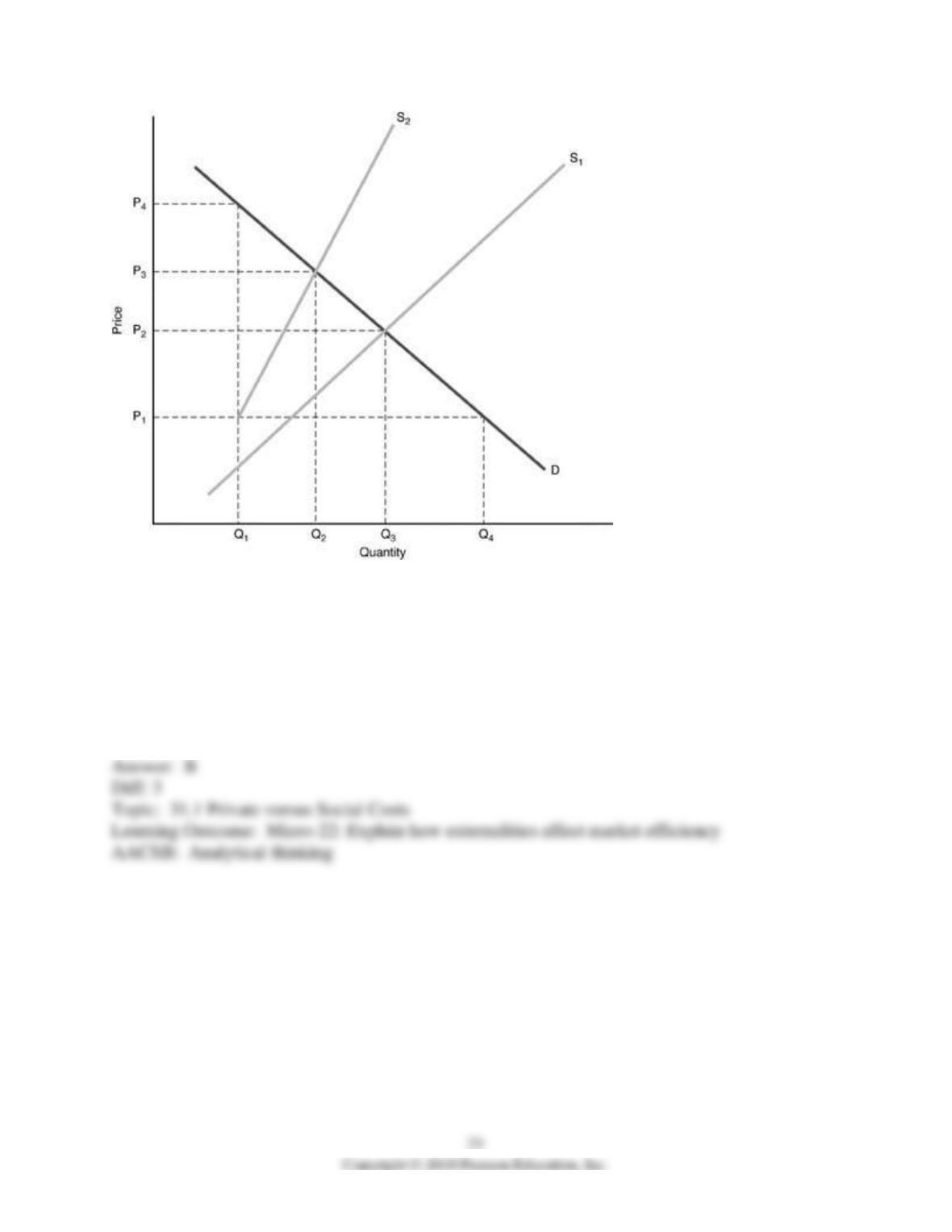
81) In the above figure, S1 represents the supply curve which includes private costs, and S2 is
the supply curve which includes social costs. If the firm is producing a product that has external
costs that the firm does NOT have to pay, what will be the equilibrium price and quantity?
A) P1, Q4
B) P2, Q3
C) P4, Q1
D) P3, Q2
82) In the above figure, S1 represents the supply curve which includes private costs, and S2 is
the supply curve which includes social costs. If the firm is producing a product that has external
costs that the firm does have to pay, what will be the equilibrium price and quantity?
A) P1, Q4
B) P2, Q3
C) P4, Q1
D) P3, Q2
83) An externality occurs whenever
A) private costs are the same as social costs.
B) private costs are the same as internal costs.
C) private costs diverge from social costs.
D) private costs plus internal costs equal social costs.
84) A good that has external benefits associated with its production will be
A) produced at the optimal level.
B) underproduced.
C) overproduced.
D) not produced.
85) A large farm uses fertilizer that nearby landowners complain may contaminate their water.
Tests are conducted and contaminants are found. The costs resulting from this decision are
referred to as
A) implicit costs.
B) factor costs.
C) external costs.
D) opportunity costs.
86) All of the following are examples of goods for which external costs commonly exist
EXCEPT
A) cigarettes.
B) automobiles.
C) vaccinations.
D) oil transportation.
87) Which of the following is the main reason for externalities?
A) The full cost of a transaction is not borne by the buyer/seller of the product.
B) Police enforcement of scalping is not uniformly enforced.
C) the lack of organized exchanges for all goods and services
D) The production of public goods uses up scarce resources.
88) Which one of the following is an example of an external cost?
A) the cost to attend college
B) labor costs to a firm
C) emissions from a factory
D) a house payment owed by a friend
89) You enter a classroom, which is littered with newspapers. This is because
A) students are too lazy to clean up.
B) maintenance people only clean once a day.
C) it is a way to protest against the tuition rates.
D) students do not pay for littering.
90) Social costs of a good are equal to
A) external costs minus private costs.
B) private costs minus external costs.
C) private costs plus external costs.
D) external costs divided by the private costs.
91) There is an externality present only when
A) private costs equal social benefits.
B) private benefits equal social benefits.
C) private costs or benefits diverge from social costs or benefits.
D) private costs equal social costs.
92) An externality exists when
A) there are private costs.
B) there are internal costs.
C) there are external costs.
D) there are opportunity costs.
93) A situation in which a private cost diverges from a social cost is
A) internal costs.
B) an externality.
C) an internality.
D) a transactions cost.
94) A situation in where the costs of an action are NOT fully borne by the two parties engaged in
exchange is
A) an externality.
B) an internality.
C) internal costs.
D) a transactions cost.
95) An externality is a situation in which
A) private costs diverge from social costs.
B) internal costs diverge from private costs.
C) there are no social costs.
D) the cost borne by the consumer is greater than the monetary price.
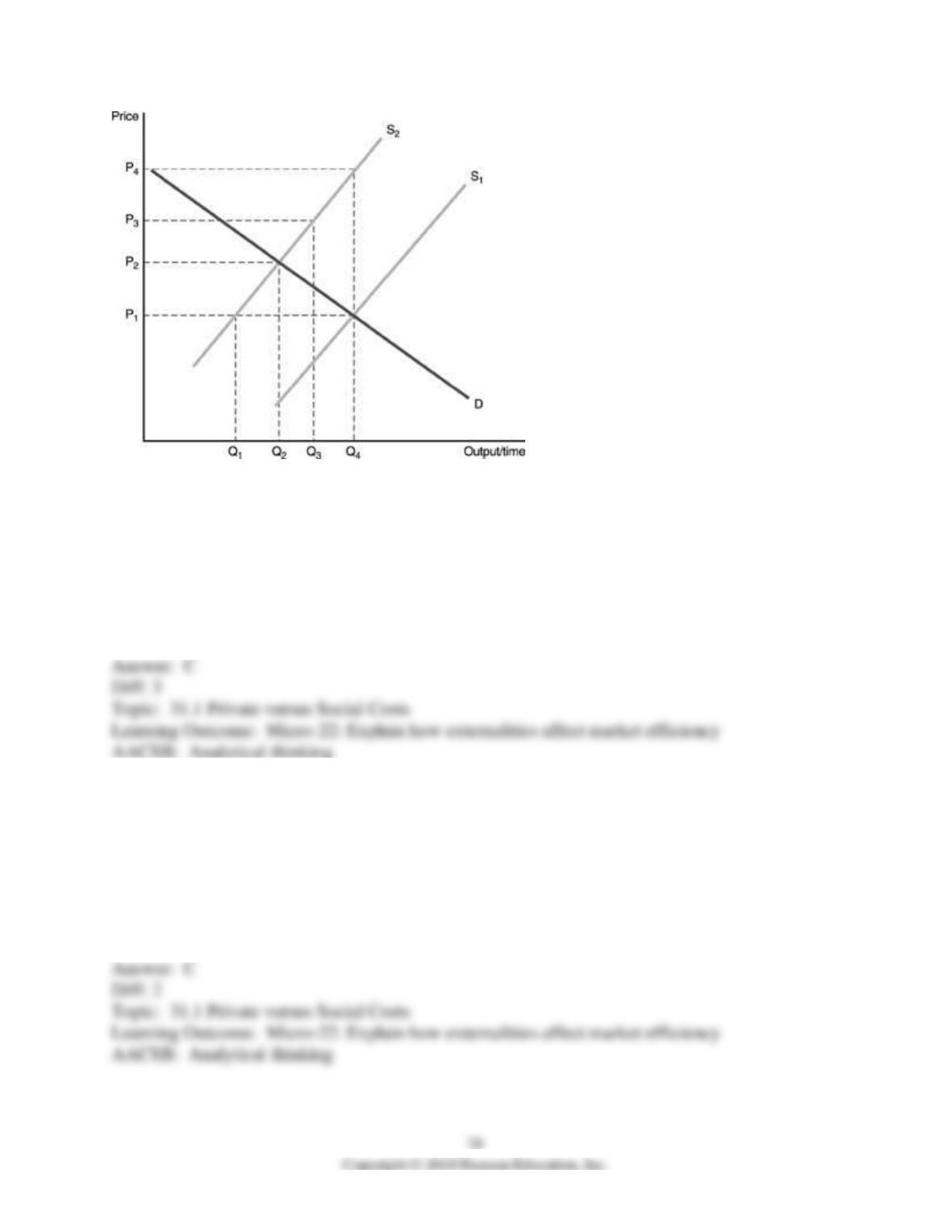
96) Refer to the above figure. S1 is the supply curve that includes only private costs. S2 is the
supply curve that includes social costs. If the firm sets output by focusing on private costs, the
per-unit external cost will equal
A) P2.
B) P4 – P2.
C) P4 – P1.
D) P2 – P1.
97) Refer to the above figure. S1 is the supply curve that includes only private costs. S2 is the
supply curve that includes social costs. The free market rate of output is ________ and the
corrected, socially optimal amount of output is ________.
A) Q4; Q1
B) Q2; Q1
C) Q4; Q2
D) Q2; Q4
98) Refer to the above figure. S1 is the supply curve that includes only private costs. S2 is the
supply curve that includes social costs. From this figure we know that
A) an external benefit exists.
B) private costs are less than social costs.
C) private costs equal social costs.
D) private costs are greater than social costs.
99) A good which has social costs that exceed private costs has a price
A) equal to marginal social cost.
B) that is too low.
C) that is too high.
D) that is inefficient because price exceeds marginal social cost.
100) A good that has social costs that exceed private costs has a quantity that is
A) too high.
B) too low.
C) just right.
D) the best society can do.
101) A good that has social costs that are equal to private costs has a price that is
A) too high.
B) too low.
C) just right.
D) equal to marginal cost.
102) A good that has social costs that are less than private costs has a quantity that is
A) too high.
B) too low.
C) just right.
D) equal to zero.
103) The inclusion of external costs in the decision making process determining equilibrium
price and quantity leads to
A) lower priced items and increased quantity.
B) lower priced items and a decline in quantity.
C) higher priced items and increased quantity.
D) higher priced items and a decline in quantity.
104) The inclusion of external benefits in the decision making process determining equilibrium
price and quantity leads to
A) lower priced items and increased quantity.
B) lower priced items and a decline in quantity.
C) higher priced items and increased quantity.
D) higher priced items and a decline in quantity.
105) Which of the following is NOT a possible solution to the problem of pollution?
A) subsidizing the costs of production of activities that generate pollution
B) converting a resource that is communally owned into a privately owned resource
C) regulating the quantity of pollution that can be generated
D) imposing a pollution tax on producers
106) If external costs are included and added to a firm’s private costs, then
A) the demand curve will shift to the right.
B) the demand curve will shift to the left.
C) the supply curve will shift to the right.
D) the supply curve will shift to the left.
107) A method of forcing a company to internalize the total cost of production is
A) to impose a tax on the company to reduce production.
B) to provide a subsidy to encourage production.
C) for government not to interfere in the company’s activities.
D) to force the company to reduce the wages it pays to its employees.
108) If a firm is forced to take external costs into account, it will
A) reduce production and charge a higher market price.
B) increase production and charge a lower market price.
C) reduce prices and hire more workers.
D) reduce prices and hire fewer workers.
109) If a firm is NOT forced to pay for external costs, it will
A) continue to overproduce the good.
B) continue to under produce the good.
C) request a subsidy from the government.
D) raise prices.
110) Economists typically suggest three choices that allow a polluter to decide how to absorb
most, or perhaps all, of the social costs of its actions, which are
A) continuing to overproduce the good, lowering the price of the good, or cutting output.
B) reducing the pollution-causing activity, changing production techniques, or paying a price to
pollute.
C) installing pollution abatement equipment, paying to pollute, or just ignoring the issue.
D) paying a pollution tax, continuing to use existing production techniques, or continuing the
polluting behavior without regard to the social implications.
111) Which of the following statements about pollution or pollution control is TRUE?
A) A nationwide uniform tax on emissions is the appropriate way to reduce pollution levels.
B) A tax to reduce pollution levels should be based on the economic damages rather than on the
absolute amount of pollution.
C) Private costs of pollution usually exceed social costs.
D) The optimum amount of pollution abatement is where the total benefits of pollution
abatement equal the total costs of pollution abatement.
112) There are two coal-burning electrical utilities—one in tiny, rural Wanunu, Montana, and
another in metropolitan Detroit, Michigan—and each produces the same amount of pollution per
unit of output. If a permit tax is going to be used to force these firms to internalize pollution
costs, the tax levied should be
A) the same in each city.
B) higher in Wanunu than in Detroit.
C) higher in Detroit than in Wanunu.
D) less than zero in each city.
113) A difficulty with using a uniform per-unit tax to address a negative externality is that
A) the tax will reduce output.
B) the tax will increase price.
C) the social cost of pollution might vary across geographic regions.
D) the social cost of pollution should not be assessed on the consumers, but should be assessed
on the firms.
114) In order to internalize the externality due to pollution, the government should impose a tax
based on
A) the economic damage associated with the pollution.
B) the physical amount of pollution.
C) the size of the firm causing the pollution.
D) the value of the pollution-causing business activity.
115) To totally internalize an externality, a government can levy a tax related only to the
physical quantity of pollution if
A) the economic damages associated with the pollution are different across different locations.
B) the economic damages are too large to be determined.
C) the economic damages associated with the pollution are the same across different locations.
D) the economic damages are zero.
116) To correct for a negative externality, a government might impose a uniform tax related only
to the physical quantity of pollution if
A) the administrative costs are high.
B) the cost of ascertaining the actual economic costs are relatively small.
C) the economic damages are zero.
D) the economic damages associated with the pollution are different across different locations.
117) An externality refers to the idea that
A) explicit costs differ from implicit costs.
B) decision-makers do not internalize all the costs.
C) we cannot do anything that does not affect other people.
D) private and internal costs differ.
118) Your neighbor has just planted some fragrant flowers. The wonderful scent drifts into your
room and makes you happy.
A) This scent is an internal cost to you.
B) This cannot be an externality since you are enjoying the scent.
C) This is an externality since you get a benefit from your neighbor’s flowers.
D) The social cost of this activity is entirely borne by you neighbor.
119) In order to correct the problems associated with external costs,
A) the signals given to the economy must change so that decision-makers will take into account
all the costs of their actions.
B) the government must take over production of industries that are responsible for most of the
pollution.
C) standards must be established that make it illegal to pollute.
D) the prices of all goods must be raised so people will consume less of the world’s resources.
120) Which of the following methods could be used to correct for external costs?
A) Impose a tax or an effluent fee on the offenders.
B) Have the offender clean up the pollution it caused.
C) Require firms in the industry to install pollution control devices.
D) All of the above would be appropriate.
121) Suppose cars are taxed according to the amount of pollution they emit per gallon of
gasoline consumed. We would expect to observe all of the following EXCEPT
A) an increase in quantity demanded of less-polluting automobiles and a reduction in quantity
demanded of more-polluting automobiles.
B) an increase in quantity demanded of more fuel-efficient cars.
C) an increase in production of automobiles that were less polluting.
D) an increase in the miles driven.
122) The most efficient way to get firms to reduce pollution is to
A) set uniform emission standards and require all firms to meet the standards.
B) make the worst polluters shut down and go out of business.
C) make them pay for the social costs of production and let them decide how to respond to the
higher costs.
D) provide firms and consumers with the information about the effects of their actions and
encourage them to behave responsibly.
123) When a polluter has to bear the full social cost of their actions, they will
A) weigh the costs and benefits of each potential action and might decide to not stop polluting by
paying a fine.
B) go out of business since pollution abatement is expensive.
C) will always decide to reduce the amount of pollution by reducing the quantity they produce.
D) increase the price of the product and the quantity produced to pay for the additional costs.
124) To efficiently improve environmental quality, it is usually
A) better to focus on the hardest areas to clean up first since these usually are the biggest
problems.
B) more appropriate to concentrate on the physical quantities of pollution rather than on
economic costs.
C) best to set up stringent emission standards that must be followed by everyone.
D) better to focus on economic damages rather than physical quantities of pollution.
125) A uniform tax according to the physical quantities of pollution may not be the appropriate
way to correct for an externality because
A) it places a unfair burden on small producers.
B) a uniform tax can only account for social costs and not external costs.
C) a firm will reduce production.
D) it may not adequately account for economic damages.
126) Which of the following might be a way that an automobile driver’s pollution costs could be
internalized?
A) The driver could purchase abatement equipment for her car.
B) The state could eliminate the gas tax.
C) The state could pay a gas subsidy for everyone who drives.
D) The state could allow her to drive in the HOV lane.
127) When an external cost exists that is NOT taken into account in the production of a product,
A) the level of output is too low, and the supply curve should shift to the right to account for the
externality.
B) the level of output is optimal, and there should be no change in the supply curve.
C) the price of the product is too high, and production should be expanded to lower the price.
D) the level of output is too high, and the supply curve should shift to the left to account for the
externality.
128) The government imposes a tax on an industry that produces goods creating a negative
externality. Yet the industry produces more than the optimum quantity of output. This means
A) the tax is more than the external cost associated with the product.
B) the tax is less than the external cost associated with the product.
C) the company should advertise the product more.
D) the company should increase the production of the product.
129) All of the following are choices for the polluter when faced with additional costs to abate
the externality EXCEPT
A) ignore the government regulations.
B) install pollution abatement equipment.
C) reduce the pollution-causing activity.
D) pay the price to pollute.
130) The government is considering levying a tax on the pollution generated from two electric
power plants (Plant A and Plant B). Plant A is located in a city with a high density of population,
and Plant B is located in the rural area with a low density of population. The government should
A) levy the same tax per unit of pollution on both plants.
B) levy a higher tax per unit of pollution on Plant A because of its higher economic damage.
C) levy a higher tax per unit of pollution on Plant B because of its lower economic damage.
D) tax only Plant A but not Plant B because Plant B generates less revenue.
131) To correct for the social impact of pollution, the government should levy a per-unit tax
A) that is the same for all polluters regardless of their locations or sizes.
B) according to the economic damage of the pollution.
C) according to the business activity of the polluter.
D) only to those polluters that can afford to pay for the tax.
132) The marginal cost curve of a firm measures
A) external costs.
B) pollution costs.
C) private costs.
D) social costs.
133) If all firms had to bear all the social costs of their actions, we should observe marginal cost
curves
A) of all firms shifting up.
B) of some firms shifting up, of some others shifting down, and of the rest not shifting at all.
C) of all firms that had generated externalities shifting up while there would be no change for the
rest of the firms.
D) of some firms shifting up and of the rest shifting down.
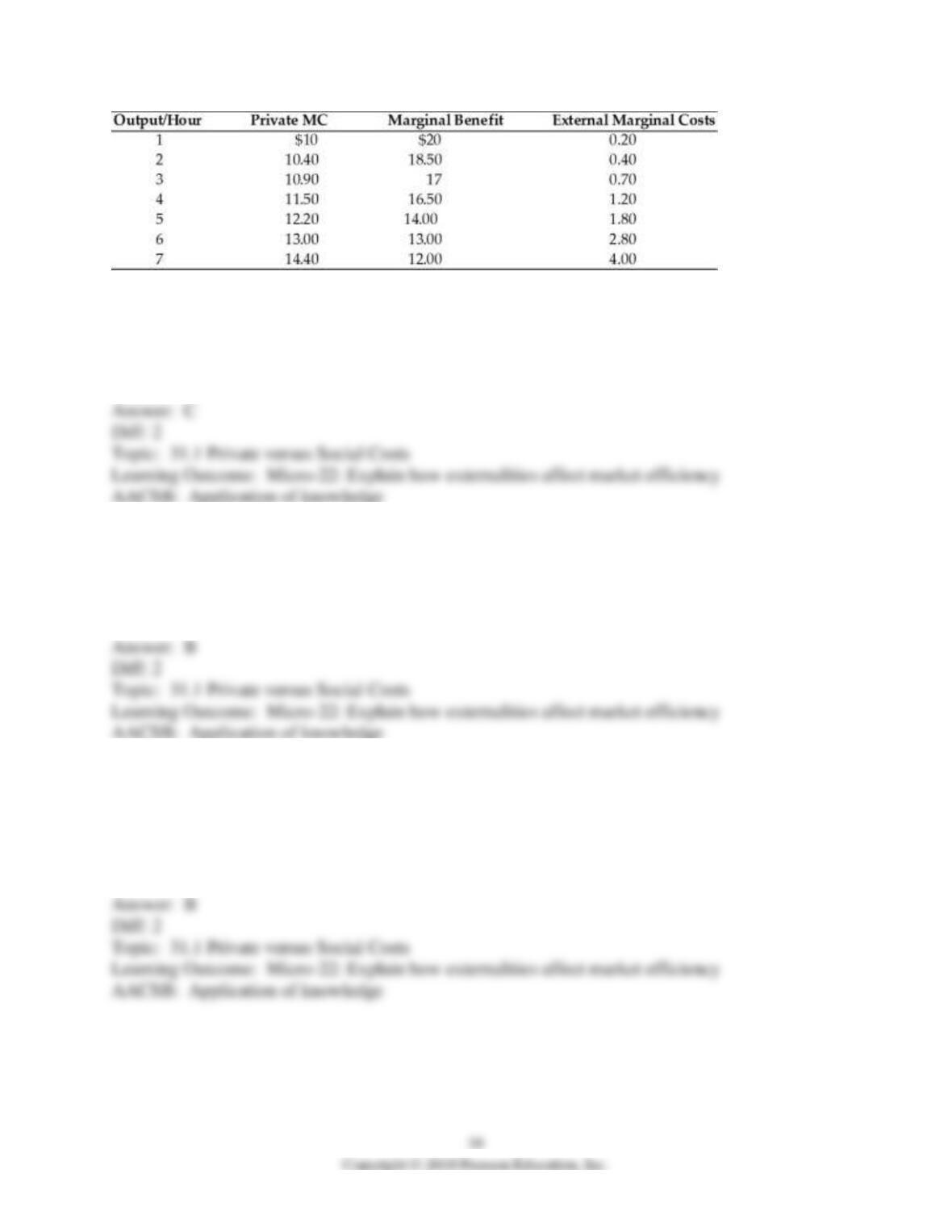
134) Use the above table. If the level of production was determined by the market, it would be
A) 4.
B) 5.
C) 6.
D) 7.
135) Use the above table. What will the price be before external costs are internalized with a tax?
A) $14
B) $13
C) $12.20
D) $1.80
136) Use the above table. What will the output level be when external costs are internalized with
a tax?
A) 4
B) 5
C) 6
D) 7
137) Use the above table. What will the price be when external costs are internalized with a tax?
A) $14
B) $13
C) $12.20
D) $1.80
138) Use the above table. What will the tax be when external costs are internalized?
A) $14
B) $13
C) $12.20
D) $1.80
139) Use the information in the above table. The external marginal costs are
A) increasing.
B) decreasing.
C) constant.
D) inverse to quantity produced.
140) The marginal cost to society of reducing pollution increases with the increased use of
pollution abatement because
A) of the diminishing marginal utility of abatement.
B) of the reduced demand for abatement.
C) of the diminishing returns from abatement.
D) of the high cost of abatement.