Economics Today, 19e (Miller)
Chapter 31 Environmental Economics
31.1 Private versus Social Costs
1) Which of the following statements best defines private costs?
A) They are internal in the sense that the buyer or seller must explicitly take them into account.
B) They are costs borne by people other than those who commit the action.
C) They are synonymous with social costs.
D) They represent explicit costs incurred by producers in the private sector.
2) Costs that are borne solely by the individuals who incur them are called
A) private costs.
B) public costs.
C) social costs.
D) implicit costs.
3) When the costs of an action are NOT fully borne by the two parties engaged in a transaction,
this is called a(n)
A) externality.
B) opportunity cost.
C) property right.
D) internal cost.
4) Noise from a hard rock concert is an example of a situation in which
A) social costs are greater than private costs.
B) social costs are less than private costs.
C) social costs are equal to private costs.
D) social costs that are not external costs.
5) An individual who pays for a vehicle has incurred a
A) social cost.
B) private cost.
C) negative externality.
D) positive externality.
6) Private costs are the same as
A) implicit costs.
B) social costs.
C) public costs.
D) internal costs.
7) All of the following are private costs of operating an automobile EXCEPT
A) gasoline for the car.
B) depreciation of the vehicle.
C) car insurance.
D) harm to the environment from emissions.
8) Internal costs are
A) costs borne solely by the individuals who incur them.
B) costs borne by people in the same society as those who incur them.
C) costs borne by people working in the firm that incurs them.
D) costs that are incurred by the producers but buyers do not pay for them.
9) To find the social cost of an action, add together
A) the external and accounting costs.
B) the private costs and the internal costs.
C) the external costs and the internal costs.
D) the internal costs and the private opportunity costs.
10) Society must pay the full opportunity cost of any activity
A) that uses scarce resources.
B) that causes costs to rise.
C) that increases revenues.
D) none of the above.
11) Social costs are
A) costs borne by society whenever a resource-using action takes place.
B) costs incurred by government and borne by all taxpayers.
C) costs incurred in governmental welfare programs.
D) external costs minus internal costs.
12) The total social cost of production is equal to
A) external cost minus internal cost.
B) internal cost minus external cost.
C) external cost plus internal cost.
D) internal cost plus opportunity cost.
13) There is “too much” steel production if the
A) social costs of steel production are significantly lower than the private costs.
B) social benefits of steel production are declining.
C) social costs of steel production are significantly higher than the private costs.
D) social costs of steel production are declining.
14) Social costs are
A) private costs plus any external costs.
B) the costs of the externality only.
C) costs incurred when common property is used.
D) the costs associated with reaching and enforcing agreements.
15) A social cost that is NOT fully paid by the individual using an automobile is
A) traffic congestion.
B) gasoline and oil.
C) insurance.
D) depreciation of the vehicle.
16) When the social costs exceed the private costs, economists state that there is
A) a positive externality.
B) an underproduction of output.
C) a negative externality.
D) a waste of resources in production.
17) When social and private costs differ, economists state that
A) there will be economic profit in the society.
B) the society will produce inside the production possibilities frontier.
C) there is an externality.
D) there is not an efficiency problem but an equity problem.
18) An externality that is NOT fully paid by the individual using an automobile is
A) insurance for the vehicle.
B) gasoline for the vehicle.
C) air pollution from the vehicle.
D) operation of the vehicle.
19) If social cost exceeds private cost, there is
A) underproduction of a good.
B) a negative externality.
C) a positive externality.
D) too little economic profit in the activity.
20) Where pollution is concerned, if an automobile driver considers only the internal costs of his
actions, he is apt to
A) use resources very carefully and in small quantities.
B) garage his car and drive very seldom.
C) be making a positive contribution to the greater community.
D) drive too much and use up more scarce resources than he would if he had to cover all his
costs.
21) If a person does NOT pay all costs associated with a particular resource-using activity, then
A) the external costs of the activity are greater than the private costs of the activity.
B) the social costs of the activity are greater than the private costs of the activity.
C) the external costs of the activity are greater than the internal costs of the activity.
D) the full costs of the activity are the sum of private costs plus internal costs.
22) If the social costs of refining oil are greater than the private costs of oil refining, then
A) the external costs of oil refining are greater than the social costs of oil refining.
B) users of products that use refined oil are paying too much for the products.
C) there is too much oil refining.
D) the amount of oil refining needs to increase in order to bring social costs and private costs in
line with each other.
23) When a person does NOT have to pay the full costs for using a scarce resource, then
A) the use of the resource is not affected since society pays for the resource.
B) more of the resource will be used.
C) the internal costs of using the resource are too high.
D) the social costs of the resource are less than they would be if the “correct” amount of the
resource were being used.
24) Suppose there are two factories on a river, and both need clean water for their production
processes. The upstream factory takes in clean water and dumps dirty water back into the river.
The downstream firm must clean up the water it gets from the river before using it. In this
situation
A) the private costs of the downstream factory are more than the private costs of the upstream
factory, but for both factories private costs and social costs are the same.
B) the social costs are greater than the private costs for the upstream firm, while the social costs
are less than the private costs for the downstream firm.
C) the upstream factory’s private costs are less than its social costs, and its external costs are
borne by the downstream factory.
D) the internal costs of the upstream factory are externalized by the downstream factory, which
then passes them on to its customers.
25) When a person does NOT have to pay the full costs for using a scarce resource, then there is
A) an underproduction of a good.
B) a negative externality.
C) a positive externality.
D) too little economic profit in the activity.
26) When social costs for using a scarce resource are included, then there is
A) a decrease in the production of the good.
B) a negative externality.
C) a decrease in the price of the good.
D) a positive externality.
27) When both internal and external costs for using a scarce resource are included, then there is
A) an increase in the production of the good.
B) a negative externality.
C) an increase in the price of the good.
D) a positive externality.
28) Which of the following is an example of an external cost?
A) the cost of labor to a firm
B) the pollution caused by automobile exhaust
C) the cost of tires for your car
D) the opportunity cost of getting a college education
29) If coal-burning electrical utility companies fully internalized pollution costs, then we could
expect
A) an increase in electricity prices.
B) a decrease in electricity prices.
C) no change in electricity prices.
D) a greater use of coal to produce electricity.
30) Externalities exist because
A) private costs differ from social costs.
B) private costs are equal to social costs.
C) low productivity of workers in production.
D) too much government interference in the market.
31) If the external costs of production are NOT taken into account, then production will
A) be less than socially desirable.
B) be more than socially desirable.
C) be the same since only prices are affected by externalities.
D) cease.
32) If crop dusting on your farm causes your neighbors to have sore throats, then crop dusting is
creating
A) only explicit costs.
B) opportunity costs.
C) external costs.
D) internal costs.
33) If firms were forced to take into account the full social costs of production, then
A) output would decrease but pollution levels would probably remain at the same levels.
B) output would be unaffected but pollution levels would come down.
C) output and pollution levels would decrease.
D) output could be increased and pollution levels would decrease.
34) If the market price of a good does NOT include all of the costs and benefits that arise from
the production or consumption of the good, then
A) the market is perfectly competitive.
B) an externality is present.
C) society is consuming and producing the optimal amount of the good.
D) resources are properly allocated.
35) In economic analysis, air pollution, water pollution, and scenery destruction are considered
to be
A) externalities.
B) internalities.
C) private costs.
D) opportunity costs.
36) If a good is produced by firms that generate external costs, the price consumers pay
A) will be efficient as long as it equals the marginal costs of the firms.
B) will be too low.
C) will be too high because the consumers end up paying the costs instead of the firm.
D) will be the correct price, but the quantity sold of the good will be too large.
37) If a good is produced by firms that incur all private and external costs, the price consumers
pay
A) will be efficient since it includes all social costs.
B) will not be socially acceptable.
C) will be too high because the consumers end up paying all of the costs instead of the firm.
D) will be the correct price, but inefficient.
38) The Clear Plastic Company’s plant discharges large quantities of toxic chemicals into some
groundwater sources. Residents in the surrounding area have higher medical bills because of
Clear Plastic’s pollution. These additional medical costs represent
A) a positive externality.
B) a negative externality.
C) the company’s private costs.
D) the neighboring families’ external costs.
39) The Clear Plastic Company’s plant discharges large quantities of toxic chemicals into some
groundwater sources. Residents in the surrounding area have higher medical bills because of
Clear Plastic’s pollution. As long as Clear Plastic Company is allowed to emit pollution and
ignore any externalities, the firm will
A) overproduce.
B) under produce.
C) charge too high a price for its output.
D) be absorbing the full value of its social costs.
40) The Clear Plastic Company’s plant discharges large quantities of toxic chemicals into some
groundwater sources. Residents in the surrounding area have higher medical bills because of
Clear Plastic’s pollution. If the firm is forced to pay the social costs of its production
A) the amount of steel it produces will increase in order to pay the additional costs.
B) the price it charges for its steel will decrease.
C) its supply curve will shift to the right.
D) it will produce less and charge more for its steel.
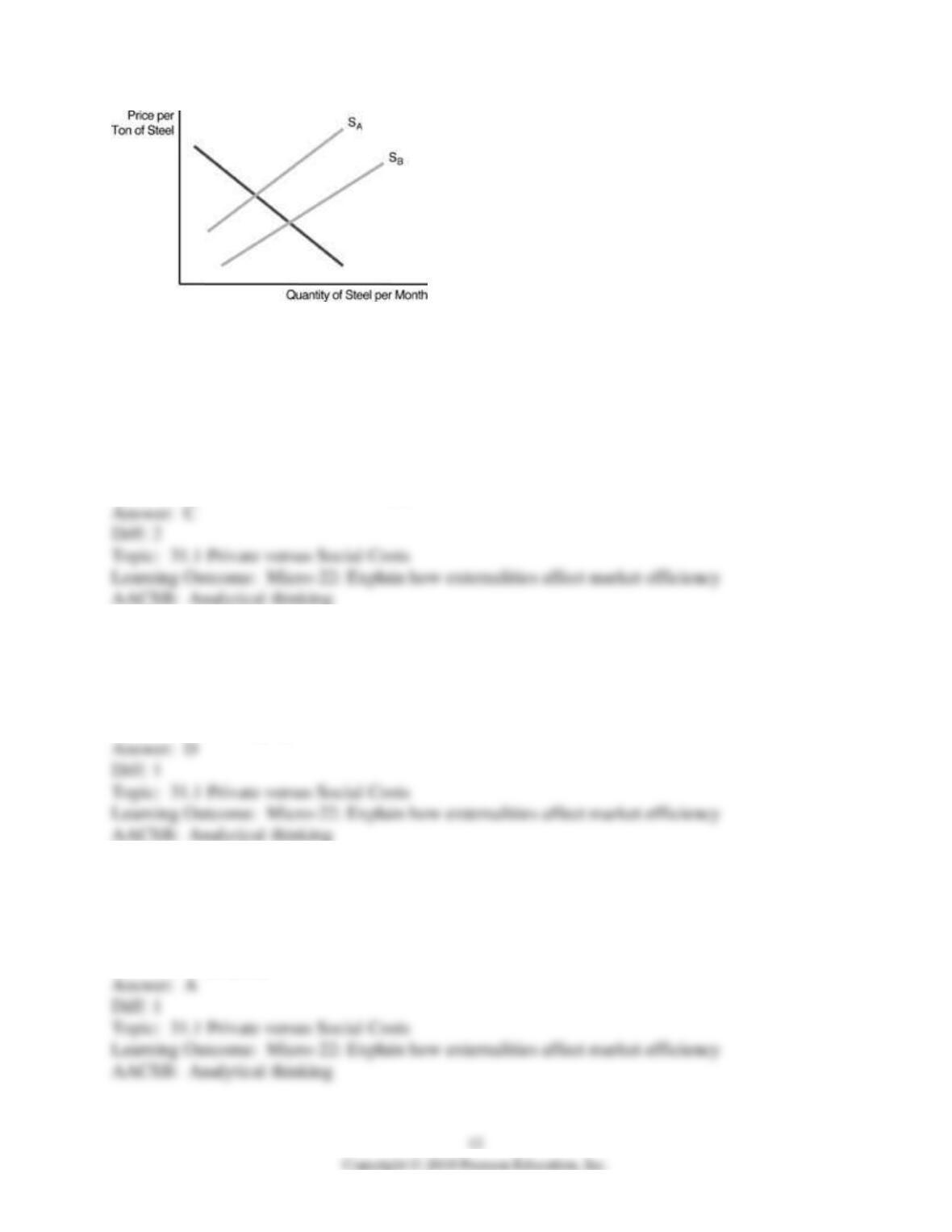
41) Refer to the above figure. It represents supply and demand for The Black Ash Steel
Company’s output. The firm’s plant belches large quantities of smelly fumes and black ash into
the air. Residents in the surrounding area have higher medical bills as a result. If the firm is
forced to pay the full social cost of its production, what will occur?
A) Black Ash’s supply curve will shift from SA to SB.
B) Demand for the firm’s steel will shift to the left.
C) The company’s supply curve will shift from SB to SA.
D) Black Ash will increase its own output to cover the cost increase.
42) Private costs are
A) external costs borne by private firms.
B) explicit costs rather than implicit costs.
C) costs borne by private members of society rather than governmental bodies.
D) costs borne solely by the individuals who incur them.
43) Costs borne solely by the individuals who incur them are
A) private costs.
B) social costs.
C) internality.
D) common property.
44) Which of the following is NOT a private cost?
A) the health insurance costs a firm must pay for its employees
B) the pollution caused by a firm dumping its wastes into the river
C) the coffee pot that Jan dropped and broke this morning
D) the amount that a firm must pay for raw materials to make its product
45) Steve raises bees to pollinate his orange trees. One of the bees just stung him. This is a(n)
A) private cost.
B) social cost.
C) opportunity cost.
D) common property.
46) John raises bees to pollinate his orchard. A couple of bees which escaped ended up
pollinating his neighbor’s orchard, so
A) John’s neighbor has received an internal cost of John’s bee-keeping.
B) John’s neighbor has received an external cost of John’s bee-keeping.
C) John’s neighbor has received an external benefit of John’s bee-keeping.
D) None of the above is correct.
47) External costs are
A) borne by individuals other than those who incurred them.
B) another term for implicit costs.
C) borne by the public but incurred by the government.
D) borne by the government but incurred by the public.
48) The sum of internal and external costs is
A) private cost.
B) social cost.
C) opportunity cost.
D) common property.
49) Social costs are
A) costs that are borne by the government.
B) the full cost borne by society whenever a resource use occurs.
C) borne by individuals who incur them.
D) borne by no one in society.
50) The total costs of using a resource are made up of
A) private costs only.
B) external costs only.
C) social costs only.
D) internal and private costs only.
51) The sum of internal and external costs is
A) externalities.
B) social costs.
C) internalities.
D) private costs.
52) When a person drives an automobile, that individual is creating
A) internal costs only.
B) private costs only because the individual pays for the insurance, gas etc.
C) external costs only.
D) social costs.
53) Which of the following statements is TRUE about the relationship among external, internal
and social costs?
A) Social costs will always be higher than external costs.
B) Social costs will always be lower than internal costs.
C) Internal costs will always be higher than external costs.
D) Internal costs will never equal external costs.
54) Which of the following statements is TRUE about the relationship among external, internal
and social costs?
A) External cost is the difference between social and internal costs.
B) Internal cost is the sum of social and external costs.
C) Social cost is the difference between internal and external costs.
D) none of the above
55) The social costs of an activity are greater than the private costs of the activity when
A) a person does not pay all costs associated with a particular resource-using activity.
B) the internal costs of the resource-using activity are less than the external costs of the activity.
C) the internal costs of the resource-using activity are positive.
D) the external costs of the resource-using activity are zero.
56) When social costs of an activity exceed private costs
A) there is a tendency for resources to be under-utilized.
B) this means that resources are being efficiently used.
C) there is a tendency for resources to be over-utilized.
D) None of the above is correct.
57) When social costs of an activity exceed private costs
A) a market failure exists.
B) there is a tendency for resources to be under-utilized.
C) this means that resources are being efficiently used.
D) the actual price is above the efficient price.
58) If the social costs of driving an automobile are greater than the private costs of driving an
automobile, then
A) the external costs of auto driving exceed the social costs of auto driving.
B) the external costs of auto driving exceed the internal costs.
C) the price of automobile driving is too high.
D) either people drive their autos too much or more funds should be spent on reducing air
pollution.
59) An example of a situation in which the social costs are greater than the private costs would
be
A) a new restaurant takes business away from an established restaurant.
B) hand-held calculators putting slide rule manufacturers out of business.
C) when a member of a rock band’s ability to hear deteriorates from performing in so many loud
concerts.
D) a physician who cannot examine patients with a stethoscope in an examination room adjacent
to an airport.
60) Suppose there are two identical factories on a river. Both require clean water for their
production processes. The upstream firm gets clean water from the river and dumps dirty water
into the river. The downstream firm must clean the water it gets from the river before it can use
the water and later it dumps dirty water into the river. In this situation
A) the private costs of the two firms are the same since both dump dirty water into the river.
B) the upstream factory’s private costs are lower than its social costs since it passes the costs of
the dirty water on to the downstream firm. For the downstream firms, private costs equal social
costs.
C) the private costs of the downstream firm are greater than the private costs of the upstream
firm and the social costs are less than the private costs for both firms.
D) the private costs of the upstream firm are less than its social costs while the social costs of the
downstream firm are less than its private costs.
61) Suppose there are two firms on a river and the production processes of both require clean
water. The upstream firm’s process dirties the water, which it dumps back into the river. The
downstream firm must clean the water before using it in its production process. If the two firms
would merge
A) the external costs of the merged firm would equal the external costs of the upstream firm,
which would then be passed on to its customers.
B) the total costs of production fall since the external costs disappear.
C) the external costs of the upstream firm are private costs after the merger.
D) the internal costs of the downstream firm become external costs of the merged firm.
62) An example of the external costs due to automobile driving is
A) wear and tear on toll roads.
B) the opportunity cost of the driver’s time.
C) air pollution due to exhaust fumes.
D) the cost of washing dirty cars.
63) When a person can pass some of her costs of using a resource on to someone else,
A) the use of the resource is not affected by her actions.
B) the internal costs of using the resource exceed the private costs.
C) she uses too much of the resource.
D) she uses too little of the resource.
64) A person removes the anti-pollution devices on his automobile. An external cost associated
with this is
A) the feeling of guilt the person feels for violating the law.
B) the ticket he gets when a highway patrol officer pulls him over.
C) the man’s neighbor washes his car more often because of increasing smog.
D) the man buys less gasoline, reducing the income of local gas stations.
65) Air pollution is a problem because
A) people are greedy.
B) people are not environmentally conscious.
C) people make use of air without having to bear all the costs of their actions.
D) a market economy does not provide as strong an incentive for environmental cleanup as a
socialist economy.
66) If pollutants from smoke stacks in a city such as Newark causes people to paint their homes
and cars more frequently, this implies
A) external benefits to the home and car owners.
B) external costs on home and car owners.
C) internal cost to home and car owners.
D) none of the above.
67) By adding internal costs to external costs, we determine the total
A) private cost.
B) social cost.
C) psychological cost.
D) opportunity cost.
68) Another name for internal cost is
A) private cost.
B) social cost.
C) psychological cost.
D) marginal cost.
69) Which of the following constitutes an external cost of driving an automobile?
A) insurance
B) fuel
C) pollution
D) license
70) In a situation in which internal costs differ from social costs, we say that there exists a(n)
A) welfare loss.
B) welfare benefit.
C) internality.
D) externality.
71) When a person smokes a cigarette in his car and throws the butt out of the window, this is
a(n)
A) marginal cost.
B) external cost.
C) marginal personal benefit.
D) internal benefit.
72) Costs that are borne solely by the individuals who incur them are
A) private costs.
B) social costs.
C) external costs.
D) transaction costs.
73) Social costs is equal to the sum of
A) internal and private costs.
B) internal and external costs.
C) internal and implicit costs.
D) internal and production costs.