
Chapter 31
Minimum Wage
Multiple Choice
1. The lowest wage that may be legally paid for an hour’s work is called the
A) just wage.
B) minimum wage.
C) maximum wage.
D) living wage.
2. A wage sufficient to keep a family out of poverty is called the
A) just wage.
B) minimum wage.
C) maximum wage.
D) living wage.
3. The minimum wage has never been sufficient to get a family of ____ above the poverty line.
A) one
B) two, three or four
C) three or four
D) four
4. The largest family size for which the earnings of a single minimum wage job holder has been
above the poverty line is
A) one.
B) two.
C) three.
D) four.
5. At $7.25 per hour the 2011 inflation adjusted minimum wage was
A) nearing a 50-year low.
B) at an all time high.
C) near its historical average.
D) statutorily constant.

6. At $5.15 per hour the 2007 inflation adjusted minimum wage was
A) nearing a 50-year low.
B) at an all time high.
C) slightly above the historical average.
D) statutorily constant.
7. To get to its inflation adjusted all time high, the minimum wage in 2007 would have to be at
least
A) $5.50.
B) $9.
C) $14.
D) $20.
8. The longest period of time where the minimum wage remained constant in nominal terms
was during
A) the Reagan Administration.
B) the Bush (George Herbert Walker) Administration.
C) the Clinton Administration.
D) the Eisenhower Administration.
9. The real minimum wage was at its all time high
A) shortly after the increase in 1992.
B) shortly after the increase in 1968.
C) shortly after the increase in 1980.
D) at its inception in the 1930’s.
10. For the minimum wage to be relevant it must be
A) above the equilibrium wage.
B) below the equilibrium wage.
C) at the equilibrium wage.
D) slightly below the equilibrium wage.

11. If a fast food restaurant was one of many hiring workers, the minimum wage was $7.25 an
hour and it was paying $8.00 an hour to attract workers, a cut in the minimum wage to $5.00
an hour would cause them to
A) lower their offering wage to $5.00 an hour.
B) raise their offering wage to $9.00 an hour.
C) do nothing differently.
D) pay $7.25.
12. If a fast food restaurant was one of many hiring workers, the minimum wage was $7.25 an
hour and it was paying $7.25 an hour, an increase in market demand so that the new
equilibrium was $9 per hour would cause them to
A) lower their offering wage to $6.50 an hour.
B) raise their offering wage to $9.00 an hour.
C) do nothing differently.
D) pay between $7.25 and $9.
13. If a fast food restaurant was one of many hiring workers, the minimum wage was $7.25 an
hour and it was paying $7.25 an hour. Suppose the economy slides into recession such that
the new equilibrium wage was $6.50 per hour. This would cause them to
A) lower their offering wage to $6.50 an hour.
B) raise their offering wage to $9.00 an hour.
C) do nothing differently.
D) pay between $7.25 and $9.
14. If a fast food restaurant was one of many hiring workers, the minimum wage was $7.25 an
hour and it was paying $7.25 an hour to new employees. Suppose a worker earns a $0.75
raise to $8 an hour. Now suppose the minimum wage rises to $8.25 and hour. This worker
would be paid.
A) $8 an hour.
B) $8.25 an hour.
C) $9 an hour.
D) Somewhere between $8.25 and $9 an hour depending on the policies of the restaurant.
15. If a fast food restaurant was one of many hiring workers, the minimum wage was $7.25 an
hour and it was paying $7.25 an hour to new employees. Suppose a worker earns a $0.75
raise to $8 an hour. Now suppose the minimum wage rises to $8.25 an hour. The government
requires this worker to be paid
A) $8 an hour.
B) $8.25 an hour.
C) $9 an hour.
D) somewhere between $8.25 and $9 an hour depending on the policies of the restaurant.
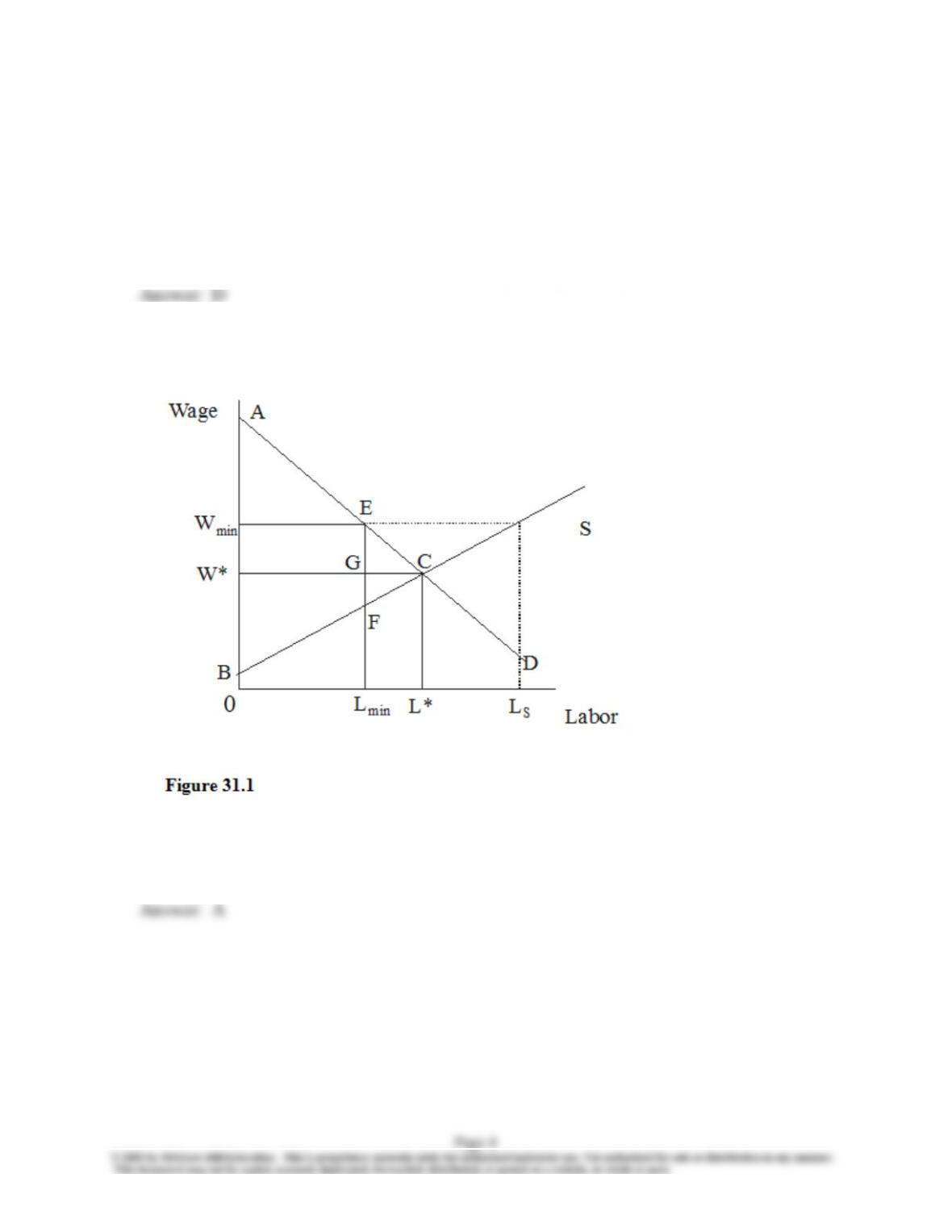
16. In Figure 31.1, at the market wage the consumer surplus is
A) W*AC
B) BW*C
C) BWminEF
D) WminAE
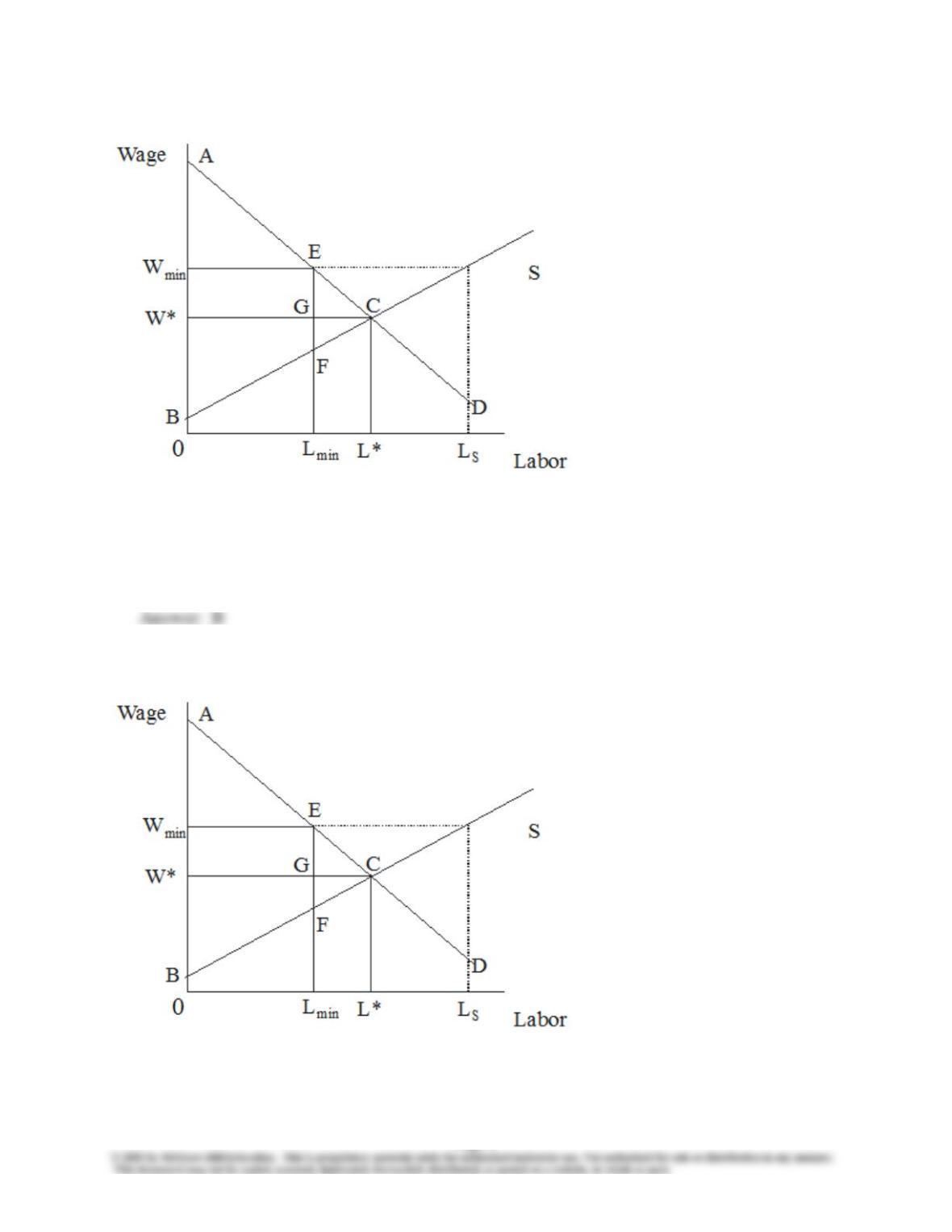
17. In Figure 31.1, at the market wage the producer surplus is
Figure 31.1
A) W*AC
B) BW*C
C) BWminEF
D) WminAE
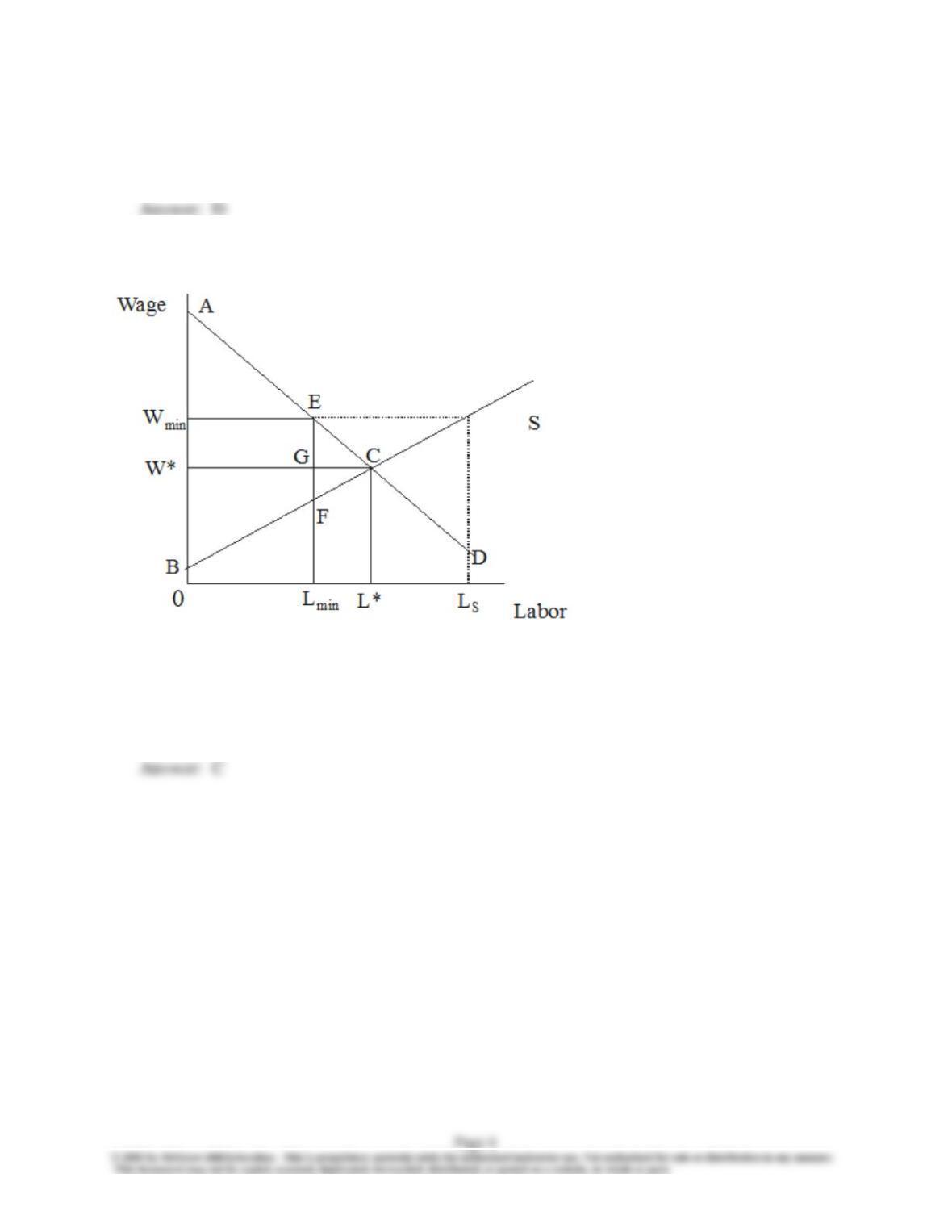
18. In Figure 31.1, at the minimum wage the consumer surplus is
Figure 31.1
A) W*AC
B) BW*C
C) BWminEF
D) WminAE
19. In Figure 31.1, at the minimum wage the producer surplus is
Figure 31.1
A) W*AC
B) BW*C
C) BWminEF
D) WminAE
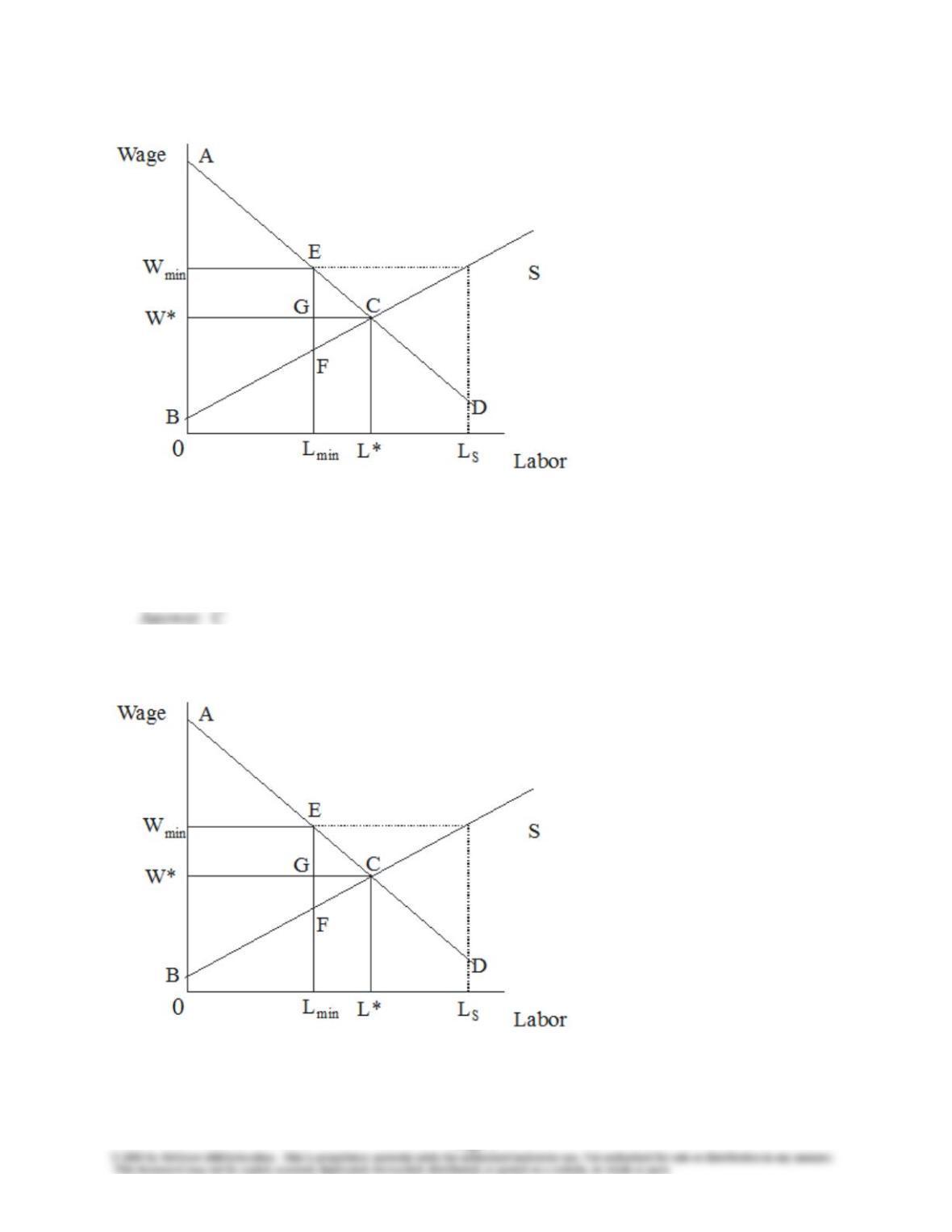
20. In Figure 31.1, how many people would be unemployed at the minimum wage?
Figure 31.1
A) LS – L*
B) L*-Lmin
C) LS-Lmin
D) L*
21. In Figure 31.1, how many people would lose their jobs as a result of the minimum wage?
Figure 31.1

A) LS – L*
B) L*-Lmin
C) LS-Lmin
D) L*
22. If you view a dollar’s worth of consumer surplus (received by employers) equal to a dollar’s
worth of producer surplus (received by employees) then the minimum wage usually
A) increases consumer surplus more than it decreases producer surplus, for a positive net
effect.
B) increases consumer surplus less than it decreases producer surplus, for a negative net
effect..
C) decreases consumer surplus less than it increases producer surplus, for a positive net
effect.
D) decreases consumer surplus more than it increases producer surplus, for a negative net
effect..
23. Those that gain from an increase in the minimum wage are
A) all workers.
B) those workers who keep their jobs.
C) employers.
D) consumers who pay lower prices for goods.
24. Those that lose from an increase in the minimum wage are
A) all workers.
B) those workers who keep their jobs.
C) employers.
D) consumers who pay lower prices for goods.
25. Those that lose from an increase in the minimum wage are
A) all workers.
B) those workers who keep their jobs.
C) workers that are laid off.
D) consumers who pay lower prices for goods.

26. The heart of the argument against an increase in the minimum wage is that the
A) net gain to workers is less than the loss to firms.
B) there is a net loss to workers.
C) there is a loss to firms.
D) there are workers who earn more than they are worth.
27. The heart of the argument against an increase in the minimum wage is one based on
A) the macroeconomic argument.
B) the elasticity argument.
C) the work effort argument.
D) consumer and producer surplus analysis.
28. The “work effort argument” criticizing traditional economic analyses of the minimum wage
implies
A) increased real GDP should result from any increase in the nominal minimum wage.
B) increased real GDP should result from any reduction in the nominal minimum wage.
C) reduced real GDP should result from any increase in the nominal minimum wage.
D) any increase in the nominal minimum wage reduces short-run aggregate supply.
29. The “elasticity argument” criticizing traditional economic analyses of the minimum wage
implies that
A) any increase in employment greatly reduces the marginal productivity of employed
workers.
B) any increase in employment greatly increases the marginal productivity of employed
workers.
C) the short-run marginal productivity of workers is independent of the number of workers
employed.
D) patriotic employers should want to pay their American employees more than their foreign
employees.
30. If the cost of living is higher in richer cities than in poorer cities, and the nominal minimum
wage were the same in every city, then the real purchasing power of the minimum wage
would necessarily be
A) higher in the richer cities.
B) higher in the poorer cities.
C) lower in the poorer cities.
D) independent of the cost of living in any city.

31. Suppose you were to hear a politician defend the minimum wage on the grounds that it would
not cause that much unemployment because firms have to hire a certain number of workers,
you would know this person to be relying on the ____ argument.
A) macroeconomic
B) elasticity
C) work effort
D) consumer and producer surplus
32. Suppose you were to hear a politician defend the minimum wage on the grounds that workers
would be happier and more productive with a higher minimum wage, you would know this
person to be relying on the ____ argument.
A) macroeconomic
B) elasticity
C) work effort
D) consumer and producer surplus
33. Suppose you were to hear a politician defend the minimum wage on the grounds that the low-
wage workers would spend more of their extra income that wealthier employers would and
therefore the effect would be positive, you would know this person to be relying on the ____
argument.
A) macroeconomic
B) elasticity
C) work effort
D) consumer and producer surplus
34. Suppose you were to hear a politician oppose the minimum wage on the grounds that it
would hurt employers and employees (who lost their jobs) more than it would help those who
earned a higher wage, you would know this person to be relying on the ____ argument.
A) macroeconomic
B) elasticity
C) work effort
D) consumer and producer surplus

35. Suppose you were to hear an economist defend the minimum wage on the grounds that she
estimated that the demand for labor is nearly vertical, you would know her to be relying on
the ____ argument.
A) macroeconomic
B) elasticity
C) work effort
D) consumer and producer surplus
36. Suppose you were to hear an economist defend the minimum wage on the grounds that she
estimated that when she estimated the saving rate of minimum wage workers and found it to
be much smaller than the savings rate of employers. You would know her to be relying on
the ____ argument.
A) macroeconomic
B) elasticity
C) work effort
D) consumer and producer surplus
37. Suppose you were to hear an economist defend the minimum wage on the grounds that she
estimated the productivity of workers both before and after an increase in the minimum wage
and found that the increase in the minimum wage increases productivity by more (on a
percentage basis) than it increased costs. You would know her to be relying on the ____
argument.
A) macroeconomic
B) elasticity
C) work effort
D) consumer and producer surplus
38. Suppose you were to hear an economist oppose the minimum wage on the grounds that she
estimated the loss to small businesses and to the unemployed and found that it exceeded the
gain to workers getting a higher wage. You would know her to be relying on the ____
argument.
A) macroeconomic
B) elasticity
C) work effort
D) consumer and producer surplus

39. The majority of minimum wage workers are
A) trying to support a family.
B) young people who are not supporting families.
C) older workers who are retired.
D) middle aged.
40. The rule-of-thumb among many economists suggests that a 10% increase in the minimum
wage results in a ________ in the number of jobs held by teens.
A) 10% to 15% drop
B) 10% to 15% increase
C) 1% to 3% increase
D) 1% to 3% drop
41. The EITC is a
A) tax credit to working poor families.
B) a welfare program for which only nonworking families are eligible.
C) a provision in the minimum wage law that allows waitresses to be paid less because they
get tips.
D) a provision in the minimum wage law that allows for a lower training wage.
42. Of the people working for the minimum wage ___ live in households with incomes below the
poverty line.
A) 10%
B) 30%
C) 70%
D) 90%
43. Of the people receiving the EITC ___ would be in poverty without it.
A) 10%
B) 30%
C) 70%
D) 90%

44. The “macroeconomics” rebuttal to the traditional analysis of the minimum wage argues that
A) the rich consume less than the poor out of extra income, therefore an increase in the
minimum wage increases aggregate demand.
B) the rich consume more than the poor out of extra income, therefore an increase in the
minimum wage increases aggregate demand.
C) people work harder when they feel they are inadequately compensated, therefore an
increase in the minimum wage may actually lower productivity.
D) in the short run the demand elasticity of labor is such that businesses will actually
increase the number of workers hired when the minimum wage increases.
45. The “elasticity” rebuttal to the traditional analysis of the minimum wage, stating that
employers’ demand for workers is unresponsive to wage changes, centers on the idea that
A) the rich consume less than the poor out of extra income, therefore an increase in the
minimum wage increases aggregate demand.
B) the rich consume more than the poor out of extra income, therefore an increase in the
minimum wage increases aggregate demand.
C) people work harder when they feel they are adequately compensated therefore an increase
in the minimum wage may pay for itself.
D) in the short run, the demand elasticity of labor is such that business will not reduce the
number of workers hired when the minimum wage increases.
46. If the demand for labor is inelastic then the unemployment caused by raising the minimum
wage is
A) less than if it were elastic.
B) the same as if it were elastic.
C) more than if it were elastic.
D) unrelated to labor demand elasticity.
47. Economists generally believe that increases in the minimum wage will
A) increase teen unemployment.
B) decrease teen unemployment.
C) have a dramatic impact on the poverty rate.
D) have a dramatic impact on the taxes paid by the working poor.

48. To achieve its goal of keeping a family of four with one wage earner out of poverty, the
minimum wage would have to be
A) $5.15 per hour
B) $7.25 per hour
C) nearly $9.00 per hour
D) nearly $11.00 per hour
49. As of June 2013, after two 70-cent increases in recent years, the federal minimum wage was
A) $5.15 per hour
B) $5.85 per hour
C) $7.25 per hour
D) nearly $9.00 per hour
50. After increasing from $5.15 in 2007 to $7.25 in 2009, the inflation-adjusted minimum wage
A) was still at its lowest level in history.
B) was at its long term historical average level.
C) was at its all-time highest level.
D) was sufficient to keep a family of four out of poverty.
51. If an increase in the minimum wage increases workers’ incomes by $75 and reduces
employers’ incomes by $100, while workers’ spend all of their income increase but
employers reduce their spending by only eighty percent of their income reduction, aggregate
spending
A) falls by $5.
B) falls by $25.
C) falls by $80.
D) remains unchanged.
52. If an increase in the minimum wage increases workers’ incomes by $75 and reduces
employers’ incomes by $100, while workers’ spend all of their income increase but
employers reduce their spending by only seventy-five percent of their income reduction,
aggregate spending
A) falls by $5.
B) falls by $25.
C) falls by $80.
D) remains unchanged.

True False
53. True or False? It is always in the interests of workers for the minimum wage to be as high as
possible.
A) True
B) False
54. True or False? Increases in the minimum wage are in every worker’s best interest.
A) True
B) False
55. True or False? State governments are not allowed to increase the minimum wage in their
states.
A) True
B) False
56. True or False? City governments are not allowed to increase the minimum wage in their
cities.
A) True
B) False
57. True or False? It is generally true that modest increases in the minimum wage help workers
that keep their jobs more than it hurts workers that lose their jobs.
A) True
B) False
58. True or False? It is generally true that massive increases in the minimum wage help workers
that keep their jobs more than it hurts workers that lose their jobs.
A) True
B) False

59. True or False? It is impossible to raise the minimum wage so high to hurt workers generally.
A) True
B) False
60. True or False? It is possible to raise the minimum wage so high to hurt workers generally.
A) True
B) False