KEYWORDS:
BLOOM’S: Comprehension
177. If the Fed reduces the required reserve ratio,
a.
excess reserves will increase.
b.
excess reserves will decrease.
c.
total reserves will increase.
d.
total reserves will decrease.
ANSWER:
POINTS:
DIFFICULTY:
DISC: Monetary and fiscal policy
United States – BPROG: Analytic
Monetary and fiscal policy
TOPICS:
Other Instruments of Monetary Policy
KEYWORDS:
BLOOM’S: Comprehension
178. If the Fed increases the required reserve ratio, how will this affect excess reserves and the money supply?
a.
Both will increase.
b.
Excess reserves increase and the money supply decreases.
c.
Both will decrease.
d.
Excess reserves decrease and the money supply increases.
ANSWER:
POINTS:
DIFFICULTY:
DISC: Monetary and fiscal policy
United States – BPROG: Analytic
Monetary and fiscal policy
TOPICS:
Other Instruments of Monetary Policy
KEYWORDS:
BLOOM’S: Comprehension
179. If the Fed reduces the required reserve ratio, how will this affect excess reserves and the money supply?
a.
Both will increase.
b.
Excess reserves increase and the money supply decreases.
c.
Both will decrease.
d.
Excess reserves decrease and the money supply increases.
ANSWER:
POINTS:
DIFFICULTY:
DISC: Monetary and fiscal policy
United States – BPROG: Analytic
Monetary and fiscal policy
TOPICS:
Other Instruments of Monetary Policy
KEYWORDS:
BLOOM’S: Comprehension
180. Which of the following will lower interest rates in the short run?
a.
an increase in reserve requirements
b.
open market sales by the Fed
c.
a decrease in real GDP
d.
an increase in the price level
DISC: Monetary and fiscal policy
United States – BPROG: Analytic
Monetary and fiscal policy
How Monetary Policy Works in Normal Times
181. Which of the following is most sensitive to monetary policy?
a.
Government expenditure
b.
Consumption spending
c.
Utility spending
d.
Investment spending
DISC: Monetary and fiscal policy
United States – BPROG: Analytic
Monetary and fiscal policy
How Monetary Policy Works in Normal Times
182. When interest rates increase, banks will normally
a.
increase lending, but decrease deposits and the money supply.
b.
increase lending, deposits, and the money supply.
c.
decrease lending, but increase deposits and the money supply.
d.
decrease lending, deposits, and the money supply.
DISC: Monetary and fiscal policy
United States – BPROG: Analytic
Monetary and fiscal policy
How Monetary Policy Works in Normal Times
Figure 13-1
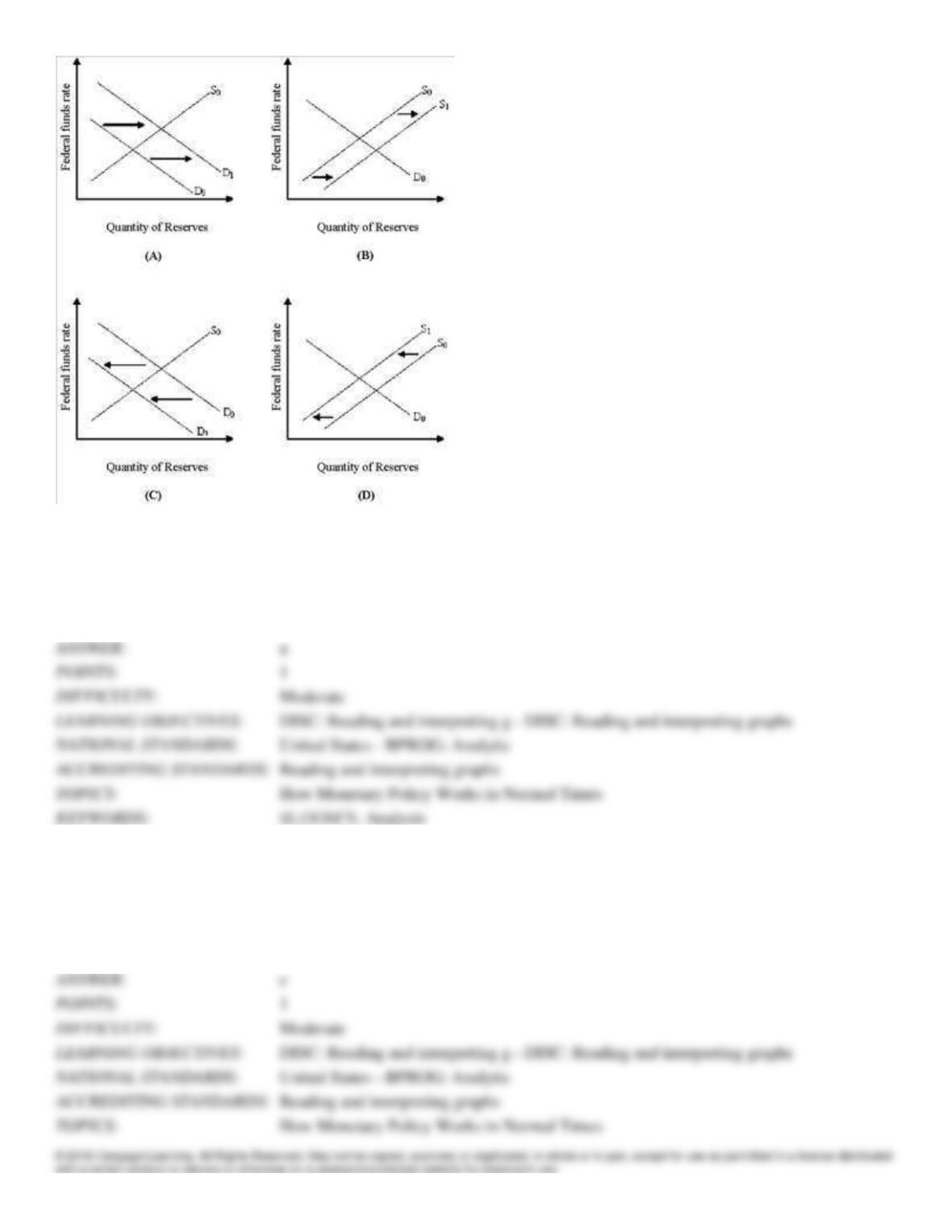
183. In Figure 13–1, which panel shows the effect of inflation on the interest rate?
a.
Panel (A)
b.
Panel (B)
c.
Panel (C)
d.
Panel (D)
DISC: Reading and interpreting g – DISC: Reading and interpreting graphs
United States – BPROG: Analytic
Reading and interpreting graphs
How Monetary Policy Works in Normal Times
184. In Figure 13–1, which panel shows the effect of a recession on the interest rate?
a.
Panel (A)
b.
Panel (B)
c.
Panel (C)
d.
Panel (D)
DISC: Reading and interpreting g – DISC: Reading and interpreting graphs
Reading and interpreting graphs
How Monetary Policy Works in Normal Times
185. In Figure 13–1, which panel shows the effect of an expansionary monetary policy on the interest rate?
a.
Panel (A)
b.
Panel (B)
c.
Panel (C)
d.
Panel (D)
DISC: Reading and interpreting g – DISC: Reading and interpreting graphs
United States – BPROG: Analytic
Reading and interpreting graphs
How Monetary Policy Works in Normal Times
186. In Figure 13–1, which panel shows the effect of a Fed open market sale on the interest rate?
a.
Panel (A)
b.
Panel (B)
c.
Panel (C)
d.
Panel (D)
DISC: Reading and interpreting g – DISC: Reading and interpreting graphs
United States – BPROG: Analytic
Reading and interpreting graphs
How Monetary Policy Works in Normal Times
187. When interest rates decrease, banks will normally
a.
increase lending, but decrease deposits and the money supply.
b.
increase lending, deposits, and the money supply.
c.
decrease lending, but increase deposits and the money supply.
d.
decrease lending, deposits, and the money supply.
DISC: Monetary and fiscal policy
United States – BPROG: Analytic
Monetary and fiscal policy
How Monetary Policy Works in Normal Times
188. Which of the following will increase interest rates in the short run?
a.
an decrease in reserve requirements
b.
open market sales by the Fed
c.
a decrease in real GDP
d.
an decrease in the price level
DISC: Monetary and fiscal policy
United States – BPROG: Analytic
Monetary and fiscal policy
How Monetary Policy Works in Normal Times
189. If interest rates increase, what is most likely to happen to the total expenditure schedule?
a.
It will increase because G increases.
b.
It will decrease because I decreases.
c.
It will decrease because (X – IM) decreases.
d.
It will increase because I increases.
DISC: Monetary and fiscal policy
United States – BPROG: Analytic
Monetary and fiscal policy
How Monetary Policy Works in Normal Times
190. Under what conditions will the inflationary impact of an expansionary monetary policy be the largest?
a.
When equilibrium real GDP is at potential real GDP.
b.
When there is a recessionary gap.
c.
When unemployment rates are high and there is substantial excess industrial capacity.
d.
When real GDP is falling and the price level is decreasing.
DISC: Monetary and fiscal policy
United States – BPROG: Analytic
Monetary and fiscal policy
Money and the Price Level
191. What determines the magnitude of the changes in price level when central bank takes monetary policy measures that
leads to a change in the aggregate demand?
a.
Changes in the money supply
b.
Slope of the aggregate supply curve
c.
Rate of change of interest rate
d.
Total money supply in the economy
DISC: Monetary and fiscal policy
United States – BPROG: Analytic
Monetary and fiscal policy
Money and the Price Level
192. The correct chain of causation illustrating the changes caused by monetary policy is
a.
money, interest rates, C + I + G + (X − IM), I.
b.
money, interest rates, I, C + I + G + (X − IM).
c.
C + I + G + (X − IM), I, interest rates, money.
d.
I, C + I + G + (X − IM), money, interest rates.
DISC: Monetary and fiscal policy
United States – BPROG: Analytic
Monetary and fiscal policy
Money and the Price Level
193. Which of the following were not actions taken by the Federal Reserve in order to stimulate the economy during the
recession of 2007-2009?
a.
decreasing the discount rate
b.
suspending trading on the major stock exchanges
c.
massive lending to banks
d.
open market purchases of assets other than Treasury bills
DISC: Monetary and fiscal policy
United States – BPROG: Analytic
Monetary and fiscal policy
Unconventional Monetary Policies
194. Some form of financial distress can become a full-blown recession if risk lead to ____ interest rates and ____
aggregate demand.
a.
higher; increased
b.
higher; decreased
c.
lower; increased
d.
lower; decreased
DISC: Monetary and fiscal policy
United States – BPROG: Analytic
Monetary and fiscal policy
From Financial Distress to Recession
195. The main purpose of expansionary monetary policy is to
a.
expand Treasury borrowing.
b.
increase reserve requirements.
c.
insure deposits.
d.
reduce interest rates.
DISC: Monetary and fiscal policy
United States – BPROG: Analytic
Monetary and fiscal policy
From Financial Distress to Recession
196. Which of the following has proved to be spectacularly false, at least recently?
a.
as an expansion proceeds, people will hold no more cash
b.
as an expansion proceeds, banks will hold no more excess reserves
c.
the oversmplified money multiplier formula is predicated on two critical assumptions
d.
All of the above are false.
DISC: Monetary and fiscal policy
United States – BPROG: Analytic
Monetary and fiscal policy
Implementing Monetary Policy in Normal Times: Open-Market Operations
197. Which of the following is an unconventional monetary policy?
a.
lending to banks in unprecedented volume
b.
lending to companies other than banks
c.
reducing the federal funds rate to zero
d.
All of these are unconventional monetary policies.
DISC: Monetary and fiscal policy
United States – BPROG: Analytic
Monetary and fiscal policy
TOPICS:
Other Instruments of Monetary Policy
KEYWORDS:
BLOOM’S: Comprehension
Essay
198. Define the following terms and explain their importance to the study of macroeconomics.
a.
central bank
b.
Federal Open Market Committee
c.
supply of money
d.
monetary policy
Federal Reserve System, established in 1913.
operations, discount rate changes, and changes in required reserve ratios.
prices and economic growth.
POINTS:
DIFFICULTY:
Easy
economics
United States – BPROG: Analytic
The study of economics, and defi – The study of economics, and definitions of economics
TOPICS:
America’s Central Bank: The Federal Reserve System
KEYWORDS:
BLOOM’S: Comprehension
199. Why is the Chair of the Fed Reserve considered by many to be the most powerful person in the economic world?
POINTS:
DIFFICULTY:
Easy
DISC: Monetary and fiscal policy
United States – BPROG: Analytic
The study of economics, and defi – The study of economics, and definitions of economics
TOPICS:
America’s Central Bank: The Federal Reserve System
KEYWORDS:
BLOOM’S: Comprehension
200. Explain how interest rates and bond prices are related to one another. Why is this important for monetary policy?
money per year as interest and this amount does not change after the bond has been
201. Why do economists insist on emphasizing the difference between money and income? Why is this difference
important in macroeconomics?
202. Describe the origins of the Fed and the arguments about the independence of the Fed.
203. How does a central bank influence the lending capacity of the banks?
204. Explain the concept of ‘lender of last resort’. What is discount rate?
205. What is the federal funds rate? What are the main determinants of the federal funds rate?
206. How does an open market purchase by the Fed affect the level of bank reserves and the interest rate? Illustrate the
interest rate effect by drawing the appropriate graph.
207. Explain the linkages in the causal chain when the Fed conducts a contractionary monetary policy. What will be the
ultimate effect on GDP?
208. In 2007, as stock prices in general were falling, many investors began switching their funds into purchasing bonds.
Surveys suggest that many of these investors did not understand the basic relationship between bond prices and interest
rates. Using a numerical example, illustrate how an increase in the demand for bonds would affect the interest rate paid on
bonds.
209. Explain the relationship between interest rates and (1) investments in housing, and (2) business investments.
210. Why does the economy’s aggregate demand curve have a negative slope?