67) The Lorenz curve shows
A) how poverty rates change over time.
B) the percentage of population below the poverty line.
C) the degree of inequality in the income distribution.
D) the ratio of cash income to payments-in-kind.
68) The most widely used measure of income inequality is
A) the Bureau of Labor Statistics’ cost-of-living index.
B) the Laffer curve.
C) the Lorenz curve.
D) the Gemini coefficient.
69) A Lorenz curve measures the ________ on the horizontal axis.
A) cumulative percentage of family income
B) cumulative percentage of family wealth
C) cumulative percentage of families
D) demand of families on welfare
70) A Lorenz curve measures the ________ on the vertical axis.
A) cumulative percentage of money income
B) cumulative percentage of family wealth
C) cumulative percentage of families
D) demand of families on welfare
71) The Lorenz curve is criticized for all of the following EXCEPT
A) that it excludes transfers-in-kind income.
B) that it does not account for the size differences of households.
C) that it does not account for age differences of households.
D) that it does not account for the impact of trade on the standard of living.
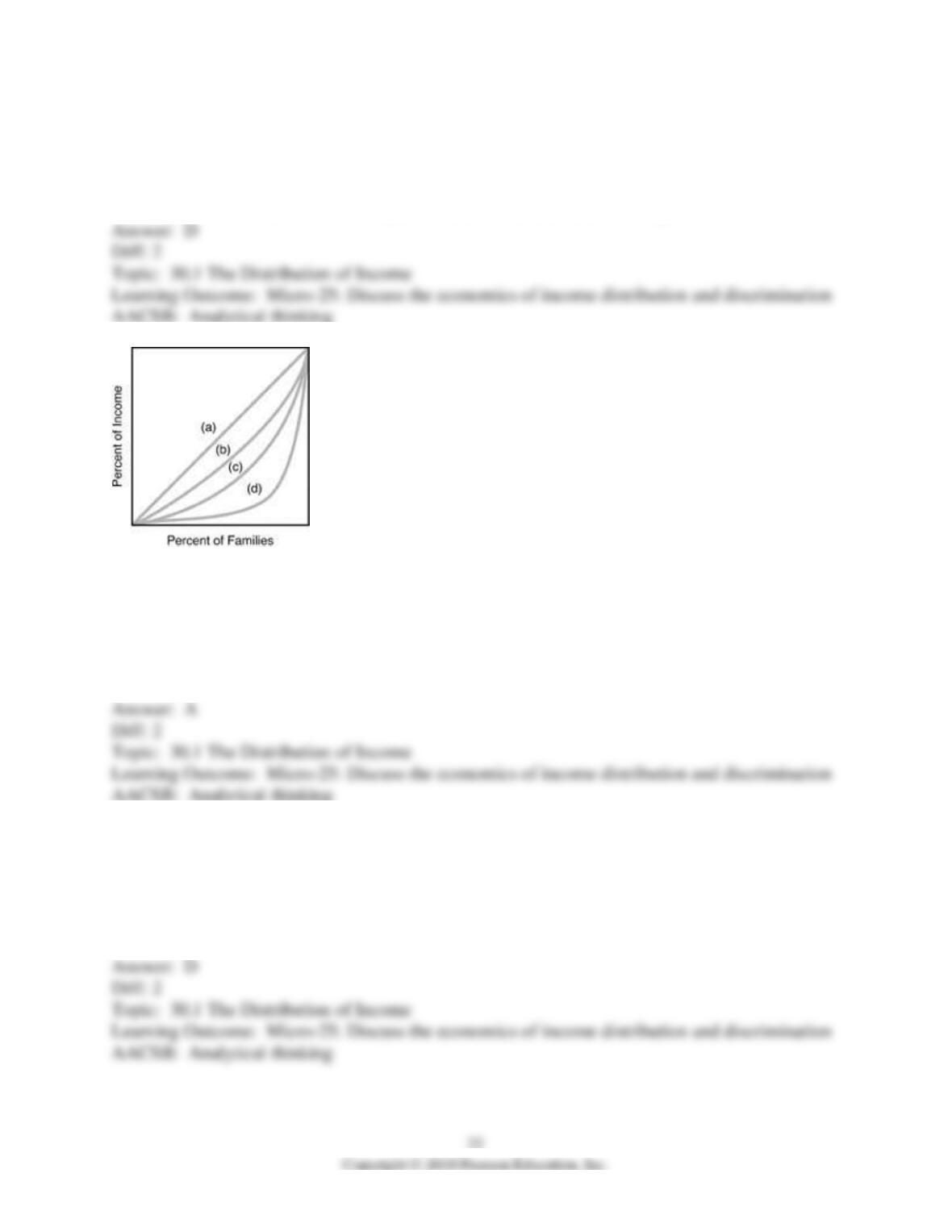
72) Use the above figure. Refer to the above diagram where curves (a) through (d) are for four
different countries. Income is equally distributed in
A) Country A.
B) Country B.
C) Country C.
D) Country D.
73) Use the above figure. Refer to the above diagram where curves (a) through (d) are for four
different countries. Income is most unequally distributed in
A) Country A.
B) Country B.
C) Country C.
D) Country D.
74) Use the above figure. Refer to the above diagram where curves (a) through (d) are for four
different countries. Income is third most unequally distributed in
A) Country A.
B) Country B.
C) Country C.
D) Country D.
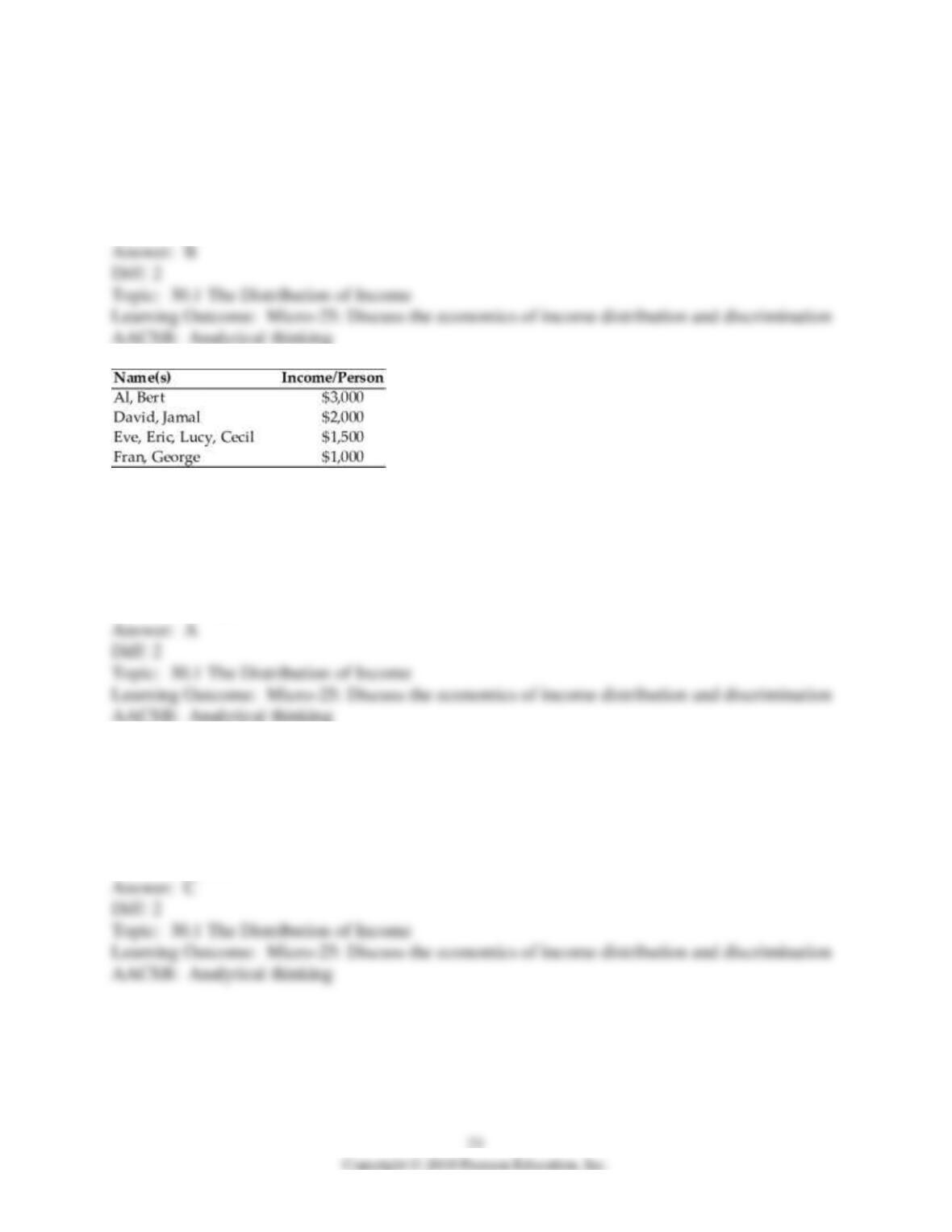
75) Use the above table. What percentage of income is received by the richest 20% of the
population?
A) 33.33 percent
B) 16.67 percent
C) 11.11 percent
D) 40.00 percent
76) Use the above table. What percentage of income is received by the poorest 60% of the
population?
A) 27.78 percent
B) 33.33 percent
C) 44.44 percent
D) 55.56 percent

77) Use the above table. What percentage of income is received by the poorest 20% of the
population?
A) 20 percent
B) 13.3 percent
C) 11.1 percent
D) 7.0 percent
78) Use the information in the above table. The top 40 percent of the population earn
A) 66.7 percent of the income.
B) 55.5 percent of the income.
C) 50.0 percent of the income.
D) 44.4 percent of the income.
79) Use the information in the above table. If Income was evenly distributed, each person would
receive
A) $9,000.
B) $2,500.
C) $1,800.
D) $1,000.
80) The distribution of money income can be represented graphically using
A) supply and demand diagrams.
B) a Lorenz curve.
C) a Keynesian curve.
D) a Distribution curve.
81) A diagonal straight line on a Lorenz curve represents
A) a perfectly unequal distribution of income (one person has everything).
B) a perfectly equal distribution of income.
C) a high level of inequality in the distribution of income.
D) an oblique distribution of income.
82) Since 1929, the distribution of money income in the United States has
A) become slightly more unequal.
B) not dramatically changed.
C) become more equal.
D) shifted toward the poorer 20 percent away from the richer 20 percent.
83) In the United States, the distribution of wealth
A) is the same as the distribution of income.
B) is more unequal than the distribution of income.
C) is more equal than the distribution of income.
D) is equal for all families.
84) The wealthiest 10 percent of the population owns about
A) 15 percent of all the wealth in the United States.
B) 50 percent of all the wealth in the United States.
C) 75 percent of all the wealth in the United States.
D) 95 percent of all the wealth in the United States.
85) A geometric representation of the distribution of income is referred to as
A) the labor supply curve.
B) the Lorenz curve.
C) the Phillips curve.
D) the Keynesian cross.
86) The 45° line on a Lorenz curve represents
A) complete income equality.
B) complete income inequality.
C) complete wealth equality.
D) complete wealth inequality.
87) Recent income distribution figures in the United States show
A) slightly more inequality.
B) less inequality.
C) greater equity.
D) less equity.
88) Regarding income distribution and the distribution of wealth
A) wealth is a stock concept and income a flow concept.
B) a stock is evaluated at a given moment in time; a flow is evaluated during a period of time.
C) income, a flow, can be viewed as a return on wealth.
D) All of the above are correct.
89) Wealth
A) is the same as income.
B) includes assets such as houses, stocks, and bonds.
C) does not include tangible objects.
D) is a flow and not a stock.
90) With respect to wealth in the United States, we presently find that the bottom 90 percent of
Americans own approximately how much of the nation’s wealth?
A) 10 percent
B) 25 percent
C) 64 percent
D) 84 percent
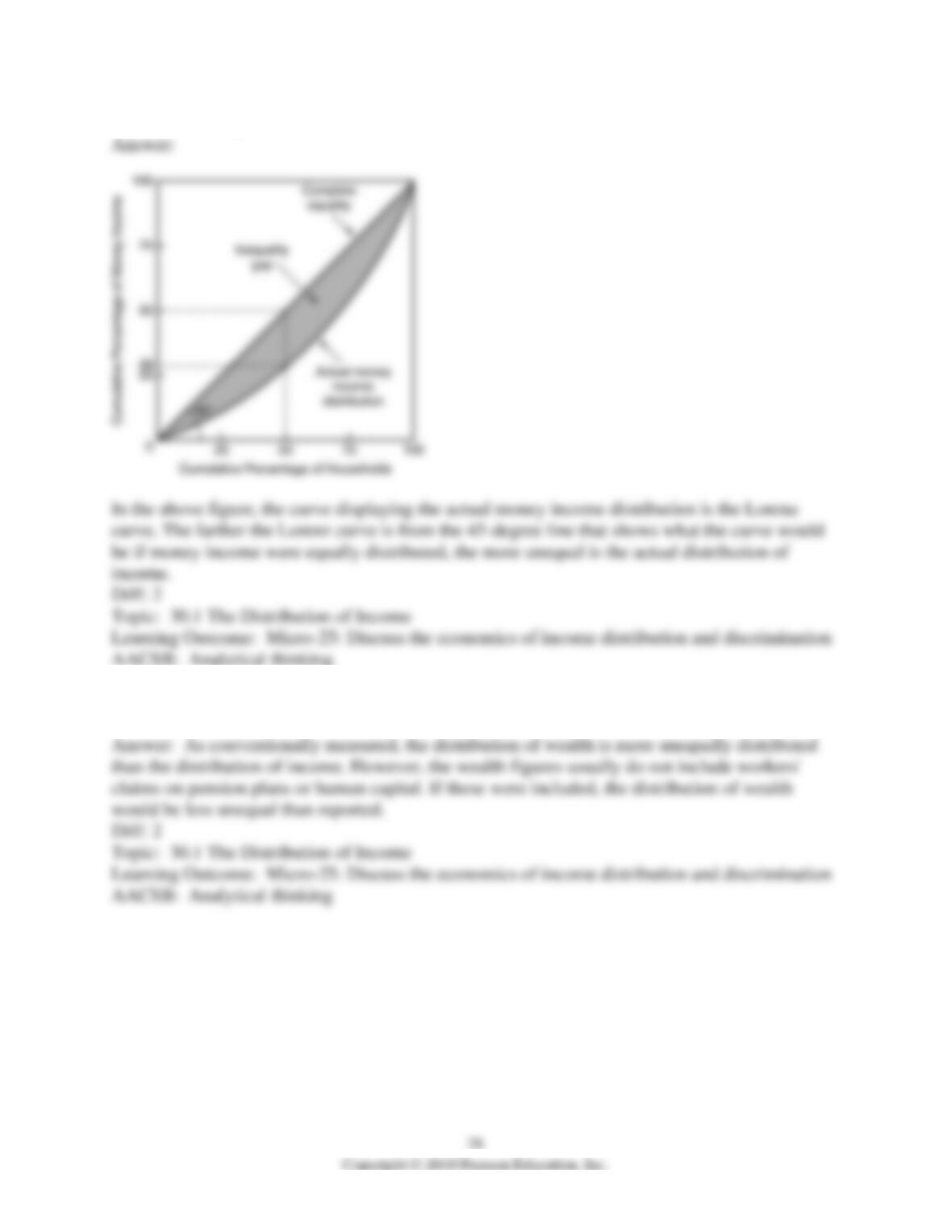
91) Draw and explain a Lorenz curve.
92) How does the distribution of wealth differ from the distribution of income in the United
States?

93) What are the major criticisms of the Lorenz curve?
94) Suppose there is a high inequality in household income between the highest and the lowest
income groups in one country. In response, the government raises the income tax for the highest
income group and provides subsidies to the lowest-income group. What would happen to the
Lorenz curve as a result of the government programs? Explain.
30.2 Determinants of Income Differences
1) Age is a determinant of income because
A) with age typically come experience, education, and training that can increase income.
B) age contributes to costs as medical expenses increase.
C) older workers have accumulated more wealth.
D) older workers have accumulated less wealth.
2) Which of the following are determinants of differences in income?
A) age
B) marginal productivity
C) discrimination
D) all of the above

3) Which factor listed below does NOT help account for the age-earning cycle?
A) productivity
B) number of hours worked each week
C) effects of aging
D) racial discrimination
4) The age-earning cycle shows an individual typically earning
A) a constant income (adjusted for inflation) over the entire working life of the worker.
B) an income that cycles upward and downward as an individual ages.
C) an income that increases with age, peaks, and then falls as retirement approaches.
D) an income that declines until age 30-35 and then increases rapidly.
5) The age-earnings profile predicts that earnings will peak at
A) the 35-40 age level.
B) the 45-50 age level.
C) the 60-65 age level.
D) retirement.
6) The age-earning cycle
A) is an earnings profile of an individual throughout his or her lifetime.
B) shows the earnings differences by age and by gender.
C) depicts differences in the relationship between age and earnings across countries.
D) shows the average incomes of people broken down by age categories.

7) The age-earning cycle usually begins
A) at relatively high income levels.
B) at relatively low income levels.
C) once a worker reaches 25 years of age.
D) only when a worker is employed full time.
8) The age-earning cycle shows declining income as a person approaches retirement age because
A) worker productivity is increasing rapidly.
B) worker and hours worked diminish.
C) companies choose to promote these workers faster.
D) companies add-in Social Security payments as a supplement.
9) The age-earning cycle predicts that a typical person will
A) be earning $50,000 in the year 2010.
B) be earning the lowest income right before retirement.
C) be earning the highest income right before retirement.
D) be earning the highest income at about the age 45-50.
10) The learning curve suggests that an individual will
A) receive the same income throughout a career.
B) gain experience and increase productivity over time.
C) be subject to frequent spells of unemployment.
D) have an income that falls over time.

11) Which of the following does NOT affect a worker’s marginal productivity?
A) education
B) training
C) talent
D) inheritance of money
12) Which of the following is NOT considered to be a factor in the determination of a person’s
marginal productivity?
A) innate abilities such as high intelligence
B) investment in human capital such as education
C) on-the-job training
D) the elasticity of supply of labor
13) Much of a person’s increased productivity can be linked to
A) on-the-job training.
B) the prevalent marginal tax rate.
C) the price elasticity of demand for the product.
D) the income elasticity of demand for the product.
14) Marginal productivity theory would suggest that
A) all workers should be paid the same wage.
B) higher productivity will increase the market wage of an individual.
C) labor demand will have no impact on the wage paid.
D) workers cannot do anything to improve their wage prospects for the future.

15) Which of the following determinants of marginal productivity cannot be acquired by
someone who wants to increase future productivity?
A) education
B) training
C) talent
D) experience
16) With a human capital investment (such as the investment in going to college), the most
important cost tends to be
A) foregone leisure.
B) books and equipment.
C) the opportunity cost of not working.
D) taxes.
17) In general, as individuals undertake additional years of schooling,
A) their stock of human capital increases.
B) the marginal productivity of individuals as workers declines.
C) the marginal benefit to society of the extra years of education increases.
D) the marginal productivity of individuals as workers becomes negative.
18) The most common type of investment in human capital is
A) having more children per family.
B) the migration of labor in search of better jobs.
C) expanded years of schooling.
D) improved health care and maintenance.

19) What is typically the main cost of pursuing a college education?
A) tuition
B) room and board
C) books and supplies
D) income forgone by not working
20) In the absence of discrimination, as human capital investments increase, wages will generally
A) decrease.
B) increase.
C) not change.
D) increase or decrease.
21) Investment in human capital
A) is quite different from and has a much lower return than investment in physical capital.
B) is just like investment in physical capital and has a return similar to that earned from other
investments.
C) is just like investment in physical capital but has a much greater return than do other
investments.
D) is not comparable to other investments in any way since human capital is embodied in the
person.
22) In the United States, inheritance accounts for roughly ________ of income inequality.
A) 50 percent
B) 30 percent
C) 20 percent
D) 10 percent

23) The following are all determinants of income differences examined in the text EXCEPT
A) age.
B) marginal productivity.
C) inheritance.
D) height.
24) Most individual’s income peaks when they are about
A) 25.
B) 40.
C) 50.
D) 65.
25) The age-earnings cycle is
A) the distribution of money income by age.
B) the distribution of wealth by age.
C) the relationship between earnings while working and retirement benefits for an individual.
D) the regular earnings profile of an individual throughout his or her lifetime.
26) The regular earnings profile of an individual throughout his or her lifetime is
A) the Lorenz curve.
B) the age-earnings cycle.
C) wealth.
D) income-in-kind.

27) Which of the following statements are correct about the age-earnings cycle?
A) Earnings generally increase up till age 30 and then steadily decrease.
B) Earnings increase throughout a prison’s lifetime until they reach retirement.
C) Earnings increase with age because workers become more productive as they age until around
50 years. Around 50 the effects of aging outweighs the further increases in productivity.
D) Since every person is different we can reach no general conclusions about the age-earnings
cycle.
28) The earnings of most people
A) increase steadily until retirement.
B) increase with age until around age 50 due to increased experience, training, and hours
worked.
C) increase with age until around age 40 due to increased experience and hours worked.
D) increase with age until around age 60 due to increased experience, training, and hours
worked, then level off as hours worked levels off.
29) Suppose all people have the same age-earnings profile and the percent of the population in
each age category is the same. The distribution of income at any point in time will be
A) equal because all have the same profile.
B) equal because incomes and wealth levels must then be the same.
C) unequal because other sources of income will differ.
D) unequal because incomes differ by age.
30) One reason earnings tend to fall before retirement age is that
A) the experience of people is no longer valuable after they are 50 or 55.
B) people tend to reduce the number of hours they work after age 50.
C) people are retiring earlier.
D) firms discriminate against older workers.
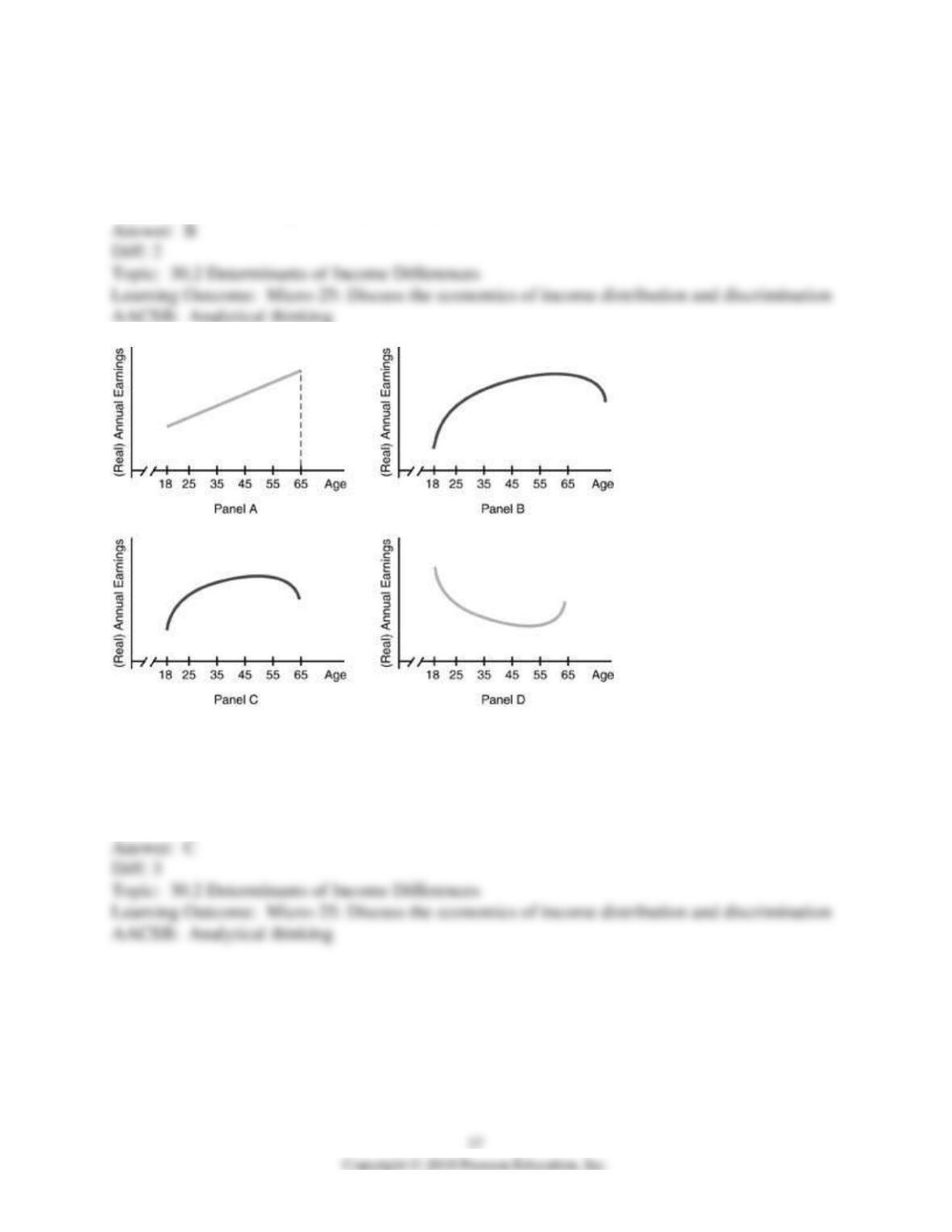
31) Refer to the above figure. Which of the graphs are consistent with the age-earnings profile?
A) Panel A
B) Panel B
C) Panel C
D) Panel D

32) In a competitive economy, workers will be paid according to their
A) status.
B) age.
C) marginal productivity.
D) need.
33) Which of the following is NOT a determinant of an individual’s marginal product?
A) talent
B) money income
C) experience
D) educational level
34) Which of the following sources of productivity is the most difficult to acquire?
A) education
B) experience
C) talent
D) training
35) The return on human capital
A) tends to be much greater than the return on physical capital.
B) tends to be much lower than the return on physical capital.
C) is similar to the return on physical capital.
D) cannot be related to the return on physical capital since human capital and physical capital are
so different.

36) The main cost of a college education is
A) tuition if one goes to a private college and room and board if one goes to a public college.
B) dependent upon whether one’s parents pay for the college or not.
C) the lack of practical experience from spending time in college.
D) the opportunity cost of not working.
37) When measuring the benefits from investing in human capital
A) the only benefits come from the increase in salary because of going to school.
B) in addition to the monetary benefits, the benefit from expanding horizons should be included.
C) we must include the costs of tuition and books but not the money made from part-time jobs.
D) we must include the foregone earnings in the benefit calculation.
38) Inheritance is responsible for about ________ percent of the income inequality in the United
States.
A) 10
B) 1
C) 67
D) 95
39) Economic discrimination exists when
A) there is an unequal distribution of income in a country.
B) both income and wealth are unequally distributed in a country.
C) there is unequal access to education.
D) workers with the same marginal revenue products are paid different wages.

40) Economic discrimination against minorities exists when
A) minorities have less education and training than whites.
B) minorities are paid less than whites on average.
C) minorities are paid less than whites with the same education, experience, and training.
D) minorities are in different occupations than whites.
41) Unequal pay that is caused by economic discrimination will be due to
A) a noneconomic factor.
B) differences in the marginal revenue product.
C) a monopolistic labor market.
D) difference in human capital.
42) Which of the following is a reason for economic discrimination to occur?
A) differences in access to education
B) differences in gender
C) differences in the quality of education
D) barriers to entry in higher-paying occupations
43) The age-earnings profile for most people indicates
A) earnings rise continually until a person retires.
B) earnings initially decline and then rise continually until retirement.
C) that when you adjust for inflation, earnings are constant throughout the entire workplace
experience.
D) earnings rise until the age of about 50 and then begin to fall until retirement.